Nation's First Black Astronaut in Space Calls for More Diversity in Science, Engineering Ranks
/“A first class education is not just a requirement, it is a civil right,” America’s first African American astronaut, aerospace engineer Guion Bluford, told an attentive and appreciative audience at the University of Hartford, speaking as part of the university’s week-long “Empowering Change” initiative marking the 50th anniversary of the Civil Rights Act. Bluford, who flew on four space shuttle missions (in 1983, 1985, 1991 and 1992) and had a distinguished career with NASA and in private industry afterwards, told a standing-room-only audience of students, faculty and local residents that the caliber of the education at the high school he attended in Philadelphia has diminished to the point that area residents can’t imagine a graduate being adequately prepared to pursue college-level engineering.
“Minorities of all kinds are seriously underrepresented in the science and engineering workforce of 5 million in this country. Only 2.7 percent of African Americans and 2.2 percent of H ispanics have science or engineering degrees. This disparity needs to be addressed,” Bluford said.
Bluford, 71, also noted that “534 astronauts have flown in space, but only 14 African Americans and 15 Hispanics have flown in space. If America is going to maintain its scientific competitiveness, we must encourage more African Americans and Hispanics to pursue careers in science and technology.”
Bluford urged math and science at the high school level be mandatory with a focus on college preparation and career development, and called on colleges to “make an extra effort” to insure that minority students succeed, citing statistics indicating that approximately 60 percent of students who enter college majoring in STEM subjects end up graduating in a non-STEM field.
He called for greater collaboration between colleges, professional organizations and industry, and with associate-degree institutions and high schools to better prepare and support students in science and math for work at the college level, and into careers.
“Success in these programs will provide a more diverse workforce with the skills they need to meet the technical demands of the 21st century,” Bluford said. “America needs more underrepresented minorities in its talent pool if we are going to be competitive in tomorrow’s world.”
Bluford earned a bachelor of science degree in aerospace engineering from Pennsylvania State University in 1964; a master of science degree with distinction in aerospace engineering from the Air Force Institute of Technology in 1974; a doctor of philosophy in aerospace engineering with a minor in laser physics from the Air Force Institute of Technology in 1978 and a master in business administration from the University of Houston. In addition to his 688 hours in space on shuttle missions, he has logged more than 5,200 hours jet flight time, including 1,300 hours as a T-38 instructor pilot. He also has an FAA commercial pilot license and is a certified scuba diver.
Describing his parents as role models, Bluford said he was fortunate not to have suffered the injustices suffered by many African Americans in the South, having been raised “in an environment where everything was possible. They taught me the importance of working hard, aiming high, chasing my dream, never giving up, and being true to myself.” He emphasized that in attending public schools, he had “excellent teachers who set high standards for achievement – teachers that were willing to stay after school to help their students. My teache rs were demanding, my parents were relentless,” Bluford recalled.
Bluford said he “never thought he would be part of the space program,” but applied, and was selected, after witnessing with his generation the space program’s remarkable accomplishments in the 1960’s, including the first manned lunar landing. He urged that interest in science be nurtured early in children – as early as kindergarten - and with after-school activities, such as traveling to "museums, scouting, summer camp, chemistry sets, robots... We need to close the education gap that exists between students attending schools in the poor inner cities and students attending schools in the affluent suburbs," Bluford said.
“For African Americans growing up in the inner cities, a rich tapestry of activities focused on math and science is essential for success. Exposing these experiences to minority students gives them a feeling that they can also do it – be pilots, scientists, and even astronauts.” As for the future, Bluford has no doubt that space exploration will continue, explaining that “curiosity will drive us to Mars and beyond.”


 ber 1, 2013, to March 31, 2014, the federal government was the major funder of in-person assistance, providing over $2.5 million in funding to the program. The reported noted that “This level of funding is no longer available, yet, the need for assistance, both for the upcoming open enrollment period (November 15, 2014, to February 15, 2015) and beyond, is great.” Plans for continuing in-person assistance, offered at store-front facilities, are under consideration according to
 one’s throw away. The reconstruction of the I-95/I-91/Route34 interchange in New Haven began in 2011 and is estimated to be completed in 2016, at a cost of $359.9 million.
 ess
ess
 s median gross apartment rent of $948.
 ould be the best fit


 In addition, it calls for creation of a consent form for parents of student athletes to sign on the warning signs, symptoms and treatment of SCA and relevant school policies. Similar legislation has already been adopted in Pennsylvania, several other states are also considering SCA bills, according to the SCAF. The provisions of the new law take effect a year from now, with the school year that begins in the fall of 2015.
 That aspect will be front and center on Saturday, June 7, when the Connecticut Technology Council sponsors the annual Girls of Innovation program in Hartford, geared specifically to middle school age girls, entering grades 7 and 8, “to experience science and its challenges in a fun, interactive way,” according to program organizers.


 es (often with state financial incentives) the report offers guidance of factors influencing the frequency of entrepreneurial launches. Connecticut Innovations, established and supported by state government, helps Connecticut businesses grow through creative financing and strategic assistance, and is the nation's sixth most-active early stage investor.
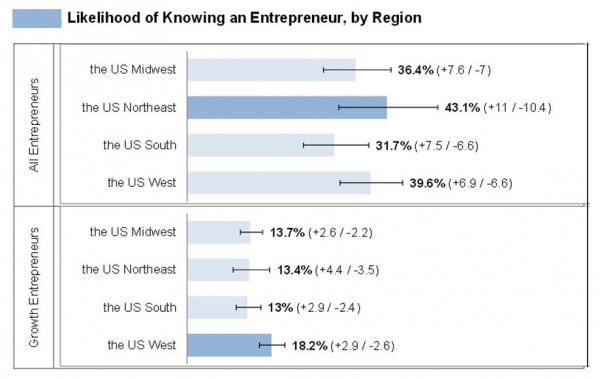 in the United States was 36.7 percent. The likelihood of knowing a growth entrepreneur was considerably lower, at 15.4 percent.
 In addition to Davidson, expert panelists participating include Carissa Ganelli, Founder & CEO, LightningBuy; Drue Hontz, Founder & President, KAZARK, Inc.; John Nobile, Founder & President, Tangen Biosciences; and Nadav Ullman, Founder & CEO, Dashride.
 nt of strategy and operations for Global Market Development in Qualcomm Technologies, Inc. In this role, he handles reporting and operations as well as executing on strategic global business initiatives. In addition, Davidson is senior vice president of investor relations where he serves as the primary liaison with the investment community and Qualcomm shareholders. Davidson has more than 25 years of experience in technical sales, marketing and general management roles in the telecommunications industry.
 naging Partner & Principal, New England Consulting Group.