Middle School Girls of Innovation to Convene in Hartford to Explore STEM Careers

Connecticut’s ongoing effort to interest young girls in pursuing education in science and technology will receive another nudge when Girls of Innovation, the Connecticut Technology Council’s signature program for middle school-age girls, is held on June 13 at the Connecticut Science Center in Hartford. The annual event for girls entering grades 7 & 8 provides opportunities to experience science and its challenges in a fun, interactive way, officials say.  The program highlights possible careers in STEM (science, technology, engineering, math) through hands on, interactive activities led by real world tech professionals.WOI

The girls in attendance will have the chance to work alongside their peers as well as with an impressive roster of volunteers who are currently working, or studying, in STEM fields in Connecticut. Volunteers come from presenting sponsor Covidien as well as professionals from CTC’s member companies and the Women of Innovation program.

A year ago, close to 40 students came to the Connecticut Science Center to experience first-hand the benefits of studying and working in STEM related careers, and gave the Girls of Innovation program high marks.  Among some of the schools that have registered to participate in the 2015 program are Ansonia Middle School, Washington Middle School (Meriden), Moran Middle School (Wallingford), CT Academy of Science & Engineering, St. Brigid School (West Hartford), Bedford Middle School (Westport), Talcott Mountain Academy, Ethel Walker School, YMCA Super Girls, Irving Robbins Middle School (Newington) and King Philip Middle School (West Hartford). In addition, 12 girls from CCSU’s Institute of Technology & Business Development TRiO Educational Talent Search program have also registered.6a00d834559ccd69e20192ab43a1f4970d-500wi1imge

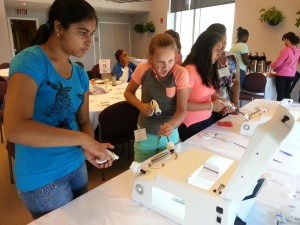
Mentors talk with students about their experiences and careers and guide them through the scientific challenges created by the Connecticut Science Center Staff Scientists.  Students spend time with mentors, ask questions and discuss the benefits and challenges associated with careers in STEM, and participate in hands-on science activities.

A key message of the Girls of Innovation program is to show the girls scientists “like me” and so inspire them with the confidence, enthusiasm and persistence to continue pursuing their scientific interests, officials point out, adding that studies of cultural beliefs indicate that girls begin to conclude that STEM is not for them in middle school, and these beliefs influence choices they make throughout their school years.  Stereotypes of who is a scientist are changing, but not quickly enough, organizers note.

“Spurring growth through creative invention will be a key objective of many companies in the next decade as it will provide the necessary fuel to address challenges in energy, healthcare, and global infrastructure realms. The solutions to these challenges will evolve and mature over many years and our bright and talented youth will drive the bus on this. This program is designed to galvanize our youth around invention and creative thought,” said Chuck Pagano, former Chair of the CTC Board of Directors, and VP of Technology at ESPN.CTCLogoLarge

The Connecticut Technology Council is a statewide association of technology oriented companies and institutions, providing leadership in areas of policy advocacy, community building and assistance for growing companies.  With over 2,000 companies that employ some 200,000 residents in the technology fields, the CTC seeks to provide a strong and urgent voice in support of the creation of a culture of innovation.

Agencies, Organizations to be Honored for Efforts Advancing Local Downtowns

A high school AP economics class that engages students in proactive land-use planning, the owners of a downtown Segway tour company that let the community help name their new business, and the state’s Department of Transportation are among the organizations and initiatives chosen to receive a 2015 Award of Excellence from the Connecticut Main Street Center (CMSC). Seven recipients were selected for the prestigious award, representing initiatives in Mansfield, New London, Putnam, Simsbury, Waterbury, and Upper Albany in Hartford.segway

The other winning entries included a First Fridays series that draws thousands of visitors with its hands-on arts and cultural events; a massive, multi-cultural downtown gathering of dozens of ethnic groups to celebrate a common community pride; a multi-year, multi-million dollar public/private partnership to design and build a brand-new town center; and a local merchant who remains committed to the neighborhood and the state despite becoming an international success.

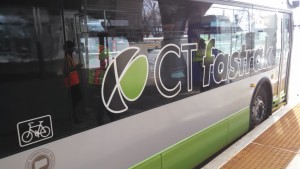
wpid-img_20150311_152459_058For the first time in the history of the awards program, a state agency was also selected to receive an award. The CT Department of Transportation received a special award for Starting a Revolution: Integration of Land Use and Transit in recognition of the progressive nature of CTfastrak, the bus rapid transit system opened earlier this year. The awards jury that selected the winners gave the award because they felt the new busway represents a cultural shift in how Connecticut views transit, and wanted to acknowledge the future promise of transit oriented development that will hopefully result around the station locations.

The Connecticut Main Street Awards annually celebrate and communicate the most successful and innovative efforts in Main Street revitalization in Connecticut. A jury comprised of industry-related professionals and CMSC staff judged the submissions on criteria that included innovation, replication, representation, partnerships utilized, and outcomes.20150507_townsquare_pavilion

"Our members continue to impress us with how they support, encourage and implement new ideas from the ground up," said CMSC President & CEO John Simone. "They're constantly forming partnerships with new groups, working to sustain local merchants, and tirelessly promoting how wonderful our downtowns and Main Streets are. We're proud of their efforts and excited to share their achievements with everyone else."putnam

The awards will be presented at the 2015 Connecticut Main Street Awards Gala on June 8th at Trinity-on-Main in downtown New Britain. This year's event will feature guided tours of downtown New Britain, including a Downtown Arts, Heritage & Culture tour, a tour of Walnut Hill Rose Garden & New Britain Museum of American Art, and a tour of CTfastrak in New Britain: Transportation, Housing & Main Street.

The full list of 2015 Awards of Excellence winners:

2015 Connecticut Main Street Awards of Excellence                 

Main Street Partnership

▪   Simsbury High School AP Economics Course, to Simsbury Main Street Partnership and Simsbury High School.

Planning

▪   Step by Step: Building a Downtown from Scratch (Storrs Center), to Mansfield Downtown Partnership, the Town of Mansfield, UConn, LeylandAlliance and the Citizens of Mansfield. (photo, above right)

Events & Programming  (Sponsored by Webster Bank)

▪    The Gathering (Downtown Waterbury), to the City of Waterbury, the Waterbury Observer, and Main Street Waterbury.

Award of Merit for Events & Programming

▪   First Fridays (Downtown Putnam), to the Town of Putnam, Putnam Business Association, and the Putnam Arts Council.

Business Owner of the Year

▪   Dawn & Kristin Harkness / Wheeling City Tours (New London), Submitted by New London Main Street.

2015 Main Street Pioneer: Outstanding Commitment to The Avenue  (Sponsored by Webster Bank)

▪    Vivian Akuoko / Evay Cosmetics (Upper Albany Avenue, Hartford), Submitted by Upper Albany Main Street.

Starting a Revolution: Integration of Land Use and Transitphoto_center_01

▪   CTfastrak, to the State of Connecticut Department of Transportation and the Capitol Region Council of Governments (CRCOG).

The Connecticut Main Street Awards of Excellence were created in 2003 to recognize outstanding projects, individuals and partnerships in community efforts to bring traditional downtowns and neighborhood commercial districts back to life, socially and economically.  In recent years, the Awards Gala has been held in New Haven, Hartford, Manchester, Torrington and Bridgeport.

Digital Citizenship Summit will Bring State, National Tech Experts to Connecticut

Connecticut will be the center of the digital universe this fall, when the University of Saint Joseph (USJ) in West Hartford hosts a Digital Citizenship Summit, bringing local and national experts together to explore the good, the bad and the ugly about the pervasive and ubiquitous use of technology in our personal and professional lives. The term “digital citizenship” describes appropriate, responsible tech and Internet use. Similar to the rights and responsibilities involved in being a citizen, there are legal and ethical obligations with being a digital citizen, organizers explain.digital-access1

The aim of the Digital Citizenship Summit, to be held on October 3, is to create positive, practical solutions along with amplifying the overall message of improving tech usage. Topics for the all-day Summit include digital literacy, etiquette, wellness, security, and law.

“We believe that digital citizenship deserves its own space for educational, non-profit, and industry leaders to focus on solutions and push new ideas forward focused on positive, practical solutions to improve our use of technology and the Internet. The Digital Citizenship Summit aims to bring together the various silos of thought and activity across the country in order to create a stronger, more unified message for better tech usage,” organizers said.

This inaugural event is being sponsored by the University of Saint Joseph’s School of Education, Office of Student Affairs and Office of Informational Technology and will engage students, teachers, parents, administrators and policy makers in a dynamic conversation focused on digital citizenship.  It comes in the first semester of the administration of incoming university President Rhona Free, who takes office July 1.  Free is a past national Professor of the Year as selected by the Carnegie Foundation for the Advancement of Teaching and the Council for Advancement and Support of Education (CASE).

Plans are for the Summit to include a panel discussion, breakaway sessions, a keynote talk TED-style, and a social event to “connect with all the fascinating big thinkers across the country who are pivotal in shaping digital citizenship.”Picture2

Among the speakers will be:

  • Alan Katzman is Founder of Social Assurity, the leading youth social media advisory service in the country. They work with students and families on customized social media training to maximize the students’ opportunities and use of social media to their advantage.  He is an entrepreneur and former attorney with an expertise in law, technology and software, compliance, human resources and investigations.
  • Mike Ribble: Known as the godfather of digital citizenship, Kansas-based Ribble is an international speaker, researcher and author of the books Digital Citizenship in Schools (soon to be in its 3rd edition) and Raising a Digital Child. He has worked within the education field his entire career, including as a science educator, an assistant principal at the high school level, and adjunct faculty at the college level.
  • Jennifer Scheffer: Mobile Learning Coach and Instructional Technology Specialist at Burlington, MA Public Schools, she is a dynamic and energetic teacher leader with over a decade of experience teaching project-based computer technology, marketing, and business management courses. She coaches students on how to leverage social media tools to showcase their talents, create a positive online presence, and build their professional network.
  • Sarah Thomas is a Google Certified Teacher and Edmodo Certified Teacher, as well as a leader of the Washington, DC Google Educator Group and founder of the EduMatch project. She is the Technology Liaison at John Hanson French Immersion School in Oxon Hill, MD and teaches Technology Integration and English Language Arts at the middle school level.  She is a recipient of the 2014 Digital Innovation in Learning Award and was named by the National School Board Association as one of the “20 to Watch” in 2015.

The organizing committee for the Summit includes:250px-UnivSJct

  • David Ryan Polgar, a frequent speaker and respected tech commentator whose ideas and thoughts concerning digital citizenship have been featured in publications including The Boston Globe, Financial Times, Sydney Morning Herald, US News & World Report, and Forbes. With a background as an attorney and college professor, he examines the use of technology from an ethical, legal, and emotional perspective.
  • Marlialice B.F.X. Currran, an Associate Professor at USJ, focuses on digital citizenship and social media in K-12 teacher education. A former middle school teacher, principal and an advocate for young adolescents, Curran was named one of the Top 10 Digital Citizenship bloggers by Common Sense Media in 2014.
  • JoAnn Freiberg is an Educational Consultant with the Connecticut State Department of Education, responsible for managing bullying, improving school climate and character education, and has taught at numerous colleges in Connecticut and currently is Co-Chair of the National School Climate Council.

organizing committeeOften referred to as a Tech Ethicist, Polgar has become a respected and unique voice in the digcit community. He is a contributing writer with the Family Online Safety Institute, iKeepSafe, and The Good Men Project, along with appearing regularly on television to discuss issues such as tech balance, cyber ethics, and tech etiquette.  He has delivered two TEDx talks on digital technology.

In describing Dr. Curran, Common Sense Media said “she is a long-time proponent of responsible online behavior, and encourages her undergraduate and graduate students to learn and explore what it means to be socially responsible both face to face and online, how teaching empathy is the most important 21st century skill and how social media can change teaching and learning in PK-12 classrooms.” Dr. Curran and Tracy Mercier co-founded the digital citizenship #digcit chat on Twitter in 2011. The first chat was inspired as a result of a digital citizenship course at USJ.

Registration for the Summit will be available later this spring, along with additional details regarding the agenda and program, at the website www.digcitsummit.com.

Photo: Marlialice B.F.X.Curran,  David Ryan Polgar,  JoAnn Freiberg. 

56 Women of Innovation Recognized; Girls Encouraged to Enter STEM Fields in CT

Fifty-six women, from across Connecticut, were honored for their innovation and leadership during the eleventh annual Women of Innovation awards gala, held this week. This awards program recognized women innovators, role models and leaders in the fields of science, technology, engineering, and math as well as outstanding women at the high school and collegiate level. “The Council is honored to recognize Connecticut’s most extraordinary and talented women representing a cross section of the state’s most important technology companies and educational institutions.” said Bruce Carlson, President and CEO of the Connecticut Technology Council.

Of the 56 women honored, 10 wewomen-of-innovationre recognized as category winners; there are two winners in both the Research and Collegian categories: Academic Innovation and Leadership: Medria Blue-Ellis, Principal, Engineering & Science University Magnet School; Collegian Innovation and Leadership (two winners): Sapna Gupta, Ph.D. Student, University of Connecticut, Monika Weber, Ph.D. Student, Yale University; Community Innovation and Leadership: Keshia Ashe, Co-Founder & CEO, ManyMentors; Entrepreneurial Innovation and Leadership: Christina Lampe-Onnerud, Founder & CEO, CLOTEAM LLC; Large Business Innovation & Leadership: Yu-Hui Rogers, Site Director, The Jackson Laboratory for Genomic Medicine; Research Innovation and Leadership (2 winners): Serap Aksoy, Professor, Yale School of Public Health, Radenka Maric, Connecticut Clean Energy Professor in Sustainable Energy, University of Connecticut; Small Business Innovation and Leadership: Lisa Braden-Harder, CEO, Appen; and Youth Innovation and Leadership: Anubhuti Mathur, High School Student, Glastonbury High SchCT-ORGool.

Presenting sponsors of this year’s event, held at the AquaTurf in Plainville, were Boehringer Ingelheim USA Corporation, Covidien, Day Pitney LLP, and United Technologies Corporation.

Efforts to interest girls in the STEM fields are underway elsewhere in Connecticut as well.  UIL Holdings Corporation is among the organizations encouraging girls to pursue careers in science, technology, engineering and math (STEM) by supporting three Generating Girls Opportunities (G2O) Expos.

ggoThese expos offer girls exposure to STEM fields, as well as the opportunity to participate in hands-on experiments.  The next G2O Girls & STEM Expo to be held April 10 at Central Connecticut State University.  It is a half-day interactive event for 9th and 10th grade girls introducing participants to all the possibilities of STEM (Science, Technology, Engineering & Math) through workshops and activities led by college professors and STEM professionals.

Activities are designed to inspire girls to question, create, design, test, explore, and more!  They learn about possible STEM careers and talk to colleges and employers to help them plan for the future. The expos, organized by the Connecticut Women’s Education and Legal Fund (CWEALF), are designed to engage the students and teachers in expanding educational opportunities in STEM programs and careers.

A study commissioned by the Girl Scout Research Institute found that girls are interested in STEM fields and aspire to STEM careers, but need more exposure and adult support to carry this interest into the future.  Additional expos will be held in West Hartford at the University of Saint Joseph on May 4 and at Mitchell College in New London on June 5.

The Connecticut Technology Council (www.ct.org), which organizes the annual Women of Innovation, is Connecticut’s industry association for the technology sector. CTC’s mission is to connect people, ideas and opportunities to the global technology and innovation community.

________________________________________

winners2015 Women of Innovation

Medria Blue-Ellis is the principal of ESUMS, a Magnet School of Excellence and CT School of Distinction. Her Curriculum expertise, creative thinking, and persistence are shared with the female STEM teachers she mentors. Her encouragement of female students to excel in STEM manifests in accomplishments such as the 2014 Verizon App Challenge State Finalist. Medria was one of 100 school leaders, educational advocates, and researches convened at the Jack Kent Cooke Foundation “Closing the Excellence Gap” conference.

Sapna Gupta is a graduate research assistant at the Center for Clean Energy Engineering and a Ph.D. candidate in materials science and engineering at UCONN. Sapna’s academic achievements, innovative research and creativity are evident in the many fellowships, distinctions, and awards she has received, including her honorable mention for the 2014 Baker Student Researcher award. She is founder and president of UCONN Keramos, and delegate of the ACerS PCSA

Monika Weber is a Ph.D. candidate in electrical engineering at Yale University and the co-inventor of Fluid-Screen, a small device that detects bacteria in 30 minutes. She has won the Grand Prize in the NASA “Create the Future” Design Contest 2011” and the Gold Prize in MassChallenge and received over $200,000 in technology and entrepreneurial awards. Monika combines leadership skills with strong technical expertise, creativity and business acumen.

Keshia Ashe is a Ph.D. candidate in chemical engineering at UCONN and co-founder and CEO of ManyMentors. ManyMentors is a STEM online and in-person mentoring nonprofit organization that connects university mentors with middle and high school students interested in STEM degrees and careers. She is a mentor, role model, TEDx speaker, and an unwavering advocate for STEM education in Connecticut.

Christina Lampe-Onnerud is known for her innovative work developing high-performance, low-cost, safe, environmentally-friendly batteries for portable electronics, electric vehicles and energy storage. She is founder of Boston-Power (IPO in 2016) and CLOTEAM, as well as holder of 80+ patents and author of numerous scientific articles. She was recognized as a Technology Pioneer by the World Economic Forum where she serves as an advisor on global innovation and renewable transport.

Yu-Hui Rogers is leading the JAX-GM Administration and Operation Team in establishing its new research institute in Connecticut. She was the vice president of Core Technology Development at the J. Craig Venter Institute where she was responsible for technology development and a large-scale genomic operation. She was instrumental in the development and implementation of a high-throughput sequencing pipeline that enabled the completion of the first human genome sequence at Celera Genomics.

Serap Aksoy is a professor at the Yale School of Public Health where she works on insects that transmit disease-causing microbes to animals and plants. She lectures internationally, maintains ongoing collaborative research programs, and has made landmark contributions to the functional and evolutionary aspects of insect-microbe interactions. Through her discoveries, she developed innovative methods that use beneficial bacteria to render insects inhospitable for disease-causing pathogens, thereby reducing their disease transmission potential.

Radenka Maric joined UCONN in 2010, where she focuses on developing new materials and novel structures for energy storage and conversion, structural ceramics and hydrogen production and separation. Previously, she was group leader and program manager at the National Research Council of Canada’s Institute for Fuel Cell Innovation, program manager at nGimat and senior scientist/team ILeader at the Japan Fine Ceramics Center in Japan. Radenka has published over 150 scientific papers.

Lisa Braden-Harder started her career in IBM’s research division, moving on to found the Butler Hill Group in 1993. There, she leveraged her background in linguistic products ranging from grammar checkers to search engines. In 2011, the company merged with Appen, an Australian company also engaged in taking devices to global markets. In 2013, she became CEO of the combined entity and in January 2015, led the company through an IPO on the Australian stock exchange.

Anabhuti Mathur conducts research at the UCONN Health Center and was a 2014 summer student fellow at The Jackson Laboratory. She was an Intel ISEF finalist, American Chemical Society award winner, National JSHS State Representative, Chemistry Olympiad Semifinalist, and the Anna Harrison award winner for top female scorer. Anubhuti captains Glastonbury’s Debate and Science Bowl teams, is president of the Medical Leaders Club, and runs a charitable multicultural dance organization.


Picture2


Economic Report Finds “Significant Shift” in Destinations for State Exports

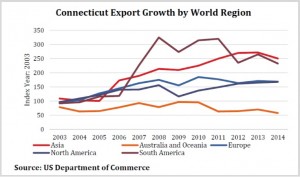
Connecticut has become more reliant on exports to drive gross state product growth during the past decade, according to a new report prepared by the Connecticut Economic Resource Center (CERC). In 2003, Connecticut exports as a percent of Gross State Product (GSP) stood at 4.5 percent, increasing to 6.6 percent of GSP in 2013. That growth, CERC points out, makes it “important to analyze Connecticut exports trends to understand how exports will impact Connecticut’s economy in the future.”commerce chart

In 2014, approximately 46 percent of Connecticut exports were comprised of transportation equipment merchandise, which includes aerospace equipment. And approximately 45 percent of Connecticut exports went to four countries: France, Canada, Germany, and Mexico, according to the report, Eye on Economics – Export Trends for Connecticut.

Although Connecticut still has strong trade ties with Europe and the North American Free Trade Agreement (NAFTA) countries (Canada, Mexico), there has been “an obvious shift in export growth among its trading partners.”   From 2013 to 2014, Connecticut exports to South America and Asia increased overall, while exports to Europe, Oceania, and the rest of North America (mostly Canada and Mexico) were “generally flat.”

From 2003 to 2014, Connecticut exports to Asia increased by 182 percent, faster than exports to any other region, according to the data.   Economic growth in Asia was primarily driven by growth in China.exports

The shift in Connecticut export locations “can be partially explained by demand changes in regions that Connecticut trades with,” the report explains, citing changes in the appetite for exports in Europe and Asia. Europe, for example, has “experienced economic weakness since 2008 and has not fully recovered. It has been particularly hit hard by credit market constraints and unemployment, which has reduced consumptions levels, and thus demand for imported merchandise, the CERC report pointed out.

Looking ahead, the CERC analysis anticipates that Connecticut exports “may slow or remain flat” because of “weaker demand in Europe, where the majority of Connecticut exports currently go to; and Asia, which received the second largest amount of Connecticut exports in 2014.”

CERC logoCERC is a nonprofit corporation and public‐private partnership that provides clients with objective research, marketing and economic development services. The organizations mission is to “provide services consistent with state strategies, leveraging Connecticut’s unique advantages as a premier business location.”

The report was developed by the CERC Research Department, including Alissa DeJonge, Carmel Ford and Matthew Ross.

Too Much Sharing on Social Media - by Parents, Survey Finds

Earlier this month, the Lymes’ Youth Services Bureau offered a program for parents on social media and internet safety.  The focus, as is usually true of similar sessions in communities across the state, was on protecting children, and understanding how they are using social media. What is often overlooked in such community meetings is how parents – especially parents of young children - are using social media. Recent statistics from a national poll by the University of Michigan indicate that the parents of today’s youngsters are increasingly online using social media, often for reassurance, advice and guidance.  And they are concerned about how other parents are using - or overusing - social media.10025429_web

Most parents of young children (84% of mothers, 70% of fathers) report using social media like Facebook, online forums, or blogs, according to the national poll. Over half of mothers (56%), compared with only 34% of fathers, discuss child health and parenting topics on social media.  When sharing parenting advice on social media, common topics include getting kids to sleep (28%), nutrition/eating tips (26%), discipline (19%), daycare/preschool (17%), and behavior problems (13%).

Parents rate social media as useful for making them feel like they are not alone (72%), learning what not to do (70%), getting advice from more experienced parents (67%), and helping them worry less (62%).  In contrast, about two-thirds of parents are concerned about someone finding out private information about their child (68%) or sharing photos of their child (67%), while 52% are concerned that when older, their child might be embarrassed about what they have shared on social media.

The majority of parents who use social media (74%) know of another parent who has shared too much information about a child on social media, including parents who gave embarrassing information about a child (56%), offered personal information that could identify a child’s location (51%), or shared inappropriate photos of a child (27%).

Parents in this national poll cite many benefits of using social media to seek and share parenting advice, most notably around feeling that they are not alone with parenting concerns. In thesharing poll analysis, it is pointed out that connecting with another parent who is awake in the middle of the night can help to counteract feelings of isolation. Asking for other parents’ recommendations can facilitate the choice of a new childcare provider. And hearing about strategies used by other parents can offer practical tips to deal with a toddler’s behavior problem.

Parents also recognize that there can be downsides to sharing too much information about children on social media. Although there are no hard and fast rules about what is appropriate to share, this poll found that three-fourths of parents think another parent has shared too much information about their child online.

Other concerns about social media use pertain to fears that postings could be used to identify a child’s home, childcare or play locations. In certain situations, such as child custody disputes or domestic violence cases, disclosure of identifying information could pose a significant risk.  Many parents employ privacy settings on social media to control who can see their personal information; however, privacy settings are not well understood by all users, the poll indicates.

The University of Michigan C.S. Mott Children’s Hospital has coined the new term “sharenting,” the social media violation parents continue to commit with a simple keystroke and click.“By the time children are old enough to use social media themselves many already have a digital identity created for them by their parents,” research scientist in the U-M Department of Pediatrics Sarah J. Clark, associate director of the poll. “Parents are responsible for their child’s privacy and need to be thoughtful about how much they share on social media, so they can enjoy the benefits of camaraderie but also protect their children’s privacy today and in the future,” Clark said.

The survey, for the C.S. Mott Children’s Hospital National Poll on Children’s Health, was administered in November/December 2014 to a randomly selected, stratified group of adults age 18 and older. Responses from parents with a child 0-4 were used for this report.

https://youtu.be/o_xn6xwl0BI

Boston Children’s Hospital Delights with Interactive Wall Developed at UConn

It lives in Boston, but was built at UConn.  Boston Children’s Hospital’s recently installed Interactive Media Wall is an immense, high-tech, engagingly interactive product of the University of Connecticut’s Digital Media and Design program – a collaboration of students and faculty that is bringing smiles to children and families who encounter the massive 30-foot wall in the facility’s reconstructed lobby. For a team of animators accustomed to designing for screens a few inches across, the task of designing a scene three stories high was daunting – but a challenge they took on energetically.  The electronic wall consists of a large high-definition video screen, and a series of cameras and sensors that observe the presence and movement of people in the space below it, allowing people entering the space to control what appears on the screen.  It can be a powerful experience, for children and adults, as their movement defines the action on screen.BCH-Still-2

Rather than just showing a pretty picture, the wall hopes to offer some therapeutic benefit to the children who interact with it, in support of the mission of the hospital, which is widely considered one of the best pediatric hospitals in the world.

“The idea was to empower emotionally and physically challenged children to take control of something in their life, at a time when things were spinning out of control,” Tim Hunter, Department Head of Digital Media & Design and Director of the Digital Media Center told UConn Today.

How did a major healthcare facility in Boston connect with Connecticut’s flagship university for the project?

Prior to joining UConn’s faculty in 2007, Hunter spent 25 years developing and producing national and international design projects through his New York City based company. His areas of expertise are in digital animation design & production, digital media design & production, lighting design, scenic design and video projection design.

Through that firm, he had worked for many years with Boston-based Elkus/Manfredi Architects, which in turn worked with Boston Children’s Hospital on various projects.  When the project to renovate the facility’s lobby came along, the architects suggested that hospital leadership contact Hunter to see what he would envision as a centerpiece, interactive experience. media_nx

It was a good match.  Initial work began on the project at UConn in the fall of 2011, accelerating during the spring 2012 semester.  Plans called for the UConn Digital Media Center faculty and students to develop a unique imaging and sensing system that would be controlled by guests of the hospital as they traveled through the lobby.  The work was completed in mid-November 2014, and has been well-received by patients, visitors and staff, earning a not-to-be-missed following.

The UConn team drew on the expertise of faculty members from a broad range of disciplines. Experts in child psychology, in human behavior, and in several disciplines of computer science and engineering contributed to the development of the installation.

That kind of collaboration was critical to the success of the wall, says Hunter, even though such projects are not usually developed at an academic institution. “A university is not the first place you would look for something like this,” said the industry veteran-turned-educator.

logoAmong the students participating in the project were William Pritchard, interaction design and project management; Somaiyeh Ghaffarnia, animation and character development; Sean Dexter, 3D animation; Kevin Richetelli, 2D animation; Samantha Menza, game design; Tom Lee, game design and music composition; and Tiffany Hoang, game design. Prtichard and Ghaffarnia began working on the project as undergrads and continued while pursuing their graduate degrees.  The other students were undergrads.

UConn faculty involved in the project, along with Hunter, were Samantha Olschan, animation and character development; Mike Vertefeuille, technology and installation; and Zsolt Palatinus, data mathematician.  Also participating were staff member Michael Toomey, interaction design and project management, and CHIP members Tim Gifford and Christian Wanamaker, engineering and coding.

There may be more to come.  UConn’s Digital Design department – with students in Storrs and Stamford - and Boston Children’s Hospital now have an ongoing relationship, with plans for UConn to develop new interactive experiences for the next five years.

https://youtu.be/DD7gk2kHP3g

FEMA to Upgrade Emergency System at WTIC-AM Tower As Station's License Renewal Remains Unresolved

As the license renewal application of WTIC-AM radio continues to languish at the Federal Communications Commission, nearly one year after the station’s broadcast license expired, another federal agency is proceeding with WTIC on a local project aimed at assuring the availability of broadcast communication in the event of an emergency. This week the Federal Emergency Management Agency (FEMA), part of the U.S. Department of Homeland Security, testified at the Avon Planning and Zoning Commission outlining a plan to upgrade the Primary Entry Point System (PEP) facility which is located on Avon Mountain at the site of the station's transmitter and operated in conjunction with WTIC. 600px-us-fema-pre2003sealsvg

The facility is part of a nationwide network of about 70 such installations, which for the past 30 years have provided a “broadcast-based capability to communicate critical life-saving information to the public in times of extreme emergencies,” according to FEMA officials.  FEMA coordinates with local broadcast stations with the most far-reaching signals in their respective regions.  WTIC is the only PEP station in Connecticut.

FCC-LogoAlso this week, an official at the FCC indicated that the "enforcement hold" status of the station’s license renewal was "unchanged," and the station continues to operate until a decision is made, as is customary with delayed renewal applications. The WTIC-AM license renewal application has been on enforcement hold at the FCC since the license expiration date of April 1, 2014, as the agency’s Enforcement Bureau continues to consider “an alleged violation of FCC rules,” according to an FCC official. The renewal application was filed by the station almost 16 months ago, on November 27, 2013. Stations must file an application for license renewal) four months prior to the expiration date of the station’s license.

The facility at the WTIC broadcast tower and antenna in Avon would be the last in the country to be upgraded by FEMA.  After hearing a FEMA presentation and comments from local residents, the Avon Planning and Zoning Commission unanimously approved the plan and construction is slated to begin later this spring.

FEMA, noting that the PEP system “proved invaluable” to the New Orleans community in the aftermath of Hurricane Katrina, places back-up generators and diesel power at the transmitter sites of key commercial radio stations, to assure that they stay on the air to broadcast emergency information if other media is off-line due to power outages or other “extreme emergencies.”  Such was the case in New Orleans with WWL-AM, which, like WTIC-AM, is a 50,000 watt broadcast station.

Federal officials noted that “WTIC is the only original PEP station that has not been upgraded with long-term back-up components.  This leaves Connecticut and its local communities in a very vulnerable position when a major disaster strikes.”  The plan approved this week calls for installation of a new emergency back-up transmitter, two state-of-the-art generators and diesel fuel tank that would enable the station to transmit broadcast signals for longer than two months if necessary.  Nationally, FEMA continues to upgrade and expand the PEP system. The agency's website indicates that direct coverage of the nation’s population will expand from approximately 67 percent in 2009 to over 90 percent through 77 PEP stations by the end of this year.

WTIC_1080_AM_Radio_logoWTIC-AM, which is licensed to Hartford but operates from studios in Farmington and has its broadcast tower on Avon Mountain, can continue broadcasting under the license that expired  on April 1, 2014, until the FCC acts on its renewal application. Until the enforcement hold is lifted the FCC Media Bureau cannot proceed with a decision on whether or not to renew the station’s broadcast license.  The Enforcement Bureau must first determine whether or not a violation of FCC rules has occurred.  If the allegation is substantiated, the agency has a range of options, such as warning that the violation not be repeated or imposing a monetary fine on the station, officials said.


Precisely what the allegation under review involves is not made known to the public, officials reiterated this week.  That information is only made available to the licensee or their attorney, FCC official have said. The agency can, and often does, communicate with the station as part of their review process.  WTIC has declined to comment on the ongoing review process at the FCC.

Hartford Attorney Ken Krayeske filed an informal objection last fall to WTIC’s broadcast license renewal, alleging that the station “demonstrated serious malfeasance” and “helped conceal violations of federal law,” related to former talk show host John G. Rowland’s use of his radio program to promote the Congressional campaign of Lisa Wilson-Foley. Krayeske had filed a previous complaint in 2012 that did not result in FCC action against the station.

When the license renewal application does reach the agency’s Media Bureau, they will consider “how the allegation of violation was resolved,” as well as a range of other factors in deciding whether or not to renew the station’s license.  The other, more routine, factors include whether any other objections have been raised about the station, whether the station has been adequately serving the public in their area of license, their history of compliance with FCC regulations, and their overall performance.  License renewals for radio stations are issued by the FCC for a period of eight years.

Connecticut Medal of Science Nomination Deadline Approaches

The Connecticut Medal of Science is Connecticut’s highest honor for scientific achievement in fields crucial to Connecticut's economic competitiveness and social-well-being. Nominations for the 2015 awards, to be announced in May, are due by Friday, March 13. The Medal recognizes an individual who has made extraordinary contributions to the advancement of science in Connecticut. For this competition, science spans the physical and biological disciplines as well as mathematics, engineering and the social and behavioral sciences.medal of science

Modeled after the National Medal of Science, the award is bestowed in alternate years with the Connecticut Medal of Technology.  (Science in odd-numbered years; Technology in even-numbered years.) The most recent Medal of Science recipient, in 2013, was Thomas A. Steitz, Sterling Professor of Molecular Biophysics and Biochemistry, Professor of Chemistry, at Yale University and Howard Hughes Medical Institute Investigator.

Unlike their federal counterparts, the state medals are designed to recognize individuals, not teams or entire corporations. The work the awards honor must also have a "clear association with Connecticut," meaning it must have been performed in the state, at least in its final stages, or in a company or institution closely affiliated with the state. Profiles of all Medal recipients are featured permanently in the Hall of Fame, located at the Connecticut Science Center in Hartford.

Selection of the Medalist is conducted by the Connecticut Academy of Science and Engineering, using the following criteria:

  1. Total impact of the candidate’s work on the current state of physical, biological, mathematical, engineering, or social and behavioral sciences. (primary criterion)CASE-Announces-Election-9-Members-from-Industry
  2. Achievements of an unusually significant nature and their potential effects on the development of scientific thought.
  3. Distinguished service in the general advancement of science and engineering accompanied by substantial contributions to the content of science.
  4. Recognition by peers within the scientific community.
  5. Contributions to innovation and industry.
  6. Influence on education through publications, students, etc.
  7. A significant portion of the candidate’s work must have been performed in, or be associated with, an institution/organization/business located in Connecticut at least in its more mature and developed stage and during which time the candidate was a citizen of the U.S. or permanent resident who had applied for citizenship.

Nominations include a narrative statement by the individual making the nomination and three statements of support “from persons familiar with the technological aspects of the candidate's work.”

To date, Connecticut Medalists are:

Medal of Science

  • Frederick M. Richards, Yale University
  • Ronald R. Coifman, Yale University
  • William C. Stwalley, University of Connecticut
  • Michael P. Snyder, Yale University
  • Robert R. Birge, University of Connecticut
  • Steven L. Suib, University of Connecticut
  • Thomas A. Steitz, Yale University

Medal of Technology

  • Joseph Gerber, Gerber Scientific
  • Charles H. Kaman, Kaman Corporation
  • Anthony J. DeMaria, DEOS, LLC
  • Gene Banucci, ATMI, Inc.
  • Tso-Ping Ma, Yale University
  • Jonathan M. Rothberg, Ion Forrent
  • Yaakov Bar-Shalom, University of Connecticut
  • Frederick J. Leonberger, EOvation Advisors

The 2015 Medal of Science will be presented at the May 19, 2015 Annual Dinner of the Connecticut Academy of Science and Engineering. Additional information is available from Richard Strauss, Executive Director of the Connecticut Academy of Science and Engineering, at 860-571-7135.

New “Digital Cookie” Program Brings On-Line Sales to Girl Scouts of Connecticut

Another time-honored tradition has transitioned to the digital age.  Girl Scouts are now selling their celebrated line of cookies on-line.  Connecticut is one of the Girl Scout Councils across the country to be participating in the inaugural year of the Digital Cookie program – and the response has been better than expected. The new Digital Cookie program strengthens, expands, and enhances the well-known and highly regarded Girl Scout Cookie Program by “combining the values and lessons of door-to-door and booth sales with crucial 21st century business and entrepreneurial skills,” official say, “continuing Girl Scouts’ long tradition of preparing today’s girls to be the female leaders of tomorrow.”14_GSCP_digital-channel_4C_multi-color

Here’s how it works:  Prospective cookie customers are able to purchase cookies on-line, after having been contacted by a Girl Scout. (Or you can tell a Girl Scout you know that you're interested in becoming a Digital Cookie customer.) Each scout has their own personal page thru which the cookies are ordered, so the scout will receive credit for the sale, just as when the transaction is completed in-person.  Officials say that some girls will market their online cookie business by inviting customers to visit their personalized cookie websites through a link sent via email.  Others will take in-person orders using a unique mobile app designed specifically for Girl Scouts.

pin“We were excited here in Connecticut to give our Girl Scouts the opportunity to participate in a pilot of Digital Cookie, a first-of-its-kind web platform that lets girls sell cookies from their own protected, personalized websites,” said Tiffany Ventura Thiele, Communications & PR Manager for Girl Scouts of Connecticut.


“Digital Cookie represents the next evolution of the iconic Girl Scout Cookie Program, adding a digital layer that broadens and strengthens the Five Skills girl learn, while introducing modern elements like website customization and e-commerce,” Thiele explained.

Those skills haven’t changed:  goal-setting, decision-making, money management, people skills and business ethics.  With the new on-line system, customers will be able to pay by credit card and have cookies either delivered by the Girl Scout or shipped.Girl-Scout-Cookies-2015-665x385

Sales are running strong thus far.  To date, in Connecticut, nearly 38,000 packages have been sold on-line, with more than 2,500 girls participating.  In fact, orders placed in Connecticut have been shipped to 49 states and the District of Columbia, as well as to military personnel.  (If you’re wondering, nearly two million boxes of cookies were delivered this past weekend, based on initial orders taken by Girl Scouts in Connecticut.)

Nationwide, a majority of the 112 local Girl Scout councils are participating in the Digital Cookie program for the inaugural 2014–2015 cookie season, which began in January.  Additional councils expected to be on board by the end of the year, using an updated version of the program, which will be tweaked based on the feedback received from participating Councils.

mtc_raisins_w_backgroundOfficials stress that “because 100 percent of the net revenue raised through the Girl Scout Cookie Program stays with local councils, when you purchase Girl Scout Cookies you’re not only getting a delicious treat — you’re also making an important investment in your community.”

There are two new cookie options locally this year:  Rah-Rah Raisins, an oatmeal cookie, and Toffee-tastics, a gluten-free butter cookie with toffee pieces.

An informal poll on the national Girl Scouts website asks visitors to vote for their favorite Girl Scout cookie.  The top three thus far:  Samoas (30%), Thin Mints (27%), and Samoas (13%).

If you’ve yet to place an order, there’s still time if you have a sweet tooth for Samoas, Thin Mints, Tagalongs, Do-Si-Dos, Savannah Smiles, Trefolis or the two new offerings.  The Girl Scouts of Connecticut’s cookie program will continue with booth sales through the month of March, so there’s still a chance to fill the cookie jar.