
Middletown, Bridgewater, Granby, Stamford Top Turnout List in 2012 Elections

In a presidential election year, high voter turnout is possible – it’s just not easy. Secretary of the State Denise Merrill has presented the 2012 “Democracy Cup” for the highest voter turnout percentage in the 2012 Presidential election in Connecticut to the town of Bridgewater (94.75%) and the city of Middletown (89.86%).   Overall, statewide voter turnout was 74%, slightly less than the last Presidential election turnout of 78.14% in 2008, in what may have been a result of difficulties in transportation and communication due to power outages and downed tree limbs from Hurricane Sandy.

The award is given annually to the small, mid-sized, large towns and city with the highest voter turnout on Election Day. The other winners of thSOTSe 2012 Democracy Cup for voter turnout are Granby (86.22%) and Stamford (71.6%).

Under Democracy Cup criteria, towns with fewer than 5,000 registered voters are considered small; municipalities with between 5,000 and 14,999 and voters are considered mid-sized, towns with 15,000 and 49,999 registered voters are considered large towns. Cities with more than 50,000 registered voters are their own category.

Each community awarded the Democracy Cup will be able to host and display a trophy through next year’s November elections. Trophy presentations were held for Middletown, Bridgewater, Stamford and Granby.

“The voters in Bridgewater, Middletown and the other communities who win the award this year really set an example for all of the voters in Connecticut of why elections and participating in democracy are important. I congratulate both Bridgewater and Middletown for doing such a wonderful job with 9 out of 10 registered voters participating in the 2012 election – it is some of the highest voter turnout in the nation!” Co-sponsored by the East Haddam Civic Association since 2000, the Democracy Cup was created as a way to encourage voter participation in each year’s elections. Merrill said Connecticut was seventh in the nation in voter turnout. Traditionally, she told the Middletown Press, Connecticut has placed 20th. “One week before a major storm, 100 of our 730 polling places were out of commission, so it took a lot of work by a lot of people to get us back online,” Merrill said.
Moving Vans Heading Outbound, Beyond Connecticut’s Borders

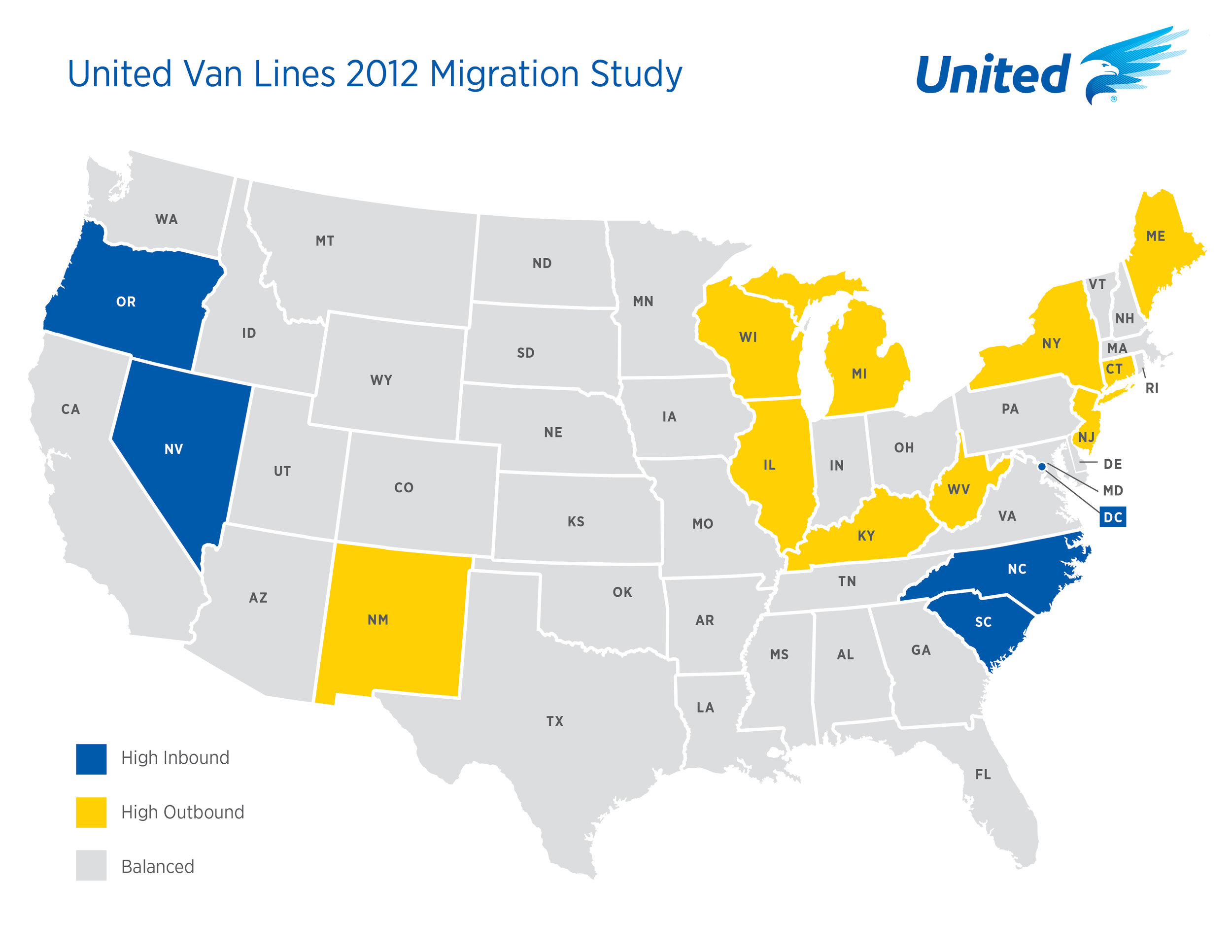
If it’s tough to tell sometimes if you’re coming or going, there is at least one well-known company that keeps close tabs on movement.  United Van Lines, long in the business of moving people from point A to point B, issues an annual “migration study” that tracks where people are moving to, and moving from. In 2012, more folks were going than coming to Connecticut, by a ratio of 56 percent to 44 percent, putting the state squarely among the top 10 outward bound leaders.  The pattern was similar throughout the Northeast.  New Jersey (62 percent) displaced the outbound leader from last year, Illinois (60 percent) reclaiming the top spot for high-outbound migration that it held in 2010.  In addition to New Jersey, New York (58 percent), Maine (56 percent) and Connecticut (56 percent) are also included.

Michigan (58 percent) and Wisconsin (55 percent) along with Illinois represented the Great Lakes region. Michigan fell to the No. 6 from the No. 4 spot it held in 2011. Previously, it had claimed the top outbound spot every year from 2006-2009.  Kentucky (55 percent) joined West Virginia (58 percent) as the only Southern states to appear on the high outbound list. New Mexico (58 percent) was the only Western state to appear on the list. The top 10 outbound states for 2012 were:

  1. New Jersey Migration Map
  2. Illinois
  3. West Virginia
  4. New York
  5. New Mexico
  6. Michigan
  7. Connecticut
  8. Maine
  9. Wisconsin
  10. Kentucky

That’s one list that states would prefer not to be included on.  United has tracked migration patterns  annually on a state-by-state basis since 1977. For 2012, the study is based on all household moves handled by United within the 48 contiguous states and Washington, D.C.  United classifies states as "high inbound" if 55 percent or more of the moves are going into a state and "high outbound" if 55 percent or more moves were coming out of a state or "balanced" if the difference of inbound and outbound is negligible.   The top-five inbound states of 2012 were 1) District of Columbia, 2) Oregon, 3) Nevada, 4) North Carolina and 5) South Carolina.

The Western United States is also represented on the high-inbound list with Oregon (61 percent) and Nevada (58 percent) both making the list. Oregon is number two for inbound migration for the third year in a row. Nevada returned to the high inbound traffic for the second consecutive year. The Carolinas each made the top five with North Carolina at 56 percent and South Carolina at 55 percent inbound moves.

Several states gained approximately the same number of residents as those that left. Those states include New Hampshire from the New England region, and the states of Louisiana, Iowa, Indiana, North Dakota, and Maryland.  This is the fifth consecutive year the District of Columbia (64 percent) was the top moving destination in the United States.  That trend may continue in 2013, what with members of Congress and the Cabinet coming and going.

Hartford’s Institute of Living Plans Research into Schizophrenia and Autism Spectrum Disorders

Last month’s tragic killing of 20 children and 6 educators at a Newtown elementary school quickly generated speculation about possible links between mental illness and autism spectrum disorder, as questions about the gunman's medical history drew attention.  Although connections between the conditions were generally dismissed as media coverage proceeded, with distinctions being made by medical professionals and others,  a scientific research study into whether a relationship exists isRounds apparently set to get underway in Connecticut. Writing in the Autumn 2012 edition of Rounds, the quarterly magazine of Hartford Hospital, Michal Assaf, M.D., director of the Autism and Functional Mapping Laboratory at the Olin Neuropsychiatry Research Center at the Institute of Living, says that “traditionally considered separate diagnoses, both schizophrenia and an autism spectrum disorder involve core social and communication deficits.  Not much is known, however, about exactly how each neurodevelopmental disorder disrupts the brain or how much they may overlap.”

“Schizophrenia and ASD are thought of as separate entities based on clinical symptoms, age of onset and the course of the illness,” says Dr. Assaf, who also is an Adjunct Assistant Professor at the Yale University School of Medicine.   “Recent evidence suggests a potential overlap.”

“Looking beyond clinical symptoms to the biological and genetic basis of these apparently differAssafent illnesses may someday lead to new treatments,” Assaf suggested in the article published prior to the Newtown killings.


She recently received a $2.9 million research grant from the National Institute of Mental Health (NIMH) to study social cognition and brain function in schizophrenia and ASD.  The study will directly compare a matched group of schizophrenia and ASD patients using a battery of social assessment tools and several neuro-imaging tasks that assess different aspects of social cognition.

Noting the commonly recognized distinctions, Dr. Assaf said that “Schizophrenia is a psychotic illness that typically appears in early adulthood.  In contrast, children with ASD show core deficits in social and communication skills – typically without psychotic symptoms – before age three.”iol_logo_300x175

The Institute of Living has been seeking individuals to participate in the research study.  The Olin Neuropsychiatry Research Center at the Institute of Living, part of Hartford Healthcare, was founded in 2001. The mission of the Center is to be at the forefront of research in psychiatric and psychological disorders, in particular schizophrenia.


Manufacturing Summit Planned to Accelerate Industry Growth

“Manufacturing is vital to Connecticut’s economic health and future. Now, after decades of uncertainty, the state’s manufacturers could be entering a new era of opportunity. Employment is rising, companies that moved overseas are returning and continuous improvement initiatives are helping many manufacturers hone their operations and enhance competitiveness.”  That assessment, from the Connecticut Business & Industry Association, is driving a Connecticut Manufacturing Summit on Friday, January 25 at the Trumbull Marriott. The program will include an overview of U.S. manufacturing from Steve Menaker, Partner,  McGladrey LLP, and a presentation of CBIA’s report, Connecticut Manufacturing: Building on the Past, Creating Our Future, issued in mid-2012, from Pete Gioia, Vice President and Economist at CBIA. Among the key stats manufacturingthat will inform the discussion:

  • Connecticut is home to nearly 5,000 manufacturing companies that employ approximately 165,000 people and produce a vast array of products.
  • A CBIA/ DataCore Partners index contained in the report, placed Connecticut as 30th in the nation for manufacturing competitiveness.
  • Connecticut ranked 9th in the nation in the Milken Science and Technology Index that measures states’ ability to support growing manufacturing industries. (The ranking is based on public investments in R&D, a well-educated and skilled workforce, and the availability of risk capital to help convert R&D into viable technology products and services.)
  • Citing manufacturing as a jobs driver, the report also said that for each manufacturing job created in the state, between 1.5 and 4 additional jobs are created in other parts of the economy.
  • Each dollar’s worth of manufactured goods creates another $1.35 of activity in other economic sectors – twice the multiplier effect of most of the services sector.
  • Each year, manufacturers purchase more than $21 billion in goods and services from other state businesses, according to the Connecticut Economic Resource Center.
  • According to a Connecticut Industrial Energy Consumers report, manufacturing contributed $25.9 billion to the gross state product and accounts for about 11.4 percent of the state’s total employment.

The Summit will also include manufacturing executives discussing approaches for achieving success, resources needed for sustaining success, and strategies for cost-control and streamlining operations.  Among the participants are Brian DiBella, Vice President and General Manager - Wiremold Electrical Wiring Systems Division, Legrand and Don Janezic, CFO, Bigelow Tea. Panel participants also include Jason Howey, President, Okay Industries, Dr. Karen Wosczyna-Birch, Executive Director College of Technology, Connecticut Community Colleges, Dave J. Tuttle, Department Head/ Manufacturing, Connecticut Technical High School System and Douglas Johnson, Vice President of Operations, Marion Manufacturing Company.

There will be a policy discussion on improving Connecticut’s manufacturing climate led by Joe Brennan, Senior Vice President of Public Policy, CBIA.

The Summit, coming at the start of the 2013 state legislative session and prior to the Governor’s presentation of the state budget, aims to build on efforts at the Capitol to focus on high-tech manufacturing as part of the state’s economic mix.  At a news conference last Many to announce the formation of a “manufacturing caucus,” Sen. Gary LeBeau, D-East Hartford, said that over the last 10 years Connecticut has lost 50,000 jobs in manufacturing, which equates to 419 jobs lost each month. The caucus includes Sen. Tony Guglielmo (R-Stafford Springs), Rep. Zeke Zalaski (D-Southington), Rep. Vincent Candelora (R-North Branford), and Rep. Jeffrey Berger (D-Waterbury).


Newington Arena Hosts Nation's First Adult Sled Hockey League

Most of us are unfamiliar with sled hockey, but the sport received major attention recently in The New York Times, which focused on - of all places - Newington, Conn., which hosts the Northeast Sled Hockey League (NESHL) monthly at the Newington Arena.  It is the first-ever organizsled hockeyed, multi-state, adult sled hockey league in the U.S, with teams representing Connecticut, New Hampshire, New York, New Jersey, Western Massachusetts, and Pennsylvania. Sled hockey, also known as sledge hockey, is a fast, exciting, rough-and-tumble version of ice hockey played primarily by people with lower limb mobility impairments. The game is essentially the same as “stand-up” ice hockey, the major difference being that the players use a sled with two hockey skate blades mounted under a seat.

A full slate of action is scheduled for Sunday, January 6 at the Newington Arena, with all the twolfpack logoeams in town to play six back-to-back games set to begin at 10 AM and run through early afternoon.  The teams will all be back in Newington again for a full slate on February 10.  Connecticut's team, the Wolfpack, is 1-0-1 on the season, in second place.

No strikes, no lockouts, no labor disputes in this league.  Just hard work and hockey.

The Times story highlighted Sara Tabor, 31, “in her rookie season with a sled-hockey team sponsored, in part, by the NHL’s Rangers, which explains why players wear red, white and blue sweaters.”  The Times reported that “Tabor was partly paralyzed when she fell in a shower in Germany four years ago.”

Each team in the NESHL plays eight regular-season games and there are also playoff games. A 45-minute game is played on a standard rink. Players strap themselves into seated sleds with two skates mounted on the bottom, one at the front, one under the seat. They propel themselves with two half-hockey sticks in a fashion similar to cross-country skiers.  The stick blades are less curved than those on standard ice-hockey sticks, and the elbows of the sticks are straighter than those on ice-hockey sticks, in part because the players are lower to the ice.

Two years ago, the Hartford Courant ran a story on the league featuring Eric Veilleux, then 27. Veilleux lost a leg in a construction accident in 2006, which he said sent him into a dive. His old friends said they'd stay in touch, but seemed to fade away, the Courant reported.  Playing with the sled hockey’s Wolfpack “has brought him out of his shell, given him a chance to get some aggression out and make new friends, whom he now considers a second family,” Veilleux told the Courant. "I was depressed before I got into sports," Veilleux said. "It's basically brought me back to life."  In 2013, Veilleux is now the second highest rated goaltender in the league.

Practices for the Connecticut team are held at Loomis Chaffee School and Westminster School.  Volunteers to support and assist the CT Wolfpack are welcome.

There is a US National Sled Hockey team, which competes in the US Paralympics, and has included members of the Connecticut team and others from throughout the NESHL.  According to the league website, "these players have competed at the highest level reinforcing our commitment to provide an environment where our athletes can mature and realize their full potential, both on and off the ice."


Modest Economic Growth Seen in 2013 Amidst Competing Indicators

The Connecticut Economic Digest, assessing the prospects for the state’s economy in the new year, has unveiled a series of observations and analyses that suggest it may be a challenging twelve months, but not without the possibility of progress, and an overall prediction of “modest growth”.  The first issue of 2013 of the journal produced by the state Departments of Labor and Department of Community and Econoecondigestmic Development, notes a range of factors that could impact economic prospects, among them:
  • Tourism: "Last year the state launched a multi-million-dollar, two-year marketing initiative to develop, foster and stimulate the state’s brand identity and bolster business and tourism. Tourism has a significant impact on the state’s economy, estimated by the University of Connecticut’s Center for Economic Analysis at $11.5 billion every year through total traveler and tourism revenue and $1.15 billion in state and local tax revenue. Travel and tourism creates more than 110,000 jobs throughout the state, or 6.5% of Connecticut’s total employment."
  • Large businesses: "The state’s “First Five” and “Next Five” job initiatives have promised substantial growth in employment and capital investment in Connecticut. At year’s end, nine business deals had been announced as part of the ongoing expansion program, which leveraged $1.3 billion in private investment. Between the nine companies — Cigna, ESPN, NBC, Alexion Pharmaceuticals, CareCentrix, Sustainable Building Systems LLC, Deloitte, Bridgewater Associates, and Charter Communications — up to 4,748 jobs are expected to be created and 11,087 retained."
  • Small Businesses: "The Small Business Express Program (EXP) provides loans and grants to Connecticut’s small businesses to spur job creation and growth and has seen vigorous activity since its inception. The state has assisted 435 companies with more than $60 million in loans and grants. With this much-needed capital, up to 1,523 jobs are expected to be created and 4,080 retained."
  • Housing: "The state’s housing market languished in 2011. Residential permit data through September 2012, however,  had grown by 32.2% compared to the same period the previous year. New homes sales grew 5.7% in September, and housing starts 3.6% in October, the highest level in four years."

The Digest noted that “the Connecticut recession from March 2008 through February 2010 saw the loss of 117,500 jobs. Jobs regained numbered 30,700 (26.1%) since February 2010 when the recovery began through November 2012, including 1,900 in the year 2012 through November (0.12%) seasonally adjusted since the beginning of the year. The private sector has regained 42,000 (38.1%) of the 110,200 private jobs lost in that same recessionary period.”  It is forecast that Connecticut will gain about 5,600 jobs or 0.3% in 2013.

In addition, the Digest pointed out that “The state’s unemployment rate, after peaking at 9.4% for five consecutive months in 2010 and falling rather steadily to 7.7% in March and April 2012, jumped unexpectedly through last summer to 9.0% and declined to 8.8% in November.” The New England Economic Partnership forecasts Connecticut’s unemployment rate will be 7.7 % in 2013.

State's Small Business Program Targets Jobs, Economic Growth

When a survey of family owned businesses last year found almost two-thirds of respondents projecting sales and revenue growth in 2013, it appeared that optimism was on the upswing. This weeks’ news from Connecticut’s Department of Economic and Community Development (DECD) on the progress of the state’s Small Business Express Program, launched a year ago, may be a contributing factor. The Small Business Express Program (SBEP) supports the retention and growth of small business in Connecticut through a combination of loans and grants. SBEP incorporates a stream-lined process that provides financial assistance in the form of revolving loan funds, job creation incentives; and matching grants. The program is designed to provide small business with access to capital, support job creation, increase skill development and encourage private investment. SBEP loans and grants are intended to have a positive impact on the growth of the companies receiving the funds, and decd-logo-spelled-out-centeredcorrespondingly on Connecticut’s overall economy.

Slightly more than 1,607 businesses with 100 or fewer employees applied for loans or matching grants in the program's first year, according to state officials. DECD approved just over half of the applications, and the program is currently helping about 500 small businesses retain 4,616 jobs and to create another 1,738.

The DECD authorized $67.2 million in financing to 494 companies through Dec. 31 -- $27.5 million in loans and $39.7 million in grants. It has already received $412,130 in principal and interest payments. State officials are reviewing applications from another 271 businesses, for an additional $38.3 million.

Components of the program include:

  • Small Business Express Revolving Loan Fund - Loans are available at a minimum of $10,000 to a maximum of $100,000 to assist small businesses with capital and operational needs.
  • Small Business Job Creation Incentive Program - Deferred Loans are available at a minimum of $10,000 and a maximum of $250,000 to assist small businesses to spur growth. DECD may forgive all or part of loan based on the attainment of job creation goals.
  • Small Business Creation Matching Grant Program - Grants are available at a minimum of $10,000 and a maximum of $100,000 to provide a dollar-for-dollar matching grant for specific job creation, capital investment and working capital goals.

The SBEP program assistance has leveraged approximately $40 million in private investment, according to DECD figures. Some participating business owners have noted that banks became more willing to lend once the business is accepted into the program.

Newtown Was Rated #4 Town Among Peers, with Lowest Crime Rate

When Connecticut magazine last ranked Connecticut’s towns and cities on their quality of life, Newtown placed fourth overall among 26 communities with between 25,000 and 50,000 residents. Breaking down the individual categories in the rating, Newtown placed first with the lowest crime rate, third in the vibrancy of its economy, and sixth in the quality of education, in data compiled for the 2011 rating.

The top eight communities were Westport, Farmington, Glastonbury, Newtown, Cheshire, Wallingford, Mansfield and New Milford. The categories included were education, crime, economy, cost, and leisure.

The crime category is based on major crimes (murder, rape, robbery, aggravated assault, burglary, motor-vehicle theft) committed in 2007, 2008 and 2009 per 1,000 population, using figures available from the state Department of Public Safety.  The education category combines five elements: the 2009, 2010 and 2011 Mastery Test results for 4th, 6th and 7th grades; results of the 2009, 2010 and 2011 Connecticut Academic Performance Test (CAPT); local SAT scores for 2008, 2009 and 2010, and the percentage of 2010 public high school graduates who went on to two- or four-year colleges. Test scores were weighted more heavily.

The strength of the local economy was determined by the 2011 Public Investment Community score, compiled by the Office of Policy and Management, which rates all Connecticut towns under a formula based on population, per capita income, the adjusted equalized grand list per capita, the unemployment rate, the equalized mill rate and per capita aid to children.

Newtown was in the middle of the pack in leisure/culture, placing 13th, and among the lowest in cost of living, placing 25th out of 26 communities evaluated. The cost of living category weighs most heavily the median price of a single-family house purchased in the first six months of 2011.   Leisure includes local library expenditures per capita in 2010, the number of theaters, museums, festivals, concert venues, historic sites, colleges and universities, golf courses, local newspapers, radio stations, state parks and forests, voter turnout in the 2008 election and good local restaurants.

New Haven Gun Buyback Program Set for Saturday

Just one week after the tragic killings of 20 elementary school children and six educators in Newtown, the New Haven Police Department will be conducting a gun buy back program on Saturday, December 22.  The event comes three weeks after a similar event in Hartford. The unofficial count for the gun buyback in Hartford on December 1, 2012 was 179 working firearms collected, 145 handguns and 34 rifles/shotguns.  Over $10,000 in retail gift cards were given to those turning in unwanted firearms.  This single day Gun Buyback program in Connecticut’s Capitol City has collected 464 firearms over the last four years.  Stepped up gun buyback programs were mentioned earlier this week by Hartford Mayor Pedro Segarra as a possible component in a comprehensive approach to the Newtown tragedy.

The New Haven gun buyback event is sponsored by the Injury Free Coalition for Kids of New Haven and Yale-New Haven Children’s Hospital’s Injury Prevention Program.  The goal is to get guns off the street, out of cars, out of basements and out of bedrooms. It has been estimated that a gun in the home is 22 times more likely to kill a family member or friend than to kill an intruder.

Gun Buyback programs have a history in Connecticut that began almost two decades ago with an overwhelming response in 1994, when then-Attorney General Richard Blumenthal, with the support of the Connecticut Retail Merchants Association and the Connecticut Police Chiefs Association, launched the nation’s first statewide program.  The response to the new initiative was far beyond all predictions – more than 4,200 guns, including 210 assault weapons, were turned in within less than a week.  That brought the statewide initiative to an end and required some state support by then-Gov. Lowell P. Weicker to fill in the gaps left by retailers and corporations that stepped up to support the initiative.

The approach, however, has continued.  Gun buyback programs in Connecticut municipalities – including Hartford, Waterbury, Bridgeport (55 weapons including rifles and handguns in 2010) and New Haven ( a total of 81 weapons in 2011 and 2012) -  have been more limited but continue to be successful, taking into account the lessons of the state’s initial effort in 1994 and the need to take a varying approaches to limit gun violence.

Said Chief State’s Attorney John M. Bailey in 1994: “I think it brought reality to the people of Connecticut. That 4,000 guns, including 210 assault weapons, could be turned in in four and a half days made people think how many guns could be out there.”

The annual Hartford gun buyback program was a collaboration between Hartford Hospital, Connecticut Children's Medical Center, St. Francis Hospital, CRT, the City of Hartford, the Hartford Police Department, the Office of the Hartford State's Attorney, and the Emergency Nurses Association.

Saturday’s New Haven buyback will be held at the New Haven Police Academy, 710 Sherman Parkway from 10:00am to 4:00pm, and is open to all Connecticut residents.  The department’s policy of “no questions asked” will be in effect allowing individuals to anonymously dispose of firearms without fear of charges for illegal possession when turning in the weapon. Non-operational guns, antiques, BB guns and holsters will be accepted but do not qualify for a gift card.

According to the New Haven Police Department, in order to receive amnesty for illegal possession at the time you turn in the weapon, protocol MUST be precisely followed.  The protocol includes:

  1. Firearms MUST be delivered unloaded;
  2. Firearms MUST be put in a clear plastic bag and put into another container (gym bag, backpack, etc);
  3. If depositing ammunition in addition to a firearm, ammunition must be delivered in  separate bag;
  4. If transporting the firearm by car, the firearm must be transported in the trunk of the car;
  5. After the firearm is screened by officers and determined to be a working firearm, a $50.00 gift card will be given;
  6. An additional $50.00 gift card will be exchanged for those firearms identified as assault weapons and/or saw-off shotguns(does not include newly sawed off for the purpose to receive extra gift cards);
  7. Non-operational guns, antiques firearms, BB guns and holsters will be accepted but do not qualify for a gift card;

Early Identification of Mental and Behavioral Health Issues Critical, CT Study Finds

A recent report by the Connecticut-based Center for Children’s Advocacy revealed that early warning signs of mental and behavioral health problems are often not identified until middle school years, but could be uncovered much earlier. In any given year, the report noted that “about one out of every five Connecticut children (87,500 to 125,000) struggles with a mental health condition or substance abuse problem. More than half receive no treatment.”

With a grant from the Connecticut Health Foundation, Dr. Andrea Spencer, dean of the School of Education at Pace University and educational consultant to the Center for Children’s Advocacy, examined children’s educational records to identify how early these warning signs appear.  The report, issued in September 2012, documents the direct link between undiagnosed and unaddressed mental health issues with increases in school suspensions, expulsions and entry into the state’s juvenile justice system.  It also noted that:

  • Over 70% of students diagnosed with mental illness and behavioral health problems by middle school exhibited warning signs by second grade.
  • Almost 25% exhibited red flags during pre-Kindergarten years.

Early indicators, according to the report, included developmental and health issues, adverse social factors and exposure to trauma. The report, entitled “Blind Spot,” found that 25 percent of the children studied had documented traumatic experiences in their records  It recommends implementation of a series of initiatives:

  • Improve screening for mental health risk factors
  • Improve referral to early intervention services (mental health and special education)
  • Improve collaboration between service providers
  • Improve community and parent education about risk factors and support available
  • Improve training and accountability for school staff and other providers

“Red flags for mental and behavioral health problems are often clear before the end of second grade,” said Dr. Spencer. “It is imperative that we improve screening and identification so support for these children can be provided before their academic careers are at risk.”

As a result of this report, the Center for Children’s Advocacy - a Connecticut nonprofit that provides legal support for abused and neglected children - introduced a statewide policy initiative to improve the quality and standard of care for children insured through the Connecticut’s Medicaid (HUSKY A) plan.

In addition, the Center noted that the Connecticut Department of Social Services (DSS) has agreed to convene a task force that includes representatives from the Center for Children’s Advocacy, Department of Children and Families, Department of Mental Health & Addiction Services, Office of Policy and Management, Value Options (contracted provider of mental health services under HUSKY/ Medicaid), American Academy of Pediatrics (CT Chapter), Academy of Child & Adolescent Psychiatrists (CT Chapter), Head Start, developmental pediatricians, Birth to Three Program, Department of Education, and the Connecticut Health Development Institute.

The task force is to review current regulations, make recommendations regarding screening and treatment protocols, and provide recommendations on reimbursement rates for pediatric providers, according to a news release issued by the Center.














