Best Pizza in America? Connecticut, Especially New Haven, Tops the Lists

When Zagat recently set out to select the best pizza in each of the nation’s 50 states, the competition both fierce and tasty.  That’s certainly true of Connecticut, where special pride is taken in pizza specialties in every corner of the state.   It was the white clam pie at Pepe’s on Wooster Street in New Haven that came out atop the list.

When the website The Daily Meal compiled the 101 best pizzas in America, the result was the same.  The number one pizza in America?  At Frank Pepe’s in New Haven.

That’s not all.  Connecticut fared quite ovenwell among the top 101, with no less than five pizza selected – including another top ten selection – the Tomato Pie at Sally’s Apizza at number seven - and yet another ranked at #11, Modern Apizza – both, of course, in New Haven.

As was pointed out by Zagat, “whether it's regional specialties like Detroit deep dish or white clam pie in Connecticut, or unusual varieties like python pizza down in Florida, we've got something for every palate and every citizen.”  And indeed they did.

“Sally's Apizza is a New Haven classic,” the Daily Meal described, “operating from the same location where they opened in the late 1930s in New Haven's Wooster Square. Their pizza is traditionally thin crust, topped with tomato sauce, garlic, and "mozz."

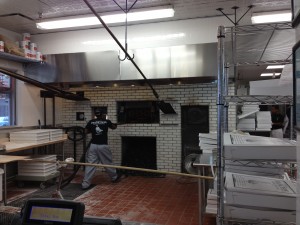
Of Modern's, the Daily Meal noted “coal-fired brick oven puts out pizza in the same thin-crust style. Modern's pies are a little topping-heavy with less structural integrity. Given the focus on toppings, the iconic Italian Bomb is the pie to try: bacon, sausage, pepperoni, garlic, mushroom, onion, and pepper.”

The 27th best pizza in America is tZagat-Logohe sausage pie from Colony Grill in Stamford. They have been serving up pizza since 1935 and now have locations in Fairfield and Milford.

At #68 on the list is the Margherita pizza from Alforno in Old Saybrook. When Bob Zemmel opened the restaurant in 1992, his goal was to bring the style of pizza you typically find in New Haven’s “Little Italy” to the shoreline. It was a success, the website noted.

Why was Pepe’s number one?

“There's a reason Frank Pepe routinely inspires a line down New Haven's Wooster Street: that101best_pizza_america670x400_a crust! It's coal-fired perfection, thin yet substantial - a true feat of pizza engineering. You can pick up a slice, and it won't flop over like most new-school Neapolitan pies. The most justly famous option is the white clam, piled with out-of-the-shell longnecks and a healthy dose of garlic - it's briny, creamy, chewy and a true revelation,” Zagat pointed out.

Established in 1925, recent years have seen the singular location replicated – or nearly replicated – in a half dozen satellite locations, the latest in West Hartford, following Fairfield, Manchester, Danbury, Mohegan Sun, and Yonkers (just over the state line in New York). It began as so many immigrant stories did, with hard work, a transplanted delicacy, and more hard work.  As the company website explains, “in 1925, with his wife Filomena, who was a pivotal influence on his success, Frank Pepe started making a simple and humble product from their homeland, pizza — or as they would say in their Neapolitan dialect, "apizza" (ah-beets). They baked their pizzas offering two types, tomatoes with grated cheese, garlic, oregano and olive oil and the other with anchovy. The Original Tomato Pie is still offered today and anchovy is still available as a topping.”

Pepe's signature pizza, the White Clam Pizza, was most likely an organic inspiration by Frank Pepe; an idea born from the fact that Pepe's also served raw little neck clams frfrank_pepe_680_340_85_s_c1om Rhode Island, on the half shell, as an appetizer. This occurred around the mid 1960's, the website explains, and gradually became popular through the years.

The Daily Meal considered 400 pizzas from throughout the U.S., using a judging panel that included 46 American chefs, restaurant critics, bloggers, writers, and pizza authorities. “Of the 101 best pizzas, 30 were from New York State (that includes Long Island),” the website reported.  “That being said, only three New York City pizzas made the top 10 and two of them were in Brooklyn. By contrast, two pizzas from Connecticut made the top 10, and three from California ranked among them.”

National Conference in Hartford to Focus on Nonprofits, Philanthropy and Voluntary Action

The theme will be “Nonprofit and Voluntary Action in an Age of Turbulence” when more than 600 researchers, leaders and teachers from around the nation gather in Hartford later this week for the annual convention of ARNOVA – the Association for Research on Nonprofit Organizations and Voluntary Action.

As the leading organization supporting research and education in the fields of voluntary action, philanthropy, nonprofit management, and civil society, ARNOVA conducts its annual conference to create a public conversation on, as well as opportunities for presenting research about, pressing issues and vital opportunities facing the voluntary or nonprofit sector. It is considered to be both a showcase for the best and most current research, as well as a seed bed from which new research is born.

Scholars, practitioners and studenArnovats from the U.S. and beyond will exchange knowledge about voluntary action, nonprofit organizations, and philanthropy – and Connecticut will be well represented among participants.   David Nee, representing the Connecticut Data Collaborative and Terry Edelstein, nonprofit liaison to the Governor will be among the panelists for a plenary session of the Conference.  Among those attending the national conference close to home are Kyle Barrette (UConn), Mary Bernstein (UConn), Ron Cretaro (Connecticut Association for Nonprofits), Robert Fisher (UConn), Richard Frieder (Hartford Public Library), Maggie Gunther Osborn (Connecticut Council for Philanthropy), Reinaldo Rojas (UConn), Homa Naficy (Hartford Public Library), Nmarasimhan Srinivasan (UConn), Rebecca Thomas (UConn) and Jun Yan (UConn).

The three-day conference (Thursday-Saturday) at the Connecticut Convention Center will include more than 100 sessions attendees can choose to attend.  Frieder will lead a session highlighting the Hartford Public Library’s Immigrant and Civic Engagement Project.  Cretaro will conduct a session devoted to outlining Connecticut’s Collaboration with Human Services Nonprofits.  Rojas will present Community Development and Its Socioeconomic Impact in Latino Neighborhoods.

Over recent decades, the public conversation at the conference – held last year in Indianapolis - has evolved to address new developments in the fields, including social entrepreneurship, social economy an4 Arnovad all aspects of civil society, as well as to meet the needs of those who study and lead “the social sector.” ARNOVA’s Annual Conference is the largest gathering held regularly anywhere devoted to these matters, according to the organization.

Conference organizers report that roughly 80 percent of participants will be based in universities or colleges, and include leading scholars and teachers. Many also serve as community consultants and nonprofit board leaders. The remaining 20 percent will be staff or leaders of nonprofit or social-economy organizations, full-time consultants to those groups, and some who play other roles in the world of philanthropy.

ARNOVA’s work benefits all of society by helping generate the knowledge and perspectives that can make organizations and enterprises more effective. With a focus on teaching, we are also playing a key role in preparing the next generation of leadership. Special projects we carry out have directly addressed the needs of nonprofits and foundations in developing new knowledge and sustaining important conversations vital to refining and improving their practices and services. In short, a wide range of organizations and individuals seeking to serve the public good are strengthened by the work of ARNOVA and its members.

Among the conference sponsors are the UConn College of Liberal Arts and Sciences Department of Public Policy and the Hartford-based law firm of Reid and Riege.

Photo:  David Nee, Terry Edelstein, Ron Cretero, Richard Frieder

Connecticut Residents Are Extroverts, Neurotic and Open, National Study Finds

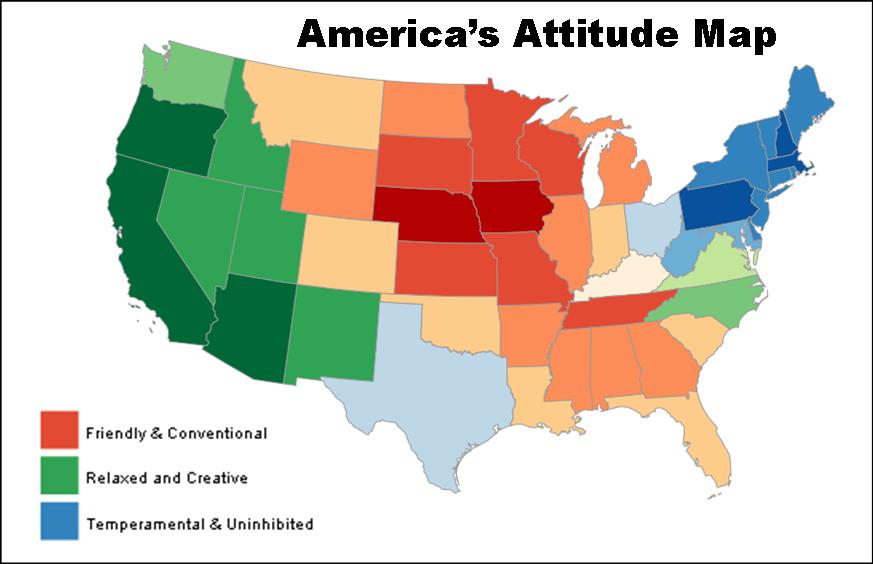
Connecticut ranks 47th among the states in conscientiousness, but #12 in extroversion and #16 in neuroticism, according to a new study published in a scientific journal and reported in TIME magazine.  Overall the state falls into the “temperamental and uninhibited” category, as does much of the Northeast, led by Vermont, Massachusetts and Pennsylvania.

Using personality test data from over one million people compiled over a decade, researchers identified three distinct personality regions in the country, and the degree to which each state reflected those characteristics.  The study was conducted by a multinational team of researchers led by psychologist and American expatriate Jason Rentfrow of the University of Cambridge in Great Britain.  big 5

The study, which maps the American mood state-by state, found that West Virginia is the most neurotic state, Utah is the most agreeable (Washington D.C. – not surprisingly – is the least agreeable) and the Wisconsin has the country's most extroverted residents. The most conscientious state in the nation?  That would be South Carolina.

The Connecticut Scoreboard indicates that state residents are above the national average in three characteristics - extroversion, neuroticism and openness, but lag in agreeableness and conscientiousness. (rank among states in parentheses; a score of 50 is the national average in each category:

  • Extroversion (12)  57.6
  • Neuroticism (16)  53.4
  • Openness (21)  53.9
  • Agreeableness (43)  38.6
  • Conscientiousness (47)  34.2

(sample size was 17,769)psp-150

The study, published in the Journal of Personality and Social Psychology, spanned 13 years and including nearly 1.6 million survey respondents from the 48 contiguous states and Washington, D.C.. (Alaska and Hawaii were excluded because not enough people responded to the researchers’ questionnaires.)

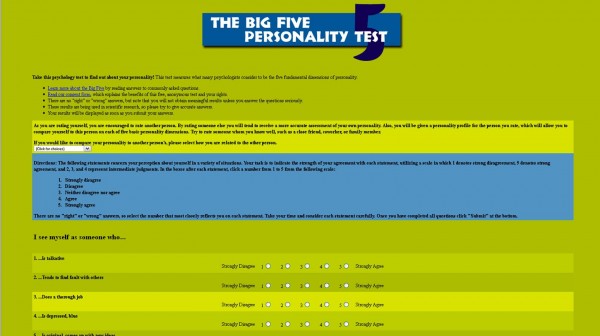
The subjects, recruited via websites and advertisements in the academic community as well as through platforms like Facebook, were asked to take one of three different personality surveys, though the most relevant one was what’s known as the Big Five Inventory, TIME reported. The survey measures personality along five different spectra: Openness, Conscientiousness, Extroversion, Agreeableness and Neuroticism.

(If you’d like to take the test, it is available online from TIME.)

Each of those categories is defined by more-specific personality descriptors, such as curiosity and a preference for novelty (openness); self-discipline and dependability (conscientiousness); sociability and Picture1gregariousness (extroversion); compassion and cooperativeness (agreeableness); and anxiety and anger (neuroticism). The inventory gets at the precise mix of those qualities in any one person by asking subjects to respond on a 1-to-5 scale, from strongly disagree to strongly agree, with 44 varied statements.

When the returns were tallied, TIME reported, the country broke down into three macro regions: New England and the Mid-Atlantic states, which the researchers termed “temperamental and uninhibited”; the South and Midwest, which were labeled “friendly and conventional”; and the West Coast, Rocky Mountains and Sun Belt, described as “relaxed and creative.”

Connecticut Ranks #13 in Workers Employed Here Who Live Elsewhere

The percentage of Connecticut workers who live outside the Constitution State is among the highest in the country, ranking 13th overall, at 6.4 percent.  Data from the American Community Survey of the U.S. Census Bureau indicates that Delaware has the largest percentage of workers who reside outside the state, at 14.8 percent. (The District of Columbia exceeds all the states, at 72.4map-usa percent.)

In examining the top commuting flows from state of residence to workplace state, Connecticut ranks at #14, with 66,652 people traveling from their homes in Connecticut to work in New York.  The leading residence-to-workplace combination is New Jersey to New York, with 396,520 workers commuting from the Garden State to the Empire State for their jobs.  The other top pairs are Maryland to D.C., Virginia to D.C., New York to New Jersey, and Pennsylvania to New Jersey.

The Survey’s analysis points out that “information about commuting activity between two specific geographic areas helps define commuting patterns and provides a gauge of economic interconnectedness.”

The top 15 states, and the percentage of their workers who live outside the state’s borders, are:

  1. D.C.                        72.4%
  2. Delaware             14.8%
  3. Rhode Island      12.8%
  4. North Dakota     11.6%
  5. New Hampshire 10.8%
  6. West Virginia     10.0%
  7. Maryland             9.1%
  8. Kansas                  8.4%
  9. Kentucky             7.8%
  10. Missouri               7.4%
  11. Vermont              7.1%
  12. Virginia                 6.8%
  13. Connecticut       6.4%morning traffic
  14. New York            6.4%
  15. Massachusetts  6.3%

 The statistics in the survey, which was issued earlier this year, reflects 2011 data.  The report also noted that among U.S. workers who did not work at home, 8.1 percent had commutes of 60 minutes or longer.  New York had the highest rage of “long commutes” at 16.2 percent, followed by Maryland and New Jersey at 14.8 percent and 14.6, respectively.  In Connecticut, 6.4 percent of workers working in the state have a commute of 60 minutes or longer.

The American Community Survey (ACS) is a nationwide survey designed to provide communities with reliable and timely demographic, social, economic, and housing data for the nation, states, congressional districts, counties, places, and other localities every year. It had a 2011 sample size of about 3.3 million.

Local Entrepreneur Brings Social Benefits to Coffee Sales with Innovative Product

It took root when he was a 9-year-old earning nickels and dimes at the Hartford Regional Market,  gained impetus at Hartford High School and was cultivated at the University of Richmond.  By the time Ray Fraser graduated college in 2011 with a business degree in marketing and finance, he was convinced that his life’s work would not center solely on making a profit, but on simultaneously making the world a better place.  He’s doing just that, one tree at a time.

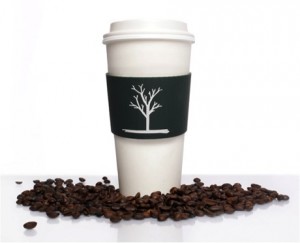
With a relentless work ethic and an engaging, easy-going personal style, Fraser’s start-up business – growing rapidly in just a few months – is called Tree Sleeves.  His mission:  to produce and sell reusable cup sleeves that combine comfort and utility with charity – “to help eradicate the cycle of deforestation affecting our planet.”

 For every Tree Sleeve sold, a tree is planted in a part of the world affected by deforestation.  It is a simple but profound concept, and the reaction has been overwhelmingly positive from a rapidly growing roster of retailers and consumers.  With a retail price of only $2.00 - a Tree Sleeve is perfect for daily use while on the go, quite affordable, and reusable.

Fraser has never shied away from challenges – in fact, he has consistently sought them out since he first visited the local Regional Market and asked what he could do to earn some money.  Told he needed to dump some boxes, he did – and came away with a nickel for his efforts.  Thus began a working relationship – and first-hand glimpse of what it takes to succeed in business – that continued as a part-time job through high school.  (The pay improved somewhat over time.)

As a teenager, Fraser was an Eagle Scout (his Eagle project was organizing a blood drive accompanied by a canned food drive for a homeless shelter) and an athlete who excelled in football, wrestling and track.  He discovered a knack – and enjoyment – in working with people, as well as an aptitude for business.  He would be the first in his family to attend college, encouraged by his parents, a machinist and teacher who resettled in Hartford from the West Indies and took education and diligence seriously.  Missing a day of scRay-005hool for being sick, Fraser recalls, was simply not an option.

In college, he developed an affinity for brands with a cause, and in addition to working as a Resident Assistant on campus, had motivating internships with United Technologies in Connecticut and Saks Fifth Avenue in New York City.  Both would express interest in hiring him after graduation, but by senior year Fraser had decided to chart his own entrepreneurial path, the example of Tom’s Shoes founder Blake Mycoskie (the subject of a college research paper), among others, serving as his frame of reference.

“I had looked at the corporate ladder,” Fraser recalled recently, “and I wanted to have a bigger impact, to do more than just bring home a paycheck.  I wanted to expand my mind, and make a difference.”
tree sleeveInnovative Idea

After graduating from college and returning to Hartford, Fraser tried to develop an entrepreneurial business with friends that didn’t quite come together, stymied by software development issues.  Then one day in January, in a local Starbucks working on elements of that initial attempt at enterprise, the frequency which employees needed to empty trash cans overflowing with disposable cardboard sleeves caught his attention, and imagination.  He thought there must be a better way, and then went about inventing it.

“They’d empty the trash, and then two hours later they’d do it again.  The waste was astronomical.  When I looked into the numbers on paper sleeves, I was shocked.  We throw away 3 billion a year,” he emphasized.  “That translates into thousands of trees cut down needlessly each year.”

The traditional disposable cardboard cup sleevemakes carrying easier and holding the cup possible by providing an extra barrier to reduce the heat from the cup. Based on his extensive and resolute research, Fraser has done the disposable cup holder one better, with purpose.

It didn’t happen overnight.  He visited local coffee shops to talk to owners about their business, customers, and interest in a potential product.  He had informal conversations with friends, inquiring whether they’d buy a reusable sleeve, and what attributes would make it attractive.  (Being good for the environment was a recurring theme.) He scoured the internet in search of potential manufacturers, first in this country, then overseas.  He taught himself about nations that produce coffee, and learned of the challenges many face due to deforestation.
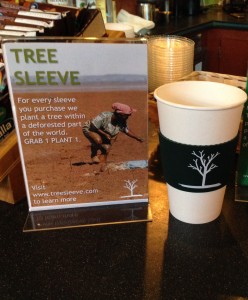
photo 1Building A Business

Fraser carefully nurtured relationships, engendering trust and crafting a business that he sees as having limitless potential – and enduring impact.  He developed and produced an attractive, lightweight design made of 100% food grade silicone, a reusable sleeve that makes going green easy.

Research completed and initial business relationships established, it was time to take a leap of faith.  With initial start-up funds borrowed, the 24-year-old ordered 1,000 silicon sleeves in July.  He was quite optimistic that he would be able to sell them to retailers.  But not certain.

After printing some promotional signs from his computer, buying handful of baskets at the local dollar store and a fistful of rubber bands at an office supplies store, Fraser set out to area coffee shops, bundles of product in hand.

One of the coffee shop owners he visited months previously to engage in speculative conversation was not surprised when he returned with a well-produced product – but he didn’t necessarily expect he’d be back.

“He was a nice polite young man, but I didn’t know that he’d actually do something.  We try to encourage renewables, so I thought I’d buy some, and if people liked the idea, they’d buy it,” said Bill Sze, owner of Jojo’s Coffee Roasting Company, with locations in Hartford and New Haven.  His initial order was for 100, this summer.  “I’ve been going through them at a good rate.  Most people like the idea.”  Sze just re-ordered, another 100 for each location.

Within a couple of months, Fraser – pounding the pavement and meeting with coffee shop owners – had Tree Sleeve locations grow from a handful, to a dozen, to now nearly 30.  By late October, he ordered the second batch of 1,000 to be manufactured, and continues to visit coffee shops personally, extolling the virtues of a product that allows purchasers to impact the planet, and people’s lives.

Along the way, he has patched together an informal set of advisors, including two of his former professors at Richmond, two volunteers from the Hartford chapter of SCORE (Senior Corps of Retired Executives), a local marketing professional that he learned of through CT NEXT, and a growing array of local coffee shop owners willing to give the product a try.

Another of the initial locations, J. Rene Coffee Roasters in West Hartford Center, has also re-ordered in recent weeks, based on solid sales.  Current locations include Avon, Stamford, Windsor, New Haven, Middletown, and Shelton.   But Fraser’s sites are set on a broader reach, and impact.

Having An Impact

The initial tree planting is being handled by Eden Reforestation Projects.  Since 2005, the California-based Eden has employed thousands of workers in Ethiopia, Madagascar, and Haiti who have planted millions of seedlings that are growing into healthy forests. They will be planting trees quarterly for Tree Sleeves, and Fraser now looks forward to 2,000 trees being planted in December.

Eden’s website explains that radical deforestation is a major cause of extreme poverty and oppression in impoverished nations, and that deforestation, which can result in soil erosion and destructive flooding, contributes to the climate change crisis.

The local start-up company’s slogan of “Grab 1 Plant 1” is quite concise: GRAB 1 - customers purchase tree sleeves and the company provides the necessary funding to a non-profit tree planting partner; PLANT 1 - Tree Sleeve's nonprofit partner plants and nurses tree seedlings in greenhouses located within deforested parts of the world. Upon maturity, trees are then transported and planted in areas most affected.photo

With patent pending, Tree Sleeves are currently manufactured overseas, but Fraser hopes that as the business grows he will be able to bring manufacturing to the U.S., while keeping prices affordable for consumers and continuing to impact the environment and vast populations.  Not unexpectedly, he is optimistic.  “Our generation wants to make a difference.  Impact is huge for me, and this is a huge issue.  I want to be the one who helps to solve it.”

Always looking ahead, co-branding, college stores and internet sales may be on the horizon, Fraser says, and perhaps a college intern to provide support.  Right now, to help pay for the gas his car requires to get him around the region, Fraser is working an overnight job at a local warehouse distribution center while building his own business by day.

Don’t even ask when he manages to sleep -that’s not a priority.  Fraser has been taking samples of Tree Sleeves to retailers since early summer, shows no sign of slowing down, and is encouraged by the response.  He’s also quite proud to be launching his business in the city where he grew up.  “It feels good.  I went away to school, I came back.  We certainly have the resources here to get this off to a great start.”

Attractive Candidates Have Evolutionary Advantage, Study Finds

Leaders of Connecticut’s Democratic and Republican parties declared victory in last week’s municipal elections around the state, and each had solid examples to back up their claims.  Writing in the Journal Inquirer, one columnist summed it up, stating that  “as usual the municipal elections were determined by local issues and personalities and both parties had successes and failures.”

 But was there a factor that crossed party lines and helped determine winners?  Were local issues and personalities only part of the story?  Was it the pretty faces that won the day, in a string of election upsets (and some less surprising results) that propelled proponenPsychological Sciencets of both political parties into mayoral offices in cities and towns across the landscape?

In a new article in the journal Psychological Science, “people’s preferences for good-looking politicians may be linked to ancient adaptations for avoiding disease,” wrote Andrew Edward White, a doctoral candidates in social psychology, and Douglas T. Kenrick, a professor of psychology, both at Arizona State University.  “Modern humans,” they write, “may have a vestigial tendency to prefer attractive leaders when disease threats are looming.” (Flu season is approaching?)

The basis of their work is that “our ancesnew mayorstors frequently confronted devastating epidemics that wiped out many of the members of their groups; at such times, having a healthy leader might have been particularly important,” they wrote recently in The New York Times.
Their study, which tested their hypothesis in a series of tests of varying approaches and reviewed past voting patterns, produced these findings:  People who said they were concerned with disease were more likely to desire that a more attractive person take charge.  And the preference for attractive group leaders goes above and beyond the more general preferences for attractive group members.   In one segment of the study, for example, they found that “in congressional districts with elevated disease threats, physically attractive candidates are more likely to be elected.” Their study abstract points out that “experimentally activating disease concerns leads people to especially value physical attractiveness in leaders.”

In their research paper, titled “Beauty at the Ballot Box:  Disease Threats Predict Preferences for Physically Attractive Leaders,” they conclude that “the link between disease and leader preferences aligns with other new findings showing that disease concerns are connected in functional ways to a host of human decisions,” noting that their work is part of a “larger program of research exploring how human decision making reflects the influence of our evolutionary past.”

Photo montage:  First-term winning candidates of Mayoral elections in Connecticut on November 5, 2013.

Virtual Wedding Planning Website Wins Top Prize in Entrepreneurial Competition

The entrepreneurial spirit of a Connecticut-based business was the big winner as Voncierge, a virtual wedding planning start-up seeking financial resources to expand its innovative services nationwide, earned the top prize in a “Shark-Tank”-like competition at the Western Mass Business Expo in Springfield, MA. 

Founder and CEO Mee-Jung Jang impressed a panel of expert judges and an enthusiastic audience of business professionals in her spirited “pitch” highlighting the fledgling company’s business plan and growth-to-date.

In winning the First AnVoncierge Logonual Pitch Competition – besting nine other entrepreneurial companies – Voncierge won $1,500 to assist the company and one year’s worth of free space at the Business Growth Center at Springfield Technology Park.  

The company is striving to change the way brides plan their wedding. Jang, a Harvard undergrad and Yale Law School graduate, was working as an intellectual property attorney in Manhattan when she got engaged, and her wedding-planning experience proved to be a challenge – and thus, Voncierge was born. 

On the Voncierge website, brides can search for vendors — bridal salons, florists, stationers, bakeries, officiants, photographers, venues and planners — in their city and schedule appointments with them.  They can also view a list of all confirmed, requested and past appointments – and also keep track of favorite vendors and wedding dresses. To aid their searVoncierge_MeeJung Jang_Photoch, they can submit their wedding date, budget and dress size. Voncierge has a unique search and tag feature where every image is tagged with the relevant vendor.
“In this modern day and time, brides still need to sit by the phone all day to book their bridal appointments. How annoying! We decided someone had to do something about it. So we built Voncierge,” the company’s website explains. The start-up was initially named Little Dress Book, but has since been renamed as Voncierge (for “virtual concierge”). It was launched in New York City last year, and Jang has since relocated to Hartford as she continues to grow the business from Connecticut.

The company is expanding its site and services city-by-city, with a smattering of listings in distant locations from Las Vegas to Dallas to New York – and more in-between.  Even at this early stage, more than 100 wedding vendors are already listed. 

“The plan is to make Voncierge available to people all over the country,” Jang explains. “We are talking with salons, venues and vendors across the country, and are continuing to add to the site.  It is tremendously well-received wherever we go, and we’re confident that the site will scale effectively and bring brides and businesses together in mutually beneficial ways.”

To participate on the site, vendors pay a fee for every appointment booked. The service is free for brides. Each vendor has a profile on the site displaying relevant information and photographs that brides can review before booking.

“When I started planning my wedding, I was still working as an attorney at a cBusiness Expo pitch winnersorporate law firm, which meant I barely had time to sleep or eat—so sitting by the phone playing phone tag with vendors did not make me happy,” Jang said.  “I knew there had to be a better way, so I set out to create it.” 

In her formal pitch presentation, Jang said she was seeking to have the Voncierge site become “ubiquitous,” with a strong presence on social media.  Joining her in developing Voncierge is chief technology officer Morry Belkin, a Carnegie Mellon graduate with more than 15 years of business experience ranging from start-ups to Fortune 500 companies. 

If the successful pitch in Springfield is any indication, prospects for the start-up appear promising.  To build a sales and marketing team and advance product development, Jang is currently seeking investments in the company. She is also looking to hire a sales associate to join her team.

The Business Growth Center at Springfield Technology Park – where Voncierge now has a year’s worth of free business space – offers a range of business services, including access to the Small Business Development Center Network, the U.S. Small Business Administration, and Business Growth Center Affiliates Program, all aimed at supporting and assisting start-up businesses.  Center Director Marla Michel was on-hand at the Business Expo November 6 to congratulate Jang and personally extend the free space offer. 

The entrepreneurial competition at the Business Expo was coordinated by Valley Venture Mentors, which provides a range of mentoring services for start-up businesses, including the ten companies that participated. They offer support to the entrepreneurial ecosystem by uniting carefully selected startups together with high quality business mentors at structured monthly pitch and planning sessions.

The other start-up businesses recognized by the judges and audience as the top presenters were Celia Grace, Kloudbook and PeopleHedge.  The Western Mass Business Expo was developed and coordinated by the publication Business West, the business journal of Western Massachusetts.  It was produced by Connecticut-based Rider Productions.

Nationwide Effort by Newman’s Own Foundation to Help Veterans; Local Initiative Lagging

When Westport-based Newman's Own Foundation launched a national fundraising competition aimed at supporting the work of veterans organizations across the country – coupled with plans to contribute an additional $180,000 to the most successful efforts - the inclusion of a Connecticut Public Broadcasting Network (CPBN) job training initiative for veterans was encouraging.

With the deadline just hours away, however, the local CPBN effort is ranked 23rd among the 28 participating organizations, having raised a total of $691.

A select group of military service nonprofits – a total of 28 organizations across the nation - were invited to raise money and compete for additional funds.  The Honoring Those Who Serve Challenge is a fundraising initiative developed to help charities gain awareness, recognition, and most importantly, cash.  It is an element in the Newman’s Own Foundation’s commitment to military personnel, veterans, and their families, providing a public awareness platform and funding support to organizations that help those who serve.

As of November 10, a total of $388,922 has been raised by 28 participating nonprofit organizations.  The Challenge began on Monday, September 30, and closes on Veterans Day, Monday, November 11, at noon.  Only charities pre-selected by Newman’s Own Foundation were eligible to compete and win – among them Connecticut Public Broadcasting’s Veterans Vocational Training Program.

The CPBN program is free to veterans to train for a career in media arts and video production at Connecticut Public Broadcasting Network’s Learning Lab in Hartford.  Veterans learn from award-winning professionals in television, radio and new media production.  Participants gain experience working on digital projects and productions, ranging from live broadcasts to studio operations to web services.  Completion of the program leads to industry-specific certifications in digital arts or video production and includes portfolio development and business connections.honoring those who serve

The charity that raises the most money during the Challenge wins a $75,000 grant. Second place will receive $50,000, and third place will receive $25,000.  Another $30,000 is being given throughout the campaign, through weekly bonus challenges.  As of November 10, the leading organizations were the Dixon Center for Military and Veterans Community Services and Easter Seals ($122,194), Operation Finally Home ($53,331) and Hero Dogs Inc. ($41,531).  All the participating organizations in the Competition – operated through a specially designed Crowdrise website - will keep the money they raise, regardless of whether they receive the additional prize money contributed by Newman’s Own Foundation.

To carry on Paul Newman’s philanthropic legacy, Newman’s Own Foundation turns all net profits and royalties from the sale of Newman’s Own products into charitable donations. To date, Paul Newman and Newman’s Own Foundation have given over $380 million to thousands of charities around the world.

Among a range of programs supported by Newman’s Own Foundation – including the Hole-in-the-Wall Gang Camp in Ashford, CT and an array of nutrition programs nationwide, the organization has been a consistent supporter of veterans initiatives and public broadcasting.  Earlier this year, the organization announced a series of grants totaling $2.4 million over two years to 13 public broadcasting stations and organizations. The grants represent an ongoing commitment to support open dialogue and promote civic engagement.ct-vets-control-room

Funds were used by some stations to generate increased donor giving through challenge grants. In other cases, funds will be directed to programming or special projects, such as National Public Radio’s Military Voices Initiative, where the experiences of military personnel, veterans, and their families are recorded and broadcast.  Among the affiliates included were Connecticut Public Broadcasting and WSHU Public Radio in Fairfield. 

This fall, Newman’s Own Foundation committed $7 million in grants over three years to support United States military men, women, and families through its “Honoring Those Who Serve” program. The grants will be awarded to more than 50 nonprofit organizations that help military personnel, veterans, and their families successfully manage deployments and the transition from active duty to civilian life.  The current Challenge that concludes on Veterans Day, along with $300,000 in grants for nonprofit organizations that assist female veterans with career development, are segments of the overall commitment.

“There is no greater sacrifice than serving and defending our country,” said Robert Forrester, President and CEO of Newman’s Own Foundation. “We have a responsibility to support our military men and women, since they protect the freedom and privileges we enjoy as Americans.”

The grants will help military serviNewman's Own Foundationce organizations across the country that deal with issues such as health, housing, education, career development, and family support. When veterans return home, they face vast and complex challenges. According to the Department of Defense, the military suicide rate hit a record high in 2012, increasing nearly 16 percent over the previous year. Over 60,000 veterans are homeless.  The unemployment rate for Gulf War-era veterans was 9.9 percent in 2012, compared to 8 percent for all Americans.

“Recalling Paul Newman’s service in the United States Naval Corps in World War II, we have been committed to supporting military nonprofits for over twenty years,” said Forrester. “Paul felt that we can all make a difference by helping others, and there is no better time to announce our military grant commitment.”   The actor and philanthropist who founded Newman’s Own passed away on September 26, 2008.

For more information on Newman’s Own Foundation, visit www.newmansownfoundation.org. Any questions regarding the Veterans Vocational Training Program can be answered by contacting Donna Sodipo, Director of Education Services at dsodipo@cpbn.org

UPDATE:  At the end of the challenge, a total of just over $670,000 was raised during the Honoring Those Who Served Competition, including $741 for the Veterans Vocational Training Program at CPBN.

Student Innovators in Computer Applications Converge at Yale's First-ever “Hackathon”

At the recent inauguration of Yale University’s first new President in two decades, the call for a greater emphasis on entrepreneurship did not go unnoticed.  This weekend, the first annual “Y-Hack” will put an estimated 1,200 innovative, primarily computer science and engineering, students and cutting edge industry minds together for an intense 24-hour effort to see what computer programs might develop – or, more literally, be developed.

Y-Hack is a “national hackathon” hosted by and at Yale University. A hackathon is an event in which computer programmers y hackand others involved in software development, including graphic designers, interface designers and project managers, collaborate intensively on software projects.


A key goal this weekend is to bring together students and entrepreneurs with experienced industrial innovators, to stimulate creativity and creation.  Anyone currently enrolled in a bachelor's program – at any college in the country – has been eligible for Y-Hack with confirmed registration.  Registration, according to the program’s website, is now full.

Developing Worldwide Impactcomputer characters

“With Y-Hack, thousands of students across the country have come to see Yale as an innovator in the technology, computer science, and engineering fields, and we're attempting to push us further onto the world stage,”  explained organizer Mike Wu, a Yale student. “We want to make sure that Yale students are actively contributing positive impact to the world by sharing their talents, creating value, and giving back to the community.”

Participants will be descending on Yale not only from throughout the New Haven campus, but from campuses all nationwide, from public and private schools, as well as from Canada and England.  Among the more than 70 colleges represented among the participants are students who attend Harvard, Princeton, MIT, Dartmouth, Brown, UMass, RPI and, more locally, Connecticut College.

The who’s who of technology companies taking part in one way or another – more than two dozen – includes locally-based Prometheus Research, as well as well-known names including Redhat, Intel, Google, Dropbox, and Bloomberg.  The top sponsors are Akamai, Amazon, Microsoft and Goldman Sachs. Connecticut Innovations, the state’s quasi-public agency that financially supports in-state start-ups, will also be on hand.

In looking ahead to the student innovation that may result, Wu said “We challenge them to push each other and make the best products they can. It's rare to have so many intelligent and motivated minds from both the industrial and educational worlds together in one place with no other goal than to make something cool. It's a pretty powerful atmosphere.”

Teams of four are encouraged; some formed during advance registration, others will be formed on the spot.  Expert judges will ultimately assess presentations by the top 15 teams, based on criteria that include innovation, technical talent, the pitch and popularity, providing the students with meaningful and instructive feedback.

24 Hour Intensity

It all beings mid-afternoon Friday (Nov. 8) with displays set up by the corporate sponsors alongside student registration. Strict credential reviews will take place, and necessary release forms signed.   Friday evening, the sponsor companies will provide technology briefings to the students.  Then the action begins in earnest.

For 24 hours, from 6 PM Friday to 6 PM Saturday, participating students will have a single focus – development of their computer applications.   There will be meals and snacks available, and some diversionary activities in need of a short break, but the intense activity will be exclusively on innovation and development. Little sleep is anticipated.  A closing dinner, keynote address, presentations, judging and awards ceremony will be held on the Yale campus beginning at 6 PM Saturday.

New Haven-based Prometheus Research, an integrated data management services provider, announced this week that co-founder Clark Evans will be one of six judges for the inaugural Yale Hackathon (Y-Hack). Evans will evaluate student projects based on the four criteria and also award a separate, "Best use of HTSQL," prize to onprometheuse talented entrant. HTSQL is a Prometheus product.
"Our developers, analysts, and clients think HTSQL is transformative,” Evans said. “It empowers them to securely interact with relational data over the Web in ways they previously wouldn't even attempt. So, it will be really fun to see how the students adapt it to their own novel applications."

There will also be a good amount of free stuff for participants, courtesy of the corporate sponsors.  As Wu points out, in addition to the opportunity to innovate with like-minded, top-caliber student and professional application innovators, “swag is what makes Hackathon enticing.”    The top prizes include thousands of dollars in cash, along with all-expense paid trips to Microsoft and Amazon to present winning “hacks” to company engineers, and there will be raffles of tablets, phones, and other devices throughout the event.


Majority of Students in 17 States Are Low Income, Study Finds; Connecticut Schools Among Most Income Diverse, Except in Cities

Echoing concerns that “a house divided against itself cannot stand,” a new study is raising alarm about the dramatically increasing percentage of low income students in American public schools – and the implications for the education of a generation of school children.

A new study from the Southern Education Foundation shows that 17 U.S. states have reached an unenviable tipping point: the majority of students in their public school systems receive free lunches — effectively indicating that the public school systems in these states can now be described as institutions that mostly serve the poor, rather than public institutions that serve a representative cross-section of their state’s population.

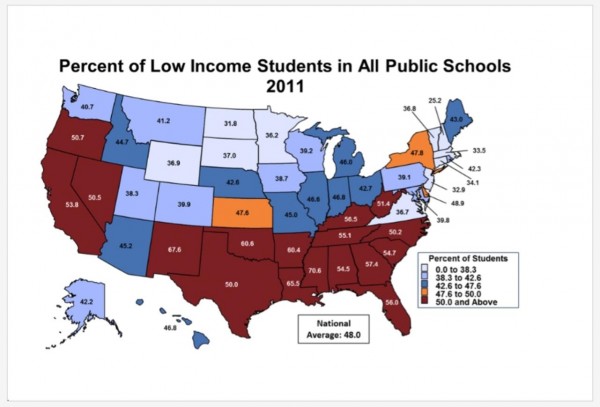
As states coast-to-coast reach that new imbalance – particularly in the South and West – the Northeast, including Connecticut, continue to have the smallest percentages of low income students in their public schools, according to the most recent data used in the study, from 2011. The states with majority-poor school systems include almost the entire South, as well as Oregon, Nevada, and California.

The study pointed out that “from 2001 through 2011, the numbers of low income students in the nation’s public schools grew by 32 percent – an increase of more than 5.7 million children. As a result, low income students attending the nation’s percent low income in schoolspublic schools moved from 38 percent of all students in 2001 to 48 percent in 2011.”

In Connecticut, the percentage of low income students in public schools was only 34 percent, among the lowest percentages in the nation.  Only four states had a lower or equal percentage – New Hampshire (25%), North Dakota (32%), New Jersey (33%) and Massachusetts (34%).

The largest percentage of low income students were in Mississippi (71%), New Mexico (68%), Louisiana (66%), Oklahoma (60%), Arkansas (60%), Georgia (57%), Kentucky (57%), Florida (56%), Alabama (55%), Tennessee (55%), South Carolina (55%) and California (54%).

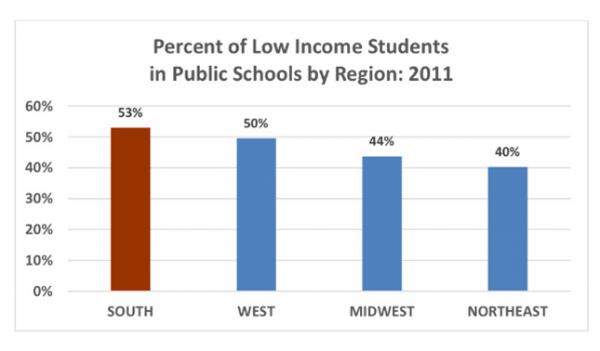
Overall, the rates of low income students in the public schools, by region, was 53 percent in the South, 50 percent in the West, 44 percent in the Midwekids at school-st and 40 percent in the Northeast.  The national average was 48 percent. As the report pointed out, “in 2011 the nation stood within only two percentage points of enrolling a majority of low income students in public schools across 50 states.”

The study  also compared the rates of low income students in cities, suburbs and rural areas in each state.  In each of the nation’s four regions, a majority of students attending public schools in the cities were eligible for free or reduced lunch.

The Northeast had the highest rates for low income school children in cities: 71 percent. The next highest rate, 62 percent, was found in Midwestern cities. The South had the third highest percentage of low income students in the cities – 59 percent.  In Connecticut, 62 percent of students in the cities were low income students, compared with 26 percent in the suburbs and 13 percent in rural areas.

“Low income students are concentrated in the nation’s cities but are by no measure confined to only cities,” the study noted.  “Forty percent or more of all public school children in the nation’s suburbs, towns and rural areas are low income students.”

by region The report, released in October 2013,  indicated that low income students “generally are more likely to score lowest on school tests, fall behind in school, fail to graduate, and never receive a college degree,” and yet “the growth in the number of low income students far out-stripped the growth in per pupil spending in public schools during the last decade in every region of the country, except the Northeast.”  The nations per pupil expenditure (adjusted for inflation) in public schools increased by only 14 percent – less than half the rate of growth in the numbers of low income students,” according to the report.

The study concludes by stating that “The trends of the last decade strongly suggest that little or nothing will change for the better if schools and communities continue to postpone addressing the primary question of education in America today: what does it take and what will be done to provide low income students with a good chance to suc556419_282077021867473_1934636139_nceed in public schools? It is a question of how, not where, to improve the education of a new majority of students.”


The Southern Education Foundation’s mission is to advance equity and excellence in education for low income students and students of color.  The Foundation’s “core belief is that education is the vehicle by which all students get fair chances to develop their talents and contribute to the common good.”