Spring Flu Hits Connecticut and Northeast Harder than Rest of USA

Not only does winter refuse to quit in Connecticut, the flu season is also slow to recede, with a second wave hitting the region this month.  According to data monitored by the state Department of Public Health, Connecticut is one of only a handful of states where flu cases have remained widespread well into April.

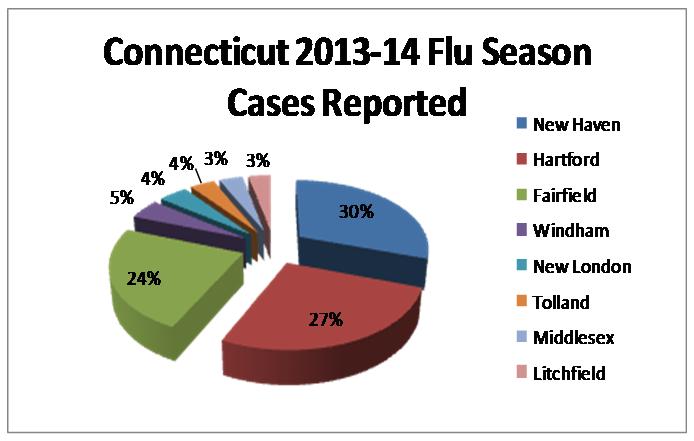
Overall, more than 5,000 cases of various strains of flu have been reported in Connecticut since the start of flu season last fall, with the largest number coming in New Haven County, followed by Hartford and Fairfield Counties.

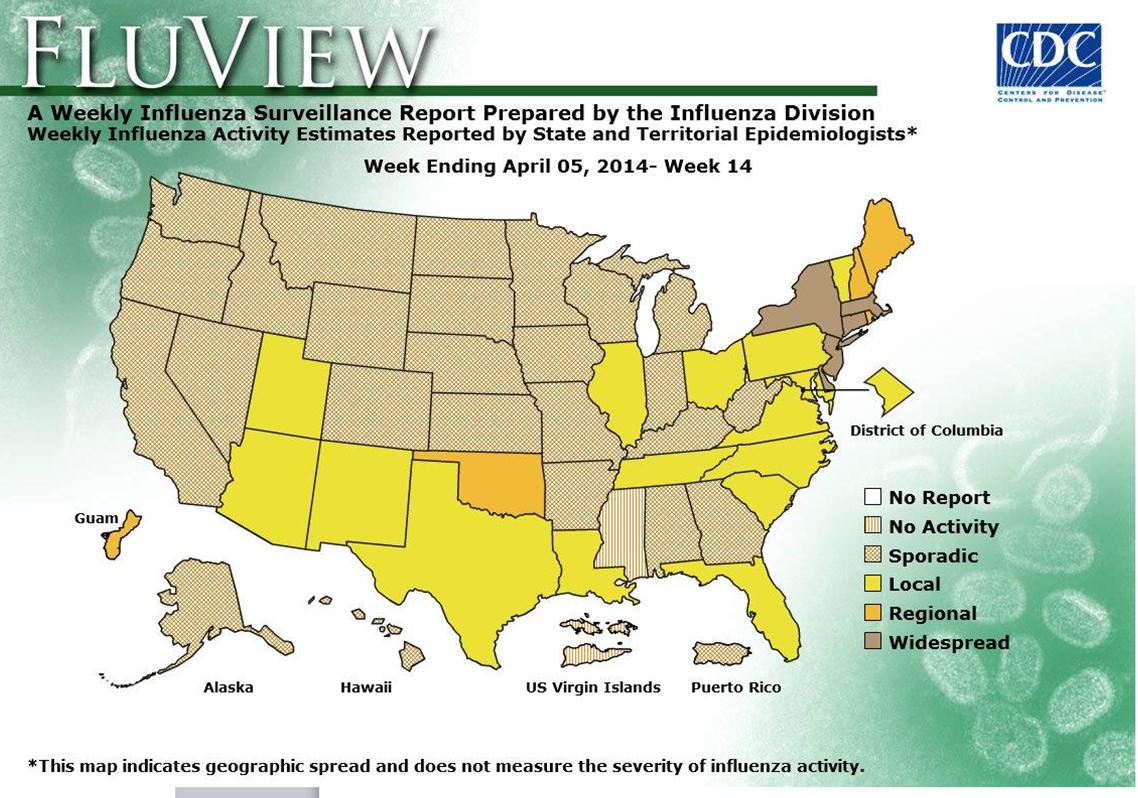
The latest “Flu View” map from the national Centers for Disease Control and Prevention (CDC) indicate while flu season appears to have ended across most of the nation, Connecticut is one of less than a half-dozen states that continue to have “widespread” influenza activity.
flu CTConnecticut is joined by regional neighbors New York, Massachusetts, New Jersey and Delaware in the recent spike in flu cases.  New York has recently been reporting its highest volumes of the entire flu season.  The states of Maine, New Hampshire, Rhode Island and Oklahoma have the next highest level of flu cases, according to the CDC data.

The most recent data, for the week ending April 5, indicates that statewide emergency department visits attributed to the “fever/flu syndrome” have recently increased in Connecticut and continue at a level near or above 5 percent statewide during the last 16 weeks.  The CDC reports that the region including Connecticut, Maine, Massachusetts, New Hampshire Vermont and Rhode Island is one of only two in the nation with “elevated” out-patient flu levels as of early April; the other region with elevated levels includes New York and New Jersey.  The rest of the nation is characterized as being at “normal” levels of flu incidence.
flu view

A total of 5,162 positive influenza reports have been reported for the current season, which is due to conclude, for data collection purposes, next month.  The initial peak in January brought record emergency volumes to some facilities, including Hartford Hospital.  This year’s second wave, is occurring later than a year ago, into April.  Last year's second wave occurred in March.

Influenza has been reported in all eight Connecticut counties since the start of flu season: New Haven (1,559 reports), Hartford (1,384), Fairfield (1,221), Windham (242), New London (220), Tolland (186), Middlesex (179), and Litchfield (171).

This month, Connecticut influenza activity continues to be classified geographically as “widespread” according to the state Department of Health, and many regions in the state are experiencing a second wave of flu activity, led by the influenza B strain, often referred to as “spring flu.”

In Connecticut, the Department of Public Health (DPH) uses multiple systems to monitor circulating influenza viruses. During the influenza season, weekly flu updates are posted from October of the current year, through May of the following year.

Last winter’s flu season brought 57 flu-related deaths to Connecticut, all were among patients at least 55 years of age including 48 (84%) who were greater than 65 years old. The year-long stats, reflecting August 2012 – August 2013, reflected flu instances from residents of all eight Connecticut counties and included: 4,177 from Fairfield County, 2,789 from New Haven County, 1,915 from Hartford County, 672 in Windham, 638 New London, 613 Middlesex, 388 Litchfield, and 319 from Tolland County.  Last year’s total was 11,511 confirmed flu cases, with the number of cases peaking twice, in the week ending Jan. 12, predominantly Type A flu, and the week ending March 23, predominantly Type B.

All data for the current flu season are considered preliminary and are updated with available information each week starting in October and ending in May; a final report will be available from DPH before the start of the next season.

 

Signatures Sought: Libraries Make A Stand At State Capitol

The Connecticut Library Association, working in conjunction with the Connecticut State Library and the Connecticut Library Consortium, will mark National Library Week at the State Capitol on Wednesday, April 16.  They will be “bringing the Declaration for the Right to Libraries to life by visually illustrating its ten principles” – and looking for indiviuals to sign the declaration, which is part of a year-long initiative of the American Library Association.

The effort in Connecticut is aimed at legislators, other elected officials, and visitors who walk the Capitol’s concourse – offering displays of “powerful, living examples of the work that is currently taking place declaration-402x600in Connecticut libraries and why it is so important that they continue to support our institutions,” officials said.
The Declaration states that “In the spirit of the United States Declaration of Independence and the Universal Declaration of Human Rights, we believe that libraries are essential to a democratic society.”

The ten principles include:

  1. Libraries Empower the Individual -  Whether developing skills to succeed in school, looking for a job, exploring possible careers, having a baby, or planning retirement, people of all ages turn to libraries for instruction, support, and access to computers and other resources to help them lead better lives.
  2. Libraries Support Literacy and Lifelong Learning - Many children and adults learn to read at their school and public libraries via story times, research projects, summer reading, tutoring and other opportunities. Others come to the library to learn the technology and information skills that help them answer their questions, discover new interests, and share their ideas with others.
  3. Libraries Strengthen Families -  Families find a comfortable, welcoming space and a wealth of resources to help them learn, grow and play together.
  4. Libraries are the Great Equalizer - Libraries serve people of every age, education level, income level, ethnicity and physical ability. For many people, libraries provide resources that they could not otherwise afford – resources they need to live, learn, work and govern.
  5. Libraries Build Communities - Libraries bring people together, both in person and online, to have conversations and to learn from and help each other. Libraries provide support for seniors, immigrants and others with special needs.
  6. Libraries Protect Our Right to Know -  Our right to read, seek information, and speak freely must not be taken for granted. Libraries and librarians actively defend this most basic freedom as guaranteed by the First Amendment.
  7. Libraries Strengthen Our Nation - The economic health and successful governance of our nation depend on people who are literate and informed. School, public, academic, and special libraries support this basic right.
  8. Libraries Advance Research and Scholarship -  Knowledge grows from knowledge. Whether doing a school assignment, seeking a cure for cancer, pursuing an academic degree, or developing a more fuel efficient engine, scholars and researchers of all ages depend on the knowledge and expertise that libraries and librarians offer.
  9. Libraries Help Us to Better Understand Each Other -   People from all walks of life come together at libraries to discuss issues of common concern. Libraries provide programs, collections, and meeting spaces to help us share and learn from our differences.
  10. Libraries Preserve Our Nation’s Cultural Heritage - The past is key to our future.  Libraries collect, digitize, and preserve original and unique historical documents that help us to better understand our past, present and future.connecticut.library.association

Based in Middletown, the Connecticut Library Association is Connecticut's 1,000 member strong professional organization of librarians, library staff, friends, and trustees working together to improve library service, advance the interests of librarians, library staff, and librarianship, and increase public awareness of libraries and library services.

There are 165 “principal” public libraries in Connecticut’s 169 towns (four towns are served by libraries in neighboring towns), as well as 27 additional libraries and 47 branch libraries in communities across the state.  A list of public libraries in Connecticut is available at http://www.ctstatelibrary.org/dld/files/community/connecticut-public-librar

Ollie is Latest to See Take-Home Pay Jump at UConn

In the aftermath of UConn’s national championship, coach Kevin Ollie’s “relatively low” salary compared to his peers, became the focus of some media attention.   It’s not the first time in the current fiscal year that salaries at UConn were in the spotlight, and Ollie is only the latest top UConn official to see his take home pay bumped during the year.

Just four monthsBulldogLogo_wht ago, hundreds of top officials and administrators at the University of Connecticut received raises, with many of the annual  increases topping $10,000.  Warde Manuel, the university's athletic director, saw his salary jump by $22,500, which brought his annual pay to $472,500.

Amidst tuition increases, programmatic cutbacks and concern over budgetary shortfalls, a total of 24 senior officials and administrators received raises in excess of $10,000, according to data provided by the university.  That included 12 individuals whose raises topped $12,000 annually.

In addition, another 13 individuals received salary increases of between $8,000 and $10,000, bringing the total to 37 individuals who received salary increases of more than $8,000.

In addition to Manuel, among those receiving the top raises, and their new annual salaries - all exceeding $200,000 - were:

2.  Provost & Executive Vice President Mun Choi ($18,500 to $388,500)

3.  Business School Dean John Elliott ($17,550 to $407,550)

4.  Executive Vice President Richard Gray ($13,124 to $275,599)

5.  Engineering School Dean Kazem Kazerqunian ($13,000 to $276,100)

6.  Education School Dean Thomas DeFranco ($12,882 to $272,852)

7.  Agriculture & Natural Resources College Dean Gregory Weidemann ($12,861 to $270, 087)

8.  Vice President for Enrollment Management Wayne Locust ($12,750 to $276,750)

9.  Interim Vice Provost for Academic Administration Sally Reis  ($12,500 to $264,825)

10. Vice Provost/Vice President Nancy Bull ($12,313 to $260,113)

11.  Associate Liberal Arts Dean Dipak Dey ($12,000 to $255,100)

12.  Fine Arts School Dean Brid Grant ($12,000 to $252,000)

 (See the full list of the raises, reported by CT Mirror.)

Last month, it was announced that UConn will pay its budget chief, Richard Gray, $138,000 in severance when he steps down from the post on April 30.  His separation agreement provides him with six months' regular pay after he leaves -- a payment the university was not required to provide for him to retire, CT Mirror reported.

That same day, UConn Vice President for Economic Development Mary Holz-Claus will step down from that post (and a $241,500 salary) after three years, moving over to become assistant dean in the school’s College of Agriculture and Natural Resources, Hartford Business Journal reported.

Kazem Kazerounian was named Dean of the School of Engineering following a nationwide search in January. He had been interim Dean since June 2012.  Tyson Kendig, hired as UConn’s Vice President of Communications in December 2012 at a salary of $227,500 which generated some controversy, saw his salary grow by $11,375 a year later to $238,875.

Nearly a year ago, the University of Minnesota announced that Lisa Lewis would be president and chief executive officer of the school’s alumni association – a post Lewis had held at UConn.  Last month, UConn announced that Montique Cotton Kelly, after nearly two decades at Bowling Green State University, would be joining UConn in June as assistant vice president of alumni relations and executive director of the UConn Alumni Association.  Her salary was not announced.

As for Ollie, Forbes magazine has reported that he has a base salary of $400,000, plus additional income from Nike, PR, consulting and media payments that were worth a combined $800,000 in the 2013 calendar year. He added $167,000 in performance bonuses from the tournament run, bringing his total pay for the season to just under $1.4 million before counting potential academic performance bonuses.  The magazine noted that top coaches like Michigan State’s Tom Izzo, Florida’s Billy Donovan and Kentucky’s John Calipari, all take home more than $4 million per year.

CT by the Numbers previously reported that according to data compiled by the website Deadspin, the ranks of the highest-paid active public employees in states across the country include 27 football coaches, 13 basketball coaches, one hockey coach, and  10 state employees with responsibilities outside of athletics.  That’s 80 percent of the states with a public employee salary roster led by a coach.

A spokeswoman for UConn told CT Mirror in December that the raises –- which costUConn $1.3 million this fiscal year -– did not need to be approved by the Board of Trustees, because money for the raises was included in the omnibus budget the board approved last summer.  The raises ranged from a top rate of 5 percent — which 12 of the 24 received — down to 4.1 percent, the Hartford Courant reported. Ollie’s performance bonuses, outlined in his contract, also do not need Board approval.

IRS Expects 147,000 Connecticut Residents to Seek Tax-Filing Extension

Running late? The Internal Revenue Service is reminding taxpayers that “quick and easy solutions” are available if they can’t file their returns or pay their taxes on time, and they can even request payment options online. The filing deadline is Tuesday, April 15 – but the IRS expects nearly 147,000 Connecticut taxpayers will file for an extension, which are are available to taxpayers who need more time to finish their returns.

Critical fact: this is an extension of time to file; not an extension of time to pay. However, taxpayers who are having trouble paying what they owe may qualify for payment plans or other options. [There is more information on the Iincome-tax-deductions-itemize-3RS website.]

Taxpayers will avoid penalties if they file either a regular income tax return or a request for a tax-filing extension by this year’s April 15 deadline. It is recommended that taxpayers file a return even if they can’t pay the full amount due.  Nationwide, the Internal Revenue Service expects to receive more than 12 million extension forms this tax season.

You may recall that in some years past, Connecticut residents have received a one-day reprieve when the tax filing deadline coincided with Patriots Day in Massachusetts, where Connecticut returns were sent for many years.  Not so this year.  Patriots Day is not until Monday, April 21.

As for Connecticut income taxes, the state Department of Revenue Services indicates that  Form CT-1040 EXT should be used to request a six-month extension to file the Connecticut income tax return for individuals. It is not necessary to include a reason for the Connecticut extension request if you have already filed an extension request on federal Form 4868 with the Internal Revenue Service, according to the DRS website. The form can be filed electronically or on paper.

Submitting the automatic tax-filing extension for the IRS on Form 4868 gives taxpayers until Oct. 15 to file a return. To get the extension, taxpayers must estimate their tax liability on this form and should also pay any amount due, according to the IRS.

This will permit taxpayers to avoid the late-filing penalty, normally five percent per month based on the unpaid balance that applies to returns filed after the deadline. In addition, any payment made with an extension request will reduce or eliminate interest and late-payment penalties that apply to payments made after April 15.

Soda Tax Won't Hurt Job Prospects, Study Finds

As the Connecticut legislature considers a proposal to implement a 2 percent tax on sodas, proposed by Senate Majority Leader Martin Looney at the suggestion of New Haven Mayor and former state senator Toni Harp, two new academic studies challenge the beverage industry’s view that state and local taxes on sugary drinks will hurt employment, and offer suggestions to policy makers based on the tobacco tax experience. Harp has said the soda tax would discourage consumption of the sugary beverages – part of her campaign to combat obesity – and bring in public health logoan estimated $144 million in revenue for the state each year. It would tax all beverages “high in calories or sugar” by two percent, but does not specify how many calories or grams of sugar would trigger the tax.

The studies, appearing in the February and March issues of the American Journal of Public Health, argue, in one case, that claims of employment losses are off base because they focus only on the effects within the industry, ignoring the economic activity that comes with people substituting lower-priced goods for more expensive products as wellsoda as new spending from tax revenues.  The other study says that tobacco taxes offer a how-to road map for policy makers.

The study to be published in March, led by Jennifer L. Pomeranz, JD, MPH, while at the Yale Rudd Center for Food Policy and Obesity at Yale University, uses as its premise that “excise taxes on sugary beverages have been proposed as a method to replicate the public health success of tobacco control and to generate revenue.”

“Sugary Beverage Tax Policy: Lessons Learned from Tobacco”  indicates that “as policymakers increase efforts to pass sugary beverage taxes, they can anticipate that manufacturers will emulate the strategies employed by tobacco companies in their attempts to counteract the impact of such taxes.”  Pomeranz suggests that “policymakers should therefore consider two complementary laws—minimum price laws and prohibitions on coupons and discounting—to accomplish the intended price increase.”

Researchers at the University of Illinois, in a just-published study in the February issue of American Journal of Public Health, found that a 20 percent increase on the price of sugar-sweetened beverages would have an overall positive impact on the labor market.

The American Beverage Association has traditionally argued that manufacturers, distributors and small business owners, particularly grocers and convenience store proprietors, would suffer were soda taxes to be imposed, but the study says that’s not likely.

In recent years, proposals to tax those beverages fell short in California, Vermont, Hawaii, Massachusetts, Mississippi, New York and Rhode Island, Governing magazine reported.  In Maine voters passed a soda tax of 42 cents per gallon in 2008 but repealed it two years later amid a major lobbying effort from the American Beverage Association. Voters in Washington state similarly reversed their legislature in 2010.  As of the end of state legislative sessions in 2011, Governing reported, only four states had taxes specifically targeting sugary beverages, including Arkansas, Tennessee, Virginia, and West Virginia, according to the Tax Foundation.

In the study publstrawished this month, researchers ran a simulation of the impact of 20-percent soda tax in Illinois and California—selected for regional differences—and found slight employment increases would occur, but the net effect would be close to nothing. They found that people choose to spend their money on other things, not to forego spending entirely, and that employment gains in other sectors of the economy far outweigh the job losses for soda makers, National Journal reported.

“We find there are losses in the beverage industry, but when you’re talking about the whole economy suffering job losses, you can’t just talk about your own industry,” Lisa Powell, health policy professor at the University of Illinois at Chicago and the study’s lead author, told National Journal. “Using job loss as a scare tactic for the economy overall is misleading.”

Public health advocates have warned of a link between added sugar and illnesses ranging  from Type 2 diabetes and obesity to heart disease and osteoporosis. The caloric intake of sugary beverages increased dramatically from 1988 to the mid 2000s, though consumption has dropped across all age groups in recent years, Governing reported, with some citing the increased public attraction to teas and other beverages.  Like Harp and Looney in Connecticut, some elected officials around the country have proposed raising taxes on sugary drinks in order to reduce consumption.  The New Haven Register reported that Harp has pointed out that revenue from the cigarette tax has decreased, showing that the effectiveness of a tax in reducing consumption.Jennifer-Pomeranz

Pomeranz is a public health law and policy researcher focusing on marketing, labeling and youth access issues related to food and beverages, over-the-counter diet drugs, and dietary supplements, publishing on topics including discrimination, the First Amendment, public health preemption, and innovative regulatory strategies to address public health problems such as obesity. She is Assistant Professor at the Center for Obesity Research and Education in the Department of Public Health and at the College of Health Professionals and Social Work at Temple University, having served previously as Director of Legal Initiatives at the Yale Rudd Center for Food Policy & Obesity.  She is currently the Policy Chair of the Health Law Section of the American Public Health Association and the official liaison between the American Academy of Pediatrics and the American Public Health Association.lisa powell 2

Lisa Powell is a Senior Research Scientist in the Institute for Health Research and Policy and Research Professor in the Department of Economics at the University of Illinois at Chicago. She has extensive experience as an applied micro-economist in the empirical analysis of the effects of public policy on a series of behavioral outcomes.

A 2011 study by the Yale Rudd Center for Food Policy & Obesity found that young people are being exposed to a massive amount of marketing for sugary drinks, such as full-calorie soda, sports drinks, energy drinks, and fruit drinks.  The study, described as the most comprehensive and science-based assessment of sugary drink nutrition and marketing ever conducted, found that companies were marketing sugary drinks targeting young people, especially black and Hispanic youth.

This story was reported by CT by the Numbers on February 16, 2014

Pilot Project Boosts Voter Engagement in Latino Community

It turns out, all that was necessary to improve voter engagement and turnout was asking – and repeated, substantive, and informative reminders.  The results of a pilot study in Hartford’s Latino community may provide critical insight into how to improve voting levels in the state’s ethnic or urban communities, as the next election season beckons.

In 2012-13, the Hartford Votes~Hartford Vota Coalition conducted a Latino Voter Engagement Initiative with the support of a grant obtained by Hartford Public Library, a founding member of the Coalition.  The goal of the initiative was to increase historically low voter engagement in Hartford’s Latino community.  It did.

The initiative includevoted traditional voter registration activities, but because voter registration by itself tends not to result in higher voter engagement, additional activities were also included in the initiative.  Among them:  candidate forums, public programs on relevant topics, production and distribution of publications such as voter guides, canvassing portions of Hartford neighborhoods, conducting a reminder to vote campaign, and civics classes in Hartford high schools.
In addition, a number of meetings were held with leaders and others from Hartford’s Latino community.  None of the conversations or interactions were partisan.  They focused exclusively on the electoral process, the importance of exercising the right to vote, and providing basic information about public issues.  The results of the initiative were impressive:

  • Voter Registration:  392 Hartford Latinos were registered to vote.
  • Voter Information: 174 Hartford Latinos attended three candidate forums and two public programs.  Three publications were produced (Hartford Voters Guide, Citizens Guide, and Guide to the Hartford Board of Education) in English and Spanish and over 4,000 copies were distributed.
  • Voter Education: 124 Hartford Latinos participated in the neighborhood canvass; 172 Hartford Latino high school students attended civics classes.

According to a sample survey conducted at the end of the project, 44 percent of Hartford Latinos with whom program organizers interacted reported an increase in their voter engagement.  For example, they registered to vote, they voted, or they attended a candidate forum or public program related to major public issues during the project period.

Project organizers concluded that “we identified and demonstrated a successful strategy that can help address the very complex problem of low voter engagement (among Latinos 1_Percentage_Increaseand others):  people vote and get involved in greater numbers when they are encouraged to do so through face-to-face contact, and multiple contacts are more effective than single contacts.”

The neighborhood canvass produced especially notable results:

  • 54 percent of Latinos who were inactive voters (i.e., they had never voted before or were registered but had not voted in the 2008 and/or the 2010 elections) who participated in the neighborhood canvass reported that they voted in 2012 as a result of the interaction.
  • 64 percent of all Latinos who participated in the neighborhood canvass reported that they voted in 2012 as a result of the interaction.
  • Those who were spoken with twice voted at a rate 21 percent higher than those that only had one interaction
  • 2012 voter turnout among all people included in the neighborhood canvass was 9.1 percent higher than overall turnout in voting districts in which an informational canvass was conducted, and 6.7 percent higher than turnout citywide.

 In addition, thirteen high school civics classes were conducted in four different Hartford schools in May and June 2013, which were attended by 172 Latino students. According to evaluation forms completed by most of the students, 91 percent said the class helped them understand more about civics and 82 percent said they were more likely to vote or take action in their community as a result of having taken the class.  Comments ranged from “I made my voice heard through my vote” to “I didn’t do it for politics but because people motivated me.”

 The Hartford experience has been corroborated by similar research in Detroit and Arizona, according to project organizers.  The Coalition’s goal in 2014 is to secure resources that will enable it to ramp up the successful strategies identified through the pilot project and as a result have greater impact.

“Through these strategies,” they suggest, “we can play a significant role in reducing the effects of low voter engagement, which is a major threat to our democracy.”

Kevin Ollie Made Believers of the Uncertain at UConn

In September 2012, the Kevin Ollie era at UConn began – with a short leash.  As Hall of Fame veteran  coach Jim Calhoun retired, Ollie – a former UConn and NBA player – was hired on a one-year trial basis.  The rest, as they say, is history.

But when it began, the view was far from unanimous that UConn had made the right choice.  The sports blog SB Nation posted a day one poll, and 30 percent of the respondents expressed the view that his selection was either a mistake, or that a national search for a new coach should still be pursued.  And NBC Sports website said this:  “Asking Ollie to win at the same level as Calhoun is incredibBulldogLogo_whtly unfair.”

Some criticized UConn Athletic Director Warde Manuel for putting Ollie in a tough position – especially in recruiting - uncertain if he’d be coaching for more than a single season.  Manuel, in November 2012, told the New York Times: “I understand the angst that a recruit would have. What I’ve said to them is we’re going to make a decision for UConn that we believe and I believe keeps us winning Big East championships and competing for national championships.”

Two months later, in December 2012, Ollie was given a new contract that runs through the end of the 2017-18 season.  The deal, the Associatepolld Press reported at the time, is worth just under $7 million and began on Jan. 1, 2013.  Ollie, who played point guard for Calhoun from 1991-95, was his former coach's hand-picked successor, the AP reported. He had become an assistant coach at UConn in 2010, after 13 years playing for 11 different teams in the NBA.

That season – one in which UConn was banned from NCAA tournament play due to poor academic performance in previous seasons – some player-athletes departed the scene.  It’s doubtful that Jeremy Lamb and Andre Drummond, who entered the NBA draft, or Alex Oriachi, Michael Bradley and Roscoe Smith, who transferred, thought they were walking away from a National Championship team.

The tenacious and confident Ollie, 52-18 as UConn’s head coach over the past 18 months, said simply after winning the 2014 NCAA Championship game, “we did it the right way.”

conn-14-mbb-champions-logo

Connecticut Ranks #48 in Federal Income Tax Refunds

Connecticut ranks #48 in the nation in income tax refunds its residents receive from the federal government.  Just over 11 percent of the taxes paid by state residents to the federal government are refunded to them, a percentage that is better than only the states of Delaware and Minnesota, and the District of Columbia.

By comparison, Mississippi residents receive more than three tbiggest tax refundsimes that percentage.  One third of the taxes paid by Mississippi residents – 34.84 percent – come back in refunds.  West Virginia residents receive 30 percent of the taxes they paid, South Carolina 26.27 percent and Alabama 26 percent.  Bloomberg.com reviewed Internal Revenue Service (IRS) data and ranked the 50 states and the District of Columbia based on the percentage of gross individual income taxes withheld or paid that were returned as refunds the following year.

Figures are for a five-year period: fiscal years 2007 through 2011 for tax collections and fiscal years 2008 through 2012 for refunds. For both collections and refunds, data include individual income tax withheld, individual income tax payments, FICA taxes, SECA taxes, unemployment insurance taxes, railroad retirement taxes and estate and trust income taxes. Refunds include interest.Tax-Refund

Connecticut’s gross total individual federal income tax collected between 2007 to 2011 was $206.31 million.  Total individual income tax refunded from the federal government between 2008 to 2012 was $23.56 million.  Joining Connecticut among the states with the lowest percentage refunded, in addition to Minnesota and Delaware, are Massachusetts, New Jersey, Ohio, New York and Nebraska. 


Connecticut Ranks Third Among Least Tax-Friendly for Retirees

“The Constitution State is a tax nightmare for many retirees.” That is the thumbnail summary for Connecticut, which ranked third among the 10 Least Tax-Friendly States for Retirees, according to a list compiled by the business and personal finance publication Kiplinger’s.

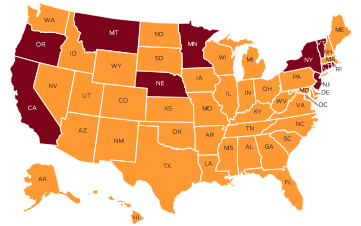
Worst in the nation, according to the list, is Rhode Island, followed by Vermont, Connecticut, Minnesota and Montana.  The publication used data from state tax departments, Commerce Clearing House and the Tax Foundation to develop the rankings. “Some states offer attractive tax benefits to woo retirees,” the publication indicated. “Then there are these ten states that are stingy with retirement tax breaks.”

Kiplinger’s pointed out that “Conneticut’s “real estate taxes are the second-highest in the nation, according to the Tax Foundation.”  Rhode Island was described as “particularly tough on retirees,” and retirees in Vermont should “prepare to pay lofty taxes,” according to Kiplinger.

  1. Rhode Islandtax friendly map
  2. Vermont
  3. Connecticut
  4. Minnesota
  5. Montana
  6. Oregon
  7. Nebraska
  8. California
  9. New Jersey
  10. New York

“When you're living on a fixed income, every penny counts, which makes these states particularly unwelcoming for retirees,” the publication noted.  Most of the states tax at least a portion of Social Security benefits. Some also have higher-than-average income taxes. Others make up for low income and sales taxes with high property taxes. The survey also considered  estate and  inheritance taxes.

The tax friendliest state for retirees is Alaska, which has no income tax, no sales tax and no inheritance tax. Alaska is followed by Wyoming, Georgia and Arizona.

Connecticut’s high cost of living —  more than 30% higher than the national average, according to Sperling’s Best Places.  However, “high prices and taxes don’t deter retirees who like the scenery and who want to stay close to children, grandchildren and lifelong friends in the nearby metropolitan areas,” according to MarketWatch, a service of the Wall Street Journal, published this week.  The data compiled by Kiplinger’s Senior Associate Editor was first reported last summer.

Kiplinger is a Washington, D.C.-based publisher of business forecasts and personal finance advice, available in print, online, audio, video and software products.  The company’s best-known publications are The Kiplinger Letter, a weekly business and economic forecasting periodical for people in management, and the monthly Kiplinger's Personal Finance magazine.