Yale University Breaks into Top 10 in World University Rankings

Yale University edged into the top 10 in the annual World University Rankings for the first time, ranking tied for 9th place on the 2014-2015 list with Imperial College in London.  For the three previous years, Yale was ranked #11. Leading the new list were California Institute of Technology, Harvard University, University of Oxford, Stanford University and University of Cambridge.  The next five are Massachusetts Institute of Technology, Princeton University, and University of California - Berkley, just ahead of Yale and Imperial College.  The University of Chicago slipped from 9th to 11th in the rankings.24677_wur-2014-2015-news

Eight of the top 10 universities are in the United States, the other two in the United Kingdom.

From other nations, the top finishers were Swiss Federal Institute of Technology at #13, University of Toronto at #20, University of Tokyo at #23, Ludwig-Maximilins-Universitat (Germany) at #29, and University of Melbourne at #33.

The Times Higher Education World University Rankings 2014-2015, powered by Thomson Reuters, are the only global university performance tables to judge world-class universities across all of their core missions - teaching, research, knowledge transfer and international outlook.

The top universities rankings employ 13 performance indicators to provide “the most comprehensive and balanced comparisons available,” which are “trusted by students, academics, university leaders, industry and governments,” the organization’s website points out.  Institutions provide and sign off on their institutional data for use in the rankings.Yale ranking

The 13 performance indicators are grouped into five areas:

  • Teaching: the learning environment (worth 30 per cent of the overall ranking score)
  • Research: volume, income and reputation (worth 30 per cent)
  • Citations: research influence (worth 30 per cent)
  • Industry income: innovation (worth 2.5 per cent)
  • International outlook: staff, students and research (worth 7.5 per cent).

The U.S. has 74 universities in the top 200, down from 77 last year. Some 60 per cent of those institutions rank lower than they did 12 months ago, with an average fall of 5.34 places per university, according to Times Higher Education. Canada and the United Kingdom also slipped slightly in the overall rankings, while Asian universities trended higher, with 24 universities in the world top 200, four more than last year.

When the top world universities are broken down by academic disciplines, Yale ranks #7 in arts and humanities, #7 in life sciences, #7 in social sciences, #10 in clinical, pre-clinical and health, and #13 in physical sciences.  Yale finishes outside of the top 100 in engineering & technology.

Times Higher Education, which produces the rankings, is based in the United Kingdom.

THE  Watch the video presenting top 10.


For 3rd Consecutive Year, Connecticut Resident Is Named White House Fellow

Lindsay Rodman, a Captain in the United States Marine Corps,  judge advocate, and foreign area officer (Latin America) from Kent, Connecticut, has been named as one of 15 White House Fellows for 2014-15. She is the only Connecticut resident named to the prestigious fellowship for the coming year, and the third state resident in the past three years.  The Fellows come from diverse backgrounds, varied professions, and have demonstrated a strong commitment to public service and leadership.1373887640000-IMG-3564-1307150728_4_3

Rodman most recently served as Deputy Legal Counsel in the Office of the Legal Counsel to the Chairman of the Joint Chiefs of Staff, where her portfolio included military justice, space law and human rights law issues. Her placement during her service as a White House Fellow will be with the National Security Council.

Before moving to the Joint Staff, Lindsay was assigned to Judge Advocate Division, Headquarters Marine Corps. From 2010-2011, she was deployed to Afghanistan as an operational law attorney. She previously served as a defense counsel and legal assistance attorney in Okinawa, Japan.

Founded in 1964, the President’s Commission on White House Fellowships is one of America’s most prestigious programs for leadership and public service. White House Fellowships offer exceptional young men and women first-hand experience working at the highest levels of the Federal government.

Selected individuals typically spend a year working as a full-time, paid Fellow to senior White House Staff, Cabinet Secretaries and other top-ranking government officials. Fellows also participate in an education program consisting of roundtable discussions with renowned leaders from the private and public sectors, and trips to study U.S. policy in action both domestically and internationally. Fellowships are awarded on a strictly non-partisan basis.white house fellows

Prior to joining the Marine Corps, Rodman worked as an associate at Arnold & Porter LLP in Washington, DC. In early 2014 she was selected as a Center for New American Security Next Generation National Security Leader. She has been a member of the Warlord Loop, and a term member at the Council on Foreign Relations.

Rodman graduated in 2003 from Duke University with an A.B. in Mathematics and in 2007 from Harvard Law School with a J.D. and the Kennedy School of Government with a Masters in Public Policy.  She has volunteered at the DC Rape Crisis Center, and authored an article on sexual assault in the military that was published in 2013 by the Wall Street Journal.

The class of White House Fellows for 2014-15 includes individuals from New York, San Diego, San Francisco, Woodside (CA), Naperville (IL), Miami, Norfolk (VA), Midland (MI), Missoula (MT), Los Angeles, Voorhees (NJ), Penn Valley (PA), McAllen (TX), and Irvine (CA).

It is the third consecutive year that Connecticut has had a resident appointed as a White House Fellow.  Last year, Justin Finnegan of Darien was selected, following Anne O’Connell of West Haven the preceding year.

The first class of White House Fellows, in 1965, included William R. Cotter, later elected to Congress representing Connecticut’s First District.  He was joined in that class by Robert E. Patricelli, who would go on to become one of Connecticut’s prominent health care entrepreneurs and business leaders.  The Patricelli Center for Social Entrepreneurship at Wesleyan University bears his name.

More information on the White House Fellows program is available at whitehousefellows@whf.eop.gov 

See White House Fellow video. 


CT’s Regional Planning Agencies Consolidate, Realign and Disappear

As the Central Connecticut Regional Planning Agency (CCRPA) prepares to go out of existence, the newly formed Naugatuck Valley Council of Governments is advertising for an Executive Director.  It’s all part of a major shake-up of regional planning agencies in central Connecticut, prompted by the state legislature’s decision to reduce the number of regional planning agencies in the state from 15 to 9, as of January 1.  Among the by-products:  Bristol and New Britain are parting company. The realignment is breaking up long-term relationships going back decades, and forcing municipalities to decide on new partners.  Regional planning agencies deal with a range of issues, but generally focus on transportation, land use, brownfield cleanup and environmental projects. For communities between two large cities that serve as anchors of regional planning agencies, it often comes down to deciding it they’d like to align to the east or the west.

The Central Connecticut Regionnew map RPAsal Planning Agency (CCRPA), for example, has been the regional and metropolitan planning organization for the cities of Bristol and New Britain and the towns of Berlin, Burlington, Plainville, Plymouth, and Southington. For over 45 years, CCRPA has worked with government, business, and the public to develop a vision for the region and resolve its challenges.  It will cease to exist at the end of the year.

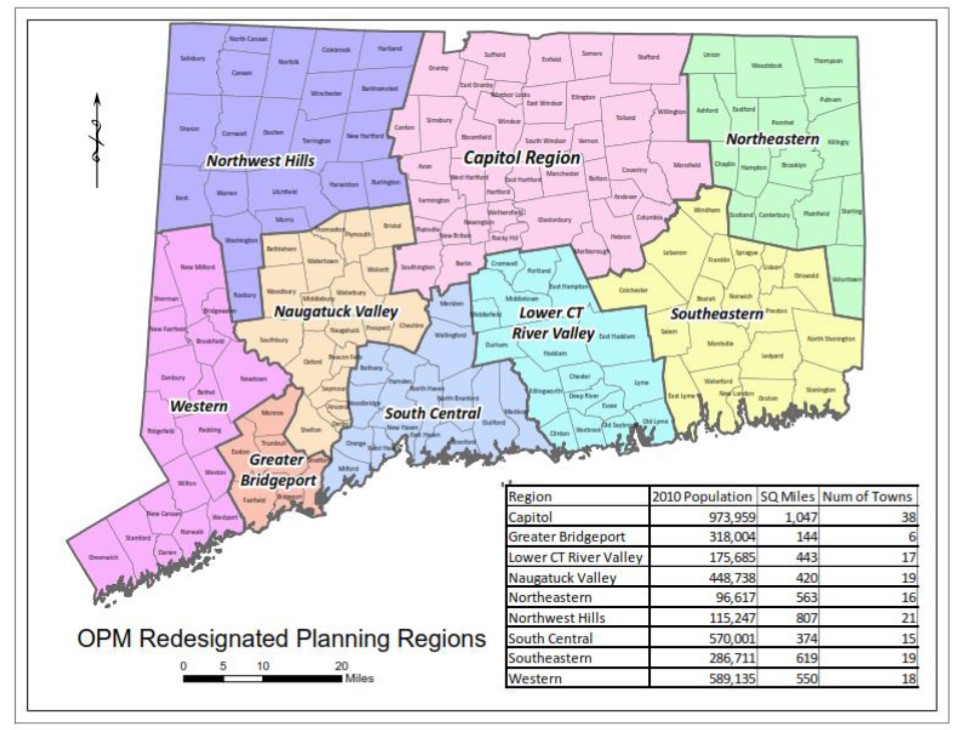
The newly formed Naugatuck Valley Council of Governments (NVCOG) will replace the Council of Governments of Central Naugatuck Valley and the Valley Council of Governments plus add two towns from the Central Connecticut Regional Planning Agency – Bristol and Plymouth.

The other CCRPA towns, including New Britain, are headed elsewhere. Most of the towns in the CCRPA have opted to join with Hartford area municipalities in the Capitol Region Council of Governments, but Bristol officials decided to join the Waterbury agency instead.  New Britain is one of eight municipalities to join CRCOG in recent months, as part of the CCRPA break-up.250px-CT_regions

CRCOG will have grown to 38 member municipalities, with a total population of just under one million, and 1,047 square miles, the largest of the state’s regional planning agencies.  Joining CRCOG since July 1 are Berlin, Columbia, Coventry, Mansfield, Plainville, Southington, Willington and New Britain.  The new Naugatuck Valley Council of Governments will represent 19 towns and cities with a population of 448,738, over 420 square miles.

Ed Edelson and Kurt Miller, the current chairmen of the two councils of governments that had been covering the Naugatuck Valley, which will be subsumed by the new Council, said recently that “although our two current organizations have done high-quality work over the past four decades, we recognize they each have had different strengths and areas of focus.”

Edelson, the Democrat first selectman of Southbury, and Miller, the Republican first selectman of Seymour, added “we believe this step to align the 19 cities and towns around the urban center of Waterbury provides the best opportunity for all of our communities to combine resources, and bring significant new investment and cost savings to each of our communities.”  NVCOG held its first organizational meeting in late summer, and launched their Executive Director search last week.new map

Bristol Mayor Ken Cockayne recently said he “looks forward to strengthening existing ties to neighbors and building new relationships and cooperation with communities that share many of Bristol’s priorities and challenges.”

They also said they “recognize the importance of our new region’s major cities — such as Waterbury, Bristol and Shelton — as the economic engines. Their economic and social future is critical to all of the surrounding towns. We are all dynamically linked.”

For those who may be interested in the Executive Director position, topping the list of characteristics for the “ideal candidate” – “honest, trustworthy, diplomatic and ethical.”  And leading the “opportunities and challenges” – managing the consolidation, “sensitive to the cultural differences” of bringing the 19 towns together as a new council of governments.

The next challenge for the state, according to Edelson and Miller, is the consolidation of the Metropolitan Planning Organizations (MPOs), which are the federal regions that plan transportation systems and jointly allocate federal funds for these projects with the Connecticut Department of Transportation. There currently are eight MPOs in Connecticut, and the aim is to have fewer MPOs with boundaries that coincide with the new councils of governments’ boundaries.

Number of CT Students Taking ACT Exam Jumps 15 Percent in 4 Years

The number of Connecticut high school students taking the ACT college readiness assessment exam as a means of demonstrating their academic ability to prospective colleges jumped 15 percent from 2010 to 2014, reflecting the increasing popularity of the test, the major national competitor to the Scholastic Aptitude Test, or SAT.  The average composite score of Connecticut students taking the exam ranked #2 in the nation, behind Massachusetts and just ahead of New Hampshire, Maine and New York. In 2010, there were 10,453 students who took the ACT exam in Connecticut.  By the graduating class of 2014, that number had increased to 12,044, reflecting a steady increase.  In 2011, 10,809 students took the ACT, followed in 2012 by 11, 192 students and 11.551 a year later. act_logo

The average score of state students has also climbed, from an average of 22.9 in 2010 to 23.6 in 2014.  The national average has remained steady, at 21.0.  The scores of Connecticut students rose in all four components:  from 23.8 to 24.2 in English, 23.5 to 24.1 in Math, 23.9 to 24.5 in Reading and 22.9 to 23.6 in Science.  All four exceed the national average among the class of 2014 taking the ACT.

Through the years, the ACT exam has traditionally been the college entrance exam of choice mainly by students in the western and mid-west states, while the SAT dominated in the east.  In recent years, that has begun to change, as colleges look to determine which exam, among other factors, are the most reliable predictors of academic performance in college.ACT exam

The percentage of graduates taking the SAT in Connecticut in 2014 was 29 percent.  In Massachusetts it was 23 percent, in New Hampshire 20 percent and in New York 27 percent.  In Maine, only 9 percent took the exam.  By contrast, 76 percent of the Class of 2014 in Minnesota took the exam, 73 percent in Wisconsin, and 86 percent in Nebraska.  A dozen states require students to take the exam.

The ACT and SAT have different areas of emphasis and approach.  ACT is an achievement test, measuring what a student has learned in school. The SAT is more of an aptitude test, testing reasoning and verbal abilities. According to the Princeton Review, among the differences between the tests include that ACT questions tend to be more straightforward, math concepts tested are more advanced, and it includes a science section.  The SAT has a stronger emphasis on vocabulary.

More than 1.84 million 2014 graduates—a record 57 percent of the national graduating class—took the ACT. This is a 3 percent increase from 2013 (despite a smaller total number of U.S. graduates nationally) and an 18 percent increase compared to 2010.

Connecticut students in the Class of 2014 taking the ACT exam exceeded the national average in the percentage of students ready for college-level coursework, according to the ACT criteria.  A benchmark score is the minimum score needed on an ACT subject-area test to indicate a 50% chance of obtaining a B or higher or about a 75% chance of obtaining a C or higher in the corresponding credit-bearing college course.

For Connecticut students taking the ACT, 86 percent surpassed the benchmark in English Composition, compared with 64 percent nationally.  In Math, 69 percent of Connecticut students and 43 percent of students nationally met the benchmark.  In Reading the breakdown was 65-44, in science, 59-37.

The ACT standards are designed to assess the types of skills needed for academic success. They serve as a direct link between what students have learned and what they are ready to do next, according to ACT.

Alternate College Ranking System Reveals Surprises for CT Colleges

It turns out that the oft-heralded and increasingly criticized U.S. News & World Report college rankings aren’t the only game in town.  Washington Monthly magazine has developed a rating system with a different emphasis, and very different results.  Among the Connecticut institutions making the list:  UConn, Yale, Wesleyan, and Trinity – but not necessarily in familiar places. The publication uses three main categories of evaluation for its analysis.  Social Mobility (recruiting and graduating low-income students), Research (producing cutting-edge scholarship and PhDs), and Service (encouraging students to give something back to their country). The publ1409.cover.220x286ication sets out to “identify the most public-minded institutions,” utilizing the three criteria and a handful of specific measures in each.

“Instead of crediting colleges that reject the most applicants, we recognize those that do the best job of enrolling and graduating low-income students,” the magazine pointed out.  The rankings also “measure both pure research spending and success in preparing undergraduates to earn PhDs.”  In addition, by “giving equal weight to public service, we identify colleges that build a sense of obligation to their communities and the nation at large,” the publication explained in the cover feature of the September/October issue.

Connecticut did not have an institution reaching the Top 30 National Universities.  That list was led by four University of California institutions in the top five slots, along with Texas A&M and Stanford University.  Harvard University placed tenth.

Yale University ranked #57 on the full list of National Universities. UConn ranked #82 - the only other school in the state listed among 277 institutions.  (Yale is ranked #3 in the U.S. News rankings; UConn places 19th)

The magazine also compiled a series of specialty lists ranking the institutions.

The only Connecticut school to reach the nation’s Top 30 Liberal Arts Colleges was Wesleyan University, which ranked #16.  (Wesleyan is ranked #15 on the U.S. News listing.) Further down the list, Trinity College ranked #184.

Among the “best-bang-for-the-buck” colleges, the University of Connecticut ranked #76, the only Connecticut college to break into the top 100.  That list was topped by three City University of New York colleges.colleges

Four Connecticut schools were among the Top 50 “Affordable Elite” institutions, according to the list compiled by the magazine.  Yale University ranked #33, Wesleyan University placed #40, UConn ranked #97 and Trinity College in Hartford just made the list at #98.

In the good news department, there were no Connecticut school reaching the “worst colleges” lists complied by the magazine.

The Social Mobility category includes four components including the percentage of students receiving Pell Grants, the cost of attendance, and the anticipated rate of graduation.   The five Research factors include research expenditures and the number of bachelors degree recipients who go on to earn PhDs  The Service category includes five factors including the number of alumni who serve in the Peace Corps, student participation in community service and the number of staff supporting community service.

Signaling the importance of the Washington Monthly rankings to colleges across the nation, a total of 47 institutions ran advertisements in the issue.  The advertisers did not include any colleges from Connecticut.

students

CT’s 40 Fastest Growing Tech Companies Achieve Statewide Recognition

Connecticut’s fasted growing technology companies will be the center of attention Thursday evening as the Connecticut Technology Council (CTC) and Marcum LLP spotlight the 2014 Marcum Tech Top 40. Now in its 7th year, the annual list features privately and publicly held companies, including some newcomers to the top 40. The 2014 winners are predominantly privately held companies, but 12 public companies also made the list, including Rogers Corporation, Gartner Inc. and Alexion Pharmaceuticals. That’s a slight drop from a year ago, when 14 public companies made the list.

Geographically, Fairfield County is home to 16 winning companies this year, followed by Hartford County and New Haven County, both with ten companies. For Fairfield and New Haven counties, the count increased by two businesses from a year ago; for Hartford County, the number was unchanged from last year. top 40 logo

The selected companies have at least $3 million in annual revenue and a demonstrated record of growth in each of the preceding four years.  Four of the businesses have over $1 billion in revenue.

The Marcum Tech Top 40 recognizes technology leaders in six industry sectors, including Advanced Manufacturing, Energy/Environmental, Life Sciences, New Media/Internet/Telecom, IT Services, and Software. This year’s winners range from newcomer VRSim, Inc., a creator of virtual reality training tools for industrial and manufacturing applications, to Priceline.com, a leader in mobile travel.

Bruce Carlson, CTC’s President and CEO added, “Connecticut is proud of its remarkable heritage of innovation and invention. Job growth in Connecticut is going to come from the technology sector and these Tech Top 40 companies are a great example of the range of technology companies that are growing substantially in Connecticut.”

Among the names on this year’s list:  Frontier Communications, based in Stamford, providing communications services to residential and business customers across the country (in the news this year for the proposed purchase of AT&T’s business in Connecticut); and Bolt Technology Corporation, based in Norwalk, the leading worldwide developer and manufacturer of seismic energy sources, synchronizers and underwater connectors used in offshore seismic exploration for oil and gas; and Fitlinxx, based in Shelton,  an industry leading provider of wellness applications, wireless activity monitors, and health tracking devices that motivate people to live active and healthy lifestyles.

The city with the largest number of companies on the Top 40 list this year is Stamford, with six, followed by Norwalk with four, Shelton with three, and Wallingford, South Windsor, Simsbury and New Haven, each with two businesses on the list.  Other towns with a top 40 high tech busineconnecticut-technology-councilss are Torrington, Danbury, West Hartford, Cheshire, Guilford, Greenwich, Plainville, Middlebury, New London, Killingly, Middletown, Fairfield, Madison, Branford, Farmington, Glastonbury, Windsor, Orange and East Hartford.
“Technology companies have a set of shared challenges that range from capital-raising and complex revenue reporting to intellectual property management and international expansion.  Whether they are private enterprises or Fortune 500 companies, this year’s Marcum Tech Top 40 winners all demonstrate management excellence and market foresight,” said Alex Discepolo, a Tax Partner in Marcum’s New Haven office and Practice Leader of the Firm’s High Technology Services Group.

The October 2 awards program, being held at the Oakdale Theater in Wallingford, will include an exhibition featuring the Marcum Tech Top 40 companies. Six category winners will be announced, and one company will be named overall winner for demonstrating the greatest percentage growth in revenue across all the technology verticals.

The Connecticut Technology Council is a statewide association of technology oriented companies and institutions, providing leadership in areas of policy advocacy, community building and assistance for growing companies. Speaking for 2,500 companies that employ some 200,000 residents, the Connecticut Technology Council seeks to provide a strong and urgent voice in support of the creation of a culture of innovation.

 The Tech Top 40:

Advanced Manufacturing

  • APS Technology Inc – Wallingford
  • Bolt Technology Corporation – Norwalk
  • Dymax Corporation – Torrington
  • Revolution Lighting Technologies Inc. – Stamford
  • Rogers Corporation – Rogers six categories

Energy/Environmental/Green Technology

  • FuelCell Energy, Inc – Danbury
  • Proton OnSite – Wallingford

 IT Services

  • Cervalis LLC – Shelton
  • Datto Inc. – Norwalk
  • Gartner Inc. – Stamford
  • Information Services Group Inc. – Stamford
  • IT direct, LLC. – West Hartford
  • VLink Inc. – South Windsor

Life Sciences

  • Alexion Pharmaceuticals, Inc. – Cheshire
  • Bio-Med Devices, Inc. – Guilford
  • Metrum Research Group LLC. – Tariffville

 New Media/Internet/Telecom

  • Chief Executive Group – Greenwich
  • EasySeat, LLC – Plainville
  • Frontier Communications – Stamford
  • HealthPlanOne LLC – Shelton
  • iSend, LLC – Middlebury
  • Job Target, LLC – New London
  • M2 Media Group – Stamford
  • Priceline.com, Inc. – Norwalk
  • Reality Interactive, LLC. – Middletown
  • TVEyes Inc. – Fairfield

Software

  • Clarity Software Solutions, Inc. – Madison
  • Core Informatics, LLC – Branford
  • Evariant, Inc. – Farmington
  • Evolution1, Inc. – Simsbury
  • Fitlinxx, Inc. – Shelton
  • Higher One, Inc. – New Haven
  • KenCast, Inc. – Norwalk
  • Link Systems Inc. – Stamford
  • Shoptech Corporation – Glastonbury
  • Square 9 Softworks Inc. – New Haven
  • SS&C Technologies Holdings Inc. – Windsor
  • Tangoe Inc. – Orange
  • TicketNetwork - South Windsor
  • VRSim, Inc. – East Hartford

CT’s Unemployment Rate Drop During Past Year Ranks #17 in U.S.

Between August 2013 and August 2014, Connecticut’s unemployment rate dropped 1.2 percent, ranking the state #17 in the U.S. in the percentage reduction in unemployment during the year-long period.  The data, compiled by the U.S. Bureau of Labor Statistics (BLS), indicated that Connecticut’s unemployment rate, seasonally adjusted, dropped from 7.8 percent to 6.6 percent. Connecticut’s top 20 finish among the states outpaced the New England states of Maine, New Hampshire and Vermont, but was slightly behind Rhode Island and Massachusetts, as well as New York and New Jersey.

The largest reductions in unemployment during the 12-month period came in Illinois (2.5 percent decrease), Nevada (2.2 percent), Rhode Island (1.9 percent), Ohio (18 percent) Colorado and Indiana (1.7 perce298px-Bureau_of_labor_statistics_logo.svgnt), Michigan and Pennsylvania (1.6 percent).  Also faring slightly better than Connecticut in reducing their state unemployment rate over the year were California, Idaho, New Hersey, Arkansas, Massachusetts, Washington, Kentucky and New York.  North Carolina was tied with Connecticut.
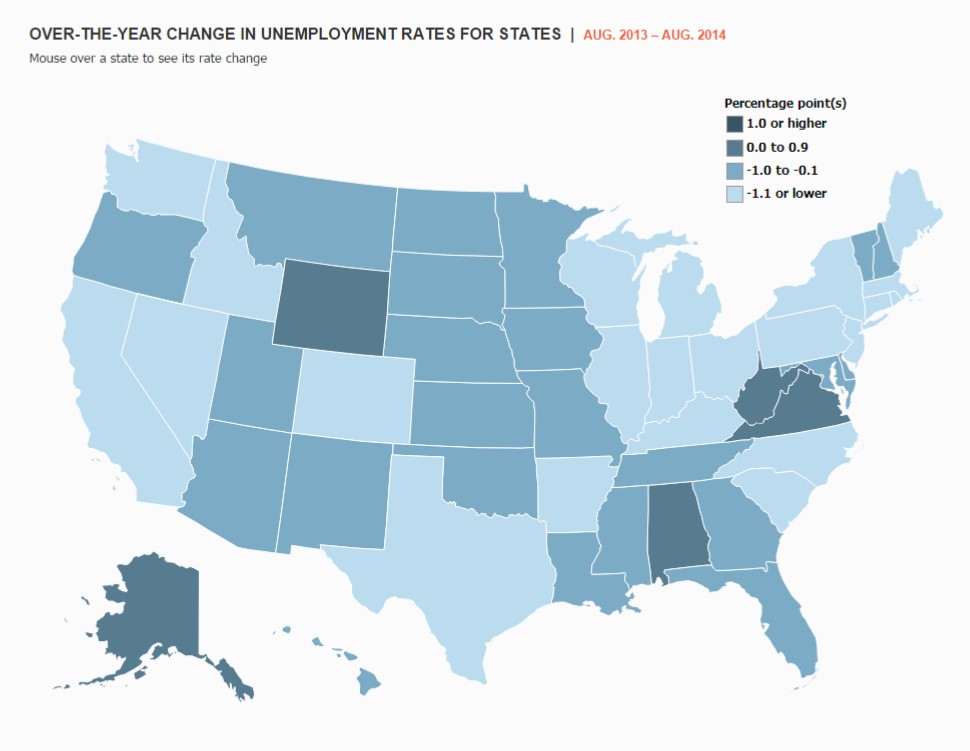

In 45 states and the District of Columbia, the unemployment rate dropped between August 2013 and August 2014.  In three states, the unemployment rate climbed during the year – Alabama, West Virginia and Alaska - and in two states, the rate remained unchanged – Virginia and Wyoming.

Connecticut was also one of 27 states deemed to have "statistically significant" changes in their unemployment rate, according to the federal agency.  The BLS data was updated as of September 19, 2014 for the 12-month period, and subsequently made available on the agency's website.

Among Connecticut's neighboring states in the region, according to the data, the unemployment rate as of August 2014 is higher in Rhode Island (7.7 percent), the same as Connecticut in New Jersey (6.6 percent), and lower in New York (6.4 percent),  Massachusetts (5.8 percent), Maine (5.6 percent), New Hampshire (4.4 percent) and Vermont (4.1 percent).

The Bureau of Labor Statistics of the U.S. Department of Labor is the principal Federal agency responsible for measuring labor market activity, working conditions, and price changes in the economy. Its mission is to collect, analyze, and disseminate essential economic information to support public and private decision-making. As an independent statistical agency, BLS serves its diverse user communities by providing products and services that are objective, timely, accurate, and relevant, the agency's website explains.

map unemployment rate change

License Renewal of WTIC-AM on “Enforcement Hold” at FCC

The Federal Communications Commission has the pending license renewal of WTIC-AM radio on “enforcement hold,” nearly six months after the station’s broadcast license technically expired.  The station can continue broadcasting under the license that expired on April 1, 2014 until the FCC acts on its renewal application, which was filed last year on November 27, just days ahead of the renewal application deadline. In the wake of the corruption conviction earlier this month of former Governor and former WTIC talk show host John G. Rowland, questions have been raised about the radio station that employed Rowland.  Although FCC officials say that “while it is too late to file a formal Petition to Deny the license renewal,” because the renewal date has passed, “an informal objection can still be filed to the license renewal” at any time prior to action on the pending renewal application.WTIC_1080_AM_Radio_logo

The FCC explains that an "informal objection," which is an official process, “may take the form of a letter signed by the objector” and should “contain sufficient information to establish any violation alleged.”   FCC officials indicate that no objections to the station’s renewal have been filed as of this week.  If the station’s license renewal is granted, it would be for an 8-year period.

There is no indication when the hold was placed on the renewal application by the FCC’s enforcement division, what the reason was, or when it might be lifted.  FCC officials indicate that most often enforcement holds are instituted due to a complaint being filed that requires investigation, but they would not confirm whether that was true in this instance.  That information is only made available to the licensee or their attorney, according to an FCC official. FCC

Action on the license renewal application remains possible at any time.  Should an informal objection be filed, the FCC would, in most instances, need to deal with any issues raised in the objection before it would act on the license renewal application.

In April 2014, Rowland resigned as a WTIC-AM radio host as his drive-time talk show, with a federal indictment imminent related in part to Rowland’s relationship with the campaign of then-Congressional candidate Lisa Wilson-Foley. Rowland had remained on the air on WTIC, even after it was revealed that his relationship with the Wilson-Foley campaign had sparked a federal grand jury investigation.

During this month’s trial, according to published reports, a former campaign operative for Wilson-Foley described ways Rowland allegedly coordinated topics on his WTIC talk show with the messages he wanted the campaign to get out.

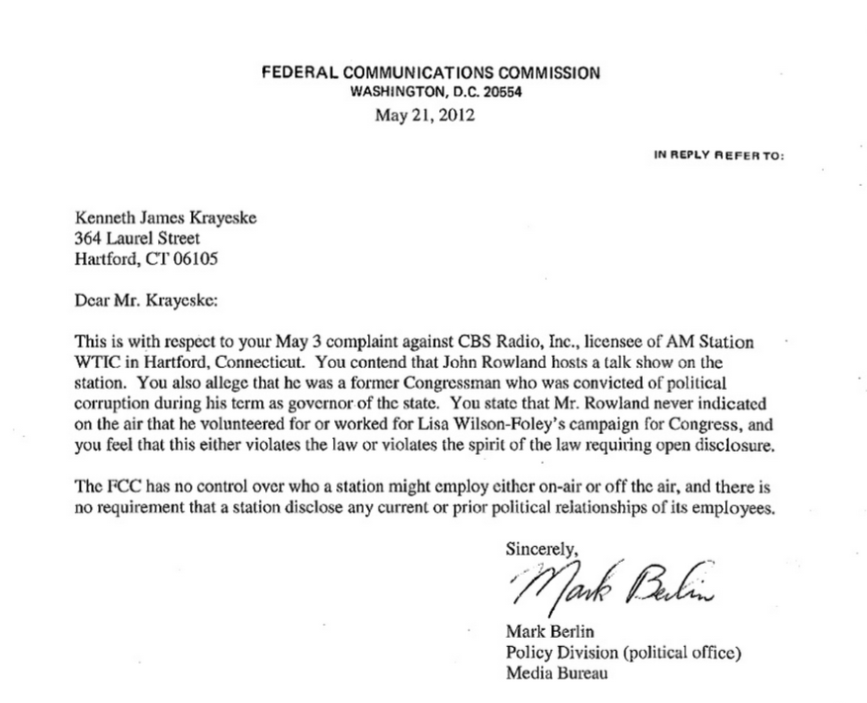
In May 2012, responding to a complaint filed that month by Kenneth James Krayeske to the FCC regarding Rowland’s unstated relationship with the Wilson-Foley campaign, Mark Berlin of the FCC’s Policy Division Media Bureau indicated that “the FCC has no control over who a station might employ either on-air or off the air, and there is no requirement that a station disclose any current or prior political relationship of its employees.”May2012FCCletter

“We accept Mr. Rowland’s decision to step down at this time," Jenneen Lee, the station's program director, said in a statement posted on the station's website soon after Rowland went off the air earlier this year, CT Mirror reported.  The Rev. Will Marotti, who was Rowland's spiritual adviser and served as his co-host when Rowland went on the air at the station in September 2010, took over as host of the weekday afternoon program and remains on the air.

Back in 2012, the Torrington Register-Citizen reported that “according to a WTIC-AM representative, former Gov. Rowland disclosed the fact that he was working with Republican Lisa Wilson-Foley’s campaign ‘months ago,’ but said the 5th congressional district race is avoided on air, intentionally. ‘He actually stays away from it on purpose,’ Jeneen Lee said. ‘To date, there’s been no conversation on the air about the campaign.’”  Editorials published in the months following the campaign-related revelations called for additional disclosure by WTIC.

CBS Radio horizontal color EPSRowland, who resigned as Governor a decade ago in a corruption scandal and served 10 months in prison, was convicted this month of federal charges that he conspired to hide payment for work on two congressional campaigns, in 2010 and 2012, including the Wilson-Foley campaign.

WTIC is owned by CBS Radio.

Student Chapter from Eastern Connecticut Earns Top Honors from Nonprofit "Best Buddies"

The Best Buddies chapter at Eastern Connecticut State University has been named Overall Outstanding Chapter in the United States.  The recognition came at the Best Buddies International Leadership Conference held at Indiana University. Best Buddies is a nonprofit, worldwide organization that helps create friendships for people with intellectual and developmental disabilities. Katharine Ferrone, chapter president, accepted the award on behalf of the club’s members and faculty advisor Charles Wynn, professor of chemistry at Eastern. Over 2,000 student leaders, volunteers, and staff from Best Buddies International programs around the world, participated in the 25thAnnual Leadership Conference  in Bloomington this summer.314112_10150786601893488_169246690_n

“The vision of Best Buddies is to put itself out of business by promoting a world that no longer requires an organization to help create friendships with people with disabilities,” said Ferrone, a senior from Wallingford. “Now five years old, Eastern’s chapter spiraled to the top thanks to the inspiration and dedication of many fine student leaders and volunteers.  It is demonstrating to both the university and community that people with disabilities are more like us than different.”

In Connecticut, Best Buddies is on the following college campuses: Connecticut College, Eastern Connecticut State University, Fairfield University, Quinnipiac University, Sacred Heart University, Southern Connecticut State University, Trinity College, University of Connecticut, University of Hartford, Wesleyan University and Yale University. The most enduring goal of the organization is to provide opportunities for one-to-one friendships. 1972343_712334228816599_428022073_n

Best Buddies programs engage participants in each of the 50 United States, and in 50 countries around the world.  Best Buddies’ seven formal programs – Best Buddies Middle Schools, High Schools, Colleges, Citizens, e-Buddies, Jobs and Ambassadors – positively impact nearly 700,000 individuals with and without disabilities worldwide. The chapter at Eastern holds a variety of events each year, from dances to friendship walks, to help close social gaps.

Anthony Kennedy Shriver is the Founder and Chairman of Best Buddies International, which he created in 1989 to foster one-to-one friendships between people with and without intellectual disabilities. Recognizing the tremendous volunteer potential of university students, Shriver first inspired his college peers to personally collaborate in expanding the realm of opportunities that persons with intellectual disabilities should experience.  Best Buddies has grown into a leading nonprofit entity with increasing international reach across six continents, establishing a global volunteer movement that creates opportunities for one-to-one friendships, integrated employment and leadership development for people with intellectual and developmental disabilities.

The Best Buddies Connecticut office is located in North Haven.

photo

Photo:  ( left to right)  Anthony Kennedy-Shriver, founder of Best Buddies; Katharine Ferrone, chapter president from Wallingford, CT, in green shorts holding the award; club members Amber Heim from East Hartford in white shorts, Kaitlyn Murphy from Mansfield in blue shorts and Monica Mordowanec from Seymour; Connecticut Best Buddies Director Angelo Santiago of Willimantic; and Kyrie Irving of the Cleveland Cavaliers.

CT Ranked #1 in Exceeding Goal in Year One of Affordable Care Act

An analysis of how states fared in the inaugural year of the Affordable Care Act, based on targets for enrollment developed by the Obama Administration, shows that Connecticut leads the list. According to the analysis published by the Wall Street Journal using data from the Department of Health and Human Services, Connecticut ranked #1, attaining 140 percent of the sign-up goal.  The only other states that did better than expected were Rhode Island (137%), New Hampshire (112%) and Florida (106%).

Rounding out the top dozen states, based on their performance compared with expectations, were Maine (92%), Idaho (90%), North Carolina (87%), Wisconsin (77%), Delaware (76%), New York (70%), Virginia (70%), New Jersey (69%), Michigan (69%).

The Journal reported that the lessons learned in the first roll-out of the health care program will be utilized when the next enrollment period begins on November 15.  The newspaper noted that more than eight million people got private insurance for 2014 through the law's insurance exchanges, which were plagued with technical problems when they opened in October 2013 but stabilized toward the end of the six-month sign-up period.

The next enrollment period runs through February 2015, and it is expected that marketing campaigns will stress testimonials from real people, more emphasis on deadlines, and an increased focus on in-person help.  Individuals can sign up at the federal website, HE-AA089_ENROLL_J_20140910143015healthcare.gov, to receive updates, focused by individual states.

Connecticut’s official health insurance marketplace, Access Health CT, is reminding state residents that Enrollment in Medicaid (HUSKY) and the Children's Health Insurance Plan (CHIP) is open year round for eligible persons and families.

The website points out that individuals may also still be eligible to enroll in coverage throughout the year “if you or a member of your household has experienced a Special Enrollment Qualifying Life Event in the past 60 days or you will in the next 60 days.” Qualifying Life Events may include: child birth, adoption, death of a member of the household, marriage, loss of current health care coverage, loss or reduction in employer insurance contributions, new legal CT or U.S. residency, or U.S. lawful presence. Individuals that qualify may not need to wait until November to enroll, and can call 855-805-4325 for additional information.

Earlier this month, Access Health CT CEO Kevin Counihan took his Connecticut experience to Washington, accepting a position overseeing the federal health exchange.  Counihan joined the federal Centers for Medicare & Medicaid Services team as Marketplace Chief Executive Officer, where he will lead the federal Marketplace, manage relationships with state marketplaces and run the Center for Consumer Information and Insurance Oversight, which regulates health insurance at the federal level.  He'll be in position when the next enrollment period gets underway later this fall.gov_access_health

“We are proud of what we’ve accomplished here—we’re a national leader with more than 280,000 people enrolled in affordable health insurance,” said Lieutenant Governor Nancy Wyman, Chair of the Access Health CT Board.

At the other end of the spectrum, according to the analysis, the states that fared well below expectations were Massachusetts (-87%), Oregon (-71%), Kentucky (-62%), Nevada (-61%) and New Mexico (-61%).