Supreme Court Justices Who Overturned CT Death Penalty Were Appointed by Three Different Governors, As Were Opponents

The four Justices of the Connecticut State Supreme Court who overturned Connecticut’s death penalty law this month were appointed to the high court by former Governor Lowell P. Weicker (Justices Richard Palmer and Flemming Norcott), former Governor M. Jodi Rell (Justice Dennis Eveleigh) and current Governor Dannel P. Malloy (Justice Andrew McDonald). The vote abolishing the death penalty in Connecticut was 4-3, with Justice Palmer joined in the majority by Justices Eveleigh, Norcott and McDonald. None are household names in the state – at least they were not before the decision – which was both widely criticized and highly praised by proponents and opponents of the death penalty, as well as legal observers and legislators.

Three dissenting opinions were written or signed by Chief Justice Chase T. Rogers, appointed to the Court by former Gov. Rell; Justice Peter Zarella, appointed by former Gov. John G. Rowland, and Justice Carmen Elisa Espinosa, appointed by Gov. Malloy.four justices

Thus former Gov. Rell and her successor, Gov. Malloy, each appointed a Justice on each side of the controversial opinion.  Two Justices on the majority opinion were appointed by former Gov. Weicker. Former Gov. Rowland's Supreme Court appointee was among the dissenters.

Justice Flemming L. Norcott Jr., who retired at age 70 in October 2013 after sitting on the case in April 2013, was the first African American appointed to the state Appellate Court, in 1987, and five years later was appointed to the state Supreme Court by Gov. Weicker. Justice Carmen Elisa Espinosa became a justice of the Supreme Court on March 6, 2013, having been appointed to the position by Gov. Malloy about six weeks before the case was heard. Justice Espinosa is the first Hispanic Supreme Court Justice in Connecticut.  Norcott and Espinosa were on opposite sides of the decision.

Chief Justice Chase T. Rogers, appointed to the Court by former Gov. Rell, was initially nominated to the Superior Court by Rowland in 2006.  Associate Justice Peter T. Zarella was nominated by Rowland in 2001.  Judge Dennis G.death Eveleigh was nominated for the state Supreme Court by Gov. Rell in 2010, after having initially been appointed to the Superior Court in October 1998 by Gov. Rowland.

The majority decision, written by Justice Palmer, found flaws in the 2012 death penalty law, which banned "prospective" death sentences, those imposed after the effective date of the law. But the majority wrote that it chose to analyze capital punishment and impose abolition from a broader perspective, according to published reports.

Justice Palmer graduated from Wethersfield High School, attended Trinity College in Hartford, and received his Juris Doctor from the University of Connecticut School of Law.  He served as an Assistant United States Attorney for Connecticut from 1980 to 1982 and from 1987 to 1990.  In 1991, Justice Palmer was appointed as United State’s Attorney for Connecticut and he was later the Chief State’s Attorney for Connecticut.

Justice Eveleigh received his J. D. from the University of Connecticut School of Law. Upon graduation from law school, Justice Eveleigh served on active duty in the U.S. Army as a First Lieutenant.

Justice McDonald began his public service career in 1993 as a member of the Stamford Board of Representatives, where he served until 1995, prior to his election to the state legislature. McDonald was later Legal Counsel to Gov. Malloy, and was nominated by Malloy to the Supreme Court in 2013, the same year as Espinosa, and a year after the legislature passed the non-retroactive death penalty ban, which was signed into law by Gov. Malloy.

In the case, State v. Santiago, Eduardo Santiago was tried for murder for hire, convicted, and sentenced to death. He appealed his sentence, and while the Court did not find that putting him to death was unconstitutional at the time, it did find that there were issues in his original trial that warranted a new sentencing hearing. While his appeal was pending, the 2012 legislation passed, abolishing the death penalty for crimes committed after April 24, 2012—which Santiago argued was grounds to remove death as a possible penalty. The Court then examined his claim that “the death penalty is no longer consistent with standards of decency in Connecticut and does not serve any valid penological objective.”

Four Justices on majority opinion, L to R, above:  Richard Palmer, Flemming Norcott, Dennis Eveleigh and Andrew McDonald.

CT Supreme Court: Seated, L to R, below: Justice Richard N. Palmer, Chief Justice Chase T. Rogers, Justice Peter T. Zarella. Standing, L to R: Justice Carmen E. Espinosa, Justice Andrew J. McDonald, Justice Dennis G. Eveleigh, Justice Richard A. Robinson, Senior Justice Christine S. Vertefeuille.  Justice Robinson was appointed to the Court after the Santiago case was heard.  

Supreme_Bench_w041614


15 CT High Schools Among Nation’s Best for College Readiness

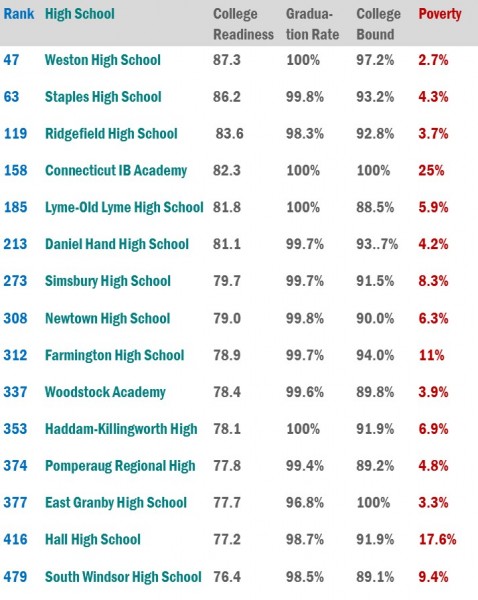
A total of 15 Connecticut public high schools made the list of the top 500 high schools in the nation, compiled by Newsweek magazine.  The top-ranked Connecticut school, Weston High School, ranked #47 in the U.S. and was the only school in the state to crack the top 50.  Also reaching the top 100 was Staples High School in Westport at #63. Three high schools were ranked between 100 and 200 on the national list – Ridgefield High School at #119, Connecticut IB Academy in East Hartford at #158, and Lyme-Old Lyme High School at #185.

The Newsweek High School Rankings—recognizing the achievements of the best public high schools in the United States for college readiness—have been published for more than a decade. The rankings were compiled using several metrics, including graduation rate, college enrollment rate, SAT and ACT scores, AP and IB scores and participation, teacher-student ratio and dropout rates.

Newsweek places an emphasis on criteria like college enrollment and graduation rate since “we know that those are some of the biggest indicators of whether students are prepared for college,” Newsweek officials said.  This year’s rankings were weighted by:0aedbf26799cf8087f8e3041633f6b4e6430abfb

  • Enrollment Rate—25 percent
  • Graduation Rate—20 percent
  • Weighted AP/IB/Dual Enrollment composite—17.5 percent
  • Weighted SAT/ACT composite—17.5 percent
  • Change in student enrollment between 9th-12th grades, to control for dropout rates—10 percent
  • Counselor-to-Student Ratio—10 percent

There are almost 30,000 public high schools in the United States.0806100thinking01

Also earning a spot among the top 10 Connecticut high schools on the list were Daniel Hand High School in Madison (#213), Simsbury High School (#273), Newtown High School (#308), Farmington High School (#312), and Woodstock Academy (#337).

The top high schools in the United States, according to Newsweek, are Thomas Jefferson High (Alexandria, VA), High Technology High School (Lincroft, NJ) and Academy for Mathematics Science and Engineering (Rockaway, NJ).

Newsweek also publishes a second list, called “Beating the Odds” which seeks to identify schools that do an excellent job of preparing their students for college while also overcoming the obstacles posed by students at an economic disadvantage.  Three Connecticut schools reached that list of top schools – Connecticut IB Academy in East Hartford at #164, Central High School at #270 and The Bridge Academy at #466.  The poverty levels for the three schools were listed as 25%, 99.9% and 80.8% respectively.

chart

Hartford's WPOP Goes Back to the Future with News, Talk Format

The goal, in the latest format change among local radio stations, is to become “the go-to station for news, weather and traffic” in the Hartford market.  WPOP, with a lengthy local history that features incarnations as a pop music station, all-news station, and sports talk station, has again assumed the moniker of “NewsRadio 1410 WPOP”, last used nearly two decades ago. Owned by iHeart radio, which has hired a new program director due in the Capitol City from a major market in the coming weeks, the newly rebranded station aims to make the transition to a news format that responds to and reflects the preferences of the local audience, according to Dave Symonds Sr., Vice President of Programming for iHeart Radio in Hartford.logo new WPOP

“There is a huge upside to the format change.  We did a lot of research and there was a high degree of dissatisfaction with the non-sports news talk programming” available in the Hartford market, Symonds said.  Regional Market President Steve Honeycomb added"It’s been almost 18-years since the all-news format was heard on WPOP 1410AM. We’re excited to bring back News Radio 1410 WPOP, an iconic brand and station focused on News, Traffic and Weather to serve the Hartford community, in the iHeartMedia line-up.”

The new WPOP-AM line-up will, at the outset, include mostly syndicated national programs including a daytime focus on financial news and The Vinnie Penn Project, which has been heard on WELI in New Haven since 2011.  The program will now be heard 6-9 AM on both stations, with an additional hour, 9-10 AM exclusively on WPOP.

“There are a lot of shared issues in New Haven and Hartford,” Symonds points out.  The program will originate in New Haven on some mornings, in Hartford on others. iHeart radio stations in Connecticut, formerly Clear Channel stations, include KC101, KISS95.7, The River 105.9, Country 92.5, 97.9 ESPN, and 960 WELI and WAVZ  in New Haven.

The new station's programming line-up will include: The Vinnie Penn Project    6-10 a.m. The Financial Exchange    10 a.m-12 p.m. Bloomberg  Radio               12:00p.m.-3 p.m. Howie Carr                            3-6 p.m. (based in Boston) Mark Levin                            6-9 p.m. America Now                        9 p.m.-12 a.m.

Most recently, the station had aired a sports/talk format including Fox Sports Radio content. Years ago, from 1956-1975, it was a pop music station, the inspiration for the station’s call letters.  The station routinely battled WDRC for the rock’n’roll music audience, before FM radio came to dominate that format.  In August 1972 it was announced that TV entertainer Merv Griffin's company, January Enterprises Inc., was buying WPOP for $2.75 million. Griffin, who came to town to visit the station, took control the following March, according to published reports.  Just a few years later, the music died on WPOP.  On June 30, 1975, WPOP abandoned music programming in favor of the new (and ultimately short-lived) NBC Radio News and Information Service.  But a news station in Hartford was born.

The station maintained an all-news format, which included local news/talk programming, for more than two decades, before the switch to sports talk programming in 1997 (first ESPN, than FOX in 2012).  Among the local newscasters who spent time at WPOP in its all-news heyday are Gerry Brooks, Scott Gray, and Joanne Nesti, whose careers blossomed at other radio and television stations in the market.  Numerous WPOP veterans went on to broadcast news careers around the country.

Those interested in hearing the new format can tune into News Radio 1410 WPOP on the station’s website, www.newsradio1410wpop.com, and through the iHeartRadio mobile app. Hartford is part of Nielsen radio market No. 52. WPOP is a 5 kW day/night station on 1410 kHz.

The Hartford market currently has other locally originated and syndicated news and talk programming.  Connecticut-based Connoisseur Media purchased a group of stations in the state including the WDRC-led “Talk of Connecticut” stations, anchored by the weekday morning locally originated Brad Davis Show.  The remainder of the broadcast schedule on WDRC-AM (as well as simulcast on WMMW Meriden, WWCO Waterbury and WSNG Torrington) consists of nationally syndicated programs, including Kilmeade & Friends, Dave Ramsey, The Savage Nation, The Schnitt Show, The Lars Larson Show and Overnight America.wpop newsradio

WTIC-AM 1080 broadcasts the local Ray Dunaway show and Jim Vicevich program weekday mornings, before moving to nationally syndicated programs, including Rush Limbaugh, for the remainder of the broadast day.

WNPR, part of the Connecticut Public Broadcasting Network, has locally originated talk programs including Where We Live, weekday mornings at 9 a.m. hosted by John Dankosky, the Colin McEnroe program each afternoon, and Faith Middleton’s long-running talk program weekday afternoons.

There is no word yet on whether WPOP will have local news reporters, as WTIC and WNPR, or news programming beyond local newscasts during the syndicated talk shows.  Those decisions will be made, officials say, as audience feedback to the new format is evaluated and the new program director settles in.  Although iHeart Radio has news and talk formatted stations in other markets across the country, Symonds said the approach taken for WPOP will be “customized for Hartford.”

[Logos for WPOP in its news formats - new logo above left, 1980's logo lower right.]

Traffic Fatalities Increasing Nationwide, But Decreasing in Connecticut

Across the United States, the number of traffic fatalities increased 14 percent in the first six months of 2015 compared with a year ago.  In Connecticut, however, the number of motor vehicle deaths dropped by 20 percent. From January through June of this year, there were 95 motor vehicle deaths in Connecticut, compared with 119 during the same period in 2014 and 116 during the first six months of 2013. Connecticut’s percentage drop in the number of traffic deaths was the 5th largest in the nation, comparing the first six months of this year to a year ago.nsc_logo

Nationwide, the number of traffic deaths rose from 16,400 during the first half of 2014 to 18,630 during the first six months of this year.  According to the National Safety Council, which analyzed the data, the increase in fatalities in 2015 likely reflects the effects of the low gas prices that have averaged 30 percent below 2014 levels over the first two quarters of 2015, helping to produce a 3.4 percent increase in cumulative vehicle mileage through May.

Distracted drivers – specifically those behind the wheel attempting to talk or text on a cell phone – are also pushing the numbers. The NSC says cell phone related activities are to blame for 27 percent of all crashes.

Connecticut is one ofcar accident 15 states where the number of traffic fatalities has dropped in the first six months of 2015, compared with a year ago.  The others were Alabama, Alaska, Delaware, D.C., Hawaii, Kansas, Montana, New Jersey, New Mexico, Oklahoma, Rhode Island, South Dakota, Tennessee and Texas.


Three states – California, Texas and Florida – have seen more than 1,000 deaths through June of this  year.

Medically consulted motor-vehicle injuries for the first six months of 2015 are estimated to be about 2,254,000, an increase of 30 percent from 2014 nationwide, the National Safety Council (NSC) indicated. The NSC estimated that the nation appears headed towards the deadliest year, in terms of traffic fatalities, since 2007.

“While the statistics point out a dangerous trend, we have the ability to influence outcomes through our choices and behavior,” said Deborah Hersman, president and CEO of the NSC. “Take your responsibilities behind the wheel this summer seriously and ensure that you get to your destination safety.”

In addition to the personal toll, the estimated cost of motor-vehicle deaths, injuries, and property damage through June was $152.0 billion, a 24 percent increase from 2014, according to the data reported by the Illinois-based NSC. The costs include wage and productivity losses, medical expenses, administrative expenses, employer costs, and property damage.

The number of traffic deaths reported this year nationwide is greater than the number for the same period in recent years; in 2012 there were 1,755 deaths, in 2013 there were 16,617; in 2014 there were 16,400.  The NSC counts both traffic and non-traffic deaths that occur within a year of the accident, while NHTSA counts only traffic deaths that occur within 30 days, so the numbers reported will differ.

Founded in 1913 and chartered by Congress, the National Safety Council, is a nonprofit organization whose mission is to save lives by preventing injuries and deaths at work, in homes and communities, and on the road through leadership, research, education and advocacy.  Deaths are reported by state traffic authorities, and all figures are preliminary.

20,000 Mattresses Recycled in CT's First-in-Nation Program Since May 1

Connecticut’s first-in-the-nation mattress recycling program, Bye Bye Mattress, has recycled 20,000 mattresses since it began in May, according to program officials. The groundbreaking program was established by state law in 2013, calling for the manufacturers and consumers of mattresses to pay for their end-of-life disposal under a concept called product stewardship. Connecticut has a similar product stewardship program for paint, one of only six states in the nation to institute that program.gI_162482_mattresses at Hartford Bulky Waste - lo res

The Connecticut mattress recycling program, launched on May 1, is funded by a $9 fee collected from consumers when a new mattress or box spring is sold. The program is administered by the Mattress Recycling Council, which is a 501(c)3 non-profit organization created by the International Sleep Products Association (ISPA). The organization’s Board of Directors includes individuals who are employed by some of the industry leaders, including King Koil, Serta Simmons, Tempur Sealy and Paramount Sleep.  It is based in Alexandria, VA.

Under the program, dubbed “Bye Bye Mattress,” any used mattress that is discarded for municipal collection, picked up by a retailer, or dropped off by a consumer in Connecticut will be sent to a mattress recycler, who will break it down to reuse its components for other products.

Connecticut’s Public Act 13-42 (enacted in 2013 and amended in 2014) required the mattress industry to create a statewide recycling program for mattresses discarded in the state.  When the program began, nearly 50 cities and towns across the state were participating to recycle the mattresses and box springs collected at their solid waste transfer stations.

Among those facilities is Park City Green in Bridgeport where employees break down old mattresses into its recyclable parts. Officials say they recycle 96 percent of mattress materials into usable products: the covers (which can be turned into mattress pads), the cotton stuffing (turned into fabric), the foam (automobile padding), wood pieces (mulch), and springs (reforged steel).  The program diverts mattresses from waste-to-energy facilities and landfills and allows materials like fiber, foam, steel and wood to be reused. bye bye mattress

Residents drop-off their used mattresses and box springs at no-cost. Then, MRC provides the collection container, transportation from the facility to the recycler and the mattress recycling services at no-cost.  MRC continues to enroll interested municipal transfer stations in the program.  A fact sheet about the program has been developed, Connecticut Recycling Program  for interested municipalities, providing information about the benefits of participating. Springs-and-Foam-358x200

A $2 reimbursement per mattress is only given at the program’s two participating recycling facilities (Recyc-Mattresses in East Hartford or Park City Green in Bridgeport). It is limited to four units per person per day; eight per person per year.

MRC is also working with mattress retailers, hotels, military facilities, universities, healthcare facilities and other public and private entities in Connecticut to divert mattresses from the solid waste stream. It will report the program’s progress to the state Department of Energy and Environmental Protection annually in October.  Earlier this month, students and staff at Central Connecticut State University recycled mattresses from student dorms as part of the program.

MRC-logo-copy-3A similar statewide mattress recycling program was adopted by the Rhode Island legislature in 2013 and is due to launch in 2016.  To participate, Rhode Island producers must have joined the Mattress Recycling Council (MRC) by July 1, 2015, according to the organization’s website.  Producer is defined as any person who manufactures or renovates a mattress that is sold, offered for sale or distributed in Rhode Island under the manufacturer’s own name or brand.  California’s program, enacted in 2013 and amended in 2014, is also expected to begin statewide in 2016, administered by the Mattress Recycling Council.

The MRC notes that more than 50,000 mattresses end up in landfills every day.  The recycling programs aim to reduce that number. Each year, 35 to 40 million new mattresses and box springs are sold in the United States, and at least 15 to 20 million used mattresses and box springs are discarded.


https://youtu.be/Gsi6KgnvJF4


With Resignation, Recommendations for Higher Education May Receive Renewed Attention

With the resignation of Board of Regents for Higher Education President Gregory Gray – announced Friday and effective December 31 – there may be renewed review of structural recommendations enumerated in the state’s Strategic Master Plan for Higher Education, published earlier this year after a more than year-long study, and the subject of legislative action during the 2015 General Assembly session. Developed by the Planning Commission for Higher Education, which was created by the Connecticut General Assembly and chaired by Judith Resnick of the Connecticut Business and Industry Association, the 19-member Commission included high-ranking individuals from higher education, state government and business.  A revised commission was established by the state legislature earlier this year in legislation (Public Act 15-75)  that took effect this summer, advancing many of the planning commission's recommendations. The new law  "requires the Board of Regents (BOR) president to implement Planning Commission strategic master plan goals. It also narrows many BOR duties prescribed by law from a statewide to a BOR institution-specific scale," according to the official summary of the legislation.report

Regarding higher education policy leadership in Connecticut, the Planning Commission indicated in a comprehensive 23-page report that “since the abolition of the former Department of Higher Education, Connecticut has not had an entity responsible for policy formulation and leadership for the higher education system as a whole.”  The Department was abolished in 2011.   The Board of Regents, created that year, oversees the four Connecticut State University campuses, the state’s 12 community colleges and Charter Oak State College.  The University of Connecticut operates separately.

The report indicates that “the Board of Regents is appropriately focused on the important work associated with forging a system out of the disparate institutions under its purview. The UCONN Board of Trustees is similarly narrowly engaged in oversight of the institutions within its jurisdiction. The Office of Higher Education is an administrative and regulatory agency, not an entity taking the broad view of higher education policy and leading efforts to create a supportive policy environment.”

“What Connecticut needs – and does not have,” the report stresses, is “an entity or venue that has the authority and responsibility to:

  • Establish, build consensus around, and sustain attention to long-term goals for post-secondary-level education attainment — or for the whole education system, P-20.
  • Develop the metrics and data/information system necessary for measuring progress toward goals and holding the system accountable for performance
  • Report annually on progress toward achieving the established goals
  • Conduct highly respected analyses that can inform policy deliberations
  • Provide a venue to discuss the challenges in reaching these goals and to shape recommendations to the Governor and Legislature on an action agenda to achieve goals (e.g., a two-year agenda toward long-term goals)quote

The report notes that “the population of Connecticut…is not educated to high enough levels to meet the skilled workforce needs in the foreseeable future.”  A series of short- and long-term recommendations include finance and policy leadership proposals, accountability and governance/decision making authority changes, and regulatory revisions.

The Strategic Plans calls for such an entity to have “a degree of independence from, but trusting relationships with the state’s political leadership (the Governor and General Assembly) and the leaders of higher education institutions. To have the stature necessary to be effective,” according to the report, the entity “must be composed of the state’s most influential civic, business/industry, and cultural leaders and represent the diversity of the state’s population.” The 2015 law "requires the state, BOR, and UConn's Board of Trustees to align their policies with the three recommended goals of the Planning Commission's strategic master plan."  Those goals are:

1. increase the education levels of the state's adult population,

2. develop a globally competitive workforce and economy in the state, and

3. ensure higher education affordability for state residents.

The legislation passed earlier this year also establishes a Higher Education Coordinating Council which meets annually and consists of "the two BOR vice-presidents, the Office of Policy and Managment Secretary, the education commissioner, the UConn president, the UConn chief academic officer, the UConn BOT chairperson, the BOR chairperson, and the BOR president."

CT-N coverage of Commission's January 2015 meeting, prior to issuance of its report and recommendations. 

Putnam Pushing New Reputation as Arts and Culture Mecca, Gaining Recognition

When the Connecticut Main Street Center announced its Award of Excellence would go to the Town of Putnam, the Putnam Business Association, and the Putnam Arts Council for First Fridays in Downtown Putnam, there may have been more than one individual uncertain as to why. Many around the state may have been unaware of the northeastern Connecticut community’s goal of connecting artists, audiences, and arts and culture agencies to enhance the economic vitality of the community, while also showcasing downtown assets including a Bandstand and Outdoor Stage, the Downtown Farmers' Market Pavilion, and the local scenic River Trail.putnam

Driven by the vision to create a 'sense of place' and feature their downtown destination, the Town, the Business Association and the Arts Council collaborated to launch a monthly arts and culturally based Street Faire from May to October each year.  Now in its fifth year, the initiative has proven quite successful.

In 2014, approximately 3,000 people attended each event, with 15-20 street artisan vendors participating. The success of First Fridays has demonstrated the town's credentials as a 'destination' in Connecticut. Putnam was voted #4 Fan Favorite Town through the state Office of Tourism in 2013, and #2 Town in 2014 - the only town in the top 5 without waterfront. To overcome the obstacles of empty storefronts, the Putnam community worked diligently to reinvent itself as the arts and cultural hub of northeastern Connecticut, leading to recognition by Boston Magazine as "One of the Best 15 Small Towns to Visit in New England".

First Fridays define cultural diversity with a different theme each month. These themes are explored through dance, theatre & storytelling, architecture, song, food, and folklore.  Each monthly theme includes: 'Art Attacks' - random acts of art to surprise, entertain, and educate; 'Menu Celebrations' - local restaurants designing and creating menu specials to pair with the monthly theme; plus street bands, artisan vendors, and children events.arts

This year, the overarching theme is 'A Century of Art'.  To start this year, the monthly themes have been:  May - Turn of the Century; June - The Roaring 20's / The Jazz Age; July - The 1940's / WWII and the Arts; August - Pop Art of the 1960's;.  Still to come: September - The 1980's / Urban Art; and October - Turn of the Century / The Digital Age.

First Fridays "feature great live entertainment, variety of art vendors lining the streets, fun and interactive art projects, and stimulating events" hosted by such downtown galleries as Arts & Framing and the Sochor Gallery, The Empty Spaces Project Gallery, Sawmill Potteryand Silver Circle Gallery, according to the event website. Officials say that since the inception of First Fridays, the exponential growth has been manageable only because of business partners, volunteers and partners stepping up to assist with the Town administration. Town employees provide services for sound systems, street closures and safety measures. Police traffic patrol has been set in place; corps of volunteers handle facilities management; and valet service companies have been hired by restaurants to assist with parking.

Putnam has begun to be described as “a mecca of revitalization and community pride.” Participants last year, for example, were given disposable cameras to take shots of Downtown architecture. The photos were then pieced to create a 9' X 3' collage spelling out the word "PUTNAM".  Educating and advocating through multi-disciplinary and inter-generational events has earned new found recognition for Putnam, and made First Fridays a destination for audiences from Northeast Connecticut, Rhode Island, and Massachusetts.  All of which makes the recognition from the Connecticut Main Street Center less surprising.

Three CT Counties Among the Nation's 244 Most Dense in Population, Comprising Half Nation's Residents

New York City's borough of Manhattan has about 1.6 million residents sharing just under 23 square miles of land. Meanwhile, 669 square mile Loving County, TX has just 86 residents, Business Insider reports in an analysis of U.S. Census Bureau data. According to the U.S. Census Bureau's population estimates and their tabulations of the land area of each county, 50.1 percent of the US population lives in the nation’s densest counties, indicated in dark purple on the illustrated map, which highlights the wide dispersion in the population density of the US's 3,142 counties. The 244 densest US counties are shown in dark purple, developed using U.S. Census Bureau data for 2014.US map pop

The nation's largest populations, by county, are in Los Angeles County, CA; Cook County, IL; Harris County, TX; Maricopa County, AZ, San Diego County, CA; Orange County, CA, Miami-Dade County, FL and Kings County, NY. CT

The most populous county in Connecticut, Fairfield County, ranked 51st by population (945,438) among the nation’s counties.  Just behind are Hartford County, ranked 59th (897,985) and New Haven County, ranked 64th (861,277).

All three are among the 244 densest U.S. counties that comprise just over half of the nation's population.

CT county population


Connecticut, Pakistan Have Similar Economic Output, Analysis Finds

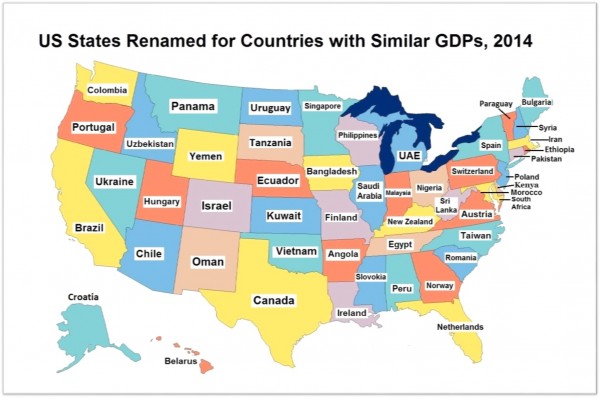
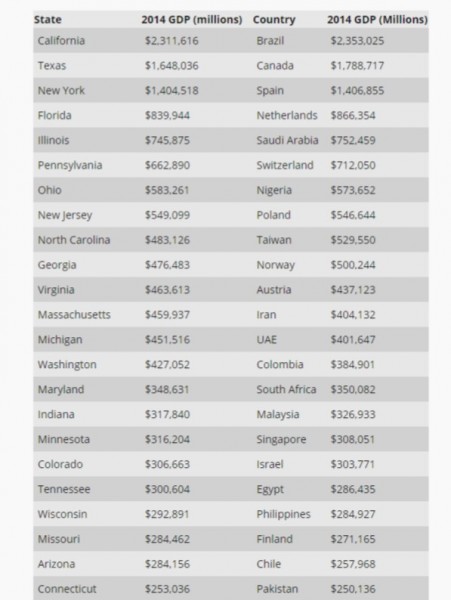
Connecticut is Pakistan. A review of state-by-state Gross Domestic Product (GDP) data for 2014 matches economic output in U.S. states to foreign countries with comparable nominal GDPs.  Connecticut’s GDP, which ranks 23rd among the states, is comparable to the nation of Pakistan – just over $250 billion.

The U.S. map, with names of nations with comparable GDP’s, “helps put America’s GDP of nearly $18 trillion in 2014 into perspective by comparing the GDP of US states to other country’s entire national GDP,” according to the American Enterprise Institute (AEI), which developed the comparative analysis.US map

Among the highlights, as described by AEI:

  1. America’s largest state economy is California, which produced $2.31 trillion of economic output in 2014, just slightly below Brazil’s GDP in the same year of $2.35 trillion. In 2014, California as a separate country would have been the 8th largest economy in the world, ahead of Italy ($2.1 trillion) and India ($2.04 trillion) and Russia ($1.86 trillion). And California’s population is only 38.8 million compared to Brazil’s population of 200.4 million, which means California produces the same economic output as Brazil with 81% fewer people.
  2. America’s second largest state economy – Texas – produced $1.65 trillion of economic output in 2014, placing it just slightly behind the world’s 11th largest country by GDP – Canada – with $1.78 trillion of economic output.
  3. Saudi Arabia’s GDP in 2014 at $752 billion was just slightly more than the state GDP of Illinois ($746 billion).
  4. America’s third largest state – New York with a GDP in 2013 of $1.4 trillion – produced the same amount of economic output last year as Spain ($1.4 trillion), even though Spain’s population of 47.3 million people is more than twice the number of people living in New York (19.75 million).
  5. Other comparisons: Florida ($840 billion) produced about the same GDP in 2014 as the Netherlands ($866 billion), Pennsylvania ($663 billion) produces almost as much as the entire country of Switzerland ($712 billion) and Ohio ($583 billion) produces more than the entire country of Nigeria ($573 billion).

Connecticut’s GDP of $253 billion is close to that of Pakistan, which was $250 billion in 2014.  Among the other New England states, Massachusetts had a GNP of $459 billion, slightly higher than that of Iran ($404 billion), New Hampshire’s GDP of $71 billion was comparable to Syria’s nearly $72 billion, and Rhode Island’s $54 billion GDP was similar to Ethiopia’s $52 billion.GDP chart

The comparison was developed by Mark J. Perry, concurrently a scholar at American Enterprise Institute and a professor of economics and finance at the University of Michigan's Flint campus. For each US state (and the District of Columbia), he determined the country closest in economic size in 2014 (measured by nominal GDP).  For each state, there was a country “with a pretty close match,” he found.

Overall, the analysis indicated, the US produced 22.5% of world GDP in 2014, with only about 4.6% of the world’s population. Three of America’s states (California, Texas and New York) – as separate countries – would rank in the world’s top 14 largest economies. And one of those states – California – produced more than $2 trillion in economic output in 2014 – and the other two (Texas and New York) produced more than $1.6 trillion and $1.4 trillion of GDP in 2014 respectively.


Go Ask ALICE – Child Care Front and Center

The phrase “go ask ALICE” may have been a lyric a few decades ago, but today it is taking on renewed significance when assessing the day-to-day life challenges of a surprisingly large segment of Connecticut’s population, an updated report by Connecticut United Ways shows. In Connecticut, 1-in-4 households have earnings that exceed the Federal Poverty Level (FPL) but fall short of a basic cost of living threshold. The United Way has defined these households as ALICE-an acronym for Asset Limited, Income Constrained, Employed, and together with the 10% of Connecticut households in poverty, more than one-third of Connecticut households (35%) are struggling to make ends meet.MonthlyExpenses_Pie

The original analysis revealed last fall has now been updated and expended with new data, which indicates that cost of child care is a significant burden, and that child care is “often the single-largest expense for families with young children.”

The Connecticut ALICE Report estimates that the cost of child care for two children (1 preschooler and 1 infant) is at least 28% of the monthly expenses included in the Household Survival Budget for a family of four. In a newly released ALICE Update, the latest available cost data from 2-1-1 Child Care is used to examine the biggest child care challenges facing ALICE families in Connecticut:

  1. Child care is often the single-largest expense for families with young children, with limited options for affordable infant and toddler care posing a significant challenge. This is especially true for ALICE families.
  2. Child care subsidies are available for working families, but some ALICE families have earnings that exceed the eligibility threshold, and others struggle to cover the difference between the subsidy and the provider fee.
  3. Availability and cost of child care varies throughout the state, limiting options for ALICE families who may not be able to find child care providers they can afford that are located near where they work or live.
  4. There are limited child care options that are available during evening, night, or weekend shifts. 2nd shift, 3rd shift, and weekend hours are more common among low- to moderate-income ALICE workers. When work schedules are unpredictable, and vary from week to week, it can be hard for ALICE families to find child care when they need it.

ALICEForumSiteThe most recent fee data available from 2-1-1 Child Care estimates the statewide average cost of full-time child care in a licensed center-based day care setting is $211/week for 1 preschooler and $253/week for an infant, which adds up to $2,011 per month. This may be less than what many Connecticut families pay for child care each month, due to variations in cost and availability throughout the state, differences in family size, and other costs associated with child care that are not included—such as the cost of alternate care arrangements when the child care setting is closedChildCareFamily

The report indicates that statewide, the average weekly cost of Infant/Toddler care ranges from $135 to $400 in Home-Based settings and from $175 to $400 in Center-Based settings. The high cost of Infant/Toddler care creates the greatest burden, as the weekly cost amounts to the highest percentage of median income in both Home-Based (30.9%) and Center-Based (48.8%) settings in Hartford, where the median income is $29,430/year.

Adding to the challenge posed by the high cost of Infant/Toddler care is the fact that its availability varies throughout the state. There are six municipalities in the state that have no licensed Center- or Home-Based Infant/Toddler child care providers at all, and 15 that only have a single provider offering Infant/Toddler care in their town. A total of 52 Connecticut towns have two to five providers of Infant/Toddler care, and the remaining 96 municipalities have at least six providers who offer Infant/Toddler care.

The report also indicates that “there are limited child care options available during evening, night or weekend shifts, and it can be hard for ALICE families to find childcare when they need it.”  The vast majority of Center-Based child care providers in Connecticut do not offer evening or weekend care, according to the report. Another challenge for ALICE workers without stable, predictable work schedules is that child care providers are typically paid for a full week of care in advance, whether the care is ultimately used or not. When work schedules change from week to week or on short notice, ALICE families may end up paying for child care that they do not use.

In November 2014, Connecticut United Ways released the first statewide ALICE Report, a data-driven, comprehensive research project that quantifies the situation confronting many low-income working families across our state - in our urban, suburban and rural communities. The Report documents that the number of Connecticut households unable to afford all of life's basic necessities far exceeds the official federal poverty statistics.