Listen, Look and Respond to Texts While Behind the Wheel – Legal in Connecticut?

In Connecticut, Public Act 10-109, enacted into law in 2010, states that “no person shall operate a motor vehicle … while using a hand-held mobile telephone to engage in a call or while using a mobile electronic device while such vehicle is in motion. An operator of a motor vehicle who types, sends or reads a text message with a hand-held mobile telephone or mobile electronic device while such vehicle is in motion shall be in violation of this section.” Now, technology and the nation’s automakers are doing their best to skirt the language of the law, with in-car electronics that allow drivers to listen to, read and send text messages while at the wheel. text car
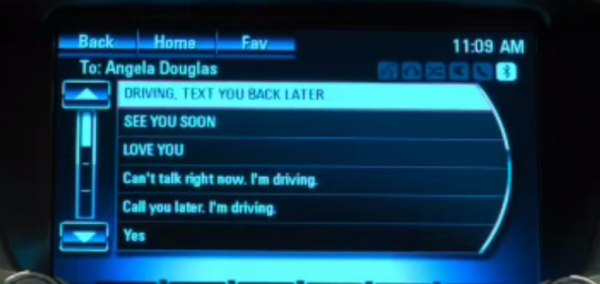
The technology, now being widely advertised as 2016 new car models reach showrooms, “may unintentionally cause greater levels of cognitive distraction,” according to AAA Foundation for Traffic Safety.

One advertisement seen recently on local television and appearing on-line, from Chevrolet, is for the company’s Text Message Alert system. The description of the new feature explains “When you’re in your vehicle, this convenient feature alerts you when a new text has been received and allows you to listen to messages, view messages (when your vehicle’s not in motion) and reply with a preset message with a compatible smartphone.”

Whether or not the new technology meets the letter and spirit of the Connecticut law, now five years old, has yet to be tested.  And if it does, is that in the best interest of Connecticticut drivers, or should the law be revised to address changing technologies?  Peter Kissinger, President and CEO of the AAA Foundation for Traffic Safety, points out that “Technologies used in the car that rely on voice communications may have unintended consequences that adversely affect road safety.”

“We already know that drivers can miss stop signs, pedestrians and other cars while using voice technologies because their mind is not fully focused on the road ahead,” adds Bob Darbelnet, President and CEO of AAA.

The Chevrolet ad exclaims that “Life doesn’t stop when you’re driving. With MyLink you can stay in touch and up-to-date safely with hands-free calling and access to your personal address book through Bluetooth® wireless technology.”  But data indicates that hands-free is not necessarily safe, according to AAA.

AAA has pointed to recent research which indicates that “the accuracy of voice recognition software significantly influences the rate of distraction.”  For example, a team led by Dr. David Strayer and researchers at the University of Utah found that using a speech-to-text system to listen to and compose emails or texts was a greater distraction than talking on a hand-held or hands-free cell phone or listening to the radio.

With three out of four drivers believing that hands-free technology is safe to use, AAA officials caution, Americans may be surprised to learn that these popular new vehicle features may actually increase distraction, according to the new research.  AAA is urging manufacturers to “continue their efforts to develop and refine systems that reduce distractions: while encouraging drivers to “minimize cognitive distraction by limiting the use of most voice-based technologies.”AAA
To assess “real-world” impact, Dr. Joel Cooper with Precision Driving Research evaluated the two most common voice-based interactions in which drivers engage – changing radio stations and voice dialing – with the actual voice-activated systems found in six different automakers’ vehicles. On the five point scale, Toyota’s Entune system garnered the lowest distraction ranking (at 1.7), which is similar to listening to an audio book. In comparison, the Chevrolet MyLink resulted in a very high level of distraction (rating of 3.7). Other systems tested included the Hyundai Blue Link (rating 2.2), the Chrysler Uconnect (rating 2.7), the Ford SYNC (rating 3.0) and the Mercedes COMMAND (rating 3.1).

Chevrolet also offers a feature called Siri Hands Free.  The company’s website explains that “The system allows limited hands-free interaction for when you need to compose important messages on the go.”

“It is clear that not all voice systems are created equal, and today’s imperfect systems can lead to the perfect storm for driver distraction,” continued Darbelnet. “AAA urges vehicle and device manufacturers to use this research to improve their voice systems and promote road safety.”

As someone once described it during the consideration banning texting while driving in Connecticut earlier in this decade, “cell phones don’t cause accidents, distractions do.”

https://youtu.be/kY6ohMfY2gQ

Three Connecticut Urban Initiatives to be Recognized by Regional Organization

When the Congress for the New Urbanism, New England Chapter, presents the 2015 Urbanism Awards recognizing achievement in the region later this month, Connecticut will dominate.  Initiatives in Stamford, New Haven and the Hartford region are three of the five award recipients. The Urbanism Awards honor the designs, plans, and policies that best embody the principles of New Urbanism in New England. The Congress for the New Urbanism (CNU) helps create vibrant and walkable cities, towns, and neighborhoods where people have diverse choices for how they live, work, shop, and get around. People want to live in well-designed places that are unique and authentic. CNU's mission, according to the orcongress logoganization’s website, is to help build those places.

The Glen Brook Springdale Transit Oriented Development (TOD) Plan in Stamford, the Downtown New Haven One-Way to Two-Way Conversion, and the CT Fastrack bus service in the Hartford Region each earned the organization’s top honors in New England.

New HavenThe submission by the City of Stamford of the Glen Brook Springdale TOD Plan is “a fine example” of creating “great livable and walkable spaces and bringing life back” to the area, the organization pointed out.  In selecting the Stamford plan, the Chapter said “The City initiated the study in order to promote much-needed public space improvements and to unlock the potential of each village as a transit-focused location for development. It promotes support and cooperation between the public and private investment for needed rail improvements and to promote walkability and bikability. The resulting plans are transit oriented development pockets and rail station improvements which lay a framework the land owners, developers and the City for good, strong New Urban development and improvements.”

Regarding the New Haven plan, the selection was made because “the Downtown New Haven One-Way to Two-Way Conversion Study strongly conveys the role that a retrofit of existing streets can have on improving the livability, safety, character, and economic development of an entire neighborhood area. The submission clearly articulates how this kind of street reclamation could both improve the efficiency of transit operations while also balancing all modes of transportation.”  Still to be completed, the selection team indicated they look forward to “seeing how this project can support overall revitalization in Downtown New Haven.”  Lead consultant on the plan is Fuss & O’Neill, Inc.stamford

CT Fastrak, operated by the state’s Department of Transportation, was selected “for their success in helping to deliver the first dedicated mass transit system to the region in over 50 years. This is an excellent example of regional cooperation which contemplates improvements at every scale of the rural to urban transect. At the regional level, the dedicated bus only roadbed maximizes mobility while reducing dependence on the automobile. This achievement is enhanced by the inclusion of a 5 mile long multi-use trail way with several access points to the busway for cyclists and pedestrians. Further, several of the new stations will foster transit oriented development (TOD).”

CT FasttrakThe awards will be presented on October 21 at The Union Club of Boston.  The Congress for the New Urbanism, New England Chapter (CNU New England) is a cross-disciplinary network of professionals and advocates working to build strong cities and towns in New England. The organization’s mission is to:

  • Educate the public and the development community about the benefits of New Urbanist planning, design and development
  • Support the implementation of projects consistent with the principles of New Urbanism at the local, state, and regional levels
  • Encourage the adoption of policies and regulations that promote traditional human-scaled urbanism

CBIA and reSET Go Head-to-Head Celebrating Business in Connecticut on Oct. 29

It’s not quite Christmas past and Christmas future, but observers of Connecticut’s business landscape will be forgiven if that’s the take-away from two simultaneous events the evening of October 29 in the state’s Capitol City of Hartford. The Connecticut Business and Industry Association, the state’s leading business membership organization, will be marking 200 years of “Connecticut innovation and ingenuity” at an historic anniversary gala at the Hartford Marriott Downtown, with MSNBC’s Joe Scarborough and Mika Brzezinski the featured guests.  Attendees will have an opportunity to “mix with Connecticut’s most successful and enterprising business leaders at this not-to-be-missed networking event,” according to the advance publicity.

The program is to be preceded by a brief CBIA business meeting. Governor Malloy is schedule to be among the speakers, along with CBIA President & Chief Executive Officer Joe Brennan. Tickets are now available for the celebratory event.

Meanwhile, across town at the Society Room, reSET, the Social Enterprise Trust, whose mission is advancing the social enterprise sector, will be highlighting the unfolding efforts of 12 impact businesses selected as honorees of the 2015 reSET Impact Challenge. Stressing social enterprise, the event has been described as “the future of business.”CBIA 200

The competition, now in its fifth year, recognizes the most innovative, impactful, and viable early stage ventures and start-ups from all industries. For the first time this year, the Challenge was opened to entrepreneurs throughout New England. Award winners will receive unrestricted seed capital, expert professional services, and public recognition. Nine of the 12 finalists are from Connecicut.

“This year’s short list was chosen from the over 100 enterprises that applied. That’s almost double that of last year, and a 700 percent increase since The Challenge launched in 2011. The talent pool gets stronger every year and narrowing it down this time around proved to be quite challenging,” said Rosie Gallant, Director of Programs at reSET.reSET

A panel of expert judges will decide the overall winners who will be revealed at an open-to-the-public celebration, starting at 5pm.   To hear the honorees’ stories and to cast your vote for the “People’s Choice Award,” people are urged to visit www.TheImpactChallenge.org/PeoplesChoice.  The honorees are:

  • Asarasi, Inc. (CT)
  • BookBugs (NH)
  • Beautiful Day / The Providence Granola Project (RI)
  • Daily General Counsel (MA)
  • Dream See Do (CT)
  • FRESH Farm Aquaponics (CT)
  • Harford Prints (CT)
  • Hugo & Hoby (CT)
  • LOTUS Alliance LLC (CT)
  • Movia Robotics (CT)
  • Parrot MD (CT)
  • Planet Fuel Beverage Company (CT)

Connecticut Public Radio host John Dankosky will moderate a panel at the celebration about how social innovation is transforming industries. The panel will feature Disruptive Innovators Jean Hammond, co-founder and partner of LearnLaunch; Makaela Kingsley, director of Wesleyan’s Patricelli Center for Social Entrepreneurship; and a co-founder of tech startup Send Help Back Home.  Tickets to the celebration next month may be purchased at www.ResetImpactAwards.Eventbrite.com.

A separate Impact Venture Showcase will begin at 4pm, with eight early stage, impact-driven startups pitching to an audience of investors, advisors, and guests seeking both social and financial returns. Seating for this pre-celebration event is limited. Separate tickets are required, available at: www.ResetImpactAwards.Eventbrite.com.

With both events spotlighting innovation and ingenuity, the state Department of Economic and Community Development’s statewide theme, “Still Revolutionary,” comes to mind.

This year’s Challenge and Awards are being made possible by a large community of supporters, including a fair number who may also be represented at the CBIA celebration.  The reSET even sponsors include Aeton Law Partners; Bank of America; BNY Mellon; Cantor Colburn; Carter Realty; Central Connecticut State University; Clark Insurance; Comcast Business; Community Investment Corporation; Connecticut Department of Economic and Community Development; Connecticut Innovations; Farrell & Farrell Consulting Services; Fiondella, Milone & LaSaracina; Health Educated, Inc.; HealthyCT; HEDCO Inc.; Murtha Cullina; Powerstation Events; Pullman & Comley, LLC; Qualidigm; Quinnipiac University; Remarkable Technologies; Tariq Farid Foundation; The City of Hartford; The Hartford; The Walker Group; Travelers; Trinity College; and Updike, Kelly & Spellacy.

https://youtu.be/07vC9ohKyyg

https://youtu.be/8hg7nUBL4P4

https://youtu.be/DR1KfGFqG5U

Survey Data Finds People Who Live Somewhere Longer, Like It Less

Criticism of state officials for public discontent about Connecticut and data indicating that more people are moving out of Connecticut than moving in has been quite steady for a number of years, and was advertised quite widely during the most recent gubernatorial campaign. Now, data reported by Governing magazine may put into perspective the consternation about Connecticut, given that the state’s population is among the oldest in the nation (ranking 7th).  Generally, Connecticut residents have been here for a long time.greetings-from-connecticut-ct-postcard

“Citizen survey data support the notion that those who have resided in their communities longest tend to have more negative feelings about them,” the magazine reported.

The National Research Center (NRC), a research firm that conducts citizen satisfaction surveys, provided Governing with data measuring citizens’ attitudes in roughly 300 localities nationwide. About two-thirds of those with residency of less than five years in a community rated the overall direction of their jurisdictions as “excellent” or “good,” compared to only 48 percent among those who had lived in an area for more than 20 years. Results for other questions yielded similar differences, according to the Governing article, titled “Familiarity Breeds Contempt” in print editions.residency

“The very characteristics of a community that attract new residents may serve as a source of frustration for some who’ve been around a while. Results for survey questions on confidence in government and treating all citizens fairly also show a drop off among longtime residents,” the magazine reported.

Ashley Kirzinger, who conducts citizen surveys at the University of Illinois at Springfield, told Governing she’s found the same link in her research on local governments in Illinois: The longer people live in a community, the lower the ratings they’ll give a jurisdiction after controlling for age, education, income and race.  Kirzinger’s research also shows that more civically engaged longtime residents tend to report more positive perceptions than those who are not as involved.png

A year ago, Forbes magazine reported that “the Nutmeg State rates third overall for quality of life thanks to low crime and poverty rates, a healthy populous and strong schools.”  A 2011 Civic Health Index report on Connecticut found that there was consider civic involvement. “Overall, Connecticut scored better than the national average when it came to voter registration and voter turnout, scored highly in terms of internet connectedness, and ranked 6th in the nation for the percentage of people who donate to charity,” the report found.

NRC President Tom Miller, reflecting on the national data, “suspects some residents gradually develop a lower tolerance for change, even in cities experiencing a transformation generally perceived as positive,” Governing reported.

CT’s Manufacturing Report Card Features Every Grade, From A to F

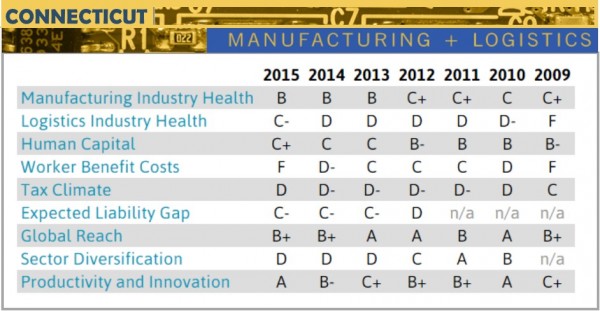
Connecticut’s report card on Manufacturing and Logistics is a mixed bag, according to data compiled by Indiana’s Ball State University Center for Business and Economic Data.  The state’s grades in nine categories range from an A in the Productivity and Innovation category to an F in Worker Benefit Costs. The other categories were Manufacturing Industry Health, Logistics Industry Health, Human Capital, Tax Climate, Expected Liability Gap, Global Reach and Sector Diversification. Overall the state received one A, one B+, one B, one C+, two C-, two D, and one F. manufac data

Connecticut’s manufacturing industry is 8.1 percent of the state economy, according to the report. The total personal income in Connecticut is $203,703,411,000 and earnings from manufacturing total $16,591,678,000, the report stated.

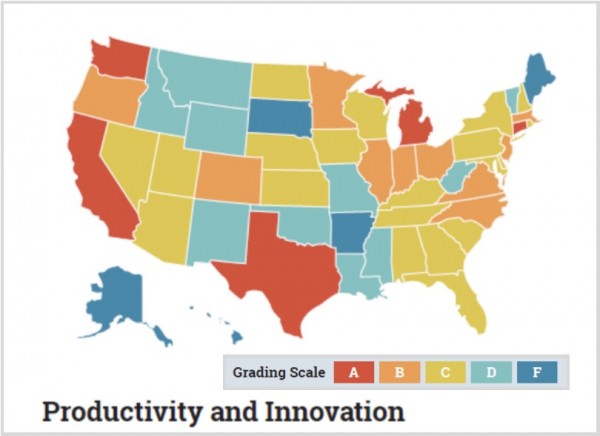
The state’s top grade was in Productivity and Innovation.  The researchers described that category as “the value of manufactured goods per worker – productivity – as well as firm access to inventions and innovations,” which “is critical to the long-term performance of a firm and the industry as a whole.”  To measure productivity and innovation, they used manufacturing productivity growth, industry research and development expenditures on a per capita basis, and the per capita number of patents issued annually.  Connecticut was one of five states to earn an A; the others were California, Michigan, Texas, and Washington State.

Compared with 2009, Connecticut’s grades improved in the categories of Productivity and Innovation, Manufacturing industry Health, and Logistics Industry Health, and declined in Tax Climate and Human Capital.  In Tax Climate, the state dropped from a D last year to a D- on 2015’s report card. Sector Diversification, which received an A in 2011, dropped to a C the following year, and has been mired at a D in each succeeding year.report card logo

The report authors note that “states that concentrate their manufacturing activity in a single sector typically suffer higher volatility in employment and incomes over a business cycle and are also more likely to experience greater effects of structural changes to the economy involving a single sector.

Connecticut’s Tax Climate grade has been a steady D or D- since 2010, after earning a C in 2009.

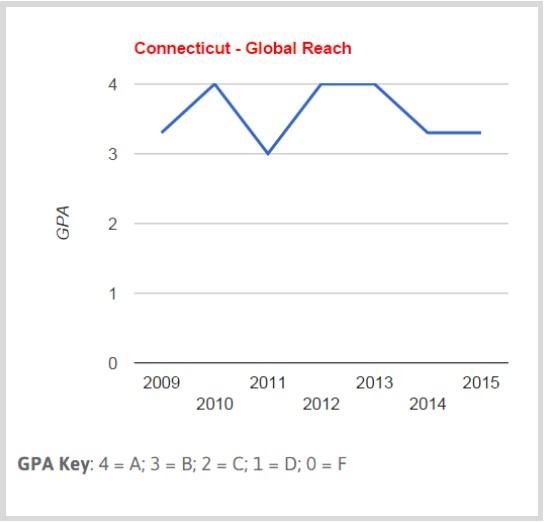
In the Global Reach category, in which Connecticut received a B+, only South Carolina, Ohio, Indiana, and Delaware received a higher grade.  Connecticut’s grade matched New Hampshire, placing Connecticut in the top six in that category.  The Ball State researchers indicated that “the level of international trade (in both imports and exports) is a robust measure of competitiveness in the production, movement and distribution of consumer durable and non-durable goods.”global reach

The university’s national report provided report cards to all fifty states in each of the categories.

The Center for Business and Economic Research is an economic policy and forecasting research center at Ball State University.  CBER research includes public finance, regional economics, manufacturing, transportation, and energy sector studies.

productivity and innovation

New Haven’s Square 9 Softworks Ranks #20 Among Nation’s Top 100 Inner City Businesses

The Inner City 100 are among the nation’s fastest-growing urban firms.  The list of the city-based businesses, thriving from coast to coast, is compiled by Initiative for a Competitive Inner City (ICIC) and featured in Fortune magazine.  The top firms range from a Philadelphia glass blowing outfit, to an Oakland-based 3D printing shop, from a high-end Brooklyn chocolatier to a New Haven software company, the only Connecticut company to earn a spot on the list. “America's urban core is filled with a wildly diverse array of fast-growing businesses,” Fortune points out in presenting this year's 100 fastest-growing inner city companies. Ranking at number 20 is Square 9 Softworks, a leading developer of innovative, business-centric software solutions, headquartered in New Haven. Square_9_Softworks_Logo

Education is paramount at Square 9 Softworks, the write-up by ICIC points out. The document management software maker “has led a number of tech-focused workshops for entrepreneurs in New Haven, as well as creating inner-city scholarships and business intern programs, while recruiting talent from local schools.”

DCIM100GOPRO

According to ICIC, half its employees are under 35 and come from area universities, and Square 9 plans to nearly double its workforce in two years. Clients and partners include Priceline, New York Life Insurance Company, Ohio State University, and Konica Minolta. According to Fortune and ICIC, the company’s 5-year growth rate is 489 percent, with 2014 revenue of $7.45 million.

The companies listed on “Inner City 100” list among the fastest-growing American companies in any location. Although based in the inner city, these companies derive more than half their revenues from regional, national and international sales, the ICIC explains.  The median firm is 11 years old with over $8 million in annual revenue, 45 full-time employees and a five-year compound annual growth rate (CAGR) of 39 percent.

The Inner City 100 Companies, according to the website listing, are producing jobs in their local communities, competitive advantage for their business partners and profits for their investors. Across all sectors, Inner City 100 firms are more productive than their sector peers throughout the U.S., according to U.S. Census data.

The top 10 companies:  Bithenergy (Baltimore); BWI (Indianapolis); Caduceus Healthcare (Atlanta); Rise Interactive (Chicago); Business Resource and Security Services (Washington DC); StreamLink Software (Cleveland); Concrete Constructors, Inc. (Jackson, MS); Impact Makers, Inc. (Richmond,VA); Creative Business Solutions, Inc. (Washington, DC); and The Onyx Company (Chicago).globalLogo

Square 9 Softworks is a privately held Connecticut-based corporation whose management team consists of tenured ECM industry professionals, according to the company’s website. Last month, Square 9 Softworks, announced that Buyers Laboratory LLC (BLI), the world’s leading independent evaluator of document imaging products and solutions, awarded Square 9’s “SmartSearch 4.2” the 2015 Summer Pick Award.

“SmartSearch is one of the few document management solutions that can be ideal for both large and small organizations,” said BLI Senior Editor, Jamie Bsales. “Unlike many document management systems, SmartSearch includes most functionality in the standard product, rather than requiring extra-cost add-ons. This makes SmartSearch much less expensive when matched feature-for-feature with other leading systems. Square 9’s SmartSearch has demonstrated to BLI its ability to satisfy complex business needs, streamline daily processes and increase productivity.”software

Square 9 is fully owner managed and as such is not subject to the direction of the markets or private equity, the website emphasizes. As a privately held corporation Square 9 has assumed a long term position of expanded growth and profitability, realizing triple digit growth in each of the four years from 2008 – 2011 while recording profitability in sixteen straight quarters, the website points out.2015-BLI

The Initiative for a Competitive Inner City (ICIC) is a nonprofit research and strategy organization and the leading authority on U.S. inner city economies and the businesses that thrive there. Founded in 1994 by Harvard Business School Professor Michael Porter, ICIC strengthens inner city economies by providing businesses, governments and investors with the most comprehensive and actionable information in the field about urban market opportunities. It is led by CEO Steve Grossman, a former Massachusetts State Treasurer and gubernatorial candidate.

https://youtu.be/5Z8qWU_nqLg


Nearly 2/3 of Americans Have Confidence in Charities, But More Than 1/3 Don’t, Survey Reveals

Almost two-thirds of Americans have confidence in charities, according to a new poll by the Chronicle of Philanthropy — the first to measure public views on the subject since 2008. Although most expressed “a great deal” or “a fair amount” of confidence in charitable organizations and more than 80 percent said charities do a very good or somewhat good job helping people, dissatisfaction was also expressed.  A significant number voiced concern about finances: a third said charities do a "not too good" or "not at all good" job spending money wisely; and 6 in 10 said their leaders are paid too much, the Chronicle reported.62

Half of those surveyed said that in deciding where they will donate, it is very important for them to know that charities spend a low amount on salaries, administration, and fundraising; 34 percent said that was somewhat important.  And 35 percent said they had little or no confidence in charities, the Chronicle underscored.

Maggie Gunther Osborn, President of the Connecticut Council for Philanthropy, points out that “in a new and positive era of transparency, better questions are being asked and more data provided about the positive impact of charities.  The sector is being asked to more openly communicate and be accountable to the public trust.  This is a good thing.”

“At the same time,” she added, “outliers and bad actors are publicized and amplified, tarnishing the sector and creating misinformation and incorrect perceptions.”

People who gave charities low marks on spending money wisely were asked what kind of spending they considered unwise. The biggest portion, 37 percent, cited salaries or other administrative costs. The second-highest answer, named by 11 percent, was advertising.50

Mary Cahalane, a Connecticut-based nonprofit fundraising consultant and author of the blog Hands On Fundraising, said that “Charities need to do a better job explaining the importance of our work to the general public. Surveys like this are instructive.”

The Chronicle poll, conducted by Princeton Survey Research Associates International, surveyed 1,000 adults in June, asking several questions identical to those included in polls that Princeton conducted from 2002 to 2008.

Americans rank charities higher than a range of other institutions. Fifteen percent said they had a great deal of confidence in charitable organizations over all, with 21 percent stating the same about charities in their own communities. Other institutions did not fare nearly as well.  In a June Gallup poll, only 4 percent said they had a great deal of confidence in Congress, 9 percent in big business, 10 percent in newspapers, and 12 percent in banks, public schools, and organized labor. The top scorers: the military (42 percent) and small business (34 percent), the Chronicle reported.Print

The survey found significant demographic differences in views toward charities. For example, young people were more positive than older people: 65 percent of 18- to 29-year-olds said they had a great deal or fair amount of confidence in charities, compared with 54 percent of people ages 65 and older. Republicans were more likely than Democrats to say nonprofits do a not-too-good or not-at-all-good job spending money wisely (38 percent and 22 percent, respectively), the Chronicle noted.

“Even the politicians are trying to highlight outliers in the sector to make statements about the whole which are creating false perceptions and in fact end up undermining the social purpose sector and creating false understandings,” Osborn explained.page-title-philanthropy

“It also undermines the ability of the sector to continue to care for the most vulnerable, lift up and advance our society through the arts and education and create ways to deal with safety, environmental and health shifts of enormous impact on our daily lives,” she continued.  “The majority of people, who have factual information or just faith, support and believe in the powerful good of the sector.”

Cahalane also noted three thoroughly debunked myths about charities, which nonetheless remain widely held, are reflected in the survey results:

  • Myth #1: Charities should spend every dollar on direct service. This has been called the “overhead myth”. Services can’t happen without administrative and fundraising support. Charities should spend money wisely, but looking at a ratio of service versus administration expenses is not wise. The largest watchdog groups have realized this, she points out.
  • Myth #2: Nonprofit staff don’t deserve to be paid for their work. Many staff people have years of specialized experience and skill. This is their profession, and they deserve to be paid fairly for their work. If charities are to run well, skilled people are needed to do the work. A few egregious examples of high executive salaries shouldn’t fool anyone: most in the industry make considerably less than they would in the for-profit world, Cahalane explains.
  • Myth #3: People make giving decisions based on low salaries or administrative costs. Most do not. Most give to organizations that make a good case for giving - organizations that move their hearts and align with their values, she emphasized.

80When asked in the survey about factors that influence their giving, the biggest portion, 68 percent, said it is very important the charity has evidence that its programs are effective. The other factors, in addition to the 50 percent who favored low overhead spending: the charity gets good ratings from watchdogs, 54 percent; it works on a cause that has affected me or my loved ones, 39 percent; it only occasionally asks for money, 27 percent; and I know people who work there, 24 percent.

In the survey, women had more confidence than men (66 percent to 57 percent) in charitable organizations, and college graduates had more than those with just some college (73 percent to 56 percent).  In 2008, 64 percent said they had a great deal or a fair amount of confidence in charities, compared with 62 percent in the new poll.

Update:  Additional Resource

Fairfield County and Westchester County Merge in Monthly Business Publication

For regular readers of the Fairfield County Business Journal, September ended with something new in the mailbox – a combined issue of that publication and the Westchester County Business Journal.  The monthly combined edition of the two weekly publications will occur the last week of each month, while the other three weeks will see a continuation of the separate publications covering the business news of the two neighboring counties in New York and Connecticut. As the publications stated, “the normally separate Fairfield and Westchester County Business Journals are combined this week in a glossy magazine format.  The look is new, but the journalism, ads and legal information remain true to our half-century tradition of excellence in publishing.”Westfair_Communications

Westfair Business Publications (Westfair), a privately held publishing firm located in White Plains, N.Y., publishes weekly business newspapers: the Westchester County Business Journal in combination with HV Biz (Hudson Valley Business) in New York state and the Fairfield County Business Journal in Connecticut.

With a weekly readership of more than 150,000, Westfair’s business publications reach business leaders and decision makers in seven counties (Westchester, Rockland, Putnam, Orange, Dutchess and Ulster in New York state, and Fairfield in Connecticut). The new monthly publication required a combining of the two mastheads, which was accomplished beginning with the premiere issue.issue

There is no question that the economic fates of the two counties are intertwined.  Earlier this month, the mayors of cities in both counties came together for a forum to explore common issues including economic development and transportation, concluding that they had “more similarities than differences,” according to published reports.

The Fairfield and Westchester Business Journals are nearly 50 years old and are the only weekly, countywide local business newspapers. They were founded by former Westchester resident David Moore, a grandson of celebrated New York publisher Joseph Pulitzer, and John Smith, a former Wall Street Journal editor.

WESTFAIRonline_logoAs the Westfair website describes, “In keeping with its founders’ principles, the newspapers focus on the local and regional business community with news and information that are helpful to business people. As a premier source of business information on matters of concern and interest …Westfair business publications and its website westfaironline.com, provide up-to-date news and information on issues important and pertinent to the regional business marketplace.”

With a staff of more than 30 industry professionals and several freelance writers and photographers and a highly informed insider network of business and community contacts in all the counties covered, Westfair brings timely business news and information in all its publications to its readers, the website points out. As is true of many business publications in Connecticut and across the country, Westfair also sponsors seminars, expos, conferences, roundtable discussions and debates, and the popular annual 40 Under 40 competition that highlights the region’s young business leaders.

Four CT Businesses Among Finalists in Martha Stewart American Made Competition

Four Connecticut small businesses owners and entrepreneurs are among the finalists selected in the Martha Stewart American Made contest, which highlights the creativity in design, crafts, food and style that is thriving nationwide.  Members of the public can vote on-line for their favorites, with the winners to be announced later this month.  The Connecticut-based finalists operate in Hartford, Bridgeport, East Lyme and Stafford Springs. “Made in America” means that “all or virtually all” of the product has been made in America—that is, all significant parts, processing, and labor that go into the product must be of U.S. origin. Products should not contain any—or should contain only negligible—foreign material. logo-am-stacked

The descriptions of the Connecticut-based finalists:

  • American Woolen (Stafford Springs - Design Finalist) is re-introducing excellence in domestic textile manufacturing and re-establishing the American "Metropolitan" style aesthetic. American Woolen occupies a red brick, textile mill in northeastern Connecticut. Originally constructed in 1853 and subsequently extended in 1919, the building offers textured surfaces and colors that provide continuous inspiration for our fabric collections.
  • Paloma's Nest (East Lyme - Design Finalist) creates new traditions for modern families- heirloom gifts that celebrate wedding, baby, home & holiday. It is the creative work of husband and wife team Jose Vasquez-Corbalan and Caroline Colom Vasquez. Designing together since the day they met (literally designing furniture on cocktail napkins), the pair handcrafts each and every Paloma's Nest item in their coastal Connecticut studio from fine wood and clay materials.studio2
  • Raw Material (Bridgeport - Crafts Finalist) is one part street, one part rural Americana. The business’s DIY Knit Kits let anyone create luxe fashion with American-spun merino and alpaca yarn.  Raw Material is a collaboration between mill, woodworker and knitwear maker, using American fiber, spun in an artisan mill. The business works out of a studio in Bridgeport, CT in the American Fabrics Art Building.
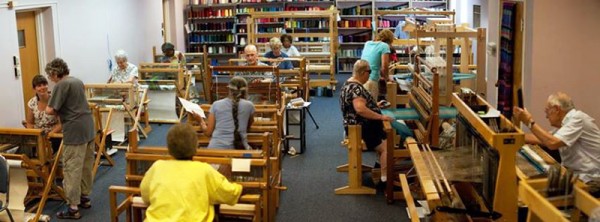
  • Hartford Artisans Weaving Center’s (Hartford - Crafts Finalist) mission is to promote the craft of hand weaving in a supportive and creative community to individuals with low or no vision or senior in age. People may enroll in the program to get out of the house, to learn a new craft, or to earn extra income; however, “they find far more at our center. They form social bonds, dispelling the loneliness and isolation so common among sight-impaired, blind, and/or senior people,” the website points out.

OLYMPUS DIGITAL CAMERA

Creative entrepreneurs and small business owners were encouraged to enter the Martha Stewart American Made Choice competition. From all the published nominees, up to 1,000 finalists have been selected to compete for the American Made Awards across the categories of crafts, design, food, and style. Of these finalists, up to 500 will be handpicked by a panel of judges. From the entire pool of finalists, one winner will be selected. Voting ends on October 19, 2015 at midnight.  The Audience Choice Award Winner will be announced on or about October 23, 2015.

American Made “spotlights the maker, supports the local, and celebrates the handmade,” according to the competition’s website.  The program is made up of people and communities that have “turned their passion for quality craftsmanship and well-designed goods into a way of life.” The categories are Crafts, Design, Food and Style.

Martha Stewart and the executive editorial team of Martha Stewart Living will serve as category judges and oversee the selection process of the finalists. The judges will base their selections on the following criteria: Innovativeness, demonstrated creativity, and originality of idea; workmanship; appearance; and embodiment of an American made theme.

https://youtu.be/9i56efixOLY

https://youtu.be/jadOiFFFA5Q

Aurora Foundation Grants Focus on College Preparedness, College Completion for Region's Girls

The Aurora Foundation, which supports women and girls in Greater Hartford, has awarded a $20,000 grant to Trinity College and four partner organizations to launch Free to Succeed, a pilot program designed to increase higher education opportunities for women being released from prison in Connecticut.  The grant is the largest among ten grants, focused on college preparation and college completion, being provided to ten organizations, totaling $92,000. By forging a collaborative initiative, the Trinity Prison Seminar Series, Capital Community College (CCC), Manchester Community College (MCC), Community Partners in Action, and Judy Dworin Performance Project have created a program providing accessible college-level course offerings, advising, arts engagement, and mentoring for female inmates at York Correctional Institution (YCI), the state’s only prison for women, and pivotal support services after their release to expedite enrollment in associate degree programs at CCC and MCC.aurora_logo_new2

At Trinity, Judy Dworin, professor of theater and dance, emerita, and Sheila Fisher, professor of English and coordinator of the Trinity Prison Seminar Series, were instrumental in developing Free to Succeed, the goal of which is to ensure that participating women, who begin taking college classes while still incarcerated, are able to complete an associate’s degree upon release.

Since 2005, Dworin’s nonprofit organization, Judy Dworin Performance Project (JDPP), has offered comprehensive arts outreach programs for women, children, and families affected by incarceration. The Trinity Prison Seminar Series (TPSS), since 2012, has provided post-secondary credit-bearing courses for women incarcerated at YCI. Prison education outreach efforts at Trinity College provide educational opportunities for Trinity undergraduates to investigate critical issues concerning the correctional system through reading and discussion, as well as through field study.

The Aurora Foundation will also be providing a $15,000 grant to the University of Saint Joseph (USJ) for a new initiative, Inspiring College Readiness &aurora Increasing College Retention for Minority Women in the Greater Hartford area. This new program will provide a stipend for USJ Latina students to complete an internship at either the Connecticut Department of Children and Families or the USJ Gengras Center. It will also provide inspiration to Bulkeley high school girls to hear from the USJ students about exploring careers and remaining in school.

The Urban League of Greater Hartford’s Project Ready College Success Program, GO, GIRLS! leverages an existing program and will pilot its first minority female cohort. This program, which also is to receive a $10,000 grant from Aurora Foundation, “has the potential for being a model to replicate at other Urban Leagues.,” according to the Foundation. The grant will enhance and expand its existing program designed to provide college preparation and retention services to at-risk minority females to increase the likelihood that they will enroll in and succeed in attaining college degrees.

The Women in Transition (WIT) program at Charter Oak State College is an initiative that provides the opportunity for single, underemployed and underserved mothers to earn a college degree on-line. A $10,000 grant from Aurora Foundation will cover the cost of tuition and fees, books and internet service. The Women in Transition Program was established in 1999 by the former President of Charter Oak State College, Dr. Merle Harris.

The Aurora Foundation, which partnered with the Farmington Bank Community Foundation to support Free to Succeed, is currently focusing strategic grant making and community initiatives in the areas of college readiness and retention, based on findings from the organization’s 2014 Aurora Report indicating that college completion is critical to a woman’s economic stability and well-being, as well as that of her family.  Grants are also being provided to the University of Hartford’s Women’s Advancement Initiative, the Hartford region YWCA, Grace Academy, Goodwin College’s Women Investing in Secure Education (WISE) program, and the Boys & Girls Club of Hartford.

The organization’s website stresses that “As we move into our planning for the 2016 grants cycle, we will be increasingly focused on partnering with organizations with programs proven to help females complete their college education, knowing how important a post-secondary degree is to economic self-sufficiency that women seek for themselves and their families.”

Trinity College President Joanne Berger-Sweeney will be the keynote speaker at the foundation’s 10th Annual Signature Breakfast on October 16.  The theme is “Driving Change for Women.”