Health Care Providers, Insurers Need to Collaborate to Improve Care, Rein in Costs

When Eric Schultz began his keynote remarks, the President and CEO of Massachusetts-based Harvard Pilgrim Health Care made sure to alert his audience to his homegrown pedigree.  Whether his youth in the Naugatuck Valley, college years (five of them) at UConn, or graduate work at Yale contributed to Harvard Pilgrim’s more-than-solid inaugural years doing business in Connecticut isn’t certain, but the above-expectations numbers are indisputable.  And Schmitt made clear that his nonprofit health insurance company is looking for even greater achievements in his home state.schultz Since entering the Connecticut market in the summer of 2014, the company has been aggressively growing its customer base in a competitive market while working diligently to grow and expand its network of doctors.  Harvard Pilgrim Health Care announced recently that its Connecticut membership has grown to more than 24,000, exceeding expectations for 2015. It now serves more than 800 Connecticut businesses.  Twenty-nine of the state’s 30 hospitals are now in-network.
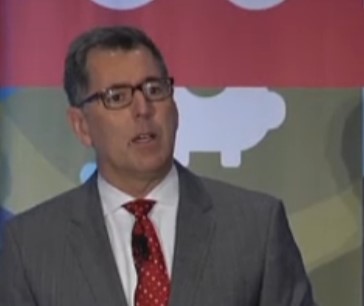

logo_harvard-pilgrimWith more than 500 business leaders in attendance at an annual Economic Summit & Outlook last week, brought together by the Connecticut Business and Industry Association and MetroHartford Alliance, Schmitt spent some time touting a new model launched in the state of New Hampshire that he believes may be a glimpse into the direction the industry is moving. Harvard Pilgrim Health Care’s footprint in New England now covers “where 90 percent of New Englanders live,” in Massachusetts, Connecticut, Maine and New Hampshire. quote
Schultz, who succeeded now-Massachusetts Governor Charlie Baker in leading the organization five years ago, pointed to what he described as “a practical example of how an insurance company and groups of providers can work together to get control of medical cost trends and to help improve medical outcomes and help create better experiences for physicians and their patients.”

The goals, Shultz explained, are to reduce insurance premium trends by 10 to 15 percent, to improve clinical outcomes, to create a better “practice environment” for medical staff and to grow business.  The partnership is driven to “produce something that’s better than what we have today, because we know the financing of health care is largely broken in the U.S.”

economic summitLaunched in October 2015 and in business as of January 1, Benevera Health, a joint venture led by senior leadership at Harvard Pilgrim Health Care and Dartmouth-Hitchcock, is a population health company, centered around “clinical and medical informatics.”  Dartmouth-Hitchcock, a nonprofit academic health system that serves a patient population of 1.2 million in New Hampshire and Vermont, is led by Dr. James Weinstein, recently named as one of “100 Physician Leaders to Know” by a national health care trade publication.

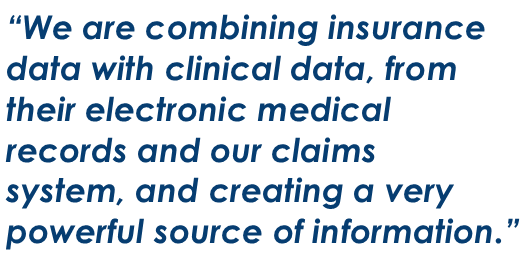
“We are combining insurance data with clinical data,” Schultz said, “from their electronic medical records and our claims system, and creating a very powerful source of information.”  That information, he stressed, could be used to better understand what’s happening in regards to patient care, and it can help to redesign and improve clinical care.  This has the potential to be especially important in chronically ill patients, noting that 10 percent of patients drive 50 percent of health care costs.  “It is a great financial opportunity and a great clinical opportunity.”

“The magic,” Shultz noted, is in having the provider and the payer sit down together and figure out” what should be done.  Too often in the past, he said, providers and insurers haven’t gotten together – a lack of cooperation and collaboration that contributes to higher costs and to disconnects regarding patient care.  His expectation is the Benevera will “reduce headaches” that insurance companies often cause providers, reduce duplication and costs, and improve patient care. cbia alliance
In fact, when the new venture was launched last fall, officials from the two companies stressed that the groundbreaking entity, “will take health care coordination to a new level by bringing together clinical, financial and operational data from across partner institutions to provide actionable analytics for clinicians to further improve the quality and efficiency of patient care.”  They added that  “at the center of this approach will be locally-based care advocates who will identify early opportunities to engage patients – especially those with chronic, complex or emerging conditions - and provide them with one-on-one support.”

Schultz noted that insurance companies tend to resist providers suggesting how insurance plans ought to be designed.  He disagrees with that resistance.  “If more insurers took more input from providers on plan design, we’d be a lot better off.”

Harvard Pilgrim is the only not-for-profit, regional health plan operating in four contiguous New England states.  Harvard Pilgrim’s flagship health plans in New England provide health coverage to 1.3 million members, while another 1.4 million individuals are served through Health Plans, Inc., a subsidiary that provides integrated care management, health coaching and plan administration solutions to self-funded employers nationwide.  Schultz holds an MBA in Health Care Leadership from Yale University’s School of Management, as well as a bachelor of science degree in biology and a bachelor of arts degree in economics from the University of Connecticut.

“We’re about change and driving change,” Schultz told those attending the Hartford summit, “and I believe we need to do more of that.”  He’s hoping to build a similar structure in Connecticut, and in other states around the country, because “it’s exactly what we need to do.”

Link to CT-N video of Economic Summit & Outlook.

Increasing Percentage of Children in Single-Parent Families; CT 21st in US

Single-parent households are growing more common across the U.S., new research reveals.  Connecticut ranks 21st in the percentage of children in single-parent families, although the number has steadily climbed in Connecticut as nationwide, according to data compiled by the Annie E. Casey Foundation.data Nearly 25 million children— 35% of the country’s children — lived in single-parent families in 2014, the latest full-year data.  That is an increase of 392,000 since 2010.

In Connecticut, the percentage has grown from 32 percent in 2010 to 34 percent in 2014, an increase of 3,000 children in single-parent families, but keeping the state below the national average.  In 2000, the percentage in Connecticut was 27 percent, with 211,000 children in single-parent families, compared with 252,000 in 2014, according to the data.kids

Compared with children in married-couple families, those raised by one parent are more likely to drop out of school, have or cause a teen pregnancy and get divorced as an adult, according to research.

Forty-six states reported an uptick in the number of children raised in single parent households, with the largest jumps occurring in New Hampshire and Delaware.

Utah has the lowest incidence of kids being raised by one parent (19%) followed by Idaho (26%), Wyoming (27%), Minnesota (29%), Iowa (29%), North Dakota (29%) and Nebraska (29%).  Louisiana (47%) and Mississippi (47%) top the list, with nearly half of all kids growing up in single-parent families.  The other states with a high percentage of single-parent children are South Carolina (43%), Delaware (42%) and New Mexico (41%).map

The report, released last month, also found that nationwide 26 perlogocent of children live in mother-only households and 8 percent live in father-only households.  Those numbers are virtually unchanged since 2010.  Back in 2000, however, 69 percent of children lived in married-couple households, 25 percent in mother-only homes and 6 percent in father-only households.

In Connecticut, the percentage of children living in married-couple households has fallen from 74 percent in 2000 to 67 percent in 2014.  The percentage of children living in mother-only households has increased from 21 percent to 26 percent, while the number of children in father –only households has grown by 16,000 between 2000 and 2014, from 5 percent of children to 7 percent of children.


PERSPECTIVE: Fiduciary Duty - A Pledge Board Members Need to Uphold

by Lisa Wills The whole of an organization is only as strong as the composition of its board.

Many individuals become nonprofit board members because of their passion for the entity’s mission.  Once the organization determines the member is a fit, it’s assumed that the pledge to honor and uphold the fiduciary duties will naturally follow.

PageLines- CTperspective.jpgThe benefits of sitting on a board are innumerable.  However, board members who use their position for surreptitious gains and lose sight of their responsibility to uphold the organization’s best interests, or are not fully paying attention, may wind up in one of these scenarios.


Recently, a jury verdict against the board of directors of Lemington Home for the Aged, a nonprofit nursing home, was upheld by the U.S Circuit Court of Appeals.  The directors were found personally liable for breach of their duty of care for failure to remove the CFO of the nursing home after learning of his mismanagement of the entity.

New York Attorney General Eric Schneiderman has called for an investigation of the board members of The Cooper Union for the Advancement of Science and Art over alleged mismanagement of the higher education institution’s endowment and physical assets.  Their actions caused the school to charge undergraduates tuition for the first time in its history.

The lack of transparency by Sweet Briar College’s board of trustees led to legal action after the board failed to communicate to its constituents the accuracy of their financial situation, yet in turn, voted to abruptly close the institution.  After a long legal battle, a settlement was reached in June 2015 to keep the institution open, with several conditions, one being the resignation of the entire board of trustees.

These are just a few of the national headlines that exhort us to question how serious some nonprofit board members take their fiduciary responsibilities. These responsibilities are known as the duties of care, loyalty and obedience.quote

Board members are expected to exercise reasonable care when making decisions on behalf of the entity in which they serve.  In instances where they do not exercise such care, board members may be held personally liable.

Increased scrutiny over the activities and decisions of nonprofit boards may result in members and prospective members evaluating if their involvement is worth the risk.  There are some key practices that board members need to uphold as assurance that they are exercising fiduciary responsibilities:

  • Know the entity – Read and understand the articles of incorporation and bylaws, and ensure that documents are updated and amended as appropriate. Be aware of pending and threatened legal claims against the entity.
  • Be informed of strategic initiatives – Read the organization-wide long-term, strategic plan. Understand the financial and economic challenges facing the entity and the industry, as a whole.
  • Stay informed of financial activities – Understand significant components of the annual budget, encourage regular reporting of financial information, review the annual audit report and management recommendations with the external auditors.
  • Understand conflict of interest policy – Be aware of potential conflicts of personal and professional conflicts of interest between the board member, a family member or an employee and the nonprofit entity. Disclose conflicts of interest and abstain from board votes where appropriate.
  • Understand the nonprofit entity’s indemnification policies – Ensure that the entity’s policies provide for indemnification of its board members, and that there is a directors’ and officers’ liability policy in place to cover claims arising from board service.
  • Prepare for and attend board meetings – Review board minutes and financial statements in advance of meetings, which will allow you to be an active participant and ask questions and understand the issues.  Don’t be afraid to roll up your sleeves.
  • Always use good judgement - Remember that the fiduciary responsibility requires board members to make decisions that are both prudent and informed.

Board members receive great satisfaction from their involvement and should feel that, in exercising due care, they have acted in the best interest of the nonprofit in furthering the mission and making a difference.

___________________________

Lisa Wills is an audit director with Whittlesey & Hadley, P.C.  She specializes in audits of nonprofit organizations.


PERSPECTIVE commentaries by contributing writers from across the state appear each Sunday on Connecticut by the Numbers.

Cellphone Likely Won’t Tell 911 Operator Your Location

The Federal Communications Commission has estimated that about 70 percent of 911 calls are placed from wireless phones, and that percentage is growing. For many Americans, according to the federal agency, “the ability to call 911 for help in an emergency is one of the main reasons they own a wireless phone.”  Yet, in an emergency, a cell phone may provide potential first responders with less information than one would expect. The National Emergency Number Association (NENA),which represents dispatchers, supervisors and private-sector service providers, points out that “when 9-1-1 calls are made from wireless phones, the call may not be routed to the most appropriate 9-1-1 center, and the call taker doesn't receive the callback phone number or the location of the caller. This presents life threatening problems due to lost response time, if callers are unable to speak or don't know where they are, or if they don't know their wireless phone callback number and the call is dropped.”  The organization’s motto is “emergency help, any time, anywhere, any device.”911 cell call

Recent published reports in Governing magazine indicate that “when you check movie times on your cellphone, search for a restaurant or hail a ride, the device automatically knows exactly where you are and can suggest things nearby. So it’s understandable that many people assume the same holds true when they call 911 for emergency assistance.  But the fact is, 911 call centers frequently receive imprecise locations of callers from wireless carriers -- and some don’t get any location information at all. Calls from landline phones are linked to addresses.”

The FCC website explains that “since wireless phones are mobile, they are not associated with one fixed location or address. While the location of the cell site closest to the 911 caller may provide a general indication of the caller's location, that information is not always specific enough for rescue personnel to deliver assistance to the caller quickly.”

More reliable and specific location information could save lives, advocates say, and earlier this year an order from the Federal Communications Commission (FCC) set targets for companies to improve both the availability and accuracy of location information. But those upgrades remain a long way off.EmergencyResponse

Under the new rules, carriers will have to provide caller location info within 50 meters 80 percent of the time by 2021, along with vertical location information, if the call is being made from an apartment building or high rise office tower -- that would have to be in place in major markets by 2023.

Some have said the industry needs to provide those capabilities much sooner.  While 911 dispatchers routinely ask callers for their location, callers at times hang up before providing that information, for any number of reasons. And, they argue, if a cell phone knows where you are, that information should be instantly made available to 911 dispatchers as well.

The latest FCC guidelines are available for public review.  “We would have liked to have seen a more compressed timetable,” NENA CEO Brian Fontes told Governing.

Published reports in Connecticut indicate that some communities are moving forward with new technology.  The town of Wolcott, according to reports, has begun using a system that will allow police to pinpoint the location of emergency calls made from cell phones.  The Republican-American newspaper reports the town was the first in the state to use the next-generation system in a pilot program that was slated to include the New Britain, Wilton, Enfield, Newington, Valley Shore, Fairfield, Middletown, Mashantucket and Shelton police departments .  The new system shows dispatchers the caller’s location within a 50-foot radius, compared with the old system  which would indicate the location of a wireless 911 call within a quarter-mile radius.

Plans are also in the works that would permit individuals to text 911 from their cell phones.  The CT Post reported last month that about 24 dispatch centers out of 110 statewide are being upgraded to the text-to-911 system. Stratford and Fairfield will be among the first towns in the state to get the texting capability. Officials hope the entire state will have text-to-911 by late 2016 or early 2017, the newspaper reported.


Newman's Own Foundation Awards $1.5 Million in Grants to Military Service Organizations, Including 8 in Connecticut

In celebration of its 10th anniversary, Newman’s Own Foundation is awarding $1.5 million in grants to 29 organizations – including eight in Connecticut - that provide services to military men, women, veterans, and their families. Based in Westport, Newman’s Own Foundation’s awards will benefit more Connecticut nonprofit organizations than in any other state; more than one-quarter of the total number of organizations slated to receive funds. Paul Newman, the late actor and philanthropist, established Newman’s Own Foundation in 2005 to carry on his philanthropic legacy after he started Newman’s Own, the food company, in 1982 with all profits going to charity. Less well known is that Newman was a World War II veteran.  According to the organization’s website, he enlisted in the United States Navy after high school, serving in the Pacific during World War II.ownlogo

“One particular experience provided the core of his belief about luck and humility. In Saipan, the pilot of his crew became sick, grounding their bomber. The rest of Paul’s squadron was ordered to deploy aboard the USS Bunker Hill and days later were killed by kamikaze aircraft. It was simply luck that Paul had not been aboard. He attributed much of his success in life to luck, and what followed was a commitment to give back to those who were perhaps not so lucky,” the website explains.

The organizations receiving the grants provide a wide variety of support to veterans, including physical/mental rehabilitation, career development, entrepreneurship, education, and housing. There are also organizations that focus on female veterans.  The organizations and services are located across the country.

The Connecticut organizations are Applied Behavioral Rehabilitation Institute, Inc. (Bridgeport), Columbus House (New Haven), Connecticut Public Broadcasting Network (Hartford), Connecticut Veterans Legal Center (West Haven), Fidelco Guide Dog Foundation, Inc. (Bloomfield), Help Our Military Heroes, Inc. (Easton), Work Vessels for Veterans, Inc. (Noank), and Workplace, Inc. (Bridgeport).

“Our men and women in uniform make great sacrifices in their own lives to protect the unique freedom, privileges, and opportunities we enjoy as Americans. It is not so much a responsibility to support them, but more a privilege to express our gratitude for their service,” said Robert Forrester, President and CEO of Newman’s Own Foundation, who served in Vietnam as an Army officer.  “We’re proud to fund these organizations that provide services for military personnel, veterans, and their families.”military

Military nonprofit organizations have been supported for over 20 years, with a total of $12 million donated since 2010, alone. In addition to the Foundation grants, Newman’s Own, Inc. has supported military service charities through the Newman’s Own Awards for 16 years, in partnership with Fisher House Foundation and Military Times.

Since the Foundation was founded, more than $280 million has been donated to charitable organizations around the world. The grants reached across international borders and countless organizations that addressed needs such as serious illness, hunger, homelessness, disaster relief, environmental issues, and education. Today the Foundation has four primary focus areas: Philanthropy, Children with Life Limiting Conditions, Empowerment, and Nutrition.   More information is available at: http://newmansownfoundation.org/military

Income Inequality in CT's 4th Congressional District is 4th Largest Gap in Nation; 2nd District Has Least Income Inequality in State

Connecticut’s 4th Congressional district, centered in Fairfield Country, has been ranked as the district with the 4th highest level income inequity in the nation.  A year ago, the 4th C.D. was ranked fifth. A ranking of congressional districts of by their level of income inequality, conducted by Bloomberg, uses the Gini coefficient, a formula that measures the distribution of income across a population. The closer a Gini number is to 1, the greater the level of inequality; the closer to zero, the closer to perfect equality. The average score for the United States was 0.4804.

All of Connecticut’s ctcountiesCongressional Districts, with the exception of the Fourth District, did better than the national average in the degree of income inequality.

Bloomberg Businessweek has previously pointed out that the U.S. congressional districts with the most inequality share certain traits: “they contain a small, enormously wealthy elite surrounded by impoverished neighbors.” Most of the districts with the greatest disparity are located in or near major urban metropolitan areas.

The greatest income inequality in the most recent analysis indicated that the Congressional Districts with the most income inequality are Pennsylvania’s 2nd District, New York’s 10th District, and Florida’s 27th District.  Following Connecticut’s 4th District on the list are Illinois; 7th District, and three additional Congressional Districts in New York – the 12th, 7th and 16th.  Rounding out the 10 C.D.’s with the most income inequality are Ohio’s 11th District and Georgia’s 5th District.inequality

In Connecticut’s 4th Congressional District, which includes Bridgeport, the state’s largest city, as well as the communities often referred to as the “Gold Coast,” 59.3 percent of the population has household income in the highest quintile, while 6.7 percent of households have income below the poverty level.

Connecticut’s 5th Congressional District (.4810) ranked number 88 on the list of Congressional Districts with the most income inequality among residents.  The state’s 3rd Congressional District (.4792) ranked at number 95, and the 1st C.D. (.4631) at number 175.  Much later in the rankings, Connecticut’s 2nd District (.4261) came in at number 387, indicating it is the C.D. in Connecticut with the least income inequality.

The Gini coefficient, which is calculated by the U.S. Census from household income share by quintiles, was used to measure distribution of wealth. It ranges from zero, which reflects absolute equality, to one, complete inequality. The data was updated in November 2015, using 2014 data.  In 2014, a person living alone making less than $12,071 was classified as in poverty. The threshold increases for each additional household member and varies by the number of adults and children in each household.


CT Start-Up Wins MassChallenge, Takes Home $300,000 to Advance Work in Glucose Monitoring

Connecticut-based Biorasis, with roots at UConn, was recently awarded the MassChallenge’s top prize at their annual awards ceremony in Boston.  The company was one of only four “Diamond Winners,” receiving a cash prize of $100,000. They were also one of two teams to receive the Sidecar Award, providing an additional $200,000 in non-dilutive funding. Biorasis Inc. is a rapidly growing medical device company committed to advancing the field of metabolic monitoring through development of implantable biosensor platforms and basic research in the areas of drug delivery, nanotechnology and microelectronics.  The company’s goal is to vastly improve the quality of life of diabetics.biorasis-inc-logo

The technology developed by Biorasis, the Glucowizzard™, is an ultra-small implantable biosensor for continuous, reliable glucose monitoring. This needle-implantable device wirelessly transmits glucose levels to a watch-like unit for real-time display, which in turn communicates with personal digital accessories like a smartphone. Continuous metabolic monitoring “holds great potential to provide an early indication of various body disorders and diseases,” the company website explains, adding that Biorasis’ implantable multi-sensor platform is “capable of such real-time, continuous monitoring.”MC

Biorasis is in the business of developing a miniaturized, hypodermic-injectable biosensor for reliable continuous glucose monitoring (CGM) with autonomous operation for 3-6 months that requires no user intervention.

Their solution “eliminates surgery for sensor implantation and extraction, restores active life style, enables remote care for juveniles and the elderly, enhances compliance, and saves 50-70% in annual healthcare costs.”

The company’s co-founders and scientific advisors are:

  • Faquir Jaina, a Professor of Electrical & Computer Engineering at the University of Connecticut. He has over 35 years of experience in design, modeling and fabrication of micro/opto-electronic devices, integrated circuits and multiple quantum-well light valves/modulators.
  • Fotios Papadimitrakopoulos, a Professor of Chemistry and Associate Director of the Institute of Materials Science at University of Connecticut. He has over 20 years of experience in the areas of polymers, nano/bio-systems and supramolecular assembly of nanostructures.

The company continues to grow, and their scientific team is currently expanding. The Biorasis website indicates that the company is seeking individuals with “a proven track record and experience in the areas of medical devices, electrochemistry, polymer science, pharmaceutics, animal studies, microelectronics and device packaging.” Inquiries can be directed to Biorasis at the UCONN Technology Incubation Program in Storrs.  Additional investors are also being sought.

mass challengeMassChallenge, an independent nonprofit organization, envisions “a creative and inspired society in which everyone recognizes that they can define their future, and is empowered to maximize their impact.” They note that “novice entrepreneurs require advice, resources and funding to bring their ideas to fruition. Currently there is a gap between the resources these entrepreneurs need and the ability of the entrepreneurial ecosystem to provide them.” To bridge that gap, the organization’s primary activities include running an annual global accelerator program and startup competition, documenting and organizing key resources, and organizing training and networking events.  They “connect entrepreneurs with the resources they need to launch and succeed immediately.”

 

CT is a Top-10 State in Energy Efficiency, Recent Growth of Solar Power Capacity

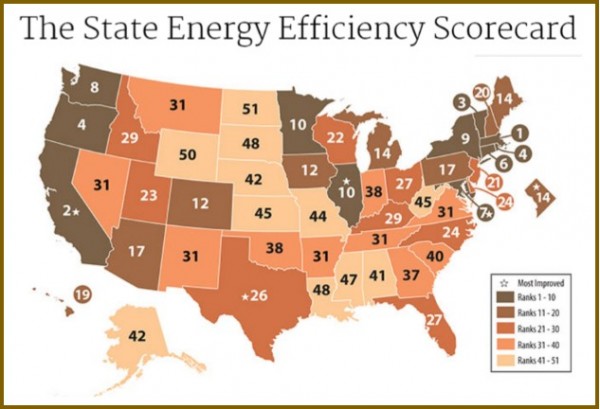
An annual ranking from the American Council for an Energy-Efficient Economy (ACEEE) rated Connecticut among the top ten energy-efficient states in the country along with Massachusetts, California, Vermont, Rhode Island, Oregon, Maryland, Washington, and New York, with Minnesota and Illinois tied for 10th place. Connecticut was noted for its financial incentives and energy efficiency investments. The state  ranked 6th in the 2015 State Energy Efficiency Scorecard, the same position it held in 2014. The state also earned the same number of points as it did in 2014, totaling 35.5 points out of 50.logo

According to the report, “Connecticut’s leadership is committed to pursuing policies that encourage energy efficiency within the state, although processes like building code adoption have moved relatively slowly in recent years. Connecticut has put significant resources behind the launching of its green bank. While there are signs of early success, these projects will need to be closely tracked as other states look to Connecticut as an example. Connecticut will need to realize even higher levels of savings in the future in order to remain in the top tier and meet state energy savings targets.”

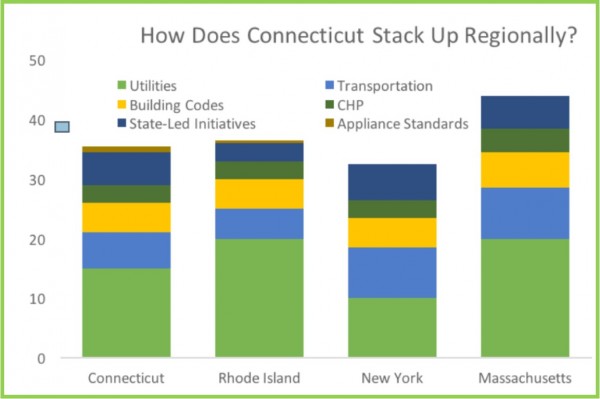
Connecticut earned 15 out of 20 points for its utility policies and programs, 6 points out of a possible 10 points for transportation policies, 5 points out of 7 for its building energy code stringency aenergy efficiencynd compliance efforts, earned 3 points out of 4 for its combined heat and power policies and programs, 5.5 out of 7 points for state-led energy efficiency initiatives, and 1 point out of 2 for appliance standards.
At the bottom of the list were Mississippi, South Dakota, Louisiana, Wyoming and North Dakota.

The ACEEE also developed a similar rating system for the nation’s largest cities, ranking the top 50.  Leading the list were Boston, New York City, Washington, San Francisco, Seattle, Chicago, Minneapolis, Portland, Austin and Denver.  The only Connecticut city to crack the top 50, Hartford, ranked at number 45.  Connecticut’s Capitol City earned 23 points out of a possible 100, in an analysis that included local government operations, community-wide initiatives, building policies, energy & water utilities, and transportation.

The report noted that “policymakers, regulators, and citizens are increasingly recognizing that energy efficiency is a crucially important resource. States and localities are leading the way when it comes to implementing energy-efficient policies and programs.”

The American Council for an Energy-Efficient Economy (ACEEE), a nonprofit, 501(c)(3) organization, acts as a catalyst to advance energy efficiency policies, programs, technologies, investments, and behaviors. The organization believes that “the United States can harness the full potential of energy efficiency to achieve greater economic prosperity, energy security, and environmental protection for all its people.”

Another  recent study, “Lighting the Way III: The Top States that Helped Drive America’s Solar Energy Boom in 2014,” by the research and policy arm of Environment Connecticut finds Connecticut ranks 10th nationally for solar power capacity per capita installed in 2014, with 13 watts of solar electric capacity per person installed last year. Nevada led all of the states in 2014, with 119 watts per capita, according to the study. Part of this success is credited to supportive state policymaking.  The organization points out that “solar power has tripled in the U.S. in the last two years, with another American family or business going solar every four minutes.  That’s in part because the price of solar has dropped more than 50 percent since 2011.”

They add that “research shows the cities and states with the most solar power aren’t necessarily the ones with the most sunshine; they also include states with smart pro-solar policies.  States like Connecticut have outpaced sunnier locales like Florida because of policies that allow increasing numbers of homeowners, businesses, communities and utilities to go solar.”

regionallyolar power in Connecticut has grown 221 percent per Capita since 2012, ranking the state 13th in the nation, the report points out. The top solar growth states in the nation, like Connecticut, have adopted renewable energy requirements, strong laws allowing solar customers to sell their excess power to the electric grid, and other policies encouraging growth of the industry, the report indicates.  The industry is also adding jobs much faster than the overall economy, employing 1,600 people in Connecticut last year, according to www.solarstates.org
“Demand for solar power in Connecticut is growing exponentially,” said Bryan Garcia, President and CEO of the Connecticut Green Bank. “Consumers continue to demand solar power despite a 70 percent reduction in state incentives. In fact, increased private investment has enabled the market to offer lease and loan products that deliver immediate positive cash flow to consumers. This makes solar PV a cleaner, cheaper and more reliable alternativeCTE_logo_notag_1."

Bipartisan legislation signed by Governor Malloy earlier this year lays a foundation for continued growth of solar power, and jobs, in Connecticut, Environment Connecticut points out, citing the stated goal of building enough residential solar systems to power over 40,000 homes in the state by 2022.

PERSPECTIVE: Here Today and Gone by January, 2030

by Peter Eder In our unending and ever accelerating pace of societal change, it might be productive to reflect on what will not be here in fifteen short years.  Looking into our crystal balls might just help us prepare to cope with changing aspects of our society.  Here are some observations.

“Full time employees” will be as extinct as “telephone switchboard operators”, and the Social Contract, no longer applying to employee / employer relationships, will only be found in the writings of Rousseau.

PageLines- CTperspective.jpgUnited States currency will have value only to Numismatists, as a global currency replacing dollars, yuans, reals and rupees will be in increasingly electronic usage.  And that currency will be paperless and coinless.  In a visit to China last year, it was somewhat surprising to discover that in Beijing, coins are no longer used.  All expenses are rounded up or down to the nearest paper yuan.

Un-earmarked charitable donations will have been replaced by the omnipresent cause-related giving permeated as a marketing and public relations strategy, and as the wealthy lay claim to their own branded intent to stamp jan 3 quoteout specific illnesses or perceived social injustices.
Genders will be non-existent in civil law, in fashion, fragrance ... and everyday life.  Labels like Mr., Mrs., and Ms. are already being replaced by Mx.

Individual privacy will have disappeared caused by individual indifference, data clouds, drones, face recognition and surveillance-everywhere cameras, and corporate and governmental manipulations of regulations.

Public place quiet will have also disappeared, thanks to ubiquitous and intrusive electronic gadgets, visual and audio advertising everywhere, and ego driven social manners.

A balkanized internet will have replaced the World Wide Web, as the war over ownership and manipulation of all forms of communications becomes an attractive replacement, or at least a supplement to, “conventional” warfare.

Brick and mortar general public libraries will have gone the way of most houses of worship, as we move into the Paper-less Books and Godless Society. The Divine Being worship vacuum will be partially filled by zealots preaching over electronic outlets.  A substantial number of church structures will be converted into museums, or studio sets for those wishing “traditional” marriage photos.

What is in your crystal ball?

____________________________________

Peter F. Eder is a retired marketing executive, AARP Connecticut community volunteer and a founding board member of At Home In Darien, his community aging-in-place organization.  Throughout his career, he has been involved with local and national organizations within the communications arena and in responding to acute needs of people in our communities.

PERSPECTIVE commentaries by contributing writers from across the state appear each Sunday on Connecticut by the Numbers.


Hartford Radio Ratings Reflect Dominance of FM Stations

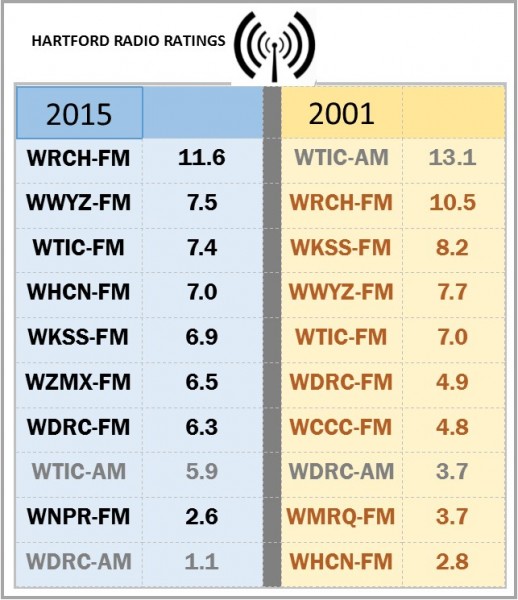
The most recent radio ratings in the Hartford market confirm the dominance of FM radio and the continued long slide of AM radio and audience levels overall.  The top seven most listened-to stations in the market are FM, led by perennial ratings leader WRCH-FM, a CBS Radio owned Adult Contemporary format station, with an 11.6 rating. Tightly bunched behind WRCH-FM are WWYZ-FM (country music), with a rating of 7.5, WTIC-FM (hot adult contemporary) at 7.4, WHCN-FM (classic hits) at 7.0 and WKSS-FM (contemporary hits) at 6.9. on air

Rounding out the top eight are WZMX-FM at 6.5, WDRC-FM at 6.3, and WTIC-AM at 5.9.

Then the ratings drop down to WNPR-FM at 2.6, WDRC-AM at 1.1, WFCR-FM (based in Amherst, MA) at 0.9 and WPOP-AM at 0.1.  WPOP recently switched to a news/talk format, and plans to broadcast Hartford Yard Goats minor league baseball games.  WDRC-FM switched to a Classic Rock format, similar to the music that played a decade ago on WCCC and WHCN.

The ratings profile, covering listening habits in November 2015, contains an quarter hour share (AQH) rating -- the average number of persons, ages 6+, who listened during any average quarter hour from 6am to midnight, Monday through Sunday in the Survey Area, Metropolitan Hartford.radio ratings

Fifteen years ago, before smart phones, internet radio, satellite radio and a limitless supply of alternate listening options, the numbers were higher across the board, and AM radio – in the case of WTIC – was often at the top of the list, or not far behind.

Here’s what the ratings looked like in April 2001:

WTIC-AM1080 was the most-listened-to radio station in the Hartford market, posting a 13.1 share in the winter rating period, up from the 10.3 it logged in the fall ratings.  WRCH fell from 11.8 to 10.5 to finish second. WKSS-FM also suffered a ratings drop, as reported at the time by the Journal Inquirer. The station racked up an 8.2 rating, down from the 9.7 it chalked up during the fall ratings period.

WWYZ-FM advanced from a 6.6 to a 7.7 to finish fourth overall.  WTIC-FM enjoyed a slight improvement, advancing from 6.8 to 7.0.  Rounding out the Top 10 were WDRC-FM (4.9), WCCC-FM (4.8), WDRC-AM (3.7), WMRQ-FM (3.) and WHCN-FM (3.1, up from 2.8).

Finishing 11th was WZMX-FM, which slid from a 3.1 in the fall to a 2.7 in the winter. WAQY-FM (West Springfield,MA), , finished 12th with a 1.9 rating.  The area's all-sports station, WPOP-AM1410, was far back in the pack with a 0.7 share.

Among the morning programs, in overall ratings, WTIC's Ray Dunaway and Diane Smith attained a 17.2 rating. WRCH was second with an 8.8 share. WTIC-FM was third with an 8.4 share, followed by WWYZ and WKSS. WCCC-FM gained a half-point to finish sixth with a 6.4 share.WRCH1

A new station took high honors among the 25-54 demographic among morning shows. WTIC-FM and host Gary Craig posted an 11.3 to grab the No. 1 spot.  WTIC-AM was second with a 10.4 rating.  WRCH was third, followed by WCCC.howard stern

In the 18-34 age bracket, WKSS was No. 1, WCCC was second overall in the young demographic. In morning shows, WCCC and Howard Stern continued in the No. 1 position. WCCC grabbed a 15.6 share in the morning, WKSS was second, at 12.8.  WMRQ and its morning host, former Twisted Sister lead singer Dee Snider, attained a 10.7 rating.