

Editorial Cartoon by Bob Englehart
/
by Heather Freeman Mothers are powerful role models. They leave an indelible imprint on a girl’s self-identity starting from before birth. When her imprint is that which supports a healthy dose of self-love and confidence, her daughter can develop her own sense of self, separate from her mother’s. She will grow up to be confident about her strengths and talents, and capable of taking the lead in her health and wellbeing.
 However, this is a rare occurrence. More often than not mothers unconsciously carry an imprint which keeps them from giving their daughters the chance to be their best. This imprint then gets passed on, leaving the next generation of girls carrying on a legacy of self-doubt and low self-esteem. Our point of power as women is to know that we do not need to repeat our mother’s unconscious legacies – that our past does not script our future. And the moment we decide to break the cycle we can then truly awaken to our potential.
According to board-certified ob-gyn and New York Times best-selling author Dr. Christiane Northrup, a mother’s belief system about health and life in general becomes the daughter’s way of being. “If your mother was happy, healthy, vibrant, and loved her menstrual cycle, her breasts, and her body in general, then your health legacy will in general be optimal. If your mother was a smoker, anorexic, depressed, self-absorbed, or anxious, this may adversely affect your confidence and overall wellbeing.”
Jaqueline Lapa Sussman, MS, LPC, a practitioner of Eidetic Imagery Psychology (a fast moving methodology which allows one to go beyond their rational surface mind and uncover stored images of their potential and wholeness) says “Image Psychology research in the last half century has shown that our mother’s influence is wired into our brains and color our automatic knee jerk reactions to life.” Throughout a girls childhood a mother’s emotional wellbeing is communicated through her tone, body language, and actions, which programs her daughter with attitudes that affect her for the rest of her life. A girl grows up and takes that image from her mother (good or bad) with her to her adult life, and if she decides to become a mother, she then imprints that image with her own children.
The journey into motherhood provides women with a unique opportunity to break the cycle, to lead their lives and their daughters from a conscious, empowered space. When they boldly step into this power they are able to create a safe relationship with their daughter. The type of relationship that girls have voiced they need in order to communicate about and navigate their lives.
The Girls Scout Research Institute Report (2003) revealed emotional safety is as important as physical safety for girls. The relational model, developed by Jean Baker Miller, M.D., author of the groundbreaking book Towards a New Psychology of Women, offers a paradigm shift in our understanding of human development and of society as a whole. Dr. Miller's relational model proposes that growth-fostering relationships are a central human necessity and that disconnections are the source of psychological problems.
The path to providing this safe space is better communications and a deeper understanding of the role interpersonal communication plays in creating a safe space. Interpersonal communication is a mutual relational, co-constructed process which John Stewart, Ph.D. Professor of Speech Communication at the University of Washington, identifies as a process, as opposed to something that one person does "to" someone else. The relational aspect of the process -- the fact that communication takes place between people and influences every aspect of their relationship -- is central to understanding why certain communications succeed while others falter.
Every time people communicate, they offer definitions of themselves and respond to their perceived definitions of the other(s). However, since these perceptions are always subjective, and therefore inherently judgmental, communication often leads to misunderstandings and bad feelings -- causing people to shut down.
A mother’s job is complex. There is no doubt she tackles it with the best intentions - and not everything a woman has learned from her mother is considered bad or damaging. There are certainly parts of the imprint that a women will want to take with her into her adult life and there are always gifts in the shortcomings one has received.
However, our point of power as women is to know that we do not need to repeat our mother’s unconscious legacies – that our past does not script our future. And the moment we decide to see the legacy that has been passed on to us and to reflect, honor, and pay tribute to that legacy, is the transformational moment when we can move forward with a new life enriching story. We can then set our mind, body, and souls free and empower the next generations to come.
__________________________________________
Heather Freeman, founder of the Gutsy Girl Club, is a resident of Colorado via Connecticut. As a transformational empowerment coach, she works with a spirited community of women who deeply support one another, build each other up, and provide a safe, supportive space to promote mothering from a place of authentic self-identity and a strong connection to one another. The free report Survival Tips for Raising a Gutsy Girl is available online. Learn more at www.gutsygirlclub.com
PERSPECTIVE commentaries by contributing writers appear each Sunday on Connecticut by the Numbers.
A total of up to $900,000 will be awarded over the next four years to a Hartford collaborative initiative to strengthen the next generation of workers and meet employer demand. The Annie E. Casey Foundation has announced plans to award $6 million in grants to increase job opportunities for young adults from low income families in Hartford and four other communities - Cleveland, Indianapolis, Philadelphia, and Seattle.
Hartford expects to receive up to $900,000 over the grant period for planning and implementation.
Through Generation Work, the Foundation aims to combine building relationships with businesses, factoring in their needs in the local economy, with youth development strategies to prepare young people for work, such as mentoring and on-the-job learning opportunities. Ultimately, the Casey Foundation hopes to help establish local networks of workforce development organizations that serve young job seekers and have strong connections with businesses.
The Hartford Generation Work initiative is led by United Way of Central and Northeastern Connecticut, working with five other community partners:
Hartford’s initiative will connect young adults, including those out-of-school or work or underemployed, with education, training and employment for careers in manufacturing and healthcare, officials said. The initiative also intends to improve coordination and collaboration among partners and youth initiatives.
“The strength of our future workforce is one of our nation’s greatest assets and is critical to our ability to compete globally,” said Allison Gerber, a senior associate who oversees the Casey Foundation’s investments in improving job opportunities for low-income individuals and families. “The next generation is eager to work, but we must create more avenues for young adults to develop the knowledge and experience they need to succeed in the job market.”
While the Great Recession hit many hard, teens and young adults have experienced the most drastic drop in employment, data show. Millions of young people — particularly young people of color, justice-system involved, or aging out of foster care and from low-income families — face obstacles to employment or education, and the percentage of young people ages 18 to 29 in the job market nationwide has steadily declined in recent years. At the same time, employers often struggle to find workers with the right set of skills for available positions, Foundation officials point out.
Though precise definitions of elder abuse vary widely across jurisdictions, conceptually, elder abuse is any form of mistreatment that results in harm or loss to an older person. That, according to a report issued by Connecticut’s Legislative Commission on Aging, is at the core of a series of 15 recommendations being made to the state legislature and executive branch to respond to increasing concerns about the growing prevalence of elder abuse.
The report explains that “it can be physical, financial, psychological, or include neglect or abandonment and it may take place in a home or institutional setting. Though often a hidden phenomenon, elder abuse is a significant human rights, public health and social justice issue that transcends race, ethnicity, religious affiliation, income and education levels.”
Earlier this year, the legislature directed the Commission to conduct a study” concerning best practices for reporting and identification of the abuse, neglect, exploitation and abandonment of older adults.” The report was submitted to the legislature, which convenes this week.
The Commission has also launched a new website focused on Financial Abuse & Exploitation, which includes a series video training videos and a range of resources.
Organized around the three areas of inquiry framed in Public Act 15-236, the report recommendations are:
To emulate national models for reporting abuse, neglect, exploitation or abandonment:
To advance standardization and uniformity in definitions, measurements and reporting mechanisms:
To promote and coordinate reporting communication among local and state government entities:
Connecticut’s Legislative Commission on Aging is a nonpartisan public policy and research office of the Connecticut General Assembly. The report indicated that according to a study sponsored by the U.S. Department of Justice, 12.4 percent of adults age 60 and older reported at least one form of emotional, physical or sexual abuse or potential neglect and 11.7 percent reported financial exploitation by a family member or stranger.
Connecticut is the 7th oldest state in the nation, based on median age. It also has the third longest-lived constituency, with an average life expectancy of 80.8 years for residents born in Connecticut today. The report indicated that the “vast scope of elder abuse is especially concerning in light of the significant adverse health consequences for victims.”
More than one-third of Connecticut’s population is over the age of 50, and that proportion continues to rise. Between 2010 and 2040, Connecticut’s population of people age 65 and older is projected to grow by 57%, with less than 2% growth for people age 20 to 64 during the same period, according to the report.
https://youtu.be/b3Dr_sqJOYE
“I know firsthand how detrimental patent trolls can be to small businesses, as my Connecticut small business was recently the victim of abusive patent litigation in which bad patents were used as weapons of financial intimidation against my small business. $100,000 in legal fees and ten months of litigation later, we successfully defended against these frivolous lawsuits, explained Michael Skelps, General Manager of Middlefield-based Capstone Photography recently in a published report. The New York Times has described patent trolls as “people who sue companies for infringement, often using patents of dubious value or questionable relevance, and then hold on like a terrier until they get license fees. In recent years, patent trolls — they prefer “patent assertion entities,” or P.A.E.’s — have gone from low-profile corporate migraine to mainstream scourge.”
Skelps said that “a year later, my small company is still recovering from exorbitant legal fees, none of which we were able to recoup from the legal system. As a result of the lawsuit, my mom-and-pop photography shop had to downsize from five full-time employees to three part-time. We spent the equivalent of a year’s worth of profit to defend ourselves, with no budget allocated before to legal defense.”
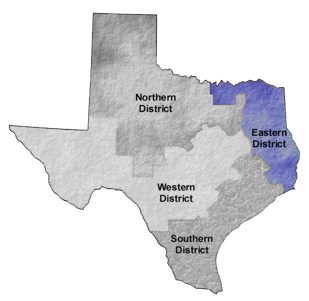 While action to combat the rapidly escalating challenge to businesses of every size has been unable to navigate through a divided Congress, the problem is growing. One jurisdiction in particular is a hospitable home for the legal attacks. Federal court in the Eastern District of Texas is the epicenter of patent troll litigation, and nearly 50 Connecticut companies are among those hauled into court there under dubious circumstances.
The Dallas Business Journal printed what read very much like a warning to American businesses, when a commentary noted that “the Eastern District of Texas’ misguided judicial system makes the towns of Tyler, Marshall, Beaumont and Texarkana the biggest patent-troll nest in the United States, filling the coffers of these tiny towns with money legally extorted from innovators that could otherwise be used to support business growth and create new jobs.”
The Connecticut businesses range from well-known names such as Xerox, UTC, Pitney Bowes, Aetna, Starwood, Priceline, WWE, Frontier Communications and Stanley Black & Decker to dozens of lesser known names lacking the deep pockets to fight what are usually unfounded allegations. Small and medium-sized businesses – many in the tech fields - are frequently sued in East Texas even if they operate outside the state. The goal appears to be either to force them to travel to the Lone Star State to defend their business practices, or to extract exorbitant settlements as the only way to avoid the travel and legal costs.
It is those out-of-court settlements that the trolls depend on, and which are bleeding some unsuspecting businesses virtually dry. The median compensatory-damage award by East Texas judges and juries in patent cases was $8.25 million, according to the article, written by the president and CEO of the Consumer Electronics Association, a U.S. trade association representing more than 2,000 consumer electronics companies.
Six months ago, in an effort to put an end to such activities, the Judiciary Committee in Congress approved legislation that would overhaul the nation’s patent laws. That effort, however, has slowed, and ultimate passage in Congress is in doubt, according to published reports.
In Connecticut, associations and organizations including The Credit Union League of Connecticut, Connecticut Food Association and the Connecticut Retail Merchant Association have called for federal action to end patent trolling. The National Retail Federation has said that the cost of defending companies against the claims is so high — the average case costs $2 million and can take 18 months — that many victims settle out of court. The cases cost legitimate businesses close to $30 billion a year in direct costs and $80 billion indirectly, amounting to $943 a year for the average household when passed on to consumers.”
Small businesses bear the brunt of the litigation, but larger businesses are not immune. About a year ago, it was reported that “Apple must pay a shell company $532.9 million because iTunes infringes upon three patents related to online patents, a jury in East Texas ruled. The company in question … is also based in Texas and doesn’t make or do anything besides file patent lawsuits, as an Apple spokesperson pointed out, noting that the company “makes no products, has no employees, creates no jobs, has no U.S. presence, and is exploiting our patent system to seek royalties for technology Apple invented.”
By mid-2015, the U.S. District Court for the Eastern District of Texas was headed to a record year. An astonishing 1,387 patent cases were filed there in the first half of the year, according to published reports. This was 44.4 percent of all patent cases nationwide, and almost all of the growth is being “fueled by patent trolls.” Reports indicate that in 1999, only fourteen patent cases were filed there. By 2003, the number of filings had grown to fifty-five. Ten years later, in 2013, it was 1,495.
Overall, patent disputes hit an all-time high of about 7,500 cases in 2015, largely driven by patent trolls who filed two-thirds of the lawsuits, according to a report from Unified Patents. The number of lawsuits filed by non-practicing entities (NPEs), known as “patent trolls,” increased by 25 percent. Last year, patent troll filings made up 95 percent of the cases in the Eastern District of Texas.
While Congress is mired in inaction, at least one state is stepping into the fray. Virginia Attorney General Mark Herring, a Democrat who took office in 2014, announced last week a new initiative to support Virginia businesses by combating patent trolling through a newly formed Attorney General’s Patent Troll Unit.
Herring’s announcement explained that “in recent years high-tech businesses, Main Street businesses, and everything in between have become frequent targets of “patent trolls” who send bad faith demand letters, request unjustified licensing fees, and threaten baseless lawsuits. Unchecked, patent trolls and their bad faith practices stifle innovation in the Commonwealth, have a negative impact on our innovation-driven economy, and tie up the courts.” Businesses are forced to “choose between paying unjustified licensing fees and engaging in costly litigation,” the announcement stressed.
The federal Government Accountability Office (GAO), according to a Washington Post report, found that a disproportionate share of patent litigation concerns software patents. The non-partisan government agency found that the number of defendants in patent lawsuits more than doubling from 2007 through 2011. Notably, this increase is specifically related to software patents — software patents account for 89% of the increase, according to the GAO's calculations.
Said Skelps: “our current patent system is ripe for exploitation. Like the abusive patent litigation we endured, malicious actors are abusing the system and using it as a weapon against legitimate businesses, harming innovation, driving small companies out of business, and overtaxing our already overburdened litigation system.”
Connecticut’s place in the ongoing national debate about guns is reflected in a new analysis which ranks the state 20th in the nation in overall dependence on the gun industry, but also ranks the state 3rd in total firearms industry output per capita and 2nd in highest average wages & benefits in the firearms industry.
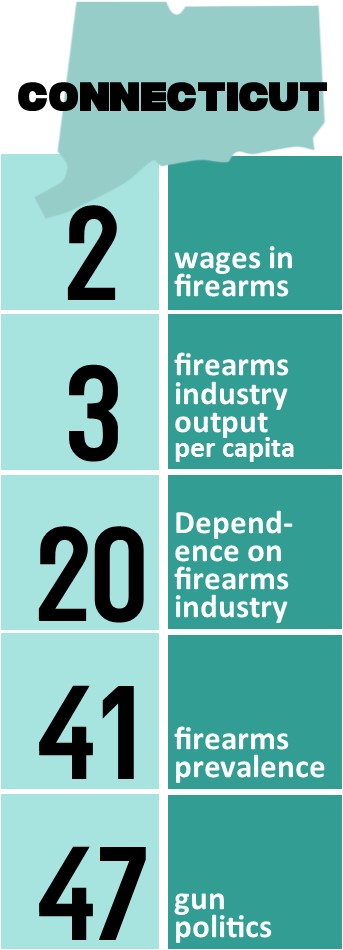 With the gun debate center-stage in the presidential primaries and in Washington, D.C., the website WalletHub analyzed which states depend most on the arms and ammunitions industry both directly for jobs and political contributions and indirectly through firearm ownership. WalletHub’s analysts compared the 50 states and the District of Columbia across three key dimensions: 1) Firearms Industry, 2) Gun Prevalence and 3) Gun Politics and eight metrics.
Connecticut also came in 41st in its "firearms prevalence rank" and 47th in "gun politics rank."
The states Most Dependent on the Gun Industry were Idaho, Alaska, Montana, South Dakota, Arkansas, Wyoming, New Hampshire, Minnesota, Kentucky and Alabama.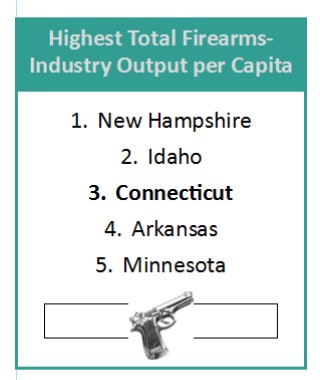
Officials point out that the gun industry plays an important role in the U.S. economy, and Connecticut is no exception. By one estimate, firearms and ammunitions contributed a total of nearly $43 billion to the national economy in 2014. That figure accounts for more than 263,000 jobs that paid $13.7 billion in total wages, according to the report from the Connecticut-based National Shooting Sports Foundation. In the same year, federal and state governments collected from the industry more than $5.79 billion in business taxes, plus an additional $863.7 million in federal excise duties, the WalletHub report indicated.
In the overall rankings, the states determined to be least dependent on the gun industry are Maryland, New York, New Jersey, Rhode Island and Delaware.
The analysis also found:
The eight relevant metrics utilized in the analysis and their corresponding weights were as follows: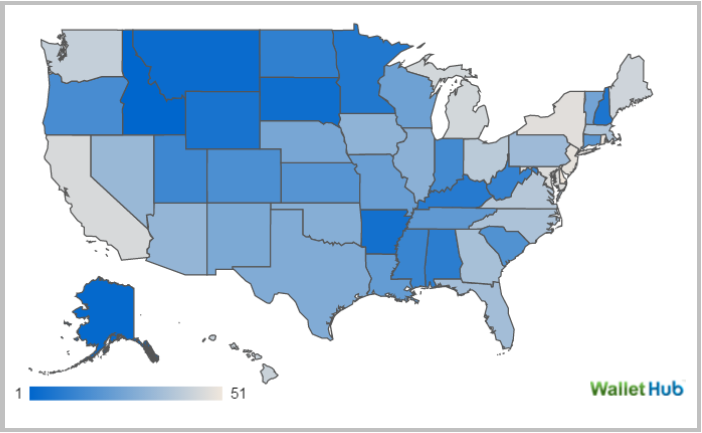
Firearms Industry – Total Points: 35
Gun Prevalence – Total Points: 35
Gun Politics – Total Points: 30
Data used to create these rankings were collected from the U.S. Census Bureau, the National Shooting Sports Foundation, the Federal Bureau of Investigation, the BMJ Publishing Group and the Center for Responsive Politics, according to WalletHub.
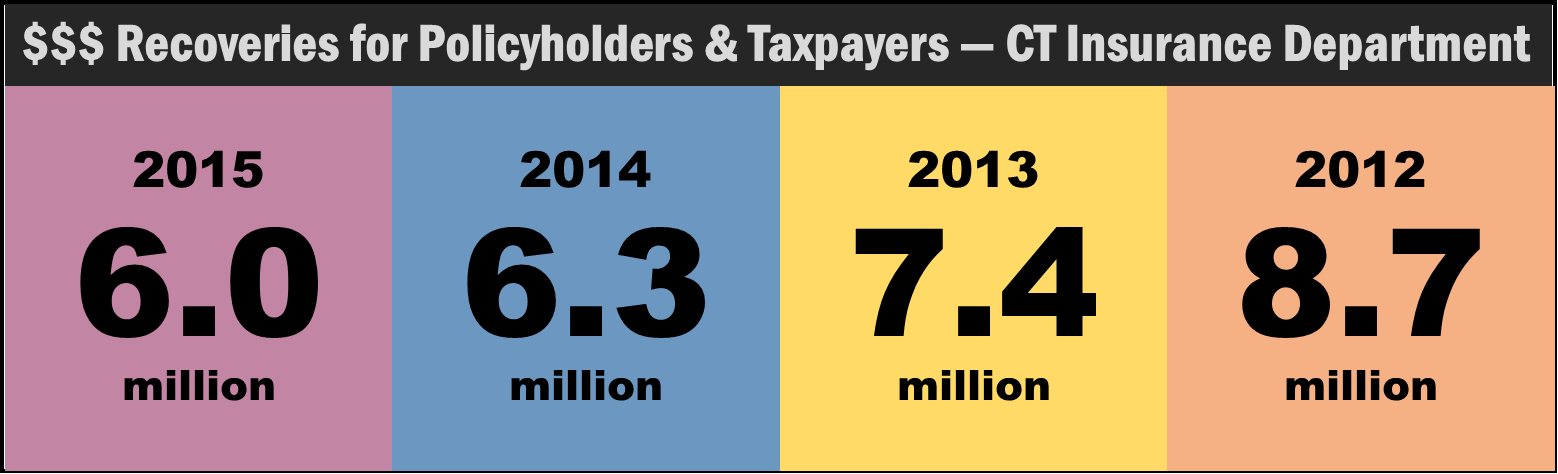
The Connecticut Insurance Department recovered approximately $6 million for policyholders and taxpayers in 2015, helping individuals and families with their claims and complaints. The total dollar amount of the recoveries declined for the third consecutive year, down from a high of $8.7 million in 2012, $7.4 million in 2013 and $6.3 million in 2014.
Officials indicated that the Department’s Consumer Affairs Unit (CAU) fielded more than 6,100 complaints and inquiries and helped policyholders recoup more than $4 million from January 1 to December 31, 2015. The number of complaints and inquiries dropped slightly from the previous year, when 6,500 were handled, recouping $4.3 million for policy owners. In 2013, policyholders saw $4.7 million returned. In 2012, the numbers were virtually identical to 2015.
“Behind these statistics are the individuals and families the Department was able to help through our intervention,” Commissioner Katharine L. Wade said. “In many cases we were able to make a real difference in their lives and I encourage anyone with questions or concerns about their insurance to contact the Department. We are here to help consumers.”
The department, in announcing the annual totals for 2015, also highlighted some individual recoveries, including:
“Our staff makes certain that companies and agents comply with all state insurance laws and regulation and have extensive knowledge to answer a wide range of insurance questions,” the Commissioner said.
In addition to recoveries for policyholders, the Department’s Market Conduct division levied approximately $1.7 million in fines against carriers and returned that money to the state General Fund in 2015. The fines resulted from a variety of violations and settlements ranging from untimely claim payments to improper licensing. That was the lowest total for fines in recent years, perhaps signifying greater compliance. In 2014, fines totaled $2.03 million, in 2013 the total was $2.7 million and in 2012 fines levied totaled $4.6 million.
The majority of the funds recovered for policyholders stemmed from complaints over health, accident, homeowners and life and annuities policies.
The following is the breakdown of funds recovered in 2015:
Recoveries in 2013 were largely focused on homeowners, as a result of Superstorm Sandy-related claims. Department recoveries in 2012 reflect the impact of claims from 2011 Storm Irene and the late October snow-filled Nor’easter that landed in Connecticut.
The Department calculates its consumer recoveries based on what the policyholder received as a result of the Department’s intervention. The inquiries and complaints also help the Department identify industry trends that may adversely affect consumers and trigger investigation by the Market Conduct division, officials said.
In addition, complaint data also help determine topics for consumer education and serve as tools to help the Department monitor the industry. The Market Conduct enforcement actions are posted on the Department’s web site at www.ct.gov/cid
by Mary Cahalane The numbers
In Connecticut, the nonprofit sector employs almost 14% of our workforce. Connecticut nonprofits generate $33.4 billion in revenues annually. Individuals in Connecticut contribute $2.7 billion a year. The sector is important to our state.
Recently, I wrote about the struggles of balancing work and life – especially for those of us in the nonprofit world.
Stress is a real problem in the sector. And it’s getting in the way of our organizations’ missions.
 The New York Times article that inspired my original post looked at the problem of stress in our lives.
The author suggested as a society, we’ve separated caregiving and work. Work we prioritize; caregiving is sidelined. And the need for both in our lives puts a great deal of pressure on the people who are caregivers – mainly women.
The impact on women in the nonprofit sector
Our approach to caregiving versus work is also holding women back. The need to juggle so many responsibilities at work and at home becomes impossible.
Women in Connecticut make up almost 70% of private nonprofit salaried workers. Yet median wages for women are $46,004 compared to $60,168 for men.
Nationally, it’s the same: nonprofit workers are also overwhelmingly women. Yet men fill most of the leadership roles – particularly in larger organizations.
The impact on nonprofit organizations
Dan Pallotta wrote a piece for The Daily Beast 6 years ago, Gender Trouble at Nonprofits. One paragraph really whacked me in the face.
Charity is not allowed to use the same tools as business because society subconsciously regards it as female, and discriminates against it the same way it has historically discriminated against women. Charity is subservient. The for-profit sector heads to the office every day to do the real business of the world, while charity stays at home and dabbles in idealism and sentiment. Even the governing structure of charity is patriarchal; business people direct nonprofit staff—seven in 10 of whom are women—from the perches of their board seats.
Wow.
We have a leadership problem
Here’s the irony of it all, though. When you survey people about the most important leadership qualities, they’re the ones most associated with women.
Diversity is needed to build a strong organization. We applaud it in theory, but struggle with it in practice. That’s not lip service, that’s fact. Surveys point to a need for the qualities women score more highly on. These traits include “expressive”, “plans for the future”, “reasonable”, “loyal”, “flexible” and “patient”.
Why the disconnect? An article in the Harvard Business Review talks about second generation bias – unconscious, unintentional, but still present.
It’s a trap for women: men who score high on likeability are also seen as more competent leaders. For men, the two leadership traits are complementary. Women are seen as less competent if they’re more likable.
This infographic from TCC Group makes the problem of gender diversity in our sector quite clear.
Double whammy?
Nonprofit organizations must work twice as hard to care for the needs of the world. And as Pallotta says, they’re denied many of the tools used in the for-profit world. Somehow, we’re supposed to innovate without investment. We’re supposed to care for people while not caring for our employees.
Nonprofit work is seen as less important – even though it’s desperately needed. (And not likely to be done by the private sector.)
That’s bad enough. But then within our sector, women are still fighting for a place at the grown-ups’ table.
So what can we do?
We can mentor. We can push for flexibility. We can be conscious of bias when we hire or promote. We can model kinder, gentler organizations.
But what’s needed to create real change is leadership.
We need leaders with those qualities usually identified with women.
We need the loudest voices to be those who value empathy, vulnerability, loyalty, flexibility and patience.
This isn’t only about what’s just.
It’s about what’s best for the sector and for the world. It’s about effectiveness.
We’re killing ourselves to save the world.
Doesn’t that mean we’re doing it wrong?
___________________________________________
Mary Cahalane is a nonprofit fundraising consultant, and author of the blog Hands-On Fundraising. She has more than 30 years of experience with community-based organizations, major regional theaters and a variety of nonprofit organizations in Connecticut and beyond.
PERSPECTIVE commentaries by contributing writers appear each Sunday on Connecticut by the Numbers.
Three Hartford area nonprofit organizations have received a financial boost from the charitable foundation of Yelp, the website of business recommendations. This past fall, Yelp nominated three non-profit organizations in 75 cities around the country that support the Yelp Foundation’s mission of addressing the needs of local communities, including access to information, education, local economic development, and freedom of expression.
In Hartford, those organizations were The Connecticut Forum, Literacy Volunteers of Greater Hartford and reSET Social Enterprise Trust. 
The Yelp Foundation announced it would grant $5,000 to the organization with the most votes at the end of a web-based public voting campaign. The second and third place winners would be granted $3,000 and $2,000 respectively. Individuals could vote once each day during the two-week web voting period.
The Foundation announced this week that the top-vote getter, The Connecticut Forum, will be receiving a $5,000 grant. Literacy Volunteers of Greater Hartford will be receiving a $3,000 grant; reSET Social Enterprise Trust will receive $2,000.
The Yelp Foundation's mission is to support charitable organizations and activities addressing the needs of local communities, including access to information, education, local economic development, and freedom of expression, and to promote a culture of philanthropy among employees of Yelp Inc. Nationwide, 225 organizations will be receiving grants totaling $750,000.
The Connecticut Forum presents live, unscripted conversations among renowned experts and celebrities, and community outreach programs including the Connecticut YOUTH Forum. The organization’s mission: “to encourage the free and active exchange of ideas in Forums that inform, challenge, entertain, inspire and build bridges among all people and organizations in our community.”
 Literacy Volunteers of Greater Hartford is a private non-profit organization that has provided adult literacy services in Greater Hartford since 1972. Their “vision is to build a stronger, more resilient Greater Hartford by creating a community of fully literate adults.” Annually, the organization now serves over 850 adults in 20 towns throughout the region.
reSET is a non-profit organization whose mission is to advance the social enterprise sector. Its strategic goals are threefold: to be the “go-to” place for impact entrepreneurs, to make Hartford the Impact City, and Connecticut the social enterprise state. reSET serves all entrepreneurs, but specializes in social enterprise ― impact driven business with a double and sometimes triple bottom line. In addition to providing co-working space and accelerator and mentoring programs, reSET aims to inspire innovation and community collaboration, and to support entrepreneurs in creating market-based solutions to community challenges.
 Yelp was founded in 2004 to help people find great local businesses like dentists, hair stylists and mechanics. Yelp had a monthly average of 89 million unique visitors who visited Yelp via their mobile device in the third quarter of 2015, according to the company, which also notes that “Yelpers” have written more than 90 million reviews since the company’s inception.
In 2011 Yelp Inc. established the Yelp Foundation with one percent of company equity to support charitable organizations and activities addressing the needs of local communities, including access to information, education, local economic development, and freedom of expression, and to promote a culture of philanthropy among employees of Yelp Inc.
The Foundation accomplishes its charitable goals by making grants to deserving nonprofits throughout the U.S. and matching donations made to charities by Yelp employees up to $1,000 per person per year, according to the Foundation website. In 2014, the Foundation committed $1 million to charity. To learn more about the Yelp Foundation, visit http://www.yelpfoundation.org/





















© 2025 Connecticut By The Numbers [TM] 557 Prospect Avenue - 1st Floor, West Hartford, CT 06105
Designed by RDK Design & Photography
