Connecticut is Most Religious State in New England

Connecticut is the most religious state New England, ranked number 38 in the nation, according to a new Gallup poll.  The other New England states are all in the bottom ten, according to the survey, which covered the year 2015. New Hampshire is the least religious state in the nation, with 20 percent of residents considering themselves to be “very religious,” 24 percent “moderately religious” and 55 percent “non-religious.”  Just ahead of New Hampshire at the bottom of the list, are Vermont (22 percent very religious), Maine (26 percent very religious) and Massachusetts (27 percent very religious).  Rhode Island is ranked 43, with 32 percent of residents considering themselves to be very religious.CT religion

Connecticut, the only New England state ranked higher than the bottom ten, broke down this way:  33 percent very religious, 28 percent moderately religious, and 39 percent non-religious.

In the annual survey, Mississippi (63 percent) has extended its eight-year streak as the most religious state, followed closely by neighboring Alabama (57 percent), according to Gallup.  Rounding out the top ten “very religious” states were Utah, Louisiana, Tennessee, Arkansas, Georgia, South Carolina, North Carolina, Kentucky and Texas.

The state-by-state results are based on over 174,000 interviews conducted as part of Gallup Daily tracking in 2015, including more than 480 interviews in every state and more than 1,000 interviews in most states.  In Connecticut 1,919 interviews were conducted, according to Gallup.framed church Lee, MA

Gallup classifies Americans into three religious groups based on their responses to a question measuring religious service attendance and how important religion is in their daily life. Very religious Americans are those who say religion is important to them and who attend services every week or almost every week. Nonreligious Americans are those for whom religion is not important and who seldom or never attend religious services. Moderately religious Americans meet just one of the criteria, either saying religion is important or that they attend services almost every week or more.

Nationwide, the percentage classified as very religious on the basis of their attendance and view on the importance of religion has stayed remarkably stable since the survey began seven years ago. In 2008, 41% of Americans were very religious, 29% moderately religious and 30% nonreligious. In 2015, those same percentages are almost identical: 40%, 29% and 31%, respectively.

religion USA

Federal Transportation Funds to Increase As Connecticut Considers Long-Term Plan

As Connecticut policy makers consider a long-term infrastructure investment in Connecticut’s transportation system, they do so just months after the federal government, after years of inaction, adopted the FAST (Fixing America’s Surface Transportation) Act at year’s end.  It is the first comprehensive transportation law since 2005, according to Connecticut’s Office of Legislative Research (OLR). The act includes $225.2 billion for highway investment, $61 billion for federal transit programs, and $10 billion for the Federal Railroad Administration and Amtrak.  States will get about a 5.1 percent increase in funding in FFY 16 and annual increases ranging from 2.1 percent to 2.4 percent in subsequent years, according to OLR.fast-act

State lawmakers are considering Governor Malloy’s proposed $100 billion, 30-year Let's Go CT! program, unveiled earlier this month, which included a call to enact a constitutional amendment creating a financial lockbox to protect transportation funds. Officials have said that 47 percent of state-maintained roadways are in “less-than-good condition”, and 35 percent of Connecticut's bridges are functionally obsolete or structurally deficient.  The Connecticut Business and Industry Association has said that 42 percent of businesses think the state's road congestion hinders their opportunities and growth.

As a result of the FAST Act, Connecticut will receive about $3.5 billion over five years, or about $700 million annually, for highway and transit programs, which is about $62 million more per year than Connecticut received in 2015.  The state Department of Transportation says the act’s importance isn’t in the amount of money it provides, which does not change dramatically from previous levels, but in the predictability and assurance of funding it provides, OLR Principal Analyst Paul Frisman points out in a report to state legislators. ct usa

The FAST Act’s transfer of the $70 billion into the federal Highway Trust Fund (HTF) was essential to keep the fund solvent. The federal government has not increased the federal 18.4 cent gas tax in more than 20 years, and this has reduced the HTF’s purchasing power and reduced its ability to keep pace with rising infrastructure costs and inflation. Decreased revenues because of more fuel efficient vehicles and the popularity of alternative fuel vehicles also cloud the HTF’s future, the report indicates.  There continue to be concerns that if revenues going into the fund are not increased, insolvency may await, as soon as 2020.

The FAST Act also includes two new freight initiatives, including a National Freight Program which authorizes $6.2 billion over five years for national and state projects to improve highway freight transportation. The OLR report indicates that to participate, a state must complete a State Freight Plan, which it must update every five years. The American Road and Transportation Builders Association (ARTBA) has said that participating states will be able to obligate up to 10 percent of this funding to improve freight rail services or ports, which may be of particular interest to Connecticut.  The other new program is aimed at highway, bridge, rail-grade crossing, intermodal, and freight rail projects that cost at least $100 million, improve movement of both freight and people, reduce bottlenecks, and improve connectivity.

The FAST Act also makes changes to several highway funding programs, with a focus on surface transportation, local roads and bridges, transportation alternatives such as bicycling.  To increase efficiency and speed up the project review process, ARTBA reports that the FAST Act encourages the use of a single environmental review document throughout the entire review process, instead of the current practice of having each agency involved in a project conduct a separate review.

cars connecticutThe OLR report also indicates that a Federal Highway Administration pilot program permits up to three states to toll existing Interstate highways that they could not otherwise adequately maintain or improve, and increase funding available for public transportation initiatives.  In addition, $2.6 billion is provided to Amtrak’s Northeast Corridor (and $5.4 billion to other Amtrak lines) over five years. It separates the Northeast Corridor, from Boston to Washington, D.C, from other Amtrak accounts to ensure that the amounts assigned to that Corridor are used there, OLR reports.

Even with the additional funding nationwide, transportation officials in Connecticut and around the country continue to warn that “long-term, sustainable funding for transportation is yet to be achieved,” as described by the American Association of State Highway and Transportation Officials.

Connecticut’s Presidential Primary Ballot to Take Shape for April 26

In the roller-coaster that is the presidential nomination process, with its progress of caucuses and primaries in states across the country, Connecticut’s card does not come up until late-April.  Who will reach the Connecticut ballot, and the order in which they will be listed, will be determined in the coming weeks by Secretary of the State Denise Merrill, in accordance with criteria outlined in state law. That process begins this Tuesday, February 16,  with the announcement of presidential candidates who have qualified for the Connecticut primary ballot.  The order in which candidates will appear on the ballot for the Republican and Democratic parties will not be known until March 22, when Secretary Merrill will “determine the order of all candidates by lot in a public ceremony.”  Connecticut law also requires that “Uncommitted” appear last on each party’s ballot.

april 26When Connecticut voters go to the polling places on Tuesday, April 26, voters in nearly two-thirds of the states will already have made their preferences known.  The same day as Connecticut, presidential primaries will also be held in Delaware, Maryland, Pennsylvania and Rhode Island.  The previous week, primaries will be held in New York, a state called home, at various times, by three of this year’s leading contenders – Hillary Clinton, Bernie Sanders and Donald Trump.

March 1 and March 15 are major dates on the presidential primary calendar this year.  Dubbed Super Tuesday, March 1 will see votes cast in Alabama, Alaska, Arkansas, Colorado, Georgia, Massachusetts, Minnesota, Oklahoma, Tennessee, Texas, Vermont, Virginia and Wyoming.  Two weeks later, the spotlight will fall on Florida, Illinois, Missouri, North Carolina, and Ohio.

Also prior to Connecticut, the states of Wisconsin, Wyoming, Washington, Hawaii, Arizona, Utah Idaho, Michigan and Mississippi will conduct their presidential primaries, according to the Council on State Governments.

According to Connecticut’s Office of Legislative Research, in August 2010, the Democratic National Committee and the Republican National Committee adopted rules prohibiting states, other than Iowa, New Hampshire, South Carolina, or Nevada from holding a presidential primary before the first Tuesday in March in the year in which a national convention is held (Democratic National Committee, Delegate Selection Rules, Rule 11(A) and Republican National Committee Rules, Rule No. 16(c)(1)).  In response, Connecticut delayed the date of its presidential primary from the first Tuesday in February to the last Tuesday in April (CGS § 9-464).voting

Reaching the Primary Ballot

In Connecticut, the political parties with the largest and second largest number of enrolled members conduct presidential preference primaries, according to the website Ballotpedia. There are two methods by which candidates can access the primary ballot:

  • The Connecticut Secretary of the State can order that a candidate's name be printed on the primary ballot if he or she "determines ... that the candidacy of such person for such party's nomination for president is generally and seriously advocated or recognized according to reports in the national or state news media." The secretary of state must publish a listing of such candidates at 10:00 a.m. on the 74th day preceding the primary.  (This year, that is Tuesday, February 16.)
  • A candidate who is not included on the Secretary of the State’s list can petition for placement on a party's primary ballot. A candidate may request the requisite forms from the secretary of the state’s office beginning at 12:00 p.m. on Tuesday. The petition must contain signatures equaling at least 1 percent of the total number of enrolled members in the candidate's party in the state, and must be submitted to "the registrar of voters of the party holding the primary in the town of voting residence of the signers thereof" by 4:00 p.m. on the 53rd day preceding the primary (March 4). The registrar of voters must verify the signatures and forward the petition to the secretary of state by 4:00 p.m. on the 49th day preceding the primary (March 11).

Among the states holding presidential primaries after Connecticut in May and June are Inpres primariesdiana, New Mexico, California, New Jersey, Nebraska, West Virginia, Oregon and Montana.  Most states have their Democratic and Republic primaries on the same day, although a handful hold party primaries on different days. South Carolina’s Republican primary will be on February 20, for example, and its Democratic primary on February 27.

Should any candidate whose name is set to appear on the Connecticut April 26 primary ballot decide to withdraw from the race, the deadline is March 21.  A letter indicating withdrawal must be received by the Secretary of the State by 12 Noon.  Petitioning candidates may not withdraw, according to state officials.

Absentee ballots for military and overseas voters become available on March 12.  Absentee ballots will be available as of April 5.  Only registered voters in a particular political party can vote in the presidential primary of that party.  The deadline for new voters, and for unaffiliated voters to mail in party affiliations is April 21.  The in-person deadline is April 25, the day before the primary, at 12 Noon.  On primary day April 26, the polls are open from 6 AM to 8 PM.


PERSPECTIVE: 2016 to be a Year of Power Shifts and Workforce Facelifts

by Thomas Phillips and Sandra Rodriguez With New England as clearly the oldest region in the country with an average age of 40.3 years,[1] there significant retirements are expected for the next 15 years that will have a profound impact on the size and quality of our labor force.

Yet, with workforce demand at high levels, the supply side isn’t sufficient to meet employer needs.  There are many reasons for this supply/demand mismatch.

CT perspectiveNOT ENOUGH PEOPLE.  The growth rate of the US population aged 18 to 64 is rapidly decelerating and will remain very low through 2030.[2]  That should translate into a continued difficult time in finding qualified workers, while the knowledge base within businesses and organizations is eroding.

NOT ENOUGH HARD and SOFT SKILLS. There is a perceived shortage of people with the hard and soft “essential” skills both required and desired by hiring professionals.  This may be why nearly half of those jobless in Connecticut and neighboring states are considered long-term unemployed.[3]  The technical skills these individuals possess are no longer applicable and essential skills get “rusty” when not used over a period of time.  For the younger population, these skills are often untested.

NOT ENOUGH INTEREST FOR THE JOBS IN DEMAND.  Demand is high for healthcare and manufacturing workers.  Construction employment has also been increasing in Connecticut[4] and is expected to continue to rebound over the next few years.[5]  However, according to The Hartford’s 2015 Millennial Leadership Survey (published by The Hartford), less than 7% of the younger generation interviewed responded favorably to wanting careers in Manufacturing or Construction.  Fortunately, 31% of the 18-34 year olds interviewed said their interests lie in healthcare, but percentage-wise, they are more interested Arts and Entertainment, Education and Technology.

NOT ENOUGH COLLABORATION. As Connecticut and the New England region is facing economic quotechallenges, an aging workforce, and lack of coordination and overlap in services, now is the time to create more public / private partnerships to drive success.

PROMISING APPROACHES.  The Supply/Demand Workforce mismatch can’t be solved by any one organization, with any one grant or source of funding, or with any one strategy.  In North Central Connecticut, Capital Workforce Partners and other collaborative organizations are stoking the pipeline with skilled talent, in areas of current or expected business demand through a web of integrated partnerships.  Here are just two examples:

MOVEUP! COLLABORATIVE. This is a collaborative effort among 26 adult education providers, workforce training programs and community colleges to improve adult literacy services in the Capital Region of Connecticut.  Move UP!’s partners envision a regional adult literacy system that offers a coordinated continuum of literacy services, childcare, counseling and other social service support, career pathways that lead to well-paying jobs and coordination within the community to get the work done.

HARTFORD OPPORTUNITY YOUTH COLLABORATIVE.  This Collaborative includes leaders in education, youth development, and workforce development committed to addressing the education and employment needs of 16 to 24 year old disconnected youth (not in school and not working or no high school diploma) otherwise known as ‘Opportunity Youth.’  With financial support from the Aspen Forum for Community Solutions, Hartford Foundation for Public Giving, and the Social Innovation Fund (as a subgrantee of Jobs for the Future), a full scale, multi-year comprehensive plan has been developed and several youth-centered programs are underway.

These initiatives share one common thread – partnership between business, workforce development, education, economic development and government.  In this new year of power shifts and workforce facelifts, it will take all community stakeholders together to ensure there are enough people, trained and ready to work in the jobs that are in demand today and will be in demand tomorrow.  It will take public/private partnerships to guarantee that the education system is preparing youngsters with the mastery they will need to be successful in their career pathways.  And it will take groups with differing ideologies and competing missions to continue to convene and collaborate until as much common ground can be identified as possible for progress.

_________________________________________

Thomas Phillips is President and CEO, and Sandra Rodriguez is Communications Director, at Capital Workforce Partners, which provides a range of services and training to job seekers and businesses.  Learn more at www.capitalworkforce.org

PERSPECTIVE commentaries by contributing writers appear each Sunday on Connecticut by the Numbers.


[1] 2010-14 American Community Survey 5-Year Estimates

[2] Conference Board: “From Not Enough Jobs to Not Enough Workers What Retiring Baby Boomers and the Coming Labor Shortage Mean for Your Company” Publication Date: September 2014 Report Number: TCB-R-1558-14-RR. Data Source:  The Census Bureau

[3] Nick Difiesta and Derek Thomas, MPA, Connecticut Voices for Children, “The State of Working Connecticut 2015,” November 2015

[4] Connecticut Department of Labor

[5] Economic Modeling Specialists International (EMSI)

Corporate Headquarters Headed Back to Cities, But Shrinking, Report Says

The departure of GE’s corporate headquarters for Boston reflects a growing trend for headquarters of major corporations to relocate back to cities, but a recent study indicates they not only move, but shrink, becoming a “reconstituted, smaller version”of their former corporate selves. Analyst Saskia Sassen, author of The Global City, describes such moves, which often consist of “only the most senior people” in the firm as “executive headquarters.”  A feature this month by Crain’s Business Chicago investigates the trend, as it has been evolving in Chicago.  Their report points out that “these headquarters make for great headlines, but they don’t nroundecessarily result in that many jobs,” according to the website newgeography.

“The notion of the corporate headquarters in the ‘Mad Men’ world when there were hundreds or thousands of people in a building with the company logo . . . those days are gone,” says David Collis, a professor at Harvard Business School who studies corporate headquarters.

The Crain’s article points out that “when Chicago landed ADM in 2013, it got 70 executives and white-collar employees, plus a promise of 100 technology jobs that never arrived. Two years later, Decatur still has 4,200 ADM workers.”

The story points to good news and bad news for Chicago.  The bad news, is that a “headquarters ain’t what it used to be. On the other hand, Chicago is winning the battle for them,” and the ripple effect they provide.  These smaller executive headquarters, particularly for major global businesses, benefit from being in a global city, the article explains. Chicago has lured a number of these from out of town, noting that agro-industrial firms are increasingly choosing Chicago: ADM, Con Agra, Mead Johnson Nutrionals, and Oscar Mayer in recent years.

The same may be said for GE and Boston, and the city’s technology-intensive environment. Some fear that Chicago's technology startups, the article reports, are particularly vulnerable to leaving for Silicon Valley, attracted by venture capital and a deep talent poolHQ_chicago.  Boston may be in the running for similar relocations.

A similar phenomenon is occurring in Pittsburgh.  After 70 years in a suburban location, Kennametal announced plans last fall to relocate its world headquarters to an urban location. “We’re a global business that’s making changes to stay competitive in a new industrial era,” said the company.  “We have more than 13,000 employees in 40 countries serving customers in more than 60 countries every day. An urban location puts us in closer proximity to major universities and the airport and will enable us to recruit more talent.”

The Wall Street Journal reported last year that online travel agency Expedia Inc. announced plans to relocate its headquarters from a Seattle suburb that it called home for nearly 20 years to the city’s downtown.

“In the late 60s and early 70s, CEOs in places like New York City fled the city and moved to the suburbs, leading to the growth of Westchester County, Stamford and Greenwich, Connecticut,” Ed McMahon, a senior resident fellow for the Urban Land Institute, told the newspaper. “In those days, the determining factor was where the CEO of the company wanted to live.”

Now, the Journal reported, “large companies are moving back into the city in an attempt to attract and retain workers—particularly younger workers who are postponing homeownership and favor renting in walkable neighborhoods with easy access to restaurants, shopping and cultural opportunities.”

“Connecticut has really been hammered by the trend away from suburban campuses,” writes Michael Brendan Dougherty in The Week. “Aetna demolished a 1.3 million-square-foot campus in Middletown in 2011. That site is vacant. Pfizer dumped a research campus in Groton after that. The suburbs around Chicago, which once gladly received Sears' corporate headquarters, may be hit next.”  It seems that they are.

Picture6The Crain’s article reports that headquarters began shrinking a decade ago, but the trend has accelerated in the past three years, according to Vinay Couto, a consultant in the Chicago office of Strategy&. In recent years, 16 companies have relocated their main headquarters to the city from the suburbs. Seventeen came from outside the metro area. The phenomenon, he points out, is driven by the outsourcing of shared services such as IT, accounting and human resources, as well as by a mindset borrowed from private equity to cut overhead and make every part of a business count toward profitability.

The website Investopedia defines “corporate headquarters” as “a business' most prestigious location,” adding that it may “bring prestige to the city it is located in and help attract other businesses to the area.”

Moving headquarters can also be a way for companies to break from the past and shed employees and positions, Couto says.  And the loss of a major headquarters doesn't necessarily stifle job gains. When Boeing moved to Chicago, Seattle's economy kept growing, Kevin Hively, founder of Ninigret Partners, a business and economic development strategy consulting firm in Providence, R.I., told Crain’s. In that case, however, the presence of Microsoft and Amazon helped.

Firsthand Accounts of Effects of Hunger in Connecticut On Display at State Capitol

Hunger in Connecticut is described as a pervasive problem: one in seven Connecticut residents struggle with hunger; 14.3 percent of Connecticut families do not have adequate resources to purchase enough food; 68 percent of Connecticut food pantry and soup kitchen clients at one point had to choose between food and medical care. Those stark statistics come alive through the firsthand accounts of individuals in Witnesses to Hunger CT, a photovoice exhibit showcasing firsthand accounts of hunger in Connecticut, which has opened in the lower level concourse of the Legislative Office Building in Hartford and will run through Thursday, February 11.stats

“Connecticut is one of the wealthiest states in the nation but there are many who struggle every day to put food on the table,” Lucy Nolan, Executive Director, End Hunger Connecticut!, said. “The Witnesses recruited to participate in this project have been faced with choices that are hard to fathom – whether to eat low cost foods that could be harmful to their medical conditions or not eat at all, whether to pay for prescriptions or put food on the table, and whether to feed themselves or give extra food to their children. We hope this exhibit can serve as a reminder that many among us, often hidden, need the state’s support.”

The 15 Witnesses to Hunger CT come from Connecticut’s cities, suburbs and rural communities. Kimberly’s picture told the story of her teenage son who while grateful to have something to eat wished there was meat on the plate. Randy from Westport had a good job until struck by cancer and now gets many meals from the soup kitchen and pantry. In his photo he holds a grocery bag in his hands and says while he is grateful for that safety net he wishes there were more fresh foods available. The photos tell a story of everyday choices that must be made to survive.

The project is a collaboration of Connecticut nonprofit organizations, anti-hunger and anti-poverty advocates, and state agencies inspired by Witnesses to Hunger, a project of the Center for Hunger Free Communities at the Drexel University Dornsife School of Public Health.  Advocates point out that limited access to food leads to poor health outcomes, including stress, obesity, and inability to succeed in work or school.hunger map

“There are four main themes that emerged from this project and tell me a compelling story,” said State Senator Marilyn Moore, Bridgeport. “The Witnesses to Hunger CT show everyday struggles with health and wellness, food and nutrition, transportation and adequate shelter. If we want people to succeed we need to make sure we support them. I appreciate their bravery in shining a light on these themes.”

Connecticut is the last in the nation for the number of schools with a school breakfast program, according to End Hunger Connecticut! officials. They point out that 64.6 percent of schools participate, and 45 percent students participate in free and reduced price breakfast for every 100 in lunch.  Connecticut would receive an additional $9.6 million federal dollars if the participation rate of school breakfast reached 70 percent.

Connecticut’s SNAP (formerly Food Stamps) participation rate is 72 percent and 53 percent of the eligible working poor participate in the SNAP program. Many go to food pantries instead for food, organization officials said. They indicated that for every $1 spent on WIC funding, Connecticut saves $1.77-$3.13 on future medical costs.

“The members of Witnesses to Hunger are the real experts on hunger and poverty,” said Dr. Mariana Chilton, an associate professor at Drexel University’s Dornsife School of Public Health and founder of Witnesses to Hunger. “Too many decisions today are made without consulting with the people that are affected most by policies made in Washington. We are thrilled to have families from Connecticut join in the national movement of families speaking from first hand experiences to inform policy makers and the public about the true realities of America’s struggles and how to solve them.”

They noted that 11.9 percent of Connecticut residents are food insecure and 4.7 percent are very food insecure — a slight increase from 2008.

“Data shows the food insecurity rate among those living with a severe mental illness is 475 percent higher than those who are not battling mental illness,” said Billy Bromhunger exhibitage, MSW, Director of Community Organizing, Yale Program for Recovery and Community Health. “We know that good nutrition plays a key role in mental health and that’s why the mental health community is here today to support the Witnesses.”


Witnesses to Hunger CT is the second exhibit of its kind in the state. The first took place in New Haven in 2014 and was championed by Congresswoman Rosa DeLauro.  Witnesses to Hunger CT is a collaboration of:  Advocacy Unlimited, Connecticut Association for Basic Human Needs (CABHN), Center for Hunger Free Communities at the Drexel University Dornsife School of Public Health, Connecticut State Department of Mental Health and Addiction Services (DMHAS), Connecticut Food Bank, End Hunger Connecticut!, Foodshare, Immanuel Congregational Church/UCC, Hispanic Health Council, New Haven Food Policy Council, and the Yale Program for Recovery and Community Health.

The exhibit will be in the lower concourse of the Legislative Office Building (LOB) through February 11th. A booklet prepared for the exhibit can be found at http://www.endhungerct.org. The LOB is located at 300 Capitol Avenue, Hartford and is open weekdays 8:00 am to 5:00 pm.  Free parking is available (first come first served) at the LOB Garage, which is located directly behind the LOB.

https://youtu.be/e-9M4byq90w


Safety Gap: Parents Impose Rules on Teen Drivers, Teens Don’t Think So

Teen drivers are at the highest risk for crashes and crash-related fatalities, and are particularly vulnerable to distractions while driving.  The results of a new nationwide survey of teens and their parents suggest a considerable disconnect between the limitations parents believe they are imposing on driving and the use of cell phones, and their teens’ view of limitations imposed by their parents. The gap in numerous instances is wide, and has raised concerns about the resulting risks to teen drivers.

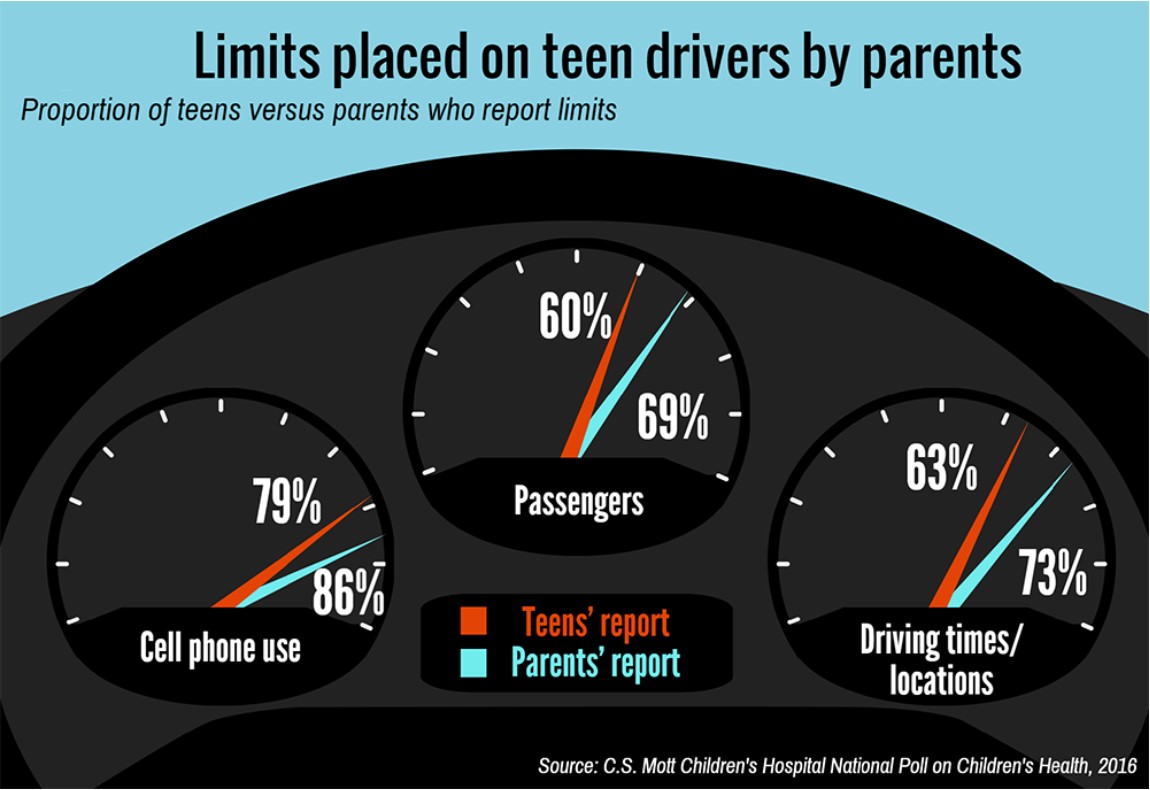
In families where parents reported limitations on their teen drivers – such as restricting cell phone use, number of teen passengers and driving times and locations – teens themselves sometimes said they did not have those limitations, according to the C.S. Mott Children’s Hospital National Poll on Children’s Health, which indicated that parents play a key role in promoting the safety of their teens by setting expectations for driving.teen drive limits

“We found that the great majority of parents do have rules for their teen drivers; however, teens consistently perceive fewer limits on their driving than what their parents report. This signals an opportunity for parents and teens to have more conversations about safe driving habits,” says lead author Michelle L. Macy, M.D., M.S., an emergency medicine physician at the University of Michigan’s C.S. Mott Children’s Hospital.

Parents of teens 13-18 years old and teens themselves were asked about limits placed on driving circumstances that can increase a teen driver’s risk of a crash. About nine in 10 parents report they place at least one limit on their teen drivers while eight out of 10 teens report having at least one driving limit placed on them by their parents.

Among parents and teens who both responded, teens consistently say they have fewer limits on their driving than were reported by their parents.  Overall, 81 percent of teens report having at least one driving limit placed on them by their parents. In families where parents report limits on cell phone use, 13 percent of teens say they have no limits. In families where parents report limits on passengers or driving times/locations, 20 percent of teens say they have no such limits.logo

Limits on cell phone use and texting while driving are most commonly reported by parents and their teens. Fewer limits are set on passengers and driving times/locations. As many as one-quarter of parents report placing no limits on teen passengers or nighttime or highway driving, suggesting opportunities to increase teen driver safety by encouraging parents to place limits on these high-risk driving conditions, officials indicated.  Among the key limitations parents impose, according to the survey:

Limits on cell phone use include:quote

  • requiring teens to park to use their cell phones (86%)
  • forbidding texting while driving (73%)
  • having cell phone turned off or put away (62%)

Limits on passengers include:

  • allowing only 1-2 friends in the car (59%)
  • allowing only certain friends (54%)
  • no teen passengers allowed (40%)

Limits on driving times/locations include:

  • no driving after 10 p.m. (61%)
  • driving only to/from school, work, or activities (57%)
  • no highway driving (36%)

Parents who judge their teens’ driving ability as “above average” (32% of all parents) are less likely to place limits on passengers and driving times/locations. Sixty-seven percent of parents set limits on passengers for their “above-average” teen drivers, compared with 81percent of parents who perceive their teen drivers as “below average.” Similarly, 69 percent of parents set limits on driving times/locations for their above-average teen drivers, compared with 85 parents of parents who perceive their teen as below average. In contrast, parents do not adjust their restrictions on cell phone use in relation to their teens’ driving ability.

There was greater agreement between parents and teens on limits placed on cell phones than on passengers or driving times/locations, according to the national survey, conducted in September 2015 and released earlier this year.

“This may indicate that parents communicate to their teens more clearly their expectations around cell phone use while driving than for other driving situations. It is also possible that parents and teens have greater awareness of the risks of using cell phones while driving, due to media attention on cell phone distractions as a common cause of crashes,” the survey analysis points out.

The analysis also indicated that the higher degree of disagreement between teens and parents in relation to the limits set for passengers and driving times/locations suggests the need for more dialogue in families to ensure rules and expectations around driving are understood. Written parent-teen driving agreements are one way for parents to clearly communicate rules and expectations, officials indicated.

Connecticut’s Tim Hollister, author of two books about parenting and safe teen driving and the website From Reid’s Dad, recently developed a video for parents, with financial support from the Travelers, which underscores the influence of parents in teen driving.  Hollister will be speaking on the subject at the Easton Public Library on February 10 and the Newington Public Library on February 24.  Hollister, whose son Reid died as a result of a car accident at age 17, will share information parents should know regarding teen driving and discuss his most recent book, His Father Still.

https://youtu.be/QmCJKvyXhEQ

https://youtu.be/wccN8aqOWA4


Eight CT Companies Among the Fastest Growing Tech Companies in North America

The Technology Fast 500 is a closely watched annual listing of the fast-growing tech companies, businesses that are releasing new, emerging technologies from the U.S. and Canada worldwide.  The latest ranking includes eight Connecticut companies, including one, operating in Stamford, that reached the top 100. Combining technological innovation, entrepreneurship, and rapid growth, Fast 500 companies—large and small, public and private—are located in cities all across North America and are “disrupting the technology industry,” according to consulting firm Deloitte, which has compiled the annual list for two decades.deloitte-technology-fast-500

Fast 500 award winners on the current list were selected based on percentage fiscal year revenue growth during the period from 2011 to 2014.  Companies must own proprietary intellectual property or technology that is sold to customers in products that contribute to a majority of the company’s operating revenues in order to be considered for inclusion on the list, according to Deloitte.

The lone Connecticut company to crack the top 100 was Milford medical device manufacturer SurgiQuest, which was number 100.  The company’s growth was pegged at 877 percent.  It was incorporated in 2006, with a focus on laproscopy technology.

Not far behind, at number 119, was Revolution Lighting Technologies, a manufacturer based in Stamford.  The analysis placed the company’s growth at 755 percent.  Revolution Lighting Technologies Inc. engages in the design, manufacture, marketing, and sale of light emitting diode (LED) lighting solutions in the United States, Canada, and internationally.  The company’s customers include the U.S. military.

SurgiQuest, Inc. Logo. (PRNewsFoto/SurgiQuest, Inc.)

Madison-based Clarity Software Solutions, Inc., with 298 percent growth, placed at number 247 on the top 500 fastest growing technology companies in North America.  Clarity Software Solutions, Inc. helps health insurance clients optimize customer relationships-and save time and money-by enhancing flexibility and control over document management and communications delivery, according to the company’s website.

newlogoAlso making the list were Evariant of Farmington, a software developer, at number 272, and HP One, a software company in Trumbull at number 307.  Biopharmaceutical company Alexion, in the midst of moving its headquarters from Cheshire to New Haven, was ranked at number 349, and etouches, a Norwalk software company ranked at number 357.  Rounding out the Connecticut companies on the list is Wallingford oil extraction technology company APS Tecnhology, at number 466.
“Amid a fierce business climate, there seems to be no shortage of new and established companies that are unlocking a seemingly unlimited potential for growth and advancement th20150320191512_Clarity_Logorough technology’s continued disruption and proliferation across industries,” said Sandra Shirai, principal, Deloitte Consulting LLP and US technology, media, and telecommunications leader.
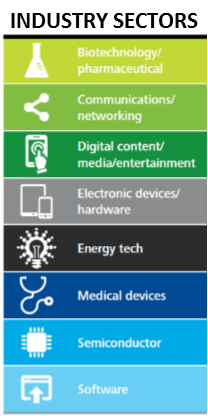
“It is inspiring to witness the innovative ways companies are incorporating emerging technologies for business gains, be it cognitive computing, or the Internet of Things. We congratulate all those ranked on the Fast 500 and look forward to seeing their continued growth into 2016.”

Revolution Lighting Technologies ranked eighth among energy tech companies, and SurgiQuest Inc. ranked sixth among medical device companies.

Picture8Overall, 283 of the 500 companies were in the software sector, and 67 percent of the 500 companies have received venture capital funding at some point in their company’s history.  Topping the list was StartApp, with a growth rate of 21,984 percent from 2011 to 2014. Based in New York and founded in 2010, StartApp provides a free monetization and distribution platform that integrates with applications on mobile devices.


Two-thirds of the companies are private, and 33 percent are public.  The average growth rate of the top 500 companies was 850 percent, with individual company growth on the list ranging from 21,984 percent to 109 percent.  Broken down by region, 20 percent of the companies are based in the San Francisco Bay Area, 14 percent in the New York Metro Area, 7 percent in New England, and 6 percent in Los Angeles and Washington, D.C.

Connecticut Leads the Nation in Preventative Health Care

Among the nation’s 34 most populous states, the rate of preventive health care visits was higher in Connecticut than any state in the nation.  Data released this month from the Centers for Disease Control and Prevention National Center for Health Statistics also found that the rate of preventive care visits to primary care physicians, among the 34 most populous states, exceeded the national rate in Connecticut more than elsewhere. Preventive care visits such as general medical examinations, prenatal visits, and well-baby visits give physicians and other health professionals the opportunity to screen for diseases or conditions, as well as to promote healthy behaviors that may delay or prevent these conditions and reduce subsequent use of emergency or inpatient care.nchs_fb_identifier

In this report, the rate of preventive care visits to office-based physicians is examined by state, patient demographics, and physician specialty. Estimates are based on data from the National Ambulatory Medical Care Survey (NAMCS), a nationally representative survey of visits to office-based physicians.

Overall, preventive care visit rates were higher for children under age 18 years (73.2 per 100 persons) and for those aged 65 and over (81.1 per 100 persons) than for adults aged 18–44 (53.2 per 100 persons) and 45–64 (51.8 per 100 persons).  The preventive care visit rates for women aged 18–44 (87.1 per 100 women) and 45–64 (60.5 per 100 women) exceeded the rates for men in those age groups (18.5 and 42.5 per 100 men, respectively).

doctorThe rate of preventive care visits in the 34 most populous states ranged from 33.1 visits per 100 persons in Arkansas to 120 visits per 100 persons in Connecticut.  Among those 34 states, the rate of preventive care visits was lower than the national rate in 11 states (Arkansas, Indiana, Iowa, Michigan, Missouri, North Carolina, Oklahoma, Oregon, Pennsylvania, South Carolina, and Washington).  The national average was 61.4 visits per 100 persons.  The data is from 2012, the most recent year available from the National Ambulatory Medical Care Survey.

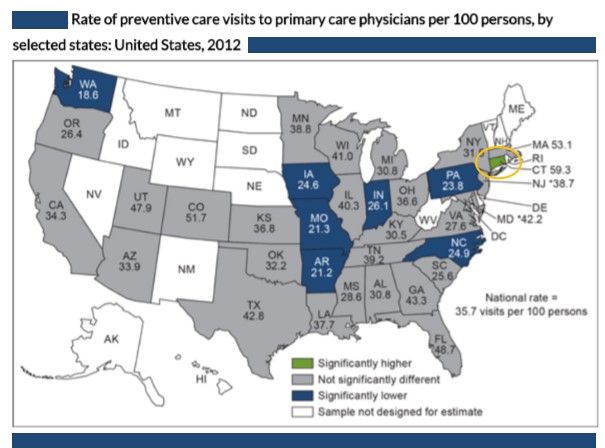
In 2012, 35.7 preventive care visits were made to primary care physicians for every 100 persons across the United States.  In Connecticut, primary care physician preventative care visits were made 59.3 times per 100 people, the highest percentage in the nation.  In Massachusetts, the rate was 53.1, in Colorado 51.7, in Florida 48.7 in Georgia 43.3, in Texas 42.8 and in Maryland 42.2.  Overall, 58.2 percent of preventive care visits were made to primary care physicians, according to the CDC data.  Primary care physicians include office-based physicians in the specialties of family or general medicine, internal medicine, and pediatrics.1u1-c15ecce858

The female rate (76.6 visits per 100 females) of preventative care visits exceeded the male rate (45.4 visits per 100 males) by 69 percent. The percentage of preventive care visits to primary care physicians, however, made by males (76.3%) exceeded those made by females (48.0%). The data suggests that women tend to make their preventative care visits to physicians other than their primary care physician, with the report’s summary suggestion. this “may be related to gynecological or obstetric care for women.”

In 2012, the NAMCS survey sample size was increased fivefold to allow for state-level estimates in the 34 most populous states for the first time.

preventative health map