Disparities Continue As Uneven Economic Recovery Challenges Children and Families; Changes Urged

Connecticut lost 85,358 jobs during the recession, which technically ended nearly seven years ago. The state has continued to hemorrhage manufacturing jobs, however, and industries dependable before the crash—particularly those in finance and health care—grew more slowly or not at all. According to a new report by Connecticut Voices for Children, 97.7 percent of Connecticut’s net job losses were in mid- or high-wage industries and 51 percent of the job losses occurred in the manufacturing and construction sectors, with another 15 percent of job losses occurring in retail trade.

The financial disparity in the state’s population is more stark than ever, the report said.  “Over the past thirty years, incomes for the bottom 99 percent grew by just 14.5 percent, while the incomes of the top 1 percent swelled by 290.8 percent. As a result of this lopsided growth—a period in which the top 1 percent captured 71.6 percent of all income—incomes of the top 1 percent are now 42.6 times greater than the bottom 99 percent.”

The report stresses that many Connecticut working families have been left out of the economic recovery. “As the share of low-wage jobs rises, so does the challenge of raising a family,” the report states. “The jobs created in low-wage sectors not only pay less, but often provide less flexibility, less predictability and fewer benefits than jobs past.”voices
In the report. Connecticut Voices for Children points out that the combination of an increase in the share of low-wage jobs, slow wage growth and persistently high unemployment for minorities and workers without a college education threaten the long term well-being of the state. Data highlighted points out that “black and Hispanic workers in Connecticut make median hourly wages that are, respectively, $7.25 and $8 less than white workers’—a gap that has widened since before the Great Recession.”

Among the recommendations:  raise the minimum wage.  Raising the minimum wage to $15 per hour would offer relief to 336,000 workers, the report points out, which would help those the state's recovery has left farthest behind. Breaking down the demographics, the research report indicated that 60 percent of benefitting workers would be women; 31.8 percent of all black workers and 37.5 percent of all Hispanic workers would benefit.

“Changes in the state economy pose challenges for low wage workers seeking to give their children the best possible start in life,” says Ellen Shemitz, Executive Director of Connecticut Voices for Children. “Higher unemployment and lower wages for workers of color exacerbate existing disparities in opportunity, with significant implications for both the competitiveness and fairness of our state’s economy.”
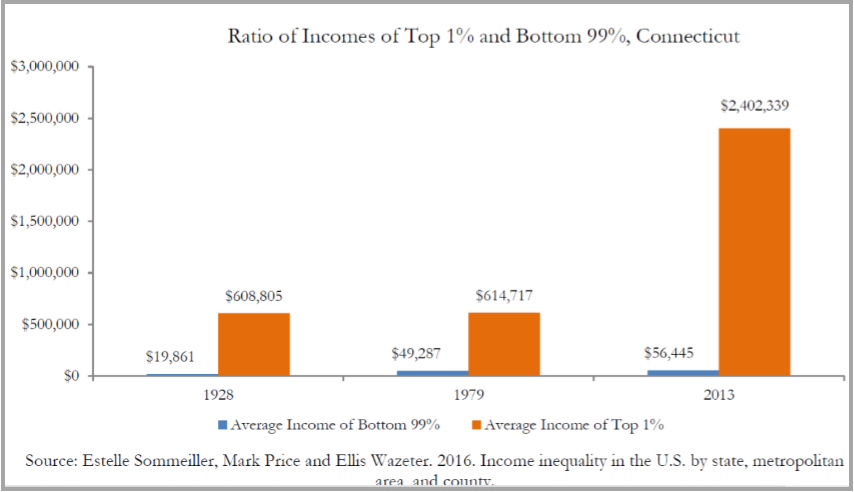
chart-3The report documents a long term shift in job and wage trends in Connecticut, with almost half of all jobs created since the start of the recovery in low-wage industries. Since 2001, the share of industries that typically pay low-wages has increased by 20 percent, while high-wage industry employment has decreased by 13 percent.

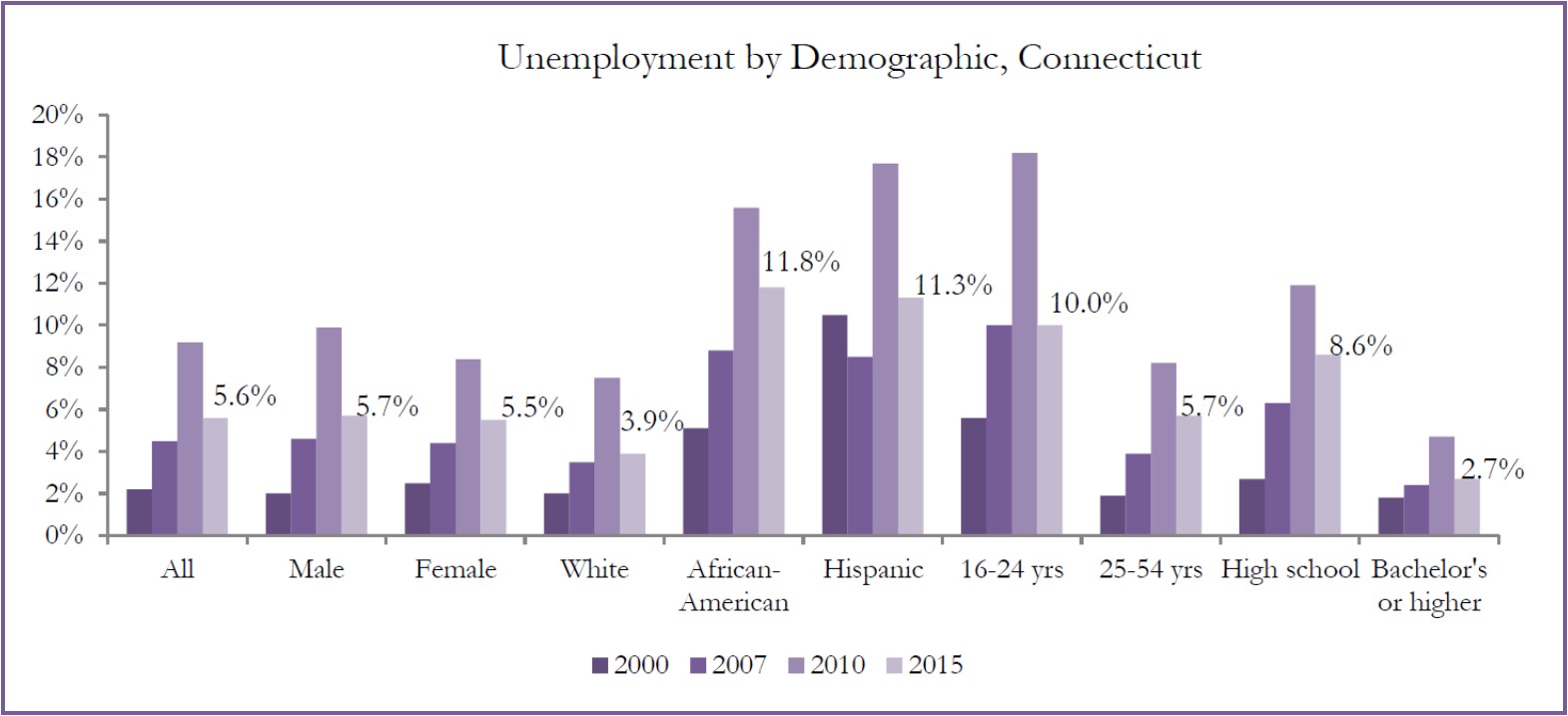
At the same time, unemployment has returned to pre-recession levels for white and college educated workers, but unemployment for workers of color and those without a college education have yet to recover.  Despite years of sustained job growth, these workers face unemployment rates that are three times higher than whites.

“Connecticut’s jobs swap has implications for individual family economic well-being and for the state’s overall revenue sufficiency,” explained Derek Thomas, Fiscal Policy Fellow at Connecticut Voices for Children and report co-author. “The first decade in the 21st-century – which includes the loss of manufacturing jobs in the early 2000s as well as the vast job losses during the Great Recession – has left the state with a sizeable high-wage jobs deficit.”

Among the reports’ key findings:

  • Since 2010, unemployment has steadily declined for white and college educated workers, but not for workers of color and those without a college education. Unemployment for workers of color is nearly triple than for whites.
  • Underemployment remains stubbornly high; the rate of part-time employees that would want to work full-time and workers that have given up on their job search in the past year is two times higher today that it was in 2007.
  • Since 2001, the share of private-sector jobs in low-wage industries has increased by 20 percent, while the share of private-sector jobs in high-wage industries has decreased by 13 percent. Nearly half of new private sector jobs since 2010 are in low-wage industries.
  • The median and bottom 10 percent of wage-earners have seen their wages decline by more than 2 percent since 2002, while the top 10 percent have experienced growth of more than 11 percent.
  • Black workers’ median hourly wage is $8 lower than white workers and Hispanic workers’ median hourly wage is $7.25 lower than white workers.
graph-unSince the workplace is meeting fewer of the needs of children and families, Connecticut Voices for Children is urging state policy makers to take action to bridge the gap between wages and the growing cost of raising a family. The report recommends five key policy initiatives:

  • Restore the earned income tax credit for low income workers to its original 2011 levels, allowing low wage workers to retain more of what they have earned
  • Raise the minimum wage to $15, allowing low wage workers to cover their families’ basic needs
  • Expand high-quality early childhood education to remove barriers to employment for parents and better prepare future generations of workers
  • Strengthen infrastructure investments to ensure economic competitiveness and economy-boosting jobs
  • Reform property taxes for a more equitable education system

Because workers of color are overrepresented in the low-wage industries that have driven the state’s job recovery, racial and ethnic wage gaps have widened. “The growth in low-wage industries is a double whammy for working families – not only do they pay less, but they also lack the benefits, predictability and flexibility of jobs past,” says Ray Noonan, Associate Fiscal Policy Fellow at Connecticut Voices for Children and report co-author.

Connecticut Voices for Children is a research-based policy think tank based in New Haven.  The organization’s mission is to promote the well-being of all of Connecticut's young people and their families by advocating for strategic public investments and wise public policies. To achieve these objectives, Connecticut Voices for Children produces “high quality research and analysis, promotes citizen education, advocates for policy change at the state and local level and works to develop the next generation of leaders.”

Financial Capital Remains Hurdle for Women Entrepreneurs

“Data reveal that an increasing number of women are choosing entrepreneurship as a career path, and of those, a growing number of them share aspirations for growth.”  That fact, pointed out in the preface of a new book co-written by a local university professor, is the proverbial tip of the iceberg. According to the U.S. Census Bureau, there are roughly 9.9 million women-owned firms in the United States, representing over a third of all firms in the country—and the ranks of new enterprises with women at the helm are growing rapidly. Between 2007 and 2012, women-owned firms in the U.S. grew by 27 percent compared to a growth rate of 2 percent for firms overall.

“But in spite of their impressive growth in numbers,” writes University of Hartford finance professor Susan Coleman, “the business ventures women are launching today continue to lag behind those launched by men in terms of revenues and employment. So while an increasing number of women can count themselves as entrepreneurs, many appear to be running into barriers, as the vast majority of their businesses remain quite small.”6a00d8342f027653ef01b8d205bcbd970c-800wi

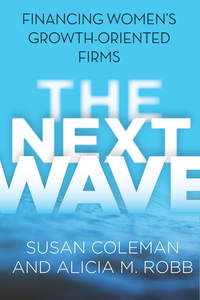
Coleman, along with Alicia M. Robb, have co-authored The Next Wavcoleman_8_13e: Financing Women’s Growth-Oriented Firms (published by Stanford University Press), which points to “three essential factors that women entrepreneurs need to thrive: knowledge, networks, and investors. In tandem, these three ingredients connect and empower emerging entrepreneurs with those who have succeeded in growing their firms while also realizing the financial and economic returns that come with doing so.”

Robb is Senior Fellow with the Ewing Marion Kauffman Foundation and Visiting Scholar at the University of California, Berkeley and the University of Colorado, Boulder. She previously worked with the Office of Economic Research in the Small Business Administration and the Federal Reserve Board of Governors. Coleman is Professor of Finance and Ansley Chair at the Barney School of Business at the University of Hartford.

Coleman notes that “A crucial pitfall is that women face unique challenges in their attempts to acquire financial capital. Growth-oriented firms typically require substantial investment—both in the form of bank loans and external equity in the form of angel or venture capital funding—to scale up.” Studies reveal, however, that “women entrepreneurs raise significantly smaller amounts of capital than men and face continued barriers in their attempts to secure external equity in particular,” Coleman points out.

In the book’s forward, the authors explain that the motives behind women-run entrepreneurial businesses vary.  “Some of these growth-oriented entrepreneurs are motivated by a desire to pursue an opportunity or an unmet need in the marketplace.  Others are frustrated by the constraints imposed by a ‘glass ceiling’ that prevents them from reaching the most senior ranks of corporations.  Still others are drawn by the financial and economic rewards that can come from leading a firm that achieves scale.”

According to IRS data, women represent over 40 percent of top wealth holders in the United States, yet estimates from the University of New Hampshire’s Center for Venture Research indicate that they represented only 25 percent of angel investors in 2015, Coleman notes.

Optimistic about the future success of women entrepreneurs, Coleman and Robb observe that “Successful women entrepreneurs who are paying it forward in a variety of ways are a driving force” in what they describe as the “next wave.”

“In a virtuous cycle, women entrepreneurs evolve from being the recipients of human, social, and financial capital into becoming the providers of those key resources as their firms grow and create economic value. The more successful women at the helm of businesses that kick off cash, the more women there are to invest in others, and the faster we see the number of women grow in the ranks of larger businesses and investing.”

In addition to appreciation expressed to the Kansas City-based Kauffman Foundation for financial support, the book’s acknowledgements note that the Barney School of Business and the University of Hartford’s Women’s Education and Leadership Fund provided grants that helped support initial research and development of case studies on women entrepreneurs. The authors also expressed appreciation to three University of Hartford graduate assistants – Ece Karhan, Mert Karhan, and Isha Sen – who “played an invaluable role in the book’s development.”

State Arts Office Completing Outreach for Strategic Plan, Adding Staff Position

Connecticut’s Office of the Arts (COA), which operates within the state Department of Economic and Community Development, is concluding a months-long strategic planning process to inform the agency’s next five-year Statewide Cultural Strategy. The Office is also looking to hire a full-time program associate, even as budget cuts and layoffs decimate state agencies from tourism to developmental disabilities. It is just one of nearly three dozen state positions currently being advertised by the state Department of Administrative Services.

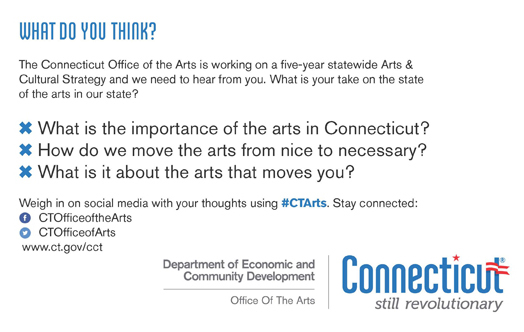
The aim of the strategic planning effort is to move perception of the arts from "nice to necessary," according to the agency’s website. “jobTo do this, we've engaged a firm to help guide our discussions and considerations and are utilizing a Design Thinking approach to this process.”
The firm, Austin-based Public City, is a culture-driven public engagement consultancy and studio. Public City works “to create authentic culture-based experiences that allow our clients to deeply connect with their publics.”  The firm’s website cites 25 years of experience “strategizing, designing, commissioning, exhibiting, and partnering with cities, businesses, artists, designers, and curators.”  Connecticut is listed first on the company’s client roster, which includes numerous Texas organizations and others from throughout the country.

COA has used social media, Survey Monkey, and regional charrettes for data collection in Connecticut.  Regional charrettes were conducted in collaboration with regional partners and were “small think tank discussions by invitation which represent a wide sampling of voices.”  Facebook and Twitter sites were used, along with the hashtag #CTArts.

The Office of the Arts develops and strengthens the arts in Connecticut and makes artistic experiences widely available to residents and visitors, according to the agency website. Through its grant programs, COA invests in Connecticut artists and arts organizations and encourages the public’s participation as creators, learners, supporters, and audience members, the site explains.

In addition, the Office of the Arts plays an ongoing convening role and provides an array of training and professional development opportunities, and also collects and disseminates state, regional, and national arts information resources via web communications, directories, publications, data-sharing, one-on-one consultations, and referrals.COA_outreach(revised.med)

The staff position that COA seeks to fill will report to the state’s Director of Culture and work “independently to support the grant-making, researching, and developing activities necessary to implement arts and cultural programs in a wide range of artistic areas.”  Applications for the position – with an anticipated salary range between $62,973 and $81,493 – are due by September 22.

Following data collection and analysis in the strategic planning process, COA anticipates sharing results and engaging in further outreach. The final plan was set to emerge this week, according to the COA website.

PERSPECTIVE: Can the ‘Sharing Economy’ of Regionalism Reduce Income Inequality?

by Frank Shafroth So far, 2016 has been framed by unfolding fiscal tragedies in a number of cities -- Flint, Mich.; Ferguson, Mo.; and East Cleveland, Ohio, come to mind. Plagued by high poverty, rising crime rates and diminished sources of revenue, these cities are examples of the increase in income inequality among U.S. municipalities.CT perspective

Just as the richest Americans have raced ahead of working-class Americans, there are haves and have-nots among cities, too. It got me thinking: What role should states play in all of this? And more specifically, are there ways to use the “sharing economy” to narrow the disparity gap?

For a change, we’re not talking about Airbnb or Uber. The sharing economy I mean is about regional governance, or sharing agreements where local policymakers create new, multijurisdictional fiscal arrangements to address regional objectives.

Right now, throughout America, otherwise identical households pay different taxes for the same level of public services simply because they live in differenq1t cities. Bo Zhao, senior economist at the Boston Federal Reserve, wonders if such differences in taxes put some cities or counties at a disadvantage in economic competition. After all, he says, fiscal disparities occur when economic resources and public service needs are unevenly distributed across localities. For the most part, it’s been up to cities and counties to attempt to address these growing disparities. There are any number of longstanding examples of regional taxation and regional tax-base sharing across the U.S., such as in Minneapolis-St. Paul. More recently, there are new innovations on the theme: The Scientific and Cultural Facilities District, for example, distributes roughly a tenth from a 1 percent sales and use tax to cultural facilities throughout the Denver metropolitan area.

States are really in the best position to implement sharing agreements, but few do. One exception is Minnesota, which more than a generation q2ago enacted legislation to encourage a sharing economy statewide. The Minnesota Fiscal Disparities law has three important goals: reduce the impact of fiscal considerations on location of business; reduce interjurisdictional competition; and direct resources to communities facing the greatest fiscal pressures.

The law shifts millions of dollars in property taxes to be shared among communities in a metro area, including cities, counties and school districts. Each jurisdiction or entity “contributes” 40 percent of post-1971 growth in its commercial-industrial property tax base to an areawide pool, where the tax base is then allocated among local governments in inverse relation to their per capita fiscal capacity.

The percentage of the total q3tax base in the Minneapolis-St. Paul areawide pool has increased from 6.7 percent in 1975 to 37.6 percent by 2012. More than $588 million of taxes were shared among the participating localities in 2012. The distribution of shared revenue reduced incentives for cities to compete for businesses and infrastructure projects, and it created greater incentives for shared investments, especially in infrastructure.


It is an effective fiscal disparities program. But unfortunately, despite the growing income disparity among localities and regions, the approach does not seem to be catching fire with other states or with the biggest potential player of all, the federal government.

________________________________________

Frank Shafroth is the director of the Center for State and Local Leadership at George Mason University, and was director of policy and federal relations for both the National Governors Association and the National League of Cities.  He is a columnist for Governing magazine, where this article first appeared.  Reprinted with permission.


PERSPECTIVE commentaries by contributing writers appear each Sunday on Connecticut by the Numbers.

 Also of interest… Progress Made on Regional Cooperationmap

UConn Study: Look-alike ‘Smart Snacks’ Confuse Students, Parents

Unhealthy snack food brands such as Cheetos, Fruit-by-the-Foot and Froot Loops have reformulated their products to meet new USDA Smart Snacks nutrition standards so they can be sold to kids in schools. But these products often come in packages that look similar to the unhealthy versions of the brands that are still sold in stores and advertised widely to youth. Selling these look-alike Smart Snacks in schools confuses students and parents, provides companies a way to market their brands to kids in schools, and may hurt schools’ credibility, according to a new study by the Rudd Center for Food Policy and Obesity at the University of Connecticut, published in the journal Childhood Obesity and reported by UConn Today.Exhibit_Revised-July (1)

It is the first to examine how selling look-alike Smart Snacks in schools affects attitudes about the brands and perceptions of schools selling these products.

“Kids think the healthier Smart Snacks they can buy in school are the same products that are sold in stores,” says Jennifer Harris, lead author of the study and director of marketing initiatives for the UConn Rudd Center. “It’s confusing because the packaging for these look-alike Smart Snacks looks so much like the less nutritious versions that kids see advertised on TV and in the stores.

“This is a great marketing tool,” she adds. “The snack makers get to sell their products in schools and at the same time market their unhealthy brands to kids every school day.”

The study involved an online experiment with 659 students 13 to 17 years old, and 859 parents of children 10 to 13 years old.  The participants viewed information about a hypothetical school that sold either look-alike Smart Snacks, regular versions of the same brands sold in stores, Smart Snacks in redesigned packages, or only brands whose regular products met Smart Snacks standards.

Specific findings of the study include:

  • Students and parents rated the healthier look-alike Smart Snacks similarly in taste, healthfulness, and purchase intent as the store versions, while considering Smart Snacks in different packages to be healthier but less tasty.
  • Most participants inaccurately believed they had seen look-alike Smart Snacks for sale in stores.
  • Participants also rated schools offering the look-alike Smart Snacks and the store versions of the brands as less concerned about students’ health and well-being.

RUdd“The practice of selling look-alike Smart Snacks in schools likely benefits the brands,” says Harris, “but may not improve children’s overall diet, and undermines schools’ ability to teach and model good nutrition.”
The Rudd Center for Food Policy & Obesity relocated to UConn in 2015 after 10 years at Yale.  The Center is a distinguished multi-disciplinary policy research center dedicated to promoting solutions to childhood obesity, poor diet, and weight bias through research and policy. The Rudd Center is a leader in building broad-based consensus to change diet and activity patterns by conducting research and educating policy makers and the public.

The research was funded by a grant from the Michael & Susan Dell Foundation.

CT Residents Concerns About Health Care Affordability, Job Prospects Increase; More Expect to Leave, Even as Optimism Grows

Nearly two-thirds of Connecticut residents are concerned about the affordability of health insurance, a jump of 12 percentage points in just the past year, and the highest level since the quarterly Inform CT Consumer Confidence Survey began 18 months ago. And slightly more than 4 in 10 Connecticut residents now say it is likely that they will move out of the state within the next five years, reflecting concerns about a lack of jobs, declining business conditions and health insurance costs. Yet, many residents continue to say that Connecticut is a good place to live and raise a family, and some optimism is evident in consumer spending expectations.  The survey found that:CTConsumConfSurveyLOGO

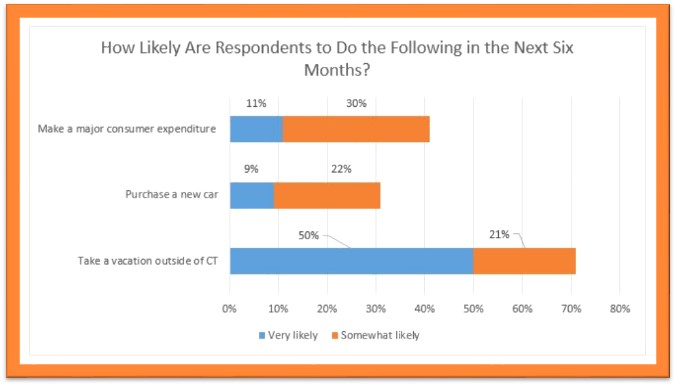
  • 41% say it is likely they will make a major consumer expenditure (for furniture or other products) during the next six months.
  • 31% say it is likely they will purchase a car in the next six months.
  • 71% indicated they expected to take a vacation outside of Connecticut in the next six months.

All are the highest percentages since the quarterly survey began in 2015.

The quarterly survey is released by InformCT, a public-private partnership that provides independent, non-partisan research, analysis, and public outreach to help create fact-based dialogue and action in Connecticut.  Administered by researchers from the Connecticut Economic Resource Center, Inc. (CERC) and Smith & Company, the analysis is based on the responses of residents across Connecticut and addresses key economic issues, providing a glimpse of the public’s views.

Despite qualms about the state’s economy, residents are increasingly optimistic about their own financial circumstances.  One-third (32%) say they are better off now than six months ago, and 42 percent believe they will be better off six months from now than they are today.  Both numbers are 5 percentage points higher than they were a year ago.  The overall view of the state’s fiscal picture differs:

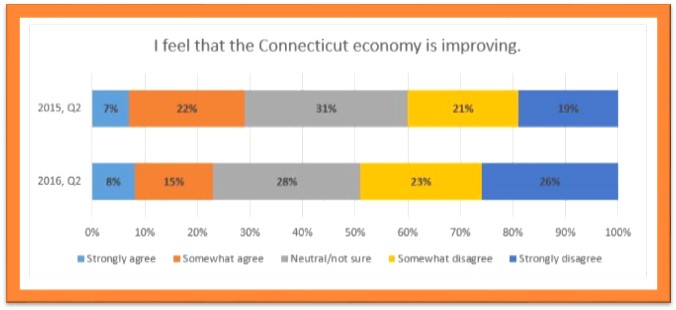
  • A year ago, 40 percent of those surveyed disagreed with the statement that the Connecticut economy is improving. That percentage has now climbed – one year later – to 49 percent, nearly half the state.
  • The percentage who believe that the state’s economy is improving has dropped from 29% a year ago to 23% during the second quarter of this year.
  • Residents of New London and Fairfield County most strongly believed that business conditions had improved over the previous six months, with Middlesex, Windham and Litchfield more likely to say that business conditions had worsened.

c1Increasingly, residents believe that jobs are “very hard to get” in Connecticut compared with six months ago (from about one-quarter to one-third of those surveyed in Q2 2016 versus Q2 2015), and are, in growing numbers, saying they would rather leave than stay.
  • A year ago, 32 percent of those surveyed said it was very likely or somewhat likely that they would move out of Connecticut within the next five years.
  • A year later, that percentage has climbed by 10 points to 42 percent.

At the same time, about half of those surveyed say that “Connecticut is a good place to live and raise a family” – a number that has remained consistent for the past year and a half.  Only 1 in 4 disagree.  More than half of 18-21 year-olds and 22-25 year olds say they are likely to leave in the next five years; in all other age categories it is less than half, with those age 56-65 the least likely.

Concerns about having “enough money to retire comfortably” have remained steady for six consecutive quarters, with about less than 1 in 4 expressing the opinion that they anticipate having sufficient funds. And 1 in 4 now say it is likely that they will refinance their home or purchase a new home in the next six months, the highest percentage since the quarterly survey began.

With increasing calls for regional support of Hartford and regional approaches to tackling budget challenges, the survey found that an increasing number of residents in Connecticut believe that a range of services “could be effectively delivered regionally.”

c2Forty-three percent, an increase from 40 percent in the year’s first quarter, answered “all of the above” when asked if education, libraries, public health, public safety and animal control could be provided regionally.  Among those services individually, there was slightly greater support for a regional approach to public safety, slightly less for each of the others.  The largest increase was for “all” of the services.

The question of what residents in the region consider to be the “best way to grow the economy” saw a preference for investing in schools and community features over recruiting companies, by an increasing margin.  In this year’s first quarter, the margin was 52% to 48%. In the most recent quarter that margin had grown by 9 percentage points to 61%-39%, from just over half to more than 6 in 10.

Veteran-Owned Small Businesses Will See Expanded Price Preference for State Work, Beginning Oct. 1

Applications are available for a new Connecticut initiative designed to “spur veterans to start a business and to help small veteran-owned businesses to flourish.”  The law, which takes effect on October 1, is the most generous of it’s kind in the nation, and provides veteran-owned businesses with a price preference of up to 15% for certain state Department of Administrative Services open-market orders or contracts. These businesses must have a gross revenue of up to $3 million in the most recently completed fiscal year, and at least 51% of the ownership must be held by one or more veterans. Under existing law, a “veteran” is anyone honorably discharged or released from active service in the U. S. Armed Forces or their reserve components, including the Connecticut National Guard performing duty under Title 32 (such as certain Homeland Security missions).branches

The legislation, which began as Senate Bill 2 in the 2016 session of the state legislature, was unanimously approved by the Veterans Affairs Committee and Government Administration and Elections Committee, before gaining unanimous approval in the Senate and House and the Governor’s signature.

The National Veteran-Owned Business Association, in testimony before the state legislature in March, said passage of the new law would “make Connecticut the most ‘Vetrepreneur-Friendly”state” in the U.S.  The organization noted that 27 states have programs in place “to create opportunities for veteran-owned businesses, and that New Mexico had recently increased its preference to 10 percent.  At the time, Connecticut’s veterans preference also stood at 10 percent.

Senate leaders Martin Looney (New Haven) and Bob Duff (Norwalk) said the move to 15% was part of a multi-year effort by the legislature to “improve the lives of our vets, and help them earn a living.” State Comptroller Kevin Lembo, testifying in support of the proposal, told the legislature it would “decrease a bit of the burden on those veterans who are doing much more than just getting by.  These veterans have not only re-entered their communities as productive taxpayers, but have taken the risk of starting up their own business to realize their piece of the American dream.”form

“We applaud your leadership of the important piece of legislation that will enhance and expand opportunities for the small businesses” owned by veterans, said Matthew Pavelek, Vice President of the national organization, NaVOBA, based in Pittsburgh.

To receive the fifteen per cent price preference, a bidding business must first obtain a Veteran-owned Micro Business certification from the Connecticut Department of Veterans Affairs. The Certification is valid for six months or until such time as the business is no longer in compliance with the statutory requirements, whichever occurs first.  Applications for the certification are now available from the state Department of Veterans Affairs.


Childcare Costs Continue to Outpace Inflation, Low Income Families Hit Hardest; CT 6th Most Expensive

One of the more notable aspects of the latest data on consumer prices provided this month by the U.S. Bureau of Labor Statistics is the striking increase in childcare and nursery school prices.  That data, along with statistics that reflect the impact of those increasing costs on families ability to afford such care, highlight the struggles and disparities that continue to exist, in Connecticut and nationwide. Over the past 25 years, childcare and nursery school costs have risen 177 percent, while prices more generally have risen just 77 percent.  Childcare and nursery school costs have been outpacing general inflation for at least 25 years (the data do not go back any further than 1991);  this is putting a significant strain on the budgets of low-income families.

child care costsThe Center for Economic and Policy Research points to an August 2014 study by the U.S. Department of Agriculture that found a two-parent, middle-income family (those making between $62,000 and $107,000 per year) will spend an average of $245,000 (in 2013 dollars) on their kids between the ages of zero and 17.

Significantly, due to rising income inequality, poor families are finding it harder to give their children the same opportunities afforded to rich children, the study points out. At present, families in the top fifth of the income distribution spend seven times as much on their children as families in the bottom fifth.

“This inequality can also be observed for paid leave: about 23 percent of workers in the top tenth of the wage distribution have access to paid family leave, compared to just four percent of workers in the bottom tenth,” the findings show.

Child care in Connecticut, the Economic Policy Institute points out, “is expensive.” Connecticut is ranked 6th out of 50 states and the District of Columbia for most expensive infant care.

  • The average annual cost of infant care in Connecticut is $13,880—that’s $1,157 per month.
  • Child care for a 4-year-old costs $11,502, or $959 each month.

Childcare is also “unaffordable” for a large percentage of Connecticut famiies.  The Economic Policy Institute indicates that infant care for one child would take up 16 percent of a typical family’s income in Connecticut, noting that according to the U.S. Department of Health and Human Services (HHS), child care is affordable if it costs no more than 10% of a family’s income. By this standard, only 28.1% of Connecticut families can afford infant care.

costsA minimum-wage worker in Connecticut would need to work full time for 36 weeks, or from January to September, just to pay for child care for one infant. And a typical child care worker in Connecticut would have to spend 63.6% of her earnings to put her own child in infant care, according to the data.

CEPR points out that other costs for raising children have increased as well, also outpacing the inflation rate. For instance, elementary and high school tuition and fees have risen 3.2 percent over the past year (four times the overall inflation rate of 0.8 percent); college tuition and fees are up 2.7 percent. At the same time, infant care in Connecticut costs $3,752 (37.1%) more per year than in-state tuition for 4-year public college, according to the Economic Policy Institute.

According to the Organisation for Economic Cooperation and Development (OECD), public expenditure on pre-primary education and childcare is just 0.4 percent of GDP in the United States; this is far lower than the rates of spending in Denmark (2.0 percent of GDP) or Iceland and Sweden (1.6 percent). By this measure, the U.S. comes in 33rd out of the 36 countries surveyed by the OECD, according to the CEPR report.up

Public expenditure on pre-primary education spending is 0.3 percent of GDP in the U.S. but averages 0.5 percent in the other OECD countries; even more shockingly, public expenditure on childcare is just 0.06 percent of GDP, well short of the 0.4 percent average from the rest of the OECD. Nor do differences in GDP make up for the latter gap.  In 2011, public expenditure on childcare was $794 per child in the U.S., less than one-third of the OECD average. By contrast, public spending on childcare is $7,100 per child in Finland, $6,400 in Norway and Denmark, $5,900 in Sweden, and $5,700 in Iceland — despite the fact that the U.S. is substantially richer than all those countries except Norway.

In a separate survey, the OECD found that just 14 percent of all public spending on children in the U.S. went to children age five and under — dead last among the 32 OECD countries in the sample. In the United States, 14 percent of all public spending on children goes to children ages zero to five; 41 percent goes to children ages six to 11; and 45 percent goes to children ages 12 to 17. For the other 31 countries (data were not available for Canada and Turkey), 26 percent of all public spending on children went to children ages zero to five; 35 percent went to children ages six to 11; and 39 percent went to children ages 12 to 17, the Center for Economic and Policy Research explained.

PERSPECTIVE: Why and How We Should All Be Concerned About College Student Retention

by Victor Neves and David Johnston The degree to which college students are capable of successfully moving from matriculation to graduation, described as “retention” or “persistence,” should be a concern for all of us.  Employers regularly complain that the skills needed for the workplace are lacking.  Policy wonks lament the declining ratio of productive workers to retirees, now about three to one, down drastically from decades ago – an ominous threat to the solvency of the Social Security system, as well as the viability of the economy and the health care system.

All the more reason to maximize proven, but not always followed, ways that can boost college persistence to graduation and through to employment.  The cost of implementing effective practices is one challenge, in light of steadily declining state support for higher education, especially for community colleges and state universities that take in the majority of our high school grads headed toward postsecondary education.CT perspective

What are these strategies?  Not quite a “top ten” list, but they’re not just catchy, they work:

  • Colleges and universities are increasingly collaborating with high schools to both expose high school students to college life -so-called bridge programs – and to help students earn college credits, through early college or dual enrollment programs.
  • Community-based agencies in our cities are increasingly practicing “seamless counseling” -- working with high school grads to avoid “summer melt,” to assure these young people make it to campus after earning acceptance to college. In some cases, these programs continue to support these students once they are enrolled.  Currently, in Hartford, about 70 percent of high school grads are accepted into some form of higher education, but only 50 percent matriculate.
  • Once on campus, more students, especially those from challenged backgrounds, are enrolled in first-year experience programs and/or learning communities that teach “college survival” – indispensable skills that can be the difference between staying and dropping out. These are required at some schools, but not all.
  • More first generation college students are mentored by older students. For students of color, connecting with a mentor who looks like them is also a powerful retention factor.  A national study of “black male college student success,” documented the value of such relationships.  UConn’s recently-announced “black male dorm” arrangements are a step in this direction.q1
  • More campuses are practicing “intrusive advising” that follows the progress of challenged students closely and intervenes quickly when they appear to be struggling academically or otherwise. Too many challenged students have non-academic obstacles that seriously disrupt their progress, and at times end their college careers before they’ve really begun.  Less than half of community college students move on to achieve a degree.
  • All students, but especially challenged students, are repeatedly encouraged to get involved on campus – a proven retention factor. Stepping up the “ask” can bring results that make retention more likely.
  • At times controversially, colleges are encouraging, and hiring, faculty who use more “student-centric,” interactive teaching styles, with new technologies increasingly integrated into the curriculum. Some veteran faculty resist, others adapt.  Traditional academic content will still be central – as it should be - but teaching, to be truly effective, has to accommodate today’s technology and media-savvy students, and build student-faculty relationships in non-traditional, interactive ways.
  • Community college students, including older students, are increasingly being guided more quickly into career paths, ideally related to job growth areas, to reduce the confusion of too many choices and too little direction. Student majors can be changed, but a clear pathway from the get-go works wonders.
  • Schools should also provide a platform in which students can showcase their accomplishments – for example, “E-Portfolios” that incorporate student work and achievements from enrollment all the way to graduation, providing students a tangible way of seeing their progress towards reaching their goals.q2
  • Campuses, back-stopped by changing Federal policies, existing and proposed (e.g., free community college), are becoming more creative with financial aid; and lower-income community college and state university students have more access to more adequate financial aid.

These “wrap-around” strategies, and others, are effective.   National research and anecdotal experience in Connecticut point clearly in these directions.  However, they continue to be the exception in Connecticut, with progress towards implementation sporadic at best.

Employers, college administrators and faculty, community leaders, legislators, parents and students need to advocate for such effective creativity. The benefits will accrue not only to students and their families, but the communities and businesses of Connecticut in desperate need of the vitality and vibrancy that a new generation of ready, willing and able college graduates can bring to the state we share.

_____________________________________________________

Victor B. Neves is a graduate of Tunxis Community College who studies Business Administration at CCSU.  He chairs the Student Committee of the Center for Higher Education Retention Excellence (CHERE), based in Hartford, a program partner of the Hartford Consortium for Higher Education.  David Johnston is Executive Director of the Center for Higher Education Retention Excellence. 

PERSPECTIVE commentaries by contributing writers appear each Sunday on Connecticut by the Numbers.

LAST WEEK:  Back to School – Don’t Forget Your Child’s Mental Health

Prompted by Economy, Only Half of Nation's Millennials Plan to Work for Same Company Next Year, Gallup Survey Says

Millennials are entering the workforce in increasing numbers, and are the intense focus both of governments – including Connecticut – and businesses seeking to attract and retain them.  As Connecticut’s economic ranking among the states continues to hover near the bottom, the job choices of millennials become increasingly important to future economic vitality. Even amidst less than favorable comparisons in recent rankings, Connecticut has managed to achieve recent employment figures that show improvement. Last month, the state added some 3,000 jobs in the private sector and wages have also risen slightly in recent reports after a period of stagnation, WNPR reported recently.

Heather Ziegler, managing partner for Deloitte in Stamford, told WNPR that in her view the state is doing some things right, like encouraging high technology industries and fostering entrepreneurship. "But what I think is most effective, and one of the challenges at the same time," she told WNPR, "is getting individuals with the right skill sets interested in staying in the area and staying in Connecticut, versus moving on to the larger metropolitan areas that we are right between."66nbc

Millennials are already in a tough situation – they’re better educated, yet earning less than their counterparts in 1990, points out Christine Schilke of Young Energetic Solutions (YES CT), a statewide initiative seeking to empower young people to create a vibrant Connecticut.  She indicates that “while 28% of millennials hold bachelor’s degrees compared to 24% in 1990, only 67% are employed, compared to 74% two decades ago.  Those who are working earn an average $40,849, versus $46,569 by their predecessors.”

“Today’s millennials,” Schilke adds, “are also burdened with college debt, and are less likely to be married, live alone or drive. Adding to these challenges is the fact that Connecticut has some of the highest homeownership and rental costs in the nation (6th and 8th most expensive, respectively), creating a tough living environment for today’s young adults.”

Nationwide, according to a recent Gallup poll, six in 10 millennials say they're open to different job opportunities, and only 50% plan to be with their company one year from now. Millennials are cracking under the weight of too much debt, according to Merrill Lynch's 2016 Workplace Benefits Report, which points out that only 24% of millennials surveyed say that they are in control of their finances.

Technology is the primary facilitator of millennials' job research: 81% of millennials indicate that they view the websites of organizations they're interested in, and a majority (62%) report that they conduct a general web search to learn about job opportunities, Gallup reports.millennials

Not surprisingly, “millennials are extremely digitally connected, and smartphones have become a ubiquitous accessory for them.” Gallup found that 91% of millennials owned smartphones in 2013, compared with 83% of those in older generations. And compared with other generations, millennials are:

  • almost 40% more likely to say they sent or read email messages "a lot" within the past day
  • 2.5 times more likely to say they posted or read messages on Facebook, Instagram or another social media site "a lot" within the past day
  • 11 times more likely to say they used Twitter, including posting or reading tweets, "a lot" within the past day
  • more than 2.5 times more likely to say they sent or read text messages "a lot" within the past day

To attract the best workers, Gallup suggests, “organizations need brand strategies that account for millennials' motivation and ability to find the best employers -- especially considering that millennials currently make up 38% of the U.S. workforce, and some estimate that they will make up as much as 75% of it by 2025.”

https://www.youtube.com/watch?v=OkOmyg5lJbQ