Superintendents on the Move as Revamped Education Funding is on State's Agenda

With a major overhaul of education funding to Connecticut communities on the state legislature's agenda when the newly elected legislature convenes in January in order to comply with a court order, some of the state’s largest school districts are undergoing seismic changes of their own, as superintendents are moving at what appears to be an unprecedented rate in the midst of a school year. Torrington selected a new superintendent just a week ago, even as vacancies were imminent or in place in Hartford, New Haven and Bridgeport, and a new Stamford superintendent is just settling in.superintendent2

Denise Clemons was appointed as the new superintendent of the Torrington public schools, returning to Connecticut after serving as superintendent in Gardner, MA. Previously she was assistant superintendent of curriculum and instruction in Groton, MA; the assistant superintendent of secondary education in Bridgeport; and an English teacher in New Haven.

“I hope to kind of bridge the gap between the community and the schools — kind of open it up. I think that we need to work together, and with that, we’ll be better,” Clemons told the Torrington Register- Citizen. “I’m glad to be here because I think that this is a great community, and I think it’s ready for change, and I’m ready to change with them.”

In Bridgeport, the city school board will soon be identifying someone already working in the district, who holds a superintendent certificate and preferably a doctorate degree, to take over for the current interim superintendent until a permanent replacement can be hired next year, the CT Post is reporting.  Fewer than a handful of current district leaders hold the superintendent certification according to the State Department of Education. They include Career and Craftsmanship principal Wayne Alexander, who was a finalist this fall for the interim superintendent position in New Haven.  Applicants in Bridgeport have until November 28 to apply and will be interviewed the first week in December. The board hopes to have made a selection before current Interim Schools Superintendent Fran Rabinowitz leaves on December 30, 2016.

New Haven Superintendent of Schools Garth Harries announced at the end of September that he would be leaving that post in November, after three years in that position, and more than a year before the end of his contract.  A buyout was worked out, reportedly due to clashing priorities and personalities inthe district.  Last month, the Board appointed Reginald Mayo, the longtime superintendent of New Haven Public Schools and the immediate predecessor to departing superintendent Harries, as the school district’s interim superintendent. Mayo worked in the district’s schools for 46 years, 21 of them as superintendent.  A search committee in New Haven has begun work to select a new superintendent, the New Haven Register has reported. glass

Beth Schiavino-Narvaez, the superintendent of Hartford public schools, announced in early September that she is stepping down to take a job with the United States Department of Defense Schools in Okinawa, Japan. She will be the Chief of Instructional Leadership Development with the United States Department of Defense Schools, which is a newly-created position.  The announcement came just weeks into the new school year, and years before her contract was due to expire.  She leaves the district on Dec. 8.  An interim superintendent is expected to be named shortly, the Hartford Courant has reported.

Stamford began the year with an interim Superintendent, James Connelly, who began his stewardship of the district in January.  Earl Kim, a Hawaii native, became Superintendent of Stamford Public Schools in July 2016, after his appointment by the Board of Education in March. Prior to arriving in Stamford, Kim served as Head of School, Kamehameha Schools – Kapālama, and prior to that as Superintendent of Schools in Montgomery Township New Jersey from 2008 to 2012, and in Verona Township New Jersey from 2003 to 2008, according to the district’s website.

Connecticut’s major urban communities are not the only districts seeing superintendent transitions.

The town of Killingly saw its superintendent depart in July, and in September the local board chose Lynne Pierson, most recently the interim superintendent for the Darien school system, to oversee the Killingly district, beginning Oct. 1. She is expected to serve through March 1, or until a new superintendent is chosen, the Norwich Bulletin reported.

And Dr. Toni Jones was appointed the new superintendent of Fairfield Public Schools by the local Board of Education in September.  Jones, who has been serving as the superintendent in the Falls Church City school district in Virginia, will begin serving in her new role in Fairfield on Dec. 5.

Stamford-based Harman to be Acquired by Samsung

Even as Connecticut’s economic development leaders toil diligently to retain and attract industry-leading businesses to the Land of Steady Habits, market forces at times pull in different directions.  That is again in evidence as Samsung has announced it will buy Stamford-based Harman for $8 billion. The acquisition of will make Samsung a major player in automotive technology, and removes an independent corporate headquarters from the state’s roster. Earlier this year, Harman was one of four Connecticut-based companies to be named among the most innovative companies by Fast Company magazine.  Harman ranked seventh on the Fast Company ranking of the 10 most innovative companies in the automotive sector.harman_logo_thmb

Upon closing, Harman will operate as a standalone Samsung subsidiary, and continue to be led by Dinesh Paliwal and Harman’s current management team, both companies indicated in a news release.  Harman has a workforce of approximately 30,000 people across the Americas, Europe, and Asia and reported sales of $7.0 billion during the 12 months ended September 30, 2016.

“Samsung is pursuing a long-term growth strategy in automotive electronics, and plans to retain Harman’s work force, headquarters and facilities, as well as all of its consumer and professional audio brands.  Samsung believes the combination will increase career development and advancement opportunities for the employees of both companies,” the news release stated. harmanmicrosoft_mid

“This compelling all-cash transaction will deliver significant and immediate value to our shareholders and provide new opportunities for our employees as part of a larger, more diversified company,” Harman Chairman, President and CEO Dinesh Paliwal said.

For Samsung, it is the biggest overseas acquisition ever by a South Korean firm, according to the news service Reuters. The Harman acquisition is subject to regulatory approvals and is expected to close in mid-2017, reports indicate. The agreement has been unanimously approved by the boards of directors of both companies.

1516092_871290752969831_1531732641_nHarman's products, which provide infotainment, telematics, connected safety and security services, are used in more than 30 million vehicles made by automakers such as BMW, Toyota Motor Corp and Volkswagen, according to its website. Harman’s portfolio of audio brands includes AKG®, Harman Kardon®, Infinity®, JBL®, Lexicon®, Mark Levinson®and Revel®

Harman executives will be at the Fleet Europe Forum and Awards on November 16 in Barcelona, Spain to highlight Harman's premium products for the fleet industry , which caters to businesses, government agencies and other organizations that purchase or lease groups of vehicles to support their services.samsung

Absenteeism Continues to Decline in CT Schools, Nation Looks to CT Approach

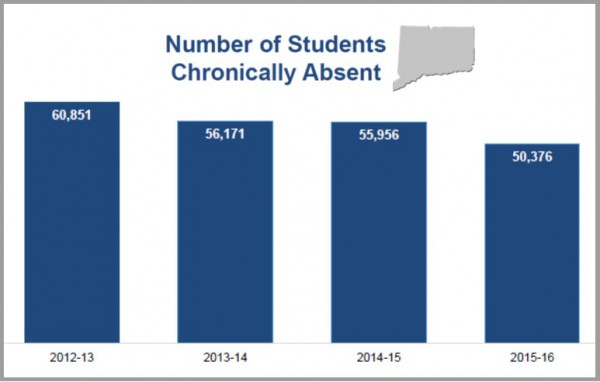
Chronic absenteeism is down across the state, according to new data released by the State Department of Education (SDE), a trend that is gaining notice beyond Connecticut and a sign that collaborative efforts to keep students across Connecticut in school and engaged are having a positive impact. The number of chronically absent students in Connecticut dropped to 9.6 percent in 2015-16, down from 10.6 percent the year before and down from a high of 11.5 percent in 2012-13. The decline in Connecticut’s chronic absenteeism rate means that over 10,000 more students are attending school on a daily basis than four years ago. Nationally, missing too much school is a coast-to-coast crisis that affects more than 6.5 million students.

Connecticut's work is gaining attention at the national level, and was subject of an article in the education publication Kappan Magazine.  The article, “Chronic early absence: What states can do” was co-authored by Hedy Chang, executive director of Attendance Works, Charlene M. Russell-Tucker, chief operating officer of the Connecticut State Department of Education, and her colleague Kari Sullivan,  state attendance lead at SDE.missing

The data also shows that while minority students have disproportionately high rates of chronic absenteeism when compared with their white peers, rates of chronic absenteeism are decreasing for black and Hispanic students in Connecticut.

In 2015-16, the chronic absenteeism rate for Hispanic students was 15.7 percent, down from 19.1 percent in 2012-13. For black students, the rate was 14.5 percent in 2015-16, down from 16 percent in 2012-13. (The new data is available on the CSDE’s data portal, EdSight. The data was released as part of a Chronic Absenteeism presentation delivered this month to the State Board of Education.)  The magazine article notes that “Low-income students are four times more likely to be chronically absent than others, often for reasons beyond their control, such as unstable housing, unreliable transportation, and a lack of access to health care.”

Chronic absenteeism is defined as missing 10 percent or more days of school for any reason, including excused absences, unexcused absences, suspensions, and other disciplinary actions.

“We have identified several areas where we are shifting our focus to fulfill our promise of an excellent public education for every Connecticut child. One of those focus areas is chronic absence,” said Commissioner of Education Dianna R. Wentzell. “We want every public school student in our state to be in school and engaged. That means we have to work with families, educators, and community stakeholders to decrease the number of days that students are out of school.”

Earlier this year, the State Board of Education adopted its Next Generation Accountability System, which uses multiple academic and non-traditional indicators to assess how well a school is performing toward the goal of preparing all students for success in college, career, and life. Chronic absenteeism is one of the new indicators included in the system, which means school districts will have to pay close attention to the problem of chronic absenteeism and take steps to ensure more students attend school on a daily basis.graph

Research shows that chronic absenteeism is inextricably linked with student performance, and students who are chronically absent are less likely to read on grade level, are less likely to perform well academically, and are at a greater risk for dropping out of high school. Risk factors for chronic absence include poverty, homelessness, chronic health conditions, frequent moves, and disabilities.

The article notes that “Most school districts and states don’t look at all the right data to improve school attendance. They track how many students show up every day and how many are skipping school without an excuse but not how many are missing so many days in excused and unexcused absence that they are headed off track academically.”

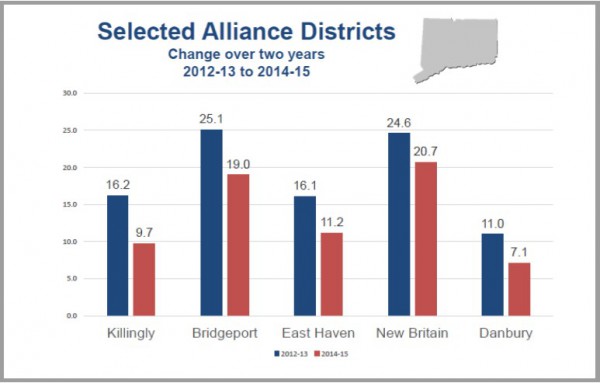
Among the communities being highlighted by SDE are Killingly, where chronic absenteeism dropped from 16.2% to 9.7%; Bridgeport, where the reduction was from 25.1% to 19.0%; East Haven, where the drop was from 16.1% to 11.2%; New Britain, where absenteeism was reduced from 24.6% to 20.7%; and Danbury, which saw a reduction from 11% to 7.1% between 2012-13 and 2014-15.  Attendance Works,  a national and state initiative that promotes awareness of the important role that school attendance plays in achieving academic success, is also highlighting specific Connecticut districts where progress is being made, including New Britain, Middletown and Vernon.  alliance

The SDE has been working with key partners such as the Governor’s Prevention Partnership, Attendance Works, the Campaign for Grade-Level Reading, and the Legislature’s Committee on Children. Chronic absenteeism is addressed in the annual Alliance District grant application for participating districts. The state is also expanding restorative justice programs, such as the Connecticut School-Based Diversion Initiative, and positive behavioral interventions and supports. Additionally, districts are increasing utilization of the Department of Children and Families’ Emergency Mobile Psychiatric Services to respond to mental health crises.

“It is critical that we all understand the importance of daily school attendance. Even in the early grades, lost time in school can put students at risk of becoming disengaged or dropping out of school down the road,” said Commissioner Wentzell.  The state approach focuses on six "high-impact" strategies:

#1: Build Awareness #2: Use Data to Promote Action #3: Cultivate Champions to Build a State-Level Infrastructure #4: Build Capacity #5: Identify and Leverage Bright Spots #6: Foster Accountability

The magazine article co-authors stress that “By monitoring chronic absence in grades K-12 — and paying particular attention to the youngest students — states can address the needs of students and their families before they require more expensive intervention and remediation.”

PERSPECTIVE: At the Next Presidential Election, the Popular Vote Must Win Out

by John R. Koza The state-based winner-take-all system no longer serves the citizens of the country and we must act to reform it now.

The fact that it appears the winner of the 2016 election, Donald Trump, was not supported by a majority of voters dictates that we elect our next president by popular vote. We can no longer endure presidential elections that primarily focus on the issues and outcomes in a shrinking number of battleground states, while the rest of us feel marginalized and muted in the political process.

The reason five of our nation’s 45 incoming presidents have entered office after losing the national popular vote is that most states have winner-take-all laws that award all the state’s electoral votes to the candidate receiving the most popular votes in that state.CT perspective

Given that the average national popular vote has been close in the last eight presidential elections (an average margin of less than 5%), it is likely that the nation will continue to experience elections in which the president wins the electoral college, but loses the nationwide popular vote.

These same state winner-take-all laws force presidential candidates to focus 94% of their general-election campaign events in 12 closely divided “battleground” states – with the remaining states receiving little or no attention. In 2012, they concentrated all of their campaign events in 12 states. As presidential candidate and Wisconsin governor Scott Walker publicly observed a year ago: “The nation as a whole is not going to elect the next president. Twelve states are.”

When presidential candidates devote virtually all of their attention to 12 states (representing just 30% of the nation’s voters), it is not just about TV advertising and rallies. It has a real impact on public policy. Battleground states receive 7% more presidentially controlled grants, twice as many disaster declarations, considerably more Superfund and No Child Left Behind exemptions, and benefit from many other major presidential policy decisions. For example, in 2016, both party’s nominees catered to Michigan, Wisconsin, Ohio and Pennsylvania on the issue of trade treaties.

Former presidential spokesman Ari Fleischer said, “If people don’t like it, they can move from a safe state to a swing state.”

q1Fortunately, the Founding Fathers provided us with a better way to improve the system than mass migration. Article II, section I of the US constitution empowers state legislatures to change their method of awarding electoral votes. National Popular Vote asks the legislatures if they want to join together as states to make every vote matter throughout the country.

The National Popular Vote bill would guarantee the presidency to the candidate who receives the most popular votes in all 50 states and the District of Columbia. This interstate compact will go into effect after it is enacted by states possessing a majority of the electoral votes – that is, enough to elect a president (270 of 538). Under this system, the compacting states award all of their electoral votes (in block) to the candidate who received the most popular votes in all 50 states (and the District of Columbia). This guarantees the presidency to the national popular vote winner and makes every voter, in every state, politically relevant in every presidential election.

Eleven states possessing 165 electoral votes have already enacted the National Popular Vote bill into law. In addition, the bill has made significant progress by passing one legislative chamber in 12 additional states with 96 electoral votes. The bill was recently approved by a bipartisan 40-16 vote in the Republican-controlled Arizona house, a 28-18 vote in the Republican-controlled Oklahoma senate, a 37-21 vote in the Democratic-controlled Oregon House, and unanimously by legislative committees in Georgia and Missouri. A total of 2,794 state legislators have endorsed it.

The National Popular Vote bill offers the additional benefit of preventing a presidential election from being thrown into the US House of Representatives.

We cannot expect a system that makes every voter happy with the end result of every election. We can, however, demand a system where all citizens feel that their vote mattered and voice was heard. National Popular Vote will deliver this promise in every presidential election.

_______________________

John R. Koza is the founder of National Popular Vote.  A plurality of voters in Connecticut and in the United States voted for presidential candidate Hillary Clinton in 2016.  Connecticut's legislature considered, but did not approve, legislation proposed by National Popular Vote in 2015, 2014, 2013, 2012, 2011, and 2009.  The Connecticut House, but not the State Senate, approved NPV legislation in 2009, the same year that a statewide poll indicated that three-quarters of state residents were of the view that the presidential candidate receiving the most votes nationwide should be elected president.  This article first appeared in The Guardian.


Aerospace Components Manufacturers to Convene in Hartford

Aerospace Components Manufacturers (ACM) “Future WorkForce Opportunities” Fair and Trade Show draws over 850 students to learn about the many career paths available in the local aerospace manufacturing industry. The event takes place the afternoon of Nov. 9 at the Connecticut Convention Center in Hartford.worldsaerospacealley_logo_rev-1 ACM comprises one of the largest, most experienced concentrations of world-class aerospace companies, the world's AEROSPACE ALLEY! ® The organization points out that member firms grew up where aerospace was born. Today, precision components manufacturer in the state take to the skies every day, in every corner of the globe, as they have since the inception of powered flight.

ACM member companies are “united by a single goal; be the world leader in providing customers with aerospace components of unsurpassed quality, at competitive prices and always, on-time delivery.”

To achieve that goal, officials work with peers and with regional, national and international experts to ensure continuous improvement of our products and services. The cornerstone of the effort is an aggressive program for adopting and implementing lean enterprise practices and conducting ongoing workforce training and development.acmlogo-notagline2

Student attendees of the event will have an opportunity to meet and talk with representatives of 100 top suppliers, all in one place at one time.  Last year, over 800 students and teachers visited from 32 schools spread across Connecticut and southwestern Massachusetts to learn about the array of career choices available in the aerospace manufacturing industry.


CT's Science and Technology Ranking Rises to 6th in the Nation

Following three consecutive finishes ranking ninth in the nation in the State Technology and Science Index (STSI), Connecticut has moved up to number six in 2016, it’s highest finish in more than a decade.  The state ranked ninth in 2010, 2012 and 2014 in the analysis produced every other year by the Milken Institute, following a 7th place ranking in 2008 and 10th in 2004.  The ranking was the highest for the state in all seven releases of the STSI index. The STSI benchmarks states on their science and technology capabilities and broader commercialization ecosystems that contribute to company growth, high-value-added job creation, and overall economic growth, the institute’s website explains.  ct-ranks-6th

“We view the STSI as a measure of a state's innovation pipeline. The index isn't intended to be a measure of immediate economic impact, but rather to demonstrate that the return on science and technology assets will accrue in future years.”

The top five states in 2016 are Massachusetts, Colorado, Maryland, California and Washington.  Rounding out the top 10, after Connecticut, are Minnesota, Utah, Virginia and Delaware.

In specific categories, the state’s ranking varied, with considerable improvement in some categories. In the Technology and Science Workforce composite index, Connecticut ranked 10th, an improvement from rankings of 16th in 2014, 13th in 2012 and 14th in 2010.  This composite measures the relative presence of high-end technical talent, and consists of 18 eighteen various indicators.

stsi-reportThe STSI's 107 individual indicators are sorted into five composites: Research and Development Inputs, Risk Capital and Entrepreneurial Infrastructure, Human Capital Investment, Technology and Science Workforce, and Technology Concentration and Dynamism.  The report indicated that "Connecticut showed major improvement in the Technology Concentration and Dynamism index, going from 21st to 10th. This dramatic rise marks one of the larger overall changes on this index. While modest increases were seen in the Research and Development Inputs index and Human Capital Investment index, these two indices have a much heavier focus on stock measures, and Connecticut’s aerospace and defense sectors help anchor the state’s performance in these areas."

Connecticut also ranked 10th in the Technology Concentration and Dynamism composite index, the state’s highest ranking in that category, and largest jump from two years ago.  In 2014, Connecticut ranked 21st.  In the two previous analyses, Connecticut was 12th in 2012 and 18th in 2010.

logoIn the Human Capital Investment composite index, Connecticut ranked third, as it did in 2014 and 2012, after ranking fifth in 2010.  In Research & Development, Connecticut placed eighth, its second highest finish, after ranking tenth, seventh and seventh in previous indexes.  Connecticut ranked 11th in Risk Capital and Entrepreneurial Infrastructure, up from 14th two years ago, but not as high as sixth place in 2012 and third in 2010.

The Human Capital Investment composite index looks at how much is invested in developing the workforce—the most important intangible asset of a regional or state economy. Twenty-one indicators are included in this composite index.  The R&D composite examines a state's R&D capacity to see if it has the facilities that attract funding and create innovations that could be commercialized and contribute to economic growth, and includes eighteen indicators.  The Risk Capital and Entrepreneurial Infrastructure Composite Index determines the success rate of converting research into commercially viable products and services. It includes 12 indicators.

While Connecticut was gaining ground, other states were bottom dwellers.  The analysis raised alarms regarding the prospects for those states.

map“The states with the weakest innovation assets and ecosystems for starting and growing innovative firms face a bleak future unless changes are made. West Virginia, Arkansas, Mississippi, Kentucky, and Louisiana make up the bottom five in this year's STSI. They are the least knowledge-intensive and their residents exhibit weak entrepreneurial skills. All of them have undertaken efforts to change their position in technology and science but have had limited success.”

Massachusetts remained in first place with a score of 83.7, retaining the position it has held since the inaugural STSI was released in 2002.

Wyoming, the most improved state, climbed 10 places, to 36th. The state had broad gains but benefited most from the broader definition of occupations in the Technology and Science Workforce category, which included its talent in mining engineering, the analysis pointed out. Missouri rose six spots, to 28th; seen as primarily attributable to a 24-place leap in Risk Capital and Entrepreneurial Infrastructure.

PERSPECTIVE: Living in an Aging Connecticut

In Connecticut, a person born today can expect to live an average of 80.8 years, the third highest life expectancy in the nation. However, there are significant disparities in life expectancy between racial and ethnic groups.  Life expectancy is 89.1 years for Asian Americans; 83.1 years for Latinos; 81.0 years for Whites, and 77.8 years for African Americans.

Between 2010 and 2040, Connecticut’s population of people age 65 and older is projected to grow by 57 percent, but its population of people age 20 to 64 is projected to grow by less than 2 percent.CT perspective

We live in an aging Connecticut.  More than one-third of Connecticut’s population is over the age of 50, and that proportion continues to rise.  Nearly every facet of our society will be impacted.

Increasing numbers of older adults will play pivotal roles, both as caregivers and as recipients of care in both families of origin and of choice.  They will prompt municipal and state leaders and their partners to ensure that communities have the features, services and funds to support aging in place.  And they will challenge our state’s creativity, polities and budgets as they increasingly outlive their financial resources, despite working longer.

q1Connecticut’s demographic transformation has been spurred by medical, social and economic advances.  And it has been buoyed by baby boomers, people born between the years 1946 and 1964, who were part of the noticeable increase in birth rate post-World War II.



At every stage, baby boomers have been changing this country, and now is no exception.  Not only are their sheer numbers larger than any other previous generation, but they are also longer-lived.

Overwhelmingly, these growing numbers of older adults what to stay in their communities and to have choice, independence and dignity.  By 2025, older adults will comprise at least 20 percent of the population of almost every town in Connecticut.

This perspective first appeared on the website of the now-defunct Connecticut Legislative Commission on Aging, with research and data analysis in conjunction with the Connecticut Data Collaborative.

UConn Study Questions Marketing, Ingredients in Food Advertised to Young Children

It would be disingenuous to describe the results as surprising, but a new study has found that marketing for baby and toddler food and drinks often contradicts the advice of health professionals. According to the study by the Rudd Center for Food Policy and Obesity at the University of Connecticut, companies tend to use marketing messages that may lead parents to believe that these commercial products are healthier alternatives to breastmilk or homemade food.baby-facts

The new Baby Food FACTS report found that companies spent $77 million in 2015 to advertise infant formula, baby food, and toddler food and beverages to parents, primarily through TV, magazines, and the internet. By comparison, companies spent $98 million to advertise fruits and vegetables in 2015 – products intended for the entire U.S. population.

“Our analysis shows that marketing for baby and toddler food, infant formula, and toddler milk and nutritional supplements often contradicts expert guidance and in some cases encourages parents to feed their young children products that may not promote healthy eating habits,” said Jennifer Harris, UConn Rudd Center Director of Marketing Initiatives and the report's lead author.

The report analyzed companies spending $100,000 or more in total advertising in 2015 and documented changes in advertising over the past five years. Eight brands from three companies (Nestle, Abbott and Mead Nohnson) were responsible for 99 percent of advertising spending. Four additional baby and toddler food brands spent $100,000 or more in advertising in magazines and online, including Plum Organics (Campbell Soup Company), Beech-Nut (Hero A.G.), and Happy Baby and Happy Tot (Nurture Inc.).rudd-logo-300x77

Among the findings:

  • Infant formula brands had the most internet advertising and were most active in social media and on mom blogs.
  • Nearly 60 percent of advertising dollars promoted products that are not recommended for young children, including sugar-sweetened toddler drinks and nutritionally poor snack food.
  • Beech-Nut and Gerber marketed their baby food products in a way that supported most expert recommendations on best practices for feeding infants.
  • Toddler milk products including Enfagrow, Gerber Good Start Grow, Nido 1+, Similac Go & Grow, and Happy Tot Grow & Shine, contained added sweeteners, including sugar, glucose syrup solids, honey, and corn syrup solids.
  • Pediasure Grow & Gain, a nutritional supplement aimed at toddlers, had 240 calories per serving and as much sugar as an 8-ounce sports drink.
  • In contrast to nutritious baby and toddler fruit, vegetable, and meal products, just four of 80 baby and toddler snack foods, such as cookies, cereal bars, puffs, and fruit snacks, were nutritious choices for young children.
  • Fifty percent of baby and 83 percent of toddler snacks contained added sugars.

kids-eatingThe findings included in this report “provide policymakers, health professionals, public health advocates, industry representatives, and parents an opportunity to address misinformation conveyed through marketing of baby and toddler food and drinks.”

The study also found that traditional advertising spending (primarily on TV and magazines) by infant formula brands declined substantially—from more than $30 million in 2011 to less than $10 million in 2015.

Among the recommendations, the Rudd Center researchers indicated that toddlers’ diets should help them develop gross and fine motor skills and learn to enjoy the taste, flavors, and textures of real fruits and vegetables. By age two, toddlers should be eating the same food as the rest of the family. For all children, they stated, a healthy diet should include a variety of fruits and vegetables every day, and limited consumption of saturated fat and sodium. Children under two should not consume any food with added sugars.

The report called on the U.S. Food and Drug Administration to issue final guidance on claims on infant formula packaging, including claims that compare infant formula to breastmilk, and also regulate claims on toddler milk packaging. The Federal Trade Commission should similarly regulate claims made in advertising, the report advised. The food industry was also urged to expand the Children’s Food and Beverage Advertising Initiative (CFBAI) self-regulatory program for improving food advertising to children to incorporate marketing of baby and toddler food and drinks.

The study was funded by a grant from the Robert Wood Johnson Foundation and presented Nov. 1 at the American Public Health Association’s 2016 Annual Meeting and Expo in Denver.  The Rudd Center for Food Policy & Obesity at the University of Connecticut is a multi-disciplinary research center dedicated to promoting solutions to childhood obesity, poor diet, and weight bias through research and policy. For more information, visit www.UConnRuddCenter.org.

New London’s Hearing Youth Voices is Finalist for Region’s First-Time $50,000 Prize

Hearing Youth Voices, a youth-led social justice organization working to create systemic change in the education system in New London, is one of seven youth organizations in New England with a chance to win a $50,000 grant from The Nellie Mae Education Foundation, the largest philanthropic organization in the region focused exclusively on education. The first-ever Nellie Mae Education Foundation Youth Organizing Award honors a New England youth organizing group that has shown tremendous commitment to advancing student-centered learning or redesigning education to meet the needs of all students - specifically focused on public secondary education.hearing-youth-voices-logo

At Hearing Youth Voices (HYV), youth leaders identify issues, research solutions, and run campaigns aimed at making concrete, meaningful changes in their public schools. The core membership and leadership are working class youth of color, many of whom are also LGBTQI, and/or immigrant, and/or have been pushed out of school.

The winner from among the finalists will be decided by online votes of the public, during a month of balloting.  From November 1 at 12:00 PM EST – November 30 at 12:00 PM EST, the public is invited to vote for finalists through email on the Students at the Center Hub and via text message. The organization with the most votes will receive a $50,000 grant to continue the organization's work around advancing student-centered learning or redesigning education to meet the needs of all students.picture3

Hearing Youth Voices describes itself as “a youth-led organization that trains young people of color to organize, fight, and deconstruct systems of oppression in our community.” Recently, HYV youth ran the “We Want to Graduate Campaign,” which focused on systemic obstacles to students graduating, specifically absence-based credit loss and suspensions.

After two years of hard work on the part of hundreds of youth, the New London Public Schools (NLPS) revised its attendance policy to offer supportive interventions instead of punishments for absent students, a change that affected the more than 3,000 students and families in NLPS. Additionally, HYV youth worked alongside a broader coalition of parent advocates, school staff, and Board of Education members to create the district's first-ever Restorative Practices pilot project.

Most recently, HYV successfully advocated for students to become voting members of the Board of Education's Policy Committee, integrating student voice into the highest level of policy decision-making in the district. Youth leaders identify issues, research solutions, and run campaigns aimed at making concrete, meaningful changes in their public schools.

“Our seven Youth Organizing Award finalists are leaders in promoting student ownership and voice as part of school decision-making in New England,” said Nick Donohue, president and CEO of the Nellie Mae Education Foundation. “These students have committed themselves to improving educational experiences for their peers while building the knowledge and skills which will serve them long after graduation. I’m proud to offer a well-deserved congratulations on the great work they’ve achieved as well as the impact they are making for future students.”

In a student-centered environment, learning is personalized, competency-based, happens anytime, anywhere and allows students to take ownership of their education. Student-centered learning prepares students to master the academic knowledge, critical thinking, problem solving and communication skills they need to thrive.

Also vying for the prize are Portland Empowered (Maine), Sociedad Latina (Boston), Granite State Organizing Project (New Hampshire), Young Voices (Providence), Providence Student Union (Providence), and UP for Learning (Vermont).

The HYV website explains that “our work is different- it is about collective action to solve systemic problems. We don't want to make life easier for one young person or one family. We want to go right down to the root of the problem and fix the system so that no more youth and families have that problem! And we believe that the people who have lived the problem are experts on it and need to help define what the solution could be.......and lead the charge to make that change happen.”

The Nellie Mae Education Foundation supports the promotion and integration of student-centered approaches to learning at the high school level across New England—where learning is personalized; learning is competency-based; learning takes place anytime, anywhere; and students exert ownership over their own learning. To elevate student-centered approaches, the Foundation utilizes a four-part strategy that focuses on: building educator ownership, understanding and capacity; advancing quality and rigor of SCL practices; developing effective systems designs; and building public understanding and demand.

https://youtu.be/WtTuHED6TM4

Diverse Hispanic Workforce More Likely to Face Challenges, Report Finds

There are about 24 million workers of Hispanic descent in the United States. While this group is frequently referred to as a single entity, the reality is that these workers come from a variety of ethnic backgrounds, each with their own challenges in the labor market. A new report from the Center for Economic and Policy Research (CEPR) provides an overview of the diverse backgrounds of the Hispanic workforce, and shows how each group experiences unique challenges in the labor market, specifically in terms of unemployment, wages, poverty, language barriers, and access to health and retirement benefits.workforce

The report, “Hispanic Workers in the United States” also shows that union representation has helped to address some of these challenges. Some highlights from the report include:

  • Workers of Mexican descent are by far the largest subgroup of the Hispanic workforce (14.9 million);
  • Women make up only 43.3 percent of the overall Hispanic workforce, but they are a majority of several subgroups, including Panamanians (58.1 percent), Bolivians (53.2 percent), and Paraguayans (51.0 percent);
  • sq-social-media-logo-gray200pxby200pxAbout two-thirds of Hispanic workers are U.S. citizens – Puerto Ricans (98.7 percent) and Spaniards (90.9 percent) are the groups most likely to be citizens;
  • Hispanic workers in general are more likely than workers of any other race/ethnicity to be in poverty. Among Hispanics, Guatemalans are most likely to be members of the working poor (19.1 percent);
  • About 30 percent of Hispanic workers do not have health insurance, but over half of Guatemalan and Honduran workers lack health insurance.

hispanics-ctConnecticut’s population is 15 percent Hispanic, the 11th largest Hispanic statewide population share nationally, according to the Pew Hispanic Center.  The Latino population increased by 50 percent in Connecticut from 2000 to 2010. The highest percentage of Hispanics in Connecticut municipalities are in Hartford, Willimantic, Bridgeport, New Britain, Waterbury, Meriden, New Haven, New London, Stamford and Danbury, according to Zip Atlas. In Connecticut, Mexicans are the second largest Hispanic community in the state behind Puerto Rican residents, CT Mirror has reported. Willimantic, New Haven and Norwalk have the three highest Mexican populations in Connecticut, with 5.24 percent, 2.8 percent and 2.28 percent, according to 2013 data.

The American Immigration Council reports that the Latino share of Connecticut’s population grew from 6.5% in 1990, to 9.4% in 2000, to 14.7% (or 527,163 people) in 2013. In 2009, 94.4% of children in Latino families in Connecticut were U.S. citizens.

Orlando Rodriguez, former legislative analyst at the now-defunct state Latino and Puerto Rican Affairs Commission, told ctlatinonews.com last year that Connecticut’s future is largely dependent on how successful Latinos are in getting into the middle class, and how successful the state is in being able to create middle class jobs for them.

“Simply put,” he said, “The numbers are growing, and if Latinos don’t enter the middle class of Connecticut in large numbers, the state’s economy will feel it negatively…and if they do enter it in large numbers, the economy will grow.”

Cherrie Bucknor, author of the CEPR report explained, “Understanding the diversity and challenges faced by Hispanic workers is key to making better policy decisions.”  The Center for Economic and Policy Research (CEPR) is an independent, nonpartisan think tank that was established to promote democratic debate on the most important economic and social issues that affect people's lives.