First Television, Now Picture Books – Contributors to Less Healthy Eating Among Children

Concerns about the impact of television promoting products such as snack food and soda have been well documented for some time, but academic research is now suggesting another culprit for childhood obesity and a growing lack of healthy eating among youngsters. Children’s picture books – the books filled with brightly colored drawings and basic themes that are staples of bedtime stories, pre-school readings and local story hours.  How they depict food – and eating – has led a UConn researcher to raise red flags.

The study – conducted by Jane Goldman, professor emerita in UConn’s Department of Human Development and Family Studies, and Lara Descartes, a former assistant professor with the department and now a professor of Family Studies at Brescia University College in Canada – found that while the ratio of healthy to unhealthy foods depicted in books is higher than it is on television, books more often link positive events and concepts – such as love and nurturing – to treats, such as ice cream and baked goods, rather than fruits or vegetables.
The findings were first published a year ago in the journal Appetite and were the subject of presentations last fall by Goldman and Descartes at the University of California at Irvine and a global conference on food in the United Kingdom, and reported this month by UConn Today.

“It’s not that you shouldn’t have ice cream in books, but people should be aware of what the underlying message is,” Goldman said. “What are the messages children are getting about foods when a picture book is read to them, and are those messages related to the obesity epidemic among children?”

The researchers evaluated 100 picture book titles in Scholastic’s “Favorite Books for Preschoolers” collection – a mix of classics and newer titles, fiction and non-fiction. Sixty-nine of the 100 books in the collection included one or more food items in the text and/or illustrations. Although “the ratio of healthy foods to nutrient-poor foods was higher in the books,” according to the researchers, there was bad news as well as good in their findings.

Goldman and Descartes first identified books in which food is mentioned one or more times – 48 titles fit into that category – and others in which food is a theme or sub-theme, a group that included 21 titles. The pages on which food is mentioned were then coded based on the placement of the food, or centrality; the level of emotion expressed, or affect; and the number of times, or frequency, with which the food is mentioned. Using characters’ expressions as a guide, researchers assigned a rating of positive, negative, or neutral to each food reference.

The researchers found that vegetables are depicted in more than a third of the books and centrally portrayed in more than half, but only 18 percent of the depictions received a positive “affect” rating.  Conversely, sweetened baked goods are both centrally positioned, and have a positive “affect” about 80 percent of the time.  And ice cream, although not in many books, always was associated with positive outcomes - five of the seven times ice cream is mentioned, it’s offered as a treat, to make someone feel better, or as a happy ending.  Among the other findings:

  • Almost all 69 picture books in the sample depict one or more healthy foods.
  • Twenty-nine (42 percent) depict only healthy foods; and thirty-three (48 percent) depict both healthy and nutrient-poor food, but the majority of the depictions are healthy foods.
  • Fruits, while depicted in more than half the books, are most often in the background, and only one-third of fruit depictions received a positive “affect” rating.

The researchers say it’s important to look at the context in which foods are presented as well as the frequency, observing that the people they interviewed rarely noticed that food was mentioned in children’s books, nor what messages were being conveyed, UConn Today reported.

Goldman was not surprised, UConn Today reported, that many of the picture books surveyed in the study portrayed sweet and comparatively unhealthy foods as very desirable or that they were associated with positive outcomes.  When nutrient- poor foods are presented both frequently and positively, she indicated, it may well contribute to children’s view of them as more desirable.  This is especially likely given the fact that picture books are just one part of a child’s total media consumption and that television content is known to promote a positive association with nutrient-poor foods.

“What we hope the study  does is make people aware of how food is presented in picture books, in the same way they have become aware of how gender roles are presented in books,” Goldman says. “Books are a tool we use all the time, so how can we use books to promote healthy ideas about food. In early childhood there is an emphasis on helping children read and on healthy eating and lifestyle, so why not think about the messages in books that support or contradict that healthy lifestyle message.”

Norwalk, Stamford Gain New Businesses, Taking From Each Other

Octagon Inc., a sports and entertainment marketing and talent management agency, is relocating its headquarters to the Shippan Landing complex in Stamford. The company, which is moving from Norwalk, has signed an 11-year lease to occupy 57,009 square feet across the entire third floor and a section of the second floor of the property at 290 Harbor Drive along the Stamford waterfront. The move apparently comes without state financial incentives, and comes months after another corporate citizen made the reverse move – from Stamford to Norwalk – with a boost from state incentives.  Less than 15 miles and 15 minutes apart, two of Fairfield County’s leading cities are experiencing the corporate version of “Trading Places.”

Crius Energy, through its wholly owned subsidiary Regional Energy Holdings, announced plans last year to move its headquarters from Stamford to Norwalk, placing 200 jobs in the city and committing to add 225 more over the next four years, according to an announcement in May from the Governor’s Office.

Officials said the company – launched in Connecticut – has become one of the largest independent energy retailers in the United States, supplying electricity, natural gas and solar energy products to more than 900,000 customers across 19 states and the District of Columbia, including 100,000 in Connecticut. According to officials, Crius also has operations in Florida, Texas and Australia.  They had outgrown their Stamford facility, which led to plans for a $29 million project in Norwalk, to include the renovation of 48,000 square feet of an existing building. 

To encourage the move, the state Department of Economic and Community Development (DECD) said it would provide a 10-year, $8 million low-interest loan to support the project, funding that can be used for fixtures and equipment and leasehold improvements. Crius is also eligible for up to $2 million in tax credits through the Urban and Industrial Sites Reinvestment Tax Credit Program, as well as a $100,000 grant to train employees, according to state officials.

The Crius Energy website points out that “Although based in Connecticut, many members of our leadership team have relocated great distances to become a part of Crius Energy. Together, they bring more than a century of combined industry and functional expertise as well as a deep-rooted passion for transforming the retail energy sector.”

It was a year and a half ago, in May 2015, that the first lease signing was announced for the then newly-renovated five story, 185,000 s/f office building within the 17-acre Shippan Landing waterfront office park in Stamford. That tenant was Stamford-based Workpoint, a provider of co-working environments geared to the needs of media firms along with independents and professionals.

Published reports indicated that since being acquired in 2012 by George Comfort & Sons in a partnership venture with Angelo Gordon & Company, the six-building, 758,000 s/f office park, formerly known as Harbor Plaza, saw an extensive repositioning and modernization program, which was then nearing completion. Workpoint leased a total of 15,173 s/f, including a 1,000 s/f multicamera studio with green screen, control room, and editing facilities on the building’s second floor, according to published reports at the time.

“Shippan Landing continues to be the preferred destination for some of the nation’s top creative companies and we are pleased to welcome Octagon to our tenant roster,” said Peter S. Duncan, president and CEO of George Comfort & Sons.  Among Octagon’s many clients are household names from the sports world - Stephen Curry of the Golden State Warriors, members of the World Series champion Chicago Cubs and other major league players, current and retired, and Olympic gymnast Simone Biles.

Shippan Point offers what the company describes as “truly is the best business location in the Stamford area,” with “spectacular grounds and magical stretching views.”

Back in 2013, the state Bond Commission approved $1 million in borrowing to help an emergency home repair company move its headquarters from Stamford to Norwalk.  The bonding was aimed at assisting the HomeServe USA Corporation in relocating its headquarters as part of an agreement to create 130 jobs and maintain another 109. In addition to a $1 million grant, the company was also eligible for a $3 million, partially forgivable, loan and up to $5 million in tax credits, local media reported.  The company’s customer call center is located in Tennessee.

And last May, the State Bond Commission approved $22 million in grants and loans for the world's largest hedge fund despite what press reports described as bipartisan complaints that the wealthy company can afford the move without state incentives.  The commission voted 7-2 to award the package to Bridgewater Associates, a financial industry powerhouse operated by Greenwich billionaire Ray Dalio, one of the nation's wealthiest individuals.

At the time, state officials indicated that the financial package helped to prevent the company from potentially relocating from Connecticut to nearby Westchester, N.Y.  The money was expected to be used to renovate and expand the firm's Westport headquarters, along with operations in Wilton and Norwalk, published reports explained. In addition to the loan, Bridgewater was said to also be eligible for two grants: $3 million for energy-efficiency upgrades and $2 million for job-training efforts.  The state apparently initially offered Bridgewater $130 million in loans and grants but the amount was scaled back after the company scrapped plans to build a new corporate complex in Stamford, south of I-95, in the face of local opposition, reports indicated.

https://youtu.be/7mfWZhlN4rE


Legislatures Consider Changes in Transportation Safety in CT, Nationwide

The National Conference of State Legislatures (NCSL), in cooperation with the National Highway Traffic Safety Administration, is tracking legislation on a range of traffic safety subjects that have been introduced in the 50 states and the District of Columbia – and is providing updates on the organization’s website.  The site reflects 14 proposed bills in Connecticut, being considered in the General Assembly session that began last month.   Traffic safety topics being tracked nationwide include: Aggressive Driving, Automated Enforcement/Photo Monitoring, Child Passenger Protection, Distracted Driving, Driver’s Licensing, Impaired Driving, Motorcycle Safety, Pedestrian and Bicycle Safety, School Bus Safety, Seatbelts and Occupant Protection, Senior Drivers Issues, Slow-Medium speed vehicles, Speed Limits, and Teen Driver Issues.

Among the proposals being considered in Connecticut is one that would require three-point seat safety belts for school buses and require passengers of a school bus to wear seat safety belts.  A similar proposal would require three-point seat safety belts for school buses that are model year 2019 or newer.  NCSL reports that 20 state legislatures are considering a variety of school bus safety proposals. 

Three proposals would increase fines for distracted driving offenses, including texting or using a hand-held mobile telephone while driving, and one calls for additional funds to be appropriated to the state Department of Emergency Services and Public Protection to “combat distracted driving.”  Connecticut is one of 14 states that have seen distracted driving bills suggested. 

Legislative proposals also include one that would mandate the use of helmets by motorcycle operators and passengers, and another that would regulate the operation of high-speed and low-speed electric bicycles in the state. Twenty-six states in addition to Connecticut have motorcycle safely proposals under consideration.

Members of the legislature’s Planning and Development Committee will consider proposals that call for modifications to urban street design guidelines, in order to “improve the safety, economic life and vibrancy of urban streets.”

Among the nation’s states, the largest number of legislative proposals relate to impaired driving, followed by motorcycle safety, pedestrian and bike safety, drivers licensing, drivers licensing, and school bus safety.

Forty-seven states have begun their 2017 legislative sessions.

PERSPECTIVE: Taking Risks, Serving Customers Key to Sustaining Success

by Mickey Herbert A few years ago, I was asked to talk to a group about my career as an entrepreneur.  I had never considered myself an entrepreneur, but I realized that I had taken risks in my professional life that were, in retrospect, pretty significant.  Here’s what I had to say regarding risk taking and a company's corporate culture.

My parents were always my mentors, teaching me integrity, and how to be respectful of others.  I'm not sure how they taught me to be a risk taker, but somehow, I think I got that from them too. 

Nobody in my family had ever gone to college, and I remember when my Swarthmore College acceptance letter came in the mail to our home my father took it to work before I even saw it. He wanted to show it to all the PhD's he worked for at the U. S. Naval Research Laboratory.

He hadn't finished college because of WWII, but he had learned glass blowing in the Navy and he was the only one who could build those lasers they designed.  He was also a terrific athlete, a football and baseball player in the mold of Babe Ruth, who might have played professional sports except he opted to be the first kid on his block to enlist after Pearl Harbor.

So, in a very real sense, he encouraged me to take the risks he never had the opportunity to take.  Above all else, he wanted me to go to college and/or to play professional baseball, the two life choices that had eluded him because of the war.

Throughout my life, I have always wanted to live up to the person my father wanted me to be - indeed, to be the person he wanted to be if circumstances in our country were different, almost 80 years ago.

To quote Mark Twain, one of our state's most famous citizens, who died over 100 years ago, "Twenty years from now, you will be more disappointed by the things you didn't do than by the ones you did.  So, throw off the bowlines.  Sail away from the safe harbor.  Catch the trade winds in your sails.  Explore, Dream, Discover.

So, with a firm sense of right and wrong, but no money to speak of, I went off to college in Pennsylvania, foregoing, by the way, an opportunity to sign a professional baseball contract. After college, I went straight to the Harvard Business School, then to New York City for a couple years before I headed to Minnesota - where I didn't know a single person in the upper Midwest.

Six years later, I set sail for Connecticut where, again, I did not know a single person in this state, but I was determined to become a successful CEO of a new health plan which would challenge Blue Cross and Blue Shield - Connecticut's dominant health insurer - covering most of our state's 3.5 million residents. I also took advantage of an opportunity to play fast-pitch softball with the Raybestos Cardinals in Stratford, the defending national fast-pitch champions at that time.

Management guru Tom Peters has said that the greatest predictor of one's success in business is one's willingness to take risks.  I used to have a sign in my office which said "Mistakes don't matter, it's the response to error that counts".  In other words, I believe we should all be risk takers, and not be afraid to make mistakes; but when you do make one (and I've made a few doozies in my life), learn from it so you won't make that mistake again.

Because I was a CEO from 1976 to 2010 (and am now one again), I had the incredible opportunity over three and a half decades to define the corporate culture at three companies - PHS, the Bridgeport Bluefish and ConnectiCare. In looking back, I realize that so much of what made these three companies special is very simple.  Peter Drucker once said that successful management is doing a few simple things and doing them well.  For me, it was figuring out what business we were in, and then sticking to the knitting. 

  • At PHS, and then again at ConnectiCare, we determined that our business was delivering the highest quality, affordable health care, with unsurpassed customer service, to the citizens of our region. Notice that I said nothing about health insurance. At PHS, we had a slogan, "Intensive Caring" that we trademarked and ingrained into every employee we hired.
  • At ConnectiCare, our slogan, and theme song, was "You Know Us by Heart" which carried the very same message.
  • At the Bluefish, we determined at the very outset that we were in the business of delivering the highest quality, affordable, family entertainment to the citizens of our region. Notice I didn't say anything about professional baseball.  We made the ballpark a happy, happening place where people wanted to be, a veritable town meeting place, a place where they could be proud to be in and from, Bridgeport, a place where something was going wonderfully right in a city that had often seen things go wrong.

At all three companies, we made all kinds of decisions to increase our likelihood of success, not the least of which was to hire the best people we could, provide them with extraordinary training, and then empower them to go out and make decisions on their own.  What I guess it is about more than anything else is having a totally-focused, customer-friendly culture.

I feel very fortunate to be able now, at the Bridgeport Regional Business Council, to continue the legacy.

______________________________

Mickey Herbert is President and CEO of the Bridgeport Regional Business Council

CT Is 35th in Well-Being Among the States, Slipping Lower in Rankings

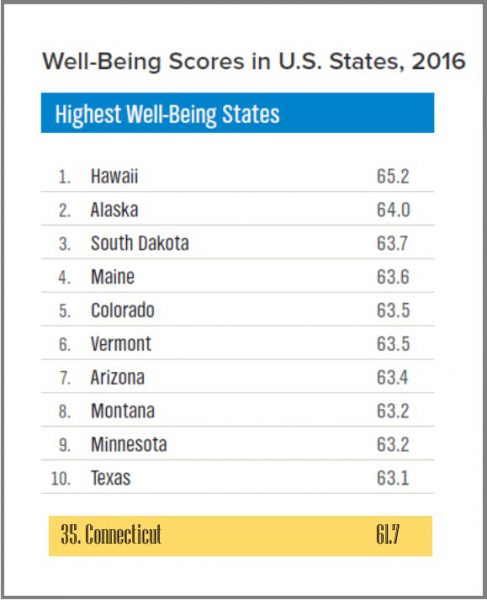
Connecticut ranks 35th in well-being among the 50 states, according to a new Gallup-Healthways 2016 State Well-Being Rankings report.  That’s a drop in the rankings for Connecticut, which averaged a 28th place finish over the past three years. In 2016, Connecticut had a Well-Being Index score of 61.7, which is lower than the national Well-Being Index score of 62.1.  The report, which is part of the Gallup-Healthways State of American Well-Being series, examines well-being across the nation, including how well-being varies by state and which states lead and lag across the five elements of well-being.  They are:
  1. Purpose — Liking what you do each day and being motivated to achieve goals
  2. Social — Having supportive relationships and love in one’s life
  3. Financial — Managing one’s economic life to reduce stress and increase security
  4. Community — Liking where you live, feeling safe and having pride in your community
  5. Physical — Having good health and enough energy to get things done daily.

Hawaii ranked the highest in well-being, followed by Alaska, South Dakota, Maine, Colorado, Vermont, Arizona, Montana, Minnesota and Texas.   Hawaii’s 65.2 was the highest score in the past three years.  Hawaii led the nation in financial, community and physical well-being. Alaska and Texas led thenation in social and purpose well-being, respectively.

West Virignia ranked the lowest, and other states at the bottom of the list included Oklahoma, Kentucky, Indiana, Arkansas, Ohio and Alabama.

In a category-by-category review, Connecticut ranked 13th in physical, 19th in social, 37th in financial, 45th in purpose, and 48th in community.

“[Well-being] can be a force multiplier to the bottom line by directly influencing healthcare costs, resilience, and retention as well as to the top line through factors such customer satisfaction, sales and innovation,” said Michael Thompson, the President and CEO of National Alliance of Healthcare Purchaser Coalitions.

Well-being in the United States continues to exhibit regional patterns with the Northern Plains, Mountain West and some Atlantic states generally reporting higher levels, while states in the South and Midwest consistently lag in certain elements.  The only New England state ranking lower than Connecticut was Rhode Island, at number 42. Rhode Island had the lowest social and community well-being categories.  Massachusetts ranked 14th  overall, improving from an average 20th place ranking in recent years.

Among the positive trends identified include historically low smoking rates (now at 18.0%, down from 21.1% in 2008); historically high exercise rates as measured by those who report they exercised for 30 minutes or more, three or more days in the last week; and the highest scores recorded on healthcare access measures, with the greatest number of Americans covered by health insurance and visiting the dentist. Americans are also reporting the lowest rates of healthcare insecurity since 2008, as measured by not being able to afford healthcare once in the last 12 months.

The report noted that married people have the lowest rates of depression (13.4%) and sadness (13.5%), and the highest rates of enjoyment (87.8%) and happiness (91.3%), compared to people from any other marital status. Adults with children living at home are more stretched emotionally, reporting more worry and stress on any given day, but also more happiness, smiling, and laughter.

In addition, the report noted that more Americans say they use their strengths on a daily basis, say their supervisor treats them like a partner, and creates a trusting and open environment than in any other year since 2008.

College Students in Connecticut Gather for Study Abroad Conference in Changing Context

Timing, as the saying goes, is everything.  This Saturday, February 4, the fourth annual Connecticut Area Study Abroad Conference will held, sponsored by eight higher education institutions and hosted at the University of Hartford.  The conference offers sessions for students who have studied abroad, highlighting “unpacking your time abroad, and learning how to use your study abroad experience to network and get your dream job.” Developed by a committee of study abroad professionals, the conference will also offer sessions on topics including career paths of study abroad participants, volunteer and non-profit opportunities abroad and internationalizing your résumé and interviews.

Organizers from eight colleges and universities in Connecticut could not have imagined, when the date was set months ago, that international travel through the United States would be the focus of world-wide attention in the wake of a presidential executive order.

Participating universities include University of Bridgeport, University of New Haven, Sacred Heart University, Fairfield University, Quinnipiac University, UConn Law School, Trinity College and University of Hartford.  Last year’s conference was hosted by the University of New Haven.

“Now more than ever, studying abroad is important,” said Trinity College’s Zachary Macinnes, one of the individuals developing the conference.  “In addition to setting students apart on the job market after graduation, participation in study abroad is positively associated with a host of benefits, including higher GPA, retention, increases in critical thinking and writing skills, greater appreciation for diversity, increased lifetime earnings and deeper engagement overall.” 

Macinnes, Outreach Coordinator and Study Away Advisor: Spain, Latin America & the Caribbean at Trinity College in Hartford, also notes that only 10 percent of U.S. students study abroad during college.  Taking the lead for the University of Hartford is Meaghan Murphy, international program administrator for the school’s Study Abroad program.  Nationwide, 33 percent of college students participating in study abroad programs are juniors, 26 percent are seniors and 13 percent are sophomores.

The top nations for U.S. students participating in study abroad programs are the United Kingdome, Italy, Spain, France, China, Germany, Ireland, Costa Rica, Australia, Japan, South Africa, Mexico, India and the Czech Republic, according to data compiled by the Institute of International Education.   The most frequent academic areas studied include the STEM fields, business & management, physical or life sciences, health professions, engineering, math or computer science, and agriculture, the organization’s data reveals.

The website promoting the event tells students that “Your study abroad experience is not an isolated activity that has a definite beginning and end. Instead, study abroad is a life-changing event that continues to develop and evolve long after you have returned home.”  The site adds that “You will find yourself changed, sometimes in surprising, unanticipated ways. Your academic and personal goals may be different, and you may now have a better appreciation for the international students on campus.”

The plan was for student resumes to be reviewed, and for information to be provided to enable students “learn more about how to go abroad again.”  Organizers indicate that will still take place, but clearly in a very different context.

The event is open to any student from a college or university in Connecticut who has studied abroad, in any foreign country, for any length of time. The conference, hosted by Trinity College and the Univeristy of Hartford, will take place on Saturday, February 4, 2017 from 9:30am-3:00pm at the University of Hartford in the Great Room of Konover Campus Center.

Economic Insecurity A Key Factor in School Shootings Nationwide, Academic Study Finds

There is a connection between economic insecurity and gun violence in the nation’s schools.  That is the conclusion reached in a “rigorous” Northwestern University study of a quarter-century of data which found that when it becomes more difficult for people coming out of school to find jobs, the rate of gun violence at schools increases. The study, “Economic Insecurity and the Rise in Gun Violence at US Schools,” was published this week in the journal Nature Human Behaviour.  It breaks new ground, researchers explain, replacing a “patchwork of contradictory claims” with a clear finding that “multiple indicators of economic distress significantly correlate with increases in the rate of gun violence” at both K-12 and post-secondary schools.

The interdisciplinary study by data scientists Adam R. Pah and Luís Amaral and sociologist John L. Hagan reveals a persistent connection over time between unemployment and the occurrence of school shootings in the country as a whole, across various regions of the country and within affected cities, including Chicago and New York City, the university reported.

“The link between education and work is central to our expectations about economic opportunity and upward mobility in America,” said Hagan, the John D. and Catherine T. MacArthur Professor of Sociology in the Weinberg College of Arts and Sciences. “Our study indicates that increases in gun violence in our schools can result from disappointment and despair during periods of increased unemployment, when getting an education does not necessarily lead to finding work.”

The December 2012 school shootings in Newtown, Connecticut is among those routinely cited among a number of mass shootings that have garnered public attention in recent years.  While a number of factors have been said to have contributed to the violence, clear answers have been elusive as to the cause or causes.

The Northwestern researchers used data from 1990 to 2013 on both gun violence in U.S. schools and economic metrics, including unemployment, in an effort to determine factors that may be relevant. They found the rate of gun violence at schools has changed over time. The most recent period studied (2007-2013) has a higher frequency of incidents than the preceding one (1994-2007), contradicting previous work in this area, according to the university.

The researchers focused on all gun violence at schools, not only mass shootings. They used the following criteria for an event to be included in the study: (1) the shooting must involve a firearm being discharged, even if by accident; (2) it must occur on a school campus; and (3) it must involve students or school employees, either as perpetrators, bystanders or victims.  They then evaluated the timing of these events against multiple indicators of economic distress, including unemployment, the foreclosure rate and consumer confidence.

The researchers found that “given the nature of the school-to-work transition, it is predictable that more violence would occur closer to the last link in the chain from education to employment. An implication of our findings is that as economic prospects improve, the frequency of shootings in K12 schools should remain relatively stable, with declines at post-secondary schools.”

The research indicated that gang-related violence and lone mass shooters comprise only small fractions of the gun violence that occurs at U.S. schools. Gang-related violence constitutes 6.6 percent of all incidents.  Among the key findings were that gun violence at schools has not become more deadly over time and that most shootings are targeted, with the shooter intending to harm a specific person.

The report also noted that while Chicago is singled out in the study as one of the six cities with the most incidents from 1990 to 2013, Chicago schools are not any more dangerous than schools in other large cities.

The results suggest that during periods of heightened unemployment, increased gun violence may be a growing risk in American college and university settings, finding that “a breakdown in the school-to-work transition contributes to an increase in gun violence at schools.”

“Once we consider how important schools are to American ideas about economic opportunity and upward mobility, we can better understand why school settings are revealed in our research as focal points of violent responses to increased unemployment,” said Hagan, who also is a research professor at the American Bar Foundation. “Prior research about gun violence in schools has not adequately analyzed these connections.”

The Northwestern study differs from earlier studies on gun violence in U.S. schools by considering accumulated knowledge about the school-to-work transition in American society. In the last 25 years, there have been two elevated periods of gun violence at U.S. schools, the researchers found; 2007-2013 was largely due to events at postsecondary schools while 1992-1994 more often involved events at K-12 schools.

“Our findings highlight the importance of economic opportunity for the next generation and suggest there are proactive actions we could take as a society to help decrease the frequency of gun violence,” concluded Pah, clinical assistant professor of management and organizations at the university's Kellogg School of Management.

Connecticut Book Awards Set to Make a Comeback in 2017

Connecticut Center for the Book at Connecticut Humanities is now accepting submissions for the Connecticut Book Awards, returning after a multi-year absence from the literary landscape in the state.  The awards were last presented in 2011.  They were presented annually beginning in 2002. These awards recognize the best books of 2016 by authors and illustrators who reside in Connecticut.   The 2017 Connecticut Book Awards will honor authors in Fiction, Nonfiction, and Poetry. There will also be awards open to authors and illustrators in the category of Books for Young Readers (Juvenile, Young Adult, and Teen).  Book award nominations may be made through April 21, with the formal announcement of recipients later this year.

"There is a void in the Connecticut literary landscape for this kind of recognition of home grown authors. Several other awards and prizes in the state exist, awards such as The Nutmeg Awards, New Voices in Children’s Literature: Tassy Walden Awards, The Windham Campbell Prize, and a small handful of others, but these awards have specific criteria and don’t necessarily focus on Connecticut-based authorship," the Center for the Book website points out. "Without the Connecticut Book Awards, there is no statewide recognition of Connecticut authors who craft words and convey ideas in a compelling way."

Entry fee starts at $40 for a 2,000 copy or less print run. Award winners will receive exposure in Connecticut media outlets and personal appearances in Connecticut locations. For guidelines and to submit, please visit http://bit.ly/CTBook2017

The Center for the Book at Connecticut Humanities promotes the written and spoken word throughout the state and is an affiliate of the Center for the Book in the Library of Congress.  "We’re bringing the Connecticut Book Awards back. Because they are important," the website notes emphatically.

Nominated authors must currently reside in Connecticut and must have lived in the state at least three successive years or have been born in the state, or the book must be substantially set in Connecticut. Panels of five judges will assess nominated books in each category.

Eligibility Requirements for Book Awards to be made in 2017:

  • Author must currently reside in Connecticut and must have lived in the state at least three successive years or have been born in the state. Alternatively, the work may be substantially set in Connecticut.
  • Titles must have been first published between January 1, 2016 and December 31, 2016.
  • All submitted books must have a valid ISBN.
  • Authors may enter more than one book per year.
  • Anthologies are acceptable. Author(s) must have resided in Connecticut for at least three years of have been born in the state. Alternatively, the works must be substantially set in Connecticut.
  • Books by deceased authors will be accepted only if the author was still living at the beginning of the eligibility year (January 1, 2016).

PERSPECTIVE: Fighting 'fake news' - The myth of 'information literacy'

by John Richard Schrock The Thunderbolt was a publication of the American Nazi Party. I saw my first copy my first year of teaching in rural Kentucky in 1969.

Before class, a high school student showed me a copy, careful that no classmates were nearby. The feature story was an outrageous claim that African-Americans were more closely related to gorillas because they could produce hybrids and white Aryans could not. The article had a picture of a very hairy black infant to “prove” the case.

I recognized the picture. I wrote the term “hirsutism” on a slip of paper and sent the student to the library with instructions to look it up in the World Book encyclopedia. When he came back, after class was over he came up and whispered: “They lied, didn’t they.” I nodded. He had found the encyclopedia entry on the wide range of infants that have this rare hirsute condition and realized how the neo-Nazis had fabricated their racist article.

We did not use the term “fake news” in 1969. We had fake news, but it was slow to spread in print, and readership was small.

Today with social media, such fake news could “go viral” overnight.

Today, both K–12 and higher education are rushing to battle fake news with so-called “information literacy” courses that have magic cures for detecting the range of amateurish didn’t-quite-get-the-story-right misinformation to vicious falsehoods, such as the example above.

Librarians are often called upon to sort truth from trash. That is ironic because before the internet, library materials were classified: 500s and 600s were the pure and applied sciences. The occult was in the 100s.

But our misunderstanding of free speech has kept the Internet free from classification. How dare anyone put vaccines-cause-asthma or dolphins-are-just-underwater-humans in the non-sciences.

So the Internet has become a vast wasteland. I let my student teachers discover this themselves. I assign them to find 10 accurate websites on the Internet in some specific biology field that they choose: kidneys, ferns, fish, etc. They think it will be an easy assignment, but it takes hours or even days.

They have more than 40 credit hours of biology under their belts and they detect website after website that looks good — until they read the details. Tips on search words and other literacy tricks have little effect.

A study in the journal Pediatrics found the majority of online information on childhood diarrhea was wrong, and sometimes fatal. Dot.gov and dot.edu sites are no more accurate than dot.com addresses.

A most damning piece of research came from the University of Connecticut. Seventh-grade students were taught to become “research pros” by using RADCAB, a “critical thinking assessment tool for online information” teaching about Relevance, Appropriateness, Detail, Currency, Authority and Bias.

The Connecticut study directed students to use RADCAB on the Pacific Northwest Tree Octopus website. The students found that the Tree Octopus website passed all the tests for authority, citations and other criteria (the Ph.D.s and journals were fake, however).  But when an actual expert was brought in to explain how the octopus only lives in the sea, nearly all of the students rejected the expert.

They now had “ownership” of this falsehood.

This would not have happened if the students had actually known something about an octopus. To combat fake information in the future, citizens are just going to have to know more content.

To return to the neo-Nazi Thunderbolt article I described at the beginning, my ability to de-fuse that terrible lie came directly from my having read through the World Book encyclopedia in fifth grade and then recognizing the picture more than a decade later.

Without that knowledge and our unique ability to recall faces and photos for long times, I would have had to resort to an authoritative “believe me” explanation that would not have undermined the legitimacy of the claim.

Abstract “information literacy” lessons don’t work. If there was any god-like truth-detector, we would all be using it.

Simply, any assertion that schools can teach students a method to separate truthful reporting from fake news, is itself “fake news.”

_____________________________

John Richard Schrock is a distinguished biology professor at Emporia State University in Kansas.  This column first appeared in the Crowley Courier Traveler and is published here with permission. 


Percentage of Unbanked, Underbanked Households Continues to Climb in CT, Now Exceeds 1 in 5 Households

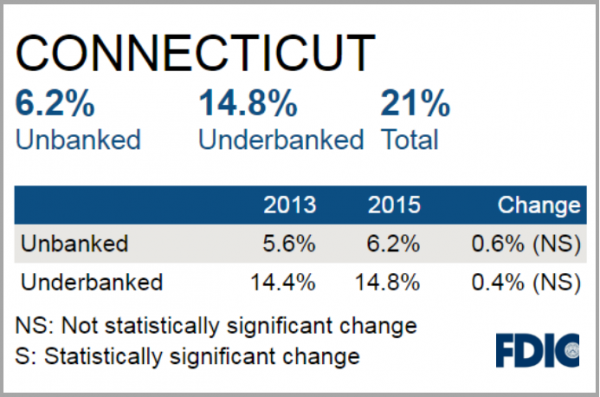
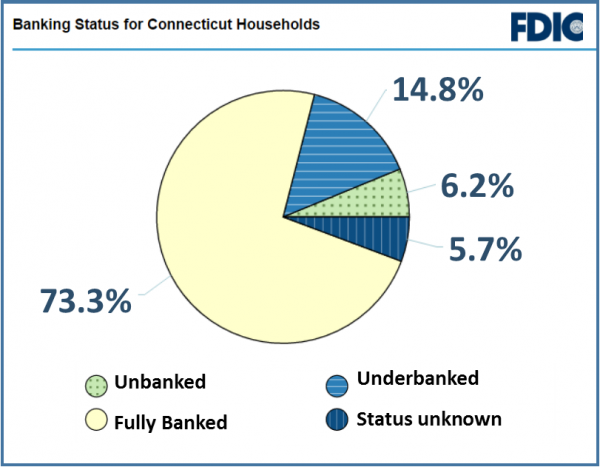
One in five Connecticut households is unbanked or underbanked, according to data compiled by the Federal Deposit Insurance Corporation, and the percentage of residents unbanked – those that do not have an account at an insured institution - has climbed in the state over the past six years. The percentage of Connecticut households considered unbanked has risen steadily, from 5.3 percent in 2009 to 6.2 percent in 2015, the most recent year for which data is available.  Connecticut ranked 21st in the nation in the percentage of unbanked households. 

Overall, the percentage of state households thatare either unbanked or underbanked increased slightly, from 20 percent to 21 percent between 2013 and 2015.  Those considered unbanked had a checking or savings account but also obtained financial products and services outside of the banking system.

Connecticut’s percentage of unbanked and underbanked individuals is better than the national average, which is 26.9 percent.  Nationally, 68 percent are considered to be fully banked, with an account or accounts at an insured institution, compared with 73.3 percent in Connecticut.

To assess the inclusiveness of the nation’s banking system, and in partial fulfillment of a statutory responsibility, the FDIC conducts biennial surveys of households to estimate the proportion of households that do not fully participate in the banking system.  The survey provides estimates of the proportion of U.S. households that do not have an account at an insured institution, and the proportion that have an account but obtained (nonbank) alternative financial services in the past 12 months.

Estimates from the 2015 survey indicate that 7.0 percent of households in the United States were unbanked in 2015. This proportion represents approximately 9.0 million households. An additional 19.9 percent of U.S. households (24.5 million) were underbanked,

The 2015 FDIC National Survey of Unbanked and Underbanked Households presents new data and insights on the size of unbanked and underbanked markets at the national, regional, state, and large metropolitan statistical area (MSA) levels. This is the fourth installment of the report.

In the Hartford-East Hartford-West Hartford metropolitan statistical area, a slightly higher percentage of households are unbanked or underbanked – 25.6 percent.  In the New Haven-Milford MSA, that percentage is slightly lower than statewide, at 19.5 percent.  The Bridgeport-Stamford-Norwalk MSA is lower still, at 18 percent.