No Chocolate Milk? Kids Get Used to Plain Milk, UConn Study Finds

There’s good news and bad news for chocolate milk advocates, depending upon which University of Connecticut research study you come across.  The studies don’t necessarily conflict, but provide differing points of view in the plain milk vs. chocolate milk debate. A new study by the Rudd Center for Food Policy and Obesity at the University of Connecticut has found that most students adjust to drinking plain milk after flavored milk is removed from school lunch menus.

Flavored milk served in the National School Lunch Program contains up to 10 grams of added sugar per serving, which is 40 percent of a child’s daily allowance of added sugar. Given the nation’s key public health target of limiting added sugars in children’s diets, flavored milk has come under scrutiny in the context of school nutrition, UConn Today recently reported.

The study, published in July in the Journal of the Academy of Nutrition and Dietetics, measured plain milk selection and consumption in the years after flavored milk was removed in two schools. Key findings include:

  • The first school year after flavored milk was removed, 51.5 percent of students selected milk and drank 4 ounces per carton, indicating school-wide per-student consumption of 2.1 ounces.
  • Two years later, 72 percent of students selected milk and drank 3.4 ounces per carton, significantly increasing the school-wide per-student consumption to 2.5 ounces.
  • Older students and boys consumed significantly more milk.
  • The availability of 100 percent fruit juice at lunch was associated with a significant decrease in students selecting milk and lower milk consumption per carton throughout the years of the study. Both years, student selection and consumption of plain milk dropped significantly on days when 100 percent fruit juice was also available.

The study could have implications for school nutrition policy and efforts to reduce added sugars in children’s diets. The study was conducted in two elementary (K-8) schools in an urban New England school district during the 2010-2011 and 2012-2013 school years. Researchers assessed the selection and consumption of milk immediately after flavored milk was removed in the 2010-2011 school year, and two years later in the 2012-2013 school year.

“The decision to remove flavored milk has both nutritional benefits and potential costs. It is clearly an effective way to lower student intake of added sugars at lunch, and over time, the majority of students will switch to plain milk,” said Marlene Schwartz, professor of human development and family studies, director of the UConn Rudd Center, and lead author of the study. “However, there will always be some students who don’t like plain milk. The challenge is finding a way to meet their dietary needs by providing other nutrient-rich options at lunch.”

The study was funded by the Cornell Center for Behavioral Economics in Child Nutrition Programs and the Rudd Foundation.  In the conclusion to the study, the researchers note that “A school policy to remove flavored milk has potential public health benefits and costs—it is likely to decrease consumption of added sugars at lunch for all children, but it is also likely to decrease consumption of milk for some children and increase their risk of missing key nutrients.”

Seven years ago, another UConn researcher was touting the virtues of chocolate milk.  That study, centered in Professor Nancy R. Rodriguez’s lab, found that drinking a 16-ounce glass of fat-free chocolate milk after exercise gives the body essential proteins and carbohydrates that help refuel weary muscles better than a beverage containing carbohydrates alone.

Rodriguez, with joint appointments in the departments of kinesiology and allied health – and who serves, then and now, as UConn’s director of sports nutrition – advocated for the benefits of milk in relation to athletic performance since the late 1990’s. But the 2010 study believed to be the first study of its kind showing a direct correlation between consuming chocolate milk and improved muscle recovery after prolonged exercise.

Results showed that chocolate milk was as effective as the carbohydrate drink in replenishing the body’s stores of glycogen, a form of carbohydrate the body uses as fuel during intense or prolonged exercise. Rodriguez said at the time that the sugar from the chocolate syrup in the milk helps athletes replace depleted glycogen in their muscles to prepare them for their next workout.

Rodriguez subsequently served on the President’s Council on Fitness, Sports, and Nutrition (PCFSN), 2014-2017. She has been a Sports Nutritionist for the NFL’s Indianapolis Colts and has provided services to the NBA’s Chicago Bulls and Charlotte Bobcats, and the AHL’s Hartford Wolfpack.

The 2010 study was funded by the National Dairy Council and the National Fluid Milk Processor Promotion Board.

Danger in CT: Not Buckling Up in Rear Seat is Hazardous to Your (and Others) Health

Twenty-nine states require passengers riding in a vehicle’s rear seat to buckle up with a seat belt.  Connecticut is not among them. A new survey from the Insurance Institute for Highway Safety highlights the common misperception that buckling up is optional – as well as the potential life-threatening hazards to rear and front seat passengers if those in the back seat opt not to buckle up.

"People who don't use safety belts might think their neglect won't hurt anyone else. That's not the case," indicates Jessica Jermakian, an IIHS senior research engineer and a co-author of the study. "In the rear seat a lap/shoulder belt is the primary means of protection in a frontal crash. Without it, bodies can hit hard surfaces or other people at full speed, leading to serious injuries.”

Among adults who admit to not always using safety belts in the back seat, 4 out of 5 surveyed say short trips or traveling by taxi or ride-hailing service are times they don't bother to use the belt.  Nearly 40 percent of people surveyed said they sometimes don't buckle up in the rear seat because there is no law requiring it. If there were such a law, 60 percent of respondents said it would convince them to use belts in the back seat. A greater percentage said they would be more likely to buckle up if the driver could get pulled over because someone in the back wasn't buckled.

Connecticut considered such a requirement in this year’s legislative session.  Urging legislators to approve the requirement, Julie Peters, Executive Director of the Brain Injury Alliance of Connecticut, said “In the event of a crash, unbelted back seat passengers become bullets, putting not only themselves, but everyone in the vehicle at risk. That's because unbelted back seat passengers continue to move at the same rate of speed as the vehicle they are riding in until they hit something -- the seat back, the dashboard, the windshield, the driver or another passenger. It's also not uncommon for unbelted passengers to be thrown from a vehicle and either crushed by that vehicle or another on the road.”

The new survey reveals that many rear-seat passengers don't think belts are necessary because they perceive the back seat to be safer than the front. This shows a clear misunderstanding about why belts are important, no matter where a person sits in a vehicle.

"For most adults, it's still as safe to ride in the back seat as the front seat, but not if you aren't buckled up," Jermakian said. "That applies to riding in an Uber, Lyft or other hired vehicle, too."

Except for New Hampshire, all states and the District of Columbia require adults in the front seat to use belts. All rear-seat passengers are covered by laws in 29 states and D.C. Of these laws, 20 carry primary enforcement, meaning a police officer can stop a driver solely for a belt-law violation. The rest are secondary, so an officer must have another reason to stop a vehicle before issuing a safety belt citation, the IIHS reported.

Rep. Mitch Bolinsky of Newtown, who advocated for passage of a Connecticut law this year, said in February that “Front seats have become much safer but that’s not the case in the back seat. Without the use of seat belts, we needlessly lose lives every year. Those souls should still be with their families.” He cited National Highway Transportation Safety Association (NHTSA) data that unbelted rear seat passengers are three times more likely to die than those who are buckled at the time of a serious impact.

AAA reported last year that three decades ago, Connecticut “moved ahead of the curve nationally with the passage of one of the nation’s first mandatory seat belt laws.”  AAA pointed that that estimates are that each year in Connecticut more than 120 adults are injured and approximately five adults die who were unbelted rear seat occupants. Dating back to 1995, AAA noted, that equates to close to 100 deaths and 2,500 injuries.  A survey of AAA members (AAA Allied Group and AAA Northeast) found that 7 in 10 members believe seat belts should be mandatory for back seat passengers, regardless of age.

The Governors Highway Safety Association issued a report in 2015, "Unbuckled In Back," analyzing the difference in highway fatalities between states that require rear seat passengers to buckle up and those that do not, the Hartford Courant reported.  At a Connecticut legislative hearing that year, the paper noted, state Transportation Commissioner James Redeker said that everyone in a passenger vehicle should buckle up, saying statistics show "people become projectiles because they're not strapped in a safety device."
Legislation has been introduced annually in recent years in Connecticut to require use of seat belts in the back seat.  Earlier this year, state Public Health Commissioner testified in support (HB6054 and HB6269), stressing that “adult seat belt use is the single most effective way to save lives and reduce injuries in crashes.”

Safety belts are credited with having saved 13,941 lives during 2015, the National Highway Traffic Safety Administration estimates. If everyone buckled up, an additional 2,800 deaths could have been prevented, the data indicated. More than half of the people who die in passenger vehicle crashes in the U.S. each year are unbelted.

IIHS surveyed adults 18 and older by cellphone and landline nationwide between June and August 2016. Of the 1,172 respondents who said they had ridden in the back seat of a vehicle during the preceding six months, 72 percent said they always use their belt in the back seat, while 91 percent said they always use their belt when seated in front. This is in line with the 2015 nationwide observed belt use of 75 percent for adult rear-seat occupants and 89 percent for drivers and front-seat passengers.

https://youtu.be/bdW_3oQFO0c


Ana Grace Project Establishes Partnership, New Home at CCSU

The Ana Grace Project (AGP), established to promote love, community, and connection in the wake of the Sandy Hook Elementary School shooting, has a new home at Central Connecticut State University (CCSU) in New Britain. A pilot partnership between the AGP and CCSU establishes a new base of operations for the Ana Grace Project, in addition to the blending of resources, services, and expertise, officials of both organizations have announced.

Nelba Márquez-Greene was a CCSU adjunct faculty member in 2012 when her daughter Ana Grace was killed at Sandy Hook, along with 19 other first-graders and six educators. She established The Ana Grace Project to honor her daughter’s memory and, as its executive director, she will oversee the CCSU-AGP partnership.

In announcing the partnership, CCSU President Zulma Toro said, “This arrangement will enrich our longstanding commitment to serving our communities as well as deepen our commitment to being a University of compassion. We are happy to welcome Nelba Márquez-Greene back to the CCSU family.”

“I’m looking forward to the amazing things we can do together,” says Márquez-Greene. “CCSU already has an extraordinary depth and breadth of talented, skilled people. We'll add another layer of support and love available to all.”  She is a clinical fellow of the American Association of Marriage and Family Therapy and has experience in private practice, as well as academic and community mental health settings. For a time she served as coordinator for Klingberg Family Therapy Center’s outpatient child and adolescent psychiatric clinic.

“By partnering with CCSU, we’ll be able to expand our vision of ensuring every student in Connecticut has access to healthy relationships and tools of self-regulation – setting them up for life long success,” Márquez-Greene explains.

Also expected is the continuation and expansion of AGP’s “Love Wins: Finish the Race” initiative hosted at CCSU for the past two years. Several hundred New Britain school children spend a day on campus with CCSU student volunteers for a taste of the college experience with the hope, says Márquez-Greene, of “instilling the belief that there is a world of possibilities awaiting them.”

Márquez-Greene will also work with the School of Education & Professional Studies to establish a Center for Social & Emotional Learning to provide education, training, and research to the campus, community, and state. Other expected collaborations include the training of CCSU undergraduate and graduate students in the Marriage & Family Therapy, Psychology, and Counseling programs in the use of social-emotional curriculum in the classroom.
Her husband, Jimmy Greene, is Coordinator of Jazz Studies and Assistant Professor of Music at Western Connecticut State University, another of the four state universities in the Connecticut State Colleges and Universities (CSCU) system.

Greene teaches applied jazz saxophone, jazz history, jazz pedagogy, jazz improvisation, jazz theory, jazz arranging, conducts the jazz orchestra and was awarded a 2013 Outstanding Faculty Award for his efforts. A native of Hartford, Greene is considered one of the most respected saxophonists of his generation since his graduation from the Hartt School of Music in 1997. His most recent recording, Beautiful Life (Mack Avenue) is a celebration of the life of his daughter. The album features touching performances by giants like Pat Metheny, Christian McBride, Kenny Barron and Kurt Elling amongst many others.

Three Metro Regions in CT Are Among Top 30 Most Educated in the US

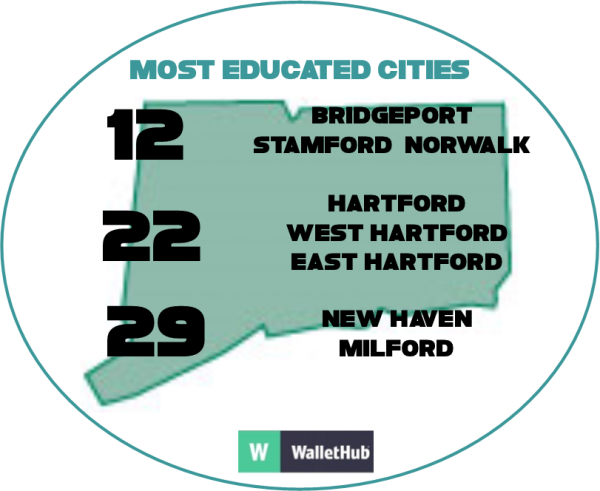
Three Connecticut metropolitan areas are among the top 30 “most educated cities in America,” according to a new analysis.  The Bridgeport-Stamford-Norwalk area ranked #12 in the nation, narrowly missing the top 10.  Hartford-West Hartford-East Hartford placed 22nd, and New Haven-Milford ranked 29th in the ranking developed by the financial website WalletHub. The Bridgeport-Stamford-Norwalk region ranked fourth in the nation for the highest percentage of individuals who have earned Bachelor’s degrees and fifth in the percentage of “graduate or professional degree holders,” according to the analysis.  The New Haven area ranked second in the nation in the quality of universities.

Overall, the top 10 most educated cities were Ann Arbor, Washington DC, San Jose, Durham, Madison, Boston, Provo, San Francisco, Austin and Tallahassee, according to the analysis.

To identify the most and least educated cities in America, WalletHub’s analysts compared the 150 most populated U.S. metropolitan statistical areas, or MSAs, across two key dimensions, including “Educational Attainment” and “Quality of Education & Attainment Gap.”  Data used to create the overall ranking were collected from the U.S. Census Bureau, Bureau of Labor Statistics, GreatSchools.org and U.S. News & World Report.

The Ann Arbor, MI, metro area has the highest share of bachelor’s degree holders aged 25 and older, 52.7 percent, which is 3.8 times higher than in Visalia-Porterville, CA, the metro area with the lowest at 13.8 percent.

Economic Policy Institute analysts point out that one way to strengthen an economy is to attract well-paying employers “by investing in education and increasing the number of well-educated workers.” In states where workers have the least schooling, for instance, the median wage is $15 an hour compared with $19 to $20 an hour in states where 40 percent or more of the working population hold a bachelor’s degree or higher.

A similar study by WalletHub earlier this year, comparing states, ranked Connecticut as having the fourth highest educated state population, just behind Maryland, Massachusetts and Colorado.


Knowledge Corridor to Gain Boost as More Frequent Rail Runs Through It

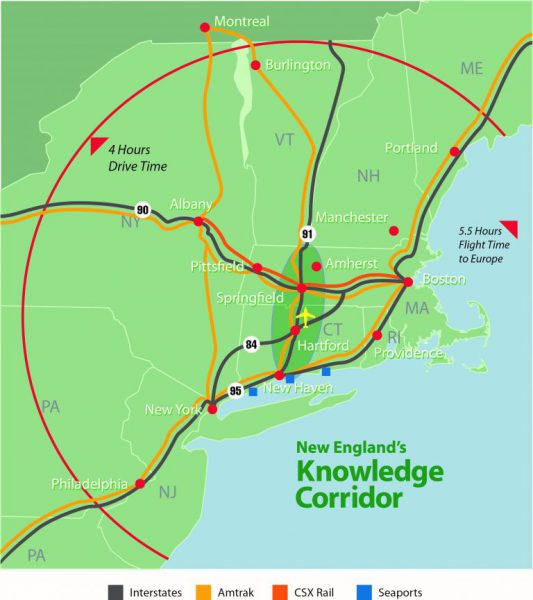
For years, the tag line has been “innovation runs through it.”  In the coming year, there will also be more frequent rail service running through it, and that may make all the difference in the world. When proponents of economic development in what’s known as “New England’s Knowledge Corridor” get together for a conference this fall, it will be with the backdrop of the three anchor cities that span two states – New Haven, Hartford, and Springfield – being more connected than ever, with the start of the new regular rail service between the cities just months away.

The half-day conference, “Leveraging the Knowledge Corridor’s Transportation Assets and Investments to Drive Economic Progress,” will be held at Union Station in Springfield on October 18.  It will serve as the coalition’s 2017 “State of the Region” conference.

The keynote speaker will be Robert Puentes, President/CEO of the Eno Center for Transportation.  Panelists will include five members of Congress from the region:  Richard Neal and James McGovern from Massachusetts and John Larson, Rosa DeLauro, and Elizabeth Esty from Connecticut.

Plans also include talks by Connecticut Commissioner of Transportation James Redeker and his counterpart in the Bay State, Stephanie Pollack, Secretary/CEO of the Massachusetts Department of Transportation.  Officials also anticipate releasing the results of the 2017 New England Knowledge Corridor Business Survey.

"In the Knowledge Corridor, we’re convinced that the transportation assets we have; new ones that will be coming online in the  next year or two, plus; those we are planning to see realized over a longer range time line constitute the bedrock of a competitive 21st century economy that enables ready and affordable access to skilled workers, attractive markets and motivated consumers on a global scale," Tim Brennan, Chairman of New England Knowledge Corridor Partnership and Executive Director of the Pioneer Valley Planning Commission, told CT by the Numbers.

On Monday, Governor Dannel P. Malloy announced that a joint venture of TransitAmerica Services and Alternate Concepts has been selected as the service provider that will operate and manage service on the Hartford Line – which is expected to launch in May 2018.

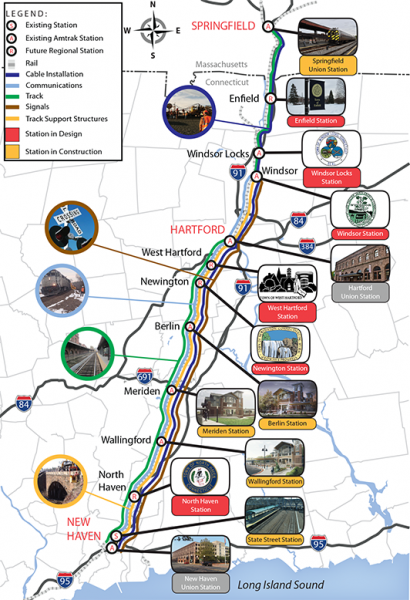
Work is continuing throughout the summer, including grade crossing upgrades in Wallingford this month, as part of the overall upgrade of the New Haven-Hartford-Springfield rail line – now branded as the CTrail Hartford Line, with expanded service scheduled to being in 2018, according to transportation officials.  Last month, construction in Meriden and Windsor included track construction upgrades.

New England’s Knowledge Corridor is an interstate partnership of regional economic development, planning, business, tourism and educational institutions that work together to advance the region’s economic progress. The region “transcends political boundaries,” officials point out, and it comprises the Hartford, Springfield and New Haven metro areas and is centered on seven counties in the two states, underscoring the area’s “rich tradition of inventions, research and higher education.”

The New Haven-Hartford-Springfield (NHHS) Rail Program is a partnership between the State of Connecticut, Amtrak and the Federal Railroad Administration.  The goal is to provide those living, working or traveling between New Haven, Hartford and Springfield with high speed rail service equal to the nation’s best rail passenger service, officials emphasize.

The Hartford Line will act as a regional link with connections to existing rail services, including Metro-North, Shoreline East, and Amtrak Acela high-speed rail services on both the New Haven Line to New York and on the Northeast Corridor to New London and Boston. There will also be direct bus connections to the Bradley Airport Flyer and to CTfastrak.  With a heightened level of direct and connecting service linking the region, the hope is that towns along the future Hartford Line will become magnets for growth – ideal places to live and to relocate businesses that depend on regional markets and travel.
All of which dovetails perfectly with the “selling points” routinely used to promote the Corridor:

  • Academic Powerhouse – One of the country’s highest academic concentrations and largest capacities for research, with 41 colleges and universities and 215,000 students
  • Exceptional Achievement – Consistently among the nation’s top 10 in percentage of the population with advanced degrees, science-engineering doctorates and new patents registered
  • Big, Concentrated Market – The nation’s 20th largest metro region, with over 2.77 million people, is comparable to Denver and St. Louis, but with twice their population density, which means ready access to labor and consumers
  • Large Workforce – A labor force of 1.34 million, 50% larger than the Charlotte metro area
  • Business Hub – 64,000 businesses – 60 percent more than the Austin metro

"Providing frequent, reliable, commuter rail service connecting New Haven-Hartford-Springfield, the three major cities that anchor the Knowledge Corridor and its over 2.7 million people, will be nothing short of a game changer enabling the cross border region’s to reach its potential as an economic powerhouse within New England while simultaneously linking it to the white hot economies found in the Boston and New York City mega regions," Brennan added.

The CTrail Hartford Line rail service will operate at speeds up to 110 mph, cutting travel time between Springfield and New Haven to as little as 81 minutes. Travelers at New Haven, Wallingford, Meriden, Berlin, Hartford, Windsor, Windsor Locks and Springfield will be able to board trains approximately every 30 minutes during the peak morning and evening rush hour and hourly during the rest of day, with direct or connecting service to New York City and multiple frequencies to Boston or Vermont (via Springfield).  New train stations also are in various stages of development in North Haven, Newington, West Hartford and Enfield.

Also, very much a part of the strengthening transportation options with the potential to spur economic development is Bradley International Airport, which recently has added international flights on Aer Lingus (last year) and Norwegian Air (last month) and a direct-to-San Francisco route via United Airlines.
Connecticut Airport Authority Executive Director Kevin A. Dillon said the aim is to “build on Bradley’s strengths and continue our focus to deliver more convenience and connectivity for our region.  Flying to Europe from Bradley has never been easier and more affordable.”

The Connecticut Department of Transportation (CTDOT) conducted a bidding process and cost-benefit analysis for the Hartford Line program and selected TransitAmerica Services and Alternate Concepts, which are forming a joint venture solely for the purpose of serving the Hartford Line. This marks the first time that CTDOT has been able to select and contract with an experienced service provider for a major transportation program, a more cost-efficient alternative to the agency creating a separate internal unit and hiring employees to manage the Hartford Line, according to state officials.

CT's Water Plan Ready for Public Comment; Recommendations Advance to Legislature in 2018

If you’re interested in Connecticut’s plans to manage a key natural resource – water – and might like to weigh in on what’s being considered, the window of opportunity to speak up has opened. The state’s Water Planning Council (WPC) published a draft version of the State Water Plan last week, on the council’s website (www.ct.gov/water).  They have also opened a public review period to provide Connecticut residents, businesses, and other stakeholders an opportunity to provide feedback before the Plan is finalized early next year. Comments will be accepted through November 20.

The draft plan recommends a framework for managing Connecticut’s water into the future and for “achieving balance with our many human and environmental needs as climate trends emerge and new needs develop,” according to officials.  The plan addresses the quality and quantity of water for drinking, ecology, recreation, business, industry, agriculture, energy, and wastewater assimilation.

The WPC members stressed that the input of Connecticut’s citizens is crucial to the development and implementation of the plan to ensure it is fair and effective at balancing the needs of all water users while protecting a valuable resource. The council will hold public hearings on the draft plan across the state during late summer and fall, and they also plan to use technological resources to advertise and educate the public on the plan throughout this period.  Comments on the plan can be filed electronically by the public.

Among the issues included is climate change.  The draft plan states that “Climate change is likely to have a significant effect on potential flooding in Connecticut, and could also result in drier summers in the next 25 years. More work is recommended on coastal impacts, longer term effects (50 – 100 years), and basins at risk of not satisfying all future needs.”

The creation of the State Water Plan was required following the adoption of a state law, Public Act 14-163, which directed the WPC to formulate a plan that will help planners, regulators, and lawmakers make decisions about managing Connecticut’s water in a manner that is consistent throughout the state.

The WPC is comprised of four members: John W. Betkoski (Chair), Vice Chairman, Public Utilities Regulatory Authority; Garrett Eucalitto, Undersecretary, Office of Policy and Management; Betsey Wingfield, Bureau Chief, Department of Energy and Environmental Protection; and Lori Mathieu, Drinking Water Section Chief, Department of Public Health.  The group’s draft plan reflects the input of various stakeholders, committee members and public participants.  There is also an advisory board for WPC.

The plan highlights five key messages:

  • Plan Function: The Plan is not an answer, but a platform for consistent, informed decision making.
  • Maintain Highest Quality Drinking Water: The Plan reaffirms the state’s dedication to the highest standard of drinking water quality in the nation (Class A).
  • Balance: Many river basins in Connecticut cannot satisfy all instream and out-of-stream needs all the time. The Plan offers ideas for understanding and improving this balance.
  • Conservation: While Connecticut leads the nation in protections of drinking water quality, the State lags in its water conservation ethic. Outreach that builds on utility initiatives is one of the most important recommendations in this Plan.
  • Maintain Scientific Data: The plan advocates for the collection and use of scientific data, as well as centralized access to it.

Details of the WPC’s public outreach efforts, information on how to comment, and links to other resources will be available in the coming weeks at www.ct.gov/water. They intend to present a final document to the Governor and various legislative committees in 2018.  The WPC next meets on August 1 at 10 Franklin Square in New Britain.

PERSPECTIVE: Yes, We Can Change the World

by Ramzi Kaiss …As we will come to find out, everyday for the rest of our lives, and not just today, will be that real celebration of the lessons we’ve learned, the relationships we’ve built, and the love that we’ve had and shared on this beautiful New London hilltop. You see our experiences cannot be objectified and contained within a piece of paper, they are bigger than that. For they shall pervade the way we got about our lives forever, and I mean it.

Look around you for a moment. Take it all in: Look at the beautiful campus you are surrounded by, but more importantly look the beautiful people you are amongst, Inside and outside these buildings that are surrounding us, and through the people we are surrounded by, we have discovered the meaning of our time at this institution and of our role in the world beyond its walls.

Here we discovered that as we face the world tomorrow, what is more worthy than merely finding a job is finding a good cause to live and work tirelessly for. Through the people we are surrounded by, we discovered that what is more essential than merely making money is making this world a better place for all of its inhabitants, regardless of their sex, race, gender, ethnicity, orientation or religion.

Because yes, there is no doubt that you will become successful. There is no doubt that you can become future peacemakers and noble CEO’s, instrumental social activists and leaders of NGO’s; future dancers and award winning musicians, inspiring academics and pious politicians; future radical educators and mind-blowing performers, and yes, oh yes, righteous revolutionaries and renowned reformers.

Nevertheless, as this place has taught us, life is not so much about how far we go, but what about we do with that distance. It is about how we utilize our positions of power to empower the people around us.

And not only did we learn these lessons with one another, but through and because of one another- whether in the classroom or at a ridge party, during office hours or campus-wide discussions, or even right here on Temple Green, as part of the many late-night conversations that I’m sure most of us have had. Because in the end, it is in the people that we have become and in the future work that we will accomplish as a result of this becoming, that the true celebration of our time at Connecticut College will be actualized. And that will take place day after day after day.

We must admit that with a Connecticut College education we are more than ready to take on some of the most important challenges that the human population faces today. At a time in our world where poisonous hatred has already ripped apart communities and destroyed lives, our education and our experiences are the much-needed antidote that can heal and rebuild.

As French philosopher Albert Camus puts it, “there is no sun without shadows, and it is essential to know the night.” Now, more than ever, not only do we know why systems of inequality continue to exist, but we know how to dismantle them in order to create a more equitable society.

_________________________

Ramzi Kaiss '17 was the 2017 Commencement Senior Class Speaker at Connecticut College in New London. Ramzi, from Beirut, Lebanon, was a philosophy and international relations double major and Mellon Fellow. He served as President of the Student Government Association, as well as co-president of the Amnesty International club. In 2016, he received a research grant from Connecticut College and spent his summer conducting research for the Boston-based global nonprofit, Facing History And Ourselves. In February 2017, he traveled to Bogotá, Colombia for the 16th World Summit for Nobel Peace Laureates.

Leaders Inspiring Hope to be Honored in Greater Hartford

Leadership Greater Hartford (LGH) will be “celebrating leaders who inspire hope,” at the organization’s annual fundraising gala this fall, personified by honorees selected to receive the prestigious Polaris Awards.  Although their individual stories differ substantially, the common thread is one of commitment to community and taking on tough challenges to provide opportunities for individuals encumbered by obstacles.  Their impact has been unmistakable, making a difference not only in individual lives, but across the community.  Being honored for their work, as described by LGH:

  • Ronit Shoham is the driving force behind many remarkable projects for young people and others in need. She is a whirlwind of activity who has helped catalyze such initiatives as the creation of the Miracle League of Connecticut (which enables children with physical and mental challenges to enjoy playing baseball), Jonathan’s Dream Re-Imagined (rebuilding one of America’s first inclusive, accessible play spaces) and The Underground (a safe and secure location for teenagers to congregate, communicate and grow together).
  • Cheryl and Jamie “Bear” McDonald are not only owners of one of the fastest growing restaurant businesses in the state, they personify dedication to both quality and the community. Starting with Bear’s Smokehouse in Windsor, South Windsor and Hartford, they have opened three other restaurants this year. And their community focus includes a commitment to hire ex-offenders, raising their minimum wage to $15 an hour for “non-tip” employees and significant support of many local charities.
  • Iran Nazario is a high school dropout and former gang member who overcame many hardships, including jail time, to become an inspirational nonprofit leader in Hartford. Today he is president of the Peace Center of Connecticut and was most recently with COMPASS Youth Collaborative Inc., positions that have allowed him to work with young people to prevent gangs, reduce violence and find peaceful paths forward.

The Polaris Awards gala, to be held on October 18 at The Bushnell, is Leadership Greater Hartford’s annual signature fundraising event that recognizes “guiding lights” in the local community. Each fall hundreds of diverse leaders from every sector in the Greater Hartford area come together to network, to celebrate and to be inspired by the unsung heroes who strengthen community leadership connections in our region, officials explain.

Founded in 1977, Leadership Greater Hartford (LGH) is “one of the largest, most diverse, and effective community leadership organizations in the country,” the LGH website points out. The organization’s mission is to “develop, connect, and inspire diverse leaders to build strong and vibrant communities.”  Event proceeds directly support Leadership Greater Hartford’s important work to strengthen the local community by training and connecting aspiring and established leaders.


Photo: (L to R) Ronit Shoham, Cheryl and Jamie “Bear” McDonald, Iran Nazario

Webster Bank, Peoples United Are Among Nation’s "Most Reputable Banks"

Webster Bank and People’s United have been named among the "most reputable banks" in the country, according to the 2017 Survey of Bank Reputations, conducted by the independent organization Reputation Institute. Webster earned the highest score of any Northeast-based banks and ranked seventh overall in the United States. People’s United ranked at number 11.  The annual survey measures U.S consumers' perceptions of major bank brands.

American Banker, a trade publication focused on the banking industry, published the ranking of the most reputable banks in the country based on the Reputation Institute survey. More than 12,000 individual ratings were collected from customers and non-customers.  The ratings took into account citizenship, ethics/integrity, innovation, leadership, performance, products, services and workplace.

In its analysis, American Banker pointed out that regional institutions “are faring particularly well.”  Webster scored 76.4 while People's United scored 74.2.  The top-ranked institution, Georgia-based Synovus Financial, had a score of 80.7.

Stephen Hahn-Griffiths, an executive vice president at the Reputation Institute, said that while providing quality products and services is obviously important, it's a company's governance — or how it conducts business — that can make or break a reputation these days.

"The No. 1 thing people are looking for in terms of reputation of a bank is ethical behavior," said Hahn-Griffiths.

Of the 39 banks evaluated in this year's survey, more than half of them received "excellent" marks from their existing customers, up from just under a third of the banks in the 2016 survey. Perhaps more tellingly, over 30% received "strong" ratings from non-customers, versus zero in last year's survey.

Webster Bank, with its roots in Waterbury dating back to 1935, has over $25 billion in assets and 176 banking centers from greater New York City to Boston, offering a full range of financial services delivered by close to 3,000 employees. People's United, founded in 1842, is a premier, community-based, regional bank in the Northeast offering commercial and retail banking, as well as wealth management services through a network of nearly 400 retail locations and 5,000 employees  in Connecticut, New York, Massachusetts, Vermont, New Hampshire and Maine.


Play with Purpose at Two Connecticut Pre-Schools

Local school systems in Enfield and Manchester implemented a purposeful play initiative, with support from LEGO Community Fund US and the Hartford Foundation for Public Giving.  The results of the initiative are highlighted in a new video, which emphasizes that there’s more to play than may be apparent at first glance. Program organizers point out that “young children are naturally curious and full of life. Provided a supportive environment, they will joyfully splash, build and smash, pretend, sing, and dance.” While they are having a ton of fun, they are also making sense of the world and learning through exploration, experimentation and social interaction.

The LEGO Community Fund US has long asserted that learning through play enables children to become creative and engaged lifelong learners. In 2014, they put forward a proposal and funding to develop and test new materials to advance facilitated play in children’s homes, preschool and kindergarten. The idea is that a young child’s parents and teachers should really be facilitators of intentional play experiences.

The Hartford Foundation matched LEGO’s grant, and the Connecticut Office of Early Childhood participated with in-kind funds to create a training video, making the initiative a cross-sector effort. Laura Post, Vice President of Consumer Insights, LEGO Group, said of the collaboration, “We shared, as organizations, a passion for early childhood.”  The pilot was run in Manchester and Enfield, home of LEGO’s U.S. headquarters.

The collaborative, 17-month initiative ran from January 2015 through May 2016. During that time, participating parents and educators learned how facilitated play can support children’s cognitive, social and emotional development. Emphasis was placed on how to teach young children, not what to teach them.  The goal was to incorporate life and academic skills in a way that is fun for young children.

The Supporting Educational Success through Playful Learning workshops, that Enfield held in English and Spanish, were a catalyst for the development of a community campaign on the importance of play.

Schools Superintendent Dr. Jeff Shumann said the program sets students up for success in the future.  “It gives them those interpersonal skills, creative thinking skills, the problem solving skills, and certainly the communication skills that will help them enhance their learning as they get into deeper and more rigorous academics in the coming years.”

Kindergarten and pre-K teachers are receiving coaching to integrate purposeful play into all curriculum areas. Early educators participated in a series of play based workshops, and families attended play events, gaining an understanding of the value of play.

Manchester’s Supervisor of Student Development, Karen Gray, says it became “obvious how developmentally appropriate it is for children to play, and to have fun, and to smile and to laugh.”  As they did, teachers would “see them develop cognitively," although "they are not necessarily aware of the skills that they are actually developing.”

Adds Latasha Easterling-Turnquest, District Director of Manchester Public Schools’ Family Resource Centers, “Given the opportunity, a child, through play, can show you what he or she can really do.”

PHOTOS:  Jeff Shumann,  Karen Gray.

https://youtu.be/y20-G6AnIV0