Best Run Cities in USA? Not in Connecticut, Study Finds

A new analysis of the best run among the 150 largest cities in America shows that Connecticut’s three largest fail to make the top half of the list, with Bridgeport coming closest. Bridgeport is ranked #77, New Haven is #122, and Hartford ranked #145. 

In order to determine the best- and worst-run cities in America, WalletHub’s analysts compared 150 of the most populated cities across six key categories: 1) Financial Stability, 2) Education, 3) Health, 4) Safety, 5) Economy and 6) Infrastructure & Pollution.

The top ten best run cities are: Nampa, ID; Provo, UT; Boise, ID; Missoula, MT; Lexington, KY; Las Cruces, NM; Billings, MT; Bismarck, ND; Fort Wayne, IN and Louisville, KY.

For each city, the analysts constructed a “Quality of City Services” score – comprising 33 key performance indicators grouped into six service categories – that was then measured against the city’s total per-capita budget.  The website evaluated those dimensions using 33 relevant metrics, with each graded on a 100-point scale, with a score of 100 representing the highest quality of service.

In the “financial stability” ranking, only four cities ranked lower than Hartford, which was #146.  New Haven was #143 and Bridgeport #128 in that category.  In the education ranking, New Haven was #115, just ahead of Bridgeport at #116 and Hartford at #121.

Bridgeport reached the top ten nationally in the “health” category, at #8.  Hartford was #42 and New Haven #56.  The cities were again bunched toward the bottom of the list of 150 cities in the “economy” category, with Bridgeport at #142, New Haven #143 and Hartford #146.

Connecticut largest cities fared better in the “infrastructure and pollution” category, with Hartford ranked #36, New Haven #60, and Bridgeport lagging at #115.

UConn Expands Presence in Hartford, Stamford

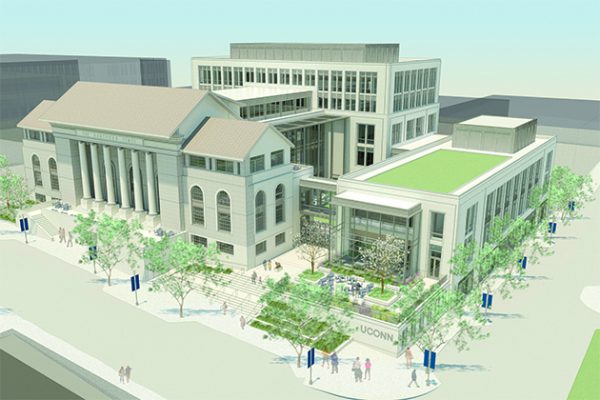
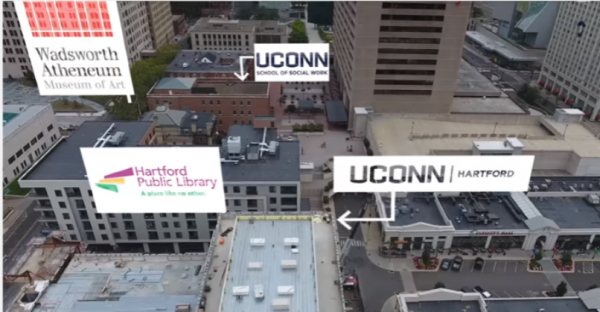
UConn is on the move this week, literally as well as figuratively.  Wednesday will see the ribbon cutting for the new Hartford campus, which is relocating from its suburban campus in West Hartford after nearly five decades away from the Capital City.  And in Stamford, students will be moving into student housing beginning this weekend, the first time that has been possible. In Hartford, the university intends to “interweave top-tier academic programs with the vitality and unique educational and service opportunities offered by Connecticut’s capital city.”  The campus – at a cost of $140 million - is anchored by the historic former Hartford Times building as part of a neighborhood campus that includes nearby cultural institutions and state and city government offices, including Hartford Public Library, which will house 12,000 square feet of UConn classrooms, a library collection, and study areas.

The campus will be the home for the university’s Department of Public Policy, Urban and Community Studies Program, Cooperative Extension System, and the Connecticut State Historian.  A new Barnes & Noble bookstore is also coming downtown as part of the new campus.

UConn is also touting the demographics of the student population:  47 percent minority students, and a 13:1 student-faculty ratio.  It anticipates 1,347 undergraduates and 1,602 graduate students downtown, at the undergraduate campus, School of Social Work and business school, which has been downtown for more than a decade.  A year ago, the Board of Trustees voted to extend the Graduate Business Learning Center’s (GBLC) lease at 100 Constitution Plaza, and to add two additional floors to the existing space, allocating a total of six floors of classroom, meeting and office space.

The UConn School of Social Work is moving from West Hartford down the block from the new undergraduate building, to 38 Prospect Street, directly across from the Wadsworth Atheneum.  And, it was announced earlier this month, regular bus service between Storrs and Hartford is getting underway, free of charge to students. There will also be a shuttle bus running a loop downtown, and although there is no designated student parking, officials say the number of available spaces in nearby lots should be more than sufficient.

Meanwhile, at UConn’s Stamford campus, the inaugural move-in weekend is scheduled for August 26th and 27th, as the campus offers student housing for the first time. The student dorm, at 900 Washington Boulevard, is 2 blocks south of the UConn Stamford campus and halfway between the main campus building and the Stamford Transportation Center.

The building is six stories tall and will have 116 apartment units. the school's website explains. The maximum occupancy of the building is approximately 350 students, but because some of the bedrooms will be single occupancy, the target occupancy is 290 students. Plans call for 100 designated parking spaces for students will be available for a small additional charge.

The residence hall also includes an 80-person meeting room, administrative offices and a lobby on the first floor. Each floor has a study lounge, and the second floor has a large community center in which students can congregate and have events. The University will manage Stamford housing as in Storrs, with an on-site Resident Director and on-floor Resident Assistants.

The current UConn Stamford academic campus, at the corner of Washington Boulevard and Broad Street in downtown Stamford, opened in 1998, although courses had previously been offered in the city. The facility also provides current UConn students, faculty and staff access the on-site Fitness Center free of charge.

In addition to the main campus in Storrs, UConn also has a presence in Waterbury and Avery Point, as well as the School of Law in Hartford’s west end and the Health Center in Farmington.  The former UConn Torrington campus closed a year ago, due to “declining interest among students, falling enrollment, a limited faculty, and changing regional demographics,” according to school officials.

PERSPECTIVE - Early Childhood Care and Education: A Prudent Investment

by Joanna Meyer, Michael Strambler, Clare Irwin and George Coleman Young children are often compared to sponges because they constantly soak up new knowledge. In serving children under five, high-quality early childhood care and education programs aim to capitalize on this stage of rapid brain development in efforts to promote positive outcomes among children.

Much has been learned about the impact of early childhood education from research over the past several decades. While some researchers have shown that the positive effects of early childhood programs on children’s achievement may fade over the first years of elementary school, research with longer time horizons tells a different story about long-term effects.

For example, the Perry Preschool Project and the Carolina Abecedarian Project are two rigorously studied programs in which at-risk children were tracked from birth into their 30s. Half of the children participated in an intensive early childhood education program from infancy to kindergarten entry while the other half did not. When children who had participated in these programs grew into adults, they had improved educational attainment, employment, earnings, and health outcomes. They also engaged in less criminal activity and fewer unhealthy behaviors.

These research findings have important implications for society. If early childhood programs produce healthier adults, investing in these programs could reduce the burden on the health care system. If children who participated in early childhood programs grow up to experience higher employment rates and earnings, requests for public assistance should decrease. If these children are less likely to engage criminal activity, their communities and society as a whole should benefit.

Research also points to clear economic implications of investing in early childhood education. For example, through studies of two specific programs that served students from birth to age five and following children into their thirties, economists have estimated a social benefit to society of $7.30 for every $1.00 spent on early childhood programs, with an annual return on investment of 13.7%.

While this estimate is based on two small demonstration programs, another study analyzed evaluations of a wider range of early childhood programs and noted that the federal Head Start program produces persistent beneficial effects on long-term outcomes. It also made the case that a comprehensive cost/benefit analyses of Head Start would reveal a high rate of return.

How would investing in early childhood education pay off in Connecticut?  In a recent policy brief by Connecticut Voices for Children, the authors use the 7.3 benefit/cost ratio to estimate the benefits and costs of early childhood education in Connecticut. According to these estimates, it would cost $1.8 billion dollars to provide high-quality early childhood care and education to all Connecticut children under age 5, and this care would have a long-term economic benefit of $13.3 billion.

It is also important to note that in states like Connecticut with vast economic disparities, the provision of high-quality early childhood education alone is not enough to level the playing field for disadvantaged children. Many low-income children are concentrated in poor neighborhoods, and research has shown that the neighborhood in which a child is raised impacts the child’s inter-generational mobility.

Children living in poverty are more likely to face toxic stress that results from food insecurity, housing instability, and limited access to health care, all of which can impact children’s short- and long-term outcomes. Maximizing the impact of high-quality early childhood education may include addressing the causes of toxic stress, which in turn requires investment in supportive services for families.

In the midst of the current fiscal crisis in Connecticut, lawmakers are urgently seeking ways to reduce the short-term budget deficit. When evaluating potential reductions to spending on education and social services for young children and their families, it is critical to consider the long-term impacts of such an approach.

According to the cost-benefit analyses described above, cutting $1M of early childhood education funding from the state budget now could result in a $7.3M reduction in long-term benefits to society. The evidence suggests that across-the-board cuts to the programs that serve Connecticut’s most vulnerable citizens is economically imprudent in the long run.

_____________________________________

Joanna Meyer, M.A.T., Michael Strambler, Ph.D., Clare Irwin, Ph.D, and George Coleman, M.Ed., M.A.are the Management Team for the Partnership for Early Education Research (PEER)an alliance among early childhood stakeholders in Connecticut that engages in collaborative research focused on children from birth through age 8. By pursuing questions developed in collaboration with its members, PEER aims to produce rigorous, actionable research that can inform early childhood education policy and practice at the local and state levels, increase access to high-quality early childhood education, and reduce disparities in educational outcomes. Funding support for PEER is provided by the U.S. Department of Education’s Institute of Education Sciences (IES) and the Spencer Foundation.


Hartford, New Haven, Bridgeport Among Highest in US for Households That Don’t Own Cars

Whether it is good news or bad news may be in the eye of the beholder.  The percentage of households without a motor vehicle in Hartford is 10th highest in the nation.  New Haven (24th) and Bridgeport (49th) also make the top 50. Some would suggest that lack of car ownership is a reflection of poverty.  Others may point to millennials and others who choose an urban lifestyle specifically because car ownership is less necessary.

In Hartford, 35.7 percent of households do not own cars.  In New Haven it is 29.2 percent; in Bridgeport, 21.2 percent, according to data compiled by Governing magazine, using data from the Census Bureau's 2010-2013 American Community Survey.

Taking cars off streets yields a number of benefits for cities, including helping to attract young people, limiting pollution and facilitating safer roadways for both drivers and pedestrians, explains Norman Garrick, who studies urban planning at the University of Connecticut. That’s part of the reason “cities are really doubling down and trying to reduce use of cars,” he pointed out to Governing magazine in 2015.

Nationwide, about 9 percent of U.S. households didn’t have access to a car in 2013, according to Census data analyzed by Governing -- a figure that has been relatively stable.  Garrick’s past research in Hartford, for example, found 71 percent of employees drove alone to work for an insurance company that charged for parking. Rates for other downtown Hartford employers offering free parking were between 83 and 95 percent.

Among the other Connecticut communities reviewed in the analysis (% of households without cars, ranking):

  • Waterbury          18.2 of HH           69th
  • New Britain        17.7% of HH        74th
  • East Hartford     15.9% of HH        87th
  • West Haven       11.9% of HH        151st
  • Stamford             11.8% of HH        156th
  • Meriden              11.4% of HH        169th
  • Norwalk               9.4% of HH          262nd
  • Danbury               9.3% of HH          271st

Census estimates suggest there were about 1.8 vehicles per U.S. household in 2013. This ratio varies greatly across cities and larger regions. As one would expect, suburban jurisdictions tend to have greater car ownership than more densely-populated cities. Data was included for all cities (794) with at least 50,000 residents.

National Leader, Connecticut Green Bank Reaches Milestone in Project Financing

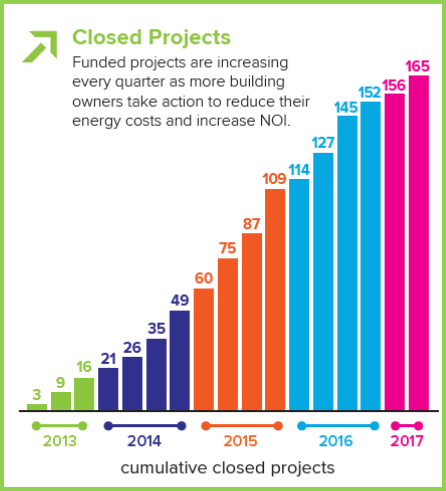
The Connecticut Green Bank’s C-PACE program recently surpassed $100 million in closed project financing. Out of the 19 states with C-PACE (Commercial Property Assessed Clean Energy) programs, this project financing level is second only to California, according to officials. The Connecticut Green Bank’s C-PACE program reached the milestone of $100 million in total closed project financing. The solar photovoltaic (PV) and energy efficiency projects, which vary in size and scope, are saving more than $9.29 million annually in energy costs for nearly 170 building owners across multiple sectors. 

The Green Bank, which administers the C-PACE program, seeks to make green energy more accessible and affordable to commercial and industrial property owners by providing no money down long-term financing for meaningful energy upgrades to their buildings.

C-PACE enables building owners to finance qualifying energy efficiency and renewable energy improvements through a voluntary assessment on their property tax bill. As the program grows, more Connecticut businesses can achieve lower energy costs. Reaching $100 million in closed project financing reaffirms Connecticut’s program as a national leader, officials indicated.

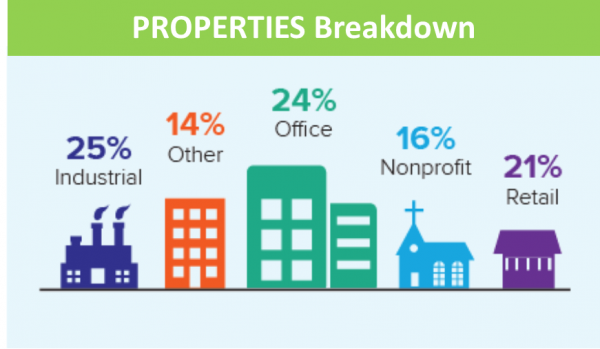
Since its inception in 2011, 166 C-PACE projects have been closed in 69 of the 128 municipalities that have opted into the program. C-PACE funds have been used in manufacturing facilities, non-profits, houses of worship, retail establishments, office buildings, and other business entities.  The projects consist of solar installations, new boilers, energy efficiency lighting measures, HVAC systems, and other energy improvements that help building owners to take control of their energy costs.

“Connecticut’s Green Bank has really been the national leader for C-PACE,” said David Gabrielson, the Executive Director of PACENation, the national non-profit that supports development of PACE programs nationwide. “The way they administer their program has really served as a great example for other program administrators throughout the U.S., and we congratulate the entire Green Bank team on this impressive milestone.”

The project that propelled the Green Bank over this milestone will be installed at Farmington Sports Arena (FSA). FSA is a 130,000-square foot modern indoor sports facility that is home to four indoor and three outdoor artificial turf fields as well as four natural grass outdoor fields. The project, which will be installed by 64 Solar, consists of two solar PV systems (170 kW total).

Connecticut’s C-PACE program maintains an open market approach, allowing private capital providers to finance projects for building owners, and, in 2015, the Green Bank reached an agreement that provided it access to up to $100 million in private funding for C-PACE projects. Today, nearly 70% of the funding in the program consists of private capital.

“The Connecticut Green Bank is a leader in the green energy movement, but the rapid growth of C-PACE wouldn’t be possible without the support of our contractors, capital providers, municipal officials, and other stakeholders who have contributed to the C-PACE movement,” said Mackey Dykes, Vice President of Commercial, Industrial and Institutional programs at the Connecticut Green Bank. “There is still significant potential for energy improvements for Connecticut businesses and non-profits, and we look forward to bringing cleaner and cheaper energy to more building owners across the state.”

The website Energy Collective noted recently that “states have and will continue to play a key role in leading the clean energy transition,” highlighting the work in Connecticut as among the national models.

“Connecticut has found a way to make the financing of clean energy deployment more accessible and affordable for consumers and businesses. In 2011 the state legislature created the Connecticut Green Bank, the nation’s first green bank. It uses public funds to attract private capital investment in green energy projects. By leveraging private investment, the Green Bank significantly increases the total amount of financing available for clean energy projects.

The site highlighted that “Among the Green Bank’s most successful initiatives is the Commercial Property Assessed Clean Energy (C-PACE) program, which allows commercial property owners to pay for clean energy or efficiency upgrades over time through their property taxes.

The Connecticut Green Bank is the nation’s first green bank. Established by the Connecticut General Assembly on July 1, 2011 as a part of Public Act 11-80, the Connecticut Green Bank evolved from the Connecticut Clean Energy Fund (CCEF) and the Clean Energy Finance and Investment Authority (CEFIA), which was given a broader mandate in 2011 to become the Connecticut Green Bank.

https://youtu.be/kPqO4QlTkDU

New School Year Approaches Without Seat Belt Requirement on School Buses

June 7 was the final day of the regular legislative session in Connecticut.  It was also the day following the signing of a new law to require seat belts on school buses – in Nevada. Gov. Brian Sandoval signed legislation, approved overwhelmingly by his state’s legislature, which requires that any new school bus purchased by a school district on or after July 1, 2019, be equipped with a shoulder-harness-type safety belt assembly for passengers.

There was no similar bill signing in Connecticut.  Legislation that would have imposed a similar requirement in Connecticut, effective in 2022, failed to get out of the Transportation Committee after a public hearing months earlier.  The new school year approaches with no requirement in Connecticut, and no change in policy on the horizon, despite years of efforts.

Nevada joins only six other states — California, Florida, Louisiana, New Jersey, New York and Texas —in enacting laws requiring seat belts. In Louisiana and Texas, however, the requirements are contingent upon funds being appropriated by the state, which has yet to occur.

The Connecticut legislator leading the unsuccessful effort says cost, rather than safety, drove the result.

"While the bill did not get voted out of the Transportation Committee, it was given a public hearing and received some favorable comments from committee members,” Rep. Fred Camillo told CT by the Numbers this week.  “The main hold up continues to be funding, something that will take out of the box concepts as the state fiscal situation has not been resolved. I look forward to continuing the effort until our goal is achieved."

It has been elusive here, and elsewhere, despite a change in position by the National Highway Traffic Administration, more than a year ago.  The federal agency previously viewed school buses as safe without seat belts, because of their construction.  That changed in 2015.  Since then, as Connecticut’s Office of Legislative Research noted last year in a report to the legislature, “NHTSA has been exploring ways to make seat belts on schools buses a reality.”

The Connecticut Association of Public School Superintendents testified against the measure, calling for approval to be “postponed” until a series of questions – ranging from the use of bus monitors to the cost of seat belt maintenance to district liability from unused seat belts – could be answered.

The Connecticut Association of Boards of Education (CABE) – representing local elected school boards across the state – also voiced their opposition at the January 30 public hearing.  CABE officials expressed concern about “years of busses” that would “need to be replaced or retrofitted.”  They also noted that lap belts “would not work best for 5-year-olds and 18-year-olds alike.”  In addition, questions were raised about students who might “unclick the belt” and the liability of bus drivers if they did.

Camillo initially proposed the bill in 2011 after a Rocky Hill student was killed in a school bus crash.   earlier this year, in March, after a school bus accident in Canterbury sent five students to the hospital, public discussion on the pending proposal was renewed, but the legislature did not take action.  “This accident today is just another reminder that we really need to do something regarding this issue. We don’t want to wait for another tragedy to occur,” Camillo told the Norwich Bulletin.  Later that month, five people were injured after a crash involving a school bus in North Haven.

Federal law doesn’t require seat belts on the “big yellow school buses” that most students ride, Stateline reported earlier this year. The buses are designed to protect riders through “compartmentalization,” structural safety features such as high, energy-absorbing seat backs and closely spaced seats so children are kept snug like eggs in a carton, Stateline reporting explained.

However, published reports indicate that those features don’t necessarily protect children during side-impact crashes or high-speed rollovers because passengers don’t always remain within their seating compartment, according to the National Transportation Safety Board, which has recommended for nearly two years that three-point seat belts be included in new buses.

Over the past 10 years, NHTSA reports, 6.2% of fatal injuries in school bus related crashes were school bus occupants.

The American School Bus Council, urging people to “support the school bus,” points out that “students are about 70 times more likely to get to school safely if they ride in the school bus instead of a car.”

Report Outlines Responses to Opioid Emergency as Numbers Climb

It’s official.  The opioid crisis has grown from a national crisis to a national emergency.  That fact is plainly evident than in Connecticut. The national Centers for Disease Control and Prevention (CDC) estimates there are enough opioid prescriptions for every American adult to have their own bottle. Connecticut saw 729 deaths from drug overdoses two years ago, and 917 last year. Published reports suggest that the number is trending towards a thousand deaths in the state this year.

In 2012, Connecticut was ranked 50th in the nation in opioid deaths, with just 2 per 100,000 people.  By 2015, that number spiked 5-and-a-half times, and Connecticut's ranking climbed to 12th.The latest numbers from the Office of the Chief State's Medical Examiner show the trend continued in 2016, with a 21 percent increase in deaths involving opioids in a year.

According to the National Center for Health Statistics, the first three quarters of 2016 brought an average overdose death rate of 19.3 per 100,000 population — a rate that’s 17 percent higher than during the same period in 2015.  If 2016’s rate holds steady through the final quarter — data for it isn’t yet available — it is anticipated that more than 62,300 people will have died of overdoses in the United States in 2016. For Connecticut, however, last year’s numbers were more than 25 deaths per 100,000 - significantly higher than the national average.

A 28-page policy report produced this year by the Governing Institute found that Baltimore, Washington, Ohio, Massachusetts and Pennsylvania “serve as models for other states to jump start their efforts,” to respond to the opioid crises.

The addictive nature of opioids and overprescribing are fueling the epidemic, the Governing report explains, pointing out that “in the last 15 years, the number of opioids prescribed and sold in the U.S. has quadrupled, even though the amount of pain Americans report is the same.”

“The most important thing for policymakers to remember is this epidemic is a multi-faceted that requires multifaceted policy solutions,” the report, “A Crisis: A Practical Guide for Policymakers to Mitigate the Opioid Epidemic,” concluded.

A report released last week from a national commission led by New Jersey Gov. Chris Christie noted that number of deaths is approaching 142 each day from drug overdoses across the country – a death toll that is "equal to September 11th every three weeks," AP reported.

State medical examiner James Gill said in May that his office sees at least two or three overdose deaths a day, and as many as five or six.  The state budget crisis has kept the state’s Chief Medical Examiner’s Office from releasing quarterly data for this year, WTNH reported this month.

“There is no single spot on the continuum of interventions that is the magic bullet,” explained Ohio’s director of the Department of Mental Health and Addiction Services in the Governing Institute report. “Really you just have to take it piece by piece.”

The  report noted that “Medicaid beneficiaries are prescribed opioids at twice the rate of the rest of the population, and research indicates they are at 3 to 6 times greater risk of a fatal overdose.”  The report also observed the impact of the epidemic on the nation’s prison population: Eighty percent of prisoners have a history of drug abuse; 50 percent are addicted to drugs; 60 to 80 percent of prisoners abusing drugs commit a new crime after release; and approximately 95 percent of addicted prisoners relapse when they’re released, according to National Association of Drug Court Professionals (NADCP) data.

In 2016, the Connecticut General Assembly passed a law that prohibits a prescribing practitioner authorized to prescribe an opioid drug from issuing a prescription for more than a seven-day supply to (1) a minor or (2) an adult for first-time outpatient use (PA 16-43).  That timeframe was tightened further under legislation signed into law last month.  The 2016 law included an exception if the prescriber, in his or her professional judgment, determines a longer prescription is necessary, OLR noted.

In June, Gov. Malloy signed a bill that has as a key component reducing the maximum opioid drug prescription for minors from seven to five days.  It was introduced by Malloy at the beginning of session and passed unanimously through the Senate and House. The bill also increases security on controlled substance prescriptions by requiring scheduled drugs to be prescribed only electronically, which officials believe will cut back on the potential for prescription forgeries.  And it requires increased data-sharing between state agencies regarding opioid abuse and overdose deaths.

Attorney General George Jepsen’s office recently announced it would be joining a multistate probe into the marketing practices of opioid drugmakers.  Jepsen did not specify any companies by name, citing “the ongoing and sensitive nature of the investigation.”

Connecticut law allows various health care providers to prescribe opioids and opioid antagonists within their professional scope of practice, including physicians, APRNs, dentists, nurse-midwives, optometrists, PAs, podiatrists, and veterinarians, according to the Office of Legislative Research. Pharmacists can prescribe opioid antagonists if they receive a special certification and training to do so.

Promise Scholar Day Kicks Off School Year for Many in Hartford

When Hartford Promise holds its second annual Promise Scholar Day, a full day of programming and college prep for local Promise Scholars, it will be plainly evident that participating Hartford students are doing precisely what the program aimed to accomplish – they’re going to (and excelling in) college. The day-long program will be held on August 15 at Central Connecticut State University. In just two years, Hartford Promise has 257 Promise Scholars attending more than 50 colleges around the country.

Harford Promise President Richard Sugarman recently told FOX61 that the program can be life changing for these students.  “This is a way to really change the trajectory not only for the kids and families, but for the city of Hartford,” said Sugarman.

The Hartford Promise Scholarship is a "last dollar" scholarship that helps pay expenses not funded by other grants and financial aid packages, allowing students to consider colleges/universities they otherwise would not be able to afford, expanding their options and their worlds, according to officials, who note that financial aid from a college/university does not always cover a student’s costs.

The first class of Promise Scholars just completed their freshman year of college. The second class of Promise Scholars graduated high school in June, having attended Hartford Public Schools throughout the city. The 113 scholarship recipients come from all 18 Hartford high schools, and represent 14 percent of the HPS graduating seniors who live in Hartford. Each will receive up to $20,000 in college scholarships.

Among the colleges that Hartford Promise Scholars are currently attending:

  • Bowdoin College
  • Central Connecticut State University
  • Clark University
  • Eastern Connecticut State University
  • Franklin & Marshall College
  • Georgia State University
  • Howard University
  • Marist College
  • Morgan State University
  • Mount Holyoke College
  • Olin College of Engineering
  • Smith College
  • Trinity College
  • Tufts University
  • University of Connecticut
  • University of Pennsylvania
  • University of St. Joseph
  • Yale University

To qualify for a Promise Scholarship, students must

  • Attend a Hartford Public High School continuously since 9th grade
  • Be a Hartford resident throughout high school
  • Have a 93 % or better cumulative attendance record during high school
  • Have a 3.0 cumulative GPA or better on a 4.0 scale in high school

Students attending any accredited, not-for-profit 4-year college or university will receive up to $5,000 per year if attending full time.  Students attending any accredited, not-for-profit 2-year college will receive up to $2,500 per year if attending full time. Between the class of 2016 and class of 2017, Hartford Promise has helped 257 scholars attend more than 50 colleges around the country totaling approximately $3.2 million in scholarship funds, according to published reports.

PERSPECTIVE: Protect Connecticut DREAMers, A Vital Part of Our Communities

by Khadija Gurnah Nearly 800,000 DREAMers -- young adults who were brought to America as children -- received critical protections and work authorization under the 2012 Deferred Action for Childhood Arrivals (DACA) program. It provided undocumented immigrant youth with opportunities to study and participate in the workforce.

DACA has been operational for five years and it is a success. It is popular with the public and enjoys the support of employers, educators, community leaders and elected officials from both political parties.

But despite this widespread support, DACA is under attack. President Trump has not decided whether to continue or end the program, and Texas Attorney General Ken Paxton -- joined by attorneys general from nine other states -- is threatening to sue the Trump Administration if DACA is not rescinded by September 5th.

Ending DACA would be short-sighted and inhumane. It would directly harm roughly 5,000 people in Connecticut who have work permits under the program, and it would indirectly harm thousands more -- young people who are a dynamic part of their communities and who contribute tremendously to the strength and vitality of our state.

Nationally, rescinding DACA would be disastrous to our economy. Removing 800,000 people from the workforce nationwide would be short-sighted and harmful. It would cost the country $433.4 billion in GDP loss over a decade. It would cost employers $3.4 billion in unnecessary turnover costs. Contributions to Medicare and Social Security would be cut by $24.6 billion over a decade.

DACA recipients are employers and consumers. Some 6 percent have launched businesses that employ American citizens. Almost 55 percent have purchased a vehicle, and more than one in ten has purchased a home.

Recognizing their contributions, last month U.S. Senators Lindsey Graham (R-S.C.) and Dick Durbin (D-Ill.) took a step in the right direction when they introduced the bipartisan DREAM Act of 2017. This urgently needed legislation would provide a path to citizenship for the nearly 1.8 million DREAMers who have grown up in this country and know no other home.

They include DREAMers like Carolina Bortolleto, a Connecticut resident, a DACA recipient and an advocate who has lived in the United States since she was ten. In October 2010, Bortolleto founded Connecticut Students for a DREAM, a statewide organization of young adults who works for the rights of undocumented youth and their families.

I met Carolina at a community roundtable with U.S. Senators Chris Murphy and Richard Blumenthal and Congresswoman Rosa DeLauro. She is working hard to create a platform to ensure other young DREAMers have an opportunity to come out of the shadows and actively participate in the economy and the communities in the only home they've ever known. Our state is stronger, and more just, for her tireless work.

Protecting family unity, ensuring that our public policies address the concerns of immigrant women and children, and ending human rights abuses that are occurring in the name of immigration law enforcement are in our national interest. We urgently need a constructive national dialog on reforming our country’s immigration policies, so they will finally reflect our values as a nation and allow all families to contribute to our culture and economy.

That begins with passing the DREAM Act -- a smart, humane immigration policy that will strengthen our communities and our country. The incredible young people known as DREAMers are contributing to our communities and our economy. Our state and our nation will benefit tremendously if the DREAM Act becomes law and we move to permanently protect DREAMers, to give them the opportunity to build lives in the country we all call home.

________________________________

Khadija Gurnah is a Campaign Director with MomsRising, an on-the-ground and online grassroots organization of more than a million people. She lives in Wallingford, Connecticut.


Immigration May Be Key to Connecticut's Economic Future (Again)

Immigrants may be a pivotal component in Connecticut’s economic strength – or weakness – in the coming decade, according to recent statistics.  Population projections from the University of Virginia’s Demographics Research Group, reported by the American Immigration Council, show that in many states in the Northeast and Midwest, including Connecticut, growth of the working-age population is slowing due to aging, lower fertility rates, and people moving out of the state. The aging of the workforce in the working-age population can mean shrinking workforces and potential economic problems, the Council reported recently. As a result, “states need to think about how immigration can ameliorate impending trouble.”

By 2020, the number of working age adults (age 25-54) is expected to decline in 16 states. For example, in Maine, while the overall population is expected to decrease by about two percent, the working age population will decline by 16 percent. Vermont and West Virginia can also expect declines of more than 10 percent, while Connecticut, Illinois, Michigan, New Hampshire, Ohio, Pennsylvania, Rhode Island and Wisconsin can expect more than five percent decline, according to the data.

Those states “will become less attractive to the people who are already there, and less attractive to newcomers,” according to UC-Berkeley demographer Ronald Lee, who explained that a shrinking working-age population can hurt a state’s economy: businesses close due to a lack of workers and customers, housing prices drop, schools close, and tax revenue declines.

The decline in the working-age population will not be offset by births, the Council reported, citing data the projects the current total fertility rate is about 1.86 children per woman and would need to be at least 2.08 for the population to replenish itself. At the same time, the U.S. population is getting older and living longer. The Bureau of Labor Statistics (BLS) projects that by 2024, Americans age 55 and older will increase by 18.2 million—reaching 102.9 million, or 38.2 percent of all people in the country.

Reliance on immigrants is nothing new for Connecticut.  The Connecticut Business and Industry Association recently cited statistics from the New American Economy, which indicated that 494,059 Connecticut residents were born abroad.  That is 14 percent of the state’s population, compared to 13 percent across the United States.

For example, almost a quarter (23%) of Connecticut workers in science, technology, engineering, and math fields such as healthcare and bioscience were immigrants.  Over 36,000 foreign-born Connecticut residents are self-employed, with immigrant-owned businesses generating $1.1 billion income in 2014 while employing 73,047 people. “Immigrants are already playing a huge part ensuring that Connecticut remains a leading innovator in industries like healthcare and bioscience,” according to the analysis.

The report also notes that foreign-born workers currently make up 21.3 percent of all entrepreneurs in the state, despite accounting for 13.7 percent of Connecticut’s population.

Immigration mitigates the downward population trends that are anticipated, in Connecticut and beyond. In many areas of the country, the foreign born have accounted for more than 20 percent of the growth of the adult population since 1990. In some areas – mainly in the Midwest – overall adult population would have declined if not for an increase in the foreign born population. Almost half of immigrants admitted between 2003 and 2012 were between the ages of 20 and 40, while only 5 percent were ages 65 or older, the Council reported.