As Hartford Nears Stadium Groundbreaking, Norwich Ranked #6 Minor League Baseball City in USA

With winter snow piling up and the planned groundbreaking for a new minor league baseball stadium in Hartford only weeks away, it seemed the perfect time to turn attention to baseball – and which cities are earning notice in the minor league landscape.  Among local franchises, tops on the list is Norwich, home of the Connecticut Tigers, the Class-A affiliate of the Detroit Tigers, and a member of the NY-Penn League. An analysis of baseball’s 159 minor league cities following the 2014 season by the website smartasset.com, ranked Norwich #6 among the Top 25 Best Minor League Towns.

The top ten were: Portland, ME; Alexandria, VA; Pearl, MS; Frisco, TX; Appleton, WI; Norwich, CT; Bowie, MD; Round Rock, TX; Hillsboro, OR; and Midland, MI.  Other New England franchises earning a slot in the top 25 include Lowell, MA and Manchester, NH. minor_league_baseball_1-1
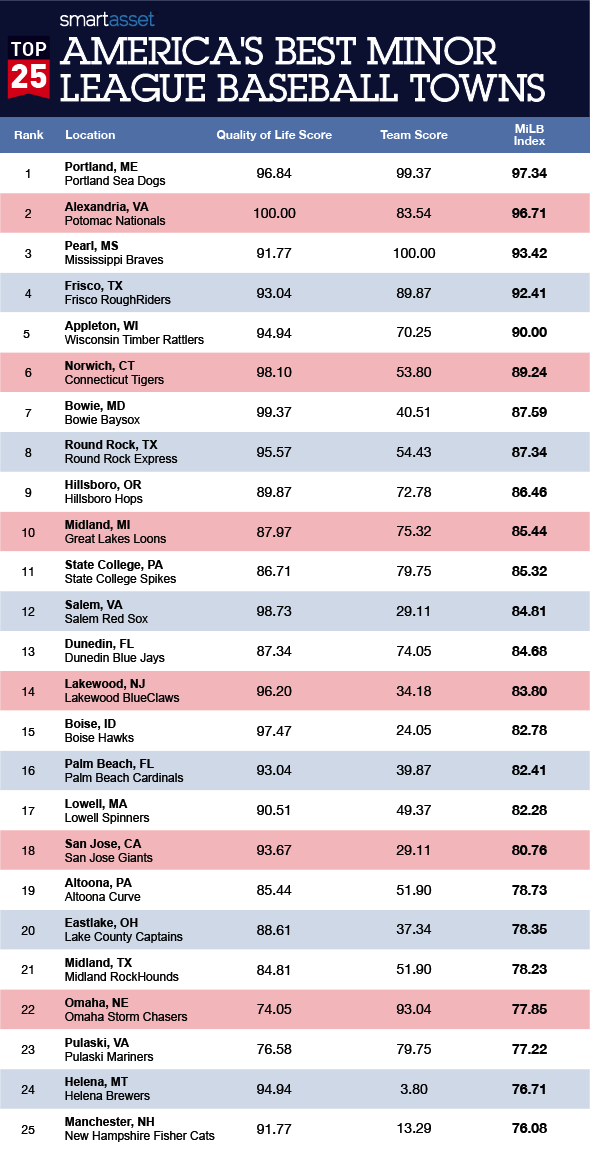
The analysis considered five “quality of life” factors in determining the top 25 baseball cities.  The factors were:

  • Violent Crime per 100,000 Residents
  • Property Crime per 100,000 Residents
  • Disposable Income – The difference between average income and the average monthly rent for a two bedroom apartment.
  • Unemployment Rate
  • Dining & Entertainment Establishments per 100,000 Residents

As a secondary consideration, the analysis sought to determine which cities enjoyed the best baseball experience, dubbed the “team” score. Three factors were considered:

  • Team Win Percentage – During the 2014 regular season.
  • Stadium Experience – A ranking of every minor league ballpark, courtesy of StadiumJourney.com, which attended a game at every single minor league stadium.
  • Minor League Class – A measure from 0-50 based on the level of competition: Triple-A teams receive a 0, Double-A teams a 10, Class A Advanced a 20, and so on.

To determine America’s Best Minor League Baseball Towns, the Quality of Life Score and the Team Score were added, giving 80% weight to the former and 20% to the latter, according to the website.

Ranked at #6, the Connecticut Tigers had their best season on the field in 2014, setting a franchise record for wins and clinching a sTigerspot in the postseason for the first time in their five year franchise history.  The franchise plays home games at Dodd Stadium in Norwich.  The facility celebrated its 20th year in 2014.

Of Norwich, the website noted that “The Rose of New England sits at the confluence of three rivers in Connecticut’s serene southeast corner,” and “had the third highest concentration of (restaurant and entertainment) attractions of any Minor League town.”

Ranked #25, the New Hampshire Fisher Cats are owned by Art Solomon, father of New Britain Rock Cats owner Josh Solomon.  The Rock Cats will be moving to Hartford from New Britain for the 2016 season, with groundbreaking on their new stadium in Hartford slated for later this month. The Colorado Rockies signed a two-year player development contract with the Rock Cats last fall, after the Minnesota Twins ended a two-decade affiliation agreemDoddent.
No state had more than three top 25 towns, and 19 different states had at least one. Texas and Virginia were the leading Minor League Baseball states, with three towns each in the top 25.  SmartAsset is a financial technology company that provides data and advice related to personal finance decisions.

 

newhartford_sept3Artists conception of planned baseball stadium in Hartford.

Malls Appeal to High-End Customers to Survive as Some Anchor Stores, Chain Retailers Close

Macy's announcement last month that it will close 14 stores across the nation will strip one of the nation's first suburban malls, opened in Michigan in 1954, of its final anchor tenant.  The Northland Center has been losing tenants for years and went into receivership last fall. The mall's occupancy is currently under 50 percent. Macy’s announcement came a day after JCPenney said it will close 39 stores across the country.  None of the latest round of closings are slated for Connecticut. Malls without anchor tenants are malls on life support – and even while some malls continue to flourish around the country and in Connecticut, others are fading away.  Outside of Schenectady, the Rotterdam Square mall will lose their Macy’s anchor, and already has empty corridors and large volume of empty spaces” according to a recent published report.  At least 16 storefronts are vacant, and three more have announced they’ll be departing.  Last year, among the malls that were demolished was the Woodville Mall just outside of Toledo, which opened in 1969. 

Since 2010, more than two dozen enclosed shopping malls have been shut, according to a report in The New York Times, which noted that “an additional 60 are on the brink,” according to Green Street Advisors, which tracks the mall industry.

As some malls fade from view, others build strength.  The news report indicates that “with income inequality continuing to widen, high-end malls are thriving,” while malls dependent on anchors stores such as “Sears, Kmart, and JC Penney falter.”

Malls with stores that appeal to the top 5 to 10 percent of the income scale are thriving, according to The Capital Times, a Wisconsin news site. “Contrary to popular belief, it isn't Internet shopping that's doing the most harm. Rather, it's been a tremendous buildup of more retail outlets and the failure of working-class wages to keep up with the rest of the economy.”

About 80 percent of the country’s 1,200 malls are considered healthy today, compared with about 94 percent in 2006, according to CoStar Group, a provider of data for the real estate industry, The Times reported.

The Fairfield County Business Journal reported this month that The Saks name is slated to return to the Stamford Town Center after a Saks Fifth Avenue store, a longtime tenant in the mall, closed last year.  Saks Fifth Avenue Off 5th, the fashion discount retail chain of Toronto-based Hudson’s Bay Co., plans to open in June.

Abercrombie & Fitch is closing its Hollister Co. store in the Westfield Meriden mall this month as part of a nationwide 60-store closure plan involving both the Hollister and Abercrombie & Fitch brands, a company spokesman told the Meriden Record-Journal.  A year ago, JC Penney announced plans to close about 33 stores — including its store at Westfield Meriden Mall.

Department stores, especially those that long have catered to middle-class customers, are feeling the pinch from online and discount sellers and are paring down stores, too, the Baltimore Sun reported this month. Sears said late last year that it was closing about 235 underperforming stores, the majority of which are Kmarts, the paper reported.

In the Hartford area, the region’s two major malls, Westfarms and The Shoppes at Buckland Hills, have gradually altered their retail mix in recent years, reflecting the nationwide upscaling trend, and continue to add tenants and demonstrate strength.

Andrew Sufian, General Manager of The Shoppes at Buckland Hills, emphasized that they “continually evaluate the evolving needs of the market, monitor trends and listen to our shoppers to provide the best in retail, dining and entertainment.”

He cited the recent opening of a new 26,000-square-foot Dave & Busters, expansion of H&M and “new dining experience, Maggie McFly’s, as among our most recent examples of the sought-after stores/experiences Buckland Hills brings to the community.  These additions complement our strong existing retail line-up, including Macy’s, Dick’s Sporting Goods, Forever 21, Victoria’s Secret, Barnes & Noble and many more.”

Sufian added that Buckland Hills is “a strong, viable shopping center” in constant conversations with retailers “to continue to keep our customers happy and coming back.”

Frontier CEO Is Half of Only “Sister Act” Among Fortune 1000; Company Opening Retail Stores

Until last year, most Connecticut residents were unfamiliar with Frontier Communications, even though the telecommunications company has operations in 28 states across the nation.  When the company purchased much of AT&T’s local operations in Connecticut in a $2 billion deal, they suddenly became a dominant player for residential and businesses customers in their home state.  But Frontier, despite its shaky hand-off from AT&T, was, and is, no small player on the national scene. On the latest list of the Fortune 1000 companies, Frontier ranks at #514.  They have hovered just above or below #500 in recent years.  The company is led by one of only 52 female CEO’s on the list, Maggie Wilderotter.  In fact, Wilderotter is half of the only sister act among the 52 – her sister is Campbell’s Soup CEO Denise Morrison, leading one of the nation’s best known brands, #315 on the Fortune 500.Frontier-logo-red

Wilderotter has served as Chief Executive Officer at Frontier since November 2004 and as Chairman of the Board since December 2005. She also served as President until April 2012.  The July/August 2013 issue of Chief Executive magazine described her as the “longest-tenured woman CEO of a Fortune 500 company.”

Sister-CEOs-480x320Denise Morrison, the subject of the lead business story in the February 2, 2015 issue of TIME magazine, has led Campbell’s since 2011.  The magazine described family dinners when Denise, Maggie and their two younger sisters were growing up, that included discussions led by their father, an executive with AT&T, in which “he taught basic business skills through childhood activities like negotiating over chores and identifying the target market when selling Girl Scout cookies.”  He “thought it was important to prepare his daughters for a business world that was growing more open to women,” the magazine reported.
The lessons were well learned.  According to Catalyst, which tracks the number of women in corporate America, women currently hold 4.8 percent of Fortune 500 CEO positions and 5.2 percent of Fortune 1000 CEO positions.  Wilderotter told TIME:  “We grew up in an environment where we would get the highest level of satisfaction from doing things people never expected us to pull off.”

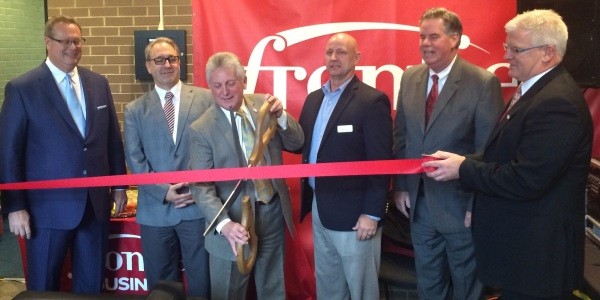
Even as Frontier finds its footing among Connecticut consumers, the company’s has begun to roll out a retail store presence.  Frontier opened its second retail outlet in Connecticut, in Norwalk, last month.  The location at 2 Washington Street joins one in New London, at 200 State Street.  The company is actively pursuing plans to add two more retail stores in Connecticut by April.  Primarily geared toward residential customers, the stores are also expected to sell business products later this year.  Frontier currently has retail stores in 23 states.F09_Frontier_bf-e1418658074267-600x300

The CEO sisters, 13 months apart in age, “talk passionately about supporting women in the boardroom and the lessons they learnt from their parents which enabled them to be self-confident and have the belief that anything was possible coupled with a focus that getting a good education would give them the freedom and flexibility to do anything they wanted,” reported the business website Footdown in 2012.


http://youtu.be/nmcHRQ3y8LM

Immigration Drives Growth, Vibrancy of New Haven Region, Study Finds

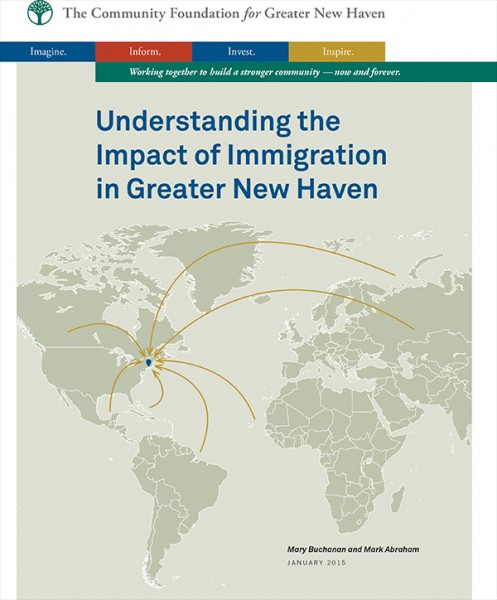
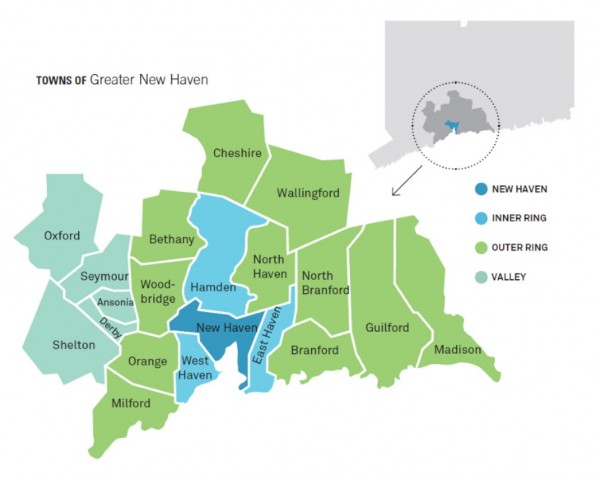
If Greater New Haven is thriving, the region’s rapidly-growing immigrant population is a key reason, according to a new research study. The report, entitled Understanding the Impact of Immigration in Greater New Haven, compiles data from federal, state and local government agencies, as well as information generated locally by DataHaven and The Community Foundation of Greater New Haven. Viewed as “an important step in its effort to enhance the civic and economic participation of immigrants in Greater New Haven,” the report was undertaken to provide a snapshot of the immigrants living in Greater New Haven and Connecticut, the impact of local population change and diversity, and the community and economic impact. It is intended to help the general public, policymakers and local leaders understand the impact of immigration in the region to inform discussions and community action.UIGNH_cover_600

According to the report:

  • Approximately 1 in 8 residents of Greater New Haven is foreign-born, originating in countries in all the world’s regions.
  • While the native-born population in Greater New Haven has barely increased since 2000, immigrants settling in the area have caused rapid population growth, making New Haven the fastest-growing city in Connecticut over this period
  • About half of all immigrants are naturalized US citizens; the other half are legal permanent residents, legal temporary residents or undocumented immigrants.
  • Greater New Haven is attracting immigrants from a wide range of countries, with the greatest increases in numerical terms between 2000-2012 attributable to immigration from Mexico (3,168), India (2,729), China (2,292), Jamaica (1,532) and Ecuador (1,382).This report explores how immigration impacts the development of both Greater New Haven and Connecticut.

“It is clear from the report that the Greater New Haven community is enhanced in many ways by immigration,” says William W. Ginsberg, President & CEO of The Community Foundation for Greater New Haven. “The data demonstrate that our rapidly growing foreign-born population is successfully building productive and contributing lives here – by working, by creating small businesses that build wealth, by owning homes, by educating their children, and by contributing to the diversity and cultural richness of this community.”foreign born population

The report also cites data indicating that the immigrant population in Greater New Haven is highly-skilled, compared to other areas. Among immigrants in this region, there are more than twice as many high-skilled workers as low-skilled workers in the region, while data for the United States as a whole show slightly less than one high-skilled worker for every low-skilled worker.

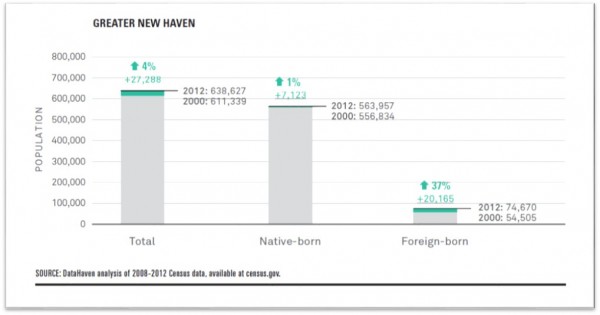
From 2000 to 2012, Greater New Haven’s population as a whole increased by more than 27,000 people, according to the report. Of that growth, about 75 percent (20,165) were foreign-born residents. About half of immigrants in Greater New Haven are naturalized citizens.

The Community Foundation for Greater New Haven explored local public opinion on immigration by interviewing key stakeholders and administering an online survey to its constituents. The survey found that “although immigration is a complex issue, the Greater New Haven community widely agrees that foreign-born people contribute to the economic, cultural, and social well-being of the region.”  Nearly all (97 percent) respondents said that the issue of immigration is very or somewhat important to Connecticut.  Only 31 percent of respondents thought they understood immigration policy extremely or fairly well.

pop growthIn New Haven’s neighborhoods in particular, the boost in immigrants has revitalized communities and spurred new businesses.  From 1970 to 1990, the foreign-born population in most New Haven neighborhoods remained flat or declined, and these neighborhoods suffered from overall population decline—similar to other central city neighborhoods in post-industrial cities. Since 1990, the report found, the foreign-born population in many city neighborhoods has rebounded sharply, particularly in areas such as Edgewood, West River, Fair Haven, and the Hill. These areas have seen a large influx of population and business overall.new haven map
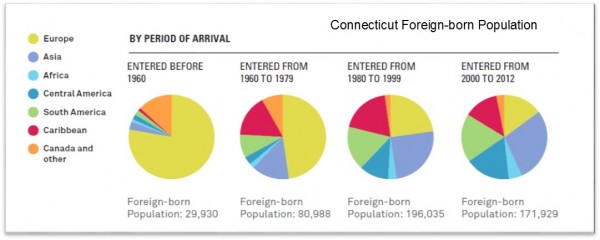
Statewide, among Connecticut’s immigrant population entering the US since 2000, only 15 percent are Europeans. 29 percent were born in Asia, and 19 percent come from South America. By contrast, 78 percent of Connecticut’s immigrant population that entered the US before 1960 was born in Europe.

The report was compiled and written by Mary Buchanan and Mark Abraham of DataHaven, with assistance from staff at The Community Foundation.

In 2015, The Community Foundation’s work will include dedicated grantmaking and other support for nonprofits working in this area, including support for advocacy efforts on State and Federal immigration policy, efforts to identify and support emerging leaders in the immigrant community, and public education and other efforts to enhance the community’s understanding of the social, cultural and economic benefits of immigration for Greater New Haven.

“New Haven has always been a welcoming community, and the surge of immigration in recent years shows us yet again how important immigration is to the growth and success of our community,” Ginsberg added.The Community Foundation is making immigrant integration a strategic focus with the goal that immigrants in Greater New Haven, including undocumented, will achieve greater civic and economic participation and success thereby becoming more fully integrated members of a more welcoming community, the report indicates.

More information on the Foundation’s philanthropy is available at www.giveGreater.org. The report is available online at www.cfgnh.org/immigrationreport  or by calling The Community Foundation at 203-777-2386.

Two Sons of CT Use State University Program to Drive Local TV Meteorology Careers

Among the meteorologists reporting on the Blizzard of 2015 on Connecticut's local television stations are Dan Amarante and Sam Kantrow, who began their careers as student meteorologists-in-training at Western Connecticut State University and now can be seen on FOX Connecticut and NewsChannel 8.  Amarante has lived in Connecticut his entire life, growing up in Cheshire, and graduated from Western Connecticut State University with a Bachelor of Science in Meteorology. While at WCSU, he produced and anchored many school run weather broadcasts for the University’s website, as well as forecasts for the school’s radio station.dan amarante Western Connecticut State University has the state's only meteorology program, which was run for many years by WTNH-TV meteorologist Dr. Mel Goldstein.  The WCSU website is chock full of charts and maps highlighting the latest conditions.The site includes the latest  Geostationary Satellite Images from the Space Science and Engineering Center at the University of Wisconsin and the National Weather Service radar mosaic Northeast Sector loop.  Greater detail is offered in Surface Charts from the National Weather Service and a series of Upper Air charts courtesy of Unisys Weather.  The school has a Weather Center, where students produce forecasts and work with clients while studying meteorology.
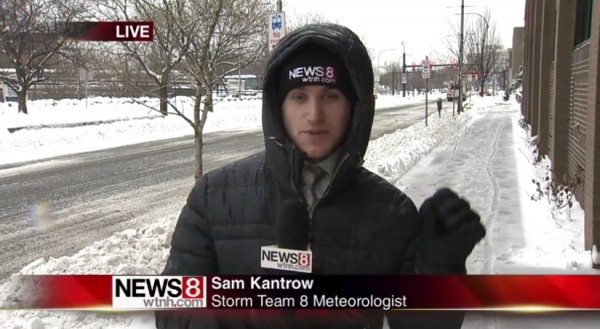
After college, Amarante got his start at WGGB ABC40/FOX6 in Springfield, MA, where he was the weekend weather anchor.  He is a Certified Broadcast Meteorologist, the highest certification from the American Meteorology Society.sam kantrow

Meteorologist Kantrow joined "Storm Team 8" on WTNH in February, 2011, first as weather producer and web meteorologist, and is now the on-air meteorologist for the weekend editions of Good Morning Connecticut.  Born and raised in Hamden, he is a graduate of WCSU and has a B.S. in Operational Meteorology and Weathercasting. Before coming to News 8, Kantrow interned at NBC Connecticut.  The WTNH website reports that "Sam’s weather interest began at a very young age, when the tornado that went through Hamden on July 10, 1989 narrowly missed his house! Ever since then, he has loved the weather, and anything about the weather. Sam grew up watching the meteorologists on News 8 and always wondered what it would be like to be in their shoes."

WCSU's Bachelor of Science in Meteorology is the only such program in Connecticut, and one of only a few in the Northeast. The university  has developed a foundation of courses in mathematics, computer science, physics, astronomy and earth science, combined with meteorology, to prepare you for television and radio weathercasting, operational forecasting, or for teaching or research in the atmospheric sciencesmap.  Students in the bachelor's program  earn credits while performing TV/radio weathercasts or doing real-time forecasting for clients in the university's on-campus Weather Center, according to the WCSU website.
The program meets recommendations for an undergraduate meteorology degree program from the American Meteorological Society.  Additionally, students graduating with this B.S. Meteorology degree will have all the course requirements for entry level positions as a meteorologist with the National Weather Service, the single largest employer of meteorologists in the country.wcsustackedBLK

The university also offers a graduate program - a Master of Arts in Earth and Planetary Science, Meteorology/Climatology Option.

Last October, WCSU hosted the 5th Annual Tri-State Weather Conference on campus in Danbury, presented by the university's Meteorology Program  and co-sponsored by the WestConn Student Chapter of the AMS, the New York City/Long Island Chapter of the AMS, NOAA/National Weather Service/Upton, N.Y and NOAA/National Weather Service/Taunton, MA.  The purpose of the conference was to enhance education, professional development and communication among private and public sector meteorologists, researchers, educators, students, emergency management officials, and weather enthusiasts.  Amarante, who joined FOX Connecticut in early 2011, was master of ceremonies for the conference at his alma mater.

The meteorology program at Western also includes among its graduates television meteorologists in a number of cities across the country. In addition to his work in Connecticut, Amarante has filled in as a weather producer at CBS 2 in New York City, and became snowed in at the station during the Blizzard of 2010.  Kantrow, who will be on-air reporting on the Blizzard of 2015 beginning at 3 AM on Tuesday, may find himself in similar circumstances, if forecasts for the day's snowfall come to fruition.

Connecticut Ranks #2 in Millionaires; New Jersey Drops to #3

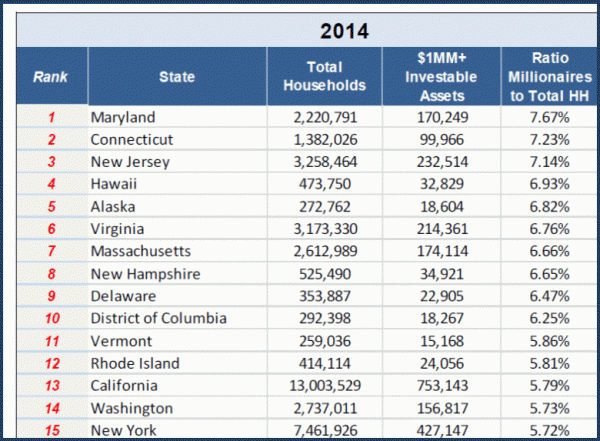
Which state has 99,965 millionaires?  Connecticut.  How many states have a greater percentage of millionaires, based on population?  Only one. Connecticut is ranked at #2 among the states in an analysis of the number of millionaires, as a percentage of population, developed by Phoenix Marketing International.  Only Maryland has a higher percentage – and Connecticut moved up one notch this year, surpassing New Jersey, which was ranked second a year ago.

Perhaps surprisingly, it’s not all about Fairfield County.  David Thompson, Managing Director of the Phoenix Global Wealth Monitor and the lead researcher, points out that the data shows “pockets of wealth” throughout the state – in the Bridgeport-Norwalk-Stamford corridor, but also in Litchfield County, Hartford-West Hartford, and Norwich-New London.  In fact, only California has more metropolitan areas in the nation’s top 30 for millionaires per capita.top states

And while some have suggested that Connecticut’s tax structure and economy are pushing people to exit the state, millionaires seem to be quite comfortable here.  The total number of millionaires dropped slightly during the past year from 100,754 to 99,965, a loss of 789 millionaires.  New Jersey lost more individuals with investable assets over a million dollars as a percentage of population, dropping behind Connecticut.  New Jersey's total number fell from 242,647 to 232,514, a loss of more than 10,000 millionaires during 2014 (from 7.49 percent to 7.14 percent of the state's population).

“Connecticut holds on to its wealthy population.  There’s no downward trend (compared with other states),” Thompson notes.  “The tax structure isn’t so onerous, the state offers stability, and attracts industries that grow wealth.”  Thompson, a Connecticut resident, adds that the quality of life in the state, as well as its accessibility to New York and Boston also prove attractive.

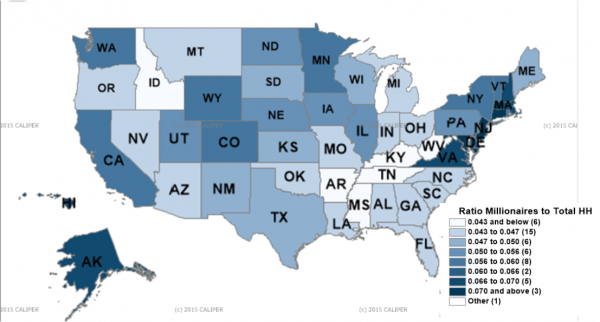
Maryland has 170,248 millionaires, a ratio of 7.67 to total households.  Connecticut ranks #2, with 99,965 and a ratio of 7.23, followed by New Jersey with a ratio of 7.14 and 232,514 millionaires.  Connecticut has consistently been a top five state, placing third  in 2013, fourth in 2012, 2011 and 2010.

Among the key findings for 2014:millionaire_1890954b

  • Maryland held strong in the first position for its fourth year in a row
  • On the strength of its oil boom, North Dakota continued its meteoric rise in the millionaire rankings, moving up to number 20 in 2014. Its neighbor, South Dakota, however, was the biggest gainer this year, rising twelve points to number 26
  • The top ten states remained the same, with only slight shifts: New Jersey #3 (down one point), Hawaii, Alaska, Virginia (up one point), Massachusetts (down one point), New Hampshire, Delaware and the District of Columbia.

Besides Maryland, the top ten states remained the same, with slight shifts: Connecticut rose one notch to hold the #2 spot, followed by New Jersey (down one spot), Hawaii, Alaska, Virginia (up one position), Massachusetts (down one slot), New Hampshire, Delaware and the District of Columbia.

“The amazing rise of North Dakota in the millionaires rankings clearly demonstrates the power of an industry to quickly create wealth,” Thompson said.  But he indicated that “new industries may not be a sustainable economy,” and cited the nation’s large population centers, including those along the east coast, as more likely to retain their positions as most attractive to wealthy individuals.

There were a few notable declines in the rankings: Louisiana dropped 6 positions to number 38, Texas dropped 5 slots to number 27, erasing gains it made last year; and Georgia lost another 5 places this year for the second year in a row, falling to number 40.

Smallest percentage of millionaires?  Mississippi, Idaho, Arkansas, Kentucky, Tennessee and West Virginia.

The PMI Global Wealth Monitor (GWM) provides ongoing intelligence on the attitudes, behaviors and needs of affluent and High Net Worth consumers to leading organizations in the U.S., Canada, and Europe.

millionaires map

Year of Volleyball Underway; First Tournament in the Books

More than 2,000 female volleyball players from across the Northeast spent the holiday weekend in Hartford for the New England Region Volleyball Association’s 2015 Mizuno New England Winterfest Volleyball Tournament, held at the Connecticut Convention Center.  The event, which started in Hartford six years ago, has steadily grown in popularity, and will be returning for at least the next two years. Tournament organizers, the Connecticut Convention & Sports Bureau (CTCSB), and the Connecticut Convention Bureau said the three-day event brought in close to 10,000 visitors over the long weekend including approximately 2,000 players, 250 coaches, 100 officials and volunteer tournament staff, and thousands of family members and fans – and tremendous enthusiasm.25

There were 25 volleyball courts arrayed on the Convention Center floor, with 12 matches per court every day, simultaneously, each lasting no more than one hour.  Five years ago, the tournament was launched with 18 courts in continuous operation.

“The Mizuno New England Winterfest is designed to showcase female volleyball players – ages 12 to 18 – to college coaches and recruiters from throughout the Northeast,” explains Tournament Chair Alex Temkin. “The Northeast has one of the largest concentrations of Collegiate Division II and Division III schools in the country, and there are many Division I schools here as well.”

“We are excited to welcome back this successful tournament, one that is projected to generate over $3.3 million in revenue for the Greater Hartford region,” said H. Scott Phelps, Interim President of the Connecticut Convention & Sports Bureau (CTCSB), prior to the tournament. Phelps reports an estimated 885 jobs in the hospitality industry will be supported by this tournament, and $270,500 in Connecticut Sales Tax will be generated.sign

Where's UConn?

”Having more than 800 matches in a single location encourages college recruitment decision-makers to come and scout as many players as possible.” Temkin said.  On Friday evening, a College Showcase was held to showcase athletes for college coaches and recruiters, as well as a College Recruiting Seminar for parents of volleyball players.

Approximately 38 colleges had coaches on hand, watching the talent.  Surprisingly absent:  the University of Connecticut.  Among the coaches on hand from local colleges were representatives of University of Hartford, University of Saint Joseph, and Sacred Heart University.  By Saturday morning, a number of institutions with volleyball teams still had materials on hand touting their programs, aimed at prospective college applicants.  None of the material was from a Connecticut school.

Temkin notes that volleyball teams’ interest in registration for Winterfest was so great this year – 25 percent more than in 2014 – that organizers established a smaller, independent volleyball tournament called the “Husky Sweet 16” to accommodate the additional athletes. That competition was held at a facility in Windsor.

More in May

There’s more volleyball to come later this year at the Connecticut Convention Center.  Building on the success of the Winterfest tournament, the New England Region Volleyball Association (NERVA) will bring its first-ever Northeast Junior Championships to Hartford over Memorial Day weekend.

The tournament, featuring junior girls and boys teams from throughout the Northeast, is expected to bring nearly 200 teams, more than 2,000 players, 400 coaches, 75 officials and volunteer tournament staff, and 3,500 family members and fans downtown, from Friday, May 22 through Monday, May 25, 2015. volleyballs

NERVA has committed to holding the event at the venue for the next three years, through at least 2017, with over 3,000 overnight rooms and 1,100 rooms anticipated for the new annual event.

“We have always valued our partnership with the Connecticut Convention Center and the Connecticut Convention and Sports Bureau,” states David Peixoto, NERVA Commissioner. “Our partnership has grown to develop Winterfest as the premier volleyball tournament in the Northeast. We look forward to making the Northeast Junior Championship just as successful.”

The new four-day event does not require teams to qualify to participate. While it will serve as a season-ending tournament for some, the event will allow for additional preparation to teams continuing on to nationals. Participants are 12-18 years old, as NERVA follows USA Volleyball age guidelines.

“Downtown Hartford is a great location for our sports event and the city and region really make our players and fans feel welcome,” added Temkin. “Restaurants extend their hours and customize the menus, the Dash shuttle bus that circulates Downtown adds hours of operation, and everyone does their best to accommodate our group.”

The New England Region is one of many Regions in the United States that aid in the governing of the sport of volleyball. Regional Volleyball Associations (RVAs) are member organizations of USA Volleyball (USAV). The RVAs serve as the grassroots function for the USAV and individually and collectively serve as a catalyst for USAV functions.

Volleyball footnote:  While many know that the sport of  basketball was invented in Springfield, MA; fewer are aware that volleyball was also invented in nearby Massachusetts, in Holyoke.  That’s where the National Volleyball Hall of Fame is located.

2013-CTCC-NERVA-Winterfest-300x200


CT Ranked #41 in Climate for Small Business and Entrepreneurship

Connecticut ranks #41 in its policy environment for small businesses and entrepreneurship, according to a study that ranked the 50 states in a Small Business Policy Index.  Most of the New England states landed towards the bottom of the list, with none ranking in the top 25. The report, Small Business Policy Index 2014: Ranking the States on Policy Measures and Costs Impacting Small Business and Entrepreneurship, tracks 42 measures with 33 of them pertaining to taxes and regulations. SBE report coverIssued by the Small Business & Entrepreneurship Council, the index ranks the 50 states according to 42 different policy measures, including a wide array of tax, regulatory and government spending measurements. The index, which has been published annually for 19 years, continues to point to South Dakota as the most entrepreneurial-friendly state in the U.S., benefiting most from the lack of individual income tax, capital gains tax, corporate income tax and inheritance tax.


The top 10 states are South Dakota, Nevada, Texas, Wyoming, Florida, Washington, Alabama, Indiana, Colorado and North Dakota.  Among the New England states, the highest ranked was New Hampshire at #27, followed by Massachusetts at #31, Rhode Island at #40, Connecticut at #41, Maine at #42 and Vermont at #45.

Commenting on Connecticut, the report indicates that “Connecticut’s entrepreneurs, businesses, investors and workers benefit from a low crime rate and low consumption-based taxes. However, the state’s negatives are numerous, including high personal income, individual capital gains, corporate income, corporate capital gains, property, gas and diesel taxes, along with high levels of government spending and debt.”

Connecticut’s ranking was unchanged from last year’s Index report.  In 2012 the state ranked #42 and in 2011 was ranked at #44.  In 2010, Connecticut ranked at #41, which was a drop from #40 in 2009.

“States like Arizona, Indiana, Kansas, New Mexico, North Carolina, North Dakota, and Ohio have really stepped up their game on the policy front. In each of these cases, tax reform and relief were undertaken, which reduces the costs of risk taking and doing business. Meanwhile, top-tier policy states like Texas, Nevada, South Dakota, Florida and Wyoming continue to leverage their long-standing policy advantage, and are doing things to get better,” said SBE Council President and CEO Karen Kerrigan.sbelogo

Of the 42 measures included in the recently issued 2014 edition of the Index, 24 are taxes or tax related, 9 relate to regulations, five deal with government spending and debt issues, with the rest gauging the effectiveness of various important government undertakings, according to the report. The lowest ranked states were New York, New Jersey and California.

The report states that “most business owners understand the array of costs and burdens imposed by government. Taxes and regulations, for example, drain enterprises of vital resources, distort decision-making, and redirect resources and energies away from maintaining, improving and/or expanding a business.”

In the individual measures, among Connecticut’s highest rankings were #7 in crime rate, #10 “State and Local Sales, Gross Receipts and Excise Taxes as a Share of Personal Income,” #13 in the rankings of “Adjusted Unemployment Taxes,” and #17 in workers compensation costs.

The Small Business and Entrepreneurship Council (SBE Council) is a 501c(4) advocacy, research, education and networking organization dedicated to protecting small business and promoting entrepreneurship.  SBE Council works to educate elected officials, policymakers, business leaders and the public about key policies that enable business start-up and growth. The report, issued in December, was authored by Raymond J. Keating, chief economist for the Small Business & Entrepreneurship Council.

small bus map


Plans Unfold for National Museum Store Conference in Hartford in April

If you’ve ever made a purchase at a museum store and wondered about how the merchandise was selected or the store operates, there will be no shortage of experts from the industry in Hartford this spring.  The 60th Annual Museum Store Association Retail Conference & Expo will be held April 17-20, 2015 at the Connecticut Convention Center. The event is the only conference and expo specifically created for retailers at museums, historic sites, botanic gardens, aquariums, zoos, libraries and more. The 2015 MSA Retail Conference & Expo is designed to help nonprofit retail professionals by providing four days of education sessions featuring industry experts and opportunities to connect with vendors who offer products matched with the museum store industry.museum

It will be the first time the national conference will be in Hartford.  In recent years the host cities were Houston, Los Angeles, New Orleans and Chicago.  The national meeting in Hartford will include a “retail boot camp” and a tour of the Mark Twain House and Harriet Beecher Stowe House.

The MSA website points out that “learning sessions are presented by the leading thinkers in nonprofit retailing who share the knowledge you need to run your store, meet the needs of management, make the most out of challenges, be a leader and through retailing contribute to your institution’s brand and extend the experience of your visitors.”Balancing-Act-600x175-indd.jpg

Manager of the Museum Shop at the Wadsworth Atheneum Museum of Art, immediate past MSA Board President Stacey Stachow, said when Hartford was selected to host the conference, “Connecticut has so much to offer with its rich cultural history, so many museums and things to do that relate to our members.”   In addition to the Wadsworth Atheneum, other MSA member institutions in the area include the Connecticut Historical Society Museum & Library, Harriet Beecher Stowe House, New Britain Museum of American Art and Friends of Dinosaur State Park and Arboretum.

The opening keynote speaker will be Roderick Buchanan, director of buying and retail at the British Museum Company.  The closing keynote speaker will be Dick Durrance, an award-winning National Geographic photographer and U.S. Army combat photographer during the Vietnam War. MSA-Logo_sm

Among the industry issues that will be discussed is fair trade, which will be the focus of a panel discussion.  The conference website points out that “as consumers are increasingly interested in the origin of the goods they purchase, the fair trade movement is gaining momentum and is affecting buying in the museum store world. Expert panelists will offer insights into critical aspects of the fair trade industry, including who benefits from fair trade, why retailers should buy fair trade, and questions that should be asked about business practices in order to ensure that products are indeed fair trade.”

Other sessions include presentations on pop-up shops, museum store launches, visual merchandizing, ecommerce, the influence of various cultures, and the importance of museum stores in the overall experience of museum visitors.

The four-day event is expected to bring in 900 participants downtown utilizing an estimated 1,130 room nights, according to organizers. There will be 21 educational sessions, and more than 200 vendors on hand.  Approximately 800 institutions are part of MSA with more than 1200 individual members representing those institutions.

Stores in cultural institutions are different from typical retail operations in several ways, the organization points out. “These retail operations play a vital role in supporting the institution’s educational mission. They offer products that provide visitors with mementos and educational materials directly related to their cultural experience.’  Purchases made at museum stores provide important financial support for the institution, officials emphasize.

FCC “Enforcement Hold” of WTIC-AM License Renewal Continues in New Year

The license renewal application of WTIC-AM, filed more than a year ago, remains on “enforcement hold” at the Federal Communications Commission, as the agency’s Enforcement Bureau continues to consider “an alleged violation of FCC rules,” according to an FCC official. Until the enforcement hold is lifted, the agency’s Media Bureau cannot proceed with a decision on whether or not to renew the station’s broadcast license.  The Enforcement Bureau must first determine whether or not a violation of FCC rules has occurred.  If the allegation is substantiated, the agency has a range of options, such as warning that the violation not be repeated or imposing a monetary fine on the station, officials said. FCC

WTIC-AM, which is licensed to Hartford but operates from studios in Farmington, can continue broadcasting under the broadcast license that expired nine months ago, on April 1, 2014, until the FCC acts on its renewal application.  The renewal application was filed by the station more than a year ago, on November 27, 2013. Stations must file an application for license renewal) four months prior to the expiration date of the station's license.

Precisely what the allegation under review involves is not made known to the public, officials reiterated this week.  That information is only made available to the licensee or their attorney, according to an FCC official. The agency can, and often does, communicate with the station as part of their review process.  WTICWTIC_1080_AM_Radio_logo has declined to comment on the ongoing review process at the FCC.

Officials say it is not unusual for a license renewal to be on enforcement hold for an extended period of time.  Stations in such a status routinely continue to operate without any interruption until a decision on license renewal is made.

When the license renewal application does reach the agency’s Media Bureau, they will consider “how the allegation of violation was resolved,” as well as a range of other factors in deciding whether or not to renew the station’s license.

The other, more routine, factors include whether any other objections have been raised about the station, whether the station has been adequately serving the public in their area of license, their history of compliance with FCC regulations, and their overall performance.  License renewals for radio stations are issued by the FCC for a period of eight years.

Connecticut by the Numbers first reported the FCC’s enforcement hold last September.  Subsequently, Hartford Attorney Ken Krayeske filed an informal objection on October 1, 2014 to WTIC’s broadcast license renewal, alleging that the station “demonstrated serious malfeasance” and “helped conceal violations of federal law,” related to Rowland’s use of his radio program to promote the Congressional campaign of Lisa Wilson-Foley. Krayeske had filed a previous complaint in 2012 that did not result in FCC action against the station.