Connecticut Ranks #18 in Payroll to Population Ratio, Analysis Shows

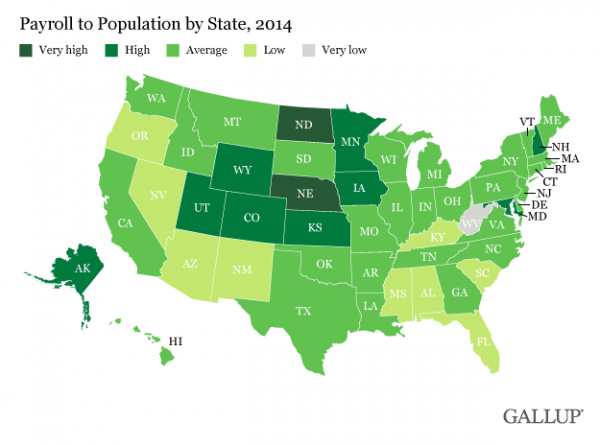
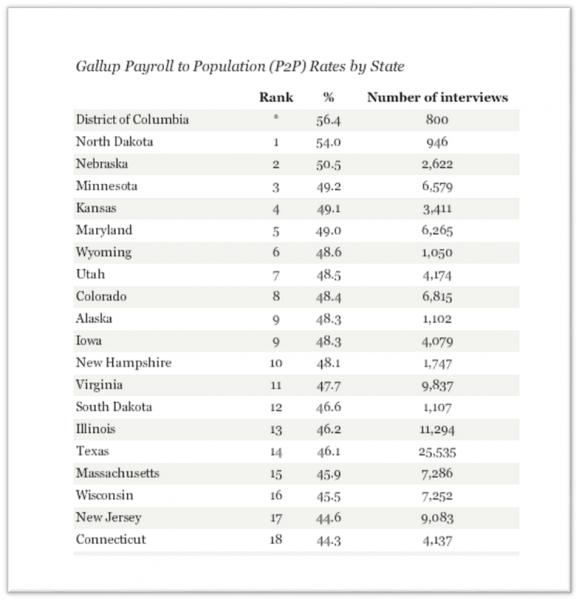
Connecticut ranks #18 in the nation in a measure of Payroll to Population (P2P), based on an analysis of the nation’s 50 states by the Gallup organization. The P2P metric tracks the percentage of the adult population aged 18 and older who are employed full-time for an employer, for at least 30 hours per week.  The rankings cover calendar year 2014. North Dakota (54 percent) had the nation’s highest Payroll to Population employment rate. A cluster of states in the northern Great Plains and Rocky Mountain regions -- including Nebraska, Minnesota, Kansas, Wyoming, Utah, Colorado and Iowa -- all made the top 10 on this measure, according to Gallup. West Virginia (35.6 percent) had the lowest P2P rate of all the states for the second consecutive year.

Connecticut was tied with Vermont with a P2P level of 44.3 percent.  Among the New England states, Connecticut and Vermont ranked in the middle, with New Hampshire ranked at #10, Massachusetts at #15, Maine at #22, and Rhode Island at #34.mpa

The year-long results are based on Gallup daily tracking interviews throughout 2014 with 353,736 U.S. adults. The payroll-employed data does not include adults who are self-employed, work fewer than 30 hours per week, who are unemployed, or are out of the workforce.

The differences in P2P rates across states may reflect several factors, Gallup points out, including the overall employment situation and the population's demographic composition. States with large older and retired populations, for example, can be expected to have a lower percentage of adults working full time. Connecticut has the 7th oldest population in the nation, which may influence the state’s overall ranking. The two states with the lowest P2P in 2014, West Virginia and Florida, have two of the largest proportions of residents aged 65 and older, at 17.3 percent and 16.9 percent, respectively.

Regardless of the underlying reasogallupn, Gallup indicates that the P2P rate provides “a good reflection of a state's economic vitality.”  Gallup also notes that P2P shows a stronger relationship than do unemployment rates with other important economic indicators, such as state GDP per capita.

In the overall rankings, Washington, D.C., had the highest P2P rate of any area in the country, at 56.4 percent, but Gallup points out that “it is unique in being the only entirely urban region in the survey, heavily dominated by the presence of the federal government, and with one of the lowest percentages of residents aged 65 and older (12.3 percent).”


Hospital Outreach Program, New Website and Video Advance Mission of The Hole in the Wall Gang Camp

The Hole in the Wall Gang Camp in Ashford, Connecticut began in 1988 as a way for seriously ill children, including those with cancer, to “raise a little hell,” as founder Paul Newman described it – a time and place when kids could simply be kids, without being self-conscious about their ongoing medical needs.  Twenty-seven years later, it is much more than a summer camp, offering a robust range of programs year round, in Connecticut and beyond. To tell that story, and increase public awareness of the array of programs available to children with acute medical needs, the Camp has launched a newly redesigned website (www.holeinthewallgangcamp.org) that eases navigation through the various program offerings, and produced a new video that highlights the range of activities and impact.hole web

Among the programs highlighted is the less widely known Hospital Outreach Program (HOP), one of a number of programs that have blossomed in recent years to extend the mission and impact of The Hole in the Wall Gang Camp into communities to reach more children.

Through one-on-one interactions and group activities, HOP “brings Camp’s unique summer programming and spirit to hospitals and clinics. Whether working bedside, in playrooms or outpatient clinic settings, our interactions and activities with children and families include arts & crafts projects, and interactive games specifically adapted for use in the medical setting, as well as other Camp-inspired programming and events. Just like at Camp, all interactions are guided by the child’s choice and are child-driven,” the website explains.

Responding to the fact that children in the hospital often feel isolated, fearful, stressed, and uncertain because of their illnesses, the Hospital Outreach Program “brings the hopeful, playful spirit of The Hole in the Wall Gang Camp to children, families, and their caregivers in the hospital setting, at no cost, year-round on a weekly basis.”

The HOP program has expanded to 35 medical facilities in Connecticut, Massachusetts, New York, New Jersey and Pennsylvania.  The Connecticut programs are offered at Connecticut Children’s Medical Center in Hartford, Yale-New Haven Hospital, Yale Pediatric Hematology and Oncology Clinic in Trumbull, and the Yale-New Haven Hospital’s Bridgeport Campus.281_2014CampWeekatCHOP-4576

The HOP Specialists that provide one-on-one sessions visits “have a bachelor’s degree, excellent kid skills, experience developing fun and exciting programming and knowledge of hospitals systems. They attend both a HOP and Hospital Orientation and receive regular opportunities for professional development,” the website points out.

At Children’s Hospital of Philadelphia (CHOP) last fall, the facility was “transformed into Downtown Camp” for a week, as nearly 30 Camp staff and volunteers and more than 60 CHOP volunteers provided five full days of Camp programming. In alogo-hop@2xll, there were “approximately 800 healing experiences with children and families throughout the week, bringing the safety, respect and love of Camp to many families” in Philadelphia.

Building on the success of the week, the Hospital Outreach teach is looking ahead to similar events across the network of partner hospitals.

Among the other programs offered during the year, in addition to the centerpiece Camp experience, are CampOut, which brings the Camp experience to campers in their own hometowns, weekend programs in Ashford in fall and spring, and Hero’s Journey for campers who have aged out of the summer program.  In addition, programs are offered for parents, caregivers and siblings of children participating in The Hole in the Wall Gang Camp.


http://youtu.be/P2516LEl6AM

Yale, UConn Among Top 100 in R&D Expenditures, Federal Data Shows

Yale University and the University of Connecticut both rank in the top 100 higher education institutions in the level of expenditures for research and development (R&D), according to data compiled by the National Science Foundation. Yale ranked at #21 and UConn at #86 in the rankings for fiscal year 2013, in the Higher Education Research and Development Survey compiled by the NSF and the National Center for Science and Engineering Statisticresearch-and-developments.

NSFThe top 10 institutions are Johns Hopkins, University of Michigan (Ann Arbor), University of Washington (Seattle), University of Wisconsin (Madison), University of California (San Diego), University of California (San Francisco), Harvard, Duke, University of North Carolina (Chapel Hill) and University of California (Los Angeles).

Among local colleges and universities in addition to Yale and UConn, nine other institutions in Connecticut appeared in the national rankings, including  Fairfield University at #343 and Wesleyan University at#348.  Southern Connecticut State University ranked #522, Connecticut College ranked #531,  University of Hartford ranked #535,Trinity College ranked #536 and Central Connecticut State University at #552.  In addition, University of New Haven ranked #575, and Quinnipiac University #611 in the analysis that reported 645 higher education institution R&D expenditures.

The Higher Education Research and Development Survey is the primary source of information on R&D expenditures at U.S. colleges and universities, according to the NSF website.

chartThe survey collects information on R&D expenditures by field of research and source of funds and also gathers information on types of research and expenses and headcounts of R&D personnel. The survey is an annual census of institutions that expended at least $150,000 in separately budgeted R&D during the fiscal year.Yale

UConn’s R&D expenditures, $242,251,000 in fiscal year 2013 according to the data, has increased from $215,098,000 in 2004.  At Yale University, R&D spending has nearly doubled - growing from $423,664,000 to $788,784,000 during the same period.

Such R&D spending often is seen as a gauge of innovation in a state, because research can turn into technology transfer or new companies and the quality of research can attract top students, the Bangor Daily News has reported.

Overall across the country, university spending on research and development in all fields totaled $67.2 billion in FY 2013, according to data from the NSF Higher Education Research and Development Survey.

When adjusted for inflation, higher education R&D increased by less than half a percent in FY 2013 from the previous year, according to NSF. Officials noted that the overall amount represents the reported totals from 891 degree-granting institutions that spent at least $150,000 in R&D in the previous fiscal year.uconn-new-logo

The published survey results include the 645 institutions that reported at least $1 million in R&D during their previous fiscal year and who contributed 99.8 percent of the total R&D expenditures reported in FY 2013.  The data was released by the NSF in late February 2015.

Note:  this article was revised to include a number of Connecticut institutions inadvertently omitted in initial publication.

Will Olympic Footprint Extend into Connecticut? State Officials Offer Possibilities to Planners; April 2 Public Forum in Springfield

Should Boston be selected in 2017 by the International Olympic Committee (IOC) to host the 2024 Olympic Summer Games, Massachusetts may not be the only northeast city to host Olympic events. Published reports indicate that venues outside the Bay State are being actively considered, and Connecticut’s Capital Region Development Authority (CRDA) is among the organizations reaching out to express interest.  Network coverage of the 2024 Olympic Games would come from NBC Sports - which has facilities based in Stamford, Connecticut - under an agreement between the network and the IOC signed last year.  Boston 2024

The official Boston 2024 website indicates that “there may be opportunities for preliminary rounds of certain events in other states.” The Boston Globe has reported that bid organizers have “held high-level conversations” with cities in addition to Boston about hosting events, including New York and Washington.  There are no indications that talks with Connecticut officials are underway.

Connecticut officials – and residents – may have an opportunity to weigh in when Boston 2024 holds a community meeting in Springfield, MA, on April 2 - one of 20 such sessions being held around the state of Massachusetts over the next few months, and the nearest location to Connecticut.  The community meetings begin in Lowell on March 11.  There does not appear to be a requirement that speakers be Massachusetts residents.

Rhode Island Gov. Gina Raimondo told the Associated Press earlier this month that she has spoken with Massachusetts Gov. Charlie Baker about collaborating and plans to put together her own team to explore how Rhode Island could benefit from Boston's bid.

CRDA, in a January letter to Boston 2024 officials, suggested that a number of Connecticut facilities “could serve for official events, whether preliminary or final; or for practice sites for teams and individuals competing in the Games.”  State officials suggested the Connecticut Convention Center and XL Center in Hartford, Rentschler Field in East Hartford, and the Connecticut Tennis Center in New Haven as facilities that could be considered by leaders of the Boston 2024 bid “as you advance your thinking and planning.”

The Globe recently reported that “by following the IOC’s guidelines and taking advantage of existing world-class facilities in other cities, Boston 2024 organizers believe they can avoid the white crda-logo-2-72053-1elephant venues and out-of-control costs that have plagued Olympic hosts for decades.”  Recently adopted IOC guidelines are aimed at reducing costs by host cities and are more amenable to having some events take place outside the immediate Olympic perimeter.

The Globe pointed out that at the most recent Summer Games in London, sailing was held 142 miles southwest of the host city and organizers staged mountain biking an hour’s drive from London. Soccer matches took place at stadiums in several cities, including Cardiff, Coventry, Glasgow, Manchester, and Newcastle, prior to finals in London.

The correspondence from CRDA Executive Director Michael Freimuth includes information about each of the Connecticut venues, and an invitation to “visit the facilities to assess them as a means to meet the demands of the Olympics.”  No word thuConnecticut-Tennis-Centers far on whether such a tour has been scheduled.  Possible sports at the Connecticut venues, as suggested by CRDA, include badminton, table tennis, wrestling, martial arts, and weightlifting.  Basketball, volleyball and soccer could be additional possibilities, along with tennis.   The Connecticut Tennis Center is described as the fourth largest tennis venue in the world, with seating capacity of 15,000.  Within the past week, options for major renovations or reconstruction of Hartford’s XL Center have been announced, with a decision on how to proceed due later this year.

The Boston 2024 website also notes that “many national Olympic and Paralympic teams will arrive months in advance of the Games to acclimate and train; they may lease facilities at high schools and colleges around the region.”

NBC owns the exclusive U.S. media rights for an unprecedented 11 consecutive Summer and Winter Olympics, a run which began with the 2000 Sydney Games and continues through the 2020 Summer Olympics.  In January 2013, the networkNBC-Sports-Logo-Small3-432x235 opened a state-of-the-art 300,000 square foot facility headquartered in Stamford, Connecticut on a thirty-three acre campus. The facility brought NBC Sports, NBC Sports Network, NBC Olympics, NBC Sports Digital, and NBC Regional Networks all under one roof.  In May 2014, NBC Universal agreed to pay a reported $7.75 billion for the exclusive broadcast rights to the six Olympic Games from 2022 to 2032.

International Olympic Committee president Thomas Bach, of Germany, called Boston’s 2024 Olympic bid “very strong” in an interview that aired during NBC’s Super Bowl XLIX pregame show earlier this month.  Boston could face formidable opposition from cities including Paris, Berlin, Rome and Hamburg and when the 102-member IOC votes to choose the host city. The deadline for cities to file bids is September 2015.


Connecticut's Mechanical Engineers Honored for Driving Innovation, Advancing Technology

A quick glance at the program book for the evening suggested this was not your typical awards ceremony.  The “detailed schedule” in the program featured a level of precision not often seen – the specific time that each speaker would reach the podium was listed… 8:17 Hartford Steam Boiler, 8:23 United Technologies Aerospace Systems, 8:34 Westinghouse Electric, and so on. This was the Awards Banquet of the Hartford Section of the American Society of Mechanical Engineers (ASME) – a night highlighting Connecticut’s longstanding role as a state of innovation and preeminent engineering expertise, and the people on the front lines – so the exactness was understandable.photo 2

A standing-room-only gathering of engineers from some of the region’s largest corporate names, joined by nearly 50 engineering students from area colleges – honored lifelong achievement, recent initiatives to advance new technologies and significant contributions to the field.  The ceremonies were held at the Society Room in Hartford.

Among the corporations presenting awards were Alstom, Belcan Engineering, Firstlight and Power, Hartford Steam Boiler, Pratt & Whitney, United Technologies Aerospace Systems, Westinghouse Electric.  Awards were also given to four veteran engineering faculty members at Central Connecticut State University, University of Hartford and University of Connecticut.

Congresswoman Elizabeth Esty (D-5th District), recalling that her father and grandfather were engineers, said in opening remarks that among the nation’s challenges is a “failure to invest consisphoto 3tently and robustly in research.”  Describing Connecticut as “the home of innovation in engineering,” Esty said that engineers provide “the inspiration to solve the world’s problems.”

The annual event, held days ahead of National Engineers Week, is part of an effort “to raise public awareness of the profession’s positive contributions to improving society and quality of life,” and highlight “the importance of a technical education and a high level of math, science and technology literacy.”

The Hartford Section of ASME, with approximately 800 members, is among the largest in the nation.  Connecticut has two other ASME sections, geographically focused in New Haven and Fairfield County.  The not-for-profit professional organization’s mission, in part, is to “serve diverse global communities by advancing, disseminating and applying engineering knowledge.”  That mission was evident as the work of each award recipient was highlighted.

Amy Ericson, Alstom U.S. Country President, noted that her company has 93,000 employees in 100 countries – and that Windsor, Connecticut is their largest U.S. location.  “We’re very committed to the United States, and to Connecticut,” she said.  The three Alstom honorees – Manager of Performance Design Engineering Danny Gelbar, Head of Global Performance Scott Herman and Consulting Engineer Rahul Terdalkar – recalled Alsom’s predecessors, ABB and Combustion Engineering, well-known names in Connecticut’s heritage.  They also looked ahead to the impact of innovations developed in Connecticut.  Alstom equipment can be found in one of every two U.S. power plants, 40 percent of all power grids and the nation’s busiest rail transportation systems.

ASMEAmong the faculty award recipients was Dr. Alfred A. Gates, Professor of Engineering at Central Connecticut State University, whose two decades at the university have been a steady stream of technical innovation and teaching.  Gates noted that CCSU has just become the first university in the United States to receive a Certificate of Authorization (COA) from the Federal Aviation Administration  to “fly unmanned aircraft in the wire zone,” within feet of electric lines.  The FAA has closely regulated such authorizations to assure public safety, conducting a comprehensive operational and technical review on each application.  Approval, after a nearly year-long review, reflects Gates record of skill and accomplishment in engineering and testing such devices.

The University of Hartford’s Leo T. Smith, a member of the engineering faculty since 1978, and UConn School of Engineering professor Nejat Olgac, a faculty member since 1981, were also honored.  Each program highlighted its recent growth, with CCSU’s program increasing to 300 students in just under a decade.

State Rep. Lonnie Reed (D-Branford), co-chair of the state legislature’s Energy and Technology Committee, saluted the “sense of buoyancy and possibility” that engineers embody, and the “solution-oriented optimism” that they bring to technical challenges.  She recalled her years as a television news reporter and the inspiring excitement of covering NASA space shuttle missions and the “failure is not an option” approach that permeated the space program, noting Connecticut’s significant contributions to those initiatives.

Honorees included Shaila Kambli, Chief Engineer, Systems and Software Engineering, at Belcan; Peter A. Goodell, Supervisor Code Services at HSB Global Standards; Tadry Domagala, Chief Project Engineer at UTC Aerospace Systems; Edward Hathaway, Senior Engineer at First Light; and Michael Foster of Westinghouse.  The Pratt & Whitney award recipients were Jesse Boyer, Fellow, Additive Manufacturing; Christopher L. Dyer, Deputy Director, Cold Section Engineering; Matthew R. Feulner, Discipline Manager of Operability, Propulsion Systems Analysis; David P. Houston, Manager of Cor Structures, Mechanical Disciplines; Katherine A. Knapp Carney, CIPT Leader, Next Generation Product Family Programs; John P. Virtue, Jr., Discipline Chief for Aero Thermal Fluids, Compressor Heat Transfer; and Ryan Walsh, Validation Manager, PW1100G-JM Engine Program.  It was the 29th annual awards ceremony; the Engineer's Night chairman and emcee was Aaron Danenberg of Belcan Engineering.

http://youtu.be/iPmdZJhVUfk

More US Cities Seek to Join Stamford in Commitment to Energy, Water Usage Reductions in Commercial Buildings

Efforts are underway this year for seven additional cities, from Albuquerque to Ann Arbor, to follow Stamford and seven others across the nation, in making a long-term commitment to reduce energy and water consumption in commercial buildings and reduce emissions from transportation, while increasing competitiveness in the business environment and owners' returns on investment. The “2030 District” initiative began with Seattle in 2011, grew by two cities in 2012, to four in 2013, and then to eight in 2014 when Stamford joined Seattle, Pittsburgh, Cleveland, Los Angeles, Denver, Dallas, and San Francisco as a 2030 District.  Now working towards the designation, in addition to Albuquerque and Ann Arbor, are Detroit, San Antonio, Ithaca, Toronto and Portland.Stamford---Website

Across the United States and Canada, 2030 Districts are forming with greater frequency to meet incremental energy, water and vehicle emissions reduction targets for existing buildings and new construction called for by Architecture 2030 in the 2030 Challenge for Planning.  Districts are generally private/public partnerships that commit to dramatic reductions in water consumption and energy and greenhouse gas (GHG) emissions, as well as adaptation and resiliency actions that address projected climatic impacts.

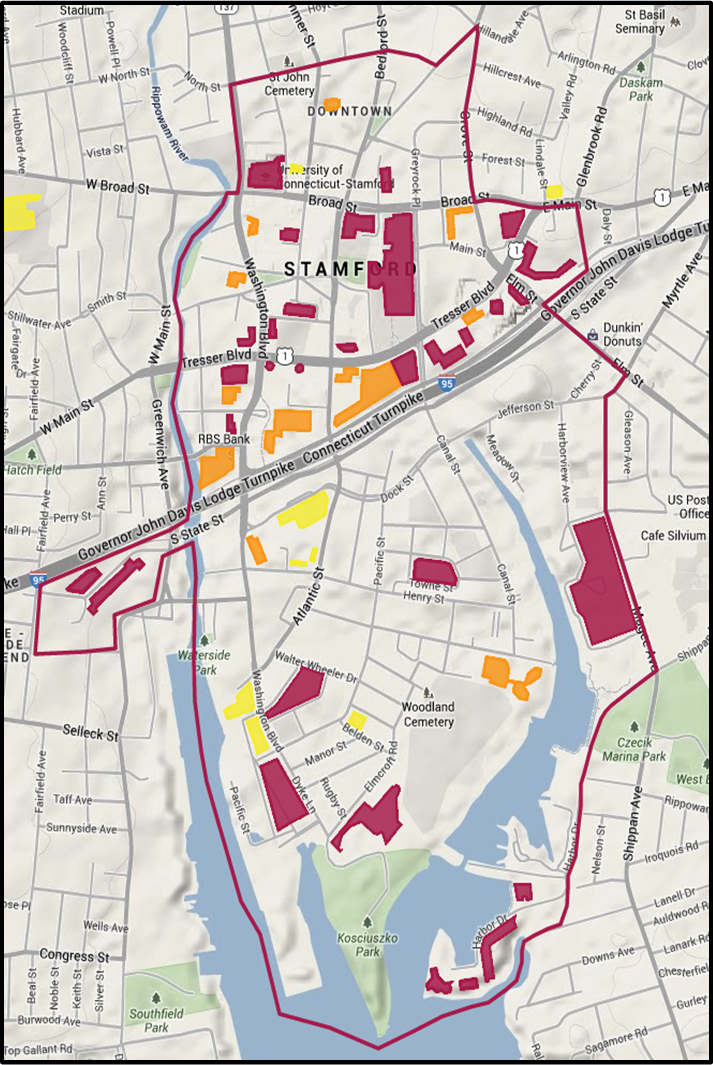
The Stamford 2030 District – launched this past  November - is an interdisciplinary public-private-nonprofit collaborative working to create a groundbreaking high performance building district in downtown Stamford.  Leading the way in the Stamford 2030 District are the Business Council of Fairfield County and Connecticut Fund for the Environment. As Stamford is a coastal city, its 2030 District will also implement a proactive vision to ensure resiliency against projected sea-level rise and storm surge.

The Stamford 2030 District – the first in New England - began with 23 founding members, including 11 property owners and 12 prominent professional and community stakeholders committed to meeting the 2030 Districts goals and targets. High performance buildings have proven track records of simultaneously increasing business and property profitability, reducing environmental impacts, and improving occupant health.Stamford

Now in the process of assessing the District’s current building performance levels, one-on-one assistance is provided to property owners and managers in benchmarking their buildings.  In addition, a first-time webinar will be held this week, on Wednesday, February 18, with several founding members highlighting best practices and procedures:

  • Jay Black of SL Green Realty/Reckson Properties will offer industry perspective through his experience with benchmarking buildings in both NY and CT.
  • WegoWise will present an overview of their web-based software that is able to benchmark a portfolio and provide deeper analytics into a buildings’ energy performance to find savings opportunities.
  • Steven Winter and Associates will demonstrate how to take benchmarking a step further with tools such as building energy audits to help identify opportunities within the building.
  • New Neighborhoods, Inc. will serve as a case study project in Stamford that has contracted with WegoWise for their benchmarking and will share their experience.

Officials indicate that District Members develop realistic, measurable, and innovative strategies to assist district property owners, managers, and tenants in meeting aggressive goals that keep properties and businesses competitive while operating buildings more efficiently, reducing costs, and reducing the environmental impacts of facility construction, operation, and maintenance.

Stamford2030boundary“These collective efforts will establish the Stamford 2030 District as an example of a financially viable, sustainability focused, multi-sector driven effort that maximizes profitability and prosperity for all involved. Through collaboration of diverse stakeholders, leveraging existing and developing new incentives and financing mechanisms, and creating and sharing joint resources, the Stamford 2030 District will prove the business case for healthy and high performing buildings.”

Property owners and managers are voluntarily committing their properties to Stamford 2030 District goals; they are not required to achieve the District goals through legislative mandates or as individuals.

“Stamford is already a business leader in Connecticut. The Stamford 2030 District will make the city a sustainability leader nationwide,” said Megan Saunders, Executive Director of the Stamford 2030 District. With over 170 million square feet of commercial building space (including 6 million thus far in Stamford), 2030 Districts are rapidly emerging as a new model for urban sustainability, officials indicate.

The Stamford 2030 District provides members a roadmap and the support they need to own, manage, and develop high performance buildings by leveraging Community and Professional Stakeholders, market resources, and by creating new tools, partnerships, and opportunities to overcome current market barriers. This type of collaborative action is not only a strategic undertaking to keep Stamford competitive in the year 2030, but also represents a major investment in Stamford's future and reflects the collaborative nature of our region.

CT Ranks Last in Job Creation, Poll of Workers in 50 States Reports

To say that the latest Gallup Poll on state-by-state job creation reflects little good news for Connecticut would be an understatement.  Connecticut ranked last in the survey for 2014, which is determined based on full- and part-time workers' reports of whether their employer is hiring and expanding the size of its workforce, not making changes, or letting people go and reducing its workforce. “Connecticut has consistently ranked in the bottom tier for job creation, and its position at the very bottom in 2014, along with continued low ratings of other New England states and neighboring New York, suggests that is unlikely to change in 2015,” the survey summary predicted.

It marked the second time this month that Gallup reported diminished economic rankings for Connecticut.  The national poll’s economic confidence report, based on Gallup Daily tracking interviews with 176,702 national adults conducted from January through December 2014, indicated that Connecticut dropped out of the top 10 and into the middle-of-the-pack among the nation’s 50 states.  Leading the nation in “economic confidence” were Minnesota, Maryland and California.    Gallup by state

The newly released 50-state survey on job creation placed Connecticut at the bottom of the pile, as workers reported the worst hiring climate, although still net positive.  All 50 states had positive net hiring scores, and all but three -- West Virginia, Alaska and New Mexico -- have markedly improved on this measure since these ratings hit their low point in 2009, according to Gallup’s survey.

Joining Connecticut in the bottom dozen were the New England states of Rhode Island, Vermont, and Maine, along with Neighboring New York and New Jersey, as well as Alabama, Kentucky, Mississippi, West Virginia, New Mexico and Alaska.

North Dakota maintained its position at the top of Gallup's annual ranking, with employed North Dakota residents providing a strongly upbeat report on hiring conditions where they work -- the most positive of any state.   In North Dakota, 48 percent of workers in 2014 said their employer is hiring and 12 percent said their employer is letting workers go, resulting in a +36 Job Creation Index score.worst list

By contrast, Connecticut's +16 index score reflects 33 percent of workers saying their employer is hiring and 17 percent letting go, the Gallup survey found.  Only two states – Vermont (31%) and Montana (33%) – had equal or lower percentages responding that their employer is hiring, expanding the workforce. Connecticut and Rhode Island tie for compiling the worst collective job creation scores since 2008 and are the only states to have ranked in the bottom 10 each year.gallup-poll-logo

The 2014 state-level findings are drawn from 201,254 interviews with employed adults nationwide, conducted throughout the year as part of Gallup Daily tracking. In Connecticut, 2,503 individuals were interviewed, with one-third saying their employer was hiring, nearly half (43%) reported hiring was not changing, and 17 percent saying that their employer was reducing the workforce.

Beyond North Dakota, other top states were Texas, Nebraska, Wisconsin, Iowa and South Dakota.  Michigan's presence among the states with the highest Job Creation Index scores is notable because it represents one of the sharpest turnarounds of any state in the seven years Gallup has measured job creation, according to Gallup. Michigan was among the worst-performing states in 2008 and 2009, but with significant improvements in that state's economy, it rose to about average net hiring in 2010, and has ranked among the top-performing states in each of the past two years, Gallup pointed out.

The index was up year-over-year in most states, the Gallup survey revealed, but particularly in Oklahoma, Oregon and New Hampshire, where it rose nine points each. At the same time, net hiring failed to improve in a handful of states -- North Dakota, Alaska, Hawaii, Delaware, South Dakota, Minnesota, Tennessee and Connecticut -- where the index was basically flat in 2014, the report indicated.

http://youtu.be/fLPPLHDo2FU

West Hartford, North Haven Hearing Opposition to Native American Nicknames for School Athletics

West Hartford is the latest community to consider whether the time has come to change the name of its high school sports teams, in order to drop longstanding names that may be insensitive to Native American culture.  The town, which has two high schools – one nicknamed the Warriors, the other ncalled the Chieftans – will hold a public forum to discuss the mascots on Thursday, Feb. 12. Last month in North Haven, controversy erupted regarding the Indians name for its high school teams, with competing petitions urging a name change and retention of the name surfacing online.  The change.org petition urging a change has 728 signatures to date, with the goal of “formally get the attention of the North Haven Board of Education, allow for some serious discussion on this issue.”  The petition advocating continuing tradition and retention of “Indians” has amassed 2,067 signatures on-line.hall, conard

The issue has come up sporadically around the state for more than a decade, and has intensified in West Hartford, North Haven and across the state as part of a wider national conversation about whether Native American symbols and mascots are inherently racist and therefore inappropriate.

West Hartford’s Hall High School has dropped the use of an American Indian head as its logo, though the warrior remains the school mascot, the Hartford Courant has reported. Conard's mascot is the chieftain, and although sports teams have gradually phased out use of the American Indian head logo, the image still exists elsewhere, such as the masthead of the student newspaper, "The PowWow." The student-led pep club at Hall is also named "The Reservation," and Conard's pep club is "The Tribe."  The website we-ha.com has reported that Conard students, teachers, coaches, and alumni have elicited the opinion of the Mohegan tribal leadership regarding the West Hartford high school’s mascot and name, and the name was discussed by students last December as part of a Human Rights Day program.AUoZA5as

Derby High Schools’ teams continue to be known as the “Red Raiders,” using an arrowhead logo, and Killingly High School's teams are known as the Redmen.  In Torrington, the schools’ website refer tDHSbanner7o their teams as “Raiders” – not “Red Raiders.”   Promoting their 2014 Thanksgiving Day football rivalry, the Torrington website said “Come out to see the Raiders take on the Watertown Indians in the 49th renewal of this holiday classic. The Raiders have held off the Indian attack the past two seasons…”

Norwich Technical High School, continues to use the nickname Warriors for its baseball, track, tennis, volleyball and most other school teams.  In some instances, Norwich Tech has combined teams with other local high schools, resulting in students playing on the Crusaders (football) or Saints (wrestling).indians

Just six months ago, the New Haven Register reported that “at least 23 high school teams in the state have names associated with Native Americans that could be considered offensive.

Northwest Catholic High School in West Hartford told WFSB-TV last spring that the school’s teams no longer officially use the name “Indians,” but as of this week, the schools website continued to feature its parent booster club as the “Tomahawk Club.” At Glastonbury High School, the athletics teams are called the “Tomahawks.”

The Guilford Public Schools Student-Athlete and Parent Handbook for 2013-2014 includes the following explanation at the front of the book:  “Guilford High School is proud of its heritage and its friendly relations with the Native Americans that inhabited the land we now call Guilford. To demonstrate this pride, Guilford High School began to use Indian names and symbols for its yearbooks and athletic teams during the l940's. We believe it is our obligation as an educational institution to inform our public about the history of our community and the role the Native American played. The use of the Indian symbol is meant to serve as a reminder of our past and should be held in the highest regard at all times.”raiders

The unofficial list of high school team nicknames that are receiving attention regarding their athletic team nicknames or mascots, in addition to those described above:

Canton High School (Warriors), Enfield High School (Raiders), Farmington High School (Indians), Guilford High School (Indians),  H.C. Wilcox Technical (Meriden) High School (Indians),Killingly High School (Redmen), ManG tomahawk Drawstring bagchester High School (Indians), Montville High School (Indians), and Newington High School (Indians).  Also, the Nonnewaug (Woodbury) High School (Chiefs), North Haven Senior High School (Indians),  RHAM Junior Senior High School (Sachems), Valley Regional (Deep River) High School (Warriors), Wamogo (Litchfield) Regional High School (Warriors), Watertown High School (Indians), Wilcox Technical (Meriden) High School (Indians), Wilton High School (Warriors), Windsor High School (Warriors), Windsor Locks High School (Raiders).



Tweed Gauges Demand for Flights to Washington, D.C., Other Destinations

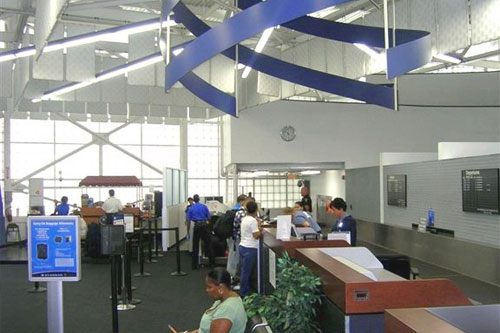
Tweed New Haven Regional Airport, the City of New Haven and the Greater New Haven Chamber of Commerce are currently soliciting feedback from businesses regarding existing air travel patterns and expenditures, as well as anticipated air service needs this year.  The survey is intended to quantify the demand for air service and to pinpoint the most critical destinations sought by local businesses. Of particular interest:  Dulles Airport in Washington, D.C.  A recent email from the New Haven Manufacturers Association to members of the association, for example, seeks opinions regarding travel to the nation’s Capital.  The email asks two questions:

  • Does your company have a need to be in the DC area on a regular basis?
  • If so how many flights a month would you estimate you company would use?

Under consideration is service that would include three flights down and three flights back each day, Monday - Friday, “which means you could be there and back within the day.” Though Dulles is outside of DC, the email continues, “the Silver Line train will soon be connecting the airport to the DC subway system.”img_logo

In urging participation in the survey, officials note that “with accurate information regarding the potential market for increased destinations, the airport can make a compelling case for additional flights and carriers.”  The survey is also posted on the Tweed New Haven website.

Currently, Tweed’s flights to Philadelphia are the airport’s primary gateway hub.  The airport’s website highlights “Fly first to Philadelphia and connect to hundreds of destinations for less that it would cost to drive and park at our other nearest airports. These costs in time, stress, and dollars are seldom counted in the cost of travel.” Tweed offers US Airways Express service to and from Philadelphia International Airport, currently three flights a day.  US Airways is currently in the midst of merging with American Airlines. img_airport_hvn3_lg

Tweed New Haven Airport Authority manages and operates Tweed New Haven Regional Airport under a long term lease from the City of New Haven, according to the Chamber of Commerce website.  Chartered by the State legislature, the Authority is a 15-member board of directors appointed by the mayors of New Haven and East Haven and by the South Central CT Regional Council of Governments.  The Airport is operated by the firm of AvPORTS and administered in part by Chamber staff.

“Improving scheduled air service and the physical infrastructure at Tweed is considered the #1 economic development priority of the region,” the Chamber website points out.

As Hartford Nears Stadium Groundbreaking, Norwich Ranked #6 Minor League Baseball City in USA

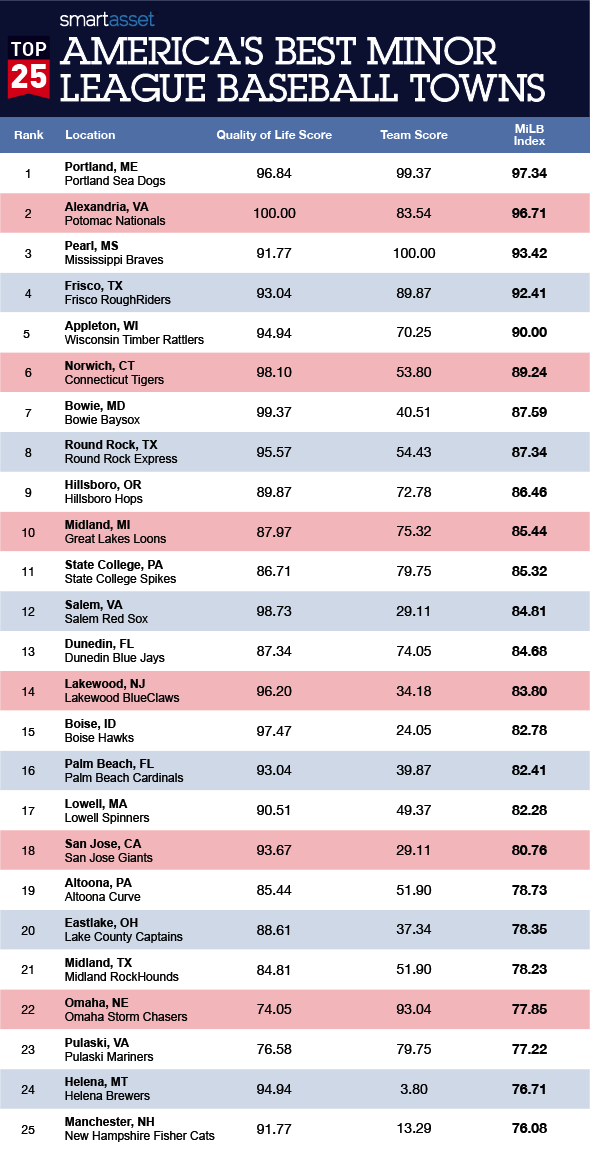
With winter snow piling up and the planned groundbreaking for a new minor league baseball stadium in Hartford only weeks away, it seemed the perfect time to turn attention to baseball – and which cities are earning notice in the minor league landscape.  Among local franchises, tops on the list is Norwich, home of the Connecticut Tigers, the Class-A affiliate of the Detroit Tigers, and a member of the NY-Penn League. An analysis of baseball’s 159 minor league cities following the 2014 season by the website smartasset.com, ranked Norwich #6 among the Top 25 Best Minor League Towns.

The top ten were: Portland, ME; Alexandria, VA; Pearl, MS; Frisco, TX; Appleton, WI; Norwich, CT; Bowie, MD; Round Rock, TX; Hillsboro, OR; and Midland, MI.  Other New England franchises earning a slot in the top 25 include Lowell, MA and Manchester, NH. minor_league_baseball_1-1

The analysis considered five “quality of life” factors in determining the top 25 baseball cities.  The factors were:

  • Violent Crime per 100,000 Residents
  • Property Crime per 100,000 Residents
  • Disposable Income – The difference between average income and the average monthly rent for a two bedroom apartment.
  • Unemployment Rate
  • Dining & Entertainment Establishments per 100,000 Residents

As a secondary consideration, the analysis sought to determine which cities enjoyed the best baseball experience, dubbed the “team” score. Three factors were considered:

  • Team Win Percentage – During the 2014 regular season.
  • Stadium Experience – A ranking of every minor league ballpark, courtesy of StadiumJourney.com, which attended a game at every single minor league stadium.
  • Minor League Class – A measure from 0-50 based on the level of competition: Triple-A teams receive a 0, Double-A teams a 10, Class A Advanced a 20, and so on.

To determine America’s Best Minor League Baseball Towns, the Quality of Life Score and the Team Score were added, giving 80% weight to the former and 20% to the latter, according to the website.

Ranked at #6, the Connecticut Tigers had their best season on the field in 2014, setting a franchise record for wins and clinching a sTigerspot in the postseason for the first time in their five year franchise history.  The franchise plays home games at Dodd Stadium in Norwich.  The facility celebrated its 20th year in 2014.

Of Norwich, the website noted that “The Rose of New England sits at the confluence of three rivers in Connecticut’s serene southeast corner,” and “had the third highest concentration of (restaurant and entertainment) attractions of any Minor League town.”

Ranked #25, the New Hampshire Fisher Cats are owned by Art Solomon, father of New Britain Rock Cats owner Josh Solomon.  The Rock Cats will be moving to Hartford from New Britain for the 2016 season, with groundbreaking on their new stadium in Hartford slated for later this month. The Colorado Rockies signed a two-year player development contract with the Rock Cats last fall, after the Minnesota Twins ended a two-decade affiliation agreemDoddent.

No state had more than three top 25 towns, and 19 different states had at least one. Texas and Virginia were the leading Minor League Baseball states, with three towns each in the top 25.  SmartAsset is a financial technology company that provides data and advice related to personal finance decisions.


newhartford_sept3Artists conception of planned baseball stadium in Hartford.