Questionable Patent Claims Push Small Businesses to Pay Rather Than Fight; Congress to Again Consider Reforms
/The odyssey began with a letter. The owner of an Old Lyme small business, providing employment services for people with disabilities, was told that by scanning documents into emails, she was violating a patent. In fact, every scan meant a $1,000 fine. Pay $75,000, she was told, or face legal action. She ignored the first letter, hoping it was junk mail. When a second, “scarier, and more threatening” arrived, she contacted an attorney, who put her in touch with a patent attorney.
What was happening was a phenomenon described as patent trolling. The New York Times has described patent trolls as “people who sue companies for infringement, often using patents of dubious value or questionable relevance, and then hold on like a terrier until they get license fees. In recent years, patent trolls — they prefer “patent assertion entities,” or P.A.E.’s — have gone from low-profile corporate migraine to mainstream scourge.”
Roberta Hurley, the small business owner in Connecticut, describes them as “creepy people,” intentionally frightening business owners with a “big scam.” They depend on the unknowing to pay the outrageous demands, afraid of being taken to court.
The company making the demand could not be reached by phone, and the letter had nothing more than a Post Office box for an address. But the tone was nonetheless daunting.
“If you’re scared, you don’t understand patent infringement, don’t have the funds to hire an attorney, which is true of many mom and pop businesses, it’s easier to write a check to stop them,” Hurley observed.
She couldn’t afford the $75,000 being demanded – “I would have had to close my doors” – and decided she would fight, and did. “I wasn’t doing it,” she recalled.
It took time, effort and energy, and a bill from her attorney, but ultimately the demands stopped. The entire process went on for nearly a year and a half, ending in 2013. Along the way, she testified in Washington, went public to the news media, and told everyone she could what was happening.
Patent trolls may not have succeeded in this instance, but often do. As The Atlantic pointed out in an article on the subject, “Given the cost, many defendants are willing to pay the troll to avoid a lawsuit even if the suit is not justified.”
In 2013, American courts saw six times as many patent lawsuits as in the 1980s, a Boston Globe op-ed by the authors of “Patent Failure” reported last fall. “Over the past decade, there has been a 900 percent increase in the number of businesses facing patent litigation.” They added that “recent research estimated that defendants spent at least $29 billion per year in out-of-pocket costs to defend or settle claims brought forth by patent trolls in 2011. Patent lawsuits by these entities drain an estimated $60 billion every year from the economy.”
 Last month, a bipartisan group of 20 members of Congress reintroduced legislation aimed at reining in "patent trolls." A similar bill last year was approved by the House, but stalled in the Senate. The legislation would express a sense of Congress that sending purposely evasive demand letters should be considered a fraudulent and deceptive practice, according to a published report in The Hill, a website that reports on Congress and the nation’s Capitol.
The Credit Union League of Connecticut is among the local and national consumer organizations urging approval of safeguards against patent trolls. "Patent trolls often allege that the use of necessary everyday technology violates the patent holders' rights, state vague or hypothetical theories of infringement, often overstate or grossly reinterpret the patent in question, and make allegations of infringement of expired or previously licensed patents," the organization said in urging Congressional action.
The Connecticut Retail Merchant Association has also called for federal action, noting that “patent trolls are entities that threaten main street businesses with frivolous lawsuits over vaguely crafted or poorly worded patents. Usually, the patent troll wins a settlement because small businesses do not have the resources to fight it out in court. In fact, most trolls wouldn’t stand a chance to win and so they rely on scare tactics to extract a settlement, said Executive Director Tim Phelan in an op-ed published last year. The National Retail Federation has pointed out that patent trolls "lose more than 90 percent of the cases that make it to trial. But the cost of defending companies against the claims is so high — the average case costs $2 million and can take 18 months — that many victims settle out of court. The cases cost legitimate businesses close to $30 billion a year in direct costs and $80 billion indirectly, amounting to $943 a year for the average household when passed on to consumers."
Authors Michael J. Meurer and James Bessen indicate, based on their research, that "there is no question that patent trolls cause immense harm. A recent survey of software startups found that nearly half reported “significant operational impacts” from patent troll lawsuits. These included a wholesale change of strategy or a shutdown of certain lines of business. Another survey found that roughly three of every four venture capitalists were adversely impacted by patent litigation."
Hurley, who has grown her Eastern Connecticut business (Southeastern Employment Services) from less than a handful of employees to 80 employees in just over a dozen years, says her advice to other small business owners is simple: “don’t give them a penny.” And she hopes that this will be the year that Congress approves patent reforms that will protect unsuspecting small business owners from “paying because they’re scared.”


 motorized transportation networks and safety. Communities that routinely collect walking and biking data, they point out, are better positioned to track trends and prioritize investments.
 “We were excited here in Connecticut to give our Girl Scouts the opportunity to participate in a pilot of Digital Cookie, a first-of-its-kind web platform that lets girls sell cookies from their own protected, personalized websites,” said Tiffany Ventura Thiele, Communications & PR Manager for Girl Scouts of Connecticut.
 Officials stress that “because 100 percent of the net revenue raised through the Girl Scout Cookie Program stays with local councils, when you purchase Girl Scout Cookies you’re not only getting a delicious treat — you’re also making an important investment in your community.”
 n,
n, 

 ll, there were “approximately 800 healing experiences with children and families throughout the week, bringing the safety, respect and love of Camp to many families” in Philadelphia.
 s.
s. The top 10 institutions are Johns Hopkins, University of Michigan (Ann Arbor), University of Washington (Seattle), University of Wisconsin (Madison), University of California (San Diego), University of California (San Francisco), Harvard, Duke, University of North Carolina (Chapel Hill) and University of California (Los Angeles).
 The survey collects information on R&D expenditures by field of research and source of funds and also gathers information on types of research and expenses and headcounts of R&D personnel. The survey is an annual census of institutions that expended at least $150,000 in separately budgeted R&D during the fiscal year.


 elephant venues and out-of-control costs that have plagued Olympic hosts for decades.” Recently adopted IOC guidelines are aimed at reducing costs by host cities and are more amenable to having some events take place outside the immediate Olympic perimeter.
 s far on whether such a tour has been scheduled. Possible sports at the Connecticut venues, as suggested by CRDA, include badminton, table tennis, wrestling, martial arts, and weightlifting. Basketball, volleyball and soccer could be additional possibilities, along with tennis. The Connecticut Tennis Center is described as the fourth largest tennis venue in the world, with seating capacity of 15,000. Within the past week, options for major renovations or reconstruction of Hartford’s XL Center have been announced, with a decision on how to proceed due later this year.
 opened a state-of-the-art 300,000 square foot facility headquartered in
 tently and robustly in research.” Describing Connecticut as “the home of innovation in engineering,” Esty said that engineers provide “the inspiration to solve the world’s problems.”
 Among the faculty award recipients was Dr. Alfred A. Gates, Professor of Engineering at Central Connecticut State University, whose two decades at the university have been a steady stream of technical innovation and teaching. Gates noted that CCSU has just become the first university in the United States to receive a

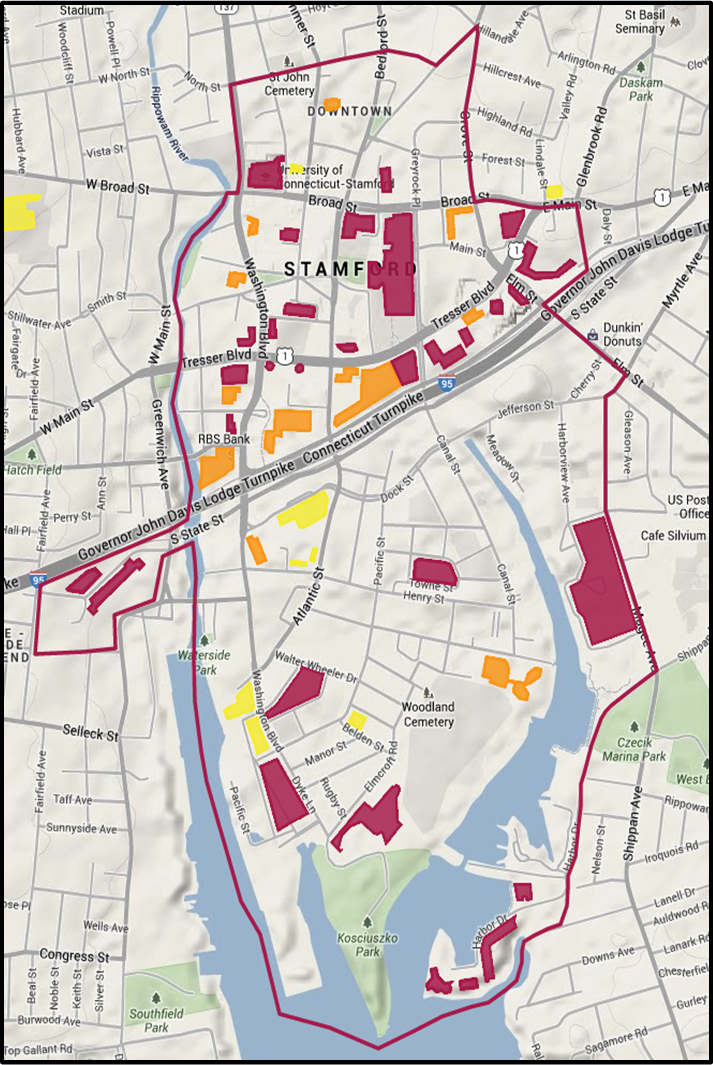 “These collective efforts will establish the Stamford 2030 District as an example of a financially viable, sustainability focused, multi-sector driven effort that maximizes profitability and prosperity for all involved. Through collaboration of diverse stakeholders, leveraging existing and developing new incentives and financing mechanisms, and creating and sharing joint resources, the Stamford 2030 District will prove the business case for healthy and high performing buildings.”