Hartford, Bridgeport Turn to Splashy Websites, Slogans to Promote Cities

Connecticut’s major cities have dual personalities on the internet – one aimed primarily at city residents, the other at potential visitors and prospective residents.  While one site is chock full of detailed information that is the lifeline for locals – with listings of city agencies, services, and department contacts – the other is dominated by splashy photographs, engaging messages, and enticing activities. Such is the mhartfordarketing of urban cores in the age of the internet, mobile technology and social media – with an eye towards economic development and young professionals seeking an urban address.

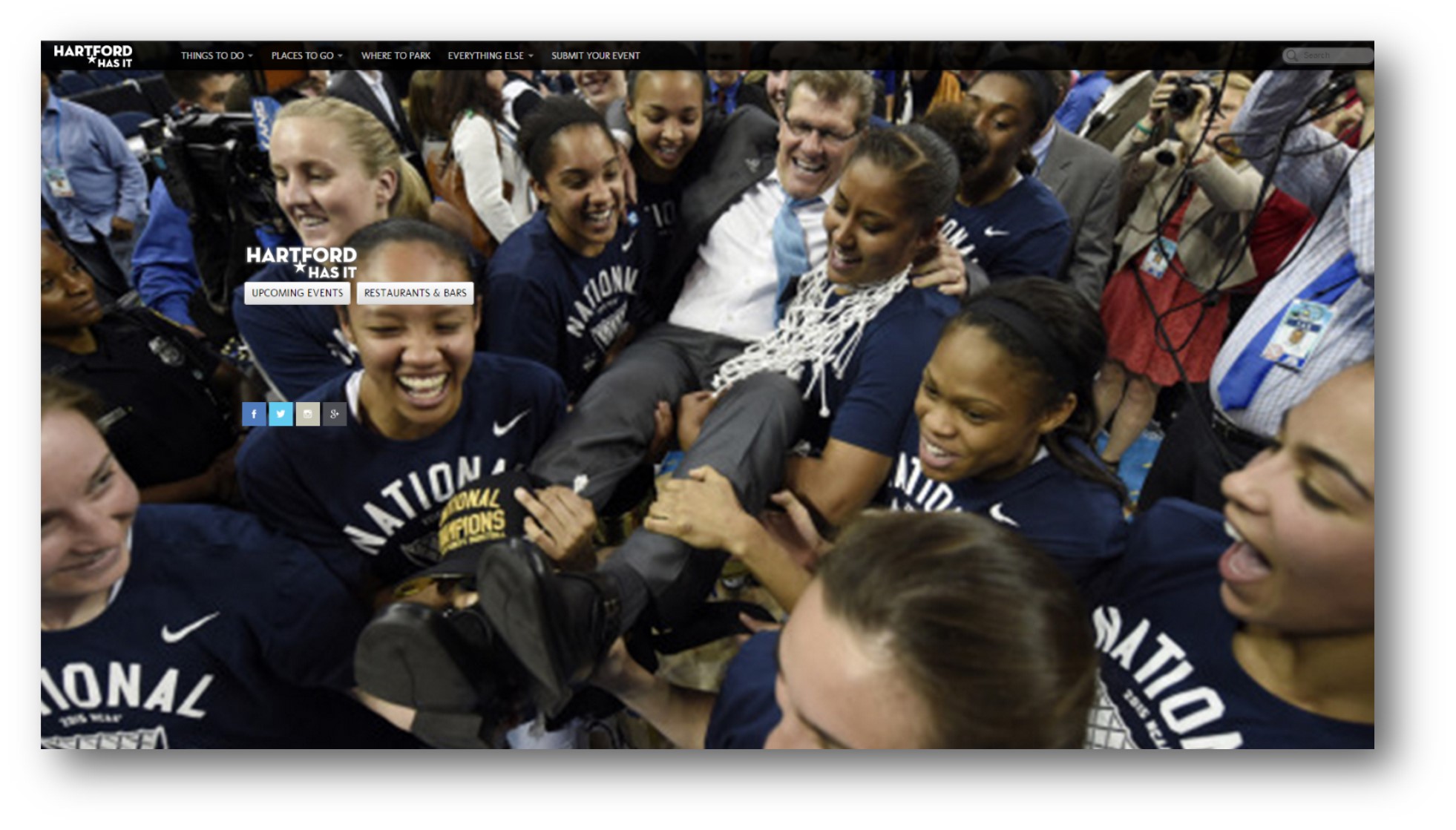
In Hartford, the government site is www.hartford.gov and the event-laden site is www.hartford.com   The marketing site currently features a photo of the National Champion UConn Huskies basketball team, which fills the entire home page, save for links to Upcoming Events and Restaurants & Bars.  The menu includes Things to Do, Places to Go, and Everything Else (such as a category named Awesome Things).  The theme Hartford Has It, the city’s tagline, appears on both sites.

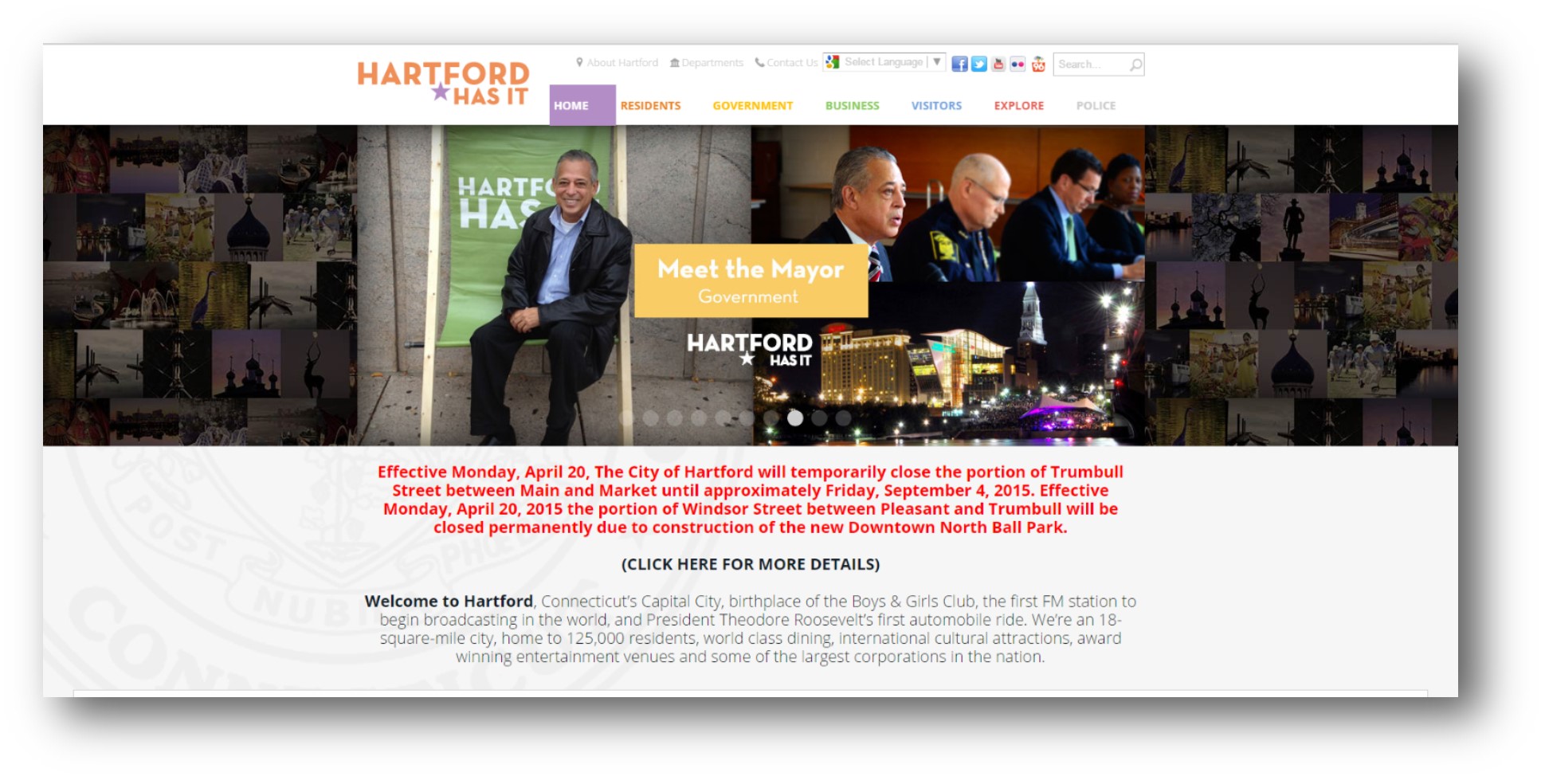
The www.hartford.gov site is led by an announcement of road closures in the city due to construction, and features links to government agencies, business services and visitors information, and police.  Hartford history highlights and facts about the city are included, along with a heading called “residents,” which includes a directory of city services, public health, public safety, family services and a link to “Pay Your Taxes.”hartford.gov

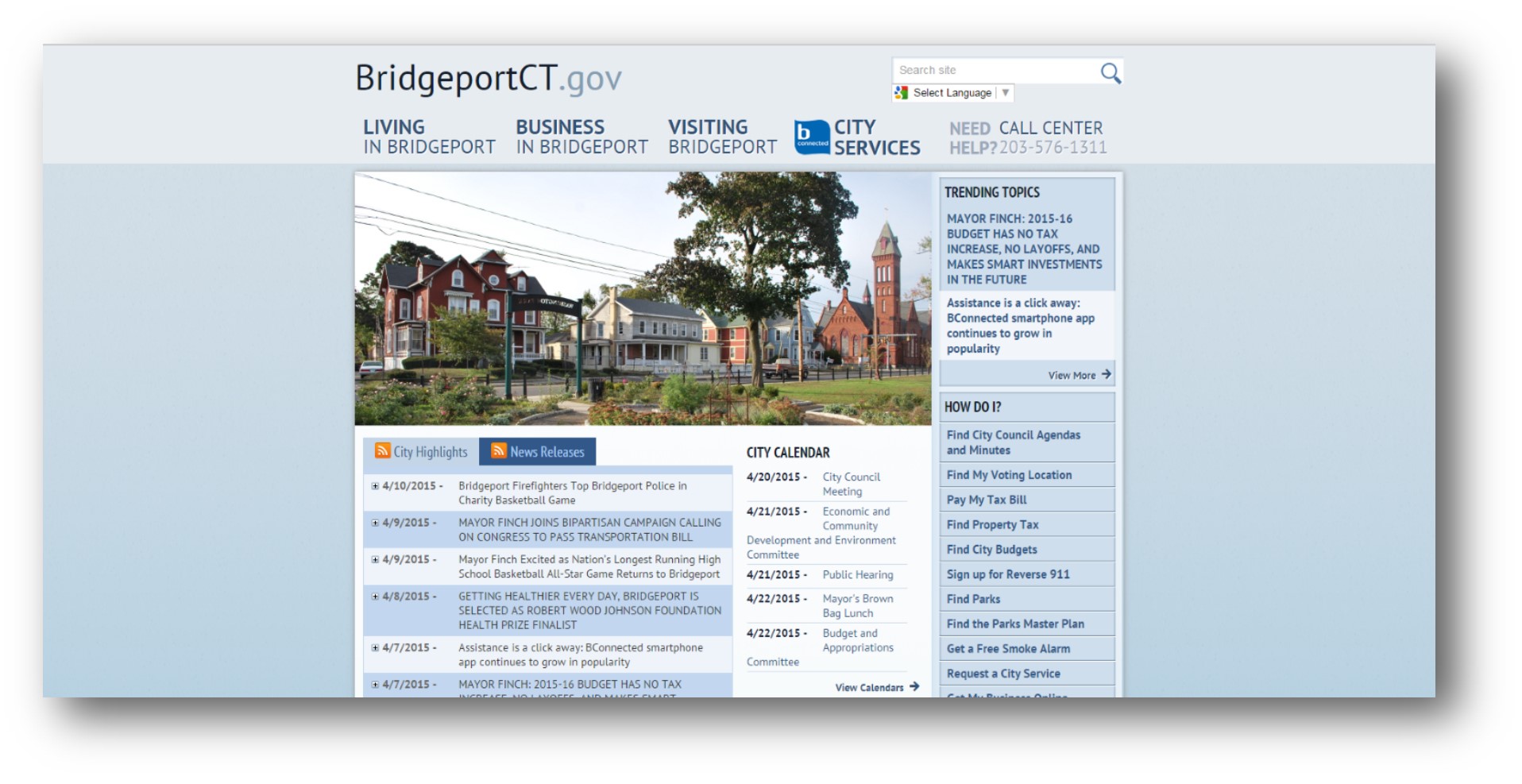
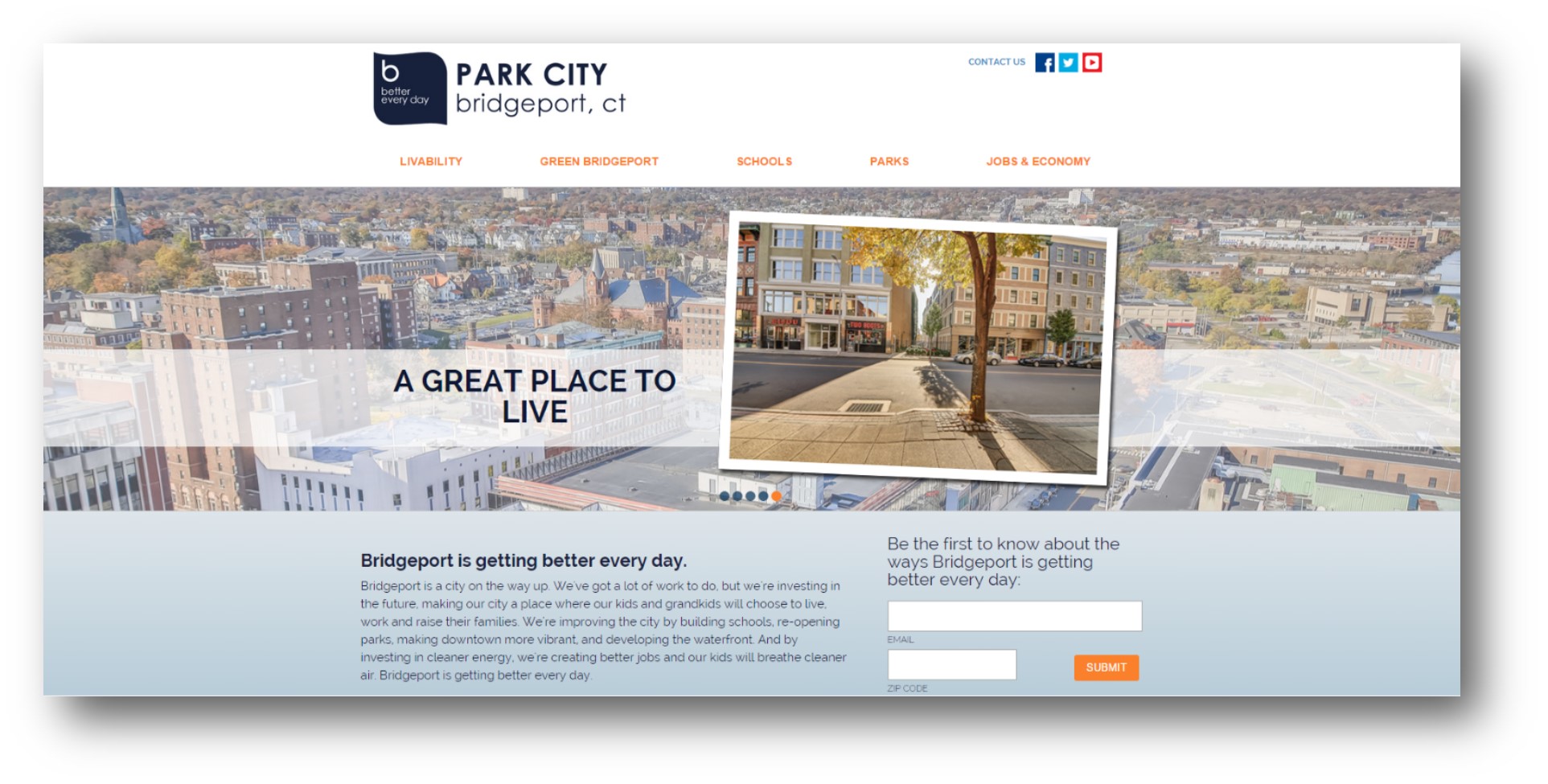
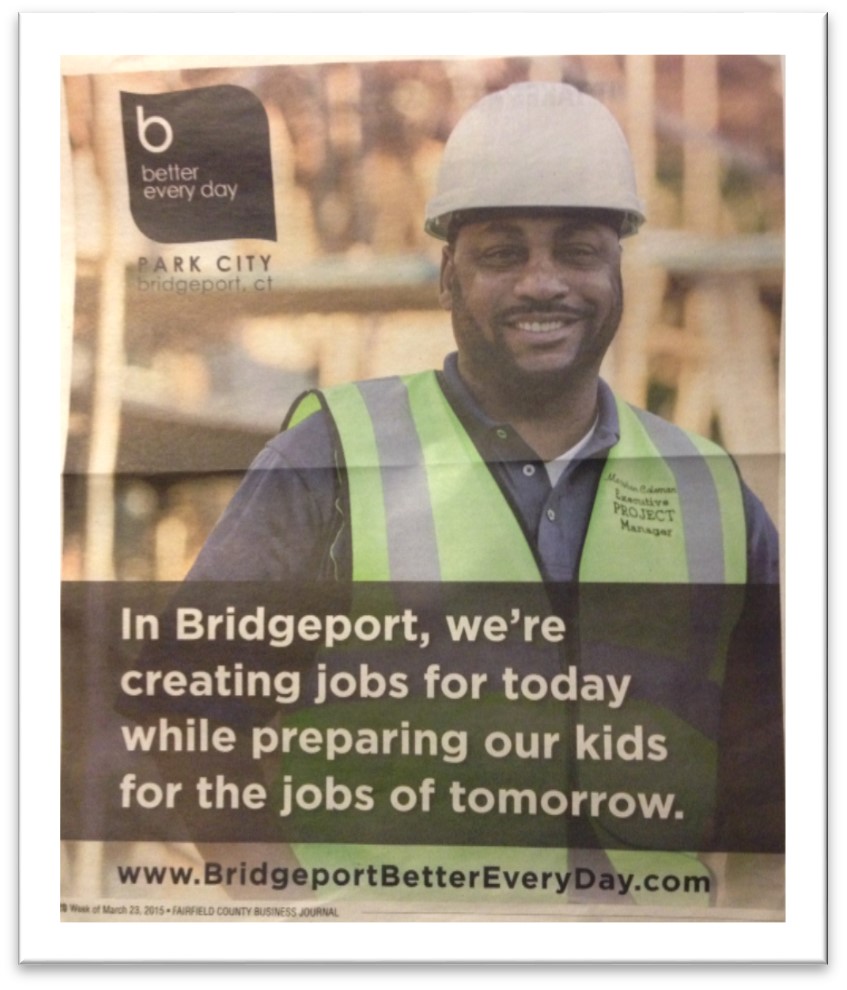
In Bridgeport, the city services site is  www.bridgeportct.gov but most of the advertising, including a full-page ad in the latest issue of the Fairfield County Business Journal, is for www.bridgeportbettereveryday.com   The site, which features the headline “Park City” above “bridgeport, ct” highlights livability, green Bridgeport, schools, parks and jobs & economy.  The theme of the site, “Bridgeport is getting better every day,” is reflected in the site’s URL, and the text featured on the home page:

“Bridgeport is a city on the way up. We've got a lot of work to do, but we're investing in the future, making our city a place where our kids and grandkids will choose to live, work and raise their families. We're improving the city by building schools, re-opening parks, making downtown more vibrant, and developing the waterfront. And by investing in cleaner energy, we're creabridgeport govbridgeportbetterting better jobs and our kids will breathe cleaner air. Bridgeport is getting better every day.”

Individual can sign up for emails from the city in order to “Be the first to know about the ways Bridgeport is getting better every day.”  Material on the site is copyrighted by the City of Bridgeport.

The site points out that:bridgeport ad

  • Bridgeport is becoming one of America’s greenest cities.
  • We’ve got a long way to go, but schools in Bridgeport are getting better every day.
  • Bridgeport’s been known as “Park City” for well over a century. And for good reason.
  • Bridgeport is a great place to live for families, young professionals, seniors, and everyone in between.

In New Haven, the city government website, www.cityofnewhaven.com, includes a home page message from Mayor Toni Harp, and an array of links to various city services.  Although not produced by the city, the websites www.infonewhaven.com and www.visitnewhaven.com offer information, events, and entertainment information about the city.

new haven


Museum Store Association Brings National Conference to Hartford; Wadsworth Atheneum Is Award Finalist

The Wadsworth Atheneum’s Museum Store is one of five nominees for the 2015 Museum Store Association (MSA) Visual Merchandising award, which recognizes excellence in visual merchandising by a museum institution. The award will be given on Sunday, April 19 in Hartford – on the final day of the Museum Store Association’s national conference, being held this weekend at the Connecticut Convention Center. Nominations were evaluated based on creative use of resources, collaboration and how well the display extends the museum experience.  The other finalists are the Columbia River Maritime Museum, Fine Arts Museums of San Francisco, Eastern National and Virginia Museum of Fine Art.Balancing-Act-600x175-indd.jpg

The 2015 MSA Retail Conference & Expo, organizers point out, is designed to help nonprofit retail professionals succeed by offering dynamic learning sessions and opportunities to connect with select MSA vendors who offer products matched with the museum store industry.

In Hartford for the annual conference are approximately 300 museum store professionals and more than 200 select vendors who offer products and services for nonprofit and independent retailers. When the conference location in Hartford was announced 15 months ago, it was expected to bring in 900 participants downtown utilizing an estimated 1,130 room nights, according to organizers.

Learning sessions throughout the conference are presented by “the leading thinkers in nonprofit retailing who share the knowledge you need to run your store, meet the needs of management, make the most out of challenges, be a leader and through retailing contribute to your institution’s brand and extend the experience of your visitors.”

It is the first time the national conference is being hosted in Hartford.  In recent years host cities have been Houston, Los Angeles, New Orleans and Chicago.  The national meeting also includes a “retail boot camp” and a tour of the Mark Twain House and Harriet Beecher Stowe House in Hartford.

The outstanding line-up of speakers includes Roderick Buchanan, the director of buying and retail sales at the British Museum Company, where he has overseen the redevelopment of the stores, products and customer service culture and increased profits four-fold since 2008.  Buchanan will deliver the conference opening keynote on Saturday morning.  The closing keynote speaker on Sunday will be Dick Durrance, described as one of the most versatile photographers of his generation. His well-known portfolio includes images from Vietnam combat, National Geographic stories, global advertising campaigns, National Parks and the world’s great golf courses.

Sessions for industry attendees include Open To Buy Workshop, Retail Boot Camp, 7 Habits of Highly Effective Retailers, Sales Guaranteed: The Only Four Things You Need to Know to Improve Museum Store Sales, Perspectives On Fair Trade, 29 Tech Tools to Create Cool Content for Social Media, Looking at Business Through Your Customers’ Eyes and eCommerce A to Z: Selling the Museum Experience Online.

In addition to the Wadsworth Atheneum, other MSA member institutions in the area include the Connecticut Historical Society Museum & Library, Harriet Beecher Stowe House, New Britain Museum of American Art and Friends of Dinosaur State Park and Arboretum. Manager of the Museum Shop at the Wadsworth Atheneum Museum of Art, Stacey Stachow, is immediate past MSA Board President.Hartford-Square

“Retailers often find themselves doing a balancing act every day, performing a variety of functions and responsibilities,” said Jama Rice, MSA Executive Director/CEO. “They balance inventory control, staffing, merchandising, displays, financial management, marketing and even event planning, and at the same time they must stay apprised of all that’s happening at their institutions and stores. The 2015 Conference & Expo will provide tools to help balance the balancing act.”

Now in its 60th year, the Museum Store Association is a nonprofit, international association dedicated to advancing the success of nonprofit retail professionals in extending the brand and contributing to the bottom lines of their institutions. MSA serves over 1,500 members in the U.S., Canada, Mexico, Asia and Europe.

CT Is Second-Tier State in Innovation Ranking of States; Earns Top Grades in Investment, Internet

Connecticut is among the second tier of states, described as an “innovation leader,” in the inaugural Innovation Scorecard compiled by the Consumer Electronics Association (CEA).  The first-of-its-kind innovation performance index is based on ten criteria, and evaluates all 50 states and Washington, D.C., according to the conduciveness of their legal, regulatory and overall business environments to welcome and encourage innovation. The Innovation Scorecard’s first group of Innovation Champions – those states that earned the highest grades – are Delaware, Indiana, Massachusetts, Michigan, North Carolina, South Dakota, Texas, Utah and Virginia, as well as the District of Columbia.CT grades

Connecticut’s grades range from A- in the “attracts investment” and “fast internet” categories to a C in “tax-friendliness,” D in “innovation friendly sustainable policies,” and F in “right to work.”  The state also received a B in four categories:  entrepreneurial activity, tech workforce, grants STEM degrees and innovation momentum.

The analysis notes that in Connecticut, “the public and private sector are funding incubators including the Connecticut Enterprise Center, Institute of Technology & Business Development and UConn Technology incubation Program to help startups launch their businesses and become financially viable companies.”

The Innovation Scorecard assesses the progress of state policies intended to advance innovation and improve business climates, while also tracking states’ responsiveness to disruptive innovation. Using established economic, educational and legislative data, the report issues grades across ten categories, including: right-to-work laws; policies that support new business models; tax friendliness; Internet speed; and size of the tech workforce.

After the innovation champions group that tops the list, the next category (innovation leader) includes Connecticut and 19 other states, including Vermont and New Hampshire in New England and Washington and Oregon on the West Coast.USA

Connecticut is one of only five states to receive an A, A- or A+ in the “attracts investment” category.  The others are California, Washington, Massachusetts, and Delaware.  Nine states and Washington, D.C. receive an A, A- or A+ for “fast internet.”  Among them are Connecticut, New Hampshire, Rhode Island and Massachusetts.

Among the CEA report’s key findings:

  • Delaware leads the nation in providing the fastest average Internet speed, at 16,200 kbps;
  • The District of Columbia leads the nation in tech jobs per capita;
  • Massachusetts and California bring in the most venture capital investment dollars, more than $500 per capita, in the U.S; and
  • Massachusetts, California, Washington, Connecticut and Delaware received higher R&D investment than other states.

Plans are for the Innovation Scorecard will be annually updated to reflect states’ evolving policies and any changes in measuring innovation.

CEAGary Shapiro, president and CEO of CEA, said “The future of growth and economic prosperity in this country is most vibrant in places where policies and political climates serve to unleash the entrepreneurial spirit and can-do attitude that is part of our American DNA. Our hope is that states will use our Scorecard as a measurable guidepost to improve their policies supporting innovation.”

The Consumer Electronics Association (CEA), with more than 2,000 member companies, is the technology trade association representing the $286 billion U.S. consumer electronics industry.

Millennials Present New Challenges to Insurance Industry Seeking Customers

Just as recently appointed Connecticut Insurance Commissioner Katharine L. Wade settles in to her job, the insurance industry is facing new challenges from a new generation. A former Cigna executive, Commissioner Wade has more than 20 years of industry experience and oversees a regulatory agency with jurisdiction over one of the largest insurance industries in the United States.  Hartford has long been considered the nation’s Insurance Capitol, so changes in the industry reverberate across the Constitution State.

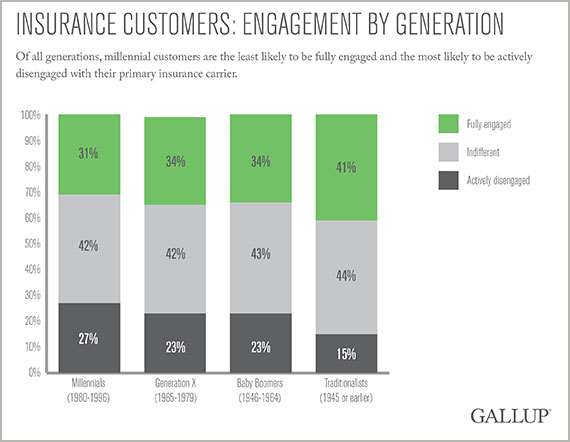
It seems insurance companies have their work cut out for them when it comes to engaging their millennial customers. Of all the generations, millennials (born in 1980 to 1996) are the least likely to be fully engaged -- and the most likely to be actively disengaged -- with their primary insurer, according to a recent Gallup survey.

3siww10abkcj3m39d9khgaMillennials are the largest generation in the U.S. and will grow to dominate the market in the years to come, Gallup points out, adding that “insurance executives who neglect to take steps to engage this age group do so at their own peril.”

Insurance companies see substantial business gains when they engage customers of any generation, Gallup finds. Compared with their actively disengaged counterparts, engaged insurance customers are less sensitive about pricing when selecting and retaining a primary insurance carrier. They spend more and buy a wider variety of products, including financial offerings, from their insurer than do actively disengaged customers. They also stay with the company longer and are more likely to recommend it to others.insurance_1

But building and maintaining customer engagement can be challenging -- especially for insurance companies with a diverse customer base. To raise millennials' engagement -- and thereby ensure a more engaged customer base in the future -- Gallup indicates that "leaders must understand how these young customers differ from others in their engagement and consumer behavior."  And they do differ, in substantial ways.

In its 2014 Insurance Panel study, Gallup uncovered insights into what drives millennials to start a relationship or stay in one with an insurance company. The analysis revealed many similarities across generations, but it also uncovered two important approaches to build relationships with millennials, and key factors that differ with past generations.

  1. Family is key. Millennials are significantly more likely than other generations to have insurance coverage under a family member who chose the company. When their family members value an insurance company's brand, millennials follow suit. This finding contrasts sharply with older generations' prioritization of factors such as cost and company reputation.
  2. Millennials are more likely to buy insurance online. Millennials are more than twice as likely (27% vs. 11%, respectively) as all other generations to purchase their policies online rather than through an agent. Online purchasing is far from the mainstream among insurance consumers overall -- 74% originally purchased with an agent vs. 14% online -- but if this trend among millennials continues to grow, it could substantially change the way insurance companies interact with customers in the coming years.

The bad news?  Millennials are least satisfied of any generation with the online experience, which could contribute to their generally low engagement overall with their primary insurer. Improving interactions with customers online is, therefore, a smart investment toward building strong relationships within this future mainstream customer base, Gallup points out.

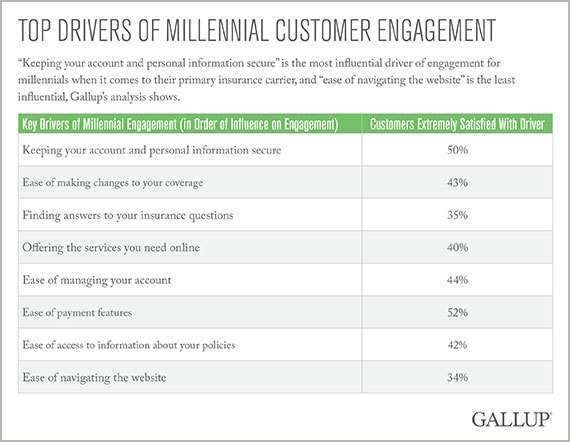
As insurance companies consider ways to improve those relationships with millennial customers, Gallup suggests seven key areas worthy of attention:  information security, family incentives, specialized services,  ease of making changes to coverage online, ease of finding answers online, easy access to a range of online services, and overall ease of use in areas including account management, payment and website navigation.

Millennials’ distinctive attitudes also extend to car insurance and long-term care insurance, according to other recent surveys.

Cars are increasingly being rejected by many millennials in favor of public transit or other modes of transportation, including increasingly popular ride-for-hire services.  As a consequence, car insurance is taking a backseat among some, the website NerdWallet reported this month. 42kr-vntpuuvwukbr__grqAccording to a study by the U.S. Public Interest Research Group, Americans are driving fewer total miles today than eight years ago, and driving fewer miles per person than we did in 1996.  It is a reversal after decades of steady growth.

Millennials are less likely to drive — or even have a driver’s license — than previous generations. From 1983 to 2008, the percentage of Americans age 20 to 24 with a driver’s license fell from about 90 percent of that age group to ju3147d6ba926618732903732fd442b68est over 80 percent, according to a University of Michigan study, the website noted.  If you don’t own a car, you don’t need car insurance.

In addition, Forbes recently reported that many of the nation’s millennials think their boomer parents are doing a lousy job planning for their long-term care needs, according to a survey from Genworth Financial, a leading seller of long-term care insurance policies.

The Aging Across Generations study, conducted with the J&K Solutions research firm, found that 27 percent of millennials would give their parents or loved ones a “failing grade” due to not planning for, or talking about, their long-term care needs.  And the kids say they’ll do better, with more than half (56 percent) of millennials surveyed expressing the view that they will plan for their long-term care needs more effectively than previous generations.

Time will tell.  Other impacts on the industry are likely to be more noticeable more quickly.

CT Ranked #3, Bridgeport-Norwalk-Stamford at #5, Among States, Regions with Most College Degrees

Connecticut has the nation’s third highest rate of residents holding a college degree – and the greater Bridgeport-Stamford-Norwalk area has the fifth highest rate among metropolitan regions, according to a new report by the Lumina Foundation. The report reveals" real progress has been made" in the national effort to increase post-secondary attainment, but "current rates won’t be enough to meet America’s future economic and workforce demands." The annual report, A Stronger Nation through Higher Education, finds that “unless actions are taken now to significantly increase post-secondary attainment, the nation will fall short of workforce needs by the end of this decade.

strongerConnecticut is making consistent progress on increasing attainment, according to the report. The most recent Census data (2013) show that 47.8 percent of the state’s 1.9 million working-age adults (those between the ages of 25 and 64) hold a two- or four-year college degree. This is an increase from last year’s rate of 47.5 percent and an increase from 46.6 percent in 2008. The state’s rate of higher education attainment is above the national rate of 40 percent.

A leading indicator of where higher education attainment rates are heading is the rate among young adults, those between the ages of 25 and 34. In 2013, this rate in Connecticut was 48.4 percent, higher than that of the adult population as a whole and also above the national rate of 41.6 percent.

According to the Georgetown Center on Education and the Workforce, 65 percent of U.S. jobs will require some form of postsecondary education by 2020. Yet, according the Lumina report, only 40 percent of working-age Americans (ages 25-64) held a two- or four-year college degree in 2013—the most recent year for which data are available. That figure is up from 2012, when the rate was 39.4 percent, and from 2008, when the rate was 37.9 percent, or a total of more than 2.8 million more degrees.

In Connecticut, 22.5 percent of residents ages 25-64 hold a bachelor’s degree, 17.1 percent have a graduate or professional degree, and 8 percent have an associate’s degree.  Eighteen percent have some college, but no degree, according to the data, provided by the U.S. Census Bureau’s 2013 American Community Survey.levels

Degree attainment in Connecticut, by ethnicity, was at 53 percent of Whites, 28.4 percent of African-Americans, 22 percent of Hispanics, 71 percent of Asians and 29 percent of Native Americans, according to the 2013 data. The progress nationally reflects incremental gains that the report authors say aren’t nearly enough to reach Goal 2025—a national effort calling for 60 percent of Americans to have a high-quality post-secondary degree, certificate or other credential by the year 2025.

The percentage of Connecticut residents (ages 25 – 64) with a college degree, by county, are:  Fairfield (53.8%), Middlesex (51.2%), Tolland (50.6%), Hartford (45.9%), Litchfield (44.6%), New Haven (43.4%), New London (41.1%), and Windham 32.1%).

In college enrollment, Connecticut exceeded the national average among residents age 18-24, but was slightly below the national average among residents ages 25-53.  Connecticut was below the national average among Hispanics 4.9% vs. 5.2%); slightly above among African-Americans, Native Americans, Asian Americans, and Whites.

“Economists and other experts give us good reason to be convinced that reaching Goal 2025 is a national imperative,” said Jamie P. Merisotis, president and CEO of Lumina Foundation, and a former Connecticut resident. “We have just 10 years to reach it, and our current pace of progress is insufficient for meeting employers’ workforce needs and addressing the growing inequality issues we face as a nation.”  Merisotis, testifying at the Connecticut General Assembly back in 2009, told legislators that "you will need to invest more in educating underprepared students than you do now. But invest you must. The alternative is a Connecticut far less prosperous and far less prepared to deal with the rapidly changing world in which we live."

A Stronger Nation estimates that if current trends continue, 30.7 million more Americans will earn college credentials by 2025. That increase will allow the nation to reach an attainment rate of 48.7 percent over the next 10 years—well short of the 60 percent needed to reach Goal 2025. To reach the Goal, Lumina estimates that another 19.8 million postsecondary credentials will need to be added.

Top 10 states—based on the percentage of adults (25-64) with at least an associate degree in 2013:

  1. Massachusetts —51.5% (up from 50.5%)
  2. Minnesota —48.1% (up from 47.7%)
  3. Connecticut —47.8% (up from 47.5%)
  4. Colorado —47.6% (up from 47.5%)
  5. New Jersey —46.5% (up from 45.8%)
  6. New Hampshire —46.4% (down from 46.7%)
  7. Virginia —46.1% (up from 45.3%)
  8. New York —46% (up from 45.1%)
  9. Maryland —46% (up from 45.5%)
  10. North Dakota —45.8% (up from 45.6%)

Among the nation’s metropolitan areas, the leading regions were:

  1. Washington, D.C./Arlington-Alexandria, Va.—55.36%
  2. San Jose-Sunnyvale-Santa Clara, Calif.—55.32%
  3. Boston-Cambridge-Newton, Mass.—54.73%
  4. Madison, Wis.—54.67%
  5. Bridgeport-Stamford-Norwalk, Conn.—54.41%
  6. San Francisco-Oakland-Hayward, Calif.—53.79%
  7. Raleigh, N.C.—53.57%
  8. Minneapolis-St. Paul-Bloomington, Minn.—51.80%
  9. Albany-Schenectady-Troy, N.Y.—49.82%
  10. Seattle-Tacoma-Bellevue, Wash.—49%


Primary School Teacher is Connecticut’s Most Common Job; Secretary Was For Most of Past Three Decades

What was the most common occupation in Connecticut in 2014?  Primary School Teacher. That’s according to data analyzed by National Public Radio, using U.S. Census data.  NPR checked the most common occupation in each of the 50 states, every two years from 1978 and 2014.

One of the key findings?  Farmers have virtually dropped off the map.  In only two states – North Dakota and South Dakota – were “farm managers” the leading occupation in 2014.  That compares with 8 states in 1978.

Primary school teachers were the most prevalent job in 2 states – New Hampshire and Alaska – in 1996. In addition to Connecticut, the other states in which Primary School Teacher was the leading job in 2014 were Alaska, Florida, Massachusetts, Rhode Island and West Virginia.

In 2014, the most common job in 4 states was “computer software developers” – Colorado, Utah , Virginia and Washington State.  The leading occupation in Washington, D.C.? Lawyers.

NPR points out that “through much of the '80s, as the U.S. economy shifted away from factories that make goods and toward offices that provide services, secretary became the most common job in more and more states. But a second shift — the rise of the personal computer — reversed this trend, as machines did more and more secretarial work.”

Connecticut’s most common occupation through the years:

  • Secretary             1978, 1982-1994, 2004, 2008, 2010job application form
  • Foreman              1980
  • Bookkeepers     1998
  • Truck drivers      1996, 2000
  • Nursing Aide      2002
  • School Teacher 2006
  • Primary School Teacher 2012, 2014

The NPR report points out that “driving a truck has been immune to two of the biggest trends affecting U.S. jobs: globalization and automation.”  The prominence of truck drivers is partly due to the way the government categorizes jobs, the report points out. It lumps together all truck drivers and delivery people, creating a very large category.

Other jobs are split more finely; for example, primary school teachers and secondary school teachers are in separate categories, as evidenced by Connecticut’s most common jobs – school teachers in 2006, primary school teachers in 2012 and 2014.common job map

56 Women of Innovation Recognized; Girls Encouraged to Enter STEM Fields in CT

Fifty-six women, from across Connecticut, were honored for their innovation and leadership during the eleventh annual Women of Innovation awards gala, held this week. This awards program recognized women innovators, role models and leaders in the fields of science, technology, engineering, and math as well as outstanding women at the high school and collegiate level. “The Council is honored to recognize Connecticut’s most extraordinary and talented women representing a cross section of the state’s most important technology companies and educational institutions.” said Bruce Carlson, President and CEO of the Connecticut Technology Council.

Of the 56 women honored, 10 wewomen-of-innovationre recognized as category winners; there are two winners in both the Research and Collegian categories: Academic Innovation and Leadership: Medria Blue-Ellis, Principal, Engineering & Science University Magnet School; Collegian Innovation and Leadership (two winners): Sapna Gupta, Ph.D. Student, University of Connecticut, Monika Weber, Ph.D. Student, Yale University; Community Innovation and Leadership: Keshia Ashe, Co-Founder & CEO, ManyMentors; Entrepreneurial Innovation and Leadership: Christina Lampe-Onnerud, Founder & CEO, CLOTEAM LLC; Large Business Innovation & Leadership: Yu-Hui Rogers, Site Director, The Jackson Laboratory for Genomic Medicine; Research Innovation and Leadership (2 winners): Serap Aksoy, Professor, Yale School of Public Health, Radenka Maric, Connecticut Clean Energy Professor in Sustainable Energy, University of Connecticut; Small Business Innovation and Leadership: Lisa Braden-Harder, CEO, Appen; and Youth Innovation and Leadership: Anubhuti Mathur, High School Student, Glastonbury High SchCT-ORGool.

Presenting sponsors of this year’s event, held at the AquaTurf in Plainville, were Boehringer Ingelheim USA Corporation, Covidien, Day Pitney LLP, and United Technologies Corporation.

Efforts to interest girls in the STEM fields are underway elsewhere in Connecticut as well.  UIL Holdings Corporation is among the organizations encouraging girls to pursue careers in science, technology, engineering and math (STEM) by supporting three Generating Girls Opportunities (G2O) Expos.

ggoThese expos offer girls exposure to STEM fields, as well as the opportunity to participate in hands-on experiments.  The next G2O Girls & STEM Expo to be held April 10 at Central Connecticut State University.  It is a half-day interactive event for 9th and 10th grade girls introducing participants to all the possibilities of STEM (Science, Technology, Engineering & Math) through workshops and activities led by college professors and STEM professionals.

Activities are designed to inspire girls to question, create, design, test, explore, and more!  They learn about possible STEM careers and talk to colleges and employers to help them plan for the future. The expos, organized by the Connecticut Women’s Education and Legal Fund (CWEALF), are designed to engage the students and teachers in expanding educational opportunities in STEM programs and careers.

A study commissioned by the Girl Scout Research Institute found that girls are interested in STEM fields and aspire to STEM careers, but need more exposure and adult support to carry this interest into the future.  Additional expos will be held in West Hartford at the University of Saint Joseph on May 4 and at Mitchell College in New London on June 5.

The Connecticut Technology Council (www.ct.org), which organizes the annual Women of Innovation, is Connecticut’s industry association for the technology sector. CTC’s mission is to connect people, ideas and opportunities to the global technology and innovation community.

________________________________________

winners2015 Women of Innovation

Medria Blue-Ellis is the principal of ESUMS, a Magnet School of Excellence and CT School of Distinction. Her Curriculum expertise, creative thinking, and persistence are shared with the female STEM teachers she mentors. Her encouragement of female students to excel in STEM manifests in accomplishments such as the 2014 Verizon App Challenge State Finalist. Medria was one of 100 school leaders, educational advocates, and researches convened at the Jack Kent Cooke Foundation “Closing the Excellence Gap” conference.

Sapna Gupta is a graduate research assistant at the Center for Clean Energy Engineering and a Ph.D. candidate in materials science and engineering at UCONN. Sapna’s academic achievements, innovative research and creativity are evident in the many fellowships, distinctions, and awards she has received, including her honorable mention for the 2014 Baker Student Researcher award. She is founder and president of UCONN Keramos, and delegate of the ACerS PCSA

Monika Weber is a Ph.D. candidate in electrical engineering at Yale University and the co-inventor of Fluid-Screen, a small device that detects bacteria in 30 minutes. She has won the Grand Prize in the NASA “Create the Future” Design Contest 2011” and the Gold Prize in MassChallenge and received over $200,000 in technology and entrepreneurial awards. Monika combines leadership skills with strong technical expertise, creativity and business acumen.

Keshia Ashe is a Ph.D. candidate in chemical engineering at UCONN and co-founder and CEO of ManyMentors. ManyMentors is a STEM online and in-person mentoring nonprofit organization that connects university mentors with middle and high school students interested in STEM degrees and careers. She is a mentor, role model, TEDx speaker, and an unwavering advocate for STEM education in Connecticut.

Christina Lampe-Onnerud is known for her innovative work developing high-performance, low-cost, safe, environmentally-friendly batteries for portable electronics, electric vehicles and energy storage. She is founder of Boston-Power (IPO in 2016) and CLOTEAM, as well as holder of 80+ patents and author of numerous scientific articles. She was recognized as a Technology Pioneer by the World Economic Forum where she serves as an advisor on global innovation and renewable transport.

Yu-Hui Rogers is leading the JAX-GM Administration and Operation Team in establishing its new research institute in Connecticut. She was the vice president of Core Technology Development at the J. Craig Venter Institute where she was responsible for technology development and a large-scale genomic operation. She was instrumental in the development and implementation of a high-throughput sequencing pipeline that enabled the completion of the first human genome sequence at Celera Genomics.

Serap Aksoy is a professor at the Yale School of Public Health where she works on insects that transmit disease-causing microbes to animals and plants. She lectures internationally, maintains ongoing collaborative research programs, and has made landmark contributions to the functional and evolutionary aspects of insect-microbe interactions. Through her discoveries, she developed innovative methods that use beneficial bacteria to render insects inhospitable for disease-causing pathogens, thereby reducing their disease transmission potential.

Radenka Maric joined UCONN in 2010, where she focuses on developing new materials and novel structures for energy storage and conversion, structural ceramics and hydrogen production and separation. Previously, she was group leader and program manager at the National Research Council of Canada’s Institute for Fuel Cell Innovation, program manager at nGimat and senior scientist/team ILeader at the Japan Fine Ceramics Center in Japan. Radenka has published over 150 scientific papers.

Lisa Braden-Harder started her career in IBM’s research division, moving on to found the Butler Hill Group in 1993. There, she leveraged her background in linguistic products ranging from grammar checkers to search engines. In 2011, the company merged with Appen, an Australian company also engaged in taking devices to global markets. In 2013, she became CEO of the combined entity and in January 2015, led the company through an IPO on the Australian stock exchange.

Anabhuti Mathur conducts research at the UCONN Health Center and was a 2014 summer student fellow at The Jackson Laboratory. She was an Intel ISEF finalist, American Chemical Society award winner, National JSHS State Representative, Chemistry Olympiad Semifinalist, and the Anna Harrison award winner for top female scorer. Anubhuti captains Glastonbury’s Debate and Science Bowl teams, is president of the Medical Leaders Club, and runs a charitable multicultural dance organization.


Picture2


Economic Report Finds “Significant Shift” in Destinations for State Exports

Connecticut has become more reliant on exports to drive gross state product growth during the past decade, according to a new report prepared by the Connecticut Economic Resource Center (CERC). In 2003, Connecticut exports as a percent of Gross State Product (GSP) stood at 4.5 percent, increasing to 6.6 percent of GSP in 2013. That growth, CERC points out, makes it “important to analyze Connecticut exports trends to understand how exports will impact Connecticut’s economy in the future.”commerce chart

In 2014, approximately 46 percent of Connecticut exports were comprised of transportation equipment merchandise, which includes aerospace equipment. And approximately 45 percent of Connecticut exports went to four countries: France, Canada, Germany, and Mexico, according to the report, Eye on Economics – Export Trends for Connecticut.

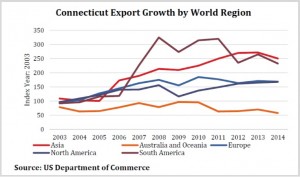
Although Connecticut still has strong trade ties with Europe and the North American Free Trade Agreement (NAFTA) countries (Canada, Mexico), there has been “an obvious shift in export growth among its trading partners.”   From 2013 to 2014, Connecticut exports to South America and Asia increased overall, while exports to Europe, Oceania, and the rest of North America (mostly Canada and Mexico) were “generally flat.”

From 2003 to 2014, Connecticut exports to Asia increased by 182 percent, faster than exports to any other region, according to the data.   Economic growth in Asia was primarily driven by growth in China.exports

The shift in Connecticut export locations “can be partially explained by demand changes in regions that Connecticut trades with,” the report explains, citing changes in the appetite for exports in Europe and Asia. Europe, for example, has “experienced economic weakness since 2008 and has not fully recovered. It has been particularly hit hard by credit market constraints and unemployment, which has reduced consumptions levels, and thus demand for imported merchandise, the CERC report pointed out.

Looking ahead, the CERC analysis anticipates that Connecticut exports “may slow or remain flat” because of “weaker demand in Europe, where the majority of Connecticut exports currently go to; and Asia, which received the second largest amount of Connecticut exports in 2014.”

CERC logoCERC is a nonprofit corporation and public‐private partnership that provides clients with objective research, marketing and economic development services. The organizations mission is to “provide services consistent with state strategies, leveraging Connecticut’s unique advantages as a premier business location.”

The report was developed by the CERC Research Department, including Alissa DeJonge, Carmel Ford and Matthew Ross.

Boston Children’s Hospital Delights with Interactive Wall Developed at UConn

It lives in Boston, but was built at UConn.  Boston Children’s Hospital’s recently installed Interactive Media Wall is an immense, high-tech, engagingly interactive product of the University of Connecticut’s Digital Media and Design program – a collaboration of students and faculty that is bringing smiles to children and families who encounter the massive 30-foot wall in the facility’s reconstructed lobby. For a team of animators accustomed to designing for screens a few inches across, the task of designing a scene three stories high was daunting – but a challenge they took on energetically.  The electronic wall consists of a large high-definition video screen, and a series of cameras and sensors that observe the presence and movement of people in the space below it, allowing people entering the space to control what appears on the screen.  It can be a powerful experience, for children and adults, as their movement defines the action on screen.BCH-Still-2

Rather than just showing a pretty picture, the wall hopes to offer some therapeutic benefit to the children who interact with it, in support of the mission of the hospital, which is widely considered one of the best pediatric hospitals in the world.

“The idea was to empower emotionally and physically challenged children to take control of something in their life, at a time when things were spinning out of control,” Tim Hunter, Department Head of Digital Media & Design and Director of the Digital Media Center told UConn Today.

How did a major healthcare facility in Boston connect with Connecticut’s flagship university for the project?

Prior to joining UConn’s faculty in 2007, Hunter spent 25 years developing and producing national and international design projects through his New York City based company. His areas of expertise are in digital animation design & production, digital media design & production, lighting design, scenic design and video projection design.

Through that firm, he had worked for many years with Boston-based Elkus/Manfredi Architects, which in turn worked with Boston Children’s Hospital on various projects.  When the project to renovate the facility’s lobby came along, the architects suggested that hospital leadership contact Hunter to see what he would envision as a centerpiece, interactive experience. media_nx

It was a good match.  Initial work began on the project at UConn in the fall of 2011, accelerating during the spring 2012 semester.  Plans called for the UConn Digital Media Center faculty and students to develop a unique imaging and sensing system that would be controlled by guests of the hospital as they traveled through the lobby.  The work was completed in mid-November 2014, and has been well-received by patients, visitors and staff, earning a not-to-be-missed following.

The UConn team drew on the expertise of faculty members from a broad range of disciplines. Experts in child psychology, in human behavior, and in several disciplines of computer science and engineering contributed to the development of the installation.

That kind of collaboration was critical to the success of the wall, says Hunter, even though such projects are not usually developed at an academic institution. “A university is not the first place you would look for something like this,” said the industry veteran-turned-educator.

logoAmong the students participating in the project were William Pritchard, interaction design and project management; Somaiyeh Ghaffarnia, animation and character development; Sean Dexter, 3D animation; Kevin Richetelli, 2D animation; Samantha Menza, game design; Tom Lee, game design and music composition; and Tiffany Hoang, game design. Prtichard and Ghaffarnia began working on the project as undergrads and continued while pursuing their graduate degrees.  The other students were undergrads.

UConn faculty involved in the project, along with Hunter, were Samantha Olschan, animation and character development; Mike Vertefeuille, technology and installation; and Zsolt Palatinus, data mathematician.  Also participating were staff member Michael Toomey, interaction design and project management, and CHIP members Tim Gifford and Christian Wanamaker, engineering and coding.

There may be more to come.  UConn’s Digital Design department – with students in Storrs and Stamford - and Boston Children’s Hospital now have an ongoing relationship, with plans for UConn to develop new interactive experiences for the next five years.

https://youtu.be/DD7gk2kHP3g

Women at Disadvantage in Seeking IPO Investments, Research Study Finds

A new study by academic researchers into decisions regarding the financing of Initial Public Offerings (IPO) of fledgling businesses has found "one significant and persistent effect on investor perceptions that did influence those evaluations—the gender of the CEO.” Even though women-owned firms represent almost half of U.S. new businesses, female founders and CEOs of start-ups fared poorly in an IPO simulation involving MBA students, the researchers found – a result of interest to Connecticut’s business start-up, venture capital, and entrepreneurial communities, at a minimum.IPO

The study found that the amount of money that participants recommended for investment in a fictionalized initial public offering for a cosmetic-surgery company was almost 4 times higher if the CEO was identified as male.  In fact, the anticipated share price of IPOs led by male CEOs was approximately 11 percent higher than those of female-led IPOs, suggesting that bias explains why successful female-led IPOs are an "extremely rare phenomenon," the researchers point out.

The paper,recently  published and now available through the Social Science Research Network, was conducted by Lyda S. Bigelow, Leif Lundmark and Robert Wuebker of the University of Utah and Judi McLean Parks of Washington University in St. Louis.McLean Parks, JudiLyda Bigelow

Skirting the Issues: Experimental Evidence of Gender Bias in IPO Prospectus Evaluations,” stresses that “given the impact of entrepreneurial activity around the world, the question of how entrepreneurs finance their ventures is a crucial question, as adequate capitalization for a new venture can make the difference between firm survival and failure. Whether a spin-off or start-up, firms that seek to grow beyond initial size at founding rely on the decisions of potential investors for the necessary financial resources.”

Given that women executives are present in the top management teams of IPO firms in increasing numbers, the lack of female-led IPO firms is a “curious fact, especially since women-owned private businesses represent almost half of the new businesses formed in the United States, with patterns of founding similar to male-owned businesses.”

In the study, using a sample of MBA students the researchers constructed a simulated initial public offering (IPO) manipulating the gender demographics of the top management team. Their results suggested that female CEOs “may be disproportionately disadvantaged in their ability to attract growth capital when all other factors are controlled.”

Despite identical personal qualifications and firm financials in the scenario, the study results indicated that:

  • firms led by females were seen as having a poorer strategic position than those led by males,
  • female Founder/CEOs were perceived as less capable than their male counterparts, and
  • IPOs led by female Founder/CEOs were considered less attractive investments.

“The disparity is significant, as is its potential economic and social impact,” the researchers state. “If companies led by females are disadvantaged in their ability to raise cash through the stock market, it can impact the viability and financial health of their companies, their ability to expand and compete in an increasingly global and competitive environment, and if they are unable to remain viable, their employees’ livelihoods.”

The 43-page research report also suggests that gender bias may extend beyond IPO’s to other disciplines within the financial world, and urge additional study.

Future research, they suggest, “could explore whether or not these findings extend to financial professionals such as bank loan officers or venture capital investors, and could investigate the role that prior experience plays in that process. This is an important question, as financial professionals, making investment decisions for individuals and institutions, control enormous amounts of money (for example, the combined assets of the nation’s mutual funds exceed $7.4 trillion, retirement funds exceed $2.7 trillion, closed end funds exceed $20 billion and exchange traded funds weigh in at $174 billion,” the research team pointed out.

Photos:  Judi Parks (left), Lyda Bigelow