

State Data Plan, Technology Board, Review of Agency Data Required by Approved Legislation
/Connecticut’s commitment to advancing the use of, and public access to, electronic data was nudged forward during the just-concluded legislative session. The legislature approval a plan to put into law – and expand – an Executive Order by Governor Malloy issued four years ago that had increasingly made open data a state government priority. The legislation establishes data requirements for executive branch agencies, including authorizing the state’s Chief Data Officer (CDO) to direct agencies on data-related topics, requiring a biennial state data plan, and establishing a Connecticut Data Analysis Technology Advisory Board. It was approved without opposition by the House and Senate in the final week of the 2018 General Assembly session.
The plan authorizes the Office of Policy and Management (OPM) to designate an existing employee to serve as the CDO to direct executive branch agencies on data use, management, sharing, coordination, and formulation of the state data plan and transparency plans. It also requires executive agencies to annually inventory their data assets and submit the inventory to OPM, and requires OPM to continue operating and maintaining the Open Data Portal.
In regard to executive branch agencies, the legislation defines “high value data” as any data that the department head determines can increase an agency's accountability and responsiveness, improve public knowledge of an agency and its operations, further its core mission, or create economic opportunity; is critical to the agency's operation, frequently requested by the public, or used to satisfy any legislative or other reporting requirements; or responds to a need and demand identified through public consultation.
So-called “protected data” means any data, the public disclosure of which would violate federal or state laws or regulations; endanger the public health, safety, or welfare; hinder the operation of the federal, state, or municipal government, including criminal and civil investigations; or impose an undue financial, operational, or administrative burden on the executive branch agency. It includes any records that are exempt from disclosure under the Freedom of Information Act.
Executive branch agencies will be required to designate one employee in each agency as the agency data officer, to serve as the agency point of contact for inquiries, requests, or concerns regarding access to data. The agencies must develop an open data access plan, in a form prescribed by OPM, and detail the agency's plan to publish, as open data, any public data that the agency has identified and any protected data that can be made public through aggregation, redaction of individually identifiable information, or other means sufficient to satisfy applicable state or federal law or regulation.
Non-executive branch agencies, quasi-public agencies, and municipalities would be permitted to voluntarily opt to comply with the open data provisions and requires OPM to publish on its website an updated list of all agencies that are complying with the policy, whether voluntarily or because they are mandated to do so. The state data plan can include recommendations concerning data management for the legislative or judicial branch agencies, but the recommendations are not binding on these agencies, according to analysis by the Office of Legislative Research.
The legislation (HB 5517) creates a 16-member Connecticut Data Analysis Technology Board to, among other things, advise the three branches of state government and municipalities on data policy. The board members, to be appointed by legislative leaders by July 1, must have professional experience or academic qualifications in data analysis, management, policy, or related fields. Ex-officio members are to include representatives of the Commissioner of Administrative Services, executive director of the Freedom of Information Commission, Attorney General, Chief Court Administrator, State Librarian, State Treasurer, Secretary of the State, State Comptroller and the state’s Chief Data Officer. The Board’s first meeting would be this summer, and they will be required to meet at least twice annually.
By November 1, 2018 and every two years after, the new legislation requires the CDO to submit a preliminary draft of the plan to the Connecticut Data Analysis Technology Advisory Board which must then hold a public hearing. A state data plan, to be completed by December 31, 2018 and biennially thereafter, requires inclusion of the information technology-related actions and initiatives of all executive branch agencies, including the acquisition of hardware and software and the development of software. It is to include specific, achievable goals within the two years following adoption of the plan, as well as longer term goals and a timeline for a review of any state or federal legal concerns or other obstacles to the internal sharing of data among agencies, including security and privacy concerns.
The legislation also expands the scope of LEANCT, a statewide process improvement initiative as well as state agencies' ability to suspend paper filing or document service requirements when an electronic filing system is established.
Executive Order 39, the basis for many of the legislation’s provisions, established open data requirements for executive branch agencies and established the Connecticut Open Data Portal and the position of Chief Data Officer. It was signed by Gov. Malloy in February 2014.
 state with a lower rate was Massachusetts.


 Once every 19 minutes, a senior citizen in America dies as a result of injuries sustained during a fall. The older Americans became, the greater their risk of dying from a fall. In 2016, there were 15.6 fatal falls for every 100,000 Americans between the ages of 65 and 74. Among adults ages 75 to 84, there were 61.4 such deaths per 100,000 people. And for those ages 85 and up, there were 247.9 fatal falls per 100,000 people.



 Conversations on Health Care
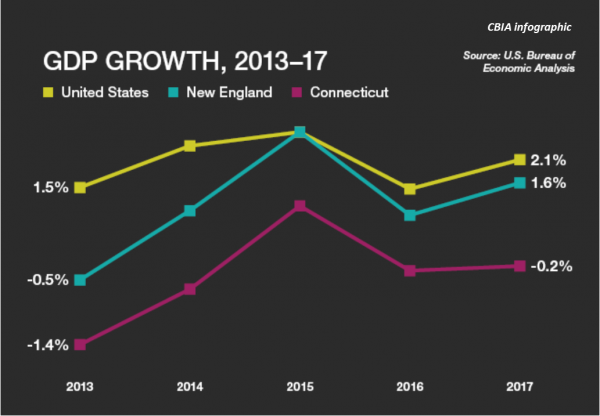
 y contracted by 0.9 percent annually while Massachusetts and New York grew by 1.6 percent and Rhode Island by .6 percent, according to data from the U.S. Bureau of Economic Analysis.
 numbers has not meant economic growth.

 The Superlative Award for “Most Improved Pitch” was won by


 “We understand, by all accounts, many of them may be using products that closely resemble a USB flash drive, have high levels of nicotine and emissions that are hard to see. These characteristics may facilitate youth use, by making the products more attractive to children and teens. These products are also more difficult for parents and teachers to recognize or detect. Several of these products fall under the JUUL brand, but other brands, such as myblu and KandyPens, that have similar characteristics are emerging.”

 Manufacturing, the sector with the most losses since 2012, is down 8,600 jobs in the five-year period. Educational Services employment (public and private) which has long been a sector with employment growth, declined during the 2015 to 2017 period, influenced by decreases in school-aged population and state and local budget issues.

 “At Pratt & Whitney, we are in a very competitive industry and our continued success depends on our people driving innovation into every part, process and service,” said Carter. “Our customers have depended on Pratt & Whitney innovators literally for generations, and with the GTF, they can continue to count on us for the next generation.”
 nation at the forefront of global technology and economic leadership.

 The Summit will feature nearly a dozen sessions and speakers, many from local businesses, highlighting best practices and latest developments in a range of technology arenas.


 Women working full-time, year-round have the highest earnings in the District of Columbia, where women’s median annual earnings are $65,000. Connecticut, Maryland, Massachusetts, and New Jersey are tied for second, with women in those states earning $50,000 at the median.





















