Weston, New Canaan Among Nation’s Richest Zip Codes

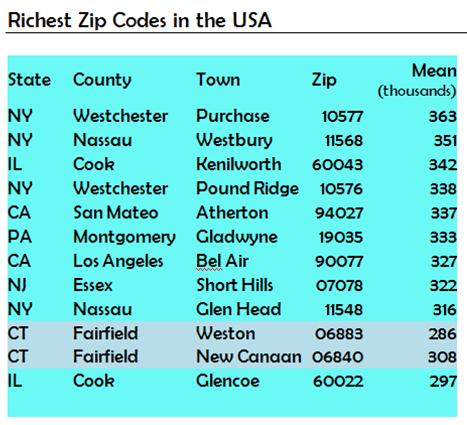
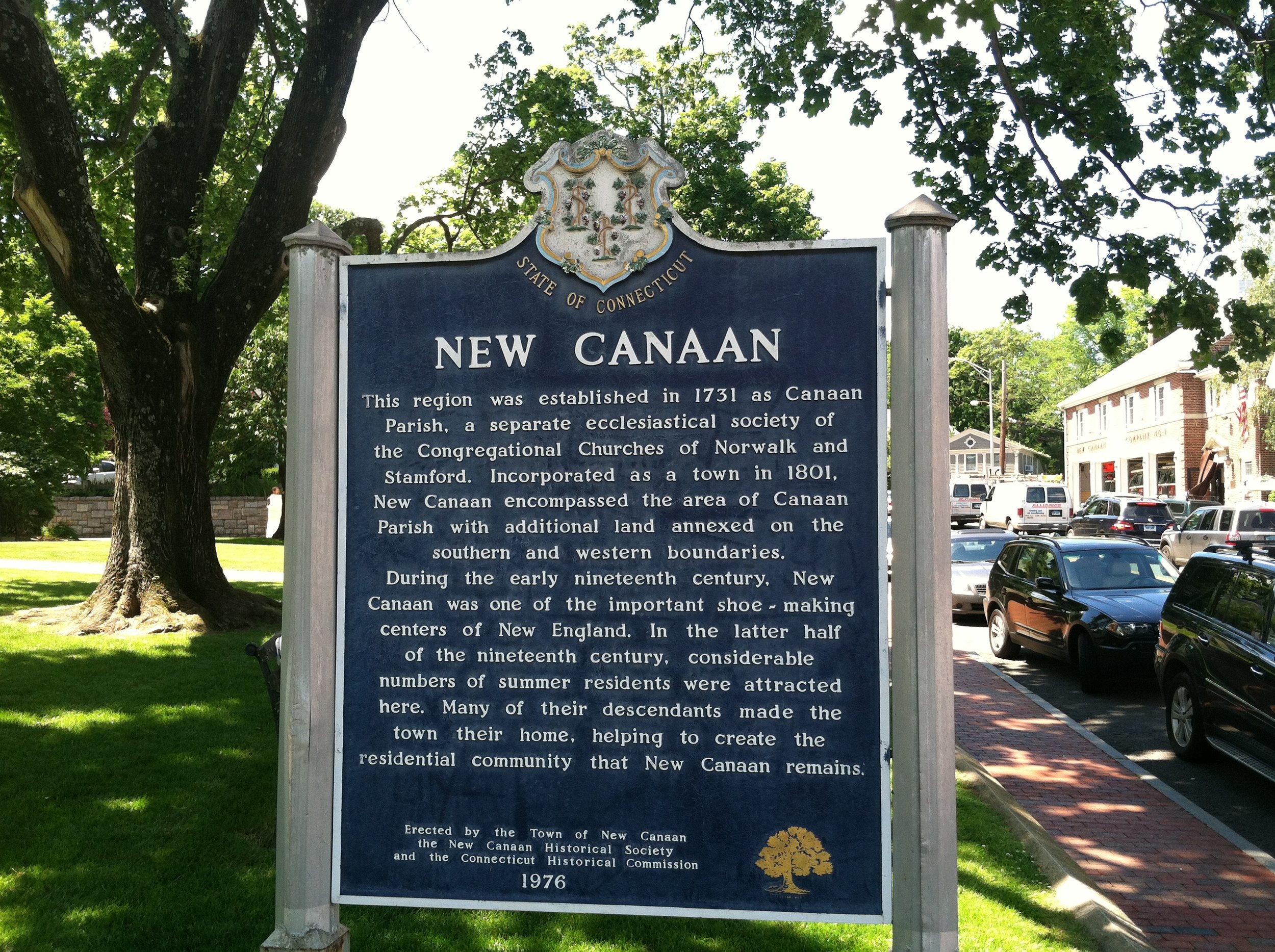
Weston and New Canaan are among the richest zip codes in the nation, according to an analysis by a University of Washington researcher.  Based on data from the U.S. Census Bureau’s American Community Survey, the batting order of the nation’s richest zip codes includes the two Fairfield County communities – Weston at #10 and New Canaan at #11.

zip codesThe zip code with the highest and the 4th highest incomes are in Westchester County, close to the Connecticut border. The second richest, Westbury, is in Nassau county, New York, which also has the 9th richest. Also in the New York City suburbs are the 8th, in New Jersey just 20 miles west of New York, while 10th and 11th richest are both located in Fairfield County, according to Richard Morrill, Professor Emeritus of Geography and Environmental Studies at the University of Washington, who outlined his research in newgeography.com.

The top 10 communities, by zip codes, are Purchase, N.Y.; Westbury, Long Island; Kenilworth, Illinois, Pound Ridge, N.Y., Atherton, California; Gladwyne, Pennsylvania; Bel Air, California; Short Hills, New Hersey, Glen Head, Long Island; followed by Weston and New Canaan.

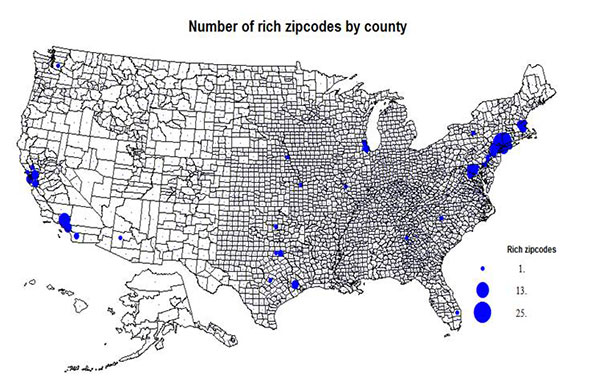
“The most astounding thing about the map,” (which shows the “rich” zip codes by the county they are part of) Morrill points out, “is their  concentration  in a few areas, led by the country’s premier global city, greater New York city, with 75 of the 170.”  New York is followed by Washington DC with 23, another sign of the growing wealth of the national capital.  Boston follows with 10, Los Angeles, 18, San Francisco (14), and Chicago (6) and then a scattering in other leading metropolitan areas.

Morrill also looked at unequal income zip codes, where income disparity was most pronounced, and poor zip codes, which often included areas with a large student population, such as Storrs, which masked thrich zip codese income level of the overall population of the zip code. Among the poorest of the inner city poor areas, the data indicated, were in Los Angeles, Waterbury, CT; Portland, OR; and Youngstown and Canton, OH.

 Morrill's research focuses on political geography (voting behavior, redistricting, local governance), population/demography/settlement/migration, urban geography, and planning, and urgan transportation.  He concluded that “the zip code data provide a partial, highly localized look at the geography of inequality,” adding that “if American society continues to accept extreme income, the geography of inequality will only become not only more extreme, but more pronounced in a diverse set of locations.”

new canaan

FI-weston-sign-lamp-flag-go1-300x180

More Children in Poverty, Less State Spending For Children, Reports Reveal

The percent of children in poverty in Connecticut increased to 13.2 percent, up from 10.4 percent in the 2000 Census, according to advocacy organization Connecticut Voices for Children, which analyzed data  in the U.S. Census Bureau’s American Community Survey (ACS) covering 2008-2012.  The statewide increase in poverty among children reflects significantly increased child poverty rates in 30 cities and towns, and decreased poverty rates for children in only 12 communities.

Income disparities among Connecticut’s communities are also clearly reflected in the data.  In Hartford, for example, the percentage of children in poverty reached a state high of 45 percent and the adult poverty rate hit 33 percent, while at the other end of the spectrum, the rate in Canterbury was less than 1 percent among children and less than 3 percent among adults.

After Hartford, the percentage of children living in poverty was at its highest in the state’s urban and rural communities:  New Haven topped 37 percent, in Waterbury 34 perckidsent, New London 29 percent, Cornwall, 27 percent, Norwich 23 percent, Meriden 22 percent, East Hartford and Preston, both at 21 percent, Stamford and Kent, both at 13 percent, and Danbury 12 percent.

The following 30 towns had statistically significant increases in the percent of all children in poverty: Ansonia, Avon, Berlin, Branford, Bridgeport, Cornwall, Danbury, Darien, Derby, East Haddam, East Hartford, East Haven, Enfield, Hartford, Harwinton, Litchfield, Meriden, Middletown, New Britain, New Hartford, New Haven, Norwich, Plymouth, Preston, Stamford, Vernon, Waterbury, West Haven, Windham, and Windsor Locks.

The following 12 towns had statistically significant decreases in the percent of children in poverty: Barkhamsted, Canterbury, Columbia, Granby, Hamden, Morris, Old Lyme, Salisbury, Sharon, Thomaston, Winchester, and Woodbridge. voices logo

The percent of all Connecticut residents in poverty increased to 10.0 percent according to the ACS data, up from 7.9 percent in Census 2000 (1999 figures).  Because the ACS is based on information gathered from a sample of local residents, the "sample size" in each town can be small in any one year.  The Census Bureau, therefore, averages together five years of data to create more reliable estimates.

In another report issued early this year, it was revealed that over the past two decades, Connecticut has committed less and less of its state budget to young people, according to the Fiscal Policy Center at Connecticut Voices for Children.

The report finds that spending on the “Children’s Budget” – state government spending that directly benefits young people – has dropped from 40% of the state budget in Fiscal Year 1992 to 30% in the current budget year (FY 2014). Spending on education has fallen by about a third -- from 26% of the state budget to 19% between Fiscal Years 19American Community Survey92 and 2014. The report, “Introducing the Children’s Budget,” is available on the Connecticut Voices for Children website at www.ctvoices.org

Connecticut Voices for Children is a research-based think tank that advocates for policies that benefit the state’s children and families.  Based in New Haven, the organization advances its mission through high quality research and analysis, strategic communications, community education, and development of the next generation of advocates.

Seven Communities Earn Grants to Strengthen Downtowns

Connecticut Main Street Center (CMSC), the downtown revitalization and economic development non-profit, has selected seven organizations and municipalities to receive a total of $70,000 in  Preservation of Place grants this year.

The 2014 grants will be used to provide Connecticut communities in Bridgeport, Canton, Essex, New London, Norwalk, the Northwest corner, and Willimantic with targeted resources to increase their capacity to plan for preservation and revitalization initiatives in their downtowns and neighborhood commercial districts.

The PreserCT Main Street LOGOvation of Place grant program provides a source of funding for new initiatives that can be integrated into, and leverage, comprehensive Main Street preservation and revitalization programs. The funds are meant to be flexible to meet individual community need.

"Historic preservation and the revitalization of our Main Streets create jobs, bring vacant buildings back on the tax rolls and add value and vitality to adjacent buildings and neighborhoods," said John Simone, CMSC President & CEO. "This year's winners are taking steps to implement these types of positive changes by proactively planning for the growth and improvement of their downtowns."

The selected organizations or initiatives will receive between $5,000 and $14,500 in Preservation of Place grant funds:

  • ·         Bridgeport Downtown Special Services District, for the creation of a plan that will use open spaces to facilitate creating placemaking in downtown Bridgeport
  • ·         Town of Canton, for the development of Collinsville Village Zoning Regulations;
  • ·         Town of Essex, for a Centerbrook Visioning & Action Plan;
  • ·         New London Main Street, for an organizational and leadership development and capacity-building plan,
  • ·         Norwalk 2.0, for the Freese Park Artist Village Plan;
  • ·         Northwest CT Regional Planning Collaborative, for Active Main Street: Enlivening Village Center Public Spaces;preservation of place
  • ·         Thread City Development, Inc. (Willimantic), for an organizational and leadership development plan.

"The diversity of locations, from the Northwest Corner of Connecticut to New London, matched with the diversity of projects, from creative placemaking in urban open spaces to organizational and leadership development that will improve the management function in downtown, will allow each community to respond to their greatest current need, actively creating their direction of growth," Simone said.

Since 2008, CMSC has awarded $376,130 through the Preservation new londonof Place grant program to twenty Connecticut communities, leveraging $842,727 in local Main Street initiatives. The program receives support from the State Historic Preservation Office with funds from the Community Investment Act.

Nearly Half of States Pushing Minimum Wage Higher Than Federal Level

Gov. Malloy’s proposal for Connecticut to raise its minimum wage to $10.10 by 2017 would extend the state’s longstanding status as consistently above the federal minimum wage.  But Connecticut is far from alone in outpacing the federal government.  The current federal minimum hourly wage is $7.25.

Data from the Pew Research Center and USA Today indicates that no fewer than 21 states have set higher minimums, ranging from $7.50 in Missouri to $9.32 in Washington State. Those states collectively include 45% of the nation’s working-age (16 and over) individuals, according to 2013 data compiled by Pew.  It is expected that by thestate wage rates end of 2014, an additional nine states may be above the federal minimum, marking the first time minimum pay in most states will be above the federal level, according to the National Employment Law Project, as reported by USA Today.

Thirteen states raised their minimum wage on January 1, 2014, including Connecticut.  On January 1, Connecticut's minimum wage moved from $8.25 to $8.70, the first of two scheduled increases in the state’s minimum hourly wage. A second increase is set to follow on January 1, 2015, bringing the state's minimum wage up to $9.00 per hour, based on legislation approved last year.   Malloy’s newly proposed three-year incremental increases would continue to bump up the hourly minimum through 2017.

Last February, a Pew Research Center survey found that 71% of people favored an increase in the federal minimum to $9.00/hour from $7.25. USA Today has reported that as many as 11 states and Washington, D.C., are expected to consider increases in 2014.

Adjusted for inflation, the federal minimum wage peaked in 1968 at $8.56 (in 2012 dollars), according to Pew researchers. Since it was last raised in 2009, tNewMinimumWageDistributiono the current $7.25/hour, the federal minimum has lost about 5.8% of its purchasing power to inflation, Pew points out.

Just over half (50.6%) of the 3.55 million U.S. workers who were at or below the federal minimum in 2012 were ages 16 to 24; an additional 20.3% were ages 25 to 34.  Pew indicated that both shares have stayed more or less constant over the past decade. The 3.55 million represents about 2.8% of all wage and salary workers.

An estimated 70,000 to 90,000 workers out of Connecticut’s total workforce of 1.7 million earn the minimum wage. It has been reported that a Connecticut resident working full time this year at minimum wage will make $18,096.  

The Bureau of Labor Statistics, which tracks the federal and state minimum wages, indicates that in 2000 the federal minimum was $5.15 and Connecticut’s was $6.15.  A generation ago, in 1972, the federal minimum wage was $1.65; Connecticut was at $1.85.

2014 increases

Connecticut Talks Issues at Forums, Conferences Across State

The Connecticut legislature, now underway for 2014, is not the only place for conversation on key issues impacting Connecticut.  A range of news organizations, nonprofits, associations and community-based groups are sponsoring forums, summits and sessions to better-inform the public and bring interest and attention to specific issues.  Among them:

February 10  - Hartford’s Edgy Arts, Mark Twain House & Museum

The Hartford area attracts an array of creative people from actors to musicians, poets to painters.  What is it that so draws artists?  What to they need to flourish here?  A discussion of the creative economy, in the Capitol City.  Refreshments at 5:30; panel discussion at 6:15.  Advance articles published in The Hartford Courant; a program of Hartford Young Professionals & Entrepreneurs (HYPE), FOX Connecticut and The Hartford Courant.

February 20 - Pay-for-Success Informational Conference, Legislative Office Building

National leaders from the emerging field of Pay for Success will be speaking, with a focus on three key elements: 1) Offering high-quality preventative services; 2) Requiring rigorous measurement of results; and 3) Capturing savings or avoided costs. The 2014 Pay-for-Success (PFS) Informational Conference, 10:00-12:30 PM, will offer interested stakeholders the chance to discuss the field with leaders from around the country, while hearing about projects underway in the areas of early childhood, juvenile recidivism, health care and workforce development.  Sponsoring organizations include BlumShapiro, Connecticut Institute for the 21st Century, Capitol Region Council of Governments, Connecticut Center for Social Innovation, Community Impact Strategies Ltd, and Connecticut Association for Human Services.

February 24 -  The Knowledge Economy; Connecticut Conference of Independent Colleges, CT Mirror, Quinnipiac University

Connecticut is home to almost 50 colleges and universities and has created an industry in surrounding towns and cities. What is expected as we continue into the 21CCICst Century? Join the Connecticut Conference of Independent Colleges and The Connecticut Mirror in the lively discussion, "The Knowledge Economy," on Monday, Feb. 24 , from 7-9 p.m., in the auditorium at the Quinnipiac University Frank H. Netter MD School of Medicine. This event is free and open to the public. No registration is necessary.  Panelists include Sal Filardi - Vice President, Facilities & Capital Planning, Quinnipiac University; Rich Jacob - Vice President for Federal and State Relations, Yale University; Todd Andrews - Vice President for Economic & Strategic Development, Goodwin College and Jeff Seemann - Vice President for Research, UCONN.

February 26 - Vital Voices in Entrepreneurship, Goodwin College

A special speaGoodwin-College-B8665EC3ker series focused on the first-hand perspectives of leaders making a mark in business and the community. The next event at Goodwin College's Community Room on February 26 will feature Stew Leonard, Jr., President and Chief Executive Officer of the unique, family-owned and operated farm fresh stores, Stew Leonard's. The keynote address will commence at 6:00 p.m., preceded by a networking reception at 5:00 p.m. with wine, beer and hors d'oeuvres.

February 28 – Retrofitting Our Towns:  Can We Add Density, Affordability and Walk-ability to Help Municipalities Survive…And TPrinthrive?  The Lyceum, Hartford

Can suburbs and smaller towns reshape and respond to the demographic, economic and lifestyle pressures of the 21st Century?  One of the nation’s leading experts – Lynn Richards of the EPA Office of Smart Growth – assesses four Connecticut municipalities and offers lessons for all the others.  Program 9:00-111:00 AM.  Sponsored by the Connecticut Main Street Center, Partnership for Strong Communities and the American Planning Association - Connecticut.

March  Ct-forum7  - An Honest Look at Mental Illness, Connecticut Forum, The Bushnell

The Connecticut Forum presents a conversation about perceptions, realities, and what it’s like to work and live with the stigma of mental illness.  Panelists include journalist and mental health advocate Andrew Solomon, Dr. Hank Schwartz, Chief of Psychiatry at Hartford’s Institute of Living, former NBA player Royce White and bipolar disorder authority Dr. Kay Redfield Jamison.   Founded in 1992, The Connecticut Forum is a one-of-a-kind 501(c)(3) nonprofit organization serving Connecticut and beyond with live, unscripted panel discussions among renowned experts and celebrities, and community outreach programs including the award-winning Connecticut Youth Forum.

March 14 – Hartford Business Journal Municipal Collaboration Summit, Goodwin College

An opportunHBJity to learn about the benefits of collaboration which save money and leverage the purchases and agreements for towns.  The event will highlight people that are already implementing positive changes.   Panel discussions, workshops and Q&A with key leaders and a panel of experts.

March 26 - Student Debt and Financial Aid: What (if anything) can we do?, Southern Connecticut State University

Sponsored by the Center for Higher Education Retention Excellence, 9AM-3PM, at Southern Connecticut State University, featuring Sandy Baum, Research Professor of Education at the George Washington School of Education and Human Development and Senior Fellow at the Urban Institute, and  panel of Connecticut financial aid directors (representing a public university, community college and private college) and a student panel.  Registration now available; limit 75 attendees.

Land of Steady Habits: CT Ranks #37 in Divorce Rate

Connecticut’s divorce rate ranks the state #37 in the nation in the percentage of residents who are divorced.  According to the U.S. Census Bureau’s American Community Survey, 10.6 percent of state residents are divorced, 1.4 percent are separated, and 48.2 percent are married.

The highest divorce rate was in Nevada, at 14.6 percent.  Right behind Nevada are Maine (14.2 percent), Oklahoma (13.5 percent), Oregon (13.4 percent), Arkansas and West Virginia (13.3 percent), Florida and Kentucky (13.2 percent).

The lowest divorcDivorcee rates were in New Jersey, 8.6 percent, New York, 8.8 percent, and the District of Columbia, 9.2 percent.  Utah, Pennsylvania, and Hawaii were tied at 9.5 percent.

The state with the highest percentage of the population married was Utah, at 55.7 percent, followed by Idaho (55 percent) and Wyoming (52.9 percent).  Connecticut has the 31st highest percentage of married people among the states, at 48.2 percent.  The state was in a tie for 11th in percentage of population who were separated.

The U.S. Census data was from calendar year 2012, the most recent data available comparing states, and was reported by Bloomberg Visual Data.

Norwalk’s Rowayton Is Ranked #6 “Happiest Seaside Town” in America

What better time than in the midst of a three-snowstorm-week to learn of the top 10 “happiest seaside towns in America,” and discover  that Rowayton, Connecticut placed at #6 in the list compiled by Coastal Living magazine.  Rowayton – a section of Norwalk – was sandwiched between higher profile communities of Newport and Kennebunkport among the leading happy seaside towns, in the 2013 list.

“This picturesque, sophisticated New England coastal village at the mouth of Connecticut's Five Mile River is straight out of a Norman Rockwell illustration,” the magazine reported.  “No wonder Rosignpicwayton, with its clapboard and shingle homes perched along its rocky shorelines, has lured artists for centuries.  In fact, many New Englanders don't even know this gem, making it all the more dear for those 4,000 or so who call it home.”


The write-up about Rowayton concludes “But art—and beauty—does come at a price. It's one of the most expensive spots in the state (as well as the nation). And yet this village has a low-key sensibility, with pizza joints, ice-cream parlors, and a volunteer fire department.”

Rowayton is in good company, among higher profile locales earning a place amongst the top 10:

  1. Beaufort, South Carolina
  2. HarwichPort, Massachusetts
  3. Sanibel Island, Florida
  4. Sag Harbor, New York
  5. Newport, Rhode Island
  6. Rowayton, Connecticut
  7. Kennebunkport, Maine
  8. Pa’ai, Maui, Hawaiihappy-towns-rowayton-0613-l
  9. LaJolla, California
  10. Pescadero, California

The Rowayton section of Norwalk is located on Long Island Sound, just 45 miles from New York City. Formerly independent, today Rowayton is the Sixth Taxing District of the City of Norwalk. Norwalk is unique among the municipalities of Connecticut in its manner of governance - and the manner in which the various public utilities, cultural assets and tax structures of a half-dozen distinct communities were joined together to form the City of Norwalk in the 1920's, according to the Rowayton Library website.

Picturesque Rowayton lies at the mouth of the Five Mile River, adjacent to Darien.. With a population of under 4,000 in approximately 1,500 households, Rowayton has kept it's village-like character, including its volunteer fire department - the only remaining volunteer department in Norwalk.

With 10 issues published each year, Coastal Living introduces readers to homes, destinations, activities, and people along the Atlantic, Pacific, and Gulf shores of North America. Hawaii, Alaska, coastal Canada and Mexico, as well as the multi-national Caribbean islands and U.S. Great Lakes, are included in the magazine’s scope.  Coastal Living.com is described as “the No. 1 online authority for those captivated by the coast ―and your quintessential resource for celebrating its unique charm, customs, and way of living.”

Hartford as Global City: Immigrant Civic Engagement Initiative Gains Recognition

Hartford is quite an international city, a melting pot of cultures and backgrounds that most assume is the exclusive province of major metropolitan areas such as New York and Boston.  But in language, nation of origin, and cultural traditions, virtually every corner of the globe is represented in Connecticut’s Capitol City, and its surrounding communities.

In fact, Hartford is a popular resettlement city, with about 25 percent of the city’s population recent immigrants.  To respond to the significant need among the various immigrant communities for assistance and guidance in navigating language barriers and cultural differences and more fully integrating into their new home community, a partneHartfordPublicLibraryPicturership of Hartford-based organizations stepped up in a way that has proven quite effective, and is gaining national recognition.


The Hartford Public Library received funding in 2010 for an Immigrant Civic Engagement Project through the Institute of Museum and Library Services (IMLS), to develop a comprehensive program to promote immigrant civic engagement.  The initiative had two goals:globe

  • Facilitate the transition of newly arrived immigrants into the community and build trusting relationships of mutual understanding between new and longtime residents
  • Engage established immigrants in civic integration and facilitate their involvement in broader community building efforts

At the annual conference of the international Association for Research on Nonprofit Organizations and Voluntary Action (ARNOVA), hosted recently by Hartford and held at the Connecticut Convention Center, the leaders of the ground-breaking Hartford partnership were called upon to lead a session to outline their work for those who may seek to emulate it in other communities across the country.

Among the presenters was Richard Frieder, Director of Community Development & Civic Engagement within the Cultural Affairs & Public Programming Department and Center for Civic Engagement of the Hartford Public Library.  Frieder was joined by Homa Naficy, Chief Adult Learning Officer and Nancy Caddigan, Intercultural Liaison of the Hartford Public Library, and Kyle Barrette and Rebecca Thomas of the UConn School of Social Work.

Innovative Approaches, Impactful Outcomes

Their session, called “Innovative Approaches to Community Development in a Challenging Economy and Changing Society,” was well-received by conference participant from across the country.  They focused on “effectiveness, evaluation and programs,” outlining what was done and why – and how it all worked.

  • They described an effort that engages immigrants and “receiving” community members, social service providers and other immigrant advocates, highlighting the importance of building networks of trusting relationships.
  • The initiative provided an opportunity to address immigrant voices isolated from the mainstream, respond to language and economic barriers, and address the lack of engagement in community and civic associations.
  • The program featured “cultural navigators” – some of them bilingual - and community dialogues – held at the Library’s American Place - all aimed at improving the immigrant experience in Hartford.

Most of all, it created bonds between existing members of the community – many of them retired teachers and social workers who volunteered to be “cultural navigators” – and immigrants looking to adcivic engagementjust to their new land.

New connections were developed between city officials, organizations and service providers to the immigrant and refugee community, and both the immigrant community and receiving community became engaged in community building.  There was also outreach to churches, community centers and other neighborhood organizations.

Over three hundred people were involved across all activities of the three year project.

The outcomes were substantial, and included the development of strong relationships, an increased awareness of immigrant issues, integration of immigrant and refugee families within their local communities, and increased social capital for immigrant as well as receiving communities.  In addition, action teams focused on new community projects, municipal and organizational investment in immigrant and refugee issues was enhanced, and a City Commission on Immigrant Affairs was established.Hartford_CT

UConn School of Social Work students, as part of the grant-funded initiative, served as program evaluators, maintaining a rigorous evaluation of outcomes, and an audit trail of activities so that the entire project could be replicated.

At the end of the day, organizers hope that the program has effectively “changed the way that people think about immigrants – and the Capitol City.”  Hartford is a global community.  And it has produced a program that can help immigrants here and elsewhere to settle in and excel.

From Connecticut, Only Hartford Region Reaches Top 50 Best Cities for Job Growth

The rankings of Best Cities for Job Growth don’t place Connecticut’s major metropolitan areas  within reach of the top of the list.47

Among the nation’s large-sized cities, "Hartford-West Hartford-East Hartford" made the top 50, ranking at #47 in the latest list from the website newgeography.com.  Leading the 2013 list were metropolitan San Francisco, greater Nashville, and Salt Lake City.  The rankings used four measures of growth to rank all 398 metro areas for which full data sets were available from the past 10 years.hartford  The Hartford region dropped four slots from the 2012 rankings.

New Haven ranked at #65 among the medium-sized cities, just behind Fresno, California and Scranton-Wilkes-Barre, Pennsylvania.  Leading the list were Boulder, Colorado and Provo-Orem, Utah.  The highest ranked New England community was Framingham, Massachusetts, at #30.  The only other city from the region to reach the list was Springfield, Massachusetts, at #91.  65

Among the leading Small Cities, Danbury was the highest ranked in Connecticut at #111, with Waterbury at #223, and Norwich-New London at  #233, on a list of 241 small cities.  Topping the list were Midland and Odessa, Texas followed by Columbus, Indiana; Cleveland, Tennessee; San Angelo, Texas and Owensboro, Kentucky.

"Large" areas include those with a current non-farm employment base of at least 450,000 jobs. "Midsize" areas range from 150,000 to 450,000 jobs. "Small" areas have as many as 150,000 jobs. The rankings reflect the current size of each MSA’s employment. Only two MSAs changed size categories, with Honolulu, HI moving from “Midsized” to “Large” and Savannah, GA moving from “Small” to “Midsized.”

In the overall rankings, Bridgeport-Stamford-Norwalk was #348, Waterbury ranked #380, and Hartford placed at #229.  All the leading Connecticut metropolitan areas dropped in the rankings in 2013, compared with 2012.

NewGeography.com, based in North Dakota and California, is a site devoted to analyzing and discussing “the places where we live and work.”   It includes “insights on economic development, metropolitan demographics, and community leadership.”  cities

The index is calculated from a normalized, weighted summary of: 1) recent growth trend: the current and prior year's employment growth rates, with the current year emphasized (two points); 2) mid-term growth: the average annual 2007-2012 growth rate (two points); 3) long-term trend and momentum: the sum of the 2007-2012 and 2001-2006 employment growth rates multiplied by the ratio of the 2001-2006 growth rate over the 2007-2012 growth rate (two points); and 4) current year growth (one point). The rankings include all of the metropolitan statistical areas (MSAs) for which the Bureau of Labor Statistics reports monthly employment data.

newgeography.com Executive Editor Joel Kotkin is distinguished Presidential Fellow in Urban Futures at Chapman University in Orange, CA and an adjunct fellow with the Legatum Institute in London. He is author of seven books including his most recent, The Next Hundred Million: America in 2050 from Penguin Press and is affiliated with the Praxis Strategy Group and the Center for an Urban Future.

Concern Over Concussions Changes Playoff, Practice Plans in CT High School Football

Concern over concussions is impacting the high school football playoff calendar, and the practice regimen throughout the season.  The Connecticut Interscholastic Athletic Conference has voted to increase to one week the minimum time between playoff games a high school team can play.  Previously, high school football games could play two games in less than a week, at times with as little as three days between games.  In making the revisions, which eliminated a quarter-final round next season, the CIAC indicated it would “continue to evaluate possibilities for changes to the regular season and postseason schedule for the 2015 season and beyond.”

In addition, the organization’s Sports Medicine Committee approved policy changes that cut back on “permitted allotment of person-to-person contact time in practice” aciacnew-300x230nd are “intended to limit live action,” including:

  • Prior to the start of the regular season a coach may conduct person-to-person contact drills up to 120 minutes during practice plus conduct one full scrimmage or seven-on-seven scrimmage per week under game-like conditions.  If a second scrimmage is conducted the time (60 minutes) must be deducted from the 120 minutes allowed.
  • From the start of the regular season through Thanksgiving a coach may conduct person-to-person contact drills up to 90 minutes per week.
  • During the post season a coach may conduct person-to-person contact drills up to 60 minutes per week.

The Hartford Courant reported that “for the first time, there will be limitations on contact drills in practice throughout the season.”football

Guidelines on the Web

The CIAC website includes an 8-page document developed  by the National Federation of State High School Associations, “A Parent’s Guide to Concussion,” which includes the admonition  (in bold type) “when in doubt, sit them out!”.  The policy was revised and approved in April 2013. CIAC is a member of NFHS, which also offers a free on-line course on the subject for coaches and administrators.

The guidelines indicate that “following a concussion, many student-athletes will have difficulty in school.  These problems may last from days to months…”   The guidelines also explain that “At this time we do not know the long-term effects of concussions (or even the frequent sub-concussive impacts) which happen during high school athletics.”

The CIAC website includes a link to the “Sports Medicine & Concussion” information under two drop-down menu categories on the organization’s website: “CIAC for Students & Parents” and “CIAC for Administrators. “  It is not listed among the “CIAC for Coaches” links.

Regarding the schedule changes, Ledyard head coach Jim Buonocore, who serves on the committee that approved the revisions, told the New London Day, "You had teams playing three games in 10 days, which is not healthy." The Day reported that quarterfinal and semifinal games were played the Tuesday and Saturday after Thanksgiving because the playoffs had to be completed in two weeks. The CIAC didn't want to extend the season another week due to weather concerns, and because it would further interfere with winter sports.

The CIAC has changed its high school football playoff format in 2010, and intends to revisit the issue, balancing the traditional Thanksgiving conclusion of the regular season with the health interests of students on teams reaching the playoffs, the realities of New England winters, and the academic and school sports calendars.

Additional information about concussions and high school sports is available from the Centers for Disease Control and Prevention.