Jepsen Stresses CyberSecurity at Home and Business, with Settlements and Warnings

National Cyber Security Awareness Month isn’t until October, but Connecticut Attorney General George Jepsen and just over a dozen of his colleagues across the country are getting a head start in warning the public about the dangers of so-called pirate websites. In televised public service announcements now airing in Connecticut, along with social media and radio psa’s, Jepsen shares hackers can infect visitors’ computers with malware and viruses that can leave consumers’ personal and financial information vulnerable.

Cyber security is a topic Jepsen has been involved with for some time.  This past March, the Attorney General announced the creation of a new department within the Connecticut Office of the Attorney General – the Privacy and Data Security Department – that works exclusively on investigations and litigation related to privacy and data security.

The new department has been responsible for all investigations involving consumer privacy and data security. It also helps to educate the public and business community about their responsibilities, which include protecting personally identifiable and sensitive data and promptly notifying affected individuals and the Office of the Attorney General when breaches do occur.

Jepsen is immediate past president of the National Association of Attorneys General (his one-year term ended in June) and has been a member of the organization’s Internet Safety/Cyber Privacy and Security Committee.

National Cyber Security Awareness Month, a month-long collaborative effort between the United States Department of Homeland Security and the National Cyber Security Alliance, began in 2004 and is held every October. During the campaign, individuals are encouraged to take advantage of resources that can help them be safer and more secure while online.

This week, Jepsen’s office announced that Connecticut has joined with 31 other states and the District of Columbia in a $5.5 million settlement with Nationwide Mutual Insurance Company and its subsidiary, Allied Property & Casualty Insurance Company, which resolves the states' investigation into a 2012 data breach that exposed sensitive personal information of 1.2 million consumers across the country. Approximately 774 Connecticut residents were impacted by the breach, the Office said. Connecticut's share of the settlement funds totals $256,559.28, which will be deposited in the state's general fund. The Connecticut Attorney General's office was a co-leader of the investigation and negotiations, along with the Offices of the Attorney General of the District of Columbia, Florida and Maryland.

In May, Jepsen announced that Connecticut joined with 46 other states and the District of Columbia in an $18.5 million settlement with the Target Corporation to resolve the states' investigation into the retail company's 2013 data breach. The settlement represented the largest multistate data breach settlement achieved to date.  That breach affected more than 41 million customer payment card accounts and contact information for more than 60 million customers. Connecticut will receive $1,012,936 from the settlement, which will be deposited in the state's General Fund.

In the new public service announcement, Jepsen stresses that “Nowadays, all of you have to worry about cybersecurity,” Jepsen tells viewers in his ad. “Hackers are always looking for new ways to break into our computers. Something as simple as visiting pirate websites can put your computer at risk.”

"State AGs often serve as the consumer protection agency for their citizens, so we appreciate the leadership they are taking in alerting consumers to the new danger that consumers face from malware and content theft websites," said Tom Galvin, Executive Director of the Digital Citizens Alliance, a consumer-focused group that looks at how to make the Internet safer. "Criminals are exploiting stolen content by baiting consumers to view videos and songs and then stealing their IDs and financial information. It should be a wake-up call for consumers."

Among the states whose Attorneys General are participating in the initiative are Arizona, Hawaii, Idaho, Indiana, Kansas, Kentucky, Louisiana, Montana, North Carolina, North Dakota, Oregon, South Dakota and Wisconsin.


https://www.youtube.com/watch?v=-r1wMnXP9Bk&feature=youtu.be

The Connecticut Attorney General's office has previously issued a series of tips for consumers:

TIP #1: When it doubt, throw it out:

Be very cautious about clicking on a link or opening an email, social media post or tweet (or its attachment) from someone you do not know and trust, and always keep virus protection software up to date. Consumers that use Facebook or Twitter should regulate their privacy settings to ensure personal information is protected and not accessible. Also, only allow those that you know into your social network rather than those that you may not recognize.

TIP #2: Watch out for phishing emails or scams:

You may do business online with financial institutions that you know and trust, however, always keep in mind that legitimate businesses will never ask you to reply in an email with any personal information such as your Social Security number, PIN number. If you question the validity of an email you received, call the number on your credit card, bank statement, or on the financial institution's actual website (which you should find online without clicking on any links in a suspicious email).  If available, always use a safe payment option when making online purchases, such as a credit card.

TIP #3: Keep your machine clean and up to date:

Online users can reduce the risk of their computers being infected with malware by keeping antivirus software up to date and having the latest versions of apps, Web browsers and operating systems. Many but not all software programs will automatically update in order to avoid risks.  Consumers should consider turning on automatic updates when available to be sure that critical updates are not missed while waiting for manual download.

TIP #4: Help to educate your children about online safety and security:

Remind your family to limit how and with whom they share any information on line.  When made available, set privacy and security settings on accounts and web browsers used by children to your comfort level for surfing the Web and information sharing.  If your browser does not support such settings, consider using one that does.  From social media to simple internet searches, it is important to talk to children about online security before they potentially confront risks on line.   

TIP #5: Regularly change and update passwords and web keys:

If you use the Internet for banking, bill-paying or other monetary transactions, be sure to select secure, difficult-to-guess passwords and PINs, and get in the habit of changing them on a regular basis whenever possible. Consumers can also protect their personal and communications data by encrypting their own wireless Internet networks and regularly changing their wifi passwords. Try not to login into any social media accounts on a public computer and if you must, be sure to never save passwords or login information.

Economic Insecurity Plagues More Than Half of Single Seniors in CT, Report Finds

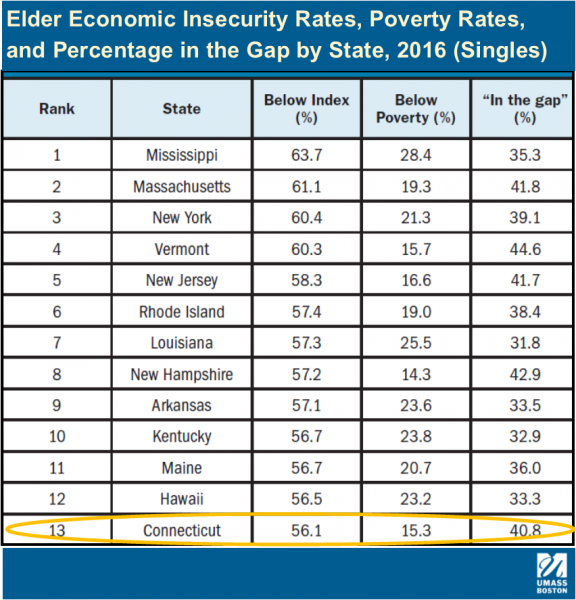
More than half of single adults age 65 and older in Connecticut can’t afford food, housing or other basic necessities, based on their income.  The “economic insecurity” of that population ranks Connecticut the 13th highest rate in the nation.  In the neighboring states of Massachusetts, New York, and Rhode Island, the situation is even worse.  Massachusetts, in fact, has the second highest rate in the nation. Nationwide, 53 percent of single older adults fall below the index’s target value.  In Connecticut, the percentage is 56.1 percent.

The report, Living Below the Line: Economic Insecurity and Older Americans Insecurity in the States 2016, was published by the Center for Social and Demographic Research on Aging Publications at the University of Massachusetts Boston’s Gerontology Institute.

According to the report’s analysis, only about 15 percent of older Connecticut residents living alone fall below the poverty line, but 56.1 percent don’t make enough to live on, and often do not qualify for public assistance, because of the relatively high cost of living in the state.  The gap, the report points out, is 40.8 percent of Connecticut’s single elderly, among the largest in the nation.   Only four states have a larger percentage of that population below the index rate but above the poverty rate, reflecting the substantial economic insecurity in the state among the single elderly population.

The states with the largest percentage of single older adults situated below the index are Mississippi, Massachusetts, New York, Vermont, New Jersey, Rhode Island, Louisiana, New Hampshire, Arkansas, Kentucky, Maine, and Hawaii.

The report notes that “Northeastern states at the top of the rankings are characterized first and foremost by high Elder Index values, reflecting the high cost of living in these locations, whereas Southern states at the top of the rankings are characterized predominantly by low incomes.”

In considering the economic insecurity of elderly couples, Connecticut fared better in the analysis, ranking 25th, midway among the states.  Still, fully one-quarter (25%) of the state’s elderly couples were below the index level, although only 2.9 percent fell below the poverty rate for income.

Most older adults rely on Social Security benefits as a key component of their incomes, the report pointed out. The Social Security Administration estimates that Social Security benefits provide one-third of all income received by older adults, and that lower-income elders are especially reliant on Social Security. The UMass-Boston analysis indicated that on average, half of older adults who live below the Elder Index rely on Social Security for at least 90 percent of their incomes.  In Connecticut, that percentage is 46.9 percent of single older adults and 45.2 percent of older couples.

The report concluded that “many older adults who live alone do not have the means to live with economic security. These older adults are of special concern, and policy and programs that address the concerns of single or couple elders living on their own— congregate and home-delivered meals, transportation, falls prevention, employment and training—should also be of special concern to federal, state and local governments.”

Noting that “Elder Economic Insecurity Rates demonstrate that a large proportion of every state’s independent older adults lack incomes that would allow them to escape the threat of poverty, to remain independent, and to age in their own homes,” the analysis implored that “each state must learn to recognize the economic security gap and those who fall into it.”

Developed by the Gerontology Institute at the University of Massachusetts Boston and Wider Opportunities for Women, and maintained through a partnership with the National Council on Aging (NCOA), the Elder Index defines economic security as the income level at which elders are able to cover basic and necessary living expenses and age in their homes, without relying on benefit programs, loans or gifts.

Ana Grace Project Establishes Partnership, New Home at CCSU

The Ana Grace Project (AGP), established to promote love, community, and connection in the wake of the Sandy Hook Elementary School shooting, has a new home at Central Connecticut State University (CCSU) in New Britain. A pilot partnership between the AGP and CCSU establishes a new base of operations for the Ana Grace Project, in addition to the blending of resources, services, and expertise, officials of both organizations have announced.

Nelba Márquez-Greene was a CCSU adjunct faculty member in 2012 when her daughter Ana Grace was killed at Sandy Hook, along with 19 other first-graders and six educators. She established The Ana Grace Project to honor her daughter’s memory and, as its executive director, she will oversee the CCSU-AGP partnership.

In announcing the partnership, CCSU President Zulma Toro said, “This arrangement will enrich our longstanding commitment to serving our communities as well as deepen our commitment to being a University of compassion. We are happy to welcome Nelba Márquez-Greene back to the CCSU family.”

“I’m looking forward to the amazing things we can do together,” says Márquez-Greene. “CCSU already has an extraordinary depth and breadth of talented, skilled people. We'll add another layer of support and love available to all.”  She is a clinical fellow of the American Association of Marriage and Family Therapy and has experience in private practice, as well as academic and community mental health settings. For a time she served as coordinator for Klingberg Family Therapy Center’s outpatient child and adolescent psychiatric clinic.

“By partnering with CCSU, we’ll be able to expand our vision of ensuring every student in Connecticut has access to healthy relationships and tools of self-regulation – setting them up for life long success,” Márquez-Greene explains.

Also expected is the continuation and expansion of AGP’s “Love Wins: Finish the Race” initiative hosted at CCSU for the past two years. Several hundred New Britain school children spend a day on campus with CCSU student volunteers for a taste of the college experience with the hope, says Márquez-Greene, of “instilling the belief that there is a world of possibilities awaiting them.”

Márquez-Greene will also work with the School of Education & Professional Studies to establish a Center for Social & Emotional Learning to provide education, training, and research to the campus, community, and state. Other expected collaborations include the training of CCSU undergraduate and graduate students in the Marriage & Family Therapy, Psychology, and Counseling programs in the use of social-emotional curriculum in the classroom.

Her husband, Jimmy Greene, is Coordinator of Jazz Studies and Assistant Professor of Music at Western Connecticut State University, another of the four state universities in the Connecticut State Colleges and Universities (CSCU) system.

Greene teaches applied jazz saxophone, jazz history, jazz pedagogy, jazz improvisation, jazz theory, jazz arranging, conducts the jazz orchestra and was awarded a 2013 Outstanding Faculty Award for his efforts. A native of Hartford, Greene is considered one of the most respected saxophonists of his generation since his graduation from the Hartt School of Music in 1997. His most recent recording, Beautiful Life (Mack Avenue) is a celebration of the life of his daughter. The album features touching performances by giants like Pat Metheny, Christian McBride, Kenny Barron and Kurt Elling amongst many others.

Three Metro Regions in CT Are Among Top 30 Most Educated in the US

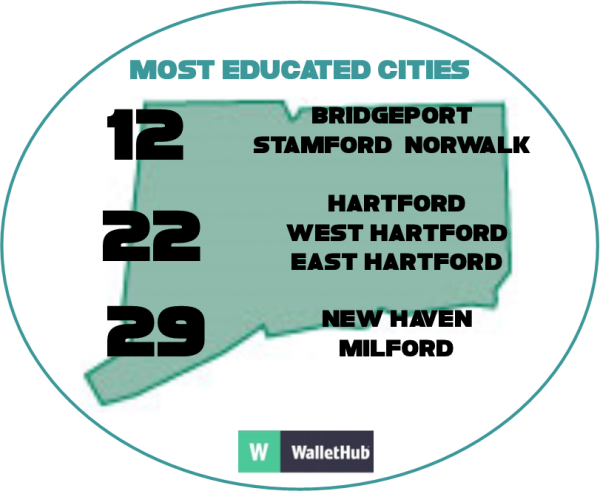
Three Connecticut metropolitan areas are among the top 30 “most educated cities in America,” according to a new analysis.  The Bridgeport-Stamford-Norwalk area ranked #12 in the nation, narrowly missing the top 10.  Hartford-West Hartford-East Hartford placed 22nd, and New Haven-Milford ranked 29th in the ranking developed by the financial website WalletHub. The Bridgeport-Stamford-Norwalk region ranked fourth in the nation for the highest percentage of individuals who have earned Bachelor’s degrees and fifth in the percentage of “graduate or professional degree holders,” according to the analysis.  The New Haven area ranked second in the nation in the quality of universities.

Overall, the top 10 most educated cities were Ann Arbor, Washington DC, San Jose, Durham, Madison, Boston, Provo, San Francisco, Austin and Tallahassee, according to the analysis.

To identify the most and least educated cities in America, WalletHub’s analysts compared the 150 most populated U.S. metropolitan statistical areas, or MSAs, across two key dimensions, including “Educational Attainment” and “Quality of Education & Attainment Gap.”  Data used to create the overall ranking were collected from the U.S. Census Bureau, Bureau of Labor Statistics, GreatSchools.org and U.S. News & World Report.

The Ann Arbor, MI, metro area has the highest share of bachelor’s degree holders aged 25 and older, 52.7 percent, which is 3.8 times higher than in Visalia-Porterville, CA, the metro area with the lowest at 13.8 percent.

Economic Policy Institute analysts point out that one way to strengthen an economy is to attract well-paying employers “by investing in education and increasing the number of well-educated workers.” In states where workers have the least schooling, for instance, the median wage is $15 an hour compared with $19 to $20 an hour in states where 40 percent or more of the working population hold a bachelor’s degree or higher.

A similar study by WalletHub earlier this year, comparing states, ranked Connecticut as having the fourth highest educated state population, just behind Maryland, Massachusetts and Colorado.


Knowledge Corridor to Gain Boost as More Frequent Rail Runs Through It

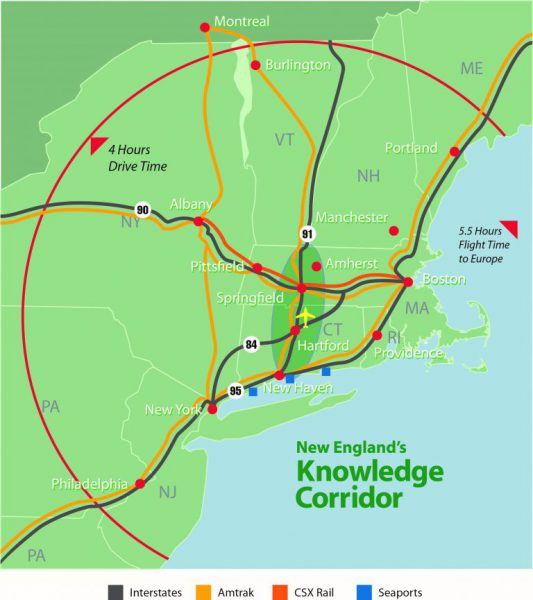
For years, the tag line has been “innovation runs through it.”  In the coming year, there will also be more frequent rail service running through it, and that may make all the difference in the world. When proponents of economic development in what’s known as “New England’s Knowledge Corridor” get together for a conference this fall, it will be with the backdrop of the three anchor cities that span two states – New Haven, Hartford, and Springfield – being more connected than ever, with the start of the new regular rail service between the cities just months away.

The half-day conference, “Leveraging the Knowledge Corridor’s Transportation Assets and Investments to Drive Economic Progress,” will be held at Union Station in Springfield on October 18.  It will serve as the coalition’s 2017 “State of the Region” conference.

The keynote speaker will be Robert Puentes, President/CEO of the Eno Center for Transportation.  Panelists will include five members of Congress from the region:  Richard Neal and James McGovern from Massachusetts and John Larson, Rosa DeLauro, and Elizabeth Esty from Connecticut.

Plans also include talks by Connecticut Commissioner of Transportation James Redeker and his counterpart in the Bay State, Stephanie Pollack, Secretary/CEO of the Massachusetts Department of Transportation.  Officials also anticipate releasing the results of the 2017 New England Knowledge Corridor Business Survey.

"In the Knowledge Corridor, we’re convinced that the transportation assets we have; new ones that will be coming online in the  next year or two, plus; those we are planning to see realized over a longer range time line constitute the bedrock of a competitive 21st century economy that enables ready and affordable access to skilled workers, attractive markets and motivated consumers on a global scale," Tim Brennan, Chairman of New England Knowledge Corridor Partnership and Executive Director of the Pioneer Valley Planning Commission, told CT by the Numbers.

On Monday, Governor Dannel P. Malloy announced that a joint venture of TransitAmerica Services and Alternate Concepts has been selected as the service provider that will operate and manage service on the Hartford Line – which is expected to launch in May 2018.

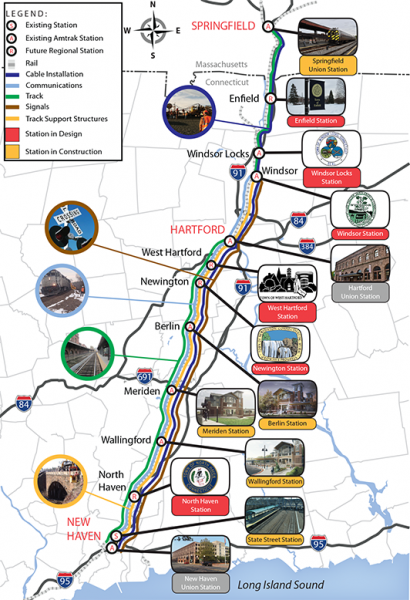
Work is continuing throughout the summer, including grade crossing upgrades in Wallingford this month, as part of the overall upgrade of the New Haven-Hartford-Springfield rail line – now branded as the CTrail Hartford Line, with expanded service scheduled to being in 2018, according to transportation officials.  Last month, construction in Meriden and Windsor included track construction upgrades.

New England’s Knowledge Corridor is an interstate partnership of regional economic development, planning, business, tourism and educational institutions that work together to advance the region’s economic progress. The region “transcends political boundaries,” officials point out, and it comprises the Hartford, Springfield and New Haven metro areas and is centered on seven counties in the two states, underscoring the area’s “rich tradition of inventions, research and higher education.”

The New Haven-Hartford-Springfield (NHHS) Rail Program is a partnership between the State of Connecticut, Amtrak and the Federal Railroad Administration.  The goal is to provide those living, working or traveling between New Haven, Hartford and Springfield with high speed rail service equal to the nation’s best rail passenger service, officials emphasize.

The Hartford Line will act as a regional link with connections to existing rail services, including Metro-North, Shoreline East, and Amtrak Acela high-speed rail services on both the New Haven Line to New York and on the Northeast Corridor to New London and Boston. There will also be direct bus connections to the Bradley Airport Flyer and to CTfastrak.  With a heightened level of direct and connecting service linking the region, the hope is that towns along the future Hartford Line will become magnets for growth – ideal places to live and to relocate businesses that depend on regional markets and travel.

All of which dovetails perfectly with the “selling points” routinely used to promote the Corridor:

  • Academic Powerhouse – One of the country’s highest academic concentrations and largest capacities for research, with 41 colleges and universities and 215,000 students
  • Exceptional Achievement – Consistently among the nation’s top 10 in percentage of the population with advanced degrees, science-engineering doctorates and new patents registered
  • Big, Concentrated Market – The nation’s 20th largest metro region, with over 2.77 million people, is comparable to Denver and St. Louis, but with twice their population density, which means ready access to labor and consumers
  • Large Workforce – A labor force of 1.34 million, 50% larger than the Charlotte metro area
  • Business Hub – 64,000 businesses – 60 percent more than the Austin metro

"Providing frequent, reliable, commuter rail service connecting New Haven-Hartford-Springfield, the three major cities that anchor the Knowledge Corridor and its over 2.7 million people, will be nothing short of a game changer enabling the cross border region’s to reach its potential as an economic powerhouse within New England while simultaneously linking it to the white hot economies found in the Boston and New York City mega regions," Brennan added.

The CTrail Hartford Line rail service will operate at speeds up to 110 mph, cutting travel time between Springfield and New Haven to as little as 81 minutes. Travelers at New Haven, Wallingford, Meriden, Berlin, Hartford, Windsor, Windsor Locks and Springfield will be able to board trains approximately every 30 minutes during the peak morning and evening rush hour and hourly during the rest of day, with direct or connecting service to New York City and multiple frequencies to Boston or Vermont (via Springfield).  New train stations also are in various stages of development in North Haven, Newington, West Hartford and Enfield.

Also, very much a part of the strengthening transportation options with the potential to spur economic development is Bradley International Airport, which recently has added international flights on Aer Lingus (last year) and Norwegian Air (last month) and a direct-to-San Francisco route via United Airlines.
Connecticut Airport Authority Executive Director Kevin A. Dillon said the aim is to “build on Bradley’s strengths and continue our focus to deliver more convenience and connectivity for our region.  Flying to Europe from Bradley has never been easier and more affordable.”

The Connecticut Department of Transportation (CTDOT) conducted a bidding process and cost-benefit analysis for the Hartford Line program and selected TransitAmerica Services and Alternate Concepts, which are forming a joint venture solely for the purpose of serving the Hartford Line. This marks the first time that CTDOT has been able to select and contract with an experienced service provider for a major transportation program, a more cost-efficient alternative to the agency creating a separate internal unit and hiring employees to manage the Hartford Line, according to state officials.

CT's Water Plan Ready for Public Comment; Recommendations Advance to Legislature in 2018

If you’re interested in Connecticut’s plans to manage a key natural resource – water – and might like to weigh in on what’s being considered, the window of opportunity to speak up has opened. The state’s Water Planning Council (WPC) published a draft version of the State Water Plan last week, on the council’s website (www.ct.gov/water).  They have also opened a public review period to provide Connecticut residents, businesses, and other stakeholders an opportunity to provide feedback before the Plan is finalized early next year. Comments will be accepted through November 20.

The draft plan recommends a framework for managing Connecticut’s water into the future and for “achieving balance with our many human and environmental needs as climate trends emerge and new needs develop,” according to officials.  The plan addresses the quality and quantity of water for drinking, ecology, recreation, business, industry, agriculture, energy, and wastewater assimilation.

The WPC members stressed that the input of Connecticut’s citizens is crucial to the development and implementation of the plan to ensure it is fair and effective at balancing the needs of all water users while protecting a valuable resource. The council will hold public hearings on the draft plan across the state during late summer and fall, and they also plan to use technological resources to advertise and educate the public on the plan throughout this period.  Comments on the plan can be filed electronically by the public.

Among the issues included is climate change.  The draft plan states that “Climate change is likely to have a significant effect on potential flooding in Connecticut, and could also result in drier summers in the next 25 years. More work is recommended on coastal impacts, longer term effects (50 – 100 years), and basins at risk of not satisfying all future needs.”

The creation of the State Water Plan was required following the adoption of a state law, Public Act 14-163, which directed the WPC to formulate a plan that will help planners, regulators, and lawmakers make decisions about managing Connecticut’s water in a manner that is consistent throughout the state.

The WPC is comprised of four members: John W. Betkoski (Chair), Vice Chairman, Public Utilities Regulatory Authority; Garrett Eucalitto, Undersecretary, Office of Policy and Management; Betsey Wingfield, Bureau Chief, Department of Energy and Environmental Protection; and Lori Mathieu, Drinking Water Section Chief, Department of Public Health.  The group’s draft plan reflects the input of various stakeholders, committee members and public participants.  There is also an advisory board for WPC.

The plan highlights five key messages:

  • Plan Function: The Plan is not an answer, but a platform for consistent, informed decision making.
  • Maintain Highest Quality Drinking Water: The Plan reaffirms the state’s dedication to the highest standard of drinking water quality in the nation (Class A).
  • Balance: Many river basins in Connecticut cannot satisfy all instream and out-of-stream needs all the time. The Plan offers ideas for understanding and improving this balance.
  • Conservation: While Connecticut leads the nation in protections of drinking water quality, the State lags in its water conservation ethic. Outreach that builds on utility initiatives is one of the most important recommendations in this Plan.
  • Maintain Scientific Data: The plan advocates for the collection and use of scientific data, as well as centralized access to it.

Details of the WPC’s public outreach efforts, information on how to comment, and links to other resources will be available in the coming weeks at www.ct.gov/water. They intend to present a final document to the Governor and various legislative committees in 2018.  The WPC next meets on August 1 at 10 Franklin Square in New Britain.

Leaders Inspiring Hope to be Honored in Greater Hartford

Leadership Greater Hartford (LGH) will be “celebrating leaders who inspire hope,” at the organization’s annual fundraising gala this fall, personified by honorees selected to receive the prestigious Polaris Awards.  Although their individual stories differ substantially, the common thread is one of commitment to community and taking on tough challenges to provide opportunities for individuals encumbered by obstacles.  Their impact has been unmistakable, making a difference not only in individual lives, but across the community.  Being honored for their work, as described by LGH:

  • Ronit Shoham is the driving force behind many remarkable projects for young people and others in need. She is a whirlwind of activity who has helped catalyze such initiatives as the creation of the Miracle League of Connecticut (which enables children with physical and mental challenges to enjoy playing baseball), Jonathan’s Dream Re-Imagined (rebuilding one of America’s first inclusive, accessible play spaces) and The Underground (a safe and secure location for teenagers to congregate, communicate and grow together).
  • Cheryl and Jamie “Bear” McDonald are not only owners of one of the fastest growing restaurant businesses in the state, they personify dedication to both quality and the community. Starting with Bear’s Smokehouse in Windsor, South Windsor and Hartford, they have opened three other restaurants this year. And their community focus includes a commitment to hire ex-offenders, raising their minimum wage to $15 an hour for “non-tip” employees and significant support of many local charities.
  • Iran Nazario is a high school dropout and former gang member who overcame many hardships, including jail time, to become an inspirational nonprofit leader in Hartford. Today he is president of the Peace Center of Connecticut and was most recently with COMPASS Youth Collaborative Inc., positions that have allowed him to work with young people to prevent gangs, reduce violence and find peaceful paths forward.

The Polaris Awards gala, to be held on October 18 at The Bushnell, is Leadership Greater Hartford’s annual signature fundraising event that recognizes “guiding lights” in the local community. Each fall hundreds of diverse leaders from every sector in the Greater Hartford area come together to network, to celebrate and to be inspired by the unsung heroes who strengthen community leadership connections in our region, officials explain.

Founded in 1977, Leadership Greater Hartford (LGH) is “one of the largest, most diverse, and effective community leadership organizations in the country,” the LGH website points out. The organization’s mission is to “develop, connect, and inspire diverse leaders to build strong and vibrant communities.”  Event proceeds directly support Leadership Greater Hartford’s important work to strengthen the local community by training and connecting aspiring and established leaders.


Photo: (L to R) Ronit Shoham, Cheryl and Jamie “Bear” McDonald, Iran Nazario

Webster Bank, Peoples United Are Among Nation’s "Most Reputable Banks"

Webster Bank and People’s United have been named among the "most reputable banks" in the country, according to the 2017 Survey of Bank Reputations, conducted by the independent organization Reputation Institute. Webster earned the highest score of any Northeast-based banks and ranked seventh overall in the United States. People’s United ranked at number 11.  The annual survey measures U.S consumers' perceptions of major bank brands.

American Banker, a trade publication focused on the banking industry, published the ranking of the most reputable banks in the country based on the Reputation Institute survey. More than 12,000 individual ratings were collected from customers and non-customers.  The ratings took into account citizenship, ethics/integrity, innovation, leadership, performance, products, services and workplace.

In its analysis, American Banker pointed out that regional institutions “are faring particularly well.”  Webster scored 76.4 while People's United scored 74.2.  The top-ranked institution, Georgia-based Synovus Financial, had a score of 80.7.

Stephen Hahn-Griffiths, an executive vice president at the Reputation Institute, said that while providing quality products and services is obviously important, it's a company's governance — or how it conducts business — that can make or break a reputation these days.

"The No. 1 thing people are looking for in terms of reputation of a bank is ethical behavior," said Hahn-Griffiths.

Of the 39 banks evaluated in this year's survey, more than half of them received "excellent" marks from their existing customers, up from just under a third of the banks in the 2016 survey. Perhaps more tellingly, over 30% received "strong" ratings from non-customers, versus zero in last year's survey.

Webster Bank, with its roots in Waterbury dating back to 1935, has over $25 billion in assets and 176 banking centers from greater New York City to Boston, offering a full range of financial services delivered by close to 3,000 employees. People's United, founded in 1842, is a premier, community-based, regional bank in the Northeast offering commercial and retail banking, as well as wealth management services through a network of nearly 400 retail locations and 5,000 employees  in Connecticut, New York, Massachusetts, Vermont, New Hampshire and Maine.


Play with Purpose at Two Connecticut Pre-Schools

Local school systems in Enfield and Manchester implemented a purposeful play initiative, with support from LEGO Community Fund US and the Hartford Foundation for Public Giving.  The results of the initiative are highlighted in a new video, which emphasizes that there’s more to play than may be apparent at first glance. Program organizers point out that “young children are naturally curious and full of life. Provided a supportive environment, they will joyfully splash, build and smash, pretend, sing, and dance.” While they are having a ton of fun, they are also making sense of the world and learning through exploration, experimentation and social interaction.

The LEGO Community Fund US has long asserted that learning through play enables children to become creative and engaged lifelong learners. In 2014, they put forward a proposal and funding to develop and test new materials to advance facilitated play in children’s homes, preschool and kindergarten. The idea is that a young child’s parents and teachers should really be facilitators of intentional play experiences.

The Hartford Foundation matched LEGO’s grant, and the Connecticut Office of Early Childhood participated with in-kind funds to create a training video, making the initiative a cross-sector effort. Laura Post, Vice President of Consumer Insights, LEGO Group, said of the collaboration, “We shared, as organizations, a passion for early childhood.”  The pilot was run in Manchester and Enfield, home of LEGO’s U.S. headquarters.

The collaborative, 17-month initiative ran from January 2015 through May 2016. During that time, participating parents and educators learned how facilitated play can support children’s cognitive, social and emotional development. Emphasis was placed on how to teach young children, not what to teach them.  The goal was to incorporate life and academic skills in a way that is fun for young children.

The Supporting Educational Success through Playful Learning workshops, that Enfield held in English and Spanish, were a catalyst for the development of a community campaign on the importance of play.

Schools Superintendent Dr. Jeff Shumann said the program sets students up for success in the future.  “It gives them those interpersonal skills, creative thinking skills, the problem solving skills, and certainly the communication skills that will help them enhance their learning as they get into deeper and more rigorous academics in the coming years.”

Kindergarten and pre-K teachers are receiving coaching to integrate purposeful play into all curriculum areas. Early educators participated in a series of play based workshops, and families attended play events, gaining an understanding of the value of play.

Manchester’s Supervisor of Student Development, Karen Gray, says it became “obvious how developmentally appropriate it is for children to play, and to have fun, and to smile and to laugh.”  As they did, teachers would “see them develop cognitively," although "they are not necessarily aware of the skills that they are actually developing.”

Adds Latasha Easterling-Turnquest, District Director of Manchester Public Schools’ Family Resource Centers, “Given the opportunity, a child, through play, can show you what he or she can really do.”

PHOTOS:  Jeff Shumann,  Karen Gray.

https://youtu.be/y20-G6AnIV0

Changing Leadership At Helm of Local Nonprofit Organizations

When Jay Williams takes over the leadership of The Hartford Foundation for Public Giving next week, he will be part of a significant changing of the guard in leading community nonprofit and business organizations. Williams succeeds Linda J. Kelly, who served the Foundation as its President for over 11 years. He recently served as U.S. Assistant Secretary of Commerce for Economic Development where he led the federal economic development agenda for the United States as head of the U.S. Economic Development Administration. He brings experience and knowledge in capacity building, workforce readiness, economic security and urban revitalization.

“He is the right person, at the right time and the right place,” said JoAnn H. Price, Board Chair of the Hartford Foundation.  “Jay has a track record of strong leadership, innovation, community and economic development and public/private partnerships. He brings a long list of accomplishments and sound skills that will help move the Foundation’s new vision and strategic focus forward.

Foodshare announced this week that Jason Jakubowski has been named president and CEO of the regional non-profit anti-hunger organization, which is headquartered in Bloomfield, and will assume his new role on July 31.  Jakubowski, currently the vice president of External Relations at the Hospital for Special Care (HSC), was chosen after a national search by Foodshare’s Board and Transition Committee.

“Jason is a recognized leader and builder of community partnerships with a lifelong dedication to tackling the issues of hunger, poverty, literacy, personal health, and job retention,” Foodshare Board Chair Tom Buckingham said in a statement. “He is well-prepared to execute Foodshare’s mission of leading an informed, coordinated response to hunger in our community.”

The Connecticut Main Street Center announced that its national search led to the selection of Patrick McMahon as its new Chief Executive Officer, effective August 21, 2017. McMahon will succeed CMSC's founding CEO John Simone, who is retiring after leading the organization for the past 17 years. 

McMahon currently serves as the Director of Economic Development for the Town of Suffield, and has previously worked in economic development in the towns of Windsor and Windsor Locks.  He is the Immediate Past President of the  Connecticut Economic Development Association (CEDAS), and a member of the Northeast Economic Development Association (NEDA).  CMSC's mission is to be the catalyst that ignites Connecticut's Main Streets as the cornerstone of thriving communities.

Judith Meyers, who for nearly two decades has been a leader improving children’s health and well-being in Connecticut, announced plans to step down as President and CEO of the Child Health and Development Institute of Connecticut (CHDI) as of September 30, 2017. At its June meeting, CHDI’s Board selected Jeffrey Vanderploeg, CHDI’s Vice President for Mental Health Initiatives to become the next President and CEO. Meyers has led CHDI since it began operations as a non-profit dedicated to improving children’s health and well-being in 1999. She became President and CEO of both CHDI and the Children’s Fund of Connecticut in 2002.

The MetroHartford Alliance also recently announced that Oz Griebel, the President and CEO of the Alliance since its inception in 2001, has informed the organization of his decision to leave his position at the end of the calendar year to pursue other leadership opportunities. Andy Bessette, Executive Vice President and Chief Administrative Officer of Travelers Companies and newly elected Board Chair, said:  “Since the Alliance’s beginning in 2001, Oz has provided invaluable leadership driving numerous economic development initiatives.  The Alliance’s marketing of the Region’s assets to national site selectors and to our local entities and residents and the creation of HYPE are just two examples of how the Alliance effectively uses investor resources to strengthen and promote the Region.”

Photos:  Jay Williams, Jason Jakubowski, Patrick McMahon