View From Abroad: Connecticut, Land of Opportunity

Connecticut, seen from afar, is the land of opportunity.  At least that would appear to be the view of people from all over the world who moved into the Constitution State from outside the U.S. - an increase of 23,862 residents - during a recent five-year period. Data from the U.S. Census Bureau’s American Community Survey indicates that between 2008 and 2012, each of Connecticut’s eight counties saw an influx of people moving here from abroad.

The new Connecticut residents from beyond the nation’s borders landed mostly in Fairfield, Hartford and New Haven counties, but each county in the state saw new arrivals from abroad  during the five-year survey period.

Here is the county-by-county breakdown:translations-globe-300x300

Fairfield County                +8,569

Hartford County               +5,848

New Haven county         +5,510

New London County      +1,356

Tolland County                  +959

Middlesex County           +804

Litchfield County              +412

Windham County             +404

According to the Migration Policy Institute, 13.8 percent of Connecticut's overall population in 2012 was foreign born, up from 10.9 percent in 2000.  Of the 2012 immigrant population, 8.9 percent came to the United States after 2010, 31.6  percent between 2000 and 2009, and 22 percent between 1990 and 1999.

The American Community Survey (ACS) is a mandatory, ongoing statistical survey by the U.S. Census that samples a small percentage of the population every year -- giving communities the information they need to plan investments and services. The Migration Policy Institute is an independent, nonpartisan, nonprofit think tank in Washington, DC dedicated to analysis of the movement of people worldwide.


ctcountymap

Number of CT Students Taking ACT Exam Jumps 15 Percent in 4 Years

The number of Connecticut high school students taking the ACT college readiness assessment exam as a means of demonstrating their academic ability to prospective colleges jumped 15 percent from 2010 to 2014, reflecting the increasing popularity of the test, the major national competitor to the Scholastic Aptitude Test, or SAT.  The average composite score of Connecticut students taking the exam ranked #2 in the nation, behind Massachusetts and just ahead of New Hampshire, Maine and New York. In 2010, there were 10,453 students who took the ACT exam in Connecticut.  By the graduating class of 2014, that number had increased to 12,044, reflecting a steady increase.  In 2011, 10,809 students took the ACT, followed in 2012 by 11, 192 students and 11.551 a year later. act_logo

The average score of state students has also climbed, from an average of 22.9 in 2010 to 23.6 in 2014.  The national average has remained steady, at 21.0.  The scores of Connecticut students rose in all four components:  from 23.8 to 24.2 in English, 23.5 to 24.1 in Math, 23.9 to 24.5 in Reading and 22.9 to 23.6 in Science.  All four exceed the national average among the class of 2014 taking the ACT.

Through the years, the ACT exam has traditionally been the college entrance exam of choice mainly by students in the western and mid-west states, while the SAT dominated in the east.  In recent years, that has begun to change, as colleges look to determine which exam, among other factors, are the most reliable predictors of academic performance in college.ACT exam

The percentage of graduates taking the SAT in Connecticut in 2014 was 29 percent.  In Massachusetts it was 23 percent, in New Hampshire 20 percent and in New York 27 percent.  In Maine, only 9 percent took the exam.  By contrast, 76 percent of the Class of 2014 in Minnesota took the exam, 73 percent in Wisconsin, and 86 percent in Nebraska.  A dozen states require students to take the exam.

The ACT and SAT have different areas of emphasis and approach.  ACT is an achievement test, measuring what a student has learned in school. The SAT is more of an aptitude test, testing reasoning and verbal abilities. According to the Princeton Review, among the differences between the tests include that ACT questions tend to be more straightforward, math concepts tested are more advanced, and it includes a science section.  The SAT has a stronger emphasis on vocabulary.

More than 1.84 million 2014 graduates—a record 57 percent of the national graduating class—took the ACT. This is a 3 percent increase from 2013 (despite a smaller total number of U.S. graduates nationally) and an 18 percent increase compared to 2010.

Connecticut students in the Class of 2014 taking the ACT exam exceeded the national average in the percentage of students ready for college-level coursework, according to the ACT criteria.  A benchmark score is the minimum score needed on an ACT subject-area test to indicate a 50% chance of obtaining a B or higher or about a 75% chance of obtaining a C or higher in the corresponding credit-bearing college course.

For Connecticut students taking the ACT, 86 percent surpassed the benchmark in English Composition, compared with 64 percent nationally.  In Math, 69 percent of Connecticut students and 43 percent of students nationally met the benchmark.  In Reading the breakdown was 65-44, in science, 59-37.

The ACT standards are designed to assess the types of skills needed for academic success. They serve as a direct link between what students have learned and what they are ready to do next, according to ACT.

Alternate College Ranking System Reveals Surprises for CT Colleges

It turns out that the oft-heralded and increasingly criticized U.S. News & World Report college rankings aren’t the only game in town.  Washington Monthly magazine has developed a rating system with a different emphasis, and very different results.  Among the Connecticut institutions making the list:  UConn, Yale, Wesleyan, and Trinity – but not necessarily in familiar places. The publication uses three main categories of evaluation for its analysis.  Social Mobility (recruiting and graduating low-income students), Research (producing cutting-edge scholarship and PhDs), and Service (encouraging students to give something back to their country). The publ1409.cover.220x286ication sets out to “identify the most public-minded institutions,” utilizing the three criteria and a handful of specific measures in each.

“Instead of crediting colleges that reject the most applicants, we recognize those that do the best job of enrolling and graduating low-income students,” the magazine pointed out.  The rankings also “measure both pure research spending and success in preparing undergraduates to earn PhDs.”  In addition, by “giving equal weight to public service, we identify colleges that build a sense of obligation to their communities and the nation at large,” the publication explained in the cover feature of the September/October issue.

Connecticut did not have an institution reaching the Top 30 National Universities.  That list was led by four University of California institutions in the top five slots, along with Texas A&M and Stanford University.  Harvard University placed tenth.

Yale University ranked #57 on the full list of National Universities. UConn ranked #82 - the only other school in the state listed among 277 institutions.  (Yale is ranked #3 in the U.S. News rankings; UConn places 19th)

The magazine also compiled a series of specialty lists ranking the institutions.

The only Connecticut school to reach the nation’s Top 30 Liberal Arts Colleges was Wesleyan University, which ranked #16.  (Wesleyan is ranked #15 on the U.S. News listing.) Further down the list, Trinity College ranked #184.

Among the “best-bang-for-the-buck” colleges, the University of Connecticut ranked #76, the only Connecticut college to break into the top 100.  That list was topped by three City University of New York colleges.colleges

Four Connecticut schools were among the Top 50 “Affordable Elite” institutions, according to the list compiled by the magazine.  Yale University ranked #33, Wesleyan University placed #40, UConn ranked #97 and Trinity College in Hartford just made the list at #98.

In the good news department, there were no Connecticut school reaching the “worst colleges” lists complied by the magazine.

The Social Mobility category includes four components including the percentage of students receiving Pell Grants, the cost of attendance, and the anticipated rate of graduation.   The five Research factors include research expenditures and the number of bachelors degree recipients who go on to earn PhDs  The Service category includes five factors including the number of alumni who serve in the Peace Corps, student participation in community service and the number of staff supporting community service.

Signaling the importance of the Washington Monthly rankings to colleges across the nation, a total of 47 institutions ran advertisements in the issue.  The advertisers did not include any colleges from Connecticut.

students

CT’s Unemployment Rate Drop During Past Year Ranks #17 in U.S.

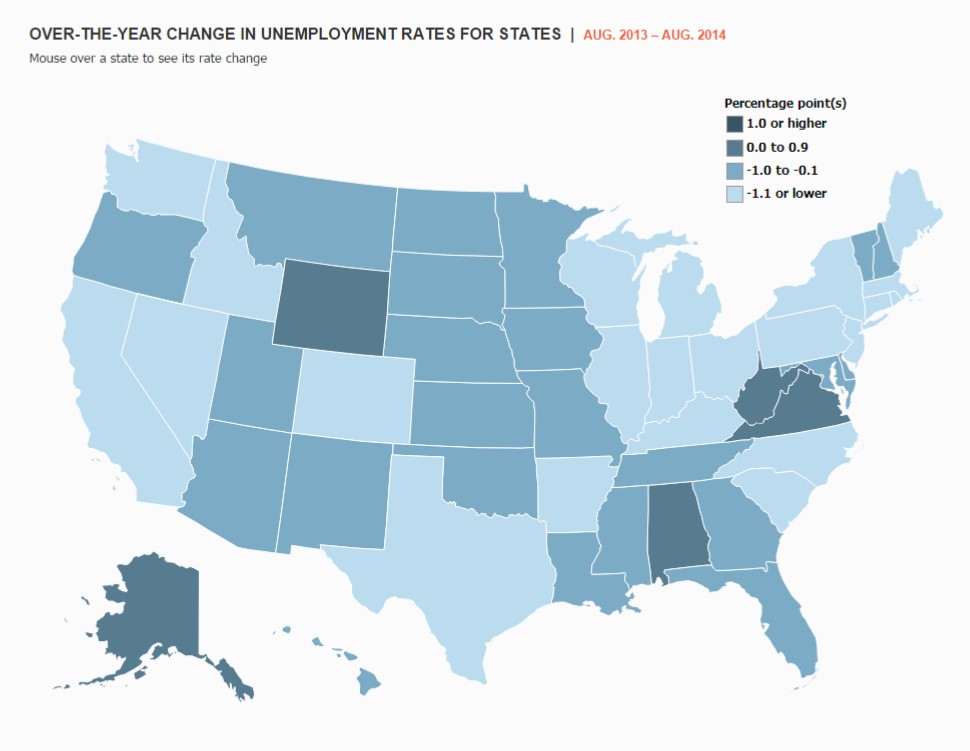
Between August 2013 and August 2014, Connecticut’s unemployment rate dropped 1.2 percent, ranking the state #17 in the U.S. in the percentage reduction in unemployment during the year-long period.  The data, compiled by the U.S. Bureau of Labor Statistics (BLS), indicated that Connecticut’s unemployment rate, seasonally adjusted, dropped from 7.8 percent to 6.6 percent. Connecticut’s top 20 finish among the states outpaced the New England states of Maine, New Hampshire and Vermont, but was slightly behind Rhode Island and Massachusetts, as well as New York and New Jersey.

The largest reductions in unemployment during the 12-month period came in Illinois (2.5 percent decrease), Nevada (2.2 percent), Rhode Island (1.9 percent), Ohio (18 percent) Colorado and Indiana (1.7 perce298px-Bureau_of_labor_statistics_logo.svgnt), Michigan and Pennsylvania (1.6 percent).  Also faring slightly better than Connecticut in reducing their state unemployment rate over the year were California, Idaho, New Hersey, Arkansas, Massachusetts, Washington, Kentucky and New York.  North Carolina was tied with Connecticut.

In 45 states and the District of Columbia, the unemployment rate dropped between August 2013 and August 2014.  In three states, the unemployment rate climbed during the year – Alabama, West Virginia and Alaska - and in two states, the rate remained unchanged – Virginia and Wyoming.

Connecticut was also one of 27 states deemed to have "statistically significant" changes in their unemployment rate, according to the federal agency.  The BLS data was updated as of September 19, 2014 for the 12-month period, and subsequently made available on the agency's website.

Among Connecticut's neighboring states in the region, according to the data, the unemployment rate as of August 2014 is higher in Rhode Island (7.7 percent), the same as Connecticut in New Jersey (6.6 percent), and lower in New York (6.4 percent),  Massachusetts (5.8 percent), Maine (5.6 percent), New Hampshire (4.4 percent) and Vermont (4.1 percent).

The Bureau of Labor Statistics of the U.S. Department of Labor is the principal Federal agency responsible for measuring labor market activity, working conditions, and price changes in the economy. Its mission is to collect, analyze, and disseminate essential economic information to support public and private decision-making. As an independent statistical agency, BLS serves its diverse user communities by providing products and services that are objective, timely, accurate, and relevant, the agency's website explains.

map unemployment rate change

In-Person Explanations of New Health Insurance Program Outperform Web, Phone

In an era increasingly dominated by technology, a new study has underscored the importance of person-to-person assistance in a critical realm:  health insurance for chronically underserved populations. Consumers found it easier to get and use information from in-person assistance, and rated information from in-person assistance significantly better compared to information from a telephone helpline or the website of Access Health CT, Connecticut’s health insurance marketplace. In-person assisters played a crucial role in enrolling hard-to-reach, underserved populations, according to a study conducted by the Community Alliance for Research and Engagement at the Yale School of Public Health for the Universal Health Care Foundation of Connecticut.capture1

The evaluation examined the enrollment experiences of people from underserved urban areas of Connecticut, and sought to evaluate the outreach and enrollment process from the perspective of consumers and the in-person assisters and navigators who worked with them.  In-person assistance provided a critical service for consumers who were unable to navigate the helpline and website, the study found.

As trusted resources in the communities where they worked, assisters were clearly valued by their customers.  The study shows high rates of satisfaction overall with the enrollment process and emphasizes that in-person assistance was preferred by customers when they were asked to compare it to their interactions with the website or helpline.

Consumers mostly heard about AHCT through ‘word of mouth’ and ‘family and friends’.  Other sources of initial awareness, cited less frequently, were news programs, tv commercials, newspaper ads, library, internet and radio commercials. heard about

Satisfaction with the application and enrollment processes was high among survey participants. Ninety-five percent of respondents reported that the application and enrollment process was "definitely" or "somewhat" easy.  Twenty-nine percent reported some dissatisfaction with the amount of time required to enroll in a health plan.

The study found thta 90 percent would "definitely" recommend Access Health CT (AHCT), and an additional 9 percent would "probably" recommend AHCT.

During the open enrollment period of Octogetinfober 1, 2013, to March 31, 2014, the federal government was the major funder of in-person assistance, providing over $2.5 million in funding to the program.  The reported noted that “This level of funding is no longer available, yet, the need for assistance, both for the upcoming open enrollment period (November 15, 2014, to February 15, 2015) and beyond, is great.”  Plans for continuing in-person assistance, offered at store-front facilities, are under consideration according to published reports, with specifics uncertain.

Consumers most often wanted to learn about the cost of plans and the availability of financial assistance for insurance premiums. Of consumers who did not enroll, the most common reason was the need for more information, according to the study.

The report also noted that "because Connecticut is a national leader in the implementation of the US health insurance marketplace, the Connecticut experience may inform policy in other states and at the federal level."

Fan Likes? Patriots Nation, Giants Country, Jets Nowhere

Although undefeated thus far this season, the New York Jets, it turns out, are nowhere.  At least nowhere on a nationwide, country-by-county map released by Facebook of the National Football League “likes” of Facebook users.tristate The breakdown showed Patriots dominance throughout New England and most of Connecticut – with the exception of Fairfield and New Haven counties, which remain Giants country.

The Jets were the only NFL team not to “win” a single county.

Months ago, The New York Times published a similar breakdown of major league baseball fans, which was especially interesting in breaking down the Red Sox-Yankees rivalry, but also highlighted the interest in the Yankees all across the country.

Unlike the MLB baseball map, there’s no clear “national” team, the Atlantic reported in analyzing the data.  Love for the the Bronx Bombers bubbled up in the absence of a prominent popular local franchise, appearing not only in greater New York City but also in far-reaching locations including North Carolina, Nebraska, Nevada and New Mexico. NoNewYorkJets

nation countryThat’s just not reflected in the NFL map. The Cowboys come closest, but they’re not “America’s team” as unambiguously, despite the longstanding public relations effort. Beyond Texas and its neighbors, the only isolated pockets of Cowboys fandom are in southern Nevada and southeastern Virginia. That’s it.

After the Cowboys, the Broncos control a huge region in the upper mid-west. Rivaling the Broncos are the 49ers, which rule almost all of California; and the Patriots, Seahawks and Saints, who all dominate their regions – at least on Facebook, if not in the NFL standings.

Connecticut, as it is in baseball, is divided in allegiances between New York and Boston professional teams.  But as is true throughout the tri-state region, the Jets don’t quite exceed Giants or Patriots fans – according to Facebook – anywhere.


NFL fan map

As CT Workforce Ages, Employers Look to Attract Young Workers, Seek State Policy Support

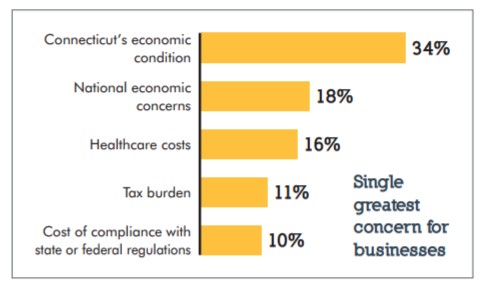
The good news:  three times as many Connecticut businesses say they are growing rather than contracting, innovation and investment in technology is strong and three-quarters of manufacturers surveyed say they are exporting. Those are among the lead findings in a survey of Connecticut businesses conducted by BlumShapiro and the Connecticut Business and Industry Association. While the 2014 Survey of Connecticut Businesses shows optimism that Connecticut’s business landscape continues to improve, there remain concerns about the economy and the ability to create jobs in Connecticut, as well as signs that the state’s workforce continues to get older. In fact, one in four respondents are facing a wave of retirements over the next decade, with at least 40% of their workforce aged 55 or older.CTbusiness survey

“Connecticut’s workforce is aging, with 53% of our respondents reporting that 20% or more of their workforce is 55 or above. There is much to be optimistic about in this survey, but the aging workforce is certainly a challenge we continue to face,” pointed out Joseph Kask, Office Managing Partner of BlumShapiro’s West Hartford office.

While 38% of companies offer flexible work hours, only 8% offer telecommuting. One in four respondents also has specific practices or policies designed to attract and retain younger workers, including internships, tuition reimbursement, high entry-level wages, apprenticeships, and school/college recruitment programs.  Many companies employ apprentices (34%), interns (57%), and temps (58%), and eight in ten companies (79%) plan to hire these workers for permanent positions.

The survey shows slightly greater anticipated demand for mid-level employees than entry level or line workers. Among businesses of all types, workforce demand through 2015 is concentrated on mid-level employees (33% of companies say this is their area of greatest demand) followed by entry-level employees (29%), line workers (28%), managers (8%), and executive leadership (2%).Other highlights of this year’s survey include:

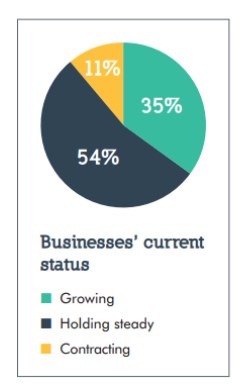
  • 35% of businesses surveyed indicate they are growing; 11% indicate they are contracting.
  • 46% of businesses surveyed introduced new products or services in the past 12 months; 47% of them plan on introducing new products or services in the next 12 months.
  • Three-quarters of manufacturers surveyed are exporting.
  • 52% of businesses surveyed say the most important step policymakers can take to enhance business in Connecticut is lowering taxes; 24% say it is reducing regulations, and 11% say it is cutting government regulations.
  • 27% of businesses surveyed say technology is the greatest single investment, 23% say it is employee training, and 23% say it is property and facilities.

concern When asked how Connecticut should address the shortage of skilled workers, 32% of businesses surveyed say the state should reduce the cost of living, 28% say the state should support trade schools, 20% say the state should support education overall, and 20% say there should be incentive for training programs.business steady;

The industries included in the survey include manufacturing, professional services, construction, retail, hospitality/tourism, wholesale, insurance, finance, real estate and software/technology.  Nearly one-third of the respondents were in the manufacturing sector.

CBIA is Connecticut’s leading business organization, with 10,000 member companies.  BlumShapiro is the largest regional accounting, tax and business consulting firm based in New England, with Connecticut offices in West Hartford and Shelton.

Connecticut Volunteers Pursue National Service; AmeriCorps to Celebrate 20th Anniversary

More than 3,700 people of all ages and backgrounds are helping to meet local needs, strengthen communities, and increase civic engagement through national service in Connecticut, according to data compiled by the Corporation for National & Community Service. Serving at more than 600 locations throughout the state, these citizens tutor and mentor children, support veterans and military families, provide health services, restore the environment, respond to disasters, increase economic opportunity, and recruit and manage volunteers.

During this past fiscal year, the Corporation for National and Community Service (CNCS) committed more than $9,390,000 to support Connecticut communities through national service initiatives. Through a unique public-private partnership, this federal investment leveraged an additional $2,720,000 in other resources to strengthen community impact, build local support, and increase return on taxpayer dollars.AC_20

Most AmeriCorps grant funding goes to the Connecticut Commission on Community Service within the state Office of Higher Education, which in turn awards grants to nonprofit groups to respond to local needs. AmeriCorps expected to provide more than 900 individuals the opportunity to provide intensive, results-driven service to meet education, environmental, health, economic, and other pressing needs in communities across Connecticut.

Nationally, AmeriCorps celebrates its 20th anniversary this month.  President Obama is scheduled to participate in a ceremony with AmeriCorps members at the White House on September 12 as part of a nationwide event marking the 20th anniversary of the AmeriCorps national service program.

The Connecticut Commission on Community Service administers programs under the National and Community Service Trust Act of 1993. The Commission is dedicated to supporting service and civic engagement to strengthen communities throughout Connecticut. In partnership with the Office of Higher Education, the Commission funds and supports programs that encourage all Connecticut residents to volunteer.  The Commission’s next meeting is scheduled for October 7.

Other individuals – in Connecticut and nationwide - serve their fellow citizens through AmeriCorps VISTA, whose members help bring individuals and communities out of poverty by serving full-time to fight illiteracy, improve health services, create businesses, and increase housing opportunities, and AmeriCorps NCCC (National Civilian Community Corps), a 10-month, full time residential program for men and women between the ages of 18 and 24. In exchange for their service, AmeriCorps members earn an education award that can be used to pay for college or to pay back qualified student loans.

In addition to the AmeriCorps participants, more than 2,800 seniors in Connecticut contribute their time and talents in one of three Senior Corps programs.logo community service

  • Foster Grandparents serve one-on-one as tutors and mentors to more than 1,000 young people who have special needs.
  • Senior Companions help more than 270 homebound seniors and other adults maintain independence in their own homes.
  • RSVP volunteers conduct safety patrols, renovate homes, protect the environment, tutor and mentor youth, respond to natural disasters, and provide other services through more than 230 groups across Connecticut.

The Corporation for National and Community Service is a federal agency that improves lives, strengthens communities, and fosters civic engagement through service and volunteering. Members of the Connecticut Commission on Community Service are appointed by the Governor and serve three-year terms. Commission members represent various areas of expertise as required by the National and Community Service Trust Act.


AmeriCorps video


Hartford Region Ranks #4 in USA in Digital Coupon Clicking, Survey Says

Coupons are fast-becoming money savers that are clicked, not clipped, and in few regions is that more the trend than in Greater Hartford.  Newly released data indicates that the Hartford-West Hartford-East Hartford market ranks #4 in the nation in the level of click activity, just behind New York, Boston and Philadelphia. According to results of a survey conducted by RetailMeNot, a leading digital offers destination, in conjunction with The Omnibus Company, the number of Americans who rely mostly on mobile coupons has been steadily increasing, as traditional scissor-clipped declines.

The study found that over the past four years, the use of printable coupons has dropped to 58 percent in 2014 from 73 percent in 2010. However, digital coupon usage has increased substantially as the world has gone more digital with online (27% in 2014 vs. 16% in 2010) and mobile (15% in 2014 vs. 4% in 2010) coupon usage.DigitalCoupon1

The latest edition of the company’s Shoppers Trend Report revealed that nearly all Americans (96 percent) are coupon users, and retailers and brands are steadily moving their marketing promotions to more mobile and digital formats. A separate survey of retail executives in May 2014, also conducted by The Omnibus Company, found that 75 percent of retailers believe that digital advertising delivers a higher ROI than offline advertising, including circulars and direct mail.

September has been designated as National Coupon Month, and based on the level of coupon click activity in ratio with each city’s population, the Northeast is leading the way.  Rounding out the top ten after New York, Boston, Philadelphia and Hartford are Providence, Baltimore, Pittsburgh, Washington, Tampa and Buffalo.

Western communities appear to lag in their savings activity, with the Las Vegas, Phoenix and Denver areas representing the bottom of the active-coupon-user list. In fact, the New York, Boston and Philadelphia areas appear to be four times more active than the Denver area at couponing, according to survey analysts.

In the top 10 active couponing cities, clothing and food categories ranked consistently at the top for click activity, followed by electronics and home and garden.Coupon

“Our survey findings show how a consumer’s mobile phone is becoming a key device within their savings tool kit as millions of shoppers increasingly take advantage of digital offers, promotions and sales opportunities.” says Trae Bodge, senior lifestyle editor for The Real Deal by RetailMeNot.

They survey also found that printable coupon usage for 18- to 34-year-olds dropped significantly in the past four years (40% in 2014 vs. 57% in 2010), and online coupon usage nearly tripled for those ages 50+ over the past four years (18% in 2014 vs. 7% in 2010).

According to the survey deep discounts aren’t the only deals that shoppers appreciate, as more than 2 in 5 (43%) coupon users consider discounts up to 25 percent to be a good deal. Respondents said they are most interested in deals that offer a specific dollar amount off of their purchase (30%).  The survey also shows that interest in different types of deals varies by region.

  • Coupon users living in the Northeast are more likely than those living in other regions to be most interested in receiving a specific percentage off a purchase (28% vs. 18% of the rest of the country).
  • Those living in the South are more likely than those living elsewhere (26% vs. 15% of the rest of the country) to be most interested in “buy one, get one free” deals.

In an August 2014 commissioned study conducted by Forrester Consulting on behalf of RetailMeNot, an overwhelming 59 percent of respondents stated that out of all the different types of promotions a retailer can employ, digital coupons still sway them the most when it comes to influencing a purchasing decision. The study also found that:

  • 63 percent of respondents agreed that digital coupons “close the deal” for them when undecided on a purchase,
  • More than 90 percent of smartphone and tablet users redeem their digital coupons within several days,retailmenot_logo_lg
  • Nearly 7 in 10 consumers (68%) said they strongly believe that digital coupons have a positive impact on a retailer’s brand
  • 68 percent state that coupons generate loyalty

RetailMeNot, Inc. operates what the company describes as the world’s largest marketplace for digital offers, and for the 12 months ended June 30, 2014, the company had more than 625 million visits to its websites.  See the complete list of the top 50 cities.

Top Cities (and Surrounding Metro Areas) Based on Click Activity

  1. New York-Newark-Jersey City
  2. Boston-Cambridge-Newton
  3. Philadelphia-Camden-Wilmington
  4. Hartford-West Hartford-East Hartford
  5. Providence-Warwick
  6.  Baltimore-Columbia-Towson
  7.  Pittsburgh
  8. Washington-Arlington-Alexandria
  9. Tampa-St. Petersburg-Clearwater
  10. Buffalo-Cheektowaga-Niagara Falls

Danbury-Based Ethan Allen In Retail Industry’s Hot 100; Only CT Company Named

The lone Connecticut-based retailer to make the list of the Hot 100 Retailers produced by the National Retail Federation is Danbury-based Ethan Allen Interiors, sliding in at #97.  Data from the national advocacy organization indicates 5 percent growth and 208 locations nationwide for the chain. Ethan Allen Interiors Inc. (NYSE:ETH) is a leading interior design company and manufacturer and retailer of quality home furnishings. The company offers free interior design service to its clients and sells a full range of furniture products and decorative accessories through ethanallen.com and a network of approximately 300 Design Centers in the United States and abroad.logo natl retail fed

Ethan Allen owns and operates eight manufacturing facilities including five manufacturing plants and one sawmill in the United States plus one plant in each of Mexico and Honduras. Approximately seventy percent of its products are made in its North American plants. Chairman, President and CEO is M. Farooq Kathwari.He has been president since 1985 and Chairman and Chief Executive Officer since 1987.

The company website indicates that “Ethan Allen is full-service. We conceptualize, design, source, manufacture, market, advertise, style, sell, distribute, and install. That means at headquarters our horizons are ever broadening. But our job is surprisingly straightforward: that is, to raise the bar — in all aspects of the company every day.”

Overall in Connecticut, the Federation highlighted the importance of the retail industry on the state’s economy:Ethan-Allen-Interiors-Inc.-ETH

  • Retail directly and indirectly supports 1 in 5 Connecticut jobs.
  • Retail is directly and indirectly responsible for 16% of Connecticut's GDP.
  • Retail directly and indirectly generates 15% of labor income in Connecticut.
  • Retail supports 476,568 jobs in Connecticut. (see breakdown below)

Among Connecticut’s neighboring New England states, Boston-based Wayfair was the #2 retailer nationwide on the Hot 100; Jordan’s Furniture, based in Taunton, MA was ranked #24; C & J Clark, headquartered in Newton, MA was #29; and Framingham-based Cumberland Farms was ranked #62.  In addition, LL Bean (Freeport, Maine) was #94 and BJ’s Wholesale Club (Westborough, MA) rounded out the list at #100.

Breaking down Connecticut employment by retail sector, the Federation reported:port_retail-ethan-allen-6-b

  1. Retail trade (including food services and drinking places) 17.2%
  2. Health care and social assistance 14.8%
  3. Finance and insurance 9.8%
  4. Manufacturing 9.4%
  5. Professional, scientific, and technical services 8.2%
  6. Other services, except public administration 5.8%
  7. Construction 5.8%
  8. Administrative and waste services 5.7%
  9. Real estate and rental and licensing 5.6%
  10. Education services 3.9%

Nationally, the top 10 leading the Hot 100 in sales growth were Albertsons (Boise, Idaho), Wayfair, Ascena Retail Group (Suffern, NY), Conn’s (The Woodlands, Texas), SpartanNash (GrandRapids, MI), Michael Kors Holdings (New York), Under Armour (Baltimore), Cardinal Health (Dublin, Ohio), Five Below (Philadelphia), and Amazon.com (Seattle).  Each of the top 10 companies had sales growth exceeding 25 percent from 2012 to 2013.

The data for the Hot 100 report was provided by Kantar Retail for the National Retail Federation.