CT Worst in Nation for Unemployed, Near Bottom in GDP Growth - But Not Miserable

Connecticut is the worst state in the nation for the unemployed, according to data compiled by Bloomberg news.  The state ranked last among the 50 states and District of Columbia on the difficulty of life for the unemployed based on three equally weighted criteria: income replacement, the unemployment pool and income disparity, based on data compiled from U.S. Bureau of Economic Analysis, U.S. Bureau of Labor Statistics, and U.S. Census.

According tbea_logo_460o the business news service, the ten most challenging states for unemployed residents are Connecticut, New Jersey, District of Columbia, California, Maryland, Alaska, New York, Virginia, Delaware, Massachusetts and New Hampshire.

The best states – at the opposite end of the data compilation – are North Dakota, Utah, Iowa, New Mexico, Oklahoma, Arkansas, West Virginia, Montana and Idaho.economic-indicators2

In developing the rankings, Bloomberg used the following:  Average weekly unemployment benefits was the quarterly average from 2Q 2012 to 1Q 2013. Personal Income per capita was calculated by dividing 2013 preliminary total personal income by state data from the Bureau of Economic Analysis by the state population from the Census as of mid-year 2012. Unemployment rates were the July 2012 to June 2013 seasonally adjusted 12-month average figures for the civilian non-institutional population. Household income ratios were from the U.S. Census Bureau, 2011.  The three scores were averaged for the final ranking.

Connecticut also ranked third from the bottom on Gross Domestic Product growth between 2008 and 2012, according to a companion Bloomberg report of data from the U.S. Bureau of Economic Analysis.  Only Arizona and Nevada had a worse track-record during the period.  Connecticut was one of ten states to experience negative GDP growth during the years of the comparison.  The state’s GDP dropped to 197.2 billion last year, from 202.5 billion in 2008.  The most dramatic increase in GDP was in North Dakota, where GDP grew 35 percent.  Next was Texas, with a 12 percent increase, followed by Oregon, West Virginia, Alaska, Louisiana, Utah, Nebraska, Maryland and Indiana.

There was some good news for the Land of Steady Habits in recent data.  Connecticut ranked #13 among the "least miserable" states in the nation.  Which are the most miserable states?  Louisiana, Mississippi, Arkansas, West Virginia, New Mexico, SoutCT welcomes youh Carolina, Alabama, Nevada, Tennessee and Kentucky.  All of which seems to indicate that a state can have solid GDP growth and still be relatively miserable - particularly for the unemployed.

Thirteen variables from the United Health Foundation's America's Health Rankings were isolated to determine each state's Misery Score. Among them:  Air pollution levels refer to micrograms of fine particles per cubic meter. High school graduation rates refer to percent of incoming ninth graders who graduate within four years. Poor health days refer to the number of days in which a person could not perform work or household tasks due to poor mental or physical health. Personal income refers to income from all sources and is not inflation adjusted.

The least miserable states were – from the top - Minnesota, North Dakota, New Hampshire, Vermont, Massachusetts, Hawaii, Iowa, Nebraska, Utah, Wisconsin, Wyoming, South Dakota – and then Connecticut, at lucky #13.
State Lottery Shows Strength in Connecticut, Land of Steady Habits

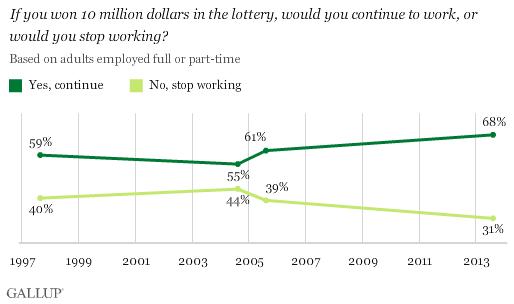
What would you do if you won the lottery?  According to a new survey, you’d go to work.  That's true not only in the Land of Steady Habits, but nationwide.

Two-thirds of American workers say they would continue working even if they won $10 million in the lottery, while 31% say they would stop, according to a new Gallup poll, released earlier this month. The desire to keep working after enjoying a financial windfall is higher today than in three earlier Gallup measures, all prior to the 2008-2009 recession, the polling firm reported.

Additionally, most American workers who predict they would continue working even after winning the lottery say they would want to stay at the same job rgallup pollather than seek a new job. The roughly 2-to-1 ratio in favor of keeping the same job versus getting a new one is about the same as in 2004, but slightly higher than in 2005 and 1997.

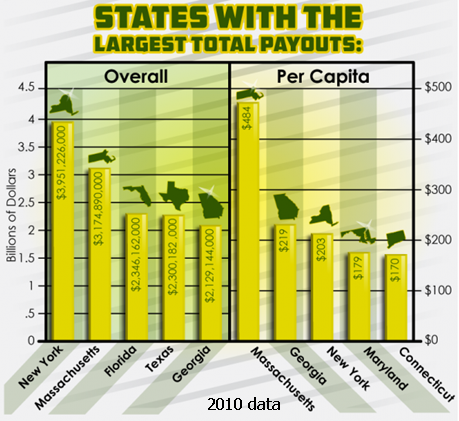
Bloomberg News has reported that lottery players in the U.S. spend an average of $396 a year purchasing lottery tickets, with residents of Massachusetts, Georgia and New York leading the way.  Using data from this analysis, Bloomberg identified which states see the highest and lowest payout ratios. Connecticut tops  neither list. On average, Massachusetts players spend $861, Georgians spend $471 and New Yorkers spend $450 on lottery tickets.  At the bottom in per person spending, on average, are Oklahoma ($71), Montana ($61) and North Dakota ($47).

In fiscal year 2012, players in Connecticut won $659.9 million in prize money. At the same time the CT Lottery provided a record $310 million to support the services and programs founded by the state’s General Fund including public health, libraries, public safety, education and more, according to state lottery officials. Connecticut’s first lottery btop 3egan in 1972, and was the fourth in the nation.

According to the quasi-public Connecticut Lottery Corp.'s most recent annual report, released in May, the lottery achieved record sales totaling nearly $1.1 billion in fiscal year 2012, an increase of $65.1 million from the previous fiscal year, the Day of New London reported.  The lottery credited a number of factors for its total sales increase, including higher sales of instant tickets and higher sales of multistate games, such as Powerball, Mega Millions and Lucky for Life. Also, 2012 was a leap year, meaning an extra day for sales.

For the first time in 15 years in fiscal year 2013 (which ended on June 30), the lottery is bringing in more revenue ($16 million) than both Foxwoods and payoutsMohegan Sun, WTNH-TV reported last week.  Lotteries are ubiquitous.  In North America every Canadian province, 43 U.S. states, the District of Columbia, Mexico, Puerto Rico, and the U.S. Virgin Islands all offer government-operated lotteries. Elsewhere in the world, according to NASPL, publicly-operated lotteries exist in at least 100 countries on every inhabited continent.

According to the U.S. Bureau of Economic Analysis, only seven U.S. states don't run lotteries: Alabama, Alaska, Hawaii, Mississippi, Utah, Wyoming, and Nevada. Of the 43 states that do run lotteries, the average payout is just under 60% of the revenue dollars collected. Using U.S. Census data, Bloomberg reported that of the estimated $50 billion spent on lottery tickets in 2010, only $32.8 billion was returned in prize money.

A previous Gallup Poll on Gambling in America found that 57% of American adults reported buying a lottery ticket in the past 12 months. People with incomes of $45,000 to $75,000 were the most likely to play -- 65 percent had played in the past year -- while those with incomes under $25,000 were the least likely to play at 53 percent. Further, people with incomes in excess of $75,000 spend roughly three times as much on lotteries each month as do those with incomes under $25,000, the National Association of State and Provincial Lotteries (NASPL) points out.

Mathematics and Transportation of Cities Draws New Research Analysis

UConn researchers have collaborated to develop a new index that will measure the sustainability of complex urban transportation systems.  The index will allow policymakers, scientists and the public to understand not just how congested cities’ transportation systems are, but the economic, social, and environmental impacts of the system as a whole.

A team of researchers in UConn’s departments of geography and civil and environmental engineering developed The Transportation Index for Sustainable Places, or TISP.  The new approach is part of the July themed issue of the journal Research in Transportation Business & Management, edited by  Carol Atkinson-Palombo, assistant professor of geography, Norman Garrick, associate professor of civil and environmental engineering, and Wesley Marshall, a former graduate student of Garrick’s who is now a faculty member at the University of Colorado, Denver. TISP

“Policy in developed countries and in the U.S. in particular has tended to focus on relieving congestion and has largely ignored social and environmental impacts associated with expanding freeways,” says Carol Atkinson-Palombo. “This index takes a more holistic approach, which gives a comprehensive sense of the effects of the system.”

The TISP takes into account environmental factors like land use efficiency, minimizing natural resource consumption, and reducing greenhouse gas emissions. Social factors are also measured, such as meeting access needs, incorporating public health and safety and maintaining a community in areas served by transportation. These factors combine with economic measures, such as affordability, self-sufficiency, and efficiency, to create a comprehensive metric, UConn Today reported.

Garrick says that many people only think about transportation in terms of traffic. These so-called congestion indices, he says, are misleading because they are not necessarily about making the city better, but simply moving cars more efficiently.

“In many cities, only 40 percenNewHavenRoute34aftert of the people commuting are in cars,” he points out. “The majority of the people aren’t affected by the congestion index, yet this is the only measure of the impact of the transportation system that is ever discussed in the media.”

Mathematics of Cities

In another initiative aimed at taking a closer look at the function of cities, the view that cities are dissimilar and disordered systems has begun to change.  Patterns have emerged within the supposed chaos, and researchers in economics, physics, complexity theory and statistical mechanics have concluded that cities, mathematically speaking, might actually be basically the same. Though strikingly different in culture and layout, cities like London and Beijing, for example, share many properties with regard to infrastructure, social interactions and productivity.

The new conclusions – decades in the making - are part of a growing field dedicated to the science of cities, Science News, the magazine of the Society for Science & The Public, reports in its most recent edition.   Roughly 75 percent of people in the developed world now live in urban environments. While much of the research is in its early days, eventually it may serve as a powerful, widely used tool for urban planners and policymakers, the publication reports.

Physicist and complex systems scientist Luís Bettencourt of the Santa Fe Institute in New Mexico has developed a theory which captures the interplay between a city’s population, its area, the properties of its infrastructure and its social connectivity. His theory suggests that city planning should not involve grand, top-down projects, but perhaps well-considered smaller ones.

The mathematical work is rooted in and reinforces the view “that cities grow from the bottom up,” says Michael Batty, who trained as an architect, planner and geographer and went on to found the Centre for Advanced Spatial Analysis at University College London. “The diversity of life [in cities] offers greater opportunities for mixing ideas.”

The emerging mathematical theory of cities stands on four basic assumptions:

  1. Cities mix varied people together, allowing them to reach each other.
  2. Cities are networks that grow gradually and incrementally, connecting people.
  3. Human effort isn’t limitless and stays the same regardless of urban size.
  4.   Measures of the socioeconomic output of a city — things like the number of patents awarded or crime rate — are proportional to the number of social interactions.

 “In a nutshell, the city is the best way of creating a vast, open-ended social network that minimizes the cost of moving things in and around an environment,” Bettencourt says. “When people brush up against each other, that’s when the magic of the city happens — the social reactor begins to work.”

Cities Reshape Transportation Mix

At UConn, when the research team used the TISP index to look at transportation in the U.S., they found some not-so-surprising results: areas with higher rates of driving rather than public transportation have greater carbon emissions, and having more cars and highways increases traffic fatality risk.  But despite the prevailing perception, says Garceau, the researchers found that decityveloping varied transportation systems that include a combination of roads and public transportation are more cost-effective than simply building highways.

Many cities have already begun to adjust their transportation planning. Some have begun dismantling freeways that run through their downtowns to reconstruct a truly urban atmosphere. New Haven is in the midst of doing precisely that in Connecticut, eliminating the Route 34 connector and replacing it with an urban boulevard that will reconnect city neighborhoods cut off for decades.

Others cities are moving forward with light rail and bus rapid transit systems (such as CTfastrak between Hartford and New Britain, now under construction) and encouraging walking and bicycle use by building compact, mixed-use communities that focus on pedestrians rather than cars.  Garrick points to Cambridge, Mass., Portland, Ore., and New York City as U.S. cities that have taken strides toward sustainable transportation. On a smaller scale, he cites Storrs, the home of UConn’s main campus, for developing a walkable town center from scratch, and planning for greater bus access as the newly-minted downtown area unfolds.

Connecticut's 40 Fastest Growing Technology Companies Earn Statewide Recognition

Some of the names may be familiar – Priceline, Alexion, TicketNetwork, HigherOne - but most will likely not be, despite steady track-records of rapid growth in their respective technology industries.  The Connecticut Technology Council (CTC) and Marcum LLP have announced the 2013 Marcum Tech Top 40 list of the 40 fastest growing technology companies in Connecticut.

Companies earn their place on the list on the basis of revenue growth over the last four years. They must have at least $3 million in revenue, with several of the public companies this year approaching or exceeding $1 billion in revenue.  Companies were grouped into six technology areas:  Software, IT Services, Life Sciences, Advanced Manufacturing, New Media/Internet/Telecom, and Energy/ Environmental Technologies.

The 2013 list features primarily privately held companies, but 14 public companies also made the list, including: Priceline.com, Rogers Corporation, Gartner Inc. and Alexion Pharmaceuticals.

Geographically, Fairfield County is home to 14 companies this year, followed by Hartford County with 10 companies and New Haven County with eight companies.

The winners in each of the six categories will be announced on September 26, and one company will be named overall winner for demonstrating the greatest percentage growth in revenue across all the technology verticals. The six category winners from 2012 – RSL Fiberstate tech Systems, FuelCell Energy, eVariant, Datto, and Alexion – as well as overall winner iSend, all earned a spot on this year’s Top 40.

Matthew Nemerson, CTC’s President & CEO said, “Connecticut is proud of its remarkable heritage of innovation and invention. The 2013 list of Tech Top 40 companies reinforces the vital role the tech sector plays in job creation. These 40 firms are also successful models in their technology verticals and deserve the attention this event brings them.”

The Connecticut Technology Council is a statewide association of technology oriented companies and institutions, providing leadership in areas of policy advocacy, community building and assistance for growing companies. Speaking for over 2,000 companies that employ some 200,000 residents, the Connecticut Technology Council seeks to provide a strong and urgent voice in support of the creation of a culture of innovation.

“Every year, the program serves as a reminder never to underestimate the promise of a great idea, the role of passion, the importance of management talent, and the significance of having the right team. Marcum is extremely proud to partner with the Connecticut Technology Council in presenting this year’s outstanding class of top technology companies. We enthusiastically congratulate all the winners,” said Anthony P. Scillia, Partner-in-Charge, Marcum New England.

CTC and Marcum LLP will honor the Top 40 companies September 26, 2013 at the Oakdale Theater in Wallingford. This year’s event sponsors include: title sponsor Marcum LLP, AT&T Connecticut, Comcast Business Class, Connecticut Innovations, MY HR Supplier, the law firm of Pullman & Comley, OneBeacon Insurance Group, Robert Half Technology, TriNet HR Corporation, UK Trade & Investment, Webster Bank, Xand, and Wellstone Insurance.  To register for the September 26 event, visit http://www.ct.org/Tech_Top_40.asp.

2013 Marcum Tech Top 40 Companies by Industry Category Advanced Manufacturing Amphenol Corp., Wallingford APS Technology, Inc., Wallingford ATMI Inc., Danbury Dymax Corporation, Torrington EDAC Technologies Corp., Farmington Foster Corporation, Putnam Harman International Industries, Stamford Rogers Corporation, Rogers RSL Fiber Systems, LLC, East Hartford

Energy/Environment/Green Technology FuelCell Energy, Inc., Danbury Proton OnSite, Wallingford

IT Services Amnet Systems LLC, Stamford Cervalis LLC, Shelton Cierant Corporation, Danbury Datto Inc., Norwalk Gartner Inc., Stamford Information Services Group Inc., Stamford VLink Inc., Hartford

Life Sciences Alexion Pharmaceuticals, Inc., Cheshire Bio-Med Devices, Inc., Guilford Metrum Research Group, LLC, Tariffville New Media/Internet/Telecom EasySeat, LLC, Plainville iSend, LLC, Middlebury JobTarget, LLC, New London M2 Media Group, Stamford Mediabistro Inc., Norwalk Priceline.com, Inc., Norwalk TicketNetwork, South Windsor

Software Clarity Software Solutions, Inc., Guilford Core Informatics, LLC, Branford ePath Learning, Inc., New London eVariant, Inc., Farmington Evolution1, Inc., Avon Higher One, Inc., New Haven PASSUR Aerospace, Inc., Stamford Shoptech Corporation, Glastonbury Square 9 Softworks, Inc., New Haven SS&C Technologies Holdings Inc, Windsor Tangoe, Inc., Orange Triple Point Technology, Westport

CT Among Best in Nation with Lowest Toxic Air Pollution; KY, OH, PA Among Worst

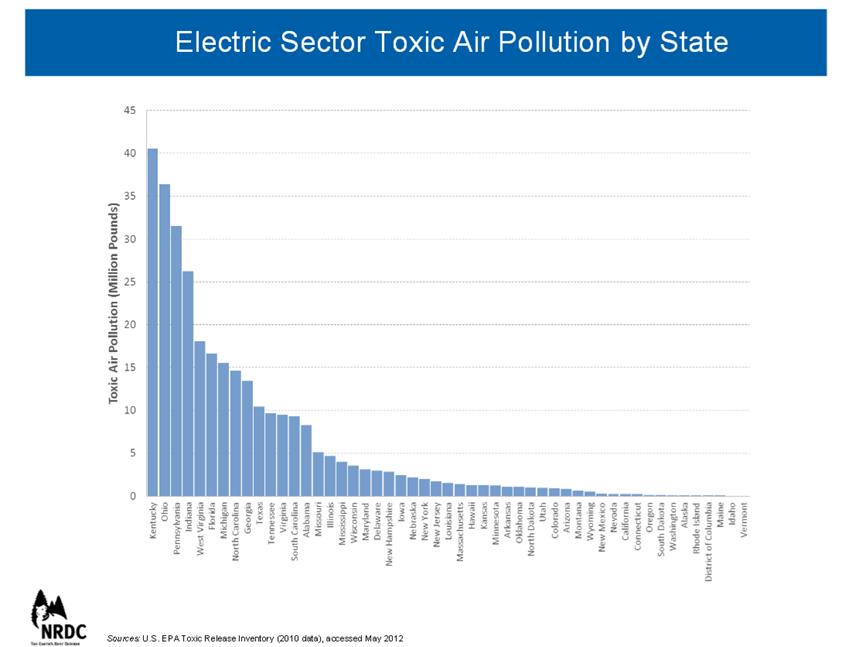
Residents of Kentucky, Ohio and Pennsylvania are exposed to more toxic air pollution from coal-fired power plants than in any other state, according to an analysis by the Natural Resources Defense Council (NRDC), leading the organization’s “toxic 20.”

At the same time, the report foundtoxic air pollution by state a 19 percent decrease in all air toxics emitted from power plants in 2010, the most recent data available, compared to 2009 levels. Connecticut ranks 42nd in toxic air pollution and 43rd in mercury air pollution according to the newly released data, among the lowest levels in the nation.

The drop in toxic levels nationwide is attributed to two factors: the increasing use by power companies of natural gas, which has become cheaper and is cleaner burning than coal; and the installation of state-of-the-art pollution controls by many plants--in anticipation of new health protections issued by the Environmental Protection Agency (EPA).

Finalized in 2011, EPA’s Mercury and Airby sector Toxics standards will cut mercury air pollution by 79 percent from 2010 levels, beginning in 2015. Connecticut is one of only 13 states to have electric sector mercury regulations that are at least as stringent as the EPA’s proposed utility air toxics rule, according to the report.

In the second edition of “Toxic Power: How Power Plants Contaminate Our Air and States,” NRDC also found that coal- and oil-fired power plants still contribute nearly half (44 percent) of all the toxic air pollution reported to the Environmental Protection Agency’s Toxics Release Inventory (TRI). The report also ranks the states by the amount of their toxic air pollution levels.

Among Connecticut’s neighboring states, New Hampshire at #21, New York at #24 and Massachusetts at #27 narrowly missed being included in the “toxic 20”.  Rhode Island was #47, Maine was #49 and Vermont was #50.

Newly installed EPA Administrator Gina McCarthy, a former Connecticut Commissioner of Environmental Protection, has spent the past four years with responsibility over EPA’s air pollution regulations as the assistant administrator of the EPA's Office of Air and Radiation.report

With pollution reductions resulting from the upcoming standard, it is estimated that as many as 11,000 premature deaths and 130,000 asthma attacks, 5,700 hospital visits, 4,700 heart attacks, and 2,800 cases of chronic bronchitis will be avoided in 2016. The public health improvements are also estimated to save $37 billion to $90 billion in health costs, and prevent up to 540,000 missed work or “sick” days each year.

Franz Matzner, NRDC associate director of Government Affairs, said:  “For too long, Americans have had no choice but to breathe toxic air pollution. Thanks to the EPA, the air is getting cleaner.”  Despite the overall reductions in total emissions, 18 of the Toxic 20 from 2009 remain in the 2010 list, although several states have made significant improvements highlighted in the report.  The states on the "Toxic 20" list (from worst to best) are:

  1. Kentucky
  2. Ohio
  3. Pennsylvania
  4. Indiana
  5. West Virginia
  6. Florida
  7. Michigan
  8. North Carolina
  9. Georgia
  10. Texas
  11. Tennessee
  12. Virginia
  13. South Carolina
  14. Alabama
  15. Missouri
  16. Illinois
  17. Mississippi
  18. Wisconsin
  19. Maryland
  20. Delaware toxic air


Manufacturing, Higher Education Strengthen Alliance, Looking Toward Future Jobs

As the New Haven Manufacturers Association celebrates its 100th anniversary in 2013, the future is looking up for an industry that has long been seeing at its heyday in the rear-view mirror.  There has been greater recognition that high tech manufacturing brings opportunities to attract and maintain jobs in Connecticut, and heightened connections between higher education and the manufacturing industry is reflecting the new approach.

That was evident when a fledgling initiative between NHMA and Southern Connecticut State University quickly filled to capacity in its pilot year.  NHMA and SCSU teamed up to sponsor a three-day program acquainting area science teachers with modern manufacturing and materials engineering methods this summer that officials hope will become an annual program.

The Materials & Manufacturing Summer Teachers' Institute, a collaboration that also includes Platt Technical High School in Milford and CRISP (Center for Research on Interface Structures and Phenomena at Yale University and Southern), attracted 30 science teachers from grades 7 to 9. NHMA

The program was designed to enable teachers to better educate middle school students about the relationship between STEM and manufacturing and what types of careers are available in the manufacturing field. Officials say that grade level was specifically targeted because students often decide as early as the middle school years whether or not to pursue math and science in high school, college and even in terms of career paths. More than 40 Connecticut teachers applied to attend the program, which could only accommodate 30 this summer.

Christine Broadbridge, chairwoman of the Physics Department at Southern and education director at CRISP, says area manufacturers and academics have been working for the past year to bring teachers, engineers and scientists together in more effective ways.

"We've learned from the teachers that they value relationships with industry," Broadbridge says. "At this institute, the teachers have found out about potential careers for their students as they learn about engineering and cutting-edge science. It has given them an opportunity to network with industry leaders and to gain hands-on knowledge about manufacturing. We hope they can bring that excitement back to their students."

Gregory W. Gray, the recently installed President of the Connecticut State Colleges and Universities, which includes 17 institutions across Connecticut, told the Connecticut Post this week that he wants the community colleges to take on a more aggressive workforce-development mission by expanding a manufacturing technology program that exists now on a few campuses, including Housatonic Community College (Bridgeport), Naugatuck Valley Community College (Waterbury) and Quinebaug Valley Community College (Danielson).  The program expanded a year ago, based on a very successful program offered at Asnuntuck Community College in Enfield.

There are almost 5,000 manufacturing commaterials-sciencepanies in Connecticut, according to the U.S. Census Bureau, and Connecticut manufacturing employees are 20 percent more productive than competing states, data from the state’s Department of Economic and Community Development indicates, as featured on the ConnSCU website.

The New Haven Independent recently reported on a New Haven company that is very much a part of the future of New Haven manufacturing. That future lies in specialization, in the rapid turnaround of high-tech niche parts, the Independent reported, according to Bill Neale, head of the New Haven Manufacturers Association and vice-president of operations at Radiall manufacturing on John Murphy Drive in the Fair Haven section of the city. The factory isn't trying to compete with massive operations in places like China and India, Neale said. It’s advantage lies not in productivity, but in speed and specificity.

Governor Malloy announced in June that state’s Advanced Manufacturing Centers at the three community colleges will receive $7,325,000 in funding for facility and equipment upgrades that will allow the centers to enhance and develop their educational opportunities. The funding was approved by the State Bond Commission.  According to ConnSCU, the funds would be allocated:

  • $1.5 million for Housatonic Community College to add a welding lab to their manufacturing center. HCC continues its work with its Regional Advisory Board to confirm the need for skilled welders in the region, including the review of options for virtual equipment and the pursuit of appropriate faculty expertise for student learning.
  • $825,000 for Naugatuck Valley Community College to add additional manufacturing equipment to the existing advanced manufacturing center, retrofitted to support local industry needs including the purchase of a deep draw press.
  • $5 million for Quinebaug Valley Community College to build an advanced manufacturing center on their campus in Danielson. For the first year, QVCC has worked with nearby Ellis Technical High School to utilize existing space until the college could grow the program and obtain funds for construction on its own campus. The funding will be used for construction, as well as for the purchase of machinery and other manufacturing equipment.

NHMA was founded in 1913 as the Employer's Association of New Haven County. Today the organization serves businesses, especially manufacturers, in the entire Southern Connecticut region and beyond. They’ll be celebrating a century of operations - looking forward - with a gala on September 19 at Housatonic Community College in Bridgeport.

14 States and D.C. Have Recovered Recession-Lost Jobs; Connecticut Hasn't Yet

While employment has steadily climbed since the nation’s economic recovery began, only a few states have seen job levels return to pre-recession numbers thus far, and Connecticut is not among them.  Last month marked the four-year anniversary of the end of the recession in June 2009, and updated U.S. Department of Labor estimates published within the week show the extent to which states are rebounding.

The U.S. has recovered 5.3 million jobs since job losses bottomed out, still about 2.2 million below pre-recession levels, Governing magazine reported. Only 14 states and the District of Columbia have fully recovered jobs dating back to 2008. Of those, only oil-rich Texas, North Dakota and Alaska recorded notable job growth exceeding a couple percentage points.  In Connecticut, net employment is down 3.6 percent and in Rhode Island it’s down 4.5 percent. Employment is up one percent in New York, and nearly one percent in Massachusetts over that period.jobs-300x211

Across the country, North Dakota experienced a 20.6 percent gain in employment since the recovery began, by far the nation’s largest increase. The state's population also jumped, accordingly.  Texas (8.6 percent), Utah (7.8 percent) and Indiana (6.4 percent) recorded the next-highest percentage increases over the four-year period.

As residents of Connecticut have seen first-hand, Texas is aggressively job poaching.  The Lone Star State and California are in the midst of a well-publicized battle for jobs, with Gov. Rick Perry making numerous visits to California and airing radio ads courting the state’s employers. The two states collectively added nearly 1.4 million jobs since the recovery began, accounting for more than a quarter of the nation’s total job growth. Perry, of course, is also taking on New York, Connecticut and Illinois in his jobs-snatching corporate romancing.

Most states still have a long way to go before payrolls return to pre-recession levels, Governing magazine reports. Nevada’s unemployment rate remains the country’s highest at 9.6 percent. The state also has registered the largest percentage drop in employment since the recession began (-9.8 percent), followed by Arizona (-6.3 percent) and Alabama (-5.2 percent).

A map developed by the publication shows the extent to which each state recovered, with states shaded based on the percentage change in nonfarm employment since the recession began in January 2008 (the National Bureau of Economic Research determined the economy peaked in December 2007).

State economies didn't all peak or bottom out at the same time either, so the data represents snapshots since the official start of the recession.  Traditionally, Connecticut enters national recessions late, and emerges from them after most states as well.  Governing also notes that the data doesn’t take into account more people entering the labor force.

The U.S. Bureau of Labor Statistics recently reported that Federal government employment continued to trend down in June (-5,000) and has declined by 65,000 over the past 12 months.  Of particular interest in Connecticut due to its employment levels in the financial services industry, employment in financial activities rose by 17,000 in June, with most of the increase occurring in credit intermediation (+6,000) and in insurance carriers and related activities (+6,000), according to the Bureau.

Employment in professional and business services rose by 53,000 in June. Over the past year, the professional and business services category has added 624,000 jobs.  Leisure and hospitality added 75,000 jobs in June. Monthly job growth in this industry has averaged 55,000 thus far in 2013, almost twice the average gain of 30,000 per month in 2012. Employment in the amusements, gambling, and recreation industry also continued to trend up in June (+19,000).

change in jobs

Waterbury, New Haven Among Nation's Leading Cities for Healthcare Social Workers

Connecticut, always on the lookout for occupations with strong potential for job growth, appears to already have one in our midst.  New statistics indicate that Waterbury and New Haven are among the top five metropolitan areas in the nation for healthcare social workers – a status that could serve to attract individuals in the fast-growing field to the state.

Nationwide, the median salary for a healthcare social worker is $47,770, and the job outlook is bright: jobs are projected to grow 26 percent from 2010 - 2020, which is twelve percentage points above the projected national job growth of 14 percent.  In Waterbury, the median salary is $65,250, the second highest in the nation; in New Haven, ranked at #5, it is $61Waterbury CT,950, according to data compiled by the data analysis website ValuePenquin.

Healthcare social workers are professionals who provide a range of services that support patients' medical needs in their psychosocial environment, from advising caregivers to coordinating medical services.  With healthcare becoming increasingly complex, the need for healthcare social workers has grown, as reflected in the analysis that determined the Best Cities for Healthcare Social Workers, based on May 2012 data.

The U.S. Bureau of Labor Statistics has reported that Connecticut is ranked fourth nationwide in  job prospects and has the fourth highest annual wages, at $60,830.  The Bureau defines the occupation as one that provides individuals, families, and groups with the psychosocial support needed to cope with chronic, acute, or terminal illnesses.  Services include advising family care givers, providing patient education and counseling, and making referrals for other services. Individuals in the field may also provide care and case management or interventions designed to promote health, prevent disease, and address barriers to access to healthcare.

In the ValuePenquin study methodology, median annual pay - a substantial factor in the decision process for people looking for work – was considered, along with how expensive the city is to live in.  Since the focus was on job opportunities, the study also factored in cities’ concentration of healthcare social workers. The ‘location quotient’ measures the concentration of a particular occupation in a city as a proportion of all occupations relative to the national average. They infer a higher location quotient to mean a relatively higher demand for a profession's services.  Data from the Bureau of Labor Statistics underscored the recent study, ranking Connecticut fourth in the nation in location quotient, reflecting a field in demand.

While the study ranked Waterbury and New Haven in the top five, Massachusetts communities also had a strong showing, reflecting the regions attractiveness for professionals in the field.  The top ten:

  1. Carson City, NV
  2. Waterbury, CT
  3.  Cumberland, MD
  4. Taunton/Norton/Raynham, MA

  5.   New Haven, CT
  6.  Napa, CA
  7.  Yuba City,  CA
  8.  Springfield, MA
  9. Boston/Cambridge/Quincy, MA
  10. Hanford/Corcoran, CA

In addition, New Bedford ranked #14, Worcester was #16, Brockton/Bridgewater/Easton, MA was #17, Providence/Fall River/Warwick was #18, Pittsfield was #19 and Barnstable was #20.

BLS

New London Harbor Light Recognized as State's Leading Lighthouse in USPS Stamp

The U.S. Postal Service has unveiling a stamp featuring the New London Harbor Light, the oldest and tallest lighthouse on Long Island Sound. The USPS indicates that it was originally established in 1761, financed by a lottery held by the Connecticut colonial legislature. The present lighthouse, built in 1801, was one of the earliest American lighthouses with a flashing beacon.

The lighthouse, which is owned by the New London Maritime Society, is the featured lighthouse for Connecticut in the 2013 United States Postal Service’s New England Coastal Lighthouses series. The stamp series highlights lighthouses from throughout the country.

New England Coastal Lighthouses also features the lighthouses at Portland Head, Maine; Portsmouth Harbor, New Hampshire; Point Judith, Rhode Island; and Boston Harbor, Massachusetts. Each stamp shows a close-up view of one of the five lighthouses that captures not only the down-to-earth aspect of the tower but also the mysteriouNew Londons qualities that compel us to come closer.

These five lighthouses are among the oldest in the U.S., and each is on the National Register of Historic Places. Boston Harbor Light is also a National Historic Landmark.  Howard Koslow created original paintings for New England Coastal Lighthouses stamp art-and for the entire lighthouse series. Howard E. Paine and Greg Breeding served as art directors.

The New England Coastal Lighthouses stamps are being issued as Forever® stamps. Forever stamps are always equal in value to the current First-Class Mail one-ounce rate.  The USPS has also developed a short video about each of the lighthouses.

Previously, the Connecticut state 34 cent stamp from the Greetings From America commemorative stamp series featured the state. The United States Postal Service released this stamp on April 4, 2002. The retro design of this stamp resembled the large letter postcards that were popular with tourists in the 1930's and 1940's.

Last fall, Westport Now reported that Westport holds a special place in U.S. Postal Service history with more of its artists (17) designing more postage stamps (161-plus) than any other community in the nation.

CT Businesses Report "Going Green" Worthwhile; Sustainability Has Multiple Impacts

Eight in ten Connecticut companies that have invested time and money in “going green” say the effort has been worthwhile, citing benefits on the bottom line as well as improved employee morale, public image, and client/customer relationships. According to a new survey,  the main barrier to going green is cost, the factor cited by 65% of businesses.  Among companies engaged in sustainability, the strongest areas of involvement are energy efficiency (90%), waste management (77%), and green purchasing (74%).

Those are among the findings of the Connecticut Business & Industry Association (CBIA) 2013 Sustainability and Connecticut Business Survey.  Sponsored by UIL Holdings, Inc., the survey gauges Connecticut companies’ commitment to environmental principles in their business operations and the impact of those efforts on business performance, stakeholder relations, and communities served.

The survey found that nearly two-thirds (66%) of Connecticut businesses engaged in sustainability. This is up from less than half (47%) in 2007, when CBIA first surveyed companies—but down from 74% in 2010, when the previous survey was conducted.

Mostt businesses (72%) find Connecticut’s environmental regulatory climate more restrictive than other states, according to the survey.  And nearly three-quarters of businesses surveyegoinggreen-icond (74%) say they would take advantage of state government incentives for going green, such as tax incentives and refunds for capital investments.

Among the other findings this yea, posted at www.cbia.com/business, include:

  • Renewable energy is the area of greatest interest among businesses for future activities.
  • Though slightly more than half (53%) of the companies surveyed say current economic conditions have not changed their level of commitment to sustainable business practices, 11% have stepped up their efforts, while 9% have made green practices less of a priority. Eighteen percent say green practices are part of their DNA.
  • Nearly one-third of businesses surveyed (32%) require others in their supply chain—manufacturers, suppliers, distributors, and retailers—to adopt green business practices; 28% say that their own customers have requested or stipulated that they incorporate green business practices into their supply chain; and 9% have received similar requests from vendors.

The 2013 Sustainability and Connecticut Business Survey was emailed to 5,035 businesses in late April and early May; 434 businesses took the survey, for a response rate of 9% and a margin of error of +/- 4.8 %.  Most respondents (77%) were small businesses employing fewer than 50 workers. Businesses represented include manufacturers (33%), professional services (23%), retail (9%), nonprofit associations (8%), construction (6%), wholesale (6%), healthcare (5%), finance, insurance, and real estate (5%), and technology firms (4%). Companies engaged in hospitality, tourism, arts, and entertainment accounted for the remainder of respondents.