Connecticut Resident Selected as Presidential Innovation Fellow, White House Announces

A Connecticut resident is one of 43 “incredible Americans” selected as new Presidential Innovation Fellows (PIFs), to serve 6- to 12-month intensive “tours of duty” in the US Government, where they will work hand-in-hand with top government innovators to develop solutions that can save lives, save taxpayer money, and help fuel private-sector job creation.

Nayan Jain is a Presidential Innovation Fellow working on the MyData Initiatives (Blue Button) at the Department of Health and Human Services.  Jain is an engineer and healthcare hacker with a passion for developing software that is able to simplify complexities by reducing noise and finding patterns in data.  His career in health IT began as an undergraduate with a dwhite hosueesign for an administrative database for the Department of Neurosurgery at Emory Hospital.

The Presidential Innovation Fellows (PIF) program was created in 2012 to tackle five inaugural projects—each focused on making a part of the Federal Government work better for the American people.  Each team of innovators is supported by a broader community of interested citizens throughout the country. Presidential Innovation Fellows put aside their jobs and day-to-day home lives to offer their skills and expertise in collaboration with Federal agency teammates to create huge value for the American public.

The 1st round of five projects was launched in August 2012 with 18 inaugural Fellows. The first round selections included Nick Bramble, Director of the Law & Media Program, Information Society Project at Yale Law School in New Haven.  Bramble is a lawyer with a strong interest in improving how governments release data and promote engagement by citizens and startups.

The 2nd round of the Presidential Innovation Fellows program will include ten projects,– four that are the second phases of Round 1 projects and six new projects. Presidential Innovation Fellows have a unique oppoNayan Jainrtunity to serve our Nation and make an impact on a truly massive scale.  The MyData Initiatives seek to spread the ability for people to securely access to their own data while spurring the growth of private-sector applications and services that a person can use to crunch his or her own data for a growing array of useful purposes.

After graduating and a stint writing applications for back-office propane systems, Nayan Jain  joined the DC-based startup, Audax Health.  While serving as Director of Mobile Technology at Audax, he helped build the core Zensey mobile and web platforms that aim to drive behavior change through consumer engagement and social game mechanics.  He collaborated to build MedTuner, an artificial intelligence that alerts its followers of important health events using techniques in machine learning and natural language processing, which was awarded first place at the 2012 Health 2.0 Developers’ World Cup in San Francisco, CA.

Most recently, he selected by Google to be a Glass Explorer and is looking forward to building wearable experiences that will help improve lives and patient outcomes.  He graduated with a BS in Computational Media, primarily focused on Human Computer Interaction and Computer Science from the Georgia Institute of Technology.  He currently lives in Connecticut, but spends his spare time in New York, according to the PIF announcement.innovation fellows
Jennifer Pahlka, Deputy U.S. Chief Technology Officer for Government Innovation reports that some of the tech innovators and change-agents who comprise the new class of Fellows will work on second phases of Round 1 PIF projects such as Blue Button (which is helping veterans and others across the country gain secure electronic access to their own personal health records); Open Data (which is making more and more government information like car safety ratings and hospital pricing available for use by the American people, including entrepreneurs and software developers who are turning those data into useful products and services); MyUSA (which is greatly simplifying the Web interface that citizens can use to find what they need from the Federal Government); and RFP-EZ.

For Round 2 of the PIF program, the White House Office of Science and Technology Policy (OSTP) and Office of Management and Budget (OMB) have partnered with the US General Services Administration (GSA).  Through this new partnership with GSA, which already works with every agency in the Federal Government, the prototype solutions that PIFs build will spread more efficiently throughout Government, enabling the program’s positive outcomes to reach more people more quickly.

For example, through Blue Button – a growing initiative across the public and private sectors – patients can download their own health information from a growing array of organizations (the Department of Veterans Affairs’ health system, private-sector health care providers, etc.) and securely share their medical histories with caregivers, import their prescription histories into mobile reminder apps, and more.

Others will work on new projects, such as developing tech tools to support disaster relief and recovery efforts; working with private-sector innovators to create consensus tech standards for the “Internet of Things,” which will connect a wide range of devices with embedded sensors and control systems, with big potential efficiencies and cost-savings; and helping Federal agencies save money through better, more cost-effective financial accounting systems.

Details on the entire class of Presidential Innovation Fellows is available on the web, and details about current and future rounds of the PIF program is at whitehouse.gov/innovationfellows,

 presidential innovation fellows

University of Hartford Student Athletes Win Conference in Academic Performance

Reporting on the academic performance of its student athletes with a level of statistical precision normally reserved for sporting events, the University of Hartford announced that it has clinched its second-straight America East Academic Cup in 2012-13 after posting the highest grade point average of any school in the 18-year history of the award, according to data from by the America East conference.

Compiling a 3.24 GPA in 2012-13, the Hawks' winning GPA was six points higher than the next highest mark, which belonged to New Hampshire (3.18 GPA). Binghamton University and University of Vermont tied for third (3.12 GPA), followed by University of Maine (3.11), Stony Brook University (3.08), Boston University (3.07), University at Albany (3.01) and UMBC (2.83), the university reported.

“We are all so proud of our student-athletes who have proven once again that we do things the right way: we excel on the field or court and in the classroom,” said University of Hartford President Walter Harrison. “Here at Hartford, the term student-athlete has meaning.”  Harrison has served as Chair of the National Collegiate Athletic Association's Committee on Academic PerforNCAA-mance.

The Academic Cup, established by the America East Board of Directors in 1995, is presented to the institution whose student-athletes post the highest grade point averages during that academic year.  Last year, Hartford student-athletes earned a 3.17 GPA, edging out the University of Vermont by one one-hundredth of a point to clinch UHart's first Academic Cup since 1996-97. In 2012-13, the Hawks surpassed last year's mark by seven one-hundredths to take home back-to-back Academic Cups for the first time in school history.

The Hawks set a record in the classroom in the Spring 2013 semester, posting a combined 3.23 GPA, edging the previous school mark of 3.22 set one year ago. This past spring, Hartford boasted 252 student-athletes with GPAs of 3.0 or better, with 150 of those student-athletes notching at least a 3.5 and 20 out of 358 student-athletes earning a perfect 4.0 GPA for the semester.

“Congratulations to the University of Hartford, most notably its student-athletes, on this historic achievement,” said America East Commissioner Amy Huchthausen. “It is indicative of the hard work put in and the value placed on academics not only by Hartford, but by all nine of our institutions and student-athletes, who consistently excel academically year in and year out, which is a core pillar of this conference and what sets us apart from so many others.” America East After a season in which its mens basketball team was ineligible for post-season play because of substandard academic performance a few years ago, UConn received the news earlier this year that they would again be eligible for post season play in 2014.

According to the NCAA's explanation of the Academic Progress Rate (APR) system which determines eligibility, each athlete earns one retention point for staying in school and one eligibility point for remaining academically eligible. The team's total points are divided by the number of possible points, then multiplied by 1,000 to reach the APR.

UConn's score for the 2011-12 academic year was 947 out of 1,000, giving the program two consecutive years with scores surpassing the NCAA benchmark. With a two-year average of 964, UConn surpassed the NCAA's two-year standard of 930 and will be eligible for postseason play in 2014, The Hartford Courant reported.

Five Quinnipiac University teams have received a Public Recognition Award from the NCAA for earning high scores in the most recent Academic Progress Rate (APR) compilation, according to the school.

The Quinnipiac squads recognized by the NCAA include: men’s indoor track & field, women’s cross country, women’s golf, women’s indoor track & field and women’s outdoor track & field. All five teams are rewarded for scoring in the top 10 percent in each sport with respect to their Academic Progress Rates (APRs).

Teacher Training in STEM Fields to Expand in CT

Connecticut’s drive to improve both teacher training and the caliber of Science, Technology, Engineering and Math (STEM) education being provided to students across the state received a boost with the announcement that the Connecticut Science Center would be tripling the capacity of its teacher professional development program, the result of a grant from Joyce D. and Andrew J. Mandell.

The number of teachers participating in the program will increase from 500 to 1,500 annually over the next few years, officials said, with the goal of giving educators the tools they need to meet rigorous new state and national standards for STEM education and core curricula.

Governor Dannel Malloy, State Education Commissioner Stephan Pryor, Hartford Mayor Pedro Segarra and Hartford’s 2012 Teacher of the Year Keith Sevigny, photoa past participant in the professional development program, were among those joining Connecticut Science Center President and CEO Matt Fleury in making the announcement.

In addition to expanding its capacity to serve more teachers, the newly named Joyce D. and Andrew J. Mandell Academy for Teachers at the Connecticut Science Center will also award graduate-level college credit through Charter Oak State College for certain programs.  Academy offerings include Student Engagement Strategies, Inquiry Teaching and Learning, STEM Education Units, Science Content Workshops, Engineering Practices, and Science Coaching. Teachers completing the covered courses can earn a total of nine credits toward their Master’s degrees over a three-year period.

Governor Malloy said the announcement made it a day of “celebration,” emphasizing that the impact “will be played out in the years to come.”  Reiterating his commitment to education and economic development, the Governor said this effort is another example of initiatives designed to “allow our state to compete.”  He  noted the BioScience Connecticut initiative and recently approved growth plans for the University of Connecticut as further indications of the state’s commitment.

Described as a “high-impact professional development program for educators,”  the Academy is “committed to supplying educators with professional development experiences that support rigorous science and curriculum standards.”   Commissioner Pryor, underscoring the challenges in education, pointed out that “15 countries do better than the U.S. in science and 24 do better in math.”  Pryor added that “we can prepare students for jobs of the future, but not if we are slipping in math and science.”

Officials pointed out that new nationally mandated benchmarks such as the Next Generation Science Standards and Common Core Education Standards will require teachers to seek training to improve the way they teach science and integrate it with the rest o f their curriculum.

“We want every child in the state to be able to compete,” said Joyce Mandell. “Teaching teachers how to connect with their students is one of the most important things we’ve ever done.  We’re very proud of our association with the Connecticut Science Center.”

Citing a story published in U.S. News, the website CT Stem Jobs, reported last month that about 20 percent of all American jobs are now in the science, technology, engineering and mathematics fields, with half of those open to workers who don't have a four-year college degree, according to a new report by the Brookings Institution called "The Hidden STEM Economy."

Those jobs constitute a "hidden STEM economy," the Washington, D.C.-based think tank says, because they are "prevalent in every large metropolitan area," but many people believe at least a bachelor's degree is necessary to work in careers that require STEM skills. Many of these so-called "blue-collar" stem jobs are in construction, installation, manufacturing and health care. They include registered nurses, mechanics, carpenters and electricians.

"Of the $4.3 billion spent annually by the federal government on STEM education and training, only one-fifth goes towards supporting sub-bachelor's level training, while twice as much supports bachelor's or higher level-STEM careers," the report says. "The vast majority of National Science Foundation spending ignores community colleges. In fact, STEM knowledge offers attractive wage and job opportunities to many workers with a post-secondary certificate or associate's degree."

Local Business Extends “Fostering Hope” Program Providing Backpacks for Foster Children

In honor of National Foster Care Month, locally owned and operated advertising specialty and marketing company The Perfect Promotion collected new duffle bags, backpacks and luggage to supply to children in foster care as part of the Fostering Hope Program that they launched in 2010.

Through donations made  by the community, factory suppliers and The Perfect Promotion, hundreds of bags have been donated since the initiative was launched, including more than 200 this year. The bags were donated in May to the Rocky Hill-based Connecticut Association of Foster and Adoptive Parents, Inc. (CAFAP) and were distributed statewide to children in the cfoster careare of the Connecticut Department of Children and Families (DCF).

According to the Connecticut DCF, as of February 2012, there were a total of 4,515 children in foster care.  The average age is 9-years-old.    The placement breakdown includes 1,953 children in direct foster care, 1,221 in congregate care, 996 in relative care, 131 in independent living and 30 in a trial home.

“When I first learned that children in foster care oftentimes use a trash bag to carry all of their worldly belongings when they move from placement to placement, I knew we had to do something,” said Jody Ferrer, president of The Perfect Promotion. “It is my goal that the Fostering Hope Program will provide every child in foster care in the State of Connecticut with a bag to call their own, and a dignified means to move their possessions.”

More information about foster care is available from the state Department of Children and Families in a pamphlet, “A New Beginning” which tells the stories of the impact of foster care on the children and their foster families.

In  an ABC Primetime report telecast in 2006, it was reported that “Children have on average three different foster care placements. Frequent moves in and out of the homes of strangers can be profoundly unsettling for children, and it is not uncommon to hear of children who have been in 20 or 30 different homes.”

All families providing foster care and pre-adoptive care for children in Connecticut are licensed or approved according to the regulations of the Connecticut DCF.  The first step is to attend an open house offered by one of 14 area offices around the state. At the open house, staff provide an overview of the agency’s mission, philosophy of foster care, and the liheartcensing process and requirements. To begin this process, or to learn more, call 1-888-KID-HERO or check the Open House Schedule.

The Perfect Promotion uses a consultative approach the focus is on the needs and goals of the client. Imprinted apparel and promotional products are used as tools to help businesses and nonprofits achieve their goals and maintain a positive, top-of-mind presence. For more information, visit www.theperfectpromotion.net.

Darien, West Hartford Top List of Leading High Schools in CT

As high schools throughout the state conduct graduation ceremonies, it is an opportune time to review the U.S. News Best High Schools 2013 rankings. Connecticut has 11 gold medal schools, 24 silver medal schools and four bronze medal schools, according to the latest annual survey of 21,035 public high schools across the country.  A total of 39 Connecticut schools made the magazine’s ranking. The top 10:

1.       Darien High School

2.       Conard High School

3.       Weston High School

4.       Ridgefield High School

5.       Farmington High School

6.       Wilton High School

7.       Staples High School

8.       William H. Hall High School

9.       Joel Barlow High School

10.   Connecticut International Baccalaureate Academy

Among Connecticut high schools, the top ranked Darien High School placed at #217 nationally, followed by West Hartford’s Conard High School at #218.  HS

The smallest student-teacher ratio was at East Granby High School, at 10:1.  More than two dozen schools had an 11:1 student – teacher ratio, including Putnam HS, Windsor HS, Housatonic Valley Regional HS, James Hillhouse HS in New Haven, East Windsor HS and Rockville HS.

An interactive database allows visitors to rank Connecticut’s high schools by college readiness, math and reading proficiency.  The top reading proficiency was at Fairfield Ludlowe HS in Farifield, the top math proficiency at Pomeraug Regional High School in Southbury, and the top college readiness was at Masuk High School, in Monroe.

West Hartford First School District to Commit to State’s Green LEAF Program

West Hartford schools are turning over a new leaf, and going green.  The school district has become the first in the state to have every school principal agree to abide by the guidelines of the Connecticut Green LEAF program, which promotes increased environmental and sustainability education and health and wellness efforts.  LEAF stands for “Leading, Educating, Achieving and Fostering green healthy schools for all.”

According to the initiative’s website, green schools create healthy, productive learning environments for students and teachers. The site points out that studies show that green schools raise student achievement and save money, while improving the health of students and staff.  In addition, it states that environmental edugreen leaf schoolscation provides a focus for learning in all content areas and builds critical thinking skills, and students are more engaged and become empowered to make a difference in their school and community and contribute to a vibrant economy and more sustainable communities.

Connecticut Green LEAF Schools is a collaborative effort of the CT Department of Education, CT Department of Energy and Environmental Protection, CT Department of Public Health, CT Department of Construction Services, as well as many environmental and educational organizations.

The state can nominate up to four Connecticut Green LEAF Schools annually for the national Green Ribbon Schools award.  In April, the U.S. Department of Education honored three Connecticut schools as recipients of the 2013 Green Ribbon Schools designation:  Barnard Environmental Studies Magnet School in New Haven, Common Ground High School in New Haven, and Environmental Sciences Magnet at Mary Hooker School, in Hartford.

The Green Ribbon Schools program is a U.S. Department of Education recognition program for K-12 schools that have made significant progress in reducing their environmental impact, improving student and staff health, and providing effective environmental education. This recognition is part of a larger U.S. Department of Education effort to identify and disseminate knowledge about practices proven to result in improved student engagement, academic achievement, graduation rates, and workforce preparedness, as well as a government-wide aim to increase energy independence and economic security.

A brochure highlighting the Connecticut Green LEAF Schools program has been developed.  According to the website, Connecticut Green Schools include:

        Common Ground High School (New Haven)

        Barnard Environmental Studies Magnet School (New Haven)

        Environmental Sciences Magnet School at Mary Hooker (Hartford)

        Staples High School (Westport)GRS Logo

        The Foote School (New Haven)

        Two Rivers Magnet Middle School (East Hartford)

        Westover School (Midddlebury)

When the 16 West Hartford school principals signed letters of commitment this month, it marked the first time that an entire district in the state signed on to participation in the program.  Connecticut schools can participate at any time, according to the process:

CT Green Schools also includes a program for college campuses.

Students From West Hartford, Fairfield and Southport Among Top U.S. Winners at National History Day Competition

Over 2,000 Connecticut students recently ended the school year with a sense of accomplishment and a better understanding of the world around them thanks to History Day in Connecticut – and ten students from the state earned national recognition last week for their efforts.

 Through this rigorous annual academic program for grades 6-12, 2,000 students developed school history projects across the state. Of those, 1,250 went on to participate in District Contests across Connecticut, and over 400 competed in the State Contest on April 27 at the Old State House in Hartford.  Connecticut’s program is coordinated by the Old State House.

 The 2013 theme was “Turning Points in History:  People, Ideas, Events.” history day CT

 The 69 students who placed 1st or 2nd in various age groups at the State Contest represented Connecticut at the week-long National History Day Contest, held at the University of Maryland, June 9 - 13. Students competed in various categories, and according to age group (junior and senior divisions).  Categories included documentaries, exhibits, websites, papers, and performances.

 The top three finishers in each category at the national contest were recognized, and included  three Connecticut entries that including participation from nine students:

 Junior Group Exhibit - Second Place

Madeline Langdon, Claire Langdon, Emma Langdon Fairfield, CT, Greenfield Hill Girls School2013_Logo_web Teacher: Gina Ludlow Entry - The Connecticut Effect: How the Hartford Circus Fire Changed a Nation

Junior Individual Exhibit – Second Place

Samuel Porcello West Hartford, CT, Sedgwick Middle School Teacher: Jennifer Hunt Entry - The Hartford Circus Fire: A 10 Minute Turning Point Sparks Lasting Change

Senior Group Performance – Third Place

Pierce Barry, Annabel Barry, Isabella Altherr, Jaden Esse, Quinn Barry Southport, CT, Pequot Homeschool Teacher: Alison Barry Entry - The Tet Offensive: Turning Point in Vietnam, Turning Point in Journalism  

In addition, student Timothy Cohn from Southbury received the organization’s “George Washington Leadership in History” award for his Senior Indivihistory day logodual Exhibit, “Washington and the French:  A Turning Point in the American Revolution.”  His teacher is Sharon Wlodarczyk.

Organizers say the History Day initiative is important because “students who think critically, understand how the past shapes the present, and know how to plumb history for answers to current issues make better citizens.”  Also, studies have shown that History Day participation helps students out-perform peers on standardized tests and develop the skills needed to succeed in work and college.

The Connecticut League of History Organizations and ConnecticutHistory.org encourage students to explore state history through their projects with help from local historical societies. The Connecticut Historical Society runs workshops and helps run the contests. Connecticut Humanities provides the major funding needed to provide 2,000 students with a rich and lasting academic opportunity.

 History Day in Connecticut is one of 54 affiliate programs of the renowned academic National History Day Program.  National History Day (NHD) correlates to the Common Core State Standards for Literacy in History/Social Studies, Science, and the Technical Subjects.

Hands-Free Electronics Are Hazardous to Driver Safety, State Ban Proposed

For the second time in recent weeks, a major driving safety study has concluded that hands-free devices produce dangers much the same as hand-held cell phones for drivers.  The latest study comes from AAA, following a study by the Texas Transportation Institute at Texas A&M University, reported by Connecticut by the Numbers earlier this month.

Connecticut teen driving safety advocate Tim Hollister, who was a member of the Governor’s Safe Teen Driving Task Force in 2007-8 and publishes a national blog for parents of teen drivers, is calling for a ban on the use of electronic devices while driving, citing increasing evidence of the dangers of distracted driving.  His proposal, outlined in The Hartford Courant prior to the release of the AAA study:  "no driver of a vehicle in gear shall use any electronic device to text, type, read, watch a video or make a phone call."

Hollister pointed out that six leading public health and traffic safety organizations (World Health Organization, National Transportation Safety Council, Insurance Institute for Highway Safety, and the Governor’s Highway Safety Association) “now agree that hands-free cellphone use is just as dangerous as hand-held.  Both cause cognitive blindness.”  The head of the National Transportation Safety Board agrees, having previously stated “we know that electronic devices that pull a driver’s attention away from his or her primary task are unsafe.”Internet-ready-driver-side-computer

Texting a friend verbally while behind the wheel caused a “large” amount of mental distraction compared with “moderate/significant” for holding a phone conversation or talking with a passenger and “small” when listening to music or an audio book, the AAA Foundation for Traffic Safety found in the latest study, released this week, Bloomberg News and other national media widely reported.

Not a single state prohibits hands-free dialing, and neither state nor federal action appears on the horizon, despite initial efforts by NTSB more than a year ago.  In fact, just the opposite is true.  Even as evidence of hazards grows, so do the range of electronic options and efforts to develop more "connected" cars.

Using voice-to-text messaging, included in systems such as Ford Motor Co.’s Sync and Toyota Motor Corp.’s Entune, is more distracting to drivers than making calls with handheld mobile phones, the AAA found. The earlier study at Texas A&M also concluded that voice-to-text is as dangerous and traditional typed texting.

Two bills that offer responses to aspects of distracted driving – although not prohibiting the popular practice - were approved in the just-concluded Connecticut General Assembly session, according to media reports.

  • The first would give prosecutors the ability to seek up to $1,000 in fines, over criminal penalties, if a distracted driver hits and injures a jogger, pedestrian, horseback ride, and other lawful “vulnerable” roadway user.
  • The other bill adds distracted driving to the list of moving violations that would be made available to insurance companies. Currently, if someone disobeys the state’s distracted driving law, they pay a fine and the insurer doesn’t know about it.  The bill also increases fines and creates a task force to study distracted driving prevention.  Both await approval by Gov. Malloy.

Automakers have vigorously promoted voice-based messaging as a safer alternative to taking hands off the wheel to place a call or talk on a hand-held phone. The hands-free systems have not been opposed by the U.S. Transportation Secretary, but the head of the National Transportation Safety Board has expressed serious reservations.  Writing in the Washington Post in 2011, NTSB Chair Deborah Hersman pointed out that “studies published as early as 1997 and 2005 have shown that there is little difference between hands-free technology and handheld devices when it comes to cognitive distraction.”

About 9 million infotainment systems will be shipped this year in cars sold worldwide, with that number projected to rise to more than 62 million by 2018, according to a March report by London-based ABI Research.

With the addition of a new law passed in Hawaii this month, 40 states, the District of Columbia, the Virgin Islands and Guam have banned text messaging for all drivers using hand-held devices.  Hawaii becomes just the 11th state (including Connecticut, as well as the District of Columbia, Puerto Rico, Guam and the Virgin Islands) to prohibit all drivers from using handheld cell phones while driving.

Voluntary guidelines recently issued (April 2013) by the Department’s National Highway Traffic Safety Administration (NHTSA), recommended specific criteria for electronic devices installed in vehicles at the time they are manufactured.  The guidelines include recommendations to limit the time a driver must take his eyes off the road to perform any task to two seconds at a time and twelve seconds total.

The back-to-back studies by the Texas Transportation Institute and AAA raise questions about those recently-issued recommendations.

Faces of Distracted Driving  USDOT video 

World Languages Being Cut by Elementary Schools, Despite Benefits

This month, the Windsor school board voted to eliminate two world language teachers at the elementary school level, which put an end to the district's elementary world language program, in a budget-cutting move.  A month earlier, the school board in Newington decided to delay the introduction of Spanish in lower elementary school grades in order to reduce the budget for the coming year.

Despite studies that have shown that language instruction beginning at the eleworld languagementary school level provides numerous benefits for students, ranging from critical and creative thinking to improved performance on standardized tests and better  job prospects, school districts in Connecticut appear to be cutting back, although the state Department of Education does not have recent data to provide a clear picture of what is occurring.  The most recent data dates back to the 2007-08 school year.

A policy statement by the American Council on The Teaching of Foreign Languages earlier this year stated that “an early start to learning a second language, programs of immersion or dual language immersion, and long learning sequences show strong results in helping all learners” and  outlines how standards-based language learning does the following: develops literacy and numeracy, prepares learners in the STEM (Science, Technology, Engineering and Math) areas, engages learners through practical applications for special purposes and strengthens college and career readiness.

According to the U.S. Department of Education, only 30 percent of American high school students are enrolled in foreign language classes, and only 25 percent of American elementary schools even offer foreign languages. The American Council on the Teaching of Foreign Languages published an alignment of the National Standards for Learning Languages with the Common Core State Standards, adopted in Connecticut and many other states.  The guidelines include standards for reading, listening and viewing as well as writing, speaking and visually representing.

The guidelines also indicate that research demonstrates that “as students come to understand how language works through their learning of a second or third language, their understanding of and attention to language conventions and functions expands and has an impact on applications in their first language.”

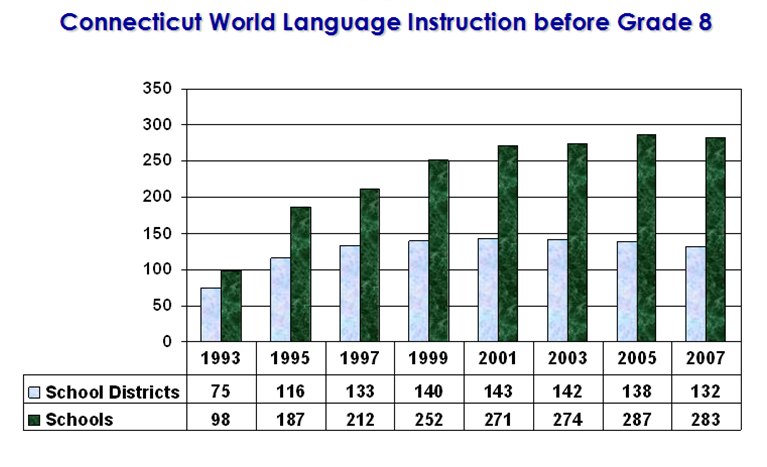
Data on the SDE website – now six years old - indicates that the number of Connecticut schools providing world language instruction before grade 4 increased from 14 in 1993 to 85 in 2007.  The number of school districts in the state with world language in the early grades increased from 6 to 40.  Expanding the report to include world language instruction before grade 8, the number of schools grew from 98 in 1993 to 283 in 2007 and the number of school districts increased from 75 to 132.  Data after 2007-08 is not readily available. world lang gr 8

world lang gr 4

Report Warns of Separate But Unequal Community Colleges

Community colleges "are in great danger of becoming indelibly separate and unequal institutions in the higher-education landscape," a Century Foundation task force warns in new report.

The report, "Bridging the Higher Education Divide: Strengthening Community Colleges and Restoring the American Dream," outlines a series of proposals aimed at shifting the patterns that result in four-year colleges' enrolling disproportionably more wealthy and white students while two-year colleges enroll a higher proportion of needy and minority students.

Among its recommendations, the group urges states and the federal government to provide additional funds to two-year colleges that serve the neediest students, much in the way the federal Title I program works for elementary and secondary schools.

The Chronicle of Higher Education reports that the task force effort is premised on the notion that community colleges, which enroll about 44 percent of the nation's college population, are in many cases not serving students well now and will be ill equipped to handle future demands without radical change.  Research undertaken for the report found that, at some community colleges, almost two-thirds of the students are COMMUNITY_COLLEGEblack, Hispanic, or members of other groups typically considered underrepresented in higher education.

The approach outlined in the report could not only create more-affordable college pathways for middle-class families and improve educational outcomes at community colleges, it could also give community colleges more political clout, the Chronicle reported.

Connecticut’s 12 community colleges have 58,228 students, according to the Connecticut State Colleges & Universities website.  According to a 2011 report by the now defunct Board of Governors for Higher Education, nearly two-thirds (62.1 percent in fall of 2010) of all Hispanic/Latino and African American students attending community college do so at four of the system’s 12 institutions – Capital Community College in Hartford, Gateway Community College in New Haven, Housatonic Community College in Bridgeport and Norwalk Community College – all situated within or near urban cities with large low-income and minority populations. These institutions also awarded more than two-thirds (68.9 percent) of the associate degrees conferred to Hispanic/Latino and African American students by the community colleges during the 2009-10.

The Board of Governors report added that “it is clear that there is no problem regarding access for minority students at the state’s community colleges; thus, the Department’s grant program designed to reward and support their diversity efforts will require that they focus solely upon the retention and graduation of targeted students.”   In 2011, the Connecticut Mirror reported that the state pays about $7,000 a year for each full-time student enrolled in one of the 12 two-year community colleges -- but only one out of every 10 full-time students who enroll seeking an associates degree or certificate will earn one in three years. That ranks Connecticut's community college graduation rate 47th in the nation, according to a report by the state Department of Higher Education.

Earlier this year, in March, the Board of Regents for Higher Education, which now oversees the state’s 12 community colleges and four state universities voted to increase tuition by 5 percent in the coming year, despite student protests.  Students at Connecticut's community colleges would pay 5.25 percent more. For a full time student, that's an increase of $188 more, for a total of $3,786, the Hartford Courant reported.

The report by the Century Foundation noted that in a survey, eighty-one percent of students entering community college for the first time saying they eventually want to transfer and earn at least a bachelor’s degree but just 12 percent do so within six years. Among low-income students with “high” qualifications for college (those who completed “at least Trigonometry”), 69 percent of students who began in a four-year institution earned a bachelor’s degree, compared with just 19 percent of those who started in a community college.

Richard D. Kahlenberg, a senior fellow at the Foundation, questions how "we shower the most resources on the wealthiest college students and the least on the neediest," noting that the idea of reducing stratification by enhancing community colleges is an important focus in the report. The 22-member task force was led by Anthony W. Marx, the former president of Amherst College who now heads the New York Public Library, and Eduardo Padrón, president of Miami Dade College.