Who Knew? Northeast is Hotbed of Entrepreneurial Activity, For Some More than Others

Takes one to know one. Or, more accurately, know one and you may become one. That’s the bottom line of an exploration into entrepreneurship by a Kauffman Foundation researcher, who found that the Northeast is the best place to catch the entrepreneurial bug. As Connecticut sinks increasing dollars into initiatives to encourage entrepreneurship, develop jobs, and turn ideas into businessentrepreneurses (often with state financial incentives) the report offers guidance of factors influencing the frequency of entrepreneurial launches.  Connecticut Innovations,  established and supported by state government,  helps Connecticut businesses grow through creative financing and strategic assistance,  and is the nation's sixth most-active early stage investor.

The survey indicated that the likelihood of a person knowing entrepreneurs varied widely by location, income, gender, and age. Respondents were much more likely to know entrepreneurs if they were male, had modest income, or were middle-aged. And they were much less likely to know entrepreneurs (or be entrepreneurs) if they were female, had a higher income, or were located in the Midwest or South.

The study suggests that there could be “material increases in entrepreneurship simply through doing a better job of exposing people to existing entrepreneurs, especially peers or contemporaries.” Entrepreneurship grows, the study found, where it is planted.

Key factors to consider when attempting to encourage entrepreneurship, according to the study:

  • Women have less exposure to growth entrepreneurs than men
  • The young have much more exposure to growth entrepreneurs
  • People in lower income strata are much less likely to be exposed to growth entrepreneurs

The study concluded that “In all cases, an individual’s exposure to entrepreneurs—and to growth entrepreneurs in particular—may increase his or her likelihood of being one. Entrepreneurship can be viral, but must be introduced early and often in environments where it is least often seen.”

The study distinguished between entrepreneurial companies and “growth entrepreneurial companies,” those companies growing more than 20 percent a year and with more than $1 million in sales, generate more employment and contribute more to wealth and GDP than do slower-growing ventures.

The likelihood of a respondent reporting knowing an entrepreneur by Region in the United States was 36.7 percent. The likelihood of knowing a growth entrepreneur was considerably lower, at 15.4 percent.
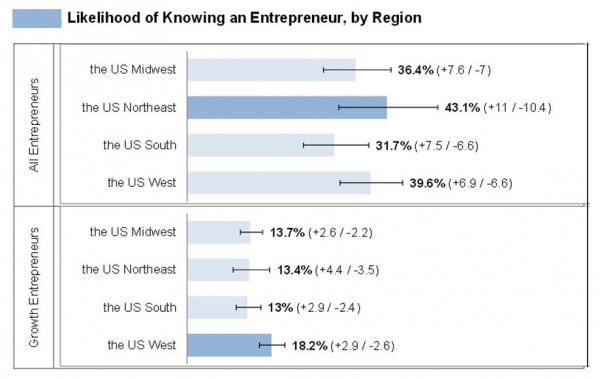
When broken down by gender, the likelihood of males knowing an entrepreneur was 39.9 percent, females 35.8 percent. For growth entrepreneurs, the gender gap was considerably wide, 24.8 percent to 12.1 percent.

A year ago, CTNext, Connecticut’s innovation ecosystem managed by Connecticut Innovations (CI), announced the launch of the Entrepreneur Innovation Awards (EIA), a competitive pitch process that provides awards up to $10,000 to entrepreneurs in Connecticut for growth-related activities. CI helps innovative companies in four key ways: by offering equity, debt, grants and strategic guidance.

A month ago CTNext announced the winners of the latest round of EIA awards; Connecticut-based companies and entrepreneurs, received $10,000 for their project ideas. CI also selected David Wurzer, formerly a senior managing director at CI, to be chief investment officer and executive vice president. As part of his new role, Wurzer will be responsible for the management of the investment function, staffing needs, portfolio and risk management, outreach to stakeholders, budget planning and performance measurement.

The study “Getting the Bug: Is (Growth) Entrepreneurship Contagious?” was conducted by Paul Kedrosky of the Kansas City-based Kauffman Foundation, and is aimed at providing data to guide efforts across the country to grow entrepreneurship. The survey, which categorizes responses of 2,000 individuals by age, income, gender, and location, was done via Consumer Google Survey.

44 Connecticut High Schools Among Best in US; Top School in State Is #15 Nationally

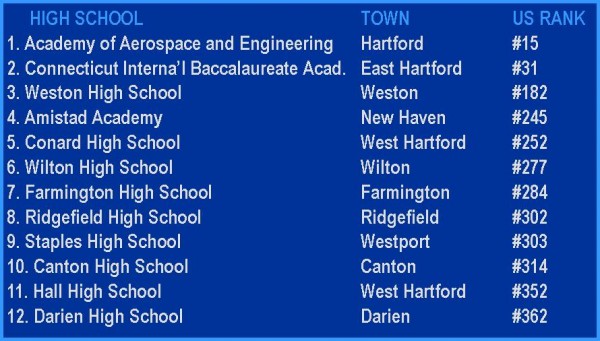
Forty-four Connecticut high schools have earned a slot on U.S. News & World Report’s list of the nation’s Best High Schools. The top school in Connecticut, according to the rankings, is Academy of Aerospace and Engineering, an inter-district magnet school run by the Capitol Region Education Council (CREC), which came in at number 15 in the U.S. rankings.

The title of number one school in the country went to School for the Talented and Gifted in Dallas, Texas.  The top ten nationally included schools in Arizona, Georgia, Virginia, Florida, Michigan and California.  TAmericas-Best-High-Schoolshe publication’s 2014 Best High School rankings, included a review of 19,411 public high schools.

According to U.S. News & World Report, Connecticut has 17 gold medal schools, 20 silver medal schools and seven bronze medal schools. In order to be eligible for a state ranking, a school must be awarded a national gold or silver medal.

CREC’s Academy of Aerospace and Engineering, at #15 nationally, was the only Connecticut school to make the top 30.  The school plans to move to a newly constructed school facility in Windsor next year. It is a grade 6 – 12 magnet school with programs that build upon each other to help students gain skills and unique experiences in science, technology, engineering and mathematics (STEM) that prepare them for college and high-demand professional careers. The diverse student body comes from more than 30 cities and towns in the Greater Hartford area.

The Connecticut International Baccalaureate Academy, in East Hartford, ranked #2 in Connecticut and #31 in the nation, according to the US News rankings.  The #3 high school in Connecticut ranked #182 nationally – Weston High School.

In addition to the top 12 high schools in Connecticut (see chart), those making the U.S. News list included Joel Barlow High School (Redding), Simsbury High School, Greenwich High School, Newtown High School, New Canaatop high school listn High School, Fairfield Ludlowe High School, Avon High School, Lyme-Old Lyme High School,  Brookfield High School, Fairfield Warde High School, Amity Regional High School (Woodbridge), Guilford High School, Glastonbury High School, Suffield High School, Litchfield High School, Metropolitan Learning Center (Bloomfield), and Bolton High School, all among the top 1,000 high schools nationally.

Also reaching the U.S. News list, were Valley Regional High School (Deep River), Bristol Central High School, South Windsor High School, Daniel Hand High School (Madison), Southington High School, Hill Regional Career High School (New Haven), Cooperative Arts and Humanities High School (New Haven), and Northwestern Regional High School (Winsted), which placed among the top 1,640 high schools nationwide.

Among the Connecticut high schools (see the full list of rankings) the top ranked school for college readiness was Lyme-Old Lyme High School, followed by Old Saybrook High School and Pomperaug Regional High School (Southbury).awards pie

The best student-teacher ratio in the state was 10:1, occurring in 13 high schools, including Bloomfield High School, Windsor High School, East Windsor High School and Windham High School.   Twelve schools were tied with the highest math proficiency in the state; four schools had the highest reading proficiency among their students – Newtown, Greenwich, Brookfield and Farmington high schools.

The US News site explains that "a three-step process determined the Best High Schools. The first two steps ensured that the schools serve all of their students well, using performance on state proficiency tests as the benchmarks. For those schools that made it past the first two steps, a third step assessed the degree to which schools prepare students for college-level work."

  • Step 1 determined whether each school's students were performing better than statistically expected for the average student in the state.
  • Step 2 determined whether the school's least-advantaged students were performing better than average for similar students in the state.
  • Step 3 judged college-readiness performance using Advanced Placement or International Baccalaureate test data as the benchmarks for success.

Gold medal designation went to the top 500 schools (about 3 percent) based on the highest college readiness, the silver medal to high performing schools with lower college readiness numbers (about 9 percent of schools), and the bronze designation went to high performing schools based on state examThe Changing Prairie performance (about 15 percent of schools).  Three-quarters of the schools whose data was analyzed did not earn a “best” designation.

Encore Entrepreneurs – Over 50 and Building New Businesses

Mix a relatively slow economy and a shortage of jobs with a large number of aging boomers looking for meaning and purpose in their work. The result is a growing number of “encore entrepreneurs” seeking to launch income-generating ventures that make a positive difference in their communities.

That has led the U.S. Small Business Administration (SBA) and AARP to launching a strategic alliance to provide counseling and training to entrepreneurs over the age of 50 who want to start or grow a small business.   AARP

April is Encore Entrepreneur Mentor Month, and would-be “encore entrepreneurs” will have the opportunity to connect with a number of organizations and community leaders for advice and assistance in their endeavors as part of seminars held as part of the AARP-SBA initiative.

Next up in Connecticut:  a free seminar, Want to Start or Grow a Small Business?, at the Hartford Public Library on Wednesday, April 23, 2-4 PM, at 500 Main Street.  Space is limited. Interested individuals can register online or call toll-free 877-926-8300.   There will also be a session in New Haven on May 15.

For many Americans born between 1946 and 1964, retirement has a very different meaning than it did a generation ago.   According to a USA Today/Gallup poll, 63% of American adults plan to work in retirement; two-thirds say enjoyment of work is the key reason. With years of valuable work experience, maturity, and plenty of energy at their disposal, today's older workers are increasingly finding financial and personal fulfillment in running their own small businesses.entrepreneur

New research released by Encore.org (formerly Civic Ventures) and funded by the MetLife Foundation shows:sba-logo-300x121

  • Approximately 25 million people – one in four Americans ages 44 to 70 – are interested in starting businesses or nonprofit ventures in the next five to 10 years.
  • More than 12 million of these aspiring entrepreneurs are potential encore entrepreneurs who want to make a positive social impact as well as a living.  Potential encore entrepreneurs have realistic financial expectations and plan local, small ventures to meet needs in their communities.
  • These aspiring entrepreneurs bring a lot of experience to the table, including an average of 31 years of work experience and 12 years of community involvement. Additionally, five out of six report having management experience – 15 years on average.

A 2010 survey by the Kauffman Foundation found that Americans 55 to 64 start new business ventures at a higher rate than any other age group, including 20-somethings. Fully 23 percent of new entrepreneurs were age 55 to 64, up from 14 percent in 1996.

The first event in Connecticut was held in Bridgeport in late January, followed by Danbury in early April.  An additional program is slated for New Haven on May 15 (2 to 4 PM) at Gateway Community College.

In Search of Adventure: A Children’s Book Diversity Mystery

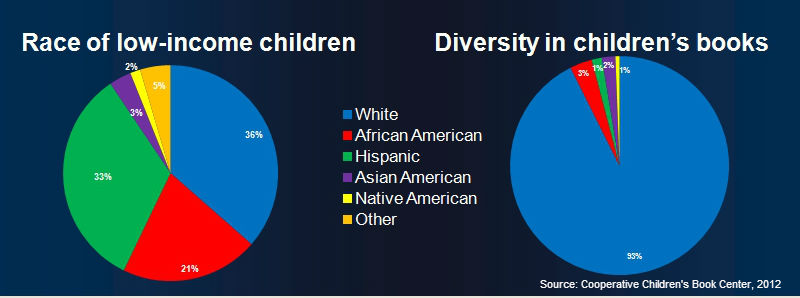
In 2012, 93 percent of children’s books written that year were written about white characters, according to a study by the Cooperative Children’s Book Center.  There were 3,600 children’s books written that year.

Apparently the hue and cry were insufficient to change the inertia of insensitivity to the range of skin colors on American children.  A similar study in 2013, recently highlighted in The New York Times, found the following:  of 3,200 children’s books published last year, just 93 were about black people and 57 were about Latinos.  The Cooperative Children’s Book Center is at the University of Wisconsin. PowerpointGraphic1

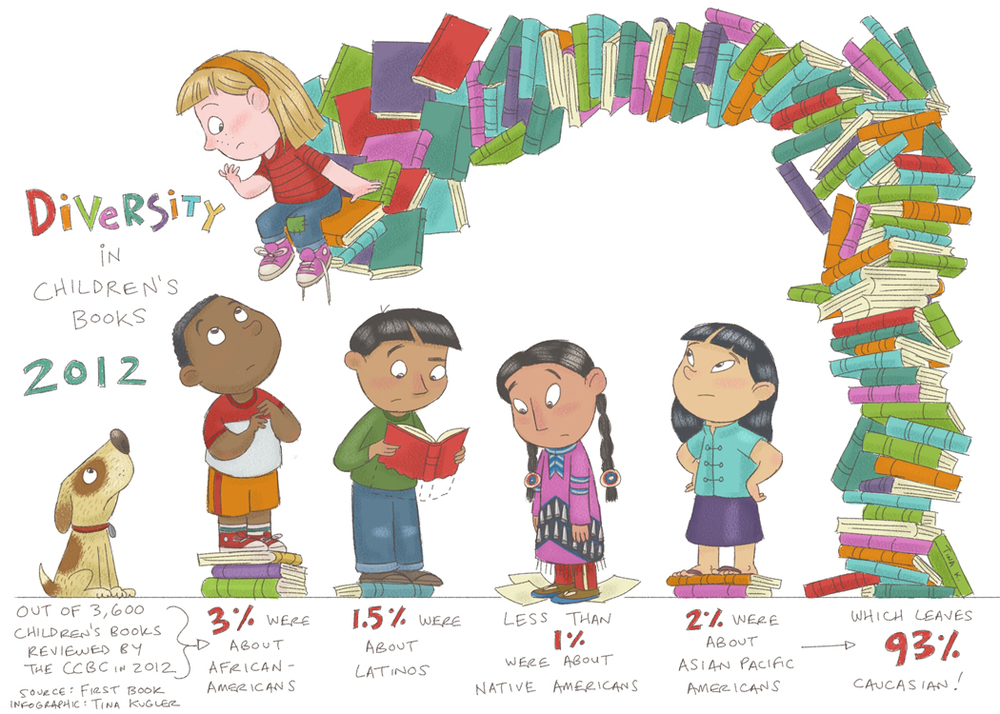
A well-circulated illustration by Tina Kugler, spurred by the 2012 numbers, highlighted them:

  •   3% were about Africans/African Americans; 1.8% were written by Africans/African Americans
  •   1.5% were about Latinos; 1.6% were written by Latinos
  •   Less than 1% were about American Indians; less than 1% were written by American Indians
  •   2% were about Asian Pacifics/Asian Pacific Americans; 2.3% were written by Asian Pacifics/Asian Pacific Americans

Back in 2008, a study by Brigham Young University found that “characters depicted in Newbery winners are more likely to be white, male and come from two-parent households than the average U.S. child,” according to published reports.  The Newberry Award is the annual top honor for children’s literature.

At the time, Bloomberg News reported the following:  The Chicago-based American Library Association has awarded the Newbery Medal to one book annually since 1922. All Newbery books remain in print, underscoring their enduring nature. Their popularity with teachers and parents means that for many younger children, Newbery medalists are a primary way they learn about the world and how to relate to others.

Writing in The New York Times, author and illustrator Christopher Myers pointed out last month that children “are much more outward looking.  They see books less as mirrors and more as maps.  They are indeed searching for their place in the world, but they are also deciding where they want to go.  They create, through the stories they’re given, an atlas of their world, of their relationships to others, of their possible destinations. … Children of color remain outside the boundaries of imagination.  The cartography we create with this literature is flawed.”

The National Education Association has added to its website “50 Multicultural books every child should read.”  The most recent title, for children from preschool to age 12, was written in 2009.diversity_tinakugler

Locally, Eastern Connecticut State University associate professor of English Dr. Raouf Mama is recipient of the 2008 National Multicultural Children's Book Award from the National Association of Multicultural Education.  The author of children’s books and master storyteller, a native of Benin, Dr. Mama performs African and multicultural stories, blending storytelling with poetry, song, music, and dance.   An orator out of the African oral tradition, he also lectures on African literature and African folklore and conducts workshops on storytelling and creative writing, and the power of folktales as multicultural teaching and learning tools, especially as tools for teaching literacy skills, creative writing, and public speaking.

When the American Association of School Librarians had their National Conference & Exhibition in Hartford last fall, the issue was on the agenda.  One of the conference session’s dealt specifically with multicultural children’s literature.  Led by acclaimed children’s book author Kelly Starling-Lyons and author Gwendolyn Hooks, the session was directed to “school librarians who want to build or expand their collections with multicultural titles.”

Conference attendees from across the country who were attending the biannual event were “invited to come celebrate a showcase of great books by African American children's book creators.”  Hooks and Starling Lyons saluted titles that have been featured on The Brown Bookshelf blog.

The conference theme during those November days in Hartford:  Rising to the Challenge.

image_race

Signatures Sought: Libraries Make A Stand At State Capitol

The Connecticut Library Association, working in conjunction with the Connecticut State Library and the Connecticut Library Consortium, will mark National Library Week at the State Capitol on Wednesday, April 16.  They will be “bringing the Declaration for the Right to Libraries to life by visually illustrating its ten principles” – and looking for indiviuals to sign the declaration, which is part of a year-long initiative of the American Library Association.

The effort in Connecticut is aimed at legislators, other elected officials, and visitors who walk the Capitol’s concourse – offering displays of “powerful, living examples of the work that is currently taking place declaration-402x600in Connecticut libraries and why it is so important that they continue to support our institutions,” officials said.
The Declaration states that “In the spirit of the United States Declaration of Independence and the Universal Declaration of Human Rights, we believe that libraries are essential to a democratic society.”

The ten principles include:

  1. Libraries Empower the Individual -  Whether developing skills to succeed in school, looking for a job, exploring possible careers, having a baby, or planning retirement, people of all ages turn to libraries for instruction, support, and access to computers and other resources to help them lead better lives.
  2. Libraries Support Literacy and Lifelong Learning - Many children and adults learn to read at their school and public libraries via story times, research projects, summer reading, tutoring and other opportunities. Others come to the library to learn the technology and information skills that help them answer their questions, discover new interests, and share their ideas with others.
  3. Libraries Strengthen Families -  Families find a comfortable, welcoming space and a wealth of resources to help them learn, grow and play together.
  4. Libraries are the Great Equalizer - Libraries serve people of every age, education level, income level, ethnicity and physical ability. For many people, libraries provide resources that they could not otherwise afford – resources they need to live, learn, work and govern.
  5. Libraries Build Communities - Libraries bring people together, both in person and online, to have conversations and to learn from and help each other. Libraries provide support for seniors, immigrants and others with special needs.
  6. Libraries Protect Our Right to Know -  Our right to read, seek information, and speak freely must not be taken for granted. Libraries and librarians actively defend this most basic freedom as guaranteed by the First Amendment.
  7. Libraries Strengthen Our Nation - The economic health and successful governance of our nation depend on people who are literate and informed. School, public, academic, and special libraries support this basic right.
  8. Libraries Advance Research and Scholarship -  Knowledge grows from knowledge. Whether doing a school assignment, seeking a cure for cancer, pursuing an academic degree, or developing a more fuel efficient engine, scholars and researchers of all ages depend on the knowledge and expertise that libraries and librarians offer.
  9. Libraries Help Us to Better Understand Each Other -   People from all walks of life come together at libraries to discuss issues of common concern. Libraries provide programs, collections, and meeting spaces to help us share and learn from our differences.
  10. Libraries Preserve Our Nation’s Cultural Heritage - The past is key to our future.  Libraries collect, digitize, and preserve original and unique historical documents that help us to better understand our past, present and future.connecticut.library.association

Based in Middletown, the Connecticut Library Association is Connecticut's 1,000 member strong professional organization of librarians, library staff, friends, and trustees working together to improve library service, advance the interests of librarians, library staff, and librarianship, and increase public awareness of libraries and library services.

There are 165 “principal” public libraries in Connecticut’s 169 towns (four towns are served by libraries in neighboring towns), as well as 27 additional libraries and 47 branch libraries in communities across the state.  A list of public libraries in Connecticut is available at http://www.ctstatelibrary.org/dld/files/community/connecticut-public-librar

Ollie is Latest to See Take-Home Pay Jump at UConn

In the aftermath of UConn’s national championship, coach Kevin Ollie’s “relatively low” salary compared to his peers, became the focus of some media attention.   It’s not the first time in the current fiscal year that salaries at UConn were in the spotlight, and Ollie is only the latest top UConn official to see his take home pay bumped during the year.

Just four monthsBulldogLogo_wht ago, hundreds of top officials and administrators at the University of Connecticut received raises, with many of the annual  increases topping $10,000.  Warde Manuel, the university's athletic director, saw his salary jump by $22,500, which brought his annual pay to $472,500.

Amidst tuition increases, programmatic cutbacks and concern over budgetary shortfalls, a total of 24 senior officials and administrators received raises in excess of $10,000, according to data provided by the university.  That included 12 individuals whose raises topped $12,000 annually.

In addition, another 13 individuals received salary increases of between $8,000 and $10,000, bringing the total to 37 individuals who received salary increases of more than $8,000.

In addition to Manuel, among those receiving the top raises, and their new annual salaries - all exceeding $200,000 - were:

2.  Provost & Executive Vice President Mun Choi ($18,500 to $388,500)

3.  Business School Dean John Elliott ($17,550 to $407,550)

4.  Executive Vice President Richard Gray ($13,124 to $275,599)

5.  Engineering School Dean Kazem Kazerqunian ($13,000 to $276,100)

6.  Education School Dean Thomas DeFranco ($12,882 to $272,852)

7.  Agriculture & Natural Resources College Dean Gregory Weidemann ($12,861 to $270, 087)

8.  Vice President for Enrollment Management Wayne Locust ($12,750 to $276,750)

9.  Interim Vice Provost for Academic Administration Sally Reis  ($12,500 to $264,825)

10. Vice Provost/Vice President Nancy Bull ($12,313 to $260,113)

11.  Associate Liberal Arts Dean Dipak Dey ($12,000 to $255,100)

12.  Fine Arts School Dean Brid Grant ($12,000 to $252,000)

 (See the full list of the raises, reported by CT Mirror.)

Last month, it was announced that UConn will pay its budget chief, Richard Gray, $138,000 in severance when he steps down from the post on April 30.  His separation agreement provides him with six months' regular pay after he leaves -- a payment the university was not required to provide for him to retire, CT Mirror reported.

That same day, UConn Vice President for Economic Development Mary Holz-Claus will step down from that post (and a $241,500 salary) after three years, moving over to become assistant dean in the school’s College of Agriculture and Natural Resources, Hartford Business Journal reported.

Kazem Kazerounian was named Dean of the School of Engineering following a nationwide search in January. He had been interim Dean since June 2012.  Tyson Kendig, hired as UConn’s Vice President of Communications in December 2012 at a salary of $227,500 which generated some controversy, saw his salary grow by $11,375 a year later to $238,875.

Nearly a year ago, the University of Minnesota announced that Lisa Lewis would be president and chief executive officer of the school’s alumni association – a post Lewis had held at UConn.  Last month, UConn announced that Montique Cotton Kelly, after nearly two decades at Bowling Green State University, would be joining UConn in June as assistant vice president of alumni relations and executive director of the UConn Alumni Association.  Her salary was not announced.

As for Ollie, Forbes magazine has reported that he has a base salary of $400,000, plus additional income from Nike, PR, consulting and media payments that were worth a combined $800,000 in the 2013 calendar year. He added $167,000 in performance bonuses from the tournament run, bringing his total pay for the season to just under $1.4 million before counting potential academic performance bonuses.  The magazine noted that top coaches like Michigan State’s Tom Izzo, Florida’s Billy Donovan and Kentucky’s John Calipari, all take home more than $4 million per year.

CT by the Numbers previously reported that according to data compiled by the website Deadspin, the ranks of the highest-paid active public employees in states across the country include 27 football coaches, 13 basketball coaches, one hockey coach, and  10 state employees with responsibilities outside of athletics.  That’s 80 percent of the states with a public employee salary roster led by a coach.

A spokeswoman for UConn told CT Mirror in December that the raises –- which costUConn $1.3 million this fiscal year -– did not need to be approved by the Board of Trustees, because money for the raises was included in the omnibus budget the board approved last summer.  The raises ranged from a top rate of 5 percent — which 12 of the 24 received — down to 4.1 percent, the Hartford Courant reported. Ollie’s performance bonuses, outlined in his contract, also do not need Board approval.

Pilot Project Boosts Voter Engagement in Latino Community

It turns out, all that was necessary to improve voter engagement and turnout was asking – and repeated, substantive, and informative reminders.  The results of a pilot study in Hartford’s Latino community may provide critical insight into how to improve voting levels in the state’s ethnic or urban communities, as the next election season beckons.

In 2012-13, the Hartford Votes~Hartford Vota Coalition conducted a Latino Voter Engagement Initiative with the support of a grant obtained by Hartford Public Library, a founding member of the Coalition.  The goal of the initiative was to increase historically low voter engagement in Hartford’s Latino community.  It did.

The initiative includevoted traditional voter registration activities, but because voter registration by itself tends not to result in higher voter engagement, additional activities were also included in the initiative.  Among them:  candidate forums, public programs on relevant topics, production and distribution of publications such as voter guides, canvassing portions of Hartford neighborhoods, conducting a reminder to vote campaign, and civics classes in Hartford high schools.

In addition, a number of meetings were held with leaders and others from Hartford’s Latino community.  None of the conversations or interactions were partisan.  They focused exclusively on the electoral process, the importance of exercising the right to vote, and providing basic information about public issues.  The results of the initiative were impressive:

  • Voter Registration:  392 Hartford Latinos were registered to vote.
  • Voter Information: 174 Hartford Latinos attended three candidate forums and two public programs.  Three publications were produced (Hartford Voters Guide, Citizens Guide, and Guide to the Hartford Board of Education) in English and Spanish and over 4,000 copies were distributed.
  • Voter Education: 124 Hartford Latinos participated in the neighborhood canvass; 172 Hartford Latino high school students attended civics classes.

According to a sample survey conducted at the end of the project, 44 percent of Hartford Latinos with whom program organizers interacted reported an increase in their voter engagement.  For example, they registered to vote, they voted, or they attended a candidate forum or public program related to major public issues during the project period.

Project organizers concluded that “we identified and demonstrated a successful strategy that can help address the very complex problem of low voter engagement (among Latinos 1_Percentage_Increaseand others):  people vote and get involved in greater numbers when they are encouraged to do so through face-to-face contact, and multiple contacts are more effective than single contacts.”

The neighborhood canvass produced especially notable results:

  • 54 percent of Latinos who were inactive voters (i.e., they had never voted before or were registered but had not voted in the 2008 and/or the 2010 elections) who participated in the neighborhood canvass reported that they voted in 2012 as a result of the interaction.
  • 64 percent of all Latinos who participated in the neighborhood canvass reported that they voted in 2012 as a result of the interaction.
  • Those who were spoken with twice voted at a rate 21 percent higher than those that only had one interaction
  • 2012 voter turnout among all people included in the neighborhood canvass was 9.1 percent higher than overall turnout in voting districts in which an informational canvass was conducted, and 6.7 percent higher than turnout citywide.

 In addition, thirteen high school civics classes were conducted in four different Hartford schools in May and June 2013, which were attended by 172 Latino students. According to evaluation forms completed by most of the students, 91 percent said the class helped them understand more about civics and 82 percent said they were more likely to vote or take action in their community as a result of having taken the class.  Comments ranged from “I made my voice heard through my vote” to “I didn’t do it for politics but because people motivated me.”

 The Hartford experience has been corroborated by similar research in Detroit and Arizona, according to project organizers.  The Coalition’s goal in 2014 is to secure resources that will enable it to ramp up the successful strategies identified through the pilot project and as a result have greater impact.

“Through these strategies,” they suggest, “we can play a significant role in reducing the effects of low voter engagement, which is a major threat to our democracy.”

Kevin Ollie Made Believers of the Uncertain at UConn

In September 2012, the Kevin Ollie era at UConn began – with a short leash.  As Hall of Fame veteran  coach Jim Calhoun retired, Ollie – a former UConn and NBA player – was hired on a one-year trial basis.  The rest, as they say, is history.

But when it began, the view was far from unanimous that UConn had made the right choice.  The sports blog SB Nation posted a day one poll, and 30 percent of the respondents expressed the view that his selection was either a mistake, or that a national search for a new coach should still be pursued.  And NBC Sports website said this:  “Asking Ollie to win at the same level as Calhoun is incredibBulldogLogo_whtly unfair.”

Some criticized UConn Athletic Director Warde Manuel for putting Ollie in a tough position – especially in recruiting - uncertain if he’d be coaching for more than a single season.  Manuel, in November 2012, told the New York Times: “I understand the angst that a recruit would have. What I’ve said to them is we’re going to make a decision for UConn that we believe and I believe keeps us winning Big East championships and competing for national championships.”

Two months later, in December 2012, Ollie was given a new contract that runs through the end of the 2017-18 season.  The deal, the Associatepolld Press reported at the time, is worth just under $7 million and began on Jan. 1, 2013.  Ollie, who played point guard for Calhoun from 1991-95, was his former coach's hand-picked successor, the AP reported. He had become an assistant coach at UConn in 2010, after 13 years playing for 11 different teams in the NBA.

That season – one in which UConn was banned from NCAA tournament play due to poor academic performance in previous seasons – some player-athletes departed the scene.  It’s doubtful that Jeremy Lamb and Andre Drummond, who entered the NBA draft, or Alex Oriachi, Michael Bradley and Roscoe Smith, who transferred, thought they were walking away from a National Championship team.

The tenacious and confident Ollie, 52-18 as UConn’s head coach over the past 18 months, said simply after winning the 2014 NCAA Championship game, “we did it the right way.”

conn-14-mbb-champions-logo

Getting to the Final Four: $140 for Some UConn Students, Multiples Higher for Fans

For 51 UConn undergraduate students, $100 will provide a round trip to Texas for the NCAA men’s basketball Final Four as UConn pursues a National Championship.  For everyone else, the price tag is considerably steeper – and climbing.

UConn’s Undergraduate Student Government is sponsoring a bus to take students from Storrs to Texas this weekend. The bus will depart from Storrs at 6:00 AM on Friday and is expected to arrive in Arlingto2014finalfourn, Texas no later than 1:00PM Saturday – in time for the early evening game at AT&T Stadium.

The student government is not responsible for meals, lodging or other accommodations at any point during the trip, but will get the fortunate 51 (first come, first served, of course) within shouting distance of the Final Four.  For a shot at a bus ticket, however, students must have proof that they are already a NCAA student ticket holder for the Final Four, showing an email confirmation from the official NCAA purchase process. Student General Admission ticket price:  $40.

Why take the bus? Norwalk-based priceline.com is reporting that the national average airfare to Dallas/Ft. Worth is around $340, but the average round trip airfare from Bradley International Airport is $604.  By comparison, the average round trip fare from the home cities of the other Final Four arPRICELINEe less - Jacksonville is $541, $584 from Wisconsin, and $385 from Lexington, priceline.com reported.  The average rate for an economy or compact rental car at the Dallas/Ft. Worth Airport is $60 a day for the weekend dates.

Online ticket aggregator TiqiQ reports that the average ticket price for the two semi-final match-ups on Saturday, as of April 2, is $1,091.81.  (A ticket for just one of the semi-finals runs averages about $595.) The Championship Game ticket for next Monday night is going for an average of $580.70.  That’s a slight drop from earlier in the week, but an increase of about 20 TIXpercent over the ticket price a week ago, before the four contenders for the National Championship were determined.

PrimeSport, the Official Ticket Exchange of the NCAA Final Four, lists available tickets ranging from $335.75 in the upper deck of the AT&T Arena to $4,037.50 in Row U facing mid-court.  There remain tickets available.

Compared to the last four years, this is shaping up as the second-most expensive price for NCAA tournament tickets to the final four, behind only last years’ Final Four in Atlanta, Forbes magazine reported this week. Last year, the average price for the semi-final game was $887, which was driven up by three big programs in Louisville, Michigan, and Syracuse, in addition to Wichita State. The lowest price for final four tickets over the last four years was 2011, the last time UConn won the national championship, the magazine reported.Cowboys-Stadium-NCAA-Tournament

Students holding the prized $40 tickets will not be able to resell them on the secondary market, TIME magazine reported this week. Students from the Final Four competitors - UConn, Wisconsin, Florida and Kentucky - must provide valid student ID’s, verification of purchase, and the originating credit card to gain entry to the Final Four stadium.

The Final Four at AT&T Stadium is expected to bring the largest crowd ever to attend a NCAA tournament game college basketball game. The previous record was the 75,421 people that saw the 2011 Final Four semifinal games at Houston's Reliant Stadium. This year’s Final Four may also break the all-time college basketball attendance record of 78,129, Huffington Post reported.

As for the return trip for the 51 UConn students taking the bus from Storrs, there are two scenerios: should UConn lose on Saturday, the bus will depart from Arlington at 9:00AM on Sunday, April 5. If the Huskies advance to the championship, the bus will depart from Arlington at 8:00AM Tuesday, April 8.  Sleep deprived, at the very least.

Investor Opportunities in Mobile Technology, Consumer Products Focus of Back-to-Back Conferences

It is described as “the Biggest and Most Disruptive Platform in Human History,” by William Davidson, Senior Vice President of Qualcomm.  Davidson will be the keynote speaker Wednesday in New Haven at “Connecticut Mobile Summit – Exploring Mobile Venture Opportunities and Challenges.”  Connecticut’s top mobile industry executives will be meeting to discuss how to accelerate mobile adoption, engagement and monetization, according to conference organizers.

Conference officials note that “penetration of smart phones into the workplace has been persistent since the iPhone launch in June of 2007. More recently, tablets have supplanted PCs as productivity boosters.”  The Connecticut Mobile Summit is designed to help educate Connecticut’s investment and technology communities in mobile venture opportunities and challenges.

mobile summittIn addition to Davidson, expert panelists participating include Carissa Ganelli, Founder & CEO, LightningBuy; Drue Hontz, Founder & President, KAZARK, Inc.; John Nobile, Founder & President, Tangen Biosciences; and Nadav Ullman, Founder & CEO, Dashride.

“In three to five years any enterprise that has not implemented mobility solutions for its customers, employees, and suppliers will be leapfrogged, disintermediated, or go bankrupt. Connecticut cannot afford to be behind this curve,” observed event moderator, Brenda Lewis, Principal of Transactions Marketing, Inc.

Davidson is senior vice presidemobile-technologynt of strategy and operations for Global Market Development in Qualcomm Technologies, Inc. In this role, he handles reporting and operations as well as executing on strategic global business initiatives. In addition, Davidson is senior vice president of investor relations where he serves as the primary liaison with the investment community and Qualcomm shareholders. Davidson has more than 25 years of experience in technical sales, marketing and general management roles in the telecommunications industry.
The half-day conference is being presented by the Connecticut Technology Council, Crossroads Venture Group and AT&T. The event is supported by Mea Mobile.

Opening remarks will come from Bruce Carlson, Acting CEO & President of the Connecticut Technology Council, Liddy Karter, Executive Director of Crossroads Venture Group, and Claire Leonardi, CEO of the recently re-branded Connecticut Innovations.  The event is $40 for members of the Connecticut Technology Council and Crossroads Venture Group, $50 for non-members.

The following day, the Northeast Consumer Product Conference will be held in Stamford, with the Connecticut Technology Council and Crossroads Venture Group joined by the Connecticut chapter of the Association for Corporate Growth (ACG) as sponsors.  The conference is described as the Northeast’s largest ‘mergers and acquisitions’ conference focused on early state and middle market consumer-facing companies.  It brings together operators, buyers, investors, and transaction professionals to discuss the challenges and opportunities within consumer industries.

The Stamford conference will include expert-led panels reviewing the state of the capital markets and share strategies for consumer marketing in a digital world, for both early and late stage firms.

Keynote presentation will be from Mike McMahon, President, Spire, a Datalogix company.  Panelists for a session on “Raising Capital in Today's Environment,”  to be moderated by Ramsey Goodrich, Managing Director, Carter Morse & Mathias, include Richard Baum, Managing Partner, Consumer Growth, Partners; Christopher Bradley, Principal, Mistral Equity Partners; and Tom Hayes, MaACGnaging Partner & Principal, New England Consulting Group.

ACG CT President Karin (McKittrick) Kovacic said, “This conference brings together owners and managers with investors and transaction professionals to discuss the challenges and opportunities within the consumer products sectors.”

The Connecticut Chapter of ACG is one of the fastest growing ACG chapters in the country, with close to 300 local professionals focused on middle-market corporate growth (i.e.: mergers and acquisitions, financing opportunities, business development, joint ventures, licensing arrangements, etc.), including a diverse group of private equity funds, intermediaries, lenders, and service providers.

The Connecticut Technology Council (CTC) is a statewide association of technology oriented companies and institutions, providing leadership in areas of policy advocacy, community building and assistance for growing companies.  With over 2,000 member companies that employ some 200,000 residents, the CTC works to position Connecticut as a leader in idea creation, workforce preparation, entrepreneurial aptitude, early stage risk capital availability and providing on-going support and mentoring to high potential firms.