
Motor Vehicle Deaths Up 14 Percent in CT in 2015, Exceeding National Average
/The death toll in Connecticut from motor vehicle accidents increased 14 percent in 2015 from the previous year, consistent with a nationwide increase but higher than the national average. The increase in Connecticut ranked the state tied for 14th in the percentage increase in motor vehicle deaths from 2014 to 2015.
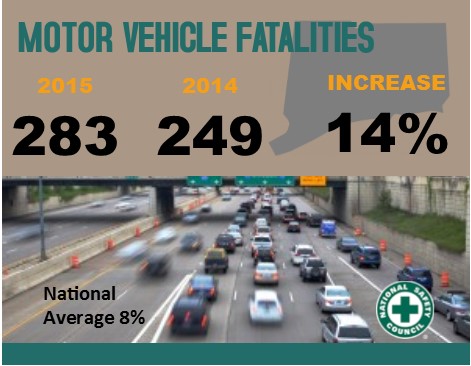 Nationally, 2015 saw the largest single-year percent increase in motor vehicle deaths since 1966. Estimates from the National Safety Council (NSC) show an 8 percent increase in 2015 compared with 2014 – with substantial changes in some states, including Connecticut. There were 283 motor-vehicle related deaths in Connecticut last year, compared with 249 in 2014 and 276 in 2013.
While many factors likely contributed to the fatality increase, a stronger economy and lower unemployment rates are likely at the core of the trend. The National Safety Council estimates 38,300 people were killed on U.S. roads, and 4.4 million were seriously injured, meaning 2015 likely was the deadliest driving year since 2008. The annual total of motor vehicle fatalities for 2014 was 35,398.
Over the last year at the state level, the National Safety Council estimates Vermont (30 percent), Oregon (27 percent), New Hampshire (24 percent), Georgia (22 percent), Washington (21 percent) and Florida (18 percent) experienced the largest percentage increase in fatalities, while only 13 states showed improvement. Among them were New Mexico (-20 percent), Kansas (-7 percent) and New Jersey (-2 percent).
Increases were also in Arizona (15%), Colorado (17%), Idaho (17%), Montana (17%), Maine (16%), Maryland (16%), and South Carolina (16%). Also seeing 14 percent increases along with Connecticut were Arkansas, Minnesota, Missouri, and Nevada. 
“These numbers are serving notice: Americans take their safety on the roadways for granted,” said Deborah A.P. Hersman, president and CEO of the National Safety Council. “Driving a car is one of the riskiest activities any of us undertake in spite of decades of vehicle design improvements and traffic safety advancements. Engage your defensive driving skills and stay alert so we can reverse this trend in 2016.”
From 2013 and 2015, Connecticut had a 3 percent increase in traffic fatalities, according to the data.
The estimated cost of motor-vehicle deaths, injuries, and property damage in 2015 was $412.1 billion, according to NSC. The costs include wage and productivity losses, medical expenses, administrative expenses, employer costs, and property damage.
The estimate is subject to slight increases or decreases as data mature, according to the National Safety Council. NSC has issued annual traffic fatality estimates since 1921. Over the last three years, preliminary estimates have fallen within 1 percent of final counts.
Average gas prices were 28 percent lower in 2015 than in 2014 and are projected to continue dropping this year, making driving more affordable for many Americans, NSC pointed out, noting that the U.S. Department of Transportation estimates a 3.5 percent increase in the number of miles driven in 2015 compared to 2014.
To help ensure  safety, the National Safety Council recommends drivers:
- Make sure every passenger buckles up on every trip
- Designate an alcohol and drug-free driver or arrange alternate transportation
- Get plenty of sleep and take regular breaks to avoid fatigue
- Never use a cell phone behind the wheel, even hands-free
- Stay engaged in teens’ driving habits, as teens are three times as likely to crash as more experienced drivers
- Learn about vehicle safety systems and how to use them, including features such as adaptive cruise control, blind spot warning systems and backup cameras.
Founded in 1913 and chartered by Congress, the National Safety Council, nsc.org, is a nonprofit organization whose mission is to save lives by preventing injuries and deaths at work, in homes and communities, and on the road through leadership, research, education and advocacy.
 When Connecticut voters go to the polling places on Tuesday, April 26, voters in nearly two-thirds of the states will already have made their preferences known. The same day as Connecticut, presidential primaries will also be held in Delaware, Maryland, Pennsylvania and Rhode Island. The previous week, primaries will be held in New York, a state called home, at various times, by three of this year’s leading contenders – Hillary Clinton, Bernie Sanders and Donald Trump.

 diana, New Mexico, California, New Jersey, Nebraska, West Virginia, Oregon and Montana. Most states have their Democratic and Republic primaries on the same day, although a handful hold party primaries on different days. South Carolina’s Republican primary will be on February 20, for example, and its Democratic primary on February 27.




 Also making the list were Evariant of Farmington, a software developer, at number 272, and HP One, a software company in Trumbull at number 307. Biopharmaceutical company Alexion, in the midst of moving its headquarters from Cheshire to New Haven, was ranked at number 349, and etouches, a Norwalk software company ranked at number 357. Rounding out the Connecticut companies on the list is Wallingford oil extraction technology company APS Tecnhology, at number 466.
 rough technology’s continued disruption and proliferation across industries,” said Sandra Shirai, principal, Deloitte Consulting LLP and US technology, media, and telecommunications leader.
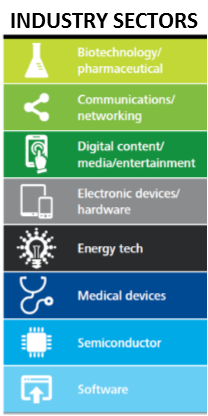 Overall, 283 of the 500 companies were in the software sector, and 67 percent of the 500 companies have received venture capital funding at some point in their company’s history. Topping the list was StartApp, with a growth rate of 21,984 percent from 2011 to 2014. Based in New York and founded in 2010, StartApp provides a free monetization and distribution platform that integrates with applications on mobile devices.




 The first TAP pathway—Biology—was approved by the Board of Regents last month, “after careful review by TAP's Framework Implementation and Review Committee (FIRC) and curriculum committees on all 17 CSCU campuses.” Additional pathways are slated to be determined beginning next month, with a total of 11 initially to be selected. Possible subject areas include history, chemistry, communication, criminology, English, math, political science, psychology, social work and sociology, according to the state Board of Regents

 The study also found that “the student demographics at community colleges appear to matter less than how the colleges serve students aiming to transfer. Regardless of whether they are rural or urban, or serving mostly lower or higher income students, community colleges can boost the transfer success of their students by looking to better performing schools to inform their practices.”


 Since entering the Connecticut market in the summer of 2014, the company has been aggressively growing its customer base in a competitive market while working diligently to grow and expand its network of doctors. Harvard Pilgrim Health Care announced recently that its Connecticut membership has grown to more than 24,000, exceeding expectations for 2015. It now serves more than 800 Connecticut businesses. Twenty-nine of the state’s 30 hospitals are now in-network.
 With more than 500 business leaders in attendance at an annual Economic Summit & Outlook last week, brought together by the Connecticut Business and Industry Association and MetroHartford Alliance, Schmitt spent some time touting a new model launched in the state of New Hampshire that he believes may be a glimpse into the direction the industry is moving. Harvard Pilgrim Health Care’s footprint in New England now covers “where 90 percent of New Englanders live,” in Massachusetts, Connecticut, Maine and New Hampshire.
 Launched