Economic Report Finds “Significant Shift” in Destinations for State Exports
/Connecticut has become more reliant on exports to drive gross state product growth during the past decade, according to a new report prepared by the Connecticut Economic Resource Center (CERC).
In 2003, Connecticut exports as a percent of Gross State Product (GSP) stood at 4.5 percent, increasing to 6.6 percent of GSP in 2013. That growth, CERC points out, makes it “important to analyze Connecticut exports trends to understand how exports will impact Connecticut’s economy in the future.”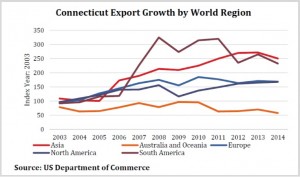
In 2014, approximately 46 percent of Connecticut exports were comprised of transportation equipment merchandise, which includes aerospace equipment. And approximately 45 percent of Connecticut exports went to four countries: France, Canada, Germany, and Mexico, according to the report, Eye on Economics – Export Trends for Connecticut.
Although Connecticut still has strong trade ties with Europe and the North American Free Trade Agreement (NAFTA) countries (Canada, Mexico), there has been “an obvious shift in export growth among its trading partners.” From 2013 to 2014, Connecticut exports to South America and Asia increased overall, while exports to Europe, Oceania, and the rest of North America (mostly Canada and Mexico) were “generally flat.”
From 2003 to 2014, Connecticut exports to Asia increased by 182 percent, faster than exports to any other region, according to the data. Economic growth in Asia was primarily driven by growth in China.
The shift in Connecticut export locations “can be partially explained by demand changes in regions that Connecticut trades with,” the report explains, citing changes in the appetite for exports in Europe and Asia. Europe, for example, has “experienced economic weakness since 2008 and has not fully recovered. It has been particularly hit hard by credit market constraints and unemployment, which has reduced consumptions levels, and thus demand for imported merchandise, the CERC report pointed out.
Looking ahead, the CERC analysis anticipates that Connecticut exports “may slow or remain flat” because of “weaker demand in Europe, where the majority of Connecticut exports currently go to; and Asia, which received the second largest amount of Connecticut exports in 2014.”
 CERC is a nonprofit corporation and public‐private partnership that provides clients with objective research, marketing and economic development services. The organizations mission is to “provide services consistent with state strategies, leveraging Connecticut’s unique advantages as a premier business location.”
The report was developed by the CERC Research Department, including Alissa DeJonge, Carmel Ford and Matthew Ross.

 poll analysis, it is pointed out that connecting with another parent who is awake in the middle of the night can help to counteract feelings of isolation. Asking for other parents’ recommendations can facilitate the choice of a new childcare provider. And hearing about strategies used by other parents can offer practical tips to deal with a toddler’s behavior problem.

 Among the students participating in the project were William Pritchard, interaction design and project management; Somaiyeh Ghaffarnia, animation and character development; Sean Dexter, 3D animation; Kevin Richetelli, 2D animation; Samantha Menza, game design; Tom Lee, game design and music composition; and Tiffany Hoang, game design. Prtichard and Ghaffarnia began working on the project as undergrads and continued while pursuing their graduate degrees. The other students were undergrads.
 Also this week, an official at the FCC indicated that the "enforcement hold" status of the station’s license renewal was "unchanged," and the station continues to operate until a decision is made, as is customary with delayed renewal applications. The WTIC-AM license renewal application has been on enforcement hold at the FCC since the license expiration date of April 1, 2014, as the agency’s Enforcement Bureau continues to consider “an alleged violation of FCC rules,” according to an FCC official. The renewal application was filed by the station almost 16 months ago, on November 27, 2013. Stations must file an application for license renewal) four months prior to the expiration date of the station’s license.
 WTIC-AM, which is licensed to Hartford but operates from studios in Farmington and has its broadcast tower on Avon Mountain, can continue broadcasting under the license that expired on April 1, 2014, until the FCC acts on its renewal application. Until the enforcement hold is lifted the FCC Media Bureau cannot proceed with a decision on whether or not to renew the station’s broadcast license. The Enforcement Bureau must first determine whether or not a violation of FCC rules has occurred. If the allegation is substantiated, the agency has a range of options, such as warning that the violation not be repeated or imposing a monetary fine on the station, officials said.


 “We were excited here in Connecticut to give our Girl Scouts the opportunity to participate in a pilot of Digital Cookie, a first-of-its-kind web platform that lets girls sell cookies from their own protected, personalized websites,” said Tiffany Ventura Thiele, Communications & PR Manager for Girl Scouts of Connecticut.
 Officials stress that “because 100 percent of the net revenue raised through the Girl Scout Cookie Program stays with local councils, when you purchase Girl Scout Cookies you’re not only getting a delicious treat — you’re also making an important investment in your community.”

 ll, there were “approximately 800 healing experiences with children and families throughout the week, bringing the safety, respect and love of Camp to many families” in Philadelphia.
 s.
s. The top 10 institutions are Johns Hopkins, University of Michigan (Ann Arbor), University of Washington (Seattle), University of Wisconsin (Madison), University of California (San Diego), University of California (San Francisco), Harvard, Duke, University of North Carolina (Chapel Hill) and University of California (Los Angeles).
 The survey collects information on R&D expenditures by field of research and source of funds and also gathers information on types of research and expenses and headcounts of R&D personnel. The survey is an annual census of institutions that expended at least $150,000 in separately budgeted R&D during the fiscal year.


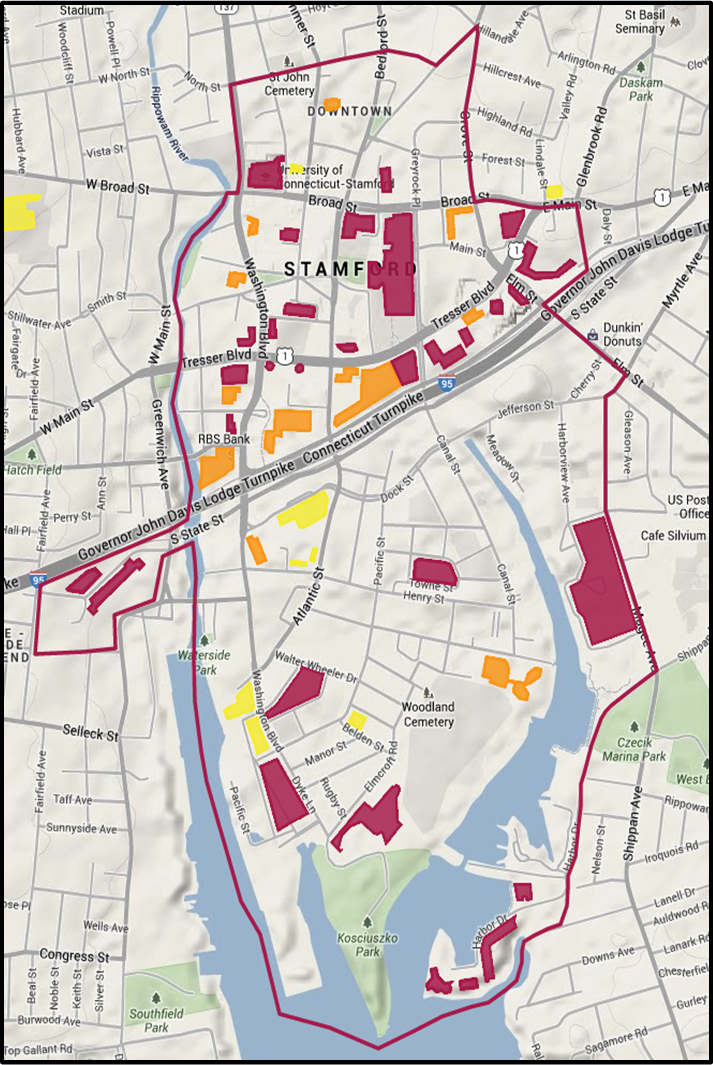 “These collective efforts will establish the Stamford 2030 District as an example of a financially viable, sustainability focused, multi-sector driven effort that maximizes profitability and prosperity for all involved. Through collaboration of diverse stakeholders, leveraging existing and developing new incentives and financing mechanisms, and creating and sharing joint resources, the Stamford 2030 District will prove the business case for healthy and high performing buildings.”