Summer Olympics May Come to CT if Boston Bid for 2024 Succeeds

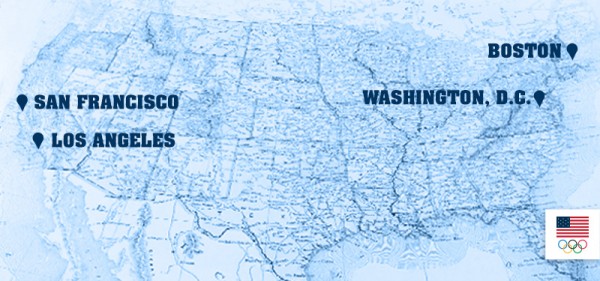
Boston is one of four cities being considered to be the United States entry in the international competition to host the 2024 Olympic Games.  If Boston's bid were to become a reality, at least one Olympics observer is suggesting that Connecticut may have an Olympic supporting role to play. Boston, San Francisco, Washington D.C. and Los Angeles have been selected to develop bids to be considered by the U.S. Olympic Committee, which would decide which  city - if any - to support and present to the International Olympic Committee (IOC), which will decide in 2017 on the host city for the 2024 Olympics.2024

Rosanna Garcia, associate professor of marketing in the D’Amore-McKim School of Business at Northeastern University in Boston, who has attended the past eight Summer Olympics, sees the city turning to Connecticut and Rhode Island to host some events.

“With more than 300 events that typically occur at the Olympics, many cities around Massachusetts, and even Rhode Island and Connecticut, will need to partner with the International Olympic Committee to host these events,” Garcia points out.

garcia1501“Many preliminary competition events would need to take place outside of the main Olympic Park areas so events may occur as far away as Connecticut. This also is an opportunity for more people to get involved with the Olympic Spirit,” Garcia adds.Olympic_rings_without_rims.svg

The Boston Globe has reported that the U.S. Olympic Committee is expected to decide early next year whether to enter a U.S. city in the international competition to host the 2024 Olympics.  That would be just after the IOC acts on recent recommendations to reform its selection process, which would take effect with the 2024 Summer Games host selection.  The IOC meets next month to consider the series of recommendations.

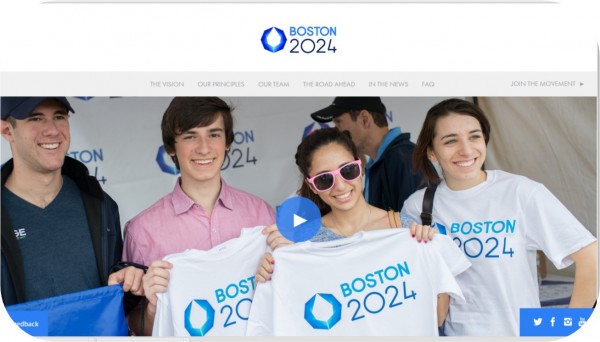
Members of the U.S. Olympic Committee were in Boston last week, meeting with representatives of the Boston bid and area colleges which would participate, potentially providing sports venues, dorms, and other support services.  Last month, a promotional video advocating a Boston bid was released, and a website was launched. With an eye toward innovation and efficiency, the video highlights Boston’s bid “to create a sustainable model for hosting the Olympic and Paralympic Games that can become the blueprint for future host cities.”

The Connecticut Convention & Sports Bureau, the state’s official meetings and sports event sales and marketing organization, "supports Boston’s bid for the 2024 Olympics," said Interim President H. Scott Phelps.  "Regardless of whether or not Boston wins the Olympics, the City’s bid has helped to elevate the Boston and other New England brands to sports event planners from all over the world."  Officials noted that if the Olympic Games decide to come to Boston, "it could be great for tourism in nearby Connecticut as well, as spectators and competitors would be encouraged to come visit our State’s attractions," adding that "there might be opportunities for our state to host pre-Olympic competitions and ... athletes."
bsd_usoc_SiteGraphic_BidAnnouncement_800x375_al2

The Globe noted that if the International Olympic Committee, meeting in Switzerland in December, decides that its preference is for compact venues, as is expected, Boston is seen as a strong candidate and could gain an advantage over Los Angeles, San Francisco, and Washington, whose plans offer less intimate settings, according to the Globe.  Supporters of the San Francisco bid have noted that the chairman of the U.S. Olympic Committee, Larry Probst, lives in nearby Burlingame, CA.  The San Francisco effort is being led by Larry Baer, the chief executive officer of baseball's World Series champion Giants, according to published reports.la2024logo
It is the first time that Boston has prepared a bid to host the Games, and it is being led by an organization called the Boston 2024 Partnership, a nonprofit organization formed to prepare the bid materials. The group is governed by a 36-member executive committee, and has launched a series of subcommittees aimed at master planning, fundraising, outreach, and engagement. Organizers note that no tax dollars have been spent on Boston 2024, and tax dollars will not be used to build venues or pay for the operation of the Games. Public investment will be confined to roadway, transportation and infrastructure improvements, most of which are already planned and are needed with or without the Olympics.
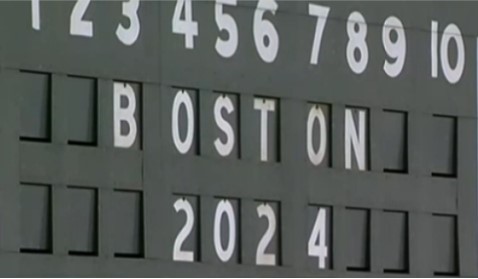
fenwayAn Olympic games in Boston would utilize existing sports venues of both professional teams and area colleges, which could reduce potential costs.  Infrastructure improvements, such as in transportation, are already on the drawing board, and could accelerate with a Boston bid.U.S.-Olympic-Committee-logo
The U.S. last hosted a Summer Olympiad in Atlanta in 1996; a Winter Olympics in 2002.  St. Louis hosted in 1904 and Los Angeles held the Games in both 1932 and 1984. In recent years, the unsuccessful U.S. bids to the IOC was to host the Summer Games were New York (2012) and Chicago (2016).  The 2016 Games will be held in Rio de Janeiro and the 2020 Summer Olympics are scheduled to be held in Tokyo, Japan.  Other potential contenders, according to published reports, include Paris, Rome,Doha, Istanbul and either Hamburg or Berlin in Germany.

“Holding the Games in the Boston area would serve as a catalyst for growth in the region,” said John Fish, CEO of Suffolk Construction and driving force in the initiative. “We are also excited for the chance to deliver something that is both powerful and meaningful for the worldwide Olympic and Paralympic movements that will also connect more youth to sport.”
Picture4


Fairfield County May Hold Key to Trans-Atlantic Flights at Bradley; Passenger Numbers Increasing

Bradley International Airport has seen passenger traffic increase for two consecutive months, and is stepping up efforts to re-establish service to trans-Atlantic destinations. The Connecticut Airport Authority (CAA) is working with the state’s business community and potential airline carriers to demonstrate the need for the overseas service. In May, passenger traffic at Bradley increased 9 percent, compared with a 7.8 percent decrease at T.F. Green Airport in Providence and a 9.5 percent decrease at Manchester Regional Airport in New Hampshire. Logan International Airport in Boston increased 7.5 percent that month.

During June, Bradley saw a 9.3 percent increase in passengers, while Providence saw a 7.3 percent decrease and Manchester saw passenger numbers drop by 14.6 percent. Logan experienced a 4.1 percent increase in June.  July data was not yet available.

Kevin A. Dillon, ExecuBradley_INTL_Logo.svgtive Director of the Connecticut Airport Authority, told members of the CAA at their August meeting that the state’s improved economy and ongoing efforts to add capacity at the airport are lead factors in the upbeat numbers. United Airlines recently announced plans to begin service to Houston in October. In June, JetBlue initiated service from Bradley to Reagan National Airport in Washington, D.C.

Year to date, Dillon reported, passenger numbers at Bradley are up 10.6 percent, while Providence is down 6.8 percent, Manchester is down 13.0 percent, and Logan is up slightly, 4.4 percent.

The return of trans-Atlantic service to Bradley is one of the CAA’s top priorities, Dillon said. Much of the business case for trans-Atlantic routes depends on corporate clients outside the immediate Hartford-Springfield market, Dillon explained. He indicated that the CAA would be “orienting our advertising program for the next year” toward Fairfield County and Southeastern Connecticut, to include targeted outreach urging potential business customers to “give Bradley a try,” underscoring that “Bradley is a great option” compared with the New York airports.

The CAA is also poised to move forward with the demolition of the old Terminal B at Bradley, with the contract awarded to S&R Corporation of Lowell MA, with a price tag of $12, 572,622.75. The CAA anticipates that the demolition will begin before the end of this month, consistent with the airport’s strategic plan. The goal of the CAA is to make Connecticut’s airports more attractive to new airlines, bring in new routes, and support Connecticut’s overall economic development and growth strategy.CAA logo

Members of the CAA also discussed a potential new retail business for the airport – Dairy Queen – and approved plans for a 20-year agreement with WFSB-TV for the lease of land at Bradley for a Doppler radar installation at Bradley, which would be relocated from Terminal B where it has been since 1999.

Bradley will also be enhancing band-with capacity of wi-fi at the airport, which has seen increased usage as passenger levels have increased.

Bradley International Airport is the second largest airport in New England. According to the most recent economic impact analysis, Bradley contributes $4 billion in economic activity to the state of Connecticut and the surrounding region, representing $1.2 billion in wages and 18,000 full-time jobs. The CAA was established in 2011 to develop, improve, and operate Bradley International Airport and the state’s five general aviation airports.

Summer Sandwiches: Lobster Roll is Connecticut Standout, Zagat Says

When Zagat’s decided to take a bite into the uniqueness of sandwiches during August (It is national sandwich month! Who knew?) – highlighting particularly noteworthy culinary endeavors in every state in the nation – the focus in Connecticut landed squarely on the lobster roll. Their review of “delicious regional sandwiches” found in each state had some overlap (Maine was also noted for its Lobster Roll, for example) and some regional favorites with a national following. And some surprises (see bison, reindeer, and marshmallow, below). zagat_logo

“While many consider the cold, mayonnaise-driven Maine lobster roll to be the quintessential version of the sandwich, the first lobster roll was actually a hot, buttered one served at a restaurant called Perry’s in Milford, Connecticut, in the 1920s,” Zagat’s explained. “This version is usually simpler, featuring just lobster meat, butter, and maybe some black pepper or lemon juice on a grilled, split-top hot dog bun, and served with potato chips or French fries. “

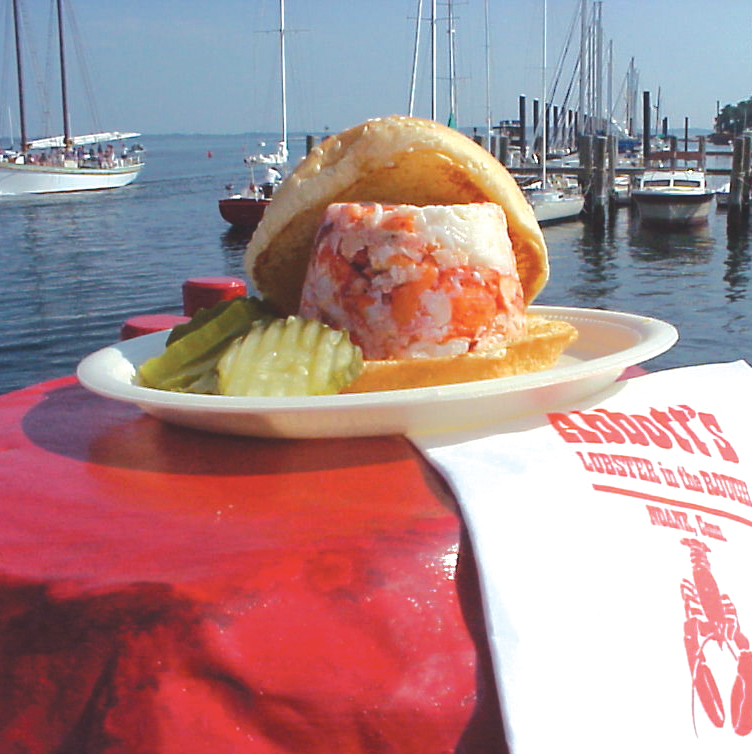
Cited by the Zagat surveyhotlob600 was Abbott’s Lobster in the Rough in Noank, founded in 1947. “They take the simplicity of the Connecticut-style hot lobster roll and turn it into an art form. Their award-winning sandwich is made with a full quarter-pound of lobster meat (more than is found in the average small lobster) drenched in melted creamery butter and heaped onto a bun. It’s a sandwich so opulent, it’s well worth the trip to this far-off-the-beaten-path lobster pound to get one (not to mention the crowds you have to battle to order).”

Noteworthy in the region were the Italian Sub in New Jersey and the Italian Grinder in Rhode Island. (A distinction without a difference?) In Massachusetts, the Zagat selection was the Fluffernutter: “The delectable marshmallow fluff was in fact invented in Somerville, Massachusetts, in 1917. A man named Archibald Query sold it door-to-door before he sold the recipe, though who it is that thought to pair it with peanut butter on white bread is not as clear. Nevertheless, the fluff is celebrated to this day with a Fluff Festival in Somerville” in September.

New Hampshire was noted for its “Beer-Battered Fish Sandwich” and Vermont for the aptly-named Vermonter, a “ sweet-and-savory sandwich that typically includes either turkey or ham (sometimes both), sharp Vermont cheddar cheese, thinly-sliced green apples and honey mustard, although there are many different variations (including a decent number that come with cranberry mayonnaise instead of honey mustard).”

In case you were wondering, in Alaska it is the Reindeer Sausage Sandwich, in Wyoming the Bison Reuben, in Alabama the Chicken Sandwich with White Sauce, and in Arkansas the Fried Bologna Sandwich, and Mississippi the Elvis sandwich (peanut butter, fried banana and bacon). The Zagat’s  reporting (and tasting) was conducted for the August 2013 observance of National Sandwich Month, with a tip of the plate to the notable Earl of Sandwich.

Most Exciting in Connecticut? New Haven, New London, Hartford Lead the Way

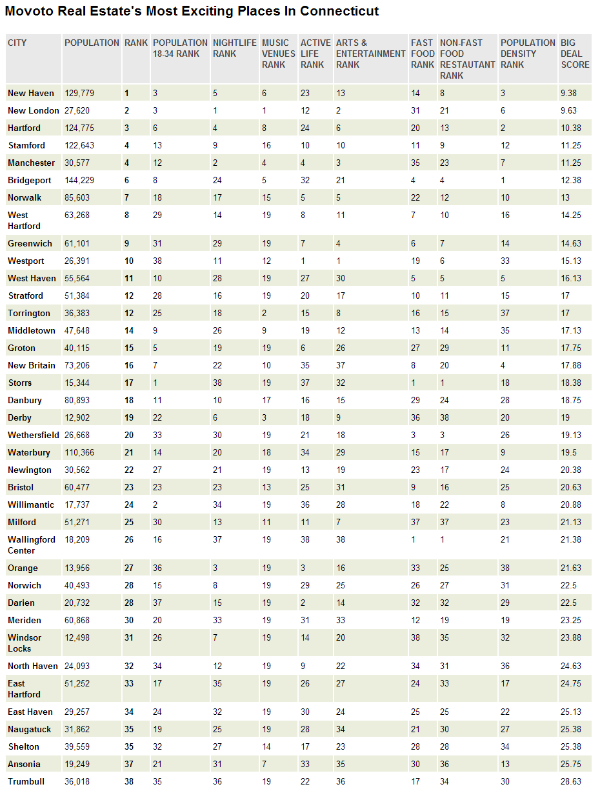
Wondering where the most exciting places are in Connecticut? If New Haven is the first place that comes to mind, you’re right. New Haven was named the “Most Exciting Place in Connecticut,” followed by New London, Hartford, Stamford, and Manchester in an analysis by the real estate website Movoto. Described as “the most thrilling, the most rousing, and the most downright exciting,” the top 10 list for Connecticut includes five Fairfield County municipalities and many of the state's largest cities: TOP10

1. City of New Haven 2. City of New London 3. City of Hartford 4. City of Stamford (tie) 4. Town of Manchester (tie) 6. City of Bridgeport 7. City of Norwalk 8. Town of West Hartford 9. Town of Greenwich 10. Town of Westport

The website’s analysis pointed out that “New Haven had a ton of nightlife and music venues per capita” and was “much more densely populated than most other places in the state.” New London scored points in the website’s analysis for its “high percentage of young folks (just like New Haven, 36 percent between 18 and 34), and for its high number of nightlife options, music venues, and arts per capita.” New London ranked No. 1 in both nightlife and music venues, and No. 2 for its arts.

The highlights for Hartford noted that the Capitol City is “the second-most densely populated place in Connecticut; a good portion of that population is between the ages of 18 and 34- 31 percent, to be exact. With bars like Pourhouse and the Russian Lady, music venues like Webster Theatre, and so many museums, galleries, and festivals we can’t even name them all, Hartford is certainly way more exciting than just insurance.”

In order to come up with the list of 10, the website started out with a list of all the places in Connecticut with populations of 10,000 or more, according to the U.S. Census (2010), which provided 38 towns and cities. Then, they used the Census and business listings to assess:

  • Nightlife per capita (bars, clubs, comedy, etc.)
  • Live music venues per capita
  • Active life options per capita (parks, outdoor activities, etc.)
  • Arts and Entertainment per capita (movie theaters, festivals, galleries, theaters, etc.)
  • Fast Food restaurants per capita (the fewer the better)
  • Percentage of restaurants that are not fast food (the higher the better)
  • Percentage of young residents ages 18 to 34 (the higher the better)
  • Population density (the higher the better)

The municipalities were then ranked with scores from one to 38, where the lower the score, the more exciting the place.

Two Greater Hartford communities, in addition to the city, made the list – Manchester and West Hartford.

“Manchester also scored highly for its number of arts and entertainment options per capita, like the unique MCC on Main,” a program of Manchester Community College located on Main Street in the heart of the town. West Hartford, the website reported, “seemed to find its excitement, not in the nightlife … but in lots of healthy options,” including sports stores, gyms, galleries, theaters and “tons of restaurants.” Westport “really shined” in the number of yoga studios, sports stores, running clubs, parks, and places to get fit.”

Falling just outside the top 10 were West Haven, Stratford, Torrington, Middletown, Groton, New Britain, Storrs, Danbury, Derby and Wethersfield.

exciting

New Haven is Number One - Best Foodie City in America

New Haven is the number one “foodie city” in America, according to a new analysis published on the website Livability.com The site reports that “New Haven residents spend more on eating out than most Americans. Many frequent neighborhood bistros and cafes that get their ingredients from nearby farms. The city's farmers markets make it easy for home cooks to prepare fresh meals.”foodie

The Elm City outpaced cities including Boston in New York in the newly announced top 10 list, with New Haven praised for supporting local farmers, showcasing regional cuisine and providing residents with “bountiful opportunities to discover new flavors, textures, cooking techniques and healthy foods.”

To determine the top 10 “foodie” cities, editors analyzed data from Esri about how frequently families eat at locally owned restaurants and how much the average resident spends eating out. They also examined the accessibility residents of each city have to healthy foods like fruits, vegetables and quality meat with data from the Robert Wood Johnson Foundation.pepes

Also taken into account were cities with established farmers markets and restaurants that use locally grown ingredients, as well as critically acclaimed restaurants, successful chefs and winners of James Beard Foundation Awards.

“There’s a real foodie renaissance going on in U.S. cities,” says Livability.com Editor Matt Carmichael. “You’re seeing that coast to coast, but these cities really stand out as great places to live and eat.”

The site’s write-up of New Haven’s foodie choices noted that “restaurants cover the gamut of food genres. From Louis' Lunch to Frank Pepe Pizzeria Napoletana to Claire's Corner Copia, it’s no wonder New Haven residents spend more on eating out than most Americans.” Also among the New Haven restaurants mentioned in the profile of New Haven’s eateries are Sandra’s Next Generaclaire'stion, Mamoun’s, Prime 16, Skappo, Bella’s Care and Da Legna.
The 2014 list is quite different from a year ago. In 2013, the top city was Decatur, Georgia. Also reaching the top ten were Hoboken, New Jersey; Bloomington, Indiana; Berkeley, California; Madison, Wisconsin; Lafayette, Louisiana; Chapel Hill, North Carolina; Sante Fe, New Mexico; Alexandria, Virginia; and Burlington, Vermont. The only cities to reach the top 10 in both years were Berkeley and Burlington.  The 2014 list is the third annual developed by Livability.com.

Top 10 Foodie Cities, 2014louis lunch 1

  1. New Haven, CT
  2. Scottsdale, AZ
  3. Boston, MA
  4. Asheville, NC
  5. Traverse City, MI
  6. Berkeley, CA
  7. Boulder, CO
  8. Burlington, VT
  9. Omaha, NE
  10. Washington, D.C.


With Hockey History, North Carolina and Connecticut Look to Baseball, Attendance Growth

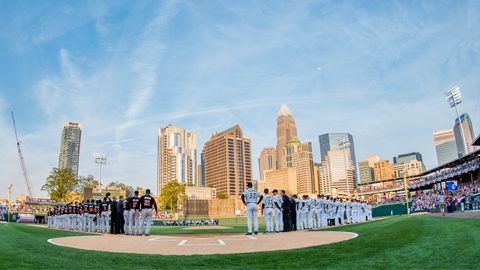
North Carolina and Connecticut – two states forever linked in the cross-currents of sports by the Hartford Whalers relocation to the Tarheel State in 1997, are both using 2014 to heighten their professional baseball credentials. The City of Hartford has announced that the Double A franchise currently in New Britain will be moving to the Capitol City in 2016 in a soon-to-be-built $60 million, nearly 10,000 seat stadium. Just two months ago, the Triple A Charlotte Knights opened their newly constructed 10,200 seat $55 million downtown stadium. The Knights are an affiliate of the Chicago White Sox. Ground was broken on the new stadium in September 2012, about an 18 month construction schedule.

BB_T_Ballpark_media_7suaxdjb_lv2jd5cuThe first Knights game took place on April 11, 2014. (photo at left) The stadium features a two-level club with skyline views as well as a VIP, climate-controlled club with full service bar. In addition to corporate suites, there are 987 club seats at the new Charlotte stadium. Of those, 170 on the upper level sell for $41.50 per game, or nearly $3,000 per season. The remaining 817 club seats, at $21 per game, sell for about $1,500 annually.  All of the club seats were sold out 10 months prior to the season opener, according to the Knights website.  Season tickets require either a two- or four-year commitment. Naming rights to the stadium were sold to BB&T Corporation in 2012. Published reports also indicate that multiple new hotels are expected to open in the area around the stadium in the coming years, along with restaurants and retail.

The Charlotte team’s website reports that “National ballpark consultants conservatively estimate that in its first year BB&T Ballpark should draw at least 600,000 fans just for baseball.” In addition to obtaining corporate sponsorships, among the fundraising initiatives along the way in Charlotte were commemorative bricks sold to be placed in the stadium’s entrance, at a cost of between $90 to $195, containing individual messages determined by purchasers. A portion of the sales went to local charities in Charlotte.

Comparing Attendance Numbers, Possibilities

The Rock Cats drew more than 307,000 fans to their 6,100-seat stadium in New Britain last year, ranking sixth in the 12-team Eastern League. The Knights were last in attendance in the Class AAA International League last year, with an average of 3,803 per game, down from a high of 4,736 in 2006, according to the Charlotte News Observer. In 2013, the New Britain Rock Cats averaged 4,653 fans per game, which ranked 59th among baseball’s minor league teams. Charlotte ranked 80th. The top team in the league - and in minor league baseball - the Columbus Clippers, drew 9,212 per game.

Knights website

The AAA Pawtucket Red Sox average attendance in 2013 was 7,827, ranked #10 in minor league baseball. The Double-A Portland Sea Dogs, also a Red Sox affiliate, ranked 47th, drawing an average of 5,096 per game. Among Double-A teams, Portland ranks tenth.

The top minor league teams, based on average attendance in 2013, are in Columbus, Lehigh Valley, Indianapolis, Sacramento, Dayton, Buffalo, Louisville, Round Rock (Texas) and Albuquerque. The top Double-A teams are in Frisco, TX (7,057); Richmond, VA (6,689); Reading, PA (6,321); Tulsa, OK (5,704); Birmingham, AL (5,669); Corpus Christi, TX (5,498); Trenton, NJ (5,373) and New Hampshire (5,125).

On July 12, 2008, the Rock Cats established a franchise record for single game attendance, with a crowd of 8,115 at New Britain Stadium. The record was broken on June 27, 2009, with a crowd of 8,212. The Rock Cats reached the 8,000 mark once again on May 31, 2014 with a crowd of 8,079.

For those who wonder if there is a Triple A future for a Hartford baseball stadium, the history of Pawtucket may be of interest. The first team to be named the Pawtucket Red Sox debuted in 1970 as a member of the Double-A Eastern League, according to Wikipedia. After three seasons as a Double-A Red Sox affiliate, Pawtucket's Eastern League franchise moved to Bristol, CT in 1973 to make room for the new Triple-A PawSox. And as most Connecticut sports fans recall, the Bristol franchise then moved to New Britain in 1983, first as a Red Sox Double-A affiliate (through 1994) and then as the farm team of the Minnesota Twins.IMG_6669

And might the presence of a stadium in Hartford, rather than New Britain, cause the Red Sox to return with an affiliate in Connecticut? Apparently not any time soon. The Sox appear set in Pawtucket and Portland.

In January 2013, the Portland Sea Dogs announced an extension of their affiliation with the Boston Red Sox as the Double A minor league team. Their contract was set to end after the 2014 season but the extension through the 2018 season was announced during the Portland Sea Dogs Hot Stove Banquet by Red Sox director of player development Mike Hazen and Sea Dogs president Charlie Eshbach. Eshbach served as Eastern League President for 11 years and is the league's longest serving active member  – dating back to his tenure as general manager of the Bristol Red Sox in Connecticut, not too many years after attending college at UConn.

“We are delighted to extend our relationship with the Portland Sea Dogs for an additional two seasons,” said Hazen at the time. “We are extremely fortunate to work with some of the best people in minor league baseball in Portland. The Burke family, Charlie Eshbach, and the entire Sea Dogs organization always go above and beyond to provide support to our players and staff. With the Sea Dogs, our minor leaguers experience the ideal environment to succeed and grow.”

The Sea Dogs are now in their 21st season at Hadlock Field, their 12th as an affiliate of the Boston Red Sox. The Red Sox originally entered into an agreement with the Sea Dogs following the 2002 season, when Portland changed affiliations from the Florida Marlins.

 (photo credit: Rob Kavaler)

rankings

Feds Disband National Blueway Program, CT River is Sole Survivor

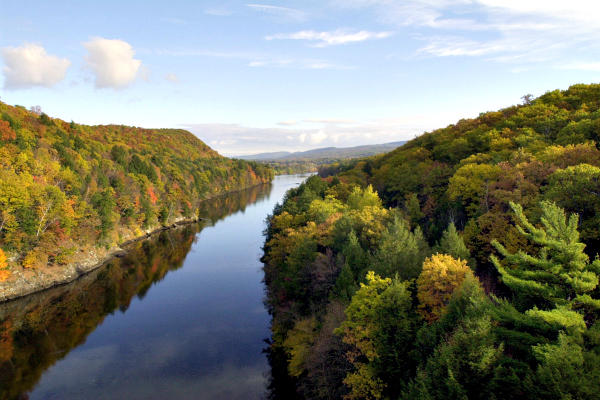
It seemed like a good idea at the time. U.S. Secretary of Agriculture Ken Salazar designated the Connecticut River as the nation’s first National Blueway, in recognition of conservation efforts underway. That was two years ago – the first of what was intended to be a series of similar designations across the country. Fast forward to 2014. The fledgling federal program was abruptly discontinued by current Ag Secretary Sally Jewell, after a departmental review. Since it’s auspicious start, only two official designations were made.

The first was the Connecticut River, which runs through Connecticut, Massachusetts, Vermont and New Hampshire. The second was the White River, which spans more than 700 miles through Missouri and Arkansas. But that second designation was revoked after local opposition. And now the entire program is history, with the Connecticut River grandfathered in as the short-livCT RIVERlogoed program’s sole survivor.

The National Blueways System wConnecticut Riveras created in May 2012 under President Barack Obama’s America’s Great Outdoors Initiative. The program was voluntary, didn’t include any new regulations, and a designation brought no additional funding, the Associated Press has reported. It was intended to promote watershed conservation and support sustainable and healthy water supplies.
Federal officials insisted the program would not include any new protective status or regulations, but opponents in Missouri and Arkansas — largely conservative groups — weren’t convinced, the AP reported. Published reports indicated that some feared the conservation recognition program would lead to increased regulation and land seizures. That led first to the revocation of the White River designation last summer, followed by the end of the entire initiative earlier this year.

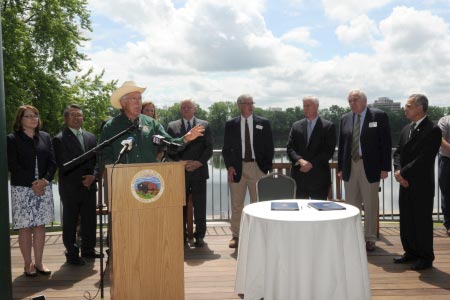
In riverfront ceremonies in Hartford on May 23, 2012, Interior Secretary Salazar designated the 410-mile-long Connecticut River as America's first National Blueway, saying restoration and preservation efforts on the river were a model for other American rivers. The blueway designation was intended to support existing local and regional conservation, recreation and restoration efforts, and does not establish a new protective status or regulations for a river, Salazar said at the time.

He was joined at Riverside Park in Hartford by U.S. Sen. Richard Blumenthal; U.S. Rep. John Larson; Principal Deputy Assistant Secretary of the Army Terrence “Rock” Salt; Friends of the Silvio O. Conte Refuge Chairman Patrick Comins and other members of the conservation and business communities. designation announcement

That would be the program’s high water mark, so to speak.

“The National Blueways Committee will be deactivated, but the department will continue to encourage collaborative, community-based watershed partnerships that support sustainable and healthy water supplies,” a department spokeswoman told the AP this year, explaining the department’s decision to end the program. She reiterated that the Connecticut River will maintain the National Blueway designation it received two years ago – and now will be the only one in the country.

Higher Percentage of Part-time Workers in CT Than New York, New Jersey, Lower Than New England

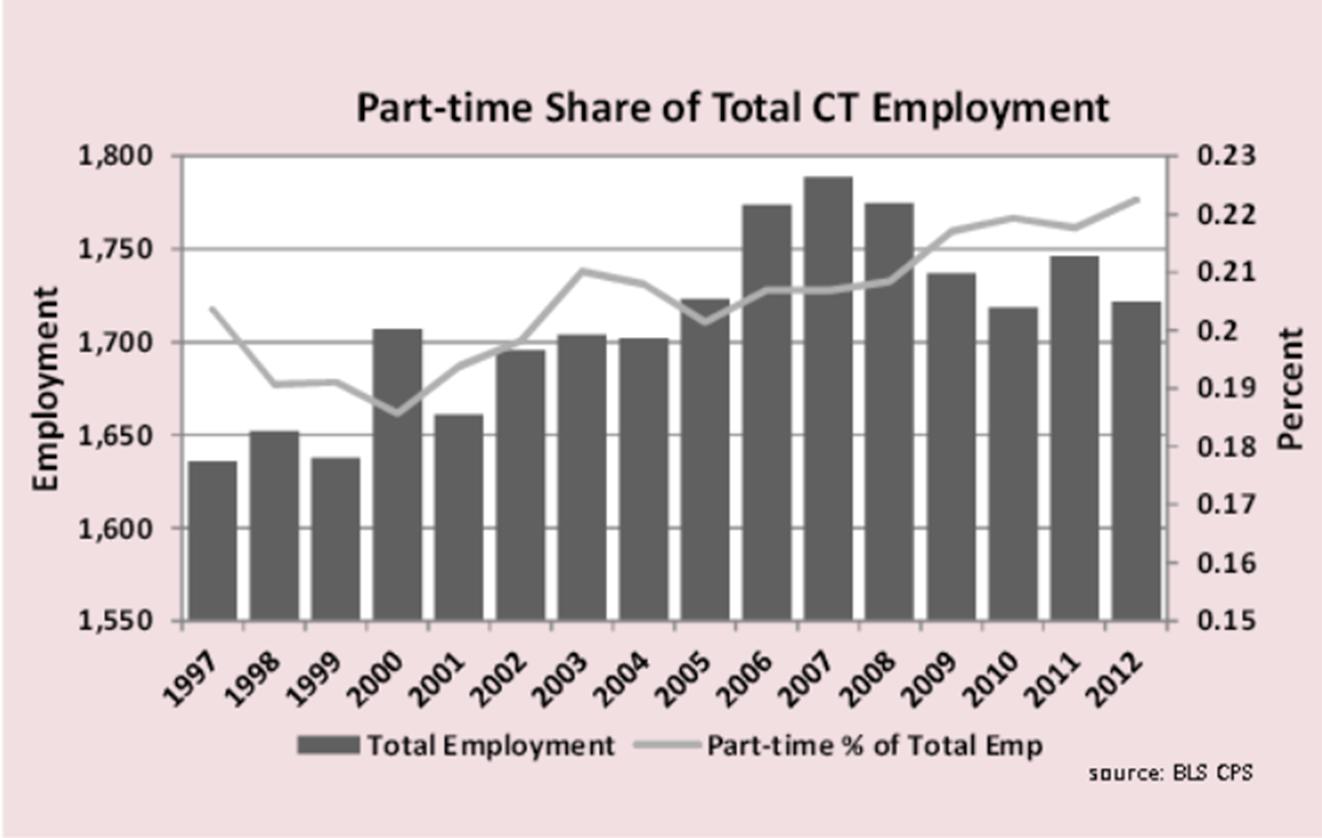
Connecticut's percentage of part-time workers (22.2 percent) outpaces much of the Northeast, South, Midwest and West, according to the latest Connecticut Economic Digest (CED), produced by the state Department of Labor and Department of Economic and Community Development. In the first examination of part-time employment in more than a decade, the publication noted that part-time employment in Connecticut numbered 383,000 - 69.5 percent of which (266,000) was women. This statewide share is among the highest in the country, which had a 50-state average of 64 percent.

part time chartConnecticut’s part-time employment share of 22.2 percent is the lowest in New England but considerably greater than neighboring states in the tri-state area, which have employment shares respectively of 17.6 percent (New York) and 17.9 percent (New Jersey), the analysis by the state Department of Labor indicated.

Part-time employment is all employment that amounts to less than 35 hours per week. Since 1997 it has averaged about 20 percent of total employment in Connecticut and fell to 18.6 percent in 2000, according to the CED, before climbing.

In recent years it has gradually trended upward and was 22.2 percent of employment in 2012, the most recent year of annual average datCEDa and the basis for the analysis. The breakdown of hours worked shows that Connecticut has less under 35 hours per week employment than other New England states but more than the Northeast region overall. Part-time employment was 23.3% of all New England employment in 2012, higher than any other census division in the country. The other eight census divisions averaged 19.3% with the West- South Central division lowest at 16.4%.
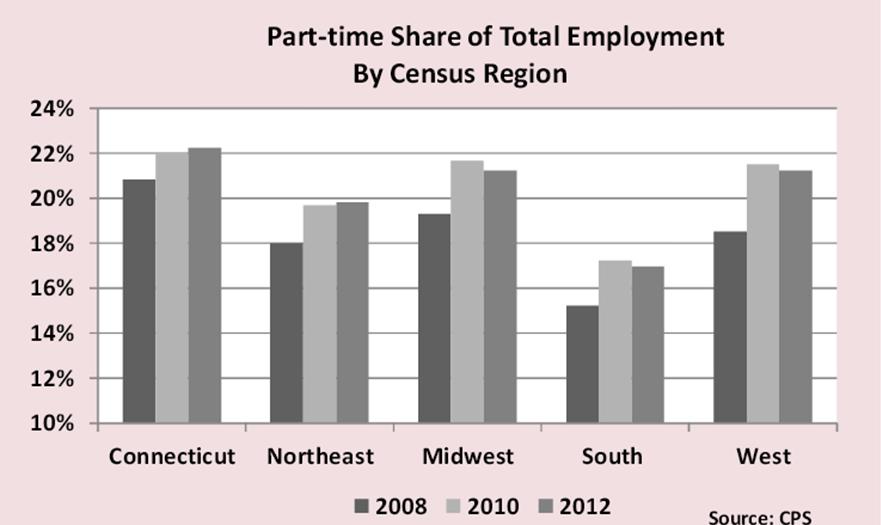
While those choosing to work part time remain the bulk of part-time workers, the number of those working less than full time has grown since 2005 as more workers have their hours cut by employers or were unable to find full-time jobs during or after the recession. From 2009 to 2011, the number of workers who wanted full-time employment but could only find part-time jobs rose 37.5 percent to 33,000 from 24,000, Hartford Business Journal reported. part time 2

The report points out, however, that a majority of part-time employment in Connecticut is due to voluntary reasons, and not a result of prevailing economic conditions. In 2012, voluntary part-time employment in Connecticut was 76.4 percent of all part-time employment, in line with the 50-state average of 76.8 percent.

The industries with the lowest average weekly hours worked are leisure and hospitality, other services, and education and health services. In 2013, these industries averaged 25.8, 30.9, and 31.2 work hours per week, according to the Connecticut Economic Digest report issued in May.


Mystic Aquarium Honored at White House Ceremony with National Medal

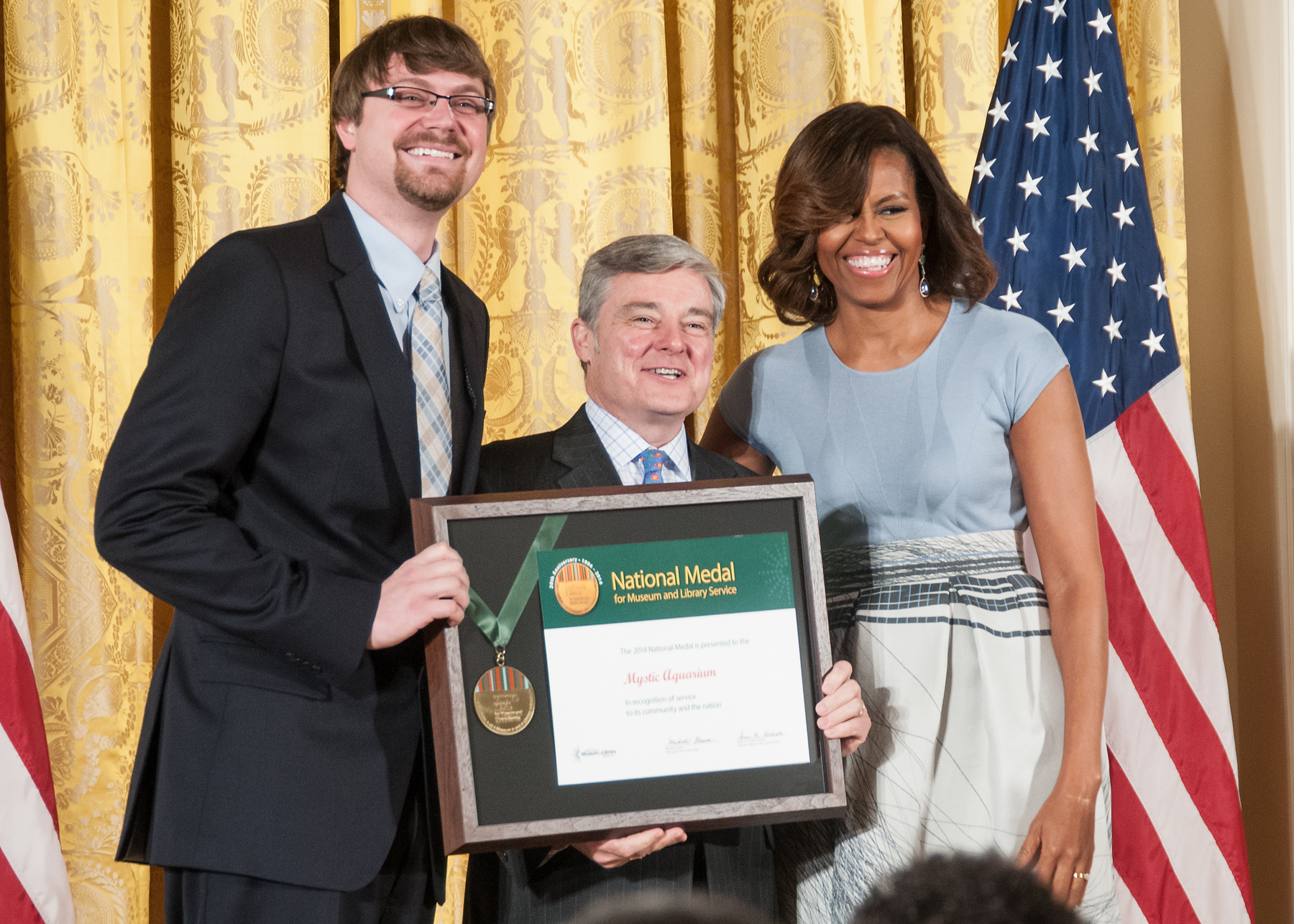
Mystic Aquarium has earned some high profile attention this month, recognized at a White House ceremony hosted by First Lady Michelle Obama. The Institute of Museum and Library Services (IMLS) honored Mystic Aquarium as the only aquarium or zoo nationwide to receive its National Medal for Museum and Library Service for 2014. Impressively, Mystic Aquarium was one of four Connecticut finalists considered for the National Medal, along with the Hartford Public Library, Mattatuck Museum in Waterbury and Otis Library in Norwich. A total of only 30 institutions across the country were finalists, from which ten winners were ultimately chosen.

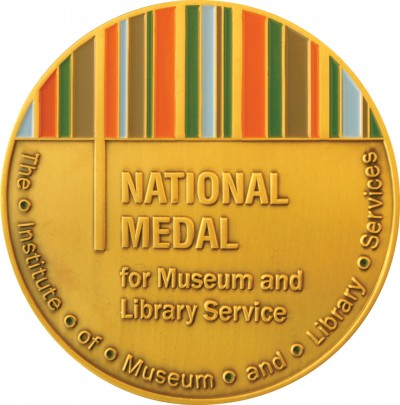
The National Medal is the nation’s highest honor conferred on museums and libraries for service to their communities. The Institute of Museum and Library Services, an independent agency of the U.S. govemedal_lg-400x405rnment with the mission to create strong libraries and museums that connect people with information and ideas, is celebrating its 20th year of saluting institutions that make a difference for individuals, families and communities.
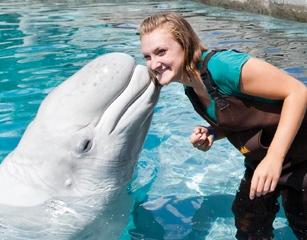
Mystic Aquarium gives back to the community with a direct financial impact of $72.2 million annually. In addition, the aquarium buys $5 million in services and supplies from Connecticut businesses annually. The institution’s conservation efforts protect the vitality of Long Island Sound, an important revenue-generating natural resource for Connecticut. It is the largest informal science education provider in Connecticut and Southeastern New England, reaching 100,000 students annually. whale

The work of Mystic Aquarium was brought to the attention of Susan H. Hildreth, Director of the Institute of Museum and Library Services, by some of Connecticut’s most prominent cultural, education and government leaders. Rodney A. Butler, Mystic Aquarium Trustee and Chairman of the Mashantucket Pequot Tribal Nation, nominated the Aquarium for the National Medal, noting the pivotal role the Aquarium plays with its education and cultural exchange program for Native American high school students from the village of Point Lay, Alaska, and the Mashantucket Pequot Tribal Nation in southeastern Connecticut.

A major criterion for the award is the institution’s impact on members of its local community. Dr. Stephen M. Coan, President and CEO of Sea Research Foundation, the parent of Mystic Aquarium, who accepted the National Medal from Mrs. Obama, said: “We are honored to receive this prestigious award. We are committed to our educational and public engagement programs that make Mystic Aquarium not only an enjoyable family destination, but also a research facility dedicated to protecting our oceans and its aquatic creatures.”

U.S. Senators Richard Blumenthal and Christopher Murphy supported the nomination along with Stonington Public Schools, which cited the Aquarium’s exemplary work with young people with intellectual disabilities. Michael Cotela, Executive Director of the Boys & Girls Club of Stamford extolled the Aquarium’s critical educational programming for underserved communities.

Founded in 1973, Mystic Aquarium has a collection of 4,00Medals2014_Mystic0 animals, including such species as beluga whales and the endangered African Penguin.


PHOTO (Left to right): Justin Richard, Stephen M. Coan, Mrs. Obama.

Connecticut's #1 Athlete Search: LeBron James

Which athlete is Connecticut most interested in?  Not Shabazz Napier, not Stefanie Dolson.  At least not according to Google, which analyzed the frequency of searches in each of the 50 states during the past 12 months.  Number one in Connecticut:  LeBron JamesPopular-Players-Complete-Blu2

In fact, LeBron James dominates the competition, showing up as the most searched athlete in 23 of the 50 states. Next in line is Peyton Manning who claims seven states, then Adrian Peterson and Tom Brady who tie for 3rd with four states.

Andrew Wiggins (two states) and Johnny Manziel (one state) are the only athletes to win at least one state despite technically not having made the transition to professional sports yet. Tiger Woods (one state - Vermont) is the only athlete on the map who doesn’t play one of the “Big Four” North American sports.

Across New England, Tom Brady is number one in Rhode Island, Massachusetts, Maine and New Hampshire.

The website Best Tickets also indicated that Google research shows that the NFL is far and away the most popular league in the United States. In almost every state, the NBA was the second-most popular league, but MLB and the NHL did make a few appearances in the number two spot.

New York is the only state in which the NBA is the most popular league. In Florida, Oklahoma and Oregon, the NBA and NFL tie for first.