Veterans Education and Career Training Gains New Focus in Connecticut

With veterans returning from active duty in increasing numbers and seeking to pursue higher education or achieve a place in the workforce, efforts are underway in Connecticut to respond.

The Veterans Vocational Training Program (VVTP), is a new initiative of Hartford-based Connecticut Public Broadcasting Network (CPBN).  The program offers veterans,free of charge, two different programs of study.  Media Arts, which focuses on the Adobe programs Photoshop, Illustrator, and In-Design, is offered during the Fall 2013 semester, which begins on August 26.   The other program seeks to develop the talents of budding video producers and editors.

Both programs incluveteransde 90 hours of classroom instruction, professional portfolio development, and an additional 60 hours of hands-on learning. In addition, the VVTP helps potential employers connect with veterans seeking specific employment opportunities.

There will be an Open House for veterans to learn more about the program on July 18 at5:30 PM at CPBN, located at 1049 Asylum Avenue in Hartford.  Inquiries about the program can be directed to Major (ret) Tim Krusko, Program Manager, at 860-275-7337 or email veterans@cpbn.org.  Questions can also be directed to CPBN’s Director of Education Services, Donna Sodipo at dsodipo@cpbn.org or 860.275.7337.  Individual tours of the facilities are also available.

The initiative has quickly developed a wide range of partners that will help CPBN provide veterans with a real-world education while increasing their employment opportunities. CPBN is also reaching out to colleges and universities for referrals of veterans who might benefit from the VVTP as a no-cost way to supplement or enhance their current media education experience through hands-on learning. The VTTP is not restricted to Connecticut residents.

The Fall 2013 semester starts August 26, 2013 and ends December 19, 2013.  The Spring semester will run January 13 through May 12, 2014.  The goal is to have 85 percent of program participants successfully employed after completing the program.

In a separate effort, the Connecticut Conference of Independent Colleges, which includes 16 higher education institutions in the state, recently held a one day, state-of-the-art training for over 100 campus participants from throughout Connecticut that focused on military culture and serving student veterans.

Offered by the Center for Deployment Psychology, the training was designed to increase competency in the concerns, challenges, culture and experience of service members and veterans attending college. Mental health professionals as well as non-clinical university staff specializing in student affairs, financial aid, disability services, housing, campus security and oveterans learning labthers attended.

The training covered:

·  Culture and Experience of Service Members & Veterans on Campus

·  The Deployment Cycle and its Impact on Students

·  Reintegration on Campus

·  Outreach Strategies and Group Exercise

·  Overview of Treatments for PTSD on Campus

The training was offered free of charge to every non-profit public and private college in Connecticut.  It funded by a grant from the Bob Woodruff Foundation and was offered through a collaboration of the American Council on Education and the Center for Deployment Psychology at the Uniformed Services University of the Health Sciences.  The event was part of an ongoing effort coordinated by CCIC “to help campus representatives learn best practices and gain an understanding of resources available to make the campus experience successful for those who made the commitment to protect and serve our country.”

The VTTP is made possible through the generous corporate sponsorship of organizations and businesses including the Wounded Warrior Project, Newman’s Own Foundation, Walmart Foundation, the SBM Charitable Foundation, Farmington Bank Community Foundation and the Corporation for Public Broadcasting.  Wounded Warrior Project awarded CPBN with a $250,000 grant for the economic empowerment of wounded warriors and their family members. CPBN is currently seeking additional grant programs to help grow the program beyond the first year and replicate it in other parts of the country.

The VVTP program is a component of CPBN’s soon-to-be-completed $3.5 million Learning Lab, which will also offer education programming aimed at Hartford public school students. CPBN will dedicate a state-of-the-art learning space to these initiatives, to include studios, sound rooms, classrooms, offices, and video production and media arts facilities.

veteranprogramenrollmentFY11

CT Businesses Report "Going Green" Worthwhile; Sustainability Has Multiple Impacts

Eight in ten Connecticut companies that have invested time and money in “going green” say the effort has been worthwhile, citing benefits on the bottom line as well as improved employee morale, public image, and client/customer relationships. According to a new survey,  the main barrier to going green is cost, the factor cited by 65% of businesses.  Among companies engaged in sustainability, the strongest areas of involvement are energy efficiency (90%), waste management (77%), and green purchasing (74%).

Those are among the findings of the Connecticut Business & Industry Association (CBIA) 2013 Sustainability and Connecticut Business Survey.  Sponsored by UIL Holdings, Inc., the survey gauges Connecticut companies’ commitment to environmental principles in their business operations and the impact of those efforts on business performance, stakeholder relations, and communities served.

The survey found that nearly two-thirds (66%) of Connecticut businesses engaged in sustainability. This is up from less than half (47%) in 2007, when CBIA first surveyed companies—but down from 74% in 2010, when the previous survey was conducted.

Mostt businesses (72%) find Connecticut’s environmental regulatory climate more restrictive than other states, according to the survey.  And nearly three-quarters of businesses surveyegoinggreen-icond (74%) say they would take advantage of state government incentives for going green, such as tax incentives and refunds for capital investments.

Among the other findings this yea, posted at www.cbia.com/business, include:

  • Renewable energy is the area of greatest interest among businesses for future activities.
  • Though slightly more than half (53%) of the companies surveyed say current economic conditions have not changed their level of commitment to sustainable business practices, 11% have stepped up their efforts, while 9% have made green practices less of a priority. Eighteen percent say green practices are part of their DNA.
  • Nearly one-third of businesses surveyed (32%) require others in their supply chain—manufacturers, suppliers, distributors, and retailers—to adopt green business practices; 28% say that their own customers have requested or stipulated that they incorporate green business practices into their supply chain; and 9% have received similar requests from vendors.

The 2013 Sustainability and Connecticut Business Survey was emailed to 5,035 businesses in late April and early May; 434 businesses took the survey, for a response rate of 9% and a margin of error of +/- 4.8 %.  Most respondents (77%) were small businesses employing fewer than 50 workers. Businesses represented include manufacturers (33%), professional services (23%), retail (9%), nonprofit associations (8%), construction (6%), wholesale (6%), healthcare (5%), finance, insurance, and real estate (5%), and technology firms (4%). Companies engaged in hospitality, tourism, arts, and entertainment accounted for the remainder of respondents.

New Technologies to Assure Safety Provide Challenges, Opportunities for Law Enforcement

New technologies are being designed and implemented in Connecticut and across the country aimed at ensuring safety by improving the effectiveness and speed of police operations. Two of the most fascinating systems, and probably the most advanced, are next-generation 911, which support text, data and video from any device, and drones, which are aerial vehicles that act as watchdogs of the sky, according to the website StateTech.

Recent news reports, however, are raising questions in Connecticut regarding at least one of the new technologies, now on the ground here.  In 2011, the city of Hartford introduced a technology to boost public safety that was ushered in as a way to respond to  Hartford gun violence, FOX Connecticut recently reported. It’s called the ShotSpotter system, built to detect gunfire and it is also used in New Haven and Springfield, Mass.

In an investigative story on the technology, FOX Connecticut reported that during an analysis of ShotSpotter in spring 2012, police records show that out of 60 total alerts, only six were confirmed, meaning the system was only 10 percent accurate. Nearly a year later, an interdepartmental police memo shows the system’s accuracy on 27 alerts was even lower, at just eight percent. Two of those 27 alerts were labeled as gunfire but really weren’t, including one which was just noise from a snow plow.sound

Additional assets are being sought, and received, by Connecticut municipalities, using both local and federal resource to boost efforts on the ground, in the air, and in the water.

The Stamford Advocate reported earlier this year that a plan to purchase a new high-tech public safety boat capable of detecting an arsenal of hazardous materials took another step forward, when the Board of Finance agreed to spend $610,000 to purchase the vessel.  The boat will ultimately be paid for by the federal government, according to the report, which noted that the federal government is also paying for other boats delivered to, or on order from, Greenwich, Norwalk, Fairfield and New Haven.

Last September, Fairfield took possession of a $488,000, 34-foot police boat paid for by the grant, the Advocate reported. In June and July, New Haven expects to take possession of a $1.1 million, 39-foot fire boat paid for by FEMA with two fire nozzles capable of spraying a total of 4,000 gallons per minute. That boat will be operated by the fire department, but the city's police department will have access to the vessel for its dive team.  And Greenwich is expecting delivery of a 38-foot, $600,000 boat to be paid for with a Port Security Grant. The police department will have ownership of the boat, but fire and EMS will have access to it.

In Bridgeport earlier this year, what ultimately proved to be an innocent wind-driven error brought a response by local police and the FBI when a drone crashed near a waterfront power plant, the Connecticut Post reported.  Among the other technologies in use around the country are automatic license plate recognition and wearable cameras, which the Hartford Advocate has reported are being used by officers in Branford.  The high-tech license readers, now mounted on 87 police cruisers statewide in Massachusetts, scan literally millions of license plates in that state each year, not only checking the car and owner’s legal history, but also creating a precise record of where each vehicle was at a given moment, according to the Boston Globe.

public-safety-infographic-web

Connecticut Resident Selected as Presidential Innovation Fellow, White House Announces

A Connecticut resident is one of 43 “incredible Americans” selected as new Presidential Innovation Fellows (PIFs), to serve 6- to 12-month intensive “tours of duty” in the US Government, where they will work hand-in-hand with top government innovators to develop solutions that can save lives, save taxpayer money, and help fuel private-sector job creation.

Nayan Jain is a Presidential Innovation Fellow working on the MyData Initiatives (Blue Button) at the Department of Health and Human Services.  Jain is an engineer and healthcare hacker with a passion for developing software that is able to simplify complexities by reducing noise and finding patterns in data.  His career in health IT began as an undergraduate with a dwhite hosueesign for an administrative database for the Department of Neurosurgery at Emory Hospital.

The Presidential Innovation Fellows (PIF) program was created in 2012 to tackle five inaugural projects—each focused on making a part of the Federal Government work better for the American people.  Each team of innovators is supported by a broader community of interested citizens throughout the country. Presidential Innovation Fellows put aside their jobs and day-to-day home lives to offer their skills and expertise in collaboration with Federal agency teammates to create huge value for the American public.

The 1st round of five projects was launched in August 2012 with 18 inaugural Fellows. The first round selections included Nick Bramble, Director of the Law & Media Program, Information Society Project at Yale Law School in New Haven.  Bramble is a lawyer with a strong interest in improving how governments release data and promote engagement by citizens and startups.

The 2nd round of the Presidential Innovation Fellows program will include ten projects,– four that are the second phases of Round 1 projects and six new projects. Presidential Innovation Fellows have a unique oppoNayan Jainrtunity to serve our Nation and make an impact on a truly massive scale.  The MyData Initiatives seek to spread the ability for people to securely access to their own data while spurring the growth of private-sector applications and services that a person can use to crunch his or her own data for a growing array of useful purposes.

After graduating and a stint writing applications for back-office propane systems, Nayan Jain  joined the DC-based startup, Audax Health.  While serving as Director of Mobile Technology at Audax, he helped build the core Zensey mobile and web platforms that aim to drive behavior change through consumer engagement and social game mechanics.  He collaborated to build MedTuner, an artificial intelligence that alerts its followers of important health events using techniques in machine learning and natural language processing, which was awarded first place at the 2012 Health 2.0 Developers’ World Cup in San Francisco, CA.

Most recently, he selected by Google to be a Glass Explorer and is looking forward to building wearable experiences that will help improve lives and patient outcomes.  He graduated with a BS in Computational Media, primarily focused on Human Computer Interaction and Computer Science from the Georgia Institute of Technology.  He currently lives in Connecticut, but spends his spare time in New York, according to the PIF announcement.innovation fellows

Jennifer Pahlka, Deputy U.S. Chief Technology Officer for Government Innovation reports that some of the tech innovators and change-agents who comprise the new class of Fellows will work on second phases of Round 1 PIF projects such as Blue Button (which is helping veterans and others across the country gain secure electronic access to their own personal health records); Open Data (which is making more and more government information like car safety ratings and hospital pricing available for use by the American people, including entrepreneurs and software developers who are turning those data into useful products and services); MyUSA (which is greatly simplifying the Web interface that citizens can use to find what they need from the Federal Government); and RFP-EZ.

For Round 2 of the PIF program, the White House Office of Science and Technology Policy (OSTP) and Office of Management and Budget (OMB) have partnered with the US General Services Administration (GSA).  Through this new partnership with GSA, which already works with every agency in the Federal Government, the prototype solutions that PIFs build will spread more efficiently throughout Government, enabling the program’s positive outcomes to reach more people more quickly.

For example, through Blue Button – a growing initiative across the public and private sectors – patients can download their own health information from a growing array of organizations (the Department of Veterans Affairs’ health system, private-sector health care providers, etc.) and securely share their medical histories with caregivers, import their prescription histories into mobile reminder apps, and more.

Others will work on new projects, such as developing tech tools to support disaster relief and recovery efforts; working with private-sector innovators to create consensus tech standards for the “Internet of Things,” which will connect a wide range of devices with embedded sensors and control systems, with big potential efficiencies and cost-savings; and helping Federal agencies save money through better, more cost-effective financial accounting systems.

Details on the entire class of Presidential Innovation Fellows is available on the web, and details about current and future rounds of the PIF program is at whitehouse.gov/innovationfellows,

 presidential innovation fellows

Two Connecticut Burgers Make America's Top 40

Two Connecticut-made burgers have been selected as among the 40 top burgers in America, according to the website The Daily Meal.  What better time to review the list then in the midst of the July 4th celebration?

Coming in at #17 is The Original Burger at Louis’ Lunch in New Haven, and at #32 the Steamed Cheeseburger from Ted’s in Meriden.  Both are perennial favorites, and no stranger to acclaim, here at home and well beyond Connecticut.32-teds-flickr_Ken-ichi

As the Louis’ Lunch website recalls the story… “One day in 1900, a gentleman hurriedly walked into Louis' Lunch and told proprietor Louis Lassen he was in a rush and wanted something he could eat on the run. In an instant, Louis placed his own blend of ground steak trimmings between two slices of toast and sent the gentleman on his way. And so, the most recognizable American sandwich was born.”  The New Haven icon was also featured by ABC television’s The Chew earlier this year, and Food and Wine magazine a year ago.

The Daily Meal added this description of the burger cooked in downtown New Haven: “A flame-broiled burger made in a vertical hinged-steel wire gridiron that cooks the burgers on both sides at the same time. That’s what. It’s a hamburger sandwich supposedly made from a blend of five cuts of ground steak. If you want condiments, you’ll have to ask. The extent that your burger is going to get tricked out is cheese, tomato, and onion. No mustard, ketchup, or mayo. But do you really need all that? You can practically taste the nostalgia. And that never disappoints.”

The other Connecticut top finisher is summed up this way by The Daily Meal: “Since 1959, Ted's, in this historic community north of New Haven (there is another location in nearby Cromwell and a food truck on the way), has steamed theirs. Steamed meat? Yep. Steamed Cheddar cheese, too. Cooked in custom-designed steam boxes, the burgers, served on kaiser-roll-like buns, lose very little bulk while cooking and, need we say, stay very moist. The steametedlogod cheese is spooned over the patties and cloaks them thickly. Add lettuce and tomato (or complimentary sautéed onions and/or mushrooms) and you've got an unusual, and unusually good, burger.”

Ted’s “world famous steamed cheeseburgers” also topped the local Advocate newspaper’s “best of” list, most recently in 2012, “Best Burger in CT” from The Food Network Magazine and “Best Burger” from Connecticut Magazine. Ted’s describes itself as the only known restaurant in the U.S. that exclusively sells steamed cheeseburgers.

If you were wondering, New York City establishments took three of the top five slots, with the others going to burgers in Atlanta and Virginia.  The Daily Meal has America’s Top 40 burgers listed on their website, with mouth-watering images accompanying.  The Daily Meal, according to its website, produces more culinary content than any other resource.

Louis Lunch

University of Hartford Student Athletes Win Conference in Academic Performance

Reporting on the academic performance of its student athletes with a level of statistical precision normally reserved for sporting events, the University of Hartford announced that it has clinched its second-straight America East Academic Cup in 2012-13 after posting the highest grade point average of any school in the 18-year history of the award, according to data from by the America East conference.

Compiling a 3.24 GPA in 2012-13, the Hawks' winning GPA was six points higher than the next highest mark, which belonged to New Hampshire (3.18 GPA). Binghamton University and University of Vermont tied for third (3.12 GPA), followed by University of Maine (3.11), Stony Brook University (3.08), Boston University (3.07), University at Albany (3.01) and UMBC (2.83), the university reported.

“We are all so proud of our student-athletes who have proven once again that we do things the right way: we excel on the field or court and in the classroom,” said University of Hartford President Walter Harrison. “Here at Hartford, the term student-athlete has meaning.”  Harrison has served as Chair of the National Collegiate Athletic Association's Committee on Academic PerforNCAA-mance.

The Academic Cup, established by the America East Board of Directors in 1995, is presented to the institution whose student-athletes post the highest grade point averages during that academic year.  Last year, Hartford student-athletes earned a 3.17 GPA, edging out the University of Vermont by one one-hundredth of a point to clinch UHart's first Academic Cup since 1996-97. In 2012-13, the Hawks surpassed last year's mark by seven one-hundredths to take home back-to-back Academic Cups for the first time in school history.

The Hawks set a record in the classroom in the Spring 2013 semester, posting a combined 3.23 GPA, edging the previous school mark of 3.22 set one year ago. This past spring, Hartford boasted 252 student-athletes with GPAs of 3.0 or better, with 150 of those student-athletes notching at least a 3.5 and 20 out of 358 student-athletes earning a perfect 4.0 GPA for the semester.

“Congratulations to the University of Hartford, most notably its student-athletes, on this historic achievement,” said America East Commissioner Amy Huchthausen. “It is indicative of the hard work put in and the value placed on academics not only by Hartford, but by all nine of our institutions and student-athletes, who consistently excel academically year in and year out, which is a core pillar of this conference and what sets us apart from so many others.” America East After a season in which its mens basketball team was ineligible for post-season play because of substandard academic performance a few years ago, UConn received the news earlier this year that they would again be eligible for post season play in 2014.

According to the NCAA's explanation of the Academic Progress Rate (APR) system which determines eligibility, each athlete earns one retention point for staying in school and one eligibility point for remaining academically eligible. The team's total points are divided by the number of possible points, then multiplied by 1,000 to reach the APR.

UConn's score for the 2011-12 academic year was 947 out of 1,000, giving the program two consecutive years with scores surpassing the NCAA benchmark. With a two-year average of 964, UConn surpassed the NCAA's two-year standard of 930 and will be eligible for postseason play in 2014, The Hartford Courant reported.

Five Quinnipiac University teams have received a Public Recognition Award from the NCAA for earning high scores in the most recent Academic Progress Rate (APR) compilation, according to the school.

The Quinnipiac squads recognized by the NCAA include: men’s indoor track & field, women’s cross country, women’s golf, women’s indoor track & field and women’s outdoor track & field. All five teams are rewarded for scoring in the top 10 percent in each sport with respect to their Academic Progress Rates (APRs).

Teacher Training in STEM Fields to Expand in CT

Connecticut’s drive to improve both teacher training and the caliber of Science, Technology, Engineering and Math (STEM) education being provided to students across the state received a boost with the announcement that the Connecticut Science Center would be tripling the capacity of its teacher professional development program, the result of a grant from Joyce D. and Andrew J. Mandell.

The number of teachers participating in the program will increase from 500 to 1,500 annually over the next few years, officials said, with the goal of giving educators the tools they need to meet rigorous new state and national standards for STEM education and core curricula.

Governor Dannel Malloy, State Education Commissioner Stephan Pryor, Hartford Mayor Pedro Segarra and Hartford’s 2012 Teacher of the Year Keith Sevigny, photoa past participant in the professional development program, were among those joining Connecticut Science Center President and CEO Matt Fleury in making the announcement.

In addition to expanding its capacity to serve more teachers, the newly named Joyce D. and Andrew J. Mandell Academy for Teachers at the Connecticut Science Center will also award graduate-level college credit through Charter Oak State College for certain programs.  Academy offerings include Student Engagement Strategies, Inquiry Teaching and Learning, STEM Education Units, Science Content Workshops, Engineering Practices, and Science Coaching. Teachers completing the covered courses can earn a total of nine credits toward their Master’s degrees over a three-year period.

Governor Malloy said the announcement made it a day of “celebration,” emphasizing that the impact “will be played out in the years to come.”  Reiterating his commitment to education and economic development, the Governor said this effort is another example of initiatives designed to “allow our state to compete.”  He  noted the BioScience Connecticut initiative and recently approved growth plans for the University of Connecticut as further indications of the state’s commitment.

Described as a “high-impact professional development program for educators,”  the Academy is “committed to supplying educators with professional development experiences that support rigorous science and curriculum standards.”   Commissioner Pryor, underscoring the challenges in education, pointed out that “15 countries do better than the U.S. in science and 24 do better in math.”  Pryor added that “we can prepare students for jobs of the future, but not if we are slipping in math and science.”

Officials pointed out that new nationally mandated benchmarks such as the Next Generation Science Standards and Common Core Education Standards will require teachers to seek training to improve the way they teach science and integrate it with the rest o f their curriculum.

“We want every child in the state to be able to compete,” said Joyce Mandell. “Teaching teachers how to connect with their students is one of the most important things we’ve ever done.  We’re very proud of our association with the Connecticut Science Center.”

Citing a story published in U.S. News, the website CT Stem Jobs, reported last month that about 20 percent of all American jobs are now in the science, technology, engineering and mathematics fields, with half of those open to workers who don't have a four-year college degree, according to a new report by the Brookings Institution called "The Hidden STEM Economy."

Those jobs constitute a "hidden STEM economy," the Washington, D.C.-based think tank says, because they are "prevalent in every large metropolitan area," but many people believe at least a bachelor's degree is necessary to work in careers that require STEM skills. Many of these so-called "blue-collar" stem jobs are in construction, installation, manufacturing and health care. They include registered nurses, mechanics, carpenters and electricians.

"Of the $4.3 billion spent annually by the federal government on STEM education and training, only one-fifth goes towards supporting sub-bachelor's level training, while twice as much supports bachelor's or higher level-STEM careers," the report says. "The vast majority of National Science Foundation spending ignores community colleges. In fact, STEM knowledge offers attractive wage and job opportunities to many workers with a post-secondary certificate or associate's degree."

Connecticut Ranks 17th in Beach Closings/Advisories in 2012

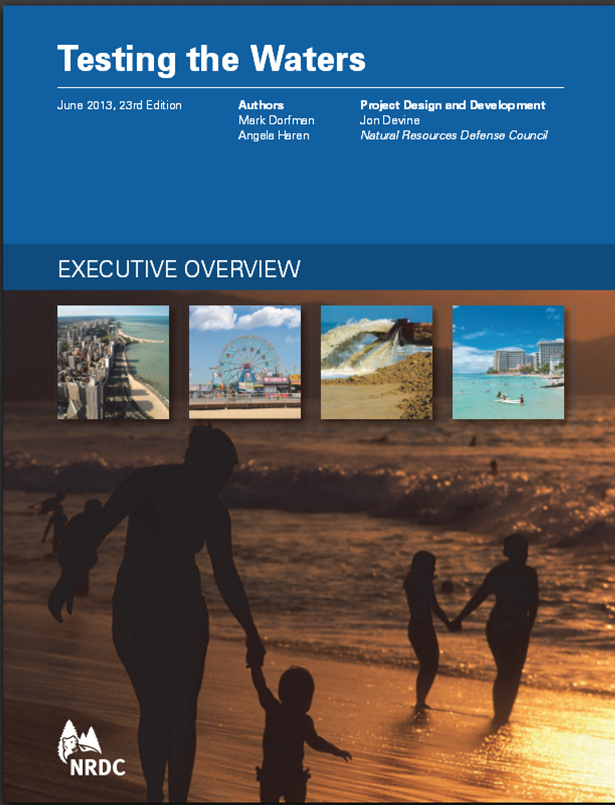
As the summer beach season moves into full swing, Save the Sound, a program of Connecticut Fund for the Environment, is calling attention to the number of days that Connecticut beaches had to be closed, or were under public advisories during 2012 due to environmental or related factors. The Natural Resources Defense Council’s (NRDC) annual “Testing the Waters” report, issued last week, found that Connecticut beaches were closed or under advisories for 198 days in 2012. That is down from 538 in 2011 but still more than twice the number of closings/advisories in 2010, 2009, or 2008.

The report analyzes beach closure and advisory statistics from beaches around the U.S.; Connecticut ranked 17th out of the 30 states listed.testing the waters

According to the NRDC report, 22 percent of Connecticut’s closing/advisory days last year were due to monitoring that revealed elevated bacteria levels and 29 percent were preemptive due to heavy rainfall, which can overwhelm outdated stormwater systems and wash untreated sewage into rivers and the Sound. The remaining days were preemptive due to wildlife.

The beaches with the worst records for exceeding the state's daily maximum bacterial standard were Pear Tree Point Beach in Fairfield County and Seabluff Beach in New Haven County, which tested above the maximum 28 percent of the time; Oak Street B Beach in New Haven County at 20 percent; and Fairfield County’s Calf Pasture Beach, Weed Beach, and Rowayton Beach, all at 19 percent.

“When it comes to clean water, being ‘middle-of-the-pack’ is not good enough,” said Leah Schmalz, director of legislative and legal affairs for Save the Sound. “One out of every ten American citizens lives within an hour’s drive of Long Island Sound, and they deserve clean, safe beaches—even one closing because of bacteria and pollution is too many.”

“Just an inch of rain in 24 hours causes many local health departments around the Sound to shut down beaches. Drought conditions may provide the perfect beach weather—no rain means no contamination from stormwater runoff—but we can’t rely on Mother Nature to do our pollution control for us. If we want to enjoy our coastline, eat local seafood, and promote tourism along the shore, rain or shine, we have to be proactive. That means stopping pollution at the source by upgrading our sewage treatment plants, separating the combined sewer overflows that dump almost two billion gallons of untreated sewage into our waterways each year, and investing in innovative stormwater runoff solutions like drain filters and green infrastructure.”DSC04553cropped

By comparison, the same NRDC report found that Westchester County in New York lost 112 beach days in 2012, and that New York State ranked 22nd out of 30 states, up from 24th in 2011.

Two Westchester County beaches had the first- and third-worst records in the state for the number of water samples that exceeded the state bacterial standard. Bacterial levels at Shore Acres Club in Mamaroneck tested above the standard fully 50 percent of the time, and Surf Club in New Rochelle exceeded 35 percent of the time. Overall, Westchester County beach samples exceeded the standard 14 percent of the time, making Westchester the fourth-worst tested county in New York. Bronx County, which also affects water quality in the western Sound, came in at number three.

Save the Sound issues weekly Sound Swim Alerts for Connecticut and Westchester County to inform residents when beaches are open for swimming and when they are closed. The alerts can be found on Save the Sound’s blog.

beach chart

Additional info on water pollution, contamination and depletion.

Connecticut Ranks #7 in Internet Connectivity Speed, National Data Shows

Connecticut ranks #7 in the nation in Internet connectivity speed, according to a report published by the website StateTech, which provides technology insights for leaders of state and local governments.  The report is based on data compiled by Akamai, a Massachusetts-based web services provider, which gathers data from 180 countries to publish a State of the Internet Report.  Akamai employed its EdgeScape geolocation tool to determine the top  U.S. states with the highest connection speeds.

In the recent report, the average connection speed increased in 43 states and the District of Columbia, during the third quarter of 2012, StateTech reports.  Fast bchartroadband is defined as speeds of 10 megabits per second (Mbps) or faster.  Although the average connection speed declined nearly 10 percent quarter-over-quarter, Delaware, at 10.9 Mbps, leads the way as the state with the highest average connection speed.

Rhode Island saw the smallest increase in connection speed, with 7.2 percent, while the District of Columbia saw the largest increase, with 50 percent. Connecticut, in placing seventh with a speed of 9.10 Mbps, came in just behind its New England neighbors of New Hampshire, Vermont, Rhode Island and Massachusetts, which finished #3 through #6.

Texas was #34, and the three states at the bottom of the list were Kentucky, Alabama and Arkansas, at less than half the speed of Connecticut.

The top 20 Internet speeds across the United States:

Rank

State

Mbps

1.

Delaware

10.88

2.

District of Columbia

10.75

3.

New Hampshire

10.41

4.

Vermont

10.38

5.

Rhode Island

9.13

6.

Massachusetts

9.12

7.

Connecticut

9.10

8.

Utah

9.07

9 .

Washington

8.51

10.

Virginia

8.44

11.

New York

8.25

12.

Pennsylvania

8.07

13.

Indiana

7.94

14.

Oregon

7.86

15.

New Jersey

7.79

16.

California

7.68

17.

Minnesota

7.48

18.

South Dakota

7.46

19.

Wisconsin

7.41

20.

North Carolina

7.41

Local Business Extends “Fostering Hope” Program Providing Backpacks for Foster Children

In honor of National Foster Care Month, locally owned and operated advertising specialty and marketing company The Perfect Promotion collected new duffle bags, backpacks and luggage to supply to children in foster care as part of the Fostering Hope Program that they launched in 2010.

Through donations made  by the community, factory suppliers and The Perfect Promotion, hundreds of bags have been donated since the initiative was launched, including more than 200 this year. The bags were donated in May to the Rocky Hill-based Connecticut Association of Foster and Adoptive Parents, Inc. (CAFAP) and were distributed statewide to children in the cfoster careare of the Connecticut Department of Children and Families (DCF).

According to the Connecticut DCF, as of February 2012, there were a total of 4,515 children in foster care.  The average age is 9-years-old.    The placement breakdown includes 1,953 children in direct foster care, 1,221 in congregate care, 996 in relative care, 131 in independent living and 30 in a trial home.

“When I first learned that children in foster care oftentimes use a trash bag to carry all of their worldly belongings when they move from placement to placement, I knew we had to do something,” said Jody Ferrer, president of The Perfect Promotion. “It is my goal that the Fostering Hope Program will provide every child in foster care in the State of Connecticut with a bag to call their own, and a dignified means to move their possessions.”

More information about foster care is available from the state Department of Children and Families in a pamphlet, “A New Beginning” which tells the stories of the impact of foster care on the children and their foster families.

In  an ABC Primetime report telecast in 2006, it was reported that “Children have on average three different foster care placements. Frequent moves in and out of the homes of strangers can be profoundly unsettling for children, and it is not uncommon to hear of children who have been in 20 or 30 different homes.”

All families providing foster care and pre-adoptive care for children in Connecticut are licensed or approved according to the regulations of the Connecticut DCF.  The first step is to attend an open house offered by one of 14 area offices around the state. At the open house, staff provide an overview of the agency’s mission, philosophy of foster care, and the liheartcensing process and requirements. To begin this process, or to learn more, call 1-888-KID-HERO or check the Open House Schedule.

The Perfect Promotion uses a consultative approach the focus is on the needs and goals of the client. Imprinted apparel and promotional products are used as tools to help businesses and nonprofits achieve their goals and maintain a positive, top-of-mind presence. For more information, visit www.theperfectpromotion.net.