Newman's Own Foundation Awards $1.5 Million in Grants to Military Service Organizations, Including 8 in Connecticut

In celebration of its 10th anniversary, Newman’s Own Foundation is awarding $1.5 million in grants to 29 organizations – including eight in Connecticut - that provide services to military men, women, veterans, and their families. Based in Westport, Newman’s Own Foundation’s awards will benefit more Connecticut nonprofit organizations than in any other state; more than one-quarter of the total number of organizations slated to receive funds. Paul Newman, the late actor and philanthropist, established Newman’s Own Foundation in 2005 to carry on his philanthropic legacy after he started Newman’s Own, the food company, in 1982 with all profits going to charity. Less well known is that Newman was a World War II veteran.  According to the organization’s website, he enlisted in the United States Navy after high school, serving in the Pacific during World War II.ownlogo
“One particular experience provided the core of his belief about luck and humility. In Saipan, the pilot of his crew became sick, grounding their bomber. The rest of Paul’s squadron was ordered to deploy aboard the USS Bunker Hill and days later were killed by kamikaze aircraft. It was simply luck that Paul had not been aboard. He attributed much of his success in life to luck, and what followed was a commitment to give back to those who were perhaps not so lucky,” the website explains.

The organizations receiving the grants provide a wide variety of support to veterans, including physical/mental rehabilitation, career development, entrepreneurship, education, and housing. There are also organizations that focus on female veterans.  The organizations and services are located across the country.

The Connecticut organizations are Applied Behavioral Rehabilitation Institute, Inc. (Bridgeport), Columbus House (New Haven), Connecticut Public Broadcasting Network (Hartford), Connecticut Veterans Legal Center (West Haven), Fidelco Guide Dog Foundation, Inc. (Bloomfield), Help Our Military Heroes, Inc. (Easton), Work Vessels for Veterans, Inc. (Noank), and Workplace, Inc. (Bridgeport).

“Our men and women in uniform make great sacrifices in their own lives to protect the unique freedom, privileges, and opportunities we enjoy as Americans. It is not so much a responsibility to support them, but more a privilege to express our gratitude for their service,” said Robert Forrester, President and CEO of Newman’s Own Foundation, who served in Vietnam as an Army officer.  “We’re proud to fund these organizations that provide services for military personnel, veterans, and their families.”military

Military nonprofit organizations have been supported for over 20 years, with a total of $12 million donated since 2010, alone. In addition to the Foundation grants, Newman’s Own, Inc. has supported military service charities through the Newman’s Own Awards for 16 years, in partnership with Fisher House Foundation and Military Times.

Since the Foundation was founded, more than $280 million has been donated to charitable organizations around the world. The grants reached across international borders and countless organizations that addressed needs such as serious illness, hunger, homelessness, disaster relief, environmental issues, and education. Today the Foundation has four primary focus areas: Philanthropy, Children with Life Limiting Conditions, Empowerment, and Nutrition.   More information is available at: http://newmansownfoundation.org/military
Income Inequality in CT's 4th Congressional District is 4th Largest Gap in Nation; 2nd District Has Least Income Inequality in State

Connecticut’s 4th Congressional district, centered in Fairfield Country, has been ranked as the district with the 4th highest level income inequity in the nation.  A year ago, the 4th C.D. was ranked fifth. A ranking of congressional districts of by their level of income inequality, conducted by Bloomberg, uses the Gini coefficient, a formula that measures the distribution of income across a population. The closer a Gini number is to 1, the greater the level of inequality; the closer to zero, the closer to perfect equality. The average score for the United States was 0.4804.

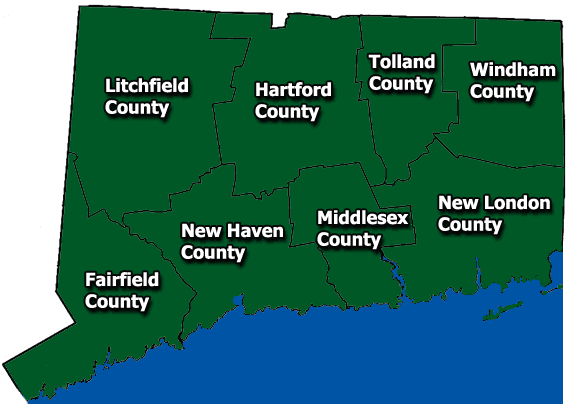
All of Connecticut’s ctcountiesCongressional Districts, with the exception of the Fourth District, did better than the national average in the degree of income inequality.

Bloomberg Businessweek has previously pointed out that the U.S. congressional districts with the most inequality share certain traits: “they contain a small, enormously wealthy elite surrounded by impoverished neighbors.” Most of the districts with the greatest disparity are located in or near major urban metropolitan areas.

The greatest income inequality in the most recent analysis indicated that the Congressional Districts with the most income inequality are Pennsylvania’s 2nd District, New York’s 10th District, and Florida’s 27th District.  Following Connecticut’s 4th District on the list are Illinois; 7th District, and three additional Congressional Districts in New York – the 12th, 7th and 16th.  Rounding out the 10 C.D.’s with the most income inequality are Ohio’s 11th District and Georgia’s 5th District.inequality

In Connecticut’s 4th Congressional District, which includes Bridgeport, the state’s largest city, as well as the communities often referred to as the “Gold Coast,” 59.3 percent of the population has household income in the highest quintile, while 6.7 percent of households have income below the poverty level.

Connecticut’s 5th Congressional District (.4810) ranked number 88 on the list of Congressional Districts with the most income inequality among residents.  The state’s 3rd Congressional District (.4792) ranked at number 95, and the 1st C.D. (.4631) at number 175.  Much later in the rankings, Connecticut’s 2nd District (.4261) came in at number 387, indicating it is the C.D. in Connecticut with the least income inequality.

The Gini coefficient, which is calculated by the U.S. Census from household income share by quintiles, was used to measure distribution of wealth. It ranges from zero, which reflects absolute equality, to one, complete inequality. The data was updated in November 2015, using 2014 data.  In 2014, a person living alone making less than $12,071 was classified as in poverty. The threshold increases for each additional household member and varies by the number of adults and children in each household.


CT Start-Up Wins MassChallenge, Takes Home $300,000 to Advance Work in Glucose Monitoring

Connecticut-based Biorasis, with roots at UConn, was recently awarded the MassChallenge’s top prize at their annual awards ceremony in Boston.  The company was one of only four “Diamond Winners,” receiving a cash prize of $100,000. They were also one of two teams to receive the Sidecar Award, providing an additional $200,000 in non-dilutive funding. Biorasis Inc. is a rapidly growing medical device company committed to advancing the field of metabolic monitoring through development of implantable biosensor platforms and basic research in the areas of drug delivery, nanotechnology and microelectronics.  The company’s goal is to vastly improve the quality of life of diabetics.biorasis-inc-logo

The technology developed by Biorasis, the Glucowizzard™, is an ultra-small implantable biosensor for continuous, reliable glucose monitoring. This needle-implantable device wirelessly transmits glucose levels to a watch-like unit for real-time display, which in turn communicates with personal digital accessories like a smartphone. Continuous metabolic monitoring “holds great potential to provide an early indication of various body disorders and diseases,” the company website explains, adding that Biorasis’ implantable multi-sensor platform is “capable of such real-time, continuous monitoring.”MC

Biorasis is in the business of developing a miniaturized, hypodermic-injectable biosensor for reliable continuous glucose monitoring (CGM) with autonomous operation for 3-6 months that requires no user intervention.

Their solution “eliminates surgery for sensor implantation and extraction, restores active life style, enables remote care for juveniles and the elderly, enhances compliance, and saves 50-70% in annual healthcare costs.”

The company’s co-founders and scientific advisors are:

  • Faquir Jaina, a Professor of Electrical & Computer Engineering at the University of Connecticut. He has over 35 years of experience in design, modeling and fabrication of micro/opto-electronic devices, integrated circuits and multiple quantum-well light valves/modulators.
  • Fotios Papadimitrakopoulos, a Professor of Chemistry and Associate Director of the Institute of Materials Science at University of Connecticut. He has over 20 years of experience in the areas of polymers, nano/bio-systems and supramolecular assembly of nanostructures.

The company continues to grow, and their scientific team is currently expanding. The Biorasis website indicates that the company is seeking individuals with “a proven track record and experience in the areas of medical devices, electrochemistry, polymer science, pharmaceutics, animal studies, microelectronics and device packaging.” Inquiries can be directed to Biorasis at the UCONN Technology Incubation Program in Storrs.  Additional investors are also being sought.

mass challengeMassChallenge, an independent nonprofit organization, envisions “a creative and inspired society in which everyone recognizes that they can define their future, and is empowered to maximize their impact.” They note that “novice entrepreneurs require advice, resources and funding to bring their ideas to fruition. Currently there is a gap between the resources these entrepreneurs need and the ability of the entrepreneurial ecosystem to provide them.” To bridge that gap, the organization’s primary activities include running an annual global accelerator program and startup competition, documenting and organizing key resources, and organizing training and networking events.  They “connect entrepreneurs with the resources they need to launch and succeed immediately.”

 

CT is a Top-10 State in Energy Efficiency, Recent Growth of Solar Power Capacity

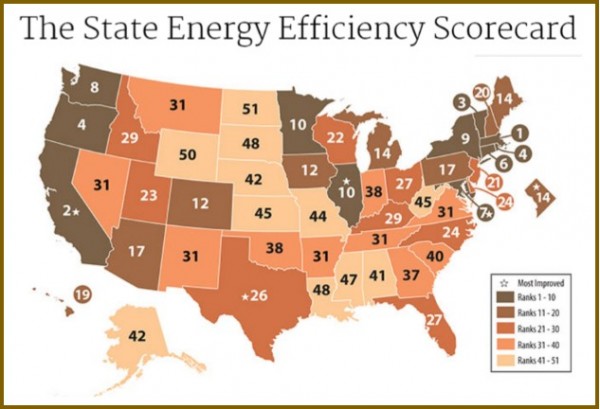
An annual ranking from the American Council for an Energy-Efficient Economy (ACEEE) rated Connecticut among the top ten energy-efficient states in the country along with Massachusetts, California, Vermont, Rhode Island, Oregon, Maryland, Washington, and New York, with Minnesota and Illinois tied for 10th place. Connecticut was noted for its financial incentives and energy efficiency investments. The state  ranked 6th in the 2015 State Energy Efficiency Scorecard, the same position it held in 2014. The state also earned the same number of points as it did in 2014, totaling 35.5 points out of 50.logo

According to the report, “Connecticut’s leadership is committed to pursuing policies that encourage energy efficiency within the state, although processes like building code adoption have moved relatively slowly in recent years. Connecticut has put significant resources behind the launching of its green bank. While there are signs of early success, these projects will need to be closely tracked as other states look to Connecticut as an example. Connecticut will need to realize even higher levels of savings in the future in order to remain in the top tier and meet state energy savings targets.”

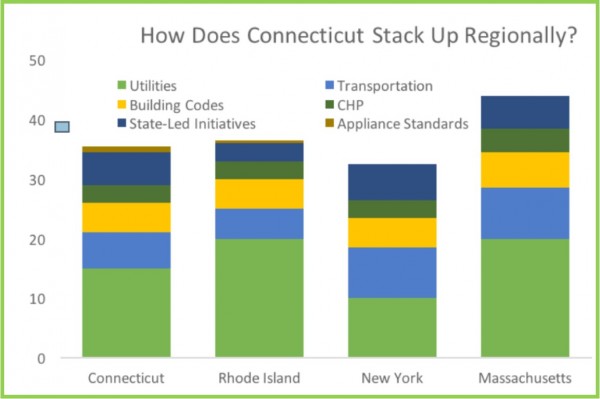
Connecticut earned 15 out of 20 points for its utility policies and programs, 6 points out of a possible 10 points for transportation policies, 5 points out of 7 for its building energy code stringency aenergy efficiencynd compliance efforts, earned 3 points out of 4 for its combined heat and power policies and programs, 5.5 out of 7 points for state-led energy efficiency initiatives, and 1 point out of 2 for appliance standards.
At the bottom of the list were Mississippi, South Dakota, Louisiana, Wyoming and North Dakota.

The ACEEE also developed a similar rating system for the nation’s largest cities, ranking the top 50.  Leading the list were Boston, New York City, Washington, San Francisco, Seattle, Chicago, Minneapolis, Portland, Austin and Denver.  The only Connecticut city to crack the top 50, Hartford, ranked at number 45.  Connecticut’s Capitol City earned 23 points out of a possible 100, in an analysis that included local government operations, community-wide initiatives, building policies, energy & water utilities, and transportation.

The report noted that “policymakers, regulators, and citizens are increasingly recognizing that energy efficiency is a crucially important resource. States and localities are leading the way when it comes to implementing energy-efficient policies and programs.”

The American Council for an Energy-Efficient Economy (ACEEE), a nonprofit, 501(c)(3) organization, acts as a catalyst to advance energy efficiency policies, programs, technologies, investments, and behaviors. The organization believes that “the United States can harness the full potential of energy efficiency to achieve greater economic prosperity, energy security, and environmental protection for all its people.”

Another  recent study, “Lighting the Way III: The Top States that Helped Drive America’s Solar Energy Boom in 2014,” by the research and policy arm of Environment Connecticut finds Connecticut ranks 10th nationally for solar power capacity per capita installed in 2014, with 13 watts of solar electric capacity per person installed last year. Nevada led all of the states in 2014, with 119 watts per capita, according to the study. Part of this success is credited to supportive state policymaking.  The organization points out that “solar power has tripled in the U.S. in the last two years, with another American family or business going solar every four minutes.  That’s in part because the price of solar has dropped more than 50 percent since 2011.”

They add that “research shows the cities and states with the most solar power aren’t necessarily the ones with the most sunshine; they also include states with smart pro-solar policies.  States like Connecticut have outpaced sunnier locales like Florida because of policies that allow increasing numbers of homeowners, businesses, communities and utilities to go solar.”

regionallyolar power in Connecticut has grown 221 percent per Capita since 2012, ranking the state 13th in the nation, the report points out. The top solar growth states in the nation, like Connecticut, have adopted renewable energy requirements, strong laws allowing solar customers to sell their excess power to the electric grid, and other policies encouraging growth of the industry, the report indicates.  The industry is also adding jobs much faster than the overall economy, employing 1,600 people in Connecticut last year, according to www.solarstates.org
“Demand for solar power in Connecticut is growing exponentially,” said Bryan Garcia, President and CEO of the Connecticut Green Bank. “Consumers continue to demand solar power despite a 70 percent reduction in state incentives. In fact, increased private investment has enabled the market to offer lease and loan products that deliver immediate positive cash flow to consumers. This makes solar PV a cleaner, cheaper and more reliable alternativeCTE_logo_notag_1."

Bipartisan legislation signed by Governor Malloy earlier this year lays a foundation for continued growth of solar power, and jobs, in Connecticut, Environment Connecticut points out, citing the stated goal of building enough residential solar systems to power over 40,000 homes in the state by 2022.

PERSPECTIVE: Here Today and Gone by January, 2030

by Peter Eder In our unending and ever accelerating pace of societal change, it might be productive to reflect on what will not be here in fifteen short years.  Looking into our crystal balls might just help us prepare to cope with changing aspects of our society.  Here are some observations.

“Full time employees” will be as extinct as “telephone switchboard operators”, and the Social Contract, no longer applying to employee / employer relationships, will only be found in the writings of Rousseau.

PageLines- CTperspective.jpgUnited States currency will have value only to Numismatists, as a global currency replacing dollars, yuans, reals and rupees will be in increasingly electronic usage.  And that currency will be paperless and coinless.  In a visit to China last year, it was somewhat surprising to discover that in Beijing, coins are no longer used.  All expenses are rounded up or down to the nearest paper yuan.

Un-earmarked charitable donations will have been replaced by the omnipresent cause-related giving permeated as a marketing and public relations strategy, and as the wealthy lay claim to their own branded intent to stamp jan 3 quoteout specific illnesses or perceived social injustices.
Genders will be non-existent in civil law, in fashion, fragrance ... and everyday life.  Labels like Mr., Mrs., and Ms. are already being replaced by Mx.

Individual privacy will have disappeared caused by individual indifference, data clouds, drones, face recognition and surveillance-everywhere cameras, and corporate and governmental manipulations of regulations.

Public place quiet will have also disappeared, thanks to ubiquitous and intrusive electronic gadgets, visual and audio advertising everywhere, and ego driven social manners.

A balkanized internet will have replaced the World Wide Web, as the war over ownership and manipulation of all forms of communications becomes an attractive replacement, or at least a supplement to, “conventional” warfare.

Brick and mortar general public libraries will have gone the way of most houses of worship, as we move into the Paper-less Books and Godless Society. The Divine Being worship vacuum will be partially filled by zealots preaching over electronic outlets.  A substantial number of church structures will be converted into museums, or studio sets for those wishing “traditional” marriage photos.

What is in your crystal ball?

____________________________________

Peter F. Eder is a retired marketing executive, AARP Connecticut community volunteer and a founding board member of At Home In Darien, his community aging-in-place organization.  Throughout his career, he has been involved with local and national organizations within the communications arena and in responding to acute needs of people in our communities.

PERSPECTIVE commentaries by contributing writers from across the state appear each Sunday on Connecticut by the Numbers.


Hartford Radio Ratings Reflect Dominance of FM Stations

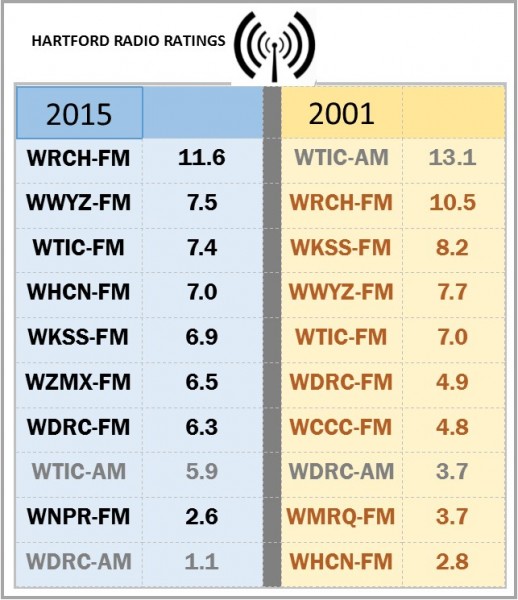
The most recent radio ratings in the Hartford market confirm the dominance of FM radio and the continued long slide of AM radio and audience levels overall.  The top seven most listened-to stations in the market are FM, led by perennial ratings leader WRCH-FM, a CBS Radio owned Adult Contemporary format station, with an 11.6 rating. Tightly bunched behind WRCH-FM are WWYZ-FM (country music), with a rating of 7.5, WTIC-FM (hot adult contemporary) at 7.4, WHCN-FM (classic hits) at 7.0 and WKSS-FM (contemporary hits) at 6.9. on air

Rounding out the top eight are WZMX-FM at 6.5, WDRC-FM at 6.3, and WTIC-AM at 5.9.

Then the ratings drop down to WNPR-FM at 2.6, WDRC-AM at 1.1, WFCR-FM (based in Amherst, MA) at 0.9 and WPOP-AM at 0.1.  WPOP recently switched to a news/talk format, and plans to broadcast Hartford Yard Goats minor league baseball games.  WDRC-FM switched to a Classic Rock format, similar to the music that played a decade ago on WCCC and WHCN.

The ratings profile, covering listening habits in November 2015, contains an quarter hour share (AQH) rating -- the average number of persons, ages 6+, who listened during any average quarter hour from 6am to midnight, Monday through Sunday in the Survey Area, Metropolitan Hartford.radio ratings

Fifteen years ago, before smart phones, internet radio, satellite radio and a limitless supply of alternate listening options, the numbers were higher across the board, and AM radio – in the case of WTIC – was often at the top of the list, or not far behind.

Here’s what the ratings looked like in April 2001:

WTIC-AM1080 was the most-listened-to radio station in the Hartford market, posting a 13.1 share in the winter rating period, up from the 10.3 it logged in the fall ratings.  WRCH fell from 11.8 to 10.5 to finish second. WKSS-FM also suffered a ratings drop, as reported at the time by the Journal Inquirer. The station racked up an 8.2 rating, down from the 9.7 it chalked up during the fall ratings period.

WWYZ-FM advanced from a 6.6 to a 7.7 to finish fourth overall.  WTIC-FM enjoyed a slight improvement, advancing from 6.8 to 7.0.  Rounding out the Top 10 were WDRC-FM (4.9), WCCC-FM (4.8), WDRC-AM (3.7), WMRQ-FM (3.) and WHCN-FM (3.1, up from 2.8).

Finishing 11th was WZMX-FM, which slid from a 3.1 in the fall to a 2.7 in the winter. WAQY-FM (West Springfield,MA), , finished 12th with a 1.9 rating.  The area's all-sports station, WPOP-AM1410, was far back in the pack with a 0.7 share.

Among the morning programs, in overall ratings, WTIC's Ray Dunaway and Diane Smith attained a 17.2 rating. WRCH was second with an 8.8 share. WTIC-FM was third with an 8.4 share, followed by WWYZ and WKSS. WCCC-FM gained a half-point to finish sixth with a 6.4 share.WRCH1

A new station took high honors among the 25-54 demographic among morning shows. WTIC-FM and host Gary Craig posted an 11.3 to grab the No. 1 spot.  WTIC-AM was second with a 10.4 rating.  WRCH was third, followed by WCCC.howard stern

In the 18-34 age bracket, WKSS was No. 1, WCCC was second overall in the young demographic. In morning shows, WCCC and Howard Stern continued in the No. 1 position. WCCC grabbed a 15.6 share in the morning, WKSS was second, at 12.8.  WMRQ and its morning host, former Twisted Sister lead singer Dee Snider, attained a 10.7 rating.

Courant Community Replaces Reminder News in Eastern, Northern Connecticut

Nearly two years ago, the Hartford Courant purchased Reminder Media Inc., long-time publisher of 15 free weekly Reminder News publications distributed in eastern and northern Connecticut. The 15 Reminder News weeklies were in Colchester, East Hartford, Enfield, Glastonbury, Hebron/Columbia, Jewett City, Killingly/Plainfield, Manchester, Putnam, South Windsor, Stafford, Vernon, Windham/Mansfield, Windsor and Windsor Locks.  Soon-to-depart publisher Nancy Meyer said at the time that the purchase “reinforces our commitment to reporting and delivering local news in Connecticut."courant community cover

Now those publications have a new look and a new name.  Beginning with the Thanksgiving week issue, the publication was redesigned and renamed “Courant Community.”  The tagline “powered by Reminder News” remains on the front page.  Existing “Courant Extra” publications in Manchester and Enfield have been “consolidated” into the new-look publications.

In a message to readers, Courant Publisher Richard J. Daniels explained the “major makeover” as key to The Hartford Courant Media Group’s “print and digital operations designed to deliver more local news to readers.”  The “sweeping redesign” of the Reminder News and Courant Extra weeklies will offer “enhanced coverage of local business, dining and entertainment, real estate, community events and more.”

The redesign doesn’t stop there.  “The makeover has extended to the Courant’s digital universe as well,” Daniels points out, “with redesigned community-based pages online (at courant.com/community)” and “more opportunities for reader interaction.”courant community

Courant Community Group Editor is Bonnie Phillips; Deputy Editor is Erin Quinlan.  Offices are based in Manchester.

On the website of The Hartford Courant, news articles submitted by readers now are categorized under the Courant Community moniker.  An interactive map, on which readers can select their town and be guided to local news, also seeks contributions ranging from birthdays and engagements to local news and events.

The list of Hartford Courant Media Group entries now includes the Courant, CTNow (which previously subsumed the Hartford Advocate), Hartford magazine (previously purchased from an independent company), New Haven Living, Courant Community and ValuMail.

Two Connecticut Librarians Receive National Public Service Recognition

Ten librarians from around the country – including two from Connecticut, in New Haven and Groton - were honored this month with this year’s I Love My Librarian Award for their exceptional public service to the community and ongoing commitment to transforming lives through education and lifelong learning. The winning librarians were selected from a pool of more than 1,300 nominations submitted by library patrons nationwide who use public, school, college, community college or university libraries. The nominations detailed stories about how their favorite librarians helped improve the quality of life in their communities. The last time Connecticut had a winner was in 2012.  There were two winners from the state in 2012 and in 2011.ilml2015-250-400_0

The nation’s more than 166,000 certified librarians “continue to play a vital role in assisting and inspiring all who seek information and access to technologies,” according to officials. “The I Love My Librarian Award winners are living examples of how library professionals are expanding beyond their traditional functions and providing more opportunities for community engagement and delivering new services that connect closely with patrons’ needs.”

The Connecticut recipients of the national recognition are:

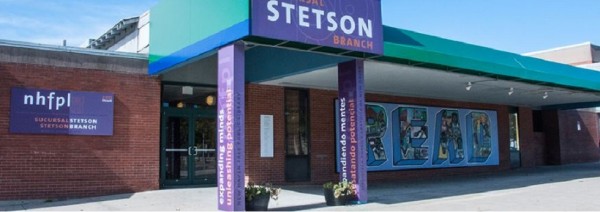
brown-dianeDiane Brown is branch manager of the New Haven Free Public Library’s Stetson Branch. Known as the “urban librarian” to her patrons, Brown develops valuable programs and services to meet the needs of the underserved residents in a community with high rates of poverty, crime and low literacy levels.  Under Brown’s leadership, the library has been transformed into a true community center. She brings residents together by hosting cultural and educational events such as an international “pop up” festival, art exhibits, lectures and health fairs, according to officials.  She has been praised for facilitating an afterschool tutoring program for K-8 students and providing opportunities for children and their families to spend time together by establishing history and game nights.
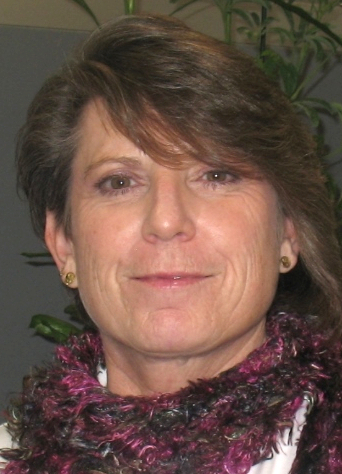
“It is gratifying to have the I Love My Librarian Award bring much deserved recognition to librarians. As libraries transform so do librarians to support individual opportunity and community progress,” said Sari Feldman, president of the American Library Association. “Every day librarians connect library users with the books, information and critical technology resources they need to thrive in the digital age.”

Each winning librarian will receive a $5,000 prize at an award ceremony and reception held in New York City, hosted by the philanthropic foundation Carnegie Corporation of New York, which sponsors the award. The New York Public Library and The New York Times are co-sponsors of the award, which is administered by the American Library Association.

rumery-e-2Elizabeth G. Rumery, library director for the Avery Point Campus Library at the University of Connecticut in Groton, has “transformed the library into a welcoming and dynamic place for students by modernizing the facility to meet the needs of 21st century learners.”  Officials indicate that she worked with contractors and school administrators on renovating the library, with improvements including new media rooms and collaborative study spaces for students and faculty.
Rumery has also expanded services to create a safe haven for students, establishing a place in the library where anyone can talk with her about concerns related to GLBTQ, depression or other personal issues. She finds the appropriate help and resources they may need. She also serves as an advisor for the student gay/straight ALLIANCE club at the campus.

The other recipients in 2015 are librarians in Texas, California, Alaska, North Carolina, Missouri, Alabama and Mississippi.  In addition to Connecticut, there were two recipients from Texas.

The award recipients include a librarian who fought censorship when residents attempted to ban and remove books from the shelves, a librarian who works with incarcerated youth at a school within a juvenile hall, a librarian who fostered a deeper understanding of the Muslim world by facilitating a campus exhibit and lecture and a librarian whose efforts helped raise student reading scores significantly at an underserved elementary school.

Stetsonver22013The librarians join “an esteemed group of award recipients who are recognized as being catalysts for powerful individual and community change.” Only 80 librarians have received the national award since its inception in 2008, including six from Connecticut.  In 2012, the recipients were Rachel Hyland, Tunxis Community College Library in Farmington, and Rae Anne Locke, Saugatuck Elementary "Secret Garden" Library in Westport. The 2011 winners included Jennifer O. Keohane, The Simsbury Public Library and Michelle Luhtala, New Canaan High School Library.

For more information regarding the 2015 I Love My Librarian Award recipients, go to www.ilovelibraries.org/ilovemylibrarian

Laurencin’s International Accolades and Research Objectives Grow, Earns National Medal of Technology and Innovation

In mid-2011, it was announced that after three years at the helm, Dr. Cato T. Laurencin would step down as vice president for health affairs and dean of the University of Connecticut School of Medicine on July 1 of that year. Laurencin, it was said, would continue conducting research, mentoring and providing clinical care. In the four and a half years since, it would seem that stepping down was the best thing that could ever have happened for Laurencin, and UConn.

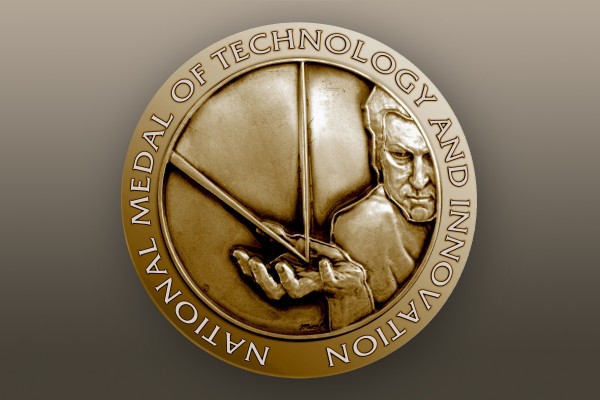
It was announced last week by the White House that Laurencin will receive the National Medal of Technology and Innovation from President Barack Obama next year.  The award is the nation's highest honor for technological achievement that is bestowed by the president on America's leading innovators.

LaurencinThe news came just weeks after it was announced that Laurencin is the recipient of the 2016 Founders Award, the highest honor of The Society For Biomaterials.  He will be honored at the 2016 World Biomaterials Congress in Montreal, Canada on May 18, 2016.
Laurencin is a world-renowned surgeon-scientist in orthopaedic surgery, engineering, and materials science, and is known as a pioneer of the field of regenerative engineering, UConn said in announcing the award. He has made fundamental contributions in polymeric materials science and engineering, and nanotechnology. His research successes have included the growth and regeneration of bone, ligaments and other musculoskeletal tissues.

In November, UConn announced the launch of a new grand research challenge: regeneration of a human knee within seven years, and an entire limb within 15 years.  This major international research undertaking, called The HEAL Project, stands for Hartford Engineering A Limb. It is the brainchild of Cato T. Laurencin, whose laboratory research successes include the growth of bone and knee ligaments.

For the project, Laurencin is teaming with other top tissue engineering, regenerative medicine, and bioengineering experts dedicated to the mission of advancing the fields and developing future therapies for patients living with musculoskeletal defects or who have limb injury or loss. HEAL’s other research investigators include Professors Lakshmi Nair and Yusuf Khan of UConn, Professor David M. Gardiner of UC Irvine, professors at Harvard University, Columbia University, and Sastra University in India.Medal

Earlier this fall, Laurencin was elected a Foreign Fellow of the National Academy of Sciences in India. He is one of only two 2015 Foreign Fellows elected, and the first from the University of Connecticut and UConn Health Center.  Laurencin was honored by India’s National Academy of Sciences “for his pioneering work in the field of material sciences.” He was recognized as a world leader in polymer-ceramic composites, and recognized for his contributions in tissue generation and bioengineering.

He was also one of select group of research scientists from around the world to be named this year to be a foreign member of the Chinese Academy of Engineering (CAE), one of the most prestigious academic institutions in China.  He was named among a group of foreign members that include five Americans, one Briton, one Canadian and one Austrian, bringing CAE's foreign members to 49.

Laurencin is a professor of chemical and biomolecular engineering; professor of materials science and engineering; and professor of biomedical engineering at UConn.  He is also the chief executive officer of the Connecticut Institute for Clinical and Translational Science (CICATS), UConn's cross-university translational science institute.

At UConn Health, he is director of the Institute for Regenerative Engineering; the Albert and Wilda Van Dusen Distinguished Professor of Orthopaedic Surgery; and director of The Raymond and Beverly Sackler Center for Biomedical, Biological, Physical, and Engineering Sciences.

Laurencin previously received the Presidential Faculty Fellow Award from President Bill Clinton for his work bridging engineering and medicine, and the Presidential Award for Excellence in Science, Math, and Engineering Mentoring from President Obama.

“Science and technology are fundamental to solving some of our Nation’s biggest challenges,” President Obama said. “The knowledge produced by these Americans today will carry our country’s legacy of innovation forward and continue to help countless others around the world. Their work is a testament to American ingenuity.”  Established by the Stevenson-Wydler Technology Innovation Act of 1980, the medal was first awarded in 1985.

Joel D. Bumgardner, chair of the Awards Committee of The Society For Biomaterials said, “Dr. Cato Laurencin has become a world leader in nanomaterials, and tissue engineering, working across the spectrum from establishing basic science and biomaterial properties to translating discoveries into clinical practice. Also, his work has led to the development of a new area called regenerative engineering. This emerging area builds on and synergizes principles in biomaterials engineering and stem cell/developmental biology to formulate new paradigms for effective repair/regeneration of diseased/damaged tissues.

Bumgardner also noted Laurencin’s mentorship of young faculty and students – “a legacy that will have a significant and long-ranging impact in the broad biomaterials community.”

$100,000 Grant to Nonprofit Collaborative Efforts to Assist Immigrants in Connecticut

George Soros has been a prominent international supporter of democratic ideals and causes for more than 30 years. His philanthropic organization, the Open Society Foundations, supports democracy and human rights in more than 100 countries. Now, the Open Society Foundation’s Emma Lazarus II Fund has officially granted $100,000 to The Community Foundation for Greater New Haven (CFGNH) on behalf of the Immigrant Strategic Funders Collaborative for Connecticut (The Collaborative) for the period that began on November 1, 2015 and continues through December 31, 2016.Open Society Foundation Logo

The Collaborative aims to provide matching funds to enhance statewide efforts and local work supporting Connecticut’s immigrant families.

The Collaborative seeks to increase the numbers of applicants for administrative relief under these programs, to ensure the applicants are screened for eligibility for more permanent immigration benefits and to continue to expand current advocacy work in support of stronger protections from detention, deportation and abuse.immigrant

The grant comes as the organization prepares to move forward with implementation of both Deferred Action for Parental Accountability (DAPA) and the expansion of Deferred Action for Childhood Arrivals (DACA), under President Obama’s 2014 Executive Actions.  Officials indicate that to achieve their objectives, The Collaborative will prioritize the following:

  • Increasing access for undocumented immigrants to a full spectrum of immigration services, including legal services;
  • Promoting the understanding of DACA and DAPA and to support outreach to DACA-eligible and DAPA-eligible residents across Connecticut;
  • Strengthening advocacy efforts at the local and State levels in support of public policy and public funding that will address the needs of undocumented immigrants and will advance the utilization of DACA and DAPA; and
  • Enhancing the capacity of immigrant serving and advocacy nonprofit organizations through funding and through supporting the sharing of knowledge and best practices.

community-foundation-560x302Thus far, eight leading funding institutions in Connecticut have expressed their intentions to commit financial contributions in support of the Collaborative goals utilizing their institutional grant-making process.  Those organizations include Fairfield County’s Community Foundation, Hartford Foundation for Public Giving, Hispanic Federation, Perrin Family Foundation, Progreso Latino Fund (a committee-advised fund at CFGNH), Tariq Farid Foundation and The Community Foundation for Greater New Haven.

Officials say that the success of The Collaborative will depend largely on the partnerships it can build with service providers, advocacy organizations and others throughout the State of Connecticut that share the goal of enhancing the lives of undocumented immigrants. The Collaborative is working with a growing list of organizations, with further additions anticipated.  Among those thus far:

  • Apostle Immigration Services (New Haven)
  • Center for Latino Progress (Hartford)
  • City of New Haven
  • City of Hamden
  • Congregations Organized for a New Connecticut (New Haven and Bridgeport)
  • Connecticut Parent Power (Statewide)
  • Connecticut Students for a Dream (Statewide)
  • Elm City Internationals (New Haven)
  • Hartford Public Library (Hartford)
  • International Institute of Connecticut (Statewide)
  • Junta for Progressive Action (New Haven)
  • Neighbors Link Stamford (Stamford)
  • New Haven Legal Assistance Association (New Haven)
  • Unidad Latina en Acción (New Haven)
  • Yale Law School Worker and Immigrant Rights Clinic (New Haven)