Health Risks of Flame-Retardant Chemicals Require Policy Changes in CT, Nation, Report Says

The 2014 session of the Connecticut General Assembly is expected to include consideration of legislation designed to protect the public from potential health risks of flame retardant chemicals that are present in many consumer products.  Such a proposal, currently being developed, comes following a report from North Haven-based Environment and Human Health Inc. (EHHI), an organization of physicians and public health professionals, that calls on state and federal governments to institute new policies to protect the public from flame-retardant exposures that the researchers say “pose health risks to fetuses, infants, children and the human population as a whole.”

The comprehensive 107-page report, “Flame Retardants: The Case for Policy Change,” closely examines the health risks that flame-retardants pose to the general population and recommends sweeping policy changes to protect the public.

"It has become clear that flame-retardants are proving to be a health risk to both the human population and the environment,” said Nancy Aldermaflame reportn, president of Environment and Human health, Inc. “It is time for flame-retardants to be removed from all low fire-risk situations and products. As well, a certification program should be established where manufacturers certify the absence of flame-retardants, just as organic food programs certify the absence of pesticides.”
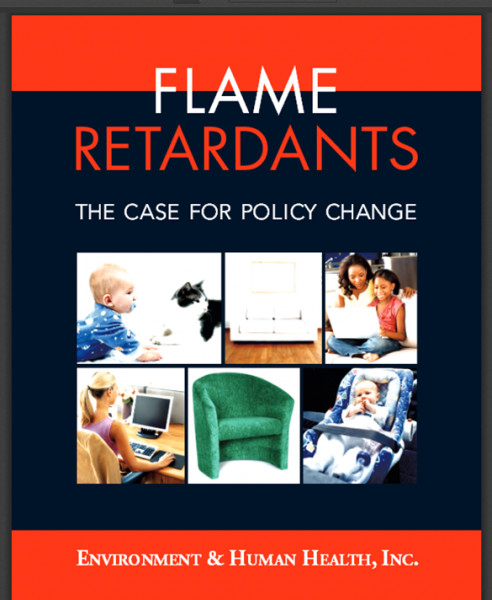
The report examines the history of flame-retardants and demonstrates the enormous scope of the problem, noting that flame-retardants “are now ubiquitous in our environment.”  The history of flame-retardant use in the United States is a story of substituting one dangerous flame-retardant for another, the report outlines. The country lived through decades when asbestos was used as a fire-retardant. Then when asbestos was proven too dangerous to be used, the country moved over to PCBs, and five decades later, when PCBs were deemed too dangerous for use, the country moved on to chlorinated and brominated flame-retardants.

The report points out that “the labeling of flame-retardant chemicals in consumer products is NOT required by Congress, EPA, FDA or the Consumer Product Safety Commission.  It is therefore impossible for consumers to avoid flame-retardants in their purchases.”  Sources of exposure cited in the report include carpets, mattresses, children’s and baby products, furniture, and electronics.  falame retardant
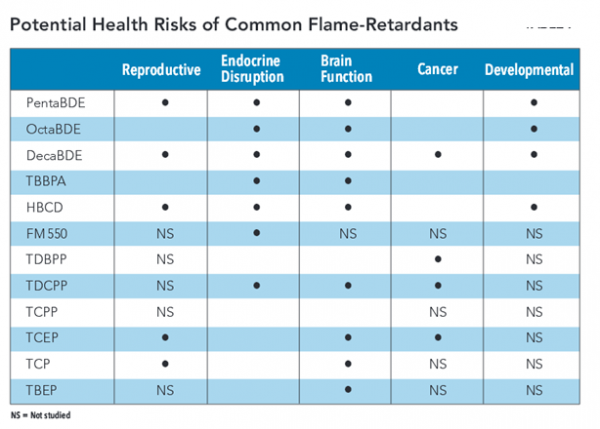
In the 1970s, a flame-retardant called "Tris" was added to children's sleepwear. Tris was later found not only to be carcinogenic but also capable of being absorbed through the skin. Tris was finally banned in children's sleepwear in 1977, according to the report.  Tris is still used in many other infant products, such as crib mattresses, changing tables, nap mats, and infant car seats, the report indicated.

"Tris was, and remains, carcinogenic," said Dr. D. Barry Boyd, oncologist at Greenwich Hospital and Affiliate Member of the Yale Cancer Center.  There is ample evidence concerning the health risks from Tris to conclude that it should be removed from all infant products."

John Wargo, Ph.D., first author of the report and the Tweedy-Ordway Professor of Environmental Health and Political Science at Yale University, said, "Flame-retardants are not required to undergo health and environmental testing, and they are not required to be labeled on the products that contain them. Because exposures to flame-retardants carry health risks, they should only be used when the risk of fire outweighs the risk from flame-retardant exposures. When risk from fire is high, such as in airplanes, then the use of flame-retardants is warranted; when the risk from fire is low, flame-retardants should not be used."

Recent toxicological studies demonstrate that flame-retardants pose the greatest risk to the normal growth and development of fetuses, infants and children. "Manufacturers should start labeling their products so that consumers can understand when flame-retardants have been added," said Dr. Andrea Asnes, associate professor of pediatrics at the Yale School of Medicine.

Environment and Human Health, Inc. (EHHI) is a non-profit organization composed of physicians, public health professionals and policy experts, dedicated to protectinEHHIg human health from environmental harms. EHHI does not receive any funds from businesses or corporations.   The organization’s mission is “to conduct research to identify environmental harms affecting human populations, promote public education concerning the relationships between the environment and human health, and promote policies in all sectors that ensure the protection of human and environmental health with fairness and timeliness.

By promoting effective communication of environmental health risks to those exposed and to responsible public and private officials, EHHI hopes to empower individuals and groups to take control over the quality of their environment and be more protective of themselves and their families.  The report was issued in November 2013.  Among the recommendations :

  • States should pass laws that protect their citizens from flame-retardant exposures.  Industry will always work to pre-empt states’ legal authority to set safety standards that are more stringent than those adopted by the federal government. States should have the right to protect their citizens when the federal government fails to do so.
  • States should restrict flame-retardants in infant and toddler products.  Recent toxicological studies show that flame-retardants pose the greatest risk to the normal growth and development of fetuses, infants and children. Infants and small children’s body weight is so low that their exposures to flame retardants, in relation to their body weight, is simply too great. The health risks that all infants and children are experiencing, due to the federal law mandating that flame retardants be in many of their products, far outweigh the risk of fire.
  • States should require that products containing flame-retardants be labeled.  Any product containing a flame-retardant should be labeled as such. Labels should include which flame-retardant has been used.
  • States should promote fire-prevention programs.  States should invigorate their fire prevention programs. Promotion of fire prevention is the most effective, least expensive, least environmentally damaging priority our nation could pursue to reduce loss of health, life and property from fires. States should promote low-cost and highly effective early warning technologies. Smoke alarms save lives. They should be available to all, regardless of income status.
  • States should offer opportunities to recycle electronic products.  Foam that contains flame-retardants remains a problem for landfills. State and local governments have primary responsibility for managing the disposal of solid and hazardous wastes. Most solid wastes in Connecticut are disposed of via incineration, but some are still placed in landfills. The broad failure to effectively recycle electronics, building materials, auto plastics and foam means that most products containing flame-retardants are released to the environment at the end of their life-cycle.

Exodus: Connecticut Ranked #1 in People Moving From State

Connecticut residents are on the move.  Out.

The state led the nation with the highest percentage of outbound moves in 2013, according to Atlas Van Lines’ annual report of moves throughout the U.S. and Canada. Of 2,055 residents' moves during the year, 1,230 of them, or 60 percent, were out of state – the highest percentage in the nation.  That's compared to 825 moves from other states into Connecticut.new_atlas_logo

A year ago, Connecticut was #7 in the nation in the ratio people moving out-of-state, with 1,123 outbound and 834 inbound moves, in a survey by United Van Lines.  This year, Connecticut led the nation in outflow of residents in the Atlas Van Lines survey.

us moving mapDuring the past five years, inbound moves peaked in 2010 at 1,009 – with a just slightly higher  1,160 outbound moves.  Since then, the numbers have skewed increasingly out-of-state, Atlas reported.

The 2013 year was the state's highest outbound percentage and highest total number of outbound moves since 2009.  Connecticut has been an outbound state for six of the past ten years, including the past three consecutively, according to Atlas.  An “outbound” state is defined as one that has more than 55 percent of moves outbound.

The remainder of the New England states were "balanced" in 2013, with the exception of New Hampshire, which was considered an inbound state in 2013. The data indicates that progressively fewer people were moving into Connecticut in the last three years, a pattern not consistent throughout New England.  None of the other New England states were outbound states in 2013.  In the previous year, Maine joined Connecticut as an outbound state in the United Van Lines survey.

States that saw the greatest percentage of inbound movers: North Dakota, North Carolina, and Texas.  States with the highest outbound move percentage after Connecticut were New York and Indiana, both at 59 percent.  Only 12 states were net outbound states:  Connecticut, New York, Indiana, Wyoming, Delaware, Nebraska, Minnesota, Illinois, Indiana, Ohio, Pennsylvania, and New Jersey.Connecticut

The Greenwich Time reported that the branch manager of Danbury's Certified Van Service of Connecticut say, his truckers – part of the United Van Lines company - relocated about 100 families from the Hartford area to Charlotte, N.C., and from Fairfield County to Atlanta. For Kevin Kaster, president and owner of Kaster Moving in Stamford, the study confirms one trend he's recently experienced.  "Texas has been a hotspot the last two years, no question," he said. "An inordinate amount of people from around here are going to Texas."  Brielle Sollinger, aoutboundssistant marketing manager at Fallon Moving and Storage in Windsor, agreed.   "Texas is big. We also do lots of Virginia, North Carolina and South Carolina," she said in a phone interview Friday afternoon.
Atlas reported that across the nation, most states were balanced evenly between inbound and outbound moves. The company also reported that the number of total moves increased during the year, something it said could be an indicator of an improving economy.  The data covered the period from January 1 through December 31, 2013.

Small Business Friendliness in CT Improved to D+ in 2013, Data Shows

Connecticut’s small business climate is improving – slowly.  That’s according to the 2013 Small Business Friendliness Survey by Thumbtack.com, in partnership with the Ewing Marion Kauffman Foundation, which ranked the state #35 for overall small business friendliness.

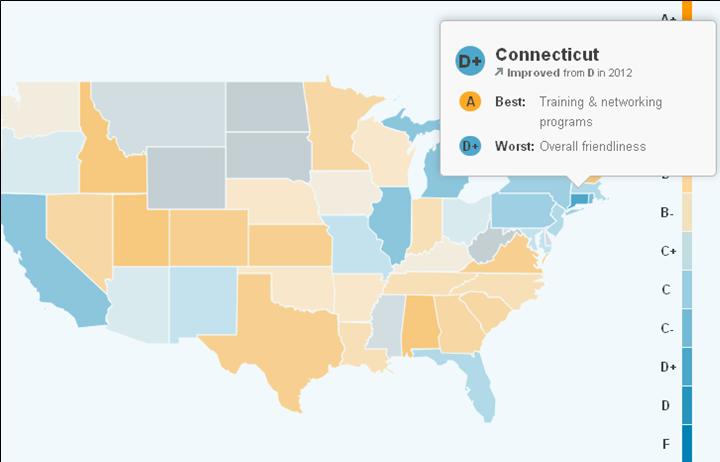
The 2013 study draws upon data from over 7,000 small business owners nationwide and shows that Connecticut improved its overall grade slightly, rising from a 'D' in 2012 to a 'D+' in state mapthis year's study.

Although the state struggled overall, the study authors reported, it received high marks in several categories. Some of the key findings for Connecticut include:

Connecticut earned an 'A' for the state's small business training and networking programs, which ranked among the top-5 nationally. Business owners were critical of Connecticut's regulatory systems, giving the state a 'C' in this category, although this was an improvement from the 'D+' grade received last year.

Among its neighbors, Connecticut ranked just behind New York (which had trailed Connecticut in last year's study) and Massachusetts, but ahead of Rhode Island for overall small business-friendliness.

The state’s overall grades, and comparison with last year, in the 11 categories compared in the survey:

D+         Overall friendliness (D last year)

D+         Ease of starting a business  (C last year)

B            Ease of hiring (C last year)

C             Regulations  (D+ last year)

B-            Health & Safety  (C+ last year)CT welcomes you

C-            Employment, labor & hiring  (D+ last year)

C-            Tax code (D last year)

C             Licensing  (D+ last year)

D+          Environmental (D+ last year)

C-            Zoning (C+ last year)

A             Training & networking program

The study aims to learn what small businesses believe constitutes a healthy political and regulatory climate by having them rate how it is to do business in their specific location along various metrics.

Over 99% of U.S. employer firms qualify as small businesses, and they employ half of all private sector employees. Over the past two decades, almost two-thirds of net new private sector jobs have come from small businesses, and that number has accelerated in recent years.

The thumbtack survey also compared the age and size of the businesses with those of the general business population. The Small Business Adkauffman-details-logoministration reports that 69% of small businesses are at least two years old, and 51% are at least five years old.  The survey sample is very close to these numbers, with 76% over two years old and 57% at least five years old.

According to US Census data, 91.6% of small businesses have between one and four employees. Another 3.8% have 5-9 employees, and 4.6% have 10 or more employees. The survey respondents followed a very similar distribution: 89.3% have between one and four employees, 6.7% have 5-9 employees, and 4% have 10 or more employees.

Some of the key findings at the national level include:

  • Professional licensing requirements were 30 percent more important than taxes in determining a state's overall business-friendliness, confirming the findings from last year's study. Furthermore, this year's research revealed that 40 percent of U.S. small businesses are subject to licensing regulations by multiple jurisdictions or levels of government.
  • Utah was the top rated state, and Austin, TX was the top rated city. At the other end of the spectrum, Rhode Island and Newark, NJ were the lowest rated state and city.
  • The ease of obtaining health insurance was an important factor for many businesses. One-third of small business owners rated obtaining and keeping health insurance as "Very Difficult," versus only 6 percent who rated it "Very Easy."
  • Small businesses were relatively unconcerned with tax rates – more than half of small business owners felt they pay about the right share of taxes.

The top 10 states were Utah, Alabama, New Hampshire, Idaho, Texas, Virginia, Kansas, Colorado, South Carolina, Georgia, Minnesota, Nevada and North Carolina. Professional/nonprofessional services make up a large share of Thumbtack’s clients, so fewer manufacturers and retailers were surveyed, which may have impacted the survey results.

"It is critical to the economic health of every city and state to create an entrepreneur-friendly environment," said Dane Stangler, director of Research and Policy at the Kauffman Foundation. "Policymakers put themselves in the best position to encourage sustainable growth and long-term prosperity by listening to the voices of small business owners themselves."

Hartford Hospital Will Devote Annual Fundraiser to Mental Health

The call to action regarding mental health awareness and treatment, which intensified in the aftermath of the Sandy Hook Elementary School murders a year ago, now has a strong local voice for the New Year.  Hartford Hospital is kicking off a campaign to end the stigma of mental illness at the annual Black & Red Gala on January 25, 2014 at The Bushnell Center for the Performing Arts in Hartford. The goal is to obtain 5,000 pledges, spreading the message that changing attitudes can begin to change minds.

Proceeds raised at this year’s Black &Red will benefit the Institute of Living (IOL) at Hartford Hospital. The IOL will be better able to respond to this national call to action with improved access to mental health care for adolescents and young adults –a critical need not only in Connecticut, but throughout the nation. Support will help carry out critically needed research, offer increased shhMainLogoSubervices and treatments, and provide much needed education to those impacted by mental illness.

An estimated 26.2 percent of Americans ages 18 and older — about one in four adults — suffer from a diagnosable mental disorder in a given year. In addition, mental disorders are the leading cause of disability in the U.S. and Canada. Many people suffer from more than one mental disorder at a given time.

Mental health stigma can be divided into two distinct types, according to the Hartford Hospital website:

  • social stigma is characterized by prejudicial attitudes and discriminating behavior directed towards individuals with mental health problems as a result of the psychiatric label they have been given.
  • perceived stigma or self-stigma, is the internalizing by the mental health sufferer of their perceptions of discrimination and perceived stigma can significantly affect feelings of shame and lead to poorer treatment outcomes.StopTheStigma_WordsMatter

The annual gala – Hartford Hospital's lead fundraising event - will feature entertainment by Barenaked Ladies, winner of two American Billboard Music Awards and two Grammy nominations.

Individuals attending the event will be asked to sign a “pledge” to...

  • Show compassion by reaching out to those in need of help. I will not let anyone suffer in silence.
  • Have the courage to speak up and challenge stereotypes and attitudes. I will not tolerate or perpetuate stigma.
  • Teach by sharing my own experiences with mental illness and encouraging others to share their stories with me. I will learn in order to change.
  • Demand a change in how we view and address mental illness. I will help lead the way.

The pledge, and additional information about mental illness and the Hartford Hospital initiative, is now available on a new webpage on the Hospital’s website, at www.stopthestigma.org   Individuals do not need to attend the event in order to sign the pledge – that can be accomplished directly on the website.

 “We will be looking to our employees of Hartford Hospital and across the Hartford HealthCare system to take the pledge. As a healthcare leader in the community and the state, it is our duty to set the example and stop the stigma associated with mental illness. Together, we can do it,” said Stuart Markowitz, M.D., President Hartford Hospital and Hartford Region, Senior Vice President Hartford HealthCare.

Harold (Hank) Schwartz, M.D., Hartford HealthCare Regional Vice President, Psychiatrist in Chief, Institute of Living at Hartford Hospital, says for some people, a mental illness iol_logo_300x175may be a lifelong condition, like diabetes. “However, as with diabetes, proper treatment enables many people with a mental illness to lead fulfilling and productive lives. By helping combat the stigma associated with mental illness, we can help increase the number of people that seek treatment.”


Examples of common mental illnesses include bipolar disorder, depression, PTSD, schizophrenia, OCD, anxiety disorders, eating disorders, ADD/ADHD, autism and Asperger’s.  CT by the Numbers has previously reported on research underway at the Institute of Living.

A year ago, over $1,000,000 in net proceeds was raised at the Black & Red gala for Hartford Hospital’s transplant services.

Connecticut is Nation’s Fourth Most Innovative State, Data Reveals

Connecticut is ranked as the nation’s fourth most innovative state, in a new analysis from Bloomberg Technology.  The state’s ranking was based on factors including education, professionals in science, technology, engineering and math (STEM) fields, state research and development spending, and technology companies.

The state’s overall score in the analysis, 76.45, is just behind top-ranked Washington’s 83.25, California’s 81.97 and Massachusetts’ 80.93. States were ranked on a scale of zero to 100 in six factors, and received an overall score that was an average of the six. Because productivity consisted of two sub-factors, each was weighted 50%.

 Connecticut’s ranking was based on the following factors:states of innovation

  • STEM professionals as a percentage of state population: 2.72% (CT ranked #7)
  • Science and tech degree holders as a percentage of state population: 10.2% (CT ranked #6)
  • Utility patents granted as a percentage of U.S. total: 1.74% (CT ranked #17)
  • State government R&D spending as a percentage of U.S. total: 2.79% (CT ranked #8)
  • Gross state product per employed person: $114,891 (CT ranked #5)
  • Three-year change in productivity: 0.88% (CT ranked #32)
  • Public tech companies as a percentage of all public companies based in the state: 17.65% (CT ranked #17)

Sources of the data include Bloomberg, Bureau of Economic Analysis, Bureau of Labor Statistics, National Science Foundation, U.S. Census, and the U.S. Patent and Trademark Office.  The analysis was updated in November 2013, and the rankings were published this month.

The remainder of the top 20 innovative states were:

5. Oregon 6. New York 7. New Jersey 8. Colorado 9. Maryland 10. Minnesotabloomberg technology 11. Virginia 12. Texas 13. Utah 14. Arizona 15. North Carolina 16.  Illinois 17. Pennsylvania 18. Kansas 19. New Hampshire 20. D.C.
At the bottom of the list of innovative states were Louisiana, Tennessee, Wyoming, Mississippi and Arkansas.

College Coaches Are Highest Paid Public Employees in 40 of 50 States, Including CT

When UConn announced the hiring of Bob Diaco as new head football coach earlier this month few flinched at the compensation – a reported five-year $8 million contract.  Diaco, who served on the Notre Dame coaching staff as the defensive coordinator for the past four years and the assistant head coach for the past two, was the 2012 winner of the Frank Broyles Award, given to the top assistant college football coach in the country and was the first Irish assistant to receive the prestigious award. He was a semifinalist for the award in 2011.

Earlier this year, the Yankee Institute for Public Policycoaches salaries compiled a list of the highest paid state employees, and three UConn coaches led the list:

  • 1. Calhoun, James A., Men's Basketball Head Coach, UConn $2,865,769
  • 2. Auriemma, Geno, Women's Basketball Head Coach, UConn $1,829,052
  • 3. Pasqualoni, Paul L., Football Head Coach, UConn $1,613,920  (dismissed as coach earlier this fall)

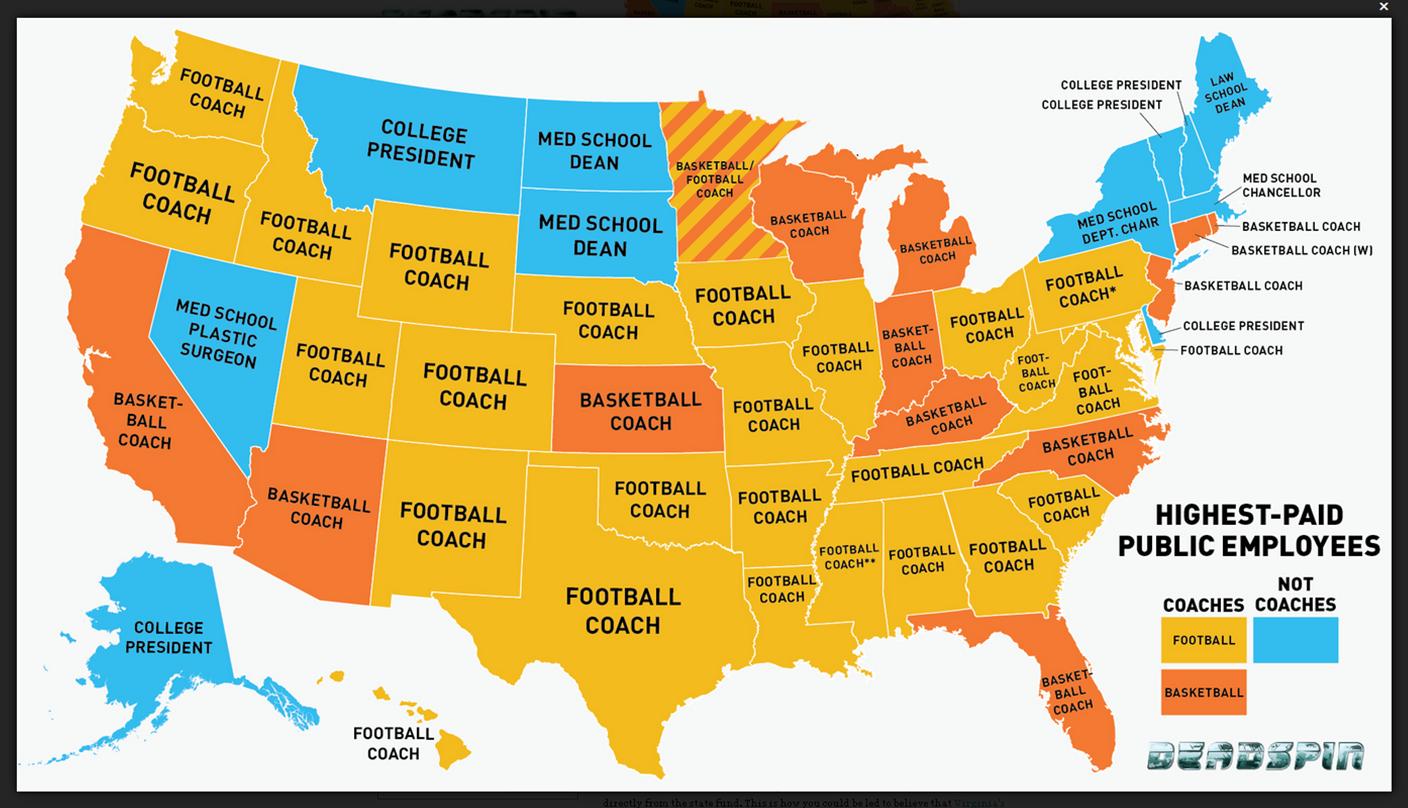
As it turns out, that is not unusual.  According to data compiled by the website Deadspin, the ranks of the highest-paid active public employees in states across the country include 27 football coaches, 13 basketball coaches, one hockey coach, and  10 state employees with responsibilities outside of athletics.  That’s 80 percent of the states with a public employee salary roster led by a coach.

Perhaps surprisingly, the states of New York, Massachusetts, Vermont, New Hampshire and Maine are among those where a college president, law school dean medical school dean or department chair top the state employee salary list.  In Rhode Island, it is the men’s basketball coach, and in Connecticut, with the retirement of Jim Calhoun, the leader is now women’s basketball coach Geno Auriemma.

Last December, UConn and head men's basketball coach Kevin Ollie, a 1995 UConn graduate,  announced a new agreement to run from January 1, 2013 through April 15, 2018.  Under the coaching contract, Ollie receives a base salary of $400,000 per calendar year and for 2013 he will receive $800,000 for institutional speaking engagements and media related appearances for a total of $1,200,000, according to the University's announcement. The payment for institutional speaking engagements will increase by $50,000 each year. Ollie's total compensation for each year of the agreement will be: 2013-$1,200,000; 2014-$1,250,000; 2015-$1,300,000; 2016-$1,325,000; 2017-$1,340,000; 2018-$502,500 (annualized from Jan. 1-April 15).

The website reports that “looking at data from 2011-2012, athletic departments at 99 major schools lost an average of $5 million once you take out revenue generated from "student fees" and "university subsidies.”

Rounding out the top 10 list in Connecticut, as of 2012:

  • 3. Onyiuke, Hilary Chief, Division of Neurosurgery UConn Health Center $1,030,732
  • 4. Nulsen, John Director, Center for Advanced Reproductive Services, UConn Health Center $917,373
  • 5. Makkar, Hanspaul Chief, Division of Pediatric Dermatology, UConn Health Center $916,600
  • 6. Whalen, James Vice Chair, Dermatology UConn Health Center $884,602
  • 7. Laurencin, Cato CEO, Connecticut Institute for Clinical and Translational Science, UConn Health Center, $701,576
  • 8. Herbst, Susan ,President, UConn $612,500
  • 9. McFadden, David, Chief, Department of Surgery, UConn Health Center $576,923
  • 10. Manuel, Warde Athletic Director UConn $551,305


New Haven Is Among Most Walkable Cities in America, Ranks #8 Nationwide

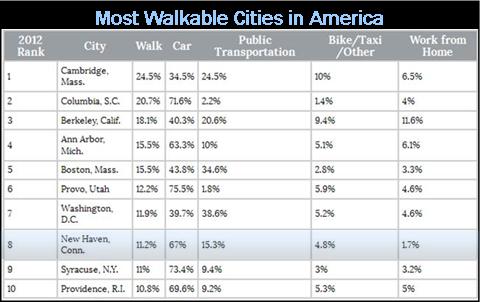
New Haven is one of America’s most walkable cities, with 11.2 percent of commuters walking to work, the 8th highest percentage in the nation, among cities with populations of at least 100,000.  The top 10 list of Most Walkable Cities, published by GOVERNING magazine, notes that many of top communities are in the Northeast, and that communities across the country are stepping up efforts to enhance alternative ways of commuting from home to work. New_Haven_downtown_mapThe top cities were Cambridge, MA (24.5%), Columbia , SC (20.7%), Berkeley, CA (18.1%), Ann Arbor, MI (15.5%), Boston, MA (15.5%), Provo, UT (12.2%), Washington, DC (11.9%), New Haven, CT (11.2%), Syracuse, NY (11%) and Providence, RI (10.8%).OLYMPUS DIGITAL CAMERA

Overall, 67 percent of New Haven commuters use their car, 11.2 percent walk, 4.8 percent bike or use other modes of transportation, and 1.7 percent work from home., according to the data developed from the U.S. Census Bureau's American Communities Survey, which included 300 metropolitan areas.

Nationally, only 2.8 percent of workers primarily commuted by walking last year, a figure that remains mostly unchanged from recent annual estimates, GOVERNING reported.

Among the New Haven walkers, 36 percent are age 16-24, 52 percent are age 25-44, 9 percent are age 45-64 and 2 percent are age 65 or older.  The median age of walk commuters is 27.8, according to the date.  In categorizing individuals, a person’s longest distance traveled is used, so those walking tp transit stations are designated as public transportation commuters, even though a portion of their daily commute involves walking.

Among Connecticut’s most populous cities, in Bridgeport 4.3 percent of commuters walk to work; in Stamford the figure is 4.7 percent, in  Hartford 7.9 percent, and in Waterbury 2.6 percent.

walkable chart

Pediatrician’s Invention to Stop Pain of Injections Could Improve Public Health

Many parents bring their infants and young children to the doctor for injections and leave muttering “there’s got to be a better way,” their child in tears or traumatized by the shot – or shots – administered to prevent illness and disease.  When Amy Baxter left the pediatrician’s office with her youngster, she resolved to find that better way.

Baxter, who attended Yale University as an undergraduate, Emory Medical School, and is now an emergency pediatrician, pain researcher and inventor in Atlanta, successfully developed  - with financial support from the National Institute of Health – a game-changing  device that combines high frequency, low amplitude vibration and a unique reusable ice pack a combination sAmy Baxter ATLpecifically designed to remove pain from the injection.

By stimulating competing sensations, nerve transmission of sharp pain, itching, or burning is blocked.  Simply put, the shots don’t hurt – and independently verified research indicates that it works.

As inventor of the unique needle pain blocking device - called Buzzy - Baxter founded a company that manufactures and distributes the product nationwide.  It is now in 1,200 children’s and adult hospitals across the country, including Yale-New Haven Hospital, Connecticut Children’s Medical Center, and Lawrence & Memorial Hospital in New London,  and it is being used in Connecticut, with varying frequency, by about 100 physicians in medical practices all across the state, from Ashford to Westport.

Buzzy is a bee-shaped palm sized device (wings included) that appears as cute as a toy but has a more important mission – to alleviate pain, thus eliminating the onset of fear. Baxter’s company, Georgia-based MMJ Labs, produces the fast, effective solution– which has applications beyond children, and beyond injections, to other ailments and sources of quick, sharp pain.

Since its launch in 2009, Buzzy has amassed more than 36,000 users, $1 million in annual revenue, and rapidly increasing sbuzzy shotales.  Baxter is one of Inc. Magazine’s Top Women in Tech to Watch, and is asked all over the world to educate physicians, nurses, Child Life specialists, and others about the importance of pain management.
“I invented Buzzy after experiencing first-hand the indifference of the healthcare system to the pain and suffering of children. As a pediatric emergency physician and pain researcher, I have learned that pain relief is not just a luxury; it actually improves the outcomes of procedures,” Baxter explains.

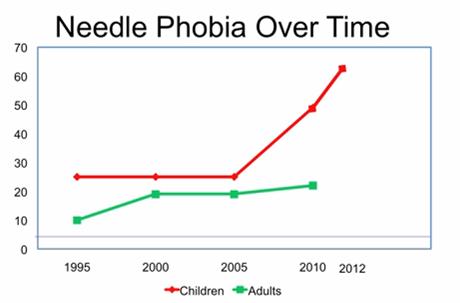
Data indicates that fear of needles is growing among children and the general population, and Baxter says that’s reason for concern.  Especially troubling is the long-term impact of a growing population oneedle phobia over timef needle-averse adults will have on their own health and the health care system.
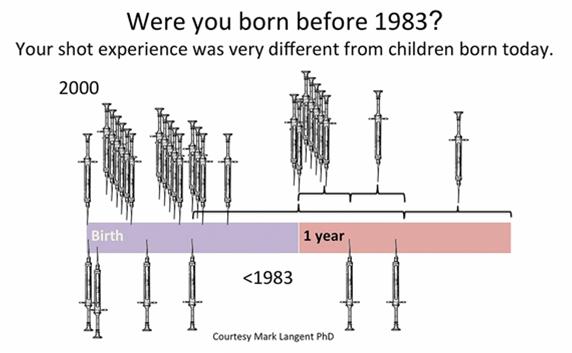
She cites statistics that reflect a dramatic increase in the number and frequency of shots children receive as youngsters – as much as four times higher than 50 years ago – and sometimes as many as four or five shots in a single doctor’s office visit.  And she stresses that pediatricians generally do little or nothing to try to diminish the pain that accompanies those injections.  That, Baxter says, has dramatic and long-lasting effects, on children as well as their parents.   The youngsters come to view the visits as more about pain than health, and the parents begin to have second thoughts about continuing to inflict the pain of needles on their children, often regardless of the potential benefits.

In a TEDx talk in Atlanta last month, Baxter discussed the public health repercussions of having populations whose fear of vaccinations could turn them shotsaway from the very remedies that can improve their individual health and the health of entire populations, warning that “by ignoring pain we’re endangering the future of health care.”

In the talk, titled “Pain, Empathy and Public Health,” Baxter warned that “the number and the way were giving shots is causing needle fear” which may lead to today’s children electing to stay away or delay visits to doctor’s offices as adults – at considerable potential health peril.

In the face of a potential “public health tsunami,” Baxter says “the solution is not to stop vaccinating, it’s to start making the shots better— vaccines shouldn't have to hurt.”

CT, NY, NJ Should Expect Unprecedented Flooding by Mid-Century, Scientists Predict

It will get worse, not better, for shoreline residents and businesses in Connecticut, New York and New Jersey within range of the Atlantic Ocean.  That’s the likely scenario based on newly completed research by a team of geoscientists who are predicting that the New Jersey shore will likely experience a sea-level rise -- about 1.5 feet by 2050 and of about 3.5 feet by 2100 – that will be 11 to 15 inches higher than the average for sea-level rise globally over the century.

Hurricane Sandy Bears Down On U.S. Mid-Atlantic CoastlineThat would mean that by the middle of this century, the one-in-10 year flood level at Atlantic City, for example, would exceed any flood level seen previously, including the natural disaster that was Superstorm Sandy.  The scientists suggest, based on their research, that “planners should account for rising sea levels,” noting that “where the consequences of flooding are high, prudent planning requires consideration of high-end projections” outlined in their study.

Geoscientists at Rutgers University and Tufts University base their projections in part upon an analysis of historic and modern-day records of sea-level rise in the U.S. mid-Atlantic region. Their research appears in the inaugural issue of the journal Earth's Future, published this month by the American Geophysical Union (AGU).

While much to the work centers on the New Jersey shore and The Battery in Lower Manhattan, Rutgers researcher Ken Miller told Connecticut by the Numbers that their analysis included both Montauk on Long Island and Bridgeport.  Since Connecticut lies on bedrock, Miller said, it will largely behave like The Battery in New York CityAGU logo.  “I believe that the projections for bedrock locations are applicable throughout Connecticut,” said Miller, a professor of earth and planetary sciences in Rutgers' School of Arts and Sciences. shore map

Miller collaborated in the study with colleagues Robert Kopp, Benjamin Horton and James Browning of Rutgers and Andrew Kemp of Tufts. Kemp, an assistant professor of earth and ocean sciences at Tufts since May, joined the faculty from Yale University, where he was a Postdoctoral Associate at the Yale Climate and Energy Institute (YCEI).  The new research builds upon a recent study by Kemp, Horton and others that reconstructed a 2,500-year record of sea level at the New Jersey shore. Horton is a professor of marine and coastal sciences in Rutgers' School of Environmental and Biological Sciences.

"It's clear from both the tide gauge and geological records that sea level has been rising in the mid-Atlantic region at a foot per century as a result of global average sea-level rise and the solid earth's ongoing adjustment to the end of the last ice age," Miller told Rutgers Today. "In the sands of the New Jersey coastal plain, sea level is also rising by another four inches per century because of sediment compaction -- due partly to natural forces and partly to groundwater withdrawal. But the rate of sea-level rise, globally and regionally, is increasing due to melting of ice sheets and the warming of the oceans."

The researchers suggest that “additional work is needed to integrate site-specific sea-level rise projections with storm tide statistics to guide planning decisions and investments that may have time frames of 20 years, 40 years, or longer.”  They indicate that sea-leEarth's Future covervel rise in the mid-Atlantic region also results from changes in ocean dynamics. The researchers said sea-level rise could be higher -- 2.3 feet by mid-century and 5.9 feet by the end of the century -- depending on how sensitive the Gulf Stream is to warming and how fast the ice sheets melt in response to that warming.
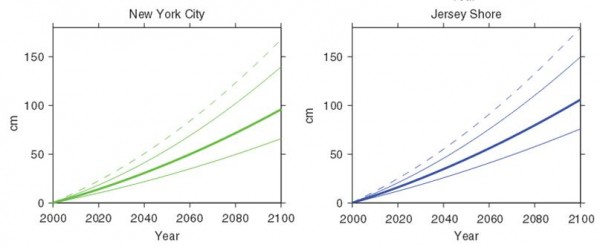
The study found that the eight inches of climate change-related regional sea-level rise in the 20th century exposed about 83,000 additional people in New Jersey and New York City to flooding during 2012's Superstorm Sandy.  The research was supported by a grant from the National Science Foundation.

Earth’s Future, with its inaugural issue, joins AGU’s prestigious portfolio of peer-reviewed research publications, including Geophysical Research Letters and Journal of Geophysical Research – Atmospheres. Both are ranked among the top ten most-highly cited research publications on climate change over the past decade.  The American Geophysical Union is dedicated to advancing the Earth and space sciences for the benefit of humanity through its scholarly publications, conferences, and outreach programs. AGU is a not-for-profit, professional, scientifinyc njc organization representing more than 62,000 members in 144 countries.
Developing Downtown Housing Above Commercial Space Brings Obstacles, Opportunities, New CT Report Finds

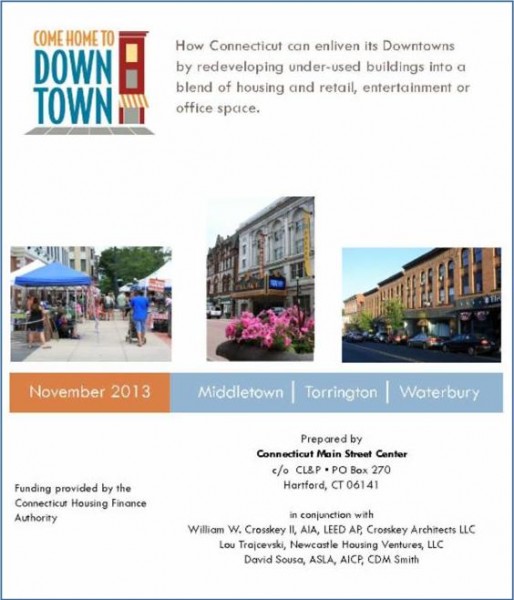
Connecticut's downtowns have a wealth of potential to redevelop under-utilized buildings into housing above commercial space - if mixed-use development can be encouraged through financing and favorable regulations, according to a new report from the Connecticut Main Street Center (CMSC).

The report comes at the conclusion of the first year of Come Home to Downtown, a pilot program CMSC established to encourage and facilitate viable, interesting housing opportunities while revitalizing downtown neighborhoods.  The initiative was contracted by the Connecticut Housing Finance Authority (CHFA) to promote housing in Connecticut's downtowns.

Three communities - Middletown, Torrington and Waterbury - as well as three property owners and their buildings, were selected as the focus of the program’s inaugural year. CMSC chose buildings typically found throughout Connecticut so they could serve as models for other towns. As a result, most of the findings expressed in the report apply to any Connecticut downtown wishing to maximize the potential of its existing infrastructure.Come-Home-logo-150x150

Among the key findings, the report indicates that mixed-use development is among the most challenging, and private owners are often in a “catch-22” as they seek financing.  Downtown management capacity is critical to the success of mixed-use development, the study found. In addition, the CMSC report explains that even when zoning regulations promote redevelopment, they are often not enough to enable mixed-use growth and a severe lack of financing impedes the growth of much-needed mixed use development.

"CMSC's report provides insights that will guide future housing development on Main Streets across Connecticut. The first year of the Come Home to Downtown program is not only creating opportunities to establish new rental housing in downtown neighborhoods, it's creating a model for other communities to follow,"   said Eric Chatman, President & Executive Director of CHFA, which has contracted with CMSC for a second year of the pilot program, which will focus on finding and creating financing.

The report's seven key findings are:

1. There is a huge amount of potential for accommodating mixed-use development - which both saves and generates monies - in Connecticut's downtowns. According to the U.S. Environmental Protection Agency, the infrastructure costs to service compact, dense development like that found Downtown reportin mixed-use neighborhoods are one-third to one-half lower than in suburban areas. It has been estimated that every downtown in Connecticut has at least one building that is under-utilized, containing a store or restaurant on the first floor, but with upper floors that are vacant or used for storage that could instead generate income if converted to apartment homes.

2. Mixed-use development is one of the hardest types to accomplish. There are several reasons why this is the case: these buildings are usually older and in need of greater rehabilitation; they are in need of complex financing from multiple sources; combine several uses in one building (such as housing and retail space); and are often owned by people with little to no redevelopment experience.

3. A severe lack of financing impedes the growth of mixed-use development. Because these deals are so intricate and multi-faceted, financing for the total development costs rarely exists from traditional sources.

4. Education and outreach to owners of possible mixed-use property is needed. Property owners are often unprepared for the complex process of redeveloping their building and unaware of the potential benefit in doing so. Very often, they also need assistance learning how to become landlords and attract good tenants.

5. Private-owners are in a catch-22 when it comes to obtaining financing. With regard to apartment homes located in mixed-use buildings, private owners can either apply for subsidies if they place income/affordability restrictions on the apartments, or the units are not restricted, but there is no subsidy for apartments at the same rental rate.

6. Even when zoning regulations promote redevelopmmiddletownent, they are often not enough to enable mixed-use growth. Favorable zoning regulations are important, but they cannot create mixed-use development by themselves. Each of the pilot communities had zoning policies that allowed for buildings with a mix of uses - a practice which should be commended and encouraged - but there were still significant impediments to promoting this type of growth. In addition, lessening current on-site parking requirements as a whole will also help promote housing in our downtowns.


7. Downtown management capacity is critical to the success of mixed-use development. Any community interested in promoting revitalization of its downtown should consider enhancing its management function by becoming a resource center for mixed-use development, including convening key stakeholders, collecting data, offering education and information and coordinating development incentives.

"There is now a better understanding of what the next steps need to be, and a greater appreciation of the importance of the public-private partnership that is necessary to overcome the challenges and achieve reuse of these properties," Rose Ponte, Torrington's former Director of Economic Development, said about the new report.

 Engaging an expert team of consultants, CMSC worked with municipal officials and the building owners to develop viable redevelopment options including: determining what financing would likely be needed for redevelopment; performing an assessment of zoning and regulatory requirements; reviewing the downtown management function; and measuring the downtown's walkability. Specific recommendations for improving the buildings, including a recommended floor plan designed to attract new residents and bring market rate housing downtown, was also provided to each property owner.

Once rehabilitated, these buildings will create 60 new units of rental housing in downtown Middletown, Torrington and Waterbury, as well as make approximately 25,000 square feet of commercial and retail space available. The total development cost to renovate all three buildings is estimated to be $11.4 million.

"You see it on an almost daily basis - news articles and reports showing the demand, especially among Millennials and Baby Boomers who want to live in walkable, interesting places. It doesn't seem to matter if the downtown is large or small, as long as they can live there and get around without a car to go to the movies, grocery store or coffee shop, that's where people want to be these days," said John Simone, CMSC President & CEO.

In the pilot program’s second year, CMSC will choose two new communities while continuing to work with the property owners and municipal officials in Middletown, Torrington and Waterbury.