Top Main Street Revitalization Initiatives in Connecticut Named

Manchester, New Britain, Waterbury, Seymour and the Northwestern CT Regional Planning Collaborative are being highlighted by the Connecticut Main Street Center (CMSC) for their strategic downtown revitalization initiatives.

As recipients of the organization’s 2014 Awards of Excellence, the efforts include a community college partnering with the downtown and others to create a co-working space; connecting the Naugatuck River with the downtown through extended trails and a linear park; and regionalizing marketing for a collection of small village centers.

The annual  Connecticut Main Street AwardCT Main Street LOGOs of Excellence were created in 2003 to recognize outstanding projects, individuals and partnerships in community efforts to bring traditional downtowns and neighborhood commercial districts back to life, socially and economically. All of the award recipients continue the tradition of stimulating economic development and reinvigorating Connecticut's social centers, officials said.

"Our members continually inspire us with how creatively they respond to the needs of their community," said CMSC President & CEO John Simone. "They're deeply committed to every aspect of their downtown - the businesses, public spaces, local institutions, and above all, creating a place that people really enjoy living in and visiting. We couldn't be happier with how this year's winners represent all we stand for in downtown revitalization."

Submissions were judged on criteria which included innovation, replication, representation, partnerships utilized, and outcomes.  The awards will be presented at the 2014 Connecticut Main Street Awards Gala on June 9th at Roia Restaurant in downtown New Haven.  Award recipients, by category, are:

Events & Programming

Award of Excellence for Wine on Main St. to Main Street Waterbury, Terry Boyd, Braza Churrascaria, Courtyard by Marriott, Diorio's Restaurant, Shamrock Pub & Grill, Tryst Lounge, Signature's Restaurant, City Hall Café, Howland Hughes Center, and Nutmeg Fine Wine & Spirits.

Marketing & Communications

Award of Excellence for Discover NW CT to Northwestern CT Regional Planning Collaborative (representing the Towns of Sharon, Falls Village, Goshen, Cornwall, Canaan, Salisbury, Kent, and Norfolk), Studio Two, local business owners in the eight towns in the "Secret Corner", and local historical societies.

Public Space

Award of Excellence for Complete Streets Master Plan for Downtown New Britain to Downtown Streetscape Working Group, the City of New Britain (including the Mayor's Office, Public Works, Planning and Parks Departments), New Britain Downtown District, Polonia Business District, Central Connecticut State University/ITBE, Capitol Region Council of Governments, and Project Consultant Team.

Renewed Commitment to Main Street

Award of Excellence for Seymour Downtown Action Strategy to the Town of Seymour, Seymour Economic Development Commission, Seymour Downtown Committee, Greater Valley Chamber of Commerce, Naugatuck River Greenway Steering Committee, Naugatuck Valley Council of Governments, Downtown Merchants Association, Planimetrics, Milone and MacBroom; CT Department of Energy and Environmental Protection,and the National Oceanic and Atmospheric Administration.

Main Street Partnership

Award of Excellence for Axis901 and MCC on Main (Manchester) to First Niagara Bank, Manchester Community College (MCC) Foundation, and the Town of Manchester (Board of Directors and Staff).

Economic & Business Development

Award of Excellence to The Business Women of Grand Street (Waterbury) to The Dutch Flower Lady, Technology Forensics, John Bale Book Company, Fine Craft Jewelers, Dottie's 2, Princess Lingerie, Brass City Market on Field, and Fashion Addict.

Yankees - Red Sox: Battle Extends Off the Field, Atop Baseball's Finances

The Yankees and Red Sox, always the focus of attention, argument and controversy across Connecticut, can each claim some victories - on the field and off.  The Red Sox are defending World Champions, having won the 2013 World Series.  They Yankees are the most valuable team in baseball, having won the 2013 monetary championship, just ahead of the Los Angeles Dodgers and Boston Red Sox, according to data compiled by Bloomberg News.MLB

The New York Yankees are worth $3.3 billion, making them the sport’s most-valuable enterprise. The Los Angeles Dodgers rank second with a value of $2.1 billion. Ten teams are worth more than $1 billion. The Boston Red Sox and New York Mets each are valued at more than $2 billion, the data shows.

The Yankees ranked first in overall team value, and 1st in the following categories:  Team Revenue ($570 Million), Gate Receipts ($265 million), Concessions $53 million), Sponsorship ($84 million), and Media Rights ($158 million).  The Yankees ranked 4th in attendance during 2013, at 3.3 million.

The Red Sox ranked third overall, just behind the Los Angeles Dodgers.  The Red Sox ranked 2nd in Team Revenue ($405 million), Gate Receipts ($174 million), Concessions ($36 million).  The team was third in Sponsorship ($40 million), seventh in Media Rights ($89 million), and 9th in Attendance (2.8 million).

In calculating team value, Bloomberg News examineMLB webd revenue from ticket sales, concessions, sponsorships and broadcast rights, as well as interests in TV channels, radio stations and real estate.

The Yankees ranked 1st in Team Value, 2nd in the value of their Regional Sports Network, 2nd in Related Business; the Red Sox ranked 3rd in Team Value, 3rd in Regional Sports Network and 3rd in Related Business.

Revenue from national TV contracts and merchandise is split evenly among the teams, as is the value of MLB Advanced Media, a subsidiary that supplies content to Internet and mobile subscribers.

Fourteen teams have stakes in regional sports networks, according to the report. Of the 10 teams valued at $1 billion or more, only the Philadelphia Phillies don’t have one. The team and Comcast are in negotiations for a new TV contract. Their current deal ends in 2015.

The average value of a team’s interest in a regional network is about $360 million, with the Mets’ 65 percent stake in SportsNet New York having the biggest valuation of almost $1.2 billion, according to data compiled by Bloomberg.

Encore Entrepreneurs – Over 50 and Building New Businesses

Mix a relatively slow economy and a shortage of jobs with a large number of aging boomers looking for meaning and purpose in their work. The result is a growing number of “encore entrepreneurs” seeking to launch income-generating ventures that make a positive difference in their communities.

That has led the U.S. Small Business Administration (SBA) and AARP to launching a strategic alliance to provide counseling and training to entrepreneurs over the age of 50 who want to start or grow a small business.   AARP

April is Encore Entrepreneur Mentor Month, and would-be “encore entrepreneurs” will have the opportunity to connect with a number of organizations and community leaders for advice and assistance in their endeavors as part of seminars held as part of the AARP-SBA initiative.

Next up in Connecticut:  a free seminar, Want to Start or Grow a Small Business?, at the Hartford Public Library on Wednesday, April 23, 2-4 PM, at 500 Main Street.  Space is limited. Interested individuals can register online or call toll-free 877-926-8300.   There will also be a session in New Haven on May 15.

For many Americans born between 1946 and 1964, retirement has a very different meaning than it did a generation ago.   According to a USA Today/Gallup poll, 63% of American adults plan to work in retirement; two-thirds say enjoyment of work is the key reason. With years of valuable work experience, maturity, and plenty of energy at their disposal, today's older workers are increasingly finding financial and personal fulfillment in running their own small businesses.entrepreneur

New research released by Encore.org (formerly Civic Ventures) and funded by the MetLife Foundation shows:sba-logo-300x121

  • Approximately 25 million people – one in four Americans ages 44 to 70 – are interested in starting businesses or nonprofit ventures in the next five to 10 years.
  • More than 12 million of these aspiring entrepreneurs are potential encore entrepreneurs who want to make a positive social impact as well as a living.  Potential encore entrepreneurs have realistic financial expectations and plan local, small ventures to meet needs in their communities.
  • These aspiring entrepreneurs bring a lot of experience to the table, including an average of 31 years of work experience and 12 years of community involvement. Additionally, five out of six report having management experience – 15 years on average.

A 2010 survey by the Kauffman Foundation found that Americans 55 to 64 start new business ventures at a higher rate than any other age group, including 20-somethings. Fully 23 percent of new entrepreneurs were age 55 to 64, up from 14 percent in 1996.

The first event in Connecticut was held in Bridgeport in late January, followed by Danbury in early April.  An additional program is slated for New Haven on May 15 (2 to 4 PM) at Gateway Community College.

Getting to the Final Four: $140 for Some UConn Students, Multiples Higher for Fans

For 51 UConn undergraduate students, $100 will provide a round trip to Texas for the NCAA men’s basketball Final Four as UConn pursues a National Championship.  For everyone else, the price tag is considerably steeper – and climbing.

UConn’s Undergraduate Student Government is sponsoring a bus to take students from Storrs to Texas this weekend. The bus will depart from Storrs at 6:00 AM on Friday and is expected to arrive in Arlingto2014finalfourn, Texas no later than 1:00PM Saturday – in time for the early evening game at AT&T Stadium.

The student government is not responsible for meals, lodging or other accommodations at any point during the trip, but will get the fortunate 51 (first come, first served, of course) within shouting distance of the Final Four.  For a shot at a bus ticket, however, students must have proof that they are already a NCAA student ticket holder for the Final Four, showing an email confirmation from the official NCAA purchase process. Student General Admission ticket price:  $40.

Why take the bus? Norwalk-based priceline.com is reporting that the national average airfare to Dallas/Ft. Worth is around $340, but the average round trip airfare from Bradley International Airport is $604.  By comparison, the average round trip fare from the home cities of the other Final Four arPRICELINEe less - Jacksonville is $541, $584 from Wisconsin, and $385 from Lexington, priceline.com reported.  The average rate for an economy or compact rental car at the Dallas/Ft. Worth Airport is $60 a day for the weekend dates.

Online ticket aggregator TiqiQ reports that the average ticket price for the two semi-final match-ups on Saturday, as of April 2, is $1,091.81.  (A ticket for just one of the semi-finals runs averages about $595.) The Championship Game ticket for next Monday night is going for an average of $580.70.  That’s a slight drop from earlier in the week, but an increase of about 20 TIXpercent over the ticket price a week ago, before the four contenders for the National Championship were determined.

PrimeSport, the Official Ticket Exchange of the NCAA Final Four, lists available tickets ranging from $335.75 in the upper deck of the AT&T Arena to $4,037.50 in Row U facing mid-court.  There remain tickets available.

Compared to the last four years, this is shaping up as the second-most expensive price for NCAA tournament tickets to the final four, behind only last years’ Final Four in Atlanta, Forbes magazine reported this week. Last year, the average price for the semi-final game was $887, which was driven up by three big programs in Louisville, Michigan, and Syracuse, in addition to Wichita State. The lowest price for final four tickets over the last four years was 2011, the last time UConn won the national championship, the magazine reported.Cowboys-Stadium-NCAA-Tournament

Students holding the prized $40 tickets will not be able to resell them on the secondary market, TIME magazine reported this week. Students from the Final Four competitors - UConn, Wisconsin, Florida and Kentucky - must provide valid student ID’s, verification of purchase, and the originating credit card to gain entry to the Final Four stadium.

The Final Four at AT&T Stadium is expected to bring the largest crowd ever to attend a NCAA tournament game college basketball game. The previous record was the 75,421 people that saw the 2011 Final Four semifinal games at Houston's Reliant Stadium. This year’s Final Four may also break the all-time college basketball attendance record of 78,129, Huffington Post reported.

As for the return trip for the 51 UConn students taking the bus from Storrs, there are two scenerios: should UConn lose on Saturday, the bus will depart from Arlington at 9:00AM on Sunday, April 5. If the Huskies advance to the championship, the bus will depart from Arlington at 8:00AM Tuesday, April 8.  Sleep deprived, at the very least.

Investor Opportunities in Mobile Technology, Consumer Products Focus of Back-to-Back Conferences

It is described as “the Biggest and Most Disruptive Platform in Human History,” by William Davidson, Senior Vice President of Qualcomm.  Davidson will be the keynote speaker Wednesday in New Haven at “Connecticut Mobile Summit – Exploring Mobile Venture Opportunities and Challenges.”  Connecticut’s top mobile industry executives will be meeting to discuss how to accelerate mobile adoption, engagement and monetization, according to conference organizers.

Conference officials note that “penetration of smart phones into the workplace has been persistent since the iPhone launch in June of 2007. More recently, tablets have supplanted PCs as productivity boosters.”  The Connecticut Mobile Summit is designed to help educate Connecticut’s investment and technology communities in mobile venture opportunities and challenges.

mobile summittIn addition to Davidson, expert panelists participating include Carissa Ganelli, Founder & CEO, LightningBuy; Drue Hontz, Founder & President, KAZARK, Inc.; John Nobile, Founder & President, Tangen Biosciences; and Nadav Ullman, Founder & CEO, Dashride.

“In three to five years any enterprise that has not implemented mobility solutions for its customers, employees, and suppliers will be leapfrogged, disintermediated, or go bankrupt. Connecticut cannot afford to be behind this curve,” observed event moderator, Brenda Lewis, Principal of Transactions Marketing, Inc.

Davidson is senior vice presidemobile-technologynt of strategy and operations for Global Market Development in Qualcomm Technologies, Inc. In this role, he handles reporting and operations as well as executing on strategic global business initiatives. In addition, Davidson is senior vice president of investor relations where he serves as the primary liaison with the investment community and Qualcomm shareholders. Davidson has more than 25 years of experience in technical sales, marketing and general management roles in the telecommunications industry.
The half-day conference is being presented by the Connecticut Technology Council, Crossroads Venture Group and AT&T. The event is supported by Mea Mobile.

Opening remarks will come from Bruce Carlson, Acting CEO & President of the Connecticut Technology Council, Liddy Karter, Executive Director of Crossroads Venture Group, and Claire Leonardi, CEO of the recently re-branded Connecticut Innovations.  The event is $40 for members of the Connecticut Technology Council and Crossroads Venture Group, $50 for non-members.

The following day, the Northeast Consumer Product Conference will be held in Stamford, with the Connecticut Technology Council and Crossroads Venture Group joined by the Connecticut chapter of the Association for Corporate Growth (ACG) as sponsors.  The conference is described as the Northeast’s largest ‘mergers and acquisitions’ conference focused on early state and middle market consumer-facing companies.  It brings together operators, buyers, investors, and transaction professionals to discuss the challenges and opportunities within consumer industries.

The Stamford conference will include expert-led panels reviewing the state of the capital markets and share strategies for consumer marketing in a digital world, for both early and late stage firms.

Keynote presentation will be from Mike McMahon, President, Spire, a Datalogix company.  Panelists for a session on “Raising Capital in Today's Environment,”  to be moderated by Ramsey Goodrich, Managing Director, Carter Morse & Mathias, include Richard Baum, Managing Partner, Consumer Growth, Partners; Christopher Bradley, Principal, Mistral Equity Partners; and Tom Hayes, MaACGnaging Partner & Principal, New England Consulting Group.

ACG CT President Karin (McKittrick) Kovacic said, “This conference brings together owners and managers with investors and transaction professionals to discuss the challenges and opportunities within the consumer products sectors.”

The Connecticut Chapter of ACG is one of the fastest growing ACG chapters in the country, with close to 300 local professionals focused on middle-market corporate growth (i.e.: mergers and acquisitions, financing opportunities, business development, joint ventures, licensing arrangements, etc.), including a diverse group of private equity funds, intermediaries, lenders, and service providers.

The Connecticut Technology Council (CTC) is a statewide association of technology oriented companies and institutions, providing leadership in areas of policy advocacy, community building and assistance for growing companies.  With over 2,000 member companies that employ some 200,000 residents, the CTC works to position Connecticut as a leader in idea creation, workforce preparation, entrepreneurial aptitude, early stage risk capital availability and providing on-going support and mentoring to high potential firms.

Survey Says: Increase Consumer Protections, Limit Marketing of Alternative Electric Companies

Too much.  That’s the opinion of Connecticut residents age 50 plus when it comes to the steady barrage of marketing by alternative electricity companies, according to a new survey by AARP Connecticut.  The survey found that 82 percent of electricity customers age 50 and older had been solicited in the past 12 months by an electric supplier – and that a significant 25 percent of the customers had changed electric suppliers during the year.

There was also a clear mandate to reign in the marketing.   Nearly three out of fourpower lines people would prefer that companies be limited to marketing to consumers only once a year.
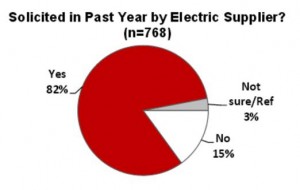

A robust 88 percent expressed concern about the increasing costs of electricity.  However, most cite loyalty with their current supplier (35%), or not finding alternative suppliers with more competitive rates (21%) as reasons they chose not to switch carriers.  Sixteen percent cited negative perceptions or concerns about alternative suppliers, such as bad reputations (6%), being untrustworthy (4%), having variable rates (4%) or being bound by contracts (2%).

The marketing takes many forms.  The majority of customers said they have received offers from alternative suppliers through the mail (74%) and by phone (58%).  Additionally, a considerable number (13%) say representatives have knocked on their door at home.  The marketing tactics have generated strong support among those over 50 for limits:

  • 84 percent support requiring sales staff to wear badges to identify themselves and their company
  • 65 percent support requiring sales staff to tell consumers they have seven days in which they can terminate their contract
  • 64 percent support requiring sales staff to provide written terms of sales agreements while on-site.solicited by company

AARP Connecticut pointed out that a study by Connecticut’s Office of Consumer Counsel found that nine out of ten customers who switched to a third party supplier in CL&P’s territory and seven out of ten customers in UI’s territory were paying more than standard rages during the study period.  The overpayments, according to AARP, totaled about $13.7 million per month –“money that residents, especially older adults on fixed incomes, could be spending on basic necessities like groceries and medication,”  AARP noted.

Ninety percent of those surveyed supported proposals to protect consumers by requiring suppliers to disclose all costs associated with their prices, including early termination fees and minimum monthly charges, and 85 percent supported requiring suppliers who offer variable rate contracts to provide specific comparison information.

“It’s clear from these survey results, and from the stories our members have shared with us, that electric customers don’t feel like they’re getting a fair shake,” said AARP Connecticut Advocacy Director, John Erlingheuser.  “They’re fed up with high electric rates, with the constant marketing and questionable practices of third-party suppliers, and with the lack of oversight and enforcement by state regulators.  They want their elected officials to do more to help lower rates and ensure adequate consumer protections are in place in the alternative electric supply market.”

Among those surveyed, 77 percent were CL&P customers, and 16 percent were United Illuminating customers.  The survey pointed out to respondents that consumer electric bills are divided into two major sections: delivery and generation supply. CL&P and United Illuminating are the primary delivery companies in Connecticut. Since 2000, the supply portion of the bill has been deregulated, “meaning that independent companies, known as ‘electric suppliers,’ can compete to sell or supply you electricity.”  CL&P and UI continue to supply as well as deliver to consumers, but under deregulation, electric supply can be provided by other companies.  The deregulation plan was adopted by state government in an effort to reduce prices through a competitive marketplace.

Testifying at the state legislature last month, AARP Connecticut indicated that an array of unscrupulous marketing practices are luring consumers – especially those over age 50 - with seemingly attractive offers, only to have consumers receive bills charging rates often well in excess those that consumers had been paying previously.  They outlined a series of reforms that would better protect consumers.

In testimony before the Energy & Technology Committee, AARP Connecticut stated “What proponents of deregulation failed to recognize that markets require supervision, consumer protections, and proper enforcement. Some marketers have turned to means to capture customer interest and agreement that have resulted in complaints, misrepresentation of prices, the use of variable rates that are not predictable or even plainly stated, teaser rates, the renewal of fixed rate contracts into variable rate contracts without affirmative customer consent, and a host of telemarketing and door to door activities that confuse customers and take advantage of their lack of education and understanding of the terms being proposed to them in a hard sell marketing technique.”

Connecticut's Public Utilities Regulatory Authority (PURA) held a series of public hearings in February to solicit public comment in its ongoing investigation of the electric supplier market in Connecticut.  The agency provides a list of electric suppliers and aggregators on its website.  Earlier this month, Attorney General George Jepson and State Consumer Counsel Elin Katz called for enhanced consumer protections, CT Watchdog reported.

AARP Connecticut commissioned a telephone survey of 800 Connecticut residents age 50 and older to learn about their opinions on electric utility marketing and regulations.  The interviews took place between March 11 and March 16, and the data was weighted to reflect the Connecticut population age 50 and older.  The survey has a margin of error of plus or minus 3.5 percent.

Intensive Workshops for Would-Be Journalists Return This Summer

Investigative journalism is alive and well, and in the midst of passing the baton to a new generation.  That’s the premise driving a one-week journalism workshop being run by leading professionals, to be held at three locations for Connecticut high school students this summer.  It is the most extensive program of its kind in the state, and one of just three in New England.

With expert practitioners providing the instruction, high school students interested in refining their research and writing skills, while learning about the evolving field of journalism from award-winning writers and editors, are perfect candidates. Now in their fourth year, the specialized workshops, offered by the Connecticut Health Investigative Team (C-HIT) will be held at:

  •   University of Connecticut (Storrs), July 14-18
  •   Quinnipiac University (Hamden), July 21-25
  •   Yale University (New Haven), July 28-Aug. 1

The non-profit C-HIT is a web-based news service dedicated to producing original, responsible, in-depth journalism on issues of health and safety, in Connecticut and the surrounding region. Consisting of a team of award-winning joC-HIT journalism laburnalists, based in Connecticut, who have come together to provide the public with informative stories about health, safety and medical issues, C-HIT stories regularly appear in newspapers, on websites, and in broadcast media statewide.

The student workshops provide select students with the opportunity to spend a week on a university campus, learning the tools of investigative journalism by participating in seminars led by current, active professional journalists.  High school students age 16 and older are eligible to apply, and sessions are limited to 20 students each.  Full and partial scholarships are available.

Students will work on developing stories for publication, gaining first-hand experience in what it takes to assemble the research and do the homework essential to effective journalism.  In addition, as part of the program, the students will spend a day visiting local newsrooms.

The team of instructors include:  C-HIT logo

  • Kate Farrish, formerly an award-winning reporter for the Hartford Courant and now a UConn adjunct professor of journalism;
  • Lisa Chedekel, C-HIT senior writer and co-founder, and formerly an investigative reporter for the Courant, where she won several national awards
  • Lynne DeLucia, C-HIT Editor and a Pulitzer Prize-winning former Courant editor.

C-HIT's workshop graduates have gone on to study at major universities, have been awarded scholarships through the Dow Jones News Fund, and have secured internships at major newspapers, including the Courant.  For information, go to www.c-hit.org or contact Lynne DeLucia at delucia@c-hit.org.

The only other intensive journalism program for high school students in Connecticut is offered by the Yale Daily News, the university’s student-run newspaper.  The publication’s Summer Journalism Program runs for one week in mid-August, and is geared toward those with writing or journalism experience, although any Connecticut high-school student with an interest in journalism, writing or photography can apply.  Details are available at sjp@yaledailynews.com.

France Replaces Canada As #1 Nation for Connecticut Exports in 2013

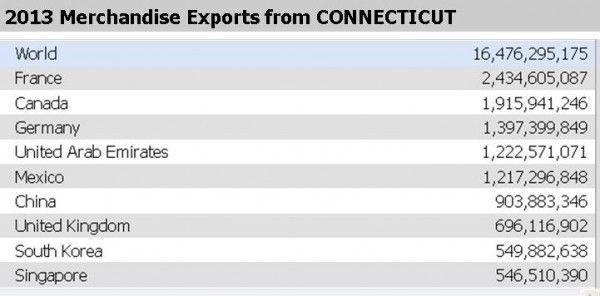
France replaced Canada as Connecticut’s top export partner in 2013.  Exports to France jumped from 1.9 billion to 2.4 billion, compared with the previous year, while exports from Connecticut to Canada remained steady at 1.9 billion.  During 2013, France received 14.8 percent of the state’s exports, while Canada received 11.6 percent, according to data from the U.S. Department of Commerce.

Germany (1.4 billion), United Arab Emirates (1.2 billion) and Mexico ($1.2 billion) round out Connecticut’s top five for 2013.  Germany also ranked third in 2012.   In 2013, UAE edged Mexico for fourth place among Connecticut’s leading export recipients, the reverse of their standing the previous year.    export chart

Overall, shipments of merchandise from Connecticut in 2013 totaled $16.5 billion, according to data from the Department of Commerce’s International Trade Administration – an increase of 3.2 percent from the previous year.  Connecticut was one of 16 states setting annual export records.  Exports were 15.9 billion a year ago, which was a drop from 16.2 billion in 2011 and 16.0 billion in 2010.

exportsOverall, the European Union was Connecticut’s largest export market, with average exports (2011-2013) totaling $6 billion annually, the agency’s report noted.
The state's largest merchandise export category is Transportation Equipment, which accounted for $8.0 billion of Connecticut's total merchandise exports in 2013, a category dominated by civilian aircraft, engines and parts, according to Commerce Department data. Other top merchandise exports are Machinery, Except Electrical ($1.9billion), Computer & Electronic Products ($1.3billion), Chemicals ($998 million), and Electrical Equipment, Appliances & Components ($760 million).

After the top five, Connecticut’s export recipients, in order, are China, United Kingdom, South Korea, Singapore, Japan, Netherlands, Brazil, Malaysia, Qatar and Turkey, rounding out the top 15.

In a year-to-year comparison of 2013 to 2012, exports to France increased by a substantial 27 percent, to Singapore by 13.6 percent and to the UAE by 12.3 percent.  Exports to Columbia jumped 232 percent, from $66 million to $219 million.  Exports dropped slightly to Japan, China, Malaysia and the Netherlands.

The United States currently has free trade export mapagreements in force with 20 countries, which account for $5.0 billion (30 percent) of Connecticut’s exports. During the past 10 years, exports from Connecticut to these markets grew by 69 percent, with NAFTA, Korea, Singapore, Colombia, and Israel showing the largest dollar growth during this period, the agency reported.

Connecticut’s goods exports to all Trans-Pacific Partnership markets increased by 9 percent from 2011 to 2013. During this period, 29 percent of Connecticut’s total goods exports went to the TPP nations, which include Australia, Brunei, Canada, Chile, Japan, Malaysia, Mexico, New Zealand, Peru, Singapore and Vietnam.  In 2013, 44 percent of total U.S. exports went to TPP nations, where the U.S. has focused on “creating a high standard, regional agreement that opens new markets and knits together existing U.S. trade agreements,” according to the agency’s update report.

The U.S. set an all-time record 2.3 trillion in exports in 2013.  Joining Connecticut in reaching state export records (see interactive map) were Texas, California, Washington, Louisiana, Michigan, Ohio, Georgia, Tennessee, North Carolina, South Carolina, Kentucky, Mississippi, Maryland, Colorado and Oklahoma.

Over one-quarter (27.4 percent) of all manufacturing workers in Connecticut depended on exports for their jobs, according to 2011, the most recent available in that category.  A total of 6,020 companies exported from Connecticut locations in 2011. Of those, 5,357(89.0percent) were small and medium-sized enterprises with fewer than 500 employees. Small and medium-sized firms generated over one quarter (26.6percent) of Connecticut's total exports of merchandise in 2011.


Women Aren’t Leading Nation's Top Art Museums; Connecticut Fares Better

When the Wadsworth Atheneum, America’s oldest public art museum, hired Susan Lubowsky Talbott as Executive Director in 2008, she was described by the museum’s board chair as “the absolute best person on the face of this planet to lead the way.”

Talbott, who will be marking six years at the helm of the state’s leading art museum, came to the state after three years as the director of Smithsonian Arts at the Smithsonian Institution in Washington.  Previously, she was director and C.E.O. of the Des Moines Art Center from 1998 to 2005, where she formed partnerships with more than 100 community organizations and is credited with doubling museum attendance during her first two years.

Having a woman at the helm of a leading art museum is more the exception than the rule, according to a report by the Association of Art Museums Directors, a professional organization, The New York Times reported recently.   The organization indicated that women run jut a quarter of the biggest art museums in the United States and Canada, and earn a third less than their male counterparts.

The report also noted that “strides mamuseum leadersde by women at small and midsize museums” (often university or contemporary art institutions) where women hold nearly half of the directorships and earn on a par with men.  Just five of the 33 most prominent art museums are led by women.

Amy Meyers is Director of the Yale Center for British Art.  The Yale Center for British Art is a public art museum and research institute for the study of British art and culture. Presented to Yale University by Paul Mellon (Yale College, Class of 1929), the Center houses the largest collection of British art outside the United Kingdom.  Meyers has served since 2002. A Yale alumna (she earned a Ph.D. in American studies in 1985), Meyers was previously curator of American art at the Henry E. Huntington Library, Art Collections and Botanical Gardens in San Marino, California.

As director of the Yale Center for British Art, Meyers has worked to strengthen the museum's role as a leading research and educational institute in the history of arts, while continuing its active exhibitions program. She has reached out to students, faculty and scholars to involve them in the life of the center and created a Preservation Committee to oversee conservation of the current museum site.atheneum

As for the other leading museums in the state, it’s reigning men.

The New Britain Museum of American Art, founded in 1903, was the first institution in this country devoted to collecting and exhibiting American art. The Museum’s collection comprises more than five thousand works and is constantly expanding in an effort to reflect our ever-evolving culture.  Leading the effort is director is Douglas Hyland.  Hyland arrived in 1999 from the San Antonio Museum, where he was director.  In a 2009 article, Connecticut magazine reported that “in the 10 years since his arrival, Hyland has doubled its collection to 10,000 objects. He has also doubled its full-time staff, from 12 to 24, doubled the number of docents, to 100, and more than doubled museum membership, from 1,200 to 3,500.”

The director of the Florence Griswold Museum in Old Lyme, the home of American Impressionism, is Jeff Anderson. Peter C. Sutton is Executive Director and Chief Executive Officer of the Bruce Museum in Greenwich.  Bruce Museum offers a changing array of exhibitions and educational programs that promote the understanding and appreciation of art and science.  The Lyman Allyn Art Museum in New London interim Director is James Eckerle. LAAM is the only museum in Southeastern Connecticut to offer a comprehensive collection of European art as well as American fine and decorative art: the permanent collection is comprised of over 10,000 objects.

Although not an art museum, prominent in Connecticut’s museum roster is the Mark Twain House & Museum, where Cindy Lovell, not yet a year into her position as Executive Director, has been characterized by a focus on Twain and education in her career.  After working for years as a university professor, she became director of the Mark Twain Boyhood Home in Hannibal, Mo. Her next stop was Hartford.

The Times reported that women leading art museum with budgets of over $20 million across the country are Kimerly Rorschach, who was hired in 2012 to lead the Seattle Art Museum, Janet Carding at the Royal Ontario Museum, Karol Wight at the Corning Museum of Glass, Nathalie Bondil at the Montreal Museum of Fine Arts and Kaywin Feldman at the Minneapolis Institute of Arts.

Photos:  Susan Lubowsky Talbott (left) and Amy Meyers; Wadsworth Atheneum.