Economic Report Finds “Significant Shift” in Destinations for State Exports

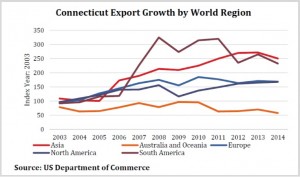
Connecticut has become more reliant on exports to drive gross state product growth during the past decade, according to a new report prepared by the Connecticut Economic Resource Center (CERC). In 2003, Connecticut exports as a percent of Gross State Product (GSP) stood at 4.5 percent, increasing to 6.6 percent of GSP in 2013. That growth, CERC points out, makes it “important to analyze Connecticut exports trends to understand how exports will impact Connecticut’s economy in the future.”commerce chart

In 2014, approximately 46 percent of Connecticut exports were comprised of transportation equipment merchandise, which includes aerospace equipment. And approximately 45 percent of Connecticut exports went to four countries: France, Canada, Germany, and Mexico, according to the report, Eye on Economics – Export Trends for Connecticut.

Although Connecticut still has strong trade ties with Europe and the North American Free Trade Agreement (NAFTA) countries (Canada, Mexico), there has been “an obvious shift in export growth among its trading partners.”   From 2013 to 2014, Connecticut exports to South America and Asia increased overall, while exports to Europe, Oceania, and the rest of North America (mostly Canada and Mexico) were “generally flat.”

From 2003 to 2014, Connecticut exports to Asia increased by 182 percent, faster than exports to any other region, according to the data.   Economic growth in Asia was primarily driven by growth in China.exports

The shift in Connecticut export locations “can be partially explained by demand changes in regions that Connecticut trades with,” the report explains, citing changes in the appetite for exports in Europe and Asia. Europe, for example, has “experienced economic weakness since 2008 and has not fully recovered. It has been particularly hit hard by credit market constraints and unemployment, which has reduced consumptions levels, and thus demand for imported merchandise, the CERC report pointed out.

Looking ahead, the CERC analysis anticipates that Connecticut exports “may slow or remain flat” because of “weaker demand in Europe, where the majority of Connecticut exports currently go to; and Asia, which received the second largest amount of Connecticut exports in 2014.”

CERC logoCERC is a nonprofit corporation and public‐private partnership that provides clients with objective research, marketing and economic development services. The organizations mission is to “provide services consistent with state strategies, leveraging Connecticut’s unique advantages as a premier business location.”

The report was developed by the CERC Research Department, including Alissa DeJonge, Carmel Ford and Matthew Ross.

Boston Children’s Hospital Delights with Interactive Wall Developed at UConn

It lives in Boston, but was built at UConn.  Boston Children’s Hospital’s recently installed Interactive Media Wall is an immense, high-tech, engagingly interactive product of the University of Connecticut’s Digital Media and Design program – a collaboration of students and faculty that is bringing smiles to children and families who encounter the massive 30-foot wall in the facility’s reconstructed lobby. For a team of animators accustomed to designing for screens a few inches across, the task of designing a scene three stories high was daunting – but a challenge they took on energetically.  The electronic wall consists of a large high-definition video screen, and a series of cameras and sensors that observe the presence and movement of people in the space below it, allowing people entering the space to control what appears on the screen.  It can be a powerful experience, for children and adults, as their movement defines the action on screen.BCH-Still-2

Rather than just showing a pretty picture, the wall hopes to offer some therapeutic benefit to the children who interact with it, in support of the mission of the hospital, which is widely considered one of the best pediatric hospitals in the world.

“The idea was to empower emotionally and physically challenged children to take control of something in their life, at a time when things were spinning out of control,” Tim Hunter, Department Head of Digital Media & Design and Director of the Digital Media Center told UConn Today.

How did a major healthcare facility in Boston connect with Connecticut’s flagship university for the project?

Prior to joining UConn’s faculty in 2007, Hunter spent 25 years developing and producing national and international design projects through his New York City based company. His areas of expertise are in digital animation design & production, digital media design & production, lighting design, scenic design and video projection design.

Through that firm, he had worked for many years with Boston-based Elkus/Manfredi Architects, which in turn worked with Boston Children’s Hospital on various projects.  When the project to renovate the facility’s lobby came along, the architects suggested that hospital leadership contact Hunter to see what he would envision as a centerpiece, interactive experience. media_nx

It was a good match.  Initial work began on the project at UConn in the fall of 2011, accelerating during the spring 2012 semester.  Plans called for the UConn Digital Media Center faculty and students to develop a unique imaging and sensing system that would be controlled by guests of the hospital as they traveled through the lobby.  The work was completed in mid-November 2014, and has been well-received by patients, visitors and staff, earning a not-to-be-missed following.

The UConn team drew on the expertise of faculty members from a broad range of disciplines. Experts in child psychology, in human behavior, and in several disciplines of computer science and engineering contributed to the development of the installation.

That kind of collaboration was critical to the success of the wall, says Hunter, even though such projects are not usually developed at an academic institution. “A university is not the first place you would look for something like this,” said the industry veteran-turned-educator.

logoAmong the students participating in the project were William Pritchard, interaction design and project management; Somaiyeh Ghaffarnia, animation and character development; Sean Dexter, 3D animation; Kevin Richetelli, 2D animation; Samantha Menza, game design; Tom Lee, game design and music composition; and Tiffany Hoang, game design. Prtichard and Ghaffarnia began working on the project as undergrads and continued while pursuing their graduate degrees.  The other students were undergrads.

UConn faculty involved in the project, along with Hunter, were Samantha Olschan, animation and character development; Mike Vertefeuille, technology and installation; and Zsolt Palatinus, data mathematician.  Also participating were staff member Michael Toomey, interaction design and project management, and CHIP members Tim Gifford and Christian Wanamaker, engineering and coding.

There may be more to come.  UConn’s Digital Design department – with students in Storrs and Stamford - and Boston Children’s Hospital now have an ongoing relationship, with plans for UConn to develop new interactive experiences for the next five years.

https://youtu.be/DD7gk2kHP3g

Women at Disadvantage in Seeking IPO Investments, Research Study Finds

A new study by academic researchers into decisions regarding the financing of Initial Public Offerings (IPO) of fledgling businesses has found "one significant and persistent effect on investor perceptions that did influence those evaluations—the gender of the CEO.” Even though women-owned firms represent almost half of U.S. new businesses, female founders and CEOs of start-ups fared poorly in an IPO simulation involving MBA students, the researchers found – a result of interest to Connecticut’s business start-up, venture capital, and entrepreneurial communities, at a minimum.IPO

The study found that the amount of money that participants recommended for investment in a fictionalized initial public offering for a cosmetic-surgery company was almost 4 times higher if the CEO was identified as male.  In fact, the anticipated share price of IPOs led by male CEOs was approximately 11 percent higher than those of female-led IPOs, suggesting that bias explains why successful female-led IPOs are an "extremely rare phenomenon," the researchers point out.

The paper,recently  published and now available through the Social Science Research Network, was conducted by Lyda S. Bigelow, Leif Lundmark and Robert Wuebker of the University of Utah and Judi McLean Parks of Washington University in St. Louis.McLean Parks, JudiLyda Bigelow

Skirting the Issues: Experimental Evidence of Gender Bias in IPO Prospectus Evaluations,” stresses that “given the impact of entrepreneurial activity around the world, the question of how entrepreneurs finance their ventures is a crucial question, as adequate capitalization for a new venture can make the difference between firm survival and failure. Whether a spin-off or start-up, firms that seek to grow beyond initial size at founding rely on the decisions of potential investors for the necessary financial resources.”

Given that women executives are present in the top management teams of IPO firms in increasing numbers, the lack of female-led IPO firms is a “curious fact, especially since women-owned private businesses represent almost half of the new businesses formed in the United States, with patterns of founding similar to male-owned businesses.”

In the study, using a sample of MBA students the researchers constructed a simulated initial public offering (IPO) manipulating the gender demographics of the top management team. Their results suggested that female CEOs “may be disproportionately disadvantaged in their ability to attract growth capital when all other factors are controlled.”

Despite identical personal qualifications and firm financials in the scenario, the study results indicated that:

  • firms led by females were seen as having a poorer strategic position than those led by males,
  • female Founder/CEOs were perceived as less capable than their male counterparts, and
  • IPOs led by female Founder/CEOs were considered less attractive investments.

“The disparity is significant, as is its potential economic and social impact,” the researchers state. “If companies led by females are disadvantaged in their ability to raise cash through the stock market, it can impact the viability and financial health of their companies, their ability to expand and compete in an increasingly global and competitive environment, and if they are unable to remain viable, their employees’ livelihoods.”

The 43-page research report also suggests that gender bias may extend beyond IPO’s to other disciplines within the financial world, and urge additional study.

Future research, they suggest, “could explore whether or not these findings extend to financial professionals such as bank loan officers or venture capital investors, and could investigate the role that prior experience plays in that process. This is an important question, as financial professionals, making investment decisions for individuals and institutions, control enormous amounts of money (for example, the combined assets of the nation’s mutual funds exceed $7.4 trillion, retirement funds exceed $2.7 trillion, closed end funds exceed $20 billion and exchange traded funds weigh in at $174 billion,” the research team pointed out.

Photos:  Judi Parks (left), Lyda Bigelow

Questionable Patent Claims Push Small Businesses to Pay Rather Than Fight; Congress to Again Consider Reforms

The odyssey began with a letter.  The owner of an Old Lyme small business, providing employment services for people with disabilities, was told that by scanning documents into emails, she was violating a patent.  In fact, every scan meant a $1,000 fine.  Pay $75,000, she was told, or face legal action. She ignored the first letter, hoping it was junk mail.  When a second, “scarier, and more threatening” arrived, she contacted an attorney, who put her in touch with a patent attorney.

What was happening was a phenomenon described as patent trolling.  The New York Times has described patent trolls as “people who sue companies for infringement, often using patents of dubious value or questionable relevance, and then hold on like a terrier until they get license fees. In recent years, patent trolls — they prefer “patent assertion entities,” or P.A.E.’s — have gone from low-profile corporate migraine to mainstream scourge.”Patent  Defined

Roberta Hurley, the small business owner in Connecticut, describes them as “creepy people,” intentionally frightening business owners with a “big scam.”  They depend on the unknowing to pay the outrageous demands, afraid of being taken to court.

The company making the demand could not be reached by phone, and the letter had nothing more than a Post Office box for an address.  But the tone was nonetheless daunting.

“If you’re scared, you don’t understand patent infringement, don’t have the funds to hire an attorney, which is true of many mom and pop businesses, it’s easier to write a check to stop them,” Hurley observed.

She couldn’t afford the $75,000 being demanded – “I would have had to close my doors” – and decided she would fight, and did.  “I wasn’t doing it,” she recalled.

It took time, effort and energy, and a bill from her attorney, but ultimately the demands stopped.  The entire process went on for nearly a year and a half, ending in 2013.  Along the way, she testified in Washington, went public to the news media, and told everyone she could what was happening.

Patent trolls may not have succeeded in this instance, but often do.  As The Atlantic pointed out in an article on the subject, “Given the cost, many defendants are willing to pay the troll to avoid a lawsuit even if the suit is not justified.”

In 2013, American courts saw six times as many patent lawsuits as in the 1980s, a Boston Globe op-ed by the authors of “Patent Failure” reported last fall.  “Over the past decade, there has been a 900 percent increase in the number of businesses facing patent litigation.”  They added that “recent research estimated that defendants spent at least $29 billion per year in out-of-pocket costs to defend or settle claims brought forth by patent trolls in 2011. Patent lawsuits by these entities drain an estimated $60 billion every year from the economy.”

trollLast month, a bipartisan group of 20 members of Congress reintroduced legislation aimed at reining in "patent trolls." A similar bill last year was approved by the House, but stalled in the Senate.  The legislation would express a sense of Congress that sending purposely evasive demand letters should be considered a fraudulent and deceptive practice, according to a published report in The Hill, a website that reports on Congress and the nation’s Capitol.

The Credit Union League of Connecticut is among the local and national consumer organizations urging approval of safeguards against patent trolls.  "Patent trolls often allege that the use of necessary everyday technology violates the patent holders' rights, state vague or hypothetical theories of infringement, often overstate or grossly reinterpret the patent in question, and make allegations of infringement of expired or previously licensed patents," the organization said in urging Congressional action.

The Connecticut Retail Merchant Association has also called for federal action, noting that “patent trolls are entities that threaten main street businesses with frivolous lawsuits over vaguely crafted or poorly worded patents. Usually, the patent troll wins a settlement because small businesses do not have the resources to fight it out in court. In fact, most trolls wouldn’t stand a chance to win and so they rely on scare tactics to extract a settlement, said Executive Director Tim Phelan in an op-ed published last year.  The National Retail Federation has pointed out that patent trolls "lose more than 90 percent of the cases that make it to trial. But the cost of defending companies against the claims is so high — the average case costs $2 million and can take 18 months — that many victims settle out of court. The cases cost legitimate businesses close to $30 billion a year in direct costs and $80 billion indirectly, amounting to $943 a year for the average household when passed on to consumers."

Authors Michael J. Meurer and James Bessen indicate, based on their research, that "there is no question that patent trolls cause immense harm. A recent survey of software startups found that nearly half reported “significant operational impacts” from patent troll lawsuits. These included a wholesale change of strategy or a shutdown of certain lines of business. Another survey found that roughly three of every four venture capitalists were adversely impacted by patent litigation."

Hurley, who has grown her Eastern Connecticut business (Southeastern Employment Services) from less than a handful of employees to 80 employees in just over a dozen years, says her advice to other small business owners is simple:  “don’t give them a penny.”  And she hopes that this will be the year that Congress approves patent reforms that will protect unsuspecting small business owners from “paying because they’re scared.”

3 Cities, 3 Towns from CT Take Up National Challenge on Pedestrian, Bicyclist Safety to Launch Thursday

Six Connecticut towns and cities are among the first 150 in the nation to respond to a challenge issued by U.S. Secretary of Transportation (USDOT) Anthony Foxx aimed at promoting bicyclist and pedestrian safety.  The year-long nationwide initiative will officially kick-off this Thursday. The chief elected officials of the cities of Hartford, Stamford, and Bridgeport, and the towns of Glastonbury, Simsbury, and South Windsor have signed on to the Mayor’s Challenge, announced earlier this year at the annual meeting of the U.S. Conference of Mayors.  The Mayors’ Challenge for Safer People and Safer Streets is a call to action by Secretary Foxx for mayors and local elected officials  to take significant action to improve safety for bicycle riders and pedestrians of all ages and abilities over the next year.mayors

The challenge is based on the 2010 USDOT Policy Statement on Bicycle and Pedestrian Accommodation to incorporate safe and convenient walking and bicycling facilities into transportation projects. In the policy statements, USDOT recognizes the many benefits walking and bicycling provide — including health, safety, environmental, transportation, and quality of life.

The challenge calls on Mayors, First Selectmen and other chief elected officials to:sign_ped-bike-share

  • Issue a public statement about the importance of bicycle and pedestrian safety
  • Form a local action team to advance safety and accessibility goals
  • Take local action through seven Challenge activities (listed below)

In Connecticut, the advocacy organization Bike Walk Connecticut is urging Connecticut's chief elected officials to participate in the challenge and engage their residents in carrying out the initiative’s objectives. They applauded Foxx, a former Mayor of Charlotte, N.C., for making “bicycle and pedestrian safety is his signature issue as the head of USDOT.”

The challenge activities, as outlined by USDOT, include:

  • Take a Complete Streets approach
  • Identify and address barriers to make streets safe and convenient for all road users, including people of all ages and abilities and those using assistive mobility devices
  • Gather and track biking and walking data
  • Use designs that are appropriate to the context of the street and its uses
  • Take advantage of opportunities to create and complete ped-bike networks through maintenance
  • Improve walking and biking safety laws and regulations
  • Educate and enforce proper road use behavior by all

A total of 154 cities nationwide have signed on as of March 6, with the official kick-off later this week in Washington, D.C.  Additional municipalities in Connecticut and across the country are expected to add their names to the list of participating cities.  USDOT has invited Mayors' Challenge participants to attend the Mayors' Challenge Summit kick-off event at USDOT’s Headquarters’ office in the nation's capital on Thursday, March 12. The Summit will bring together participating cities to network and learn more about the Challenge activities, and USDOT staff members will share the resources and tools available to help cities with Challenge activities.

Federal officials note that the lack of systematic data collection related to walking and bicycling transportation, such as count data, travel survey data, and injury data, creates challenges for improving non-Cycling to Workmotorized transportation networks and safety. Communities that routinely collect walking and biking data, they point out, are better positioned to track trends and prioritize investments.


In advocating a “complete streets” approach, USDOT emphasizes that complete streets “make it safe and convenient for people of all ages and abilities to reach their destination whether by car, train, bike, or foot” and they call for “a policy commitment to prioritize and integrate all road users into every transportation project.”

Bike Walk Connecticut has reported that there were 49 bicycle or pedestrian fatalities in Connecticut in 2012, the most recent data available.  There were an additional 1,226 injuries to bicyclists or pedestrians.  In total, from 2006 to 2012, there were more than 10,000 injuries and nearly 300 fatalities from crashes involving pedestrians or bicyclists, according to the organization, based on federal and state data.

New “Digital Cookie” Program Brings On-Line Sales to Girl Scouts of Connecticut

Another time-honored tradition has transitioned to the digital age.  Girl Scouts are now selling their celebrated line of cookies on-line.  Connecticut is one of the Girl Scout Councils across the country to be participating in the inaugural year of the Digital Cookie program – and the response has been better than expected. The new Digital Cookie program strengthens, expands, and enhances the well-known and highly regarded Girl Scout Cookie Program by “combining the values and lessons of door-to-door and booth sales with crucial 21st century business and entrepreneurial skills,” official say, “continuing Girl Scouts’ long tradition of preparing today’s girls to be the female leaders of tomorrow.”14_GSCP_digital-channel_4C_multi-color

Here’s how it works:  Prospective cookie customers are able to purchase cookies on-line, after having been contacted by a Girl Scout. (Or you can tell a Girl Scout you know that you're interested in becoming a Digital Cookie customer.) Each scout has their own personal page thru which the cookies are ordered, so the scout will receive credit for the sale, just as when the transaction is completed in-person.  Officials say that some girls will market their online cookie business by inviting customers to visit their personalized cookie websites through a link sent via email.  Others will take in-person orders using a unique mobile app designed specifically for Girl Scouts.

pin“We were excited here in Connecticut to give our Girl Scouts the opportunity to participate in a pilot of Digital Cookie, a first-of-its-kind web platform that lets girls sell cookies from their own protected, personalized websites,” said Tiffany Ventura Thiele, Communications & PR Manager for Girl Scouts of Connecticut.


“Digital Cookie represents the next evolution of the iconic Girl Scout Cookie Program, adding a digital layer that broadens and strengthens the Five Skills girl learn, while introducing modern elements like website customization and e-commerce,” Thiele explained.

Those skills haven’t changed:  goal-setting, decision-making, money management, people skills and business ethics.  With the new on-line system, customers will be able to pay by credit card and have cookies either delivered by the Girl Scout or shipped.Girl-Scout-Cookies-2015-665x385

Sales are running strong thus far.  To date, in Connecticut, nearly 38,000 packages have been sold on-line, with more than 2,500 girls participating.  In fact, orders placed in Connecticut have been shipped to 49 states and the District of Columbia, as well as to military personnel.  (If you’re wondering, nearly two million boxes of cookies were delivered this past weekend, based on initial orders taken by Girl Scouts in Connecticut.)

Nationwide, a majority of the 112 local Girl Scout councils are participating in the Digital Cookie program for the inaugural 2014–2015 cookie season, which began in January.  Additional councils expected to be on board by the end of the year, using an updated version of the program, which will be tweaked based on the feedback received from participating Councils.

mtc_raisins_w_backgroundOfficials stress that “because 100 percent of the net revenue raised through the Girl Scout Cookie Program stays with local councils, when you purchase Girl Scout Cookies you’re not only getting a delicious treat — you’re also making an important investment in your community.”
There are two new cookie options locally this year:  Rah-Rah Raisins, an oatmeal cookie, and Toffee-tastics, a gluten-free butter cookie with toffee pieces.

An informal poll on the national Girl Scouts website asks visitors to vote for their favorite Girl Scout cookie.  The top three thus far:  Samoas (30%), Thin Mints (27%), and Samoas (13%).

If you’ve yet to place an order, there’s still time if you have a sweet tooth for Samoas, Thin Mints, Tagalongs, Do-Si-Dos, Savannah Smiles, Trefolis or the two new offerings.  The Girl Scouts of Connecticut’s cookie program will continue with booth sales through the month of March, so there’s still a chance to fill the cookie jar.


Connecticut Ranks #18 in Payroll to Population Ratio, Analysis Shows

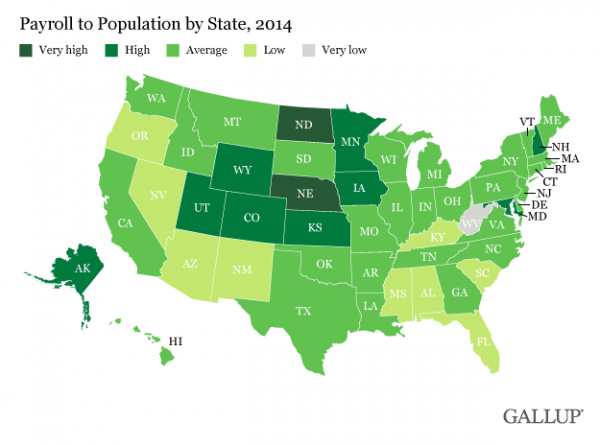
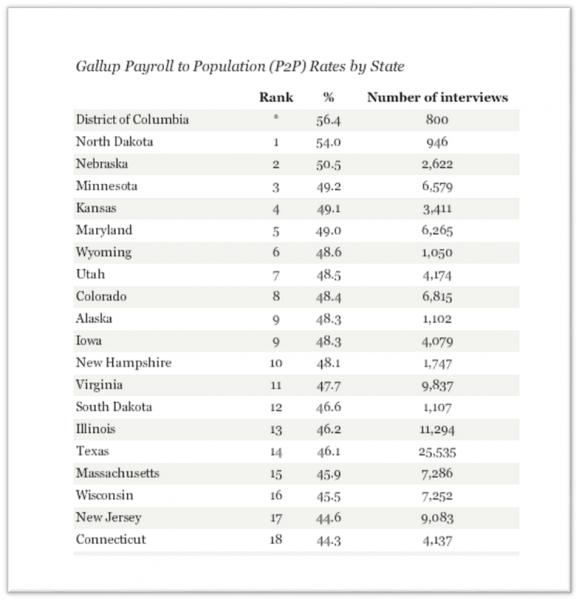
Connecticut ranks #18 in the nation in a measure of Payroll to Population (P2P), based on an analysis of the nation’s 50 states by the Gallup organization. The P2P metric tracks the percentage of the adult population aged 18 and older who are employed full-time for an employer, for at least 30 hours per week.  The rankings cover calendar year 2014. North Dakota (54 percent) had the nation’s highest Payroll to Population employment rate. A cluster of states in the northern Great Plains and Rocky Mountain regions -- including Nebraska, Minnesota, Kansas, Wyoming, Utah, Colorado and Iowa -- all made the top 10 on this measure, according to Gallup. West Virginia (35.6 percent) had the lowest P2P rate of all the states for the second consecutive year.

Connecticut was tied with Vermont with a P2P level of 44.3 percent.  Among the New England states, Connecticut and Vermont ranked in the middle, with New Hampshire ranked at #10, Massachusetts at #15, Maine at #22, and Rhode Island at #34.mpa

The year-long results are based on Gallup daily tracking interviews throughout 2014 with 353,736 U.S. adults. The payroll-employed data does not include adults who are self-employed, work fewer than 30 hours per week, who are unemployed, or are out of the workforce.

The differences in P2P rates across states may reflect several factors, Gallup points out, including the overall employment situation and the population's demographic composition. States with large older and retired populations, for example, can be expected to have a lower percentage of adults working full time. Connecticut has the 7th oldest population in the nation, which may influence the state’s overall ranking. The two states with the lowest P2P in 2014, West Virginia and Florida, have two of the largest proportions of residents aged 65 and older, at 17.3 percent and 16.9 percent, respectively.

Regardless of the underlying reasogallupn, Gallup indicates that the P2P rate provides “a good reflection of a state's economic vitality.”  Gallup also notes that P2P shows a stronger relationship than do unemployment rates with other important economic indicators, such as state GDP per capita.

In the overall rankings, Washington, D.C., had the highest P2P rate of any area in the country, at 56.4 percent, but Gallup points out that “it is unique in being the only entirely urban region in the survey, heavily dominated by the presence of the federal government, and with one of the lowest percentages of residents aged 65 and older (12.3 percent).”


Hospital Outreach Program, New Website and Video Advance Mission of The Hole in the Wall Gang Camp

The Hole in the Wall Gang Camp in Ashford, Connecticut began in 1988 as a way for seriously ill children, including those with cancer, to “raise a little hell,” as founder Paul Newman described it – a time and place when kids could simply be kids, without being self-conscious about their ongoing medical needs.  Twenty-seven years later, it is much more than a summer camp, offering a robust range of programs year round, in Connecticut and beyond. To tell that story, and increase public awareness of the array of programs available to children with acute medical needs, the Camp has launched a newly redesigned website (www.holeinthewallgangcamp.org) that eases navigation through the various program offerings, and produced a new video that highlights the range of activities and impact.hole web

Among the programs highlighted is the less widely known Hospital Outreach Program (HOP), one of a number of programs that have blossomed in recent years to extend the mission and impact of The Hole in the Wall Gang Camp into communities to reach more children.

Through one-on-one interactions and group activities, HOP “brings Camp’s unique summer programming and spirit to hospitals and clinics. Whether working bedside, in playrooms or outpatient clinic settings, our interactions and activities with children and families include arts & crafts projects, and interactive games specifically adapted for use in the medical setting, as well as other Camp-inspired programming and events. Just like at Camp, all interactions are guided by the child’s choice and are child-driven,” the website explains.

Responding to the fact that children in the hospital often feel isolated, fearful, stressed, and uncertain because of their illnesses, the Hospital Outreach Program “brings the hopeful, playful spirit of The Hole in the Wall Gang Camp to children, families, and their caregivers in the hospital setting, at no cost, year-round on a weekly basis.”

The HOP program has expanded to 35 medical facilities in Connecticut, Massachusetts, New York, New Jersey and Pennsylvania.  The Connecticut programs are offered at Connecticut Children’s Medical Center in Hartford, Yale-New Haven Hospital, Yale Pediatric Hematology and Oncology Clinic in Trumbull, and the Yale-New Haven Hospital’s Bridgeport Campus.281_2014CampWeekatCHOP-4576

The HOP Specialists that provide one-on-one sessions visits “have a bachelor’s degree, excellent kid skills, experience developing fun and exciting programming and knowledge of hospitals systems. They attend both a HOP and Hospital Orientation and receive regular opportunities for professional development,” the website points out.

At Children’s Hospital of Philadelphia (CHOP) last fall, the facility was “transformed into Downtown Camp” for a week, as nearly 30 Camp staff and volunteers and more than 60 CHOP volunteers provided five full days of Camp programming. In alogo-hop@2xll, there were “approximately 800 healing experiences with children and families throughout the week, bringing the safety, respect and love of Camp to many families” in Philadelphia.

Building on the success of the week, the Hospital Outreach teach is looking ahead to similar events across the network of partner hospitals.

Among the other programs offered during the year, in addition to the centerpiece Camp experience, are CampOut, which brings the Camp experience to campers in their own hometowns, weekend programs in Ashford in fall and spring, and Hero’s Journey for campers who have aged out of the summer program.  In addition, programs are offered for parents, caregivers and siblings of children participating in The Hole in the Wall Gang Camp.


http://youtu.be/P2516LEl6AM

Yale, UConn Among Top 100 in R&D Expenditures, Federal Data Shows

Yale University and the University of Connecticut both rank in the top 100 higher education institutions in the level of expenditures for research and development (R&D), according to data compiled by the National Science Foundation. Yale ranked at #21 and UConn at #86 in the rankings for fiscal year 2013, in the Higher Education Research and Development Survey compiled by the NSF and the National Center for Science and Engineering Statisticresearch-and-developments.

NSFThe top 10 institutions are Johns Hopkins, University of Michigan (Ann Arbor), University of Washington (Seattle), University of Wisconsin (Madison), University of California (San Diego), University of California (San Francisco), Harvard, Duke, University of North Carolina (Chapel Hill) and University of California (Los Angeles).

Among local colleges and universities in addition to Yale and UConn, nine other institutions in Connecticut appeared in the national rankings, including  Fairfield University at #343 and Wesleyan University at#348.  Southern Connecticut State University ranked #522, Connecticut College ranked #531,  University of Hartford ranked #535,Trinity College ranked #536 and Central Connecticut State University at #552.  In addition, University of New Haven ranked #575, and Quinnipiac University #611 in the analysis that reported 645 higher education institution R&D expenditures.

The Higher Education Research and Development Survey is the primary source of information on R&D expenditures at U.S. colleges and universities, according to the NSF website.

chartThe survey collects information on R&D expenditures by field of research and source of funds and also gathers information on types of research and expenses and headcounts of R&D personnel. The survey is an annual census of institutions that expended at least $150,000 in separately budgeted R&D during the fiscal year.Yale

UConn’s R&D expenditures, $242,251,000 in fiscal year 2013 according to the data, has increased from $215,098,000 in 2004.  At Yale University, R&D spending has nearly doubled - growing from $423,664,000 to $788,784,000 during the same period.

Such R&D spending often is seen as a gauge of innovation in a state, because research can turn into technology transfer or new companies and the quality of research can attract top students, the Bangor Daily News has reported.

Overall across the country, university spending on research and development in all fields totaled $67.2 billion in FY 2013, according to data from the NSF Higher Education Research and Development Survey.

When adjusted for inflation, higher education R&D increased by less than half a percent in FY 2013 from the previous year, according to NSF. Officials noted that the overall amount represents the reported totals from 891 degree-granting institutions that spent at least $150,000 in R&D in the previous fiscal year.uconn-new-logo

The published survey results include the 645 institutions that reported at least $1 million in R&D during their previous fiscal year and who contributed 99.8 percent of the total R&D expenditures reported in FY 2013.  The data was released by the NSF in late February 2015.

Note:  this article was revised to include a number of Connecticut institutions inadvertently omitted in initial publication.

Will Olympic Footprint Extend into Connecticut? State Officials Offer Possibilities to Planners; April 2 Public Forum in Springfield

Should Boston be selected in 2017 by the International Olympic Committee (IOC) to host the 2024 Olympic Summer Games, Massachusetts may not be the only northeast city to host Olympic events. Published reports indicate that venues outside the Bay State are being actively considered, and Connecticut’s Capital Region Development Authority (CRDA) is among the organizations reaching out to express interest.  Network coverage of the 2024 Olympic Games would come from NBC Sports - which has facilities based in Stamford, Connecticut - under an agreement between the network and the IOC signed last year.  Boston 2024

The official Boston 2024 website indicates that “there may be opportunities for preliminary rounds of certain events in other states.” The Boston Globe has reported that bid organizers have “held high-level conversations” with cities in addition to Boston about hosting events, including New York and Washington.  There are no indications that talks with Connecticut officials are underway.

Connecticut officials – and residents – may have an opportunity to weigh in when Boston 2024 holds a community meeting in Springfield, MA, on April 2 - one of 20 such sessions being held around the state of Massachusetts over the next few months, and the nearest location to Connecticut.  The community meetings begin in Lowell on March 11.  There does not appear to be a requirement that speakers be Massachusetts residents.

Rhode Island Gov. Gina Raimondo told the Associated Press earlier this month that she has spoken with Massachusetts Gov. Charlie Baker about collaborating and plans to put together her own team to explore how Rhode Island could benefit from Boston's bid.

CRDA, in a January letter to Boston 2024 officials, suggested that a number of Connecticut facilities “could serve for official events, whether preliminary or final; or for practice sites for teams and individuals competing in the Games.”  State officials suggested the Connecticut Convention Center and XL Center in Hartford, Rentschler Field in East Hartford, and the Connecticut Tennis Center in New Haven as facilities that could be considered by leaders of the Boston 2024 bid “as you advance your thinking and planning.”

The Globe recently reported that “by following the IOC’s guidelines and taking advantage of existing world-class facilities in other cities, Boston 2024 organizers believe they can avoid the white crda-logo-2-72053-1elephant venues and out-of-control costs that have plagued Olympic hosts for decades.”  Recently adopted IOC guidelines are aimed at reducing costs by host cities and are more amenable to having some events take place outside the immediate Olympic perimeter.

The Globe pointed out that at the most recent Summer Games in London, sailing was held 142 miles southwest of the host city and organizers staged mountain biking an hour’s drive from London. Soccer matches took place at stadiums in several cities, including Cardiff, Coventry, Glasgow, Manchester, and Newcastle, prior to finals in London.

The correspondence from CRDA Executive Director Michael Freimuth includes information about each of the Connecticut venues, and an invitation to “visit the facilities to assess them as a means to meet the demands of the Olympics.”  No word thuConnecticut-Tennis-Centers far on whether such a tour has been scheduled.  Possible sports at the Connecticut venues, as suggested by CRDA, include badminton, table tennis, wrestling, martial arts, and weightlifting.  Basketball, volleyball and soccer could be additional possibilities, along with tennis.   The Connecticut Tennis Center is described as the fourth largest tennis venue in the world, with seating capacity of 15,000.  Within the past week, options for major renovations or reconstruction of Hartford’s XL Center have been announced, with a decision on how to proceed due later this year.

The Boston 2024 website also notes that “many national Olympic and Paralympic teams will arrive months in advance of the Games to acclimate and train; they may lease facilities at high schools and colleges around the region.”

NBC owns the exclusive U.S. media rights for an unprecedented 11 consecutive Summer and Winter Olympics, a run which began with the 2000 Sydney Games and continues through the 2020 Summer Olympics.  In January 2013, the networkNBC-Sports-Logo-Small3-432x235 opened a state-of-the-art 300,000 square foot facility headquartered in Stamford, Connecticut on a thirty-three acre campus. The facility brought NBC Sports, NBC Sports Network, NBC Olympics, NBC Sports Digital, and NBC Regional Networks all under one roof.  In May 2014, NBC Universal agreed to pay a reported $7.75 billion for the exclusive broadcast rights to the six Olympic Games from 2022 to 2032.

International Olympic Committee president Thomas Bach, of Germany, called Boston’s 2024 Olympic bid “very strong” in an interview that aired during NBC’s Super Bowl XLIX pregame show earlier this month.  Boston could face formidable opposition from cities including Paris, Berlin, Rome and Hamburg and when the 102-member IOC votes to choose the host city. The deadline for cities to file bids is September 2015.