New London Features “One of America’s Most Beautiful Town Squares”

Town squares across the U.S. were built to inspire goodwill and be the hearts of their communities, often with stately landmarks and surrounding colorful shops and cafés. Travel + Leisure magazine went in search of the squares keeping that spirit alive, emphasizing smaller towns, with populations of 50,000 or less.  Among the top ten nationwide was Parade Plaza in New London.

Travel + Leisure reported that “Parade Plaza reopened in 2011 with a 100-seat amphitheater and the Whale Tail Fountain, where kids like to splash around. The improvements complement longtime attractions at the square like the schoolhouse where Nathan Hale once taught. “NL whale

Other top selections included the Yavapai County Courthouse Plaza in Prescott, AZ, which has been honored by the American Planning Association and the National Trust for Historic Preservation.  At the nation’s top squares, the article pointed out, farmers’ markets, free concerts, and holiday celebrations keep locals and visitors entertained year-round.

The Travel + Leisure website recommended that people “Set your sights on a road trip or weekend getaway to one of these small towns, and make the square your first stop.” 

The description of Parade Plaza was enthusiastic: “Reopened in 2011, this triangular plaza is new and improved, with an open amphitheater that seats 100 and the 10-foot-tall Whale Tail Fountain, popular with kids who play in the water falling from the tail. The schoolhouse where Nathan Hale once taught and the 50-foot-high granite-obelisk Soldiers and Sailors Monument are two traditional attractions. In winter, the upper section is turned into an ice-skating rink.”travel_leisure_logo

More information about Parade Plaza, and New London’s downtown revitalization efforts, is available at newlondonmainstreet.org.  The other New England squares included on the list are in Portsmouth, NH and Bar Harbor, ME.  

Joining New London on the list of top town squares selected by Travel + Leisure (in no particular order):

  • The Dover Green, Dover, DE
  • Court Square, Bardstown, KY
  • Market Square, Portsmouth, NH
  • Healdsburg Plaza, Healdsburg, CA
  • Historic Canton Square, Canton, MS
  • Yavapai County Courthouse Plaza, Prescott, AZ
  • Centerway Square, Corning, NY
  • Jackson Town Square, Jackson, WY
  • City Square Park, Oskaloosa, IA
  • Decatur Square, Decatur, GA
  • Village Green, Bar Harbor, ME
  • The Square, San Marcos, TX


Hometown Names Go Beyond Hometown for Connecticut Banks

What’s in a name?  In the banking industry in Connecticut, quite often it is the name one of the state’s towns.  Although there are more than two dozen out-of-state banks dotting our landscape, nearly an equal number of locally-based institutions have not only adopted the name of their hometown, they’re keeping that name even as the venture into neighboring communities – and well beyond.

Does Farmington Bank have the same cache in South Windsor?  Or Newington?  Does Rockville Bank sound as inviting in West Hartford as in Vernon?  Essex Savings Bank in Madison?  Jewett City Savings Bank (“your hometown bank”) in Brooklyn?  Simsbury Bank in Bloomfield? Or Savings Bank of Danbury, in Waterbury?

The recent opening  of Rockville Bank’s first west-of-the-river branch in West Hartford (joining 18 east of the Connecticut River), nearly simultaneous with Farmington Bank’s opening hometown banking 4in South Windsor and Newington Center, reflects the growing trend of “hometown” banks expanding their footprint beyond the four corners of their town borders – and seeing no need to change the name on the door.

In fact, last year Farmington Bank - now with 20 branches in central Connecticut - was recognized as the #1 small business lender in the state by the Small Business Administration (SBA) of Connecticut.  For SBA's fiscal year 2011-12, Farmington Bank approved 57 loans, totaling $8,628,000.

The town names doing double-duty as bank names:  Fairfield, New Canaan, Groton,Darien, Essex, Farmington, Greenwich, Suffield, Guilford, Jewett City, Litchfield, Milford, Naugatuck, Putnam, Rockville, Salisbury, Danbury, Simsbury, Stafford, Thomaston, Torrington, Wilton and Windsor.

And then there is Connecticut Community Bank, which operates five divisions, using five different names, which each utilize the names of their local communities in Darien, Greenwich, Norwalk, Stamford, and Westport.

Not to mention the regional institutions… from Fairfield County Bank to Northwbankest Community Bank, Naugatuck Valley Savings and Loan to Bank of Southern Connecticut and Eastern Savings Bank.  There’s also the Quinnipiac Bank & Trust Company – not quite a region, but not quite a town.  (Not connected with the university – neither is Southern or Eastern in the previous group.)

There is also Union Bank with 19 locations in Western Connecticut, which has nothing to do with the town of Union, clear across on the other side of the state.  And some local banks, such as The Community’s Bank with a single location in Bridgeport, or three of the state’s largest, Bridgeport-headquartered People’s United, Waterbury-headquartered Webster, and Middletown-headquartered Liberty Bank, which are very much homegrown but without the name of the their hometown in their moniker.

The list more than two-dozen banks, with a hometown in their name, according to the State Department of Banking:

Bank of Fairfield

Bank of New Canaan

Chelsea Groton Bank

Chelsea Groton Bank

Darien Rowayton Bank

Essex Savings Bank

Farmington Bank

First Bank of Greenwich

First National Bank of Suffield

Guilford Savings Bank

Jewett City Savings Bank

Litchfield Bancorp

Milford Bank

Naugatuck Savings Bank

Newtown Savings Bank

Putnam Bank

Rockville Bank

Salisbury Bank and Trust Company

Savings Bank of Danbury

Simsbury Bank & Trust Company

Stafford Savings Bank

Thomaston Savings Bank

Torrington Savings Bank

Wilton Bank

Windsor Federal Savings and Loan Association

Data Emerges on $20.4 Million Raised by Charities After Sandy Hook Shootings

Connecticut Attorney General George Jepsen and State Consumer Protection Commissioner William M. Rubenstein have made public information collected from dozens of charities related to the shooting deaths at Sandy Hook Elementary School in Newtown.  The data collected thus far indicates that 43 charities have collected nearly $20.4 million and have distributed nearly $2.9 million.

Among their charitable purposes, as reported by the organizations, are:  to provide direct financial support or other assistance to the 26 families who lost loved ones; to create scholarships and an endowment to support Newtown’s children and youth; to purchase memorial trees; pay for  construction of a physical memorial to those lost; and to recognize, support and inspire acts of kindness.

 The information was provided in response to a request for information by the Attorney General and Commissioner. The letter and short survey were sent March 28 to 69 charities either registered with the state Department of Consumer Protection, or publically identified as having accepted donations related to Sandy Hook Elementary, where 20 children and six adults were killed on Dec. 14, 2012. The charities were asked to respond by April 12.

 “This request was an initial step to provide information to the public, Newtown community and other charitable organizations trying to meet the needs of those affected by this tragedy,” said Attorney General George Jepsen.

There were 22 organizations that have not responded to the letter of inquiry as of April 15, and Jepsen said his office will be following up with each of them. The collected information is available on the Attorney General’s and Consumer Protection websites as a service to the public, however, the postings should not be considered an endorsement of any charity by the agencies or by the Statsandy_hook_school_Sign_balloons_thg_121215_wge.

Commissioner Rubenstein said, “We see this as a good first step toward providing transparency to the activities of the various funds, and guiding future donors who may wish to make a contribution.”  Among those outlining their fundraising and spending are the United Way of Western Connecticut, Sandy Hook Promise Foundation, Newtown Pride and the University of Connecticut Foundation.

 The charities were asked about their organization, services and funds, including the dollar amount of any donations and pledges to date; and the purposes for which money was being collected.  “Our offices may reach out in the future to all the charities to determine how the donations were expended and the steps taken to prevent fraud or misuse of funds,” Rubenstein said.

 Links are available to view:

 Survey results     Survey Questions       List of charities

 In addition, the Attorney General and Commissioner also asked charities and members of the public to refer names of other organizations collecting donations for Sandy Hook-related purposes.

 The Attorney General’s Office website also notes that Connecticut law requires groups that “ask in our state for anything of value to benefit a charitable purpose or charitable organization to register, or claim an exemption from registration, with the Public Charities Unit” of the office.   Companies that are paid to solicit on behalf of charities, usually by telephone, are also required to register.  The website explains that “registration is mandatory and does not imply that the state endorses any particular organization or paid soliciting company.”

The Public Charities Unit receives annual financial reports for registered charities.  According to the website, “Information on how the charity spends its money may help you decide whether you wish to support the organization with your donations.   If you have been solicited by telephone, we will also tell you how much of your donation goes to the charity and how much will stay with the paid solicitor.”

Regardless of the charity’s location, if the group intends to ask in Connecticut for anything of value to benefit a charitable purpose or other charitable organization, it must register to solicit (or claim an exemption from registration) by filing a form with the Public Charities Unit.

Waterbury, Hartford, Simsbury Achieve National “Main Street” Recognition

Connecticut Main Street Center (CMSC) has announced that three Connecticut Main Street designated organizations have been accredited as 2013 National Main Street Programs for meeting organizational performance standards set by the National Trust Main Street Center.  Simsbury Main Street Partnership, Upper Albany Main Street (Hartford) and Main Street Waterbury have been recognized for outstanding accomplishments toward the goal of revitalizing their historic main street districts following the Main Street methodology.  The announcement was made during the 2013 National Main Streets Conference in New Orleans.

"We congratulate this year's accredited National Main Street Programs for meeting our established performance standards," said Valecia Crisafulli, Acting Director of the National Trust Main Street Center. "Rebuilding a district's economic health and maintaining that success requires broad-based community involvement and support, in addition to establishing a solid organization with sound management that is committed to long-term success."2013MSC_WebBanner_619px_2

National Main Street Program Accreditation is a partnership between Connecticut Main Street Center and the National Trust Main Street Center to establish standards of performance for local Main Street programs. These standards set the benchmarks for measuring an individual Main Street program's application of the Main Street Four-Point Approach to commercial district revitalization, which includes Organization, Promotion, Design and Economic Restructuring.

Evaluation criteria determine the communities that are building comprehensive and sustainable revitalization efforts and include standards such as development and commitment to mission, fostering strong public-private partnerships, securing a stable operating budget, tracking economic progress, and preserving and bringing back to life historic buildings. These standards provide benchmarks and guidelines on how Main Street organizations should be functioning and serve as incentives for improvement.

Connecticut Main Street Center (CMSC) is a statewide nonprofit that inspires great Connecticut downtowns, Main Street by Main Street. Its mission is to be the champion and leading resource for vibrant and sustainable Main Streets as foundations for healthy communities.   Since the Connecticut Main Street program began in 1995, designated Main Street programs have generated waterburyover $1 billion in public and private reinvestment in their downtowns. Over the same time, 425 net new businesses have opened and 2,538 net new jobs have been created.

Connecticut's 2013 National Main Street Programs

Simsbury Main Street Partnership, designated in 1995, describes its focus as "forward-thinking economic development within the context of historic preservation, so that Simsbury's assets and legacy can be passed on to future generations." Designated a Preserve America Community by the White House in 2006, the Partnership works to integrate Simsbury Center's shopping, civic and entertainment activities into community heritage tourism opportunities. Through its partnership with the Town and the Hartford Symphony Orchestra, Simsbury Main Street Partnership has linked downtown restaurants and merchants to visitors to the Talcott Mountain Music Festival by establishing an outdoor vendor program where concert-goers can purchase food and drink and retail items. Simsbury was named by the National Trust for Historic Preservation as one of the 2010 Dozen Distinctive Destinations. More about Simsbury Main Street Partnership can be found at www.shopsimsbury.com

Upper Albany Main Street is "an economic development engine in Hartford working to improve the environment for small businesses, promote entrepreneurship, and establish Albany Avenue as a vibrant Afro-Caribbean neighborhood destination of choice." Designated by Connecticut Main Street Center in 2001, Upper Albany Main Street continues to position the organization to meet the socio-economic challenges of the neighborhood by addressing leadership development, and engaging residents in the entrepreneurial initiatives on the Avenue. Through its partnerships with the University of Hartford, the City of Hartford and the Metro Hartford Alliance, the Main Street program has developed the award-winning Micro-Business Incubator program, and a Public Safety initiative which has resulted in the Avenue being named a Weed & Seed Community by the U.S. Department of Justice. More about Upper Albany Main Street can be found at www.upperalbany.com

Main Street Waterbury, designated a Connecticut Main Street Community in 2003, has been guided by a commitment to building community consensus around the need to bring downtown back to life through a culture of collaboration. Forming a unique partnership with the City, the Waterbury Regional Chamber of Commerce and the Waterbury Development Corporation, Main Street Waterbury has been successful in bringing people back to downtown through its special events, community forums, and by focusing on a strategy of "Waterbury at Night"; recruiting restaurants and creating a downtown environment which encourages and complements activity around the existing entertainment destinations in downtown. Downtown Waterbury has seen the rehabilitation of a number of downtown's historic vacant and under-utilized mixed-use buildings, providing market-rate residential development on upper floors. More information about Main Street Waterbury can be found at www.mainstreetwaterbury.com

CMSC is supported by Founding Sponsors, the Connecticut Department of Economic & Community Development (DECD) and The Connecticut Light and Power Company, and by Growth Sponsors, The United Illuminating Company and the Connecticut State Historic Preservation Office. For more information, visit www.ctmainstreet.org


Movie Ticket Sales Up in 2012; Industry Cites Value vs. Sports, Theme Parks

Despite an increasing number of alternative forms of entertainment as technology continues to advance, the motion picture industry reminds us that movie theaters continue to draw more people than all theme parks and major U.S. sports combined. Noting that the average cinema ticket price increased by 3 cents in 2012, less than the 2% increase in inflation, the industry uses the comparisons to highlight the dollar value they provide to families nationwide.  Comparisons to other forms of entertainment, including video games and internet programming, was not included in the industry’s “Theatrical Market Statistics 2012” report.

A movie “still provides the most affordable entertainment option,” costing under $40 dollars for a family of four, according to the Motion Picture Association of America, as compared with $107.92 to attend a major league baseball game, $199.00 to attend one of the nation’s leading theme parks, $203.96 to go to an NBA game, $244.04 at an NHL arena, and $313.52 to attend an NFL game.

More than two-thirds of the population in the U.S. and Canada (age 2+) went to the cinema at least once in 2012, and the “typical moviegoer” bought six tickets during the year, a slight increase from the previous year.  A total of 1.4 billion tickets were sold during the year.

Among the nation’s 12 most populous states, 74 percent of the population of Illinois saw a movie in 2012, the highest share in any of those states.  Data pertaining to Connecticut family of fourwas not released. Cinema ticket sales continue to be driven by frequent moviegoers –those who go to the movies once a month or more. Frequent moviegoers represent 13% of the population but purchased 57% of all tickets sold in 2012.

“I am happy to report thaattendencet in 2012, both global and domestic box office were up and so were domestic admissions,” said former Connecticut Senator Chris Dodd, Chairman and CEO of the MPAA. “It’s a powerful reminder of just how much movies matter – not just to our culture, but also to our economy. Our industry supports 2.1 million jobs in the United States and more than 120,000 of those jobs are in movie theaters.”

The  top movies of 2012, by attendance:  The Avengers, The Dark Knight Rises, The Hunger Games, Skyfall and Twilight Saga: Breaking Dawn Part 2.


Stamford Ranks #7 Among Most Expensive Places to Live in U.S.

Stamford has been ranked as the seventh most expensive place to live in the United States, according to a report by CBS Moneywatch. The Council for Community and Economic Research meaCBS-MoneyWatch-2sured prices of common items in 307 urban areas across the country to create the list, the survey said. The study gave Stamford a cost of living index of 146.1 for 2012, the national average is 100.

The “market prices” that served as the data for the survey included the price of a half-gallon of milk, monthly rent, home prices, a gallon of gas, a haircut, and a bottle of wine.

Three of New York City’s boroughs – Manhattan, Brooklyn and Queens – were also in the top 10.  Stamford was just ahead of Washington, D.C.  Boston rounded out the top 10.  A year ago, Stamford ranked #6 in the survey.

The Council for Community and Economic Research, headquartered in Arlington, VA,  promotes excellence in community and economic research by working to improve data availability, enhance data quality, and foster learning about regional economic analytic methods.Stamford

The top 10 most expensive places, according to CBS Moneywatch:

1. Manhattan 2. Brooklyn 3. Honolulu 4. San Francisco 5. San Jose 6. Queens 7. Stamford 8. Washington, D.C. 9. Orange County, CA 10. Boston

Reductions in Financial Aid Would Harm CT Students in Independent Colleges

Leaders of the state’s independent colleges and universities are expressing concern about the impact on their students of proposed plans that would merge the state’s three financial aid programs into one and substantially reduce funding over the next four years. The proposal would restrict both the amount of funds that financial aid directors may award needy Connecticut students and to whom they may award the funds, points out Judith Greiman, president of Connecticut Conference of Independent Colleges.  Because the revamped system would no longer considering the cost of attendance, students at private colleges would be disproportionately impacted.

The plan is part of Gov. Malloy’s budget proposal is now being considered by the legislature.  It consolidates the longstanding financial aid programs into a single Governor’s Scholarship Program.  University of Hartford President Walter Harrison said the plan “will begin, brick by brick, to dismantle the strong array of independent colleges and universities” in Connecticut.

“While we understand the difficult budget issues that continue to impact state services, we must point out that the three primary state-funded financial aid programs, CICS, CAPCS and Capitol Scholars, have been substantially cut in the past two budgets and in the FY 13 rescission,” Greiman told the legislature. “This comes at a time of historically high student need. Cutting need-based grant aid any further will only hurt Connecticut’s students and families.”

Chart1The proposal also shifts funding from the two need-based aid programs to a program that determines financial aid based on need and merit.  In addition, for the first time it would reduce the amount of grant funds available to students by using some of the money to pay for state agency administrative costs.

Discussing the students helped by the state grants, Martha Shouldis, President of St. Vincent’s College in Bridgeport, told the legislature’s Higher Education committee that almost one-half of nursing graduates in the state, for example, are educated at private colleges.   She pointed out that students are “not only educated here but have a record of gaining employment here in Connecticut – they are an important part of the state health care labor pool now and in the future.”

CCIC has highlighted the role of the 16 independent institutions on Connecticut.  The schools:

  • Enroll 31% of all college students statewide including 45% of four-year minority students.
  • Award 44% of all degrees granted in Connecticut in 2010-11, including 44% of all Bachelor’s, 64% of all Master’s and 58.5% of all Doctoral and 57% of all Professional degrees.
  • Award 57% of all degrees received by minority students (four-year and above).
  • Award 53-72% of four-year and above degrees given in key economic development cluster areas.
  • Provided almost $65 million annually in need-based institutional financial aid to Connecticut undergraduates in 2010-11.map_2012

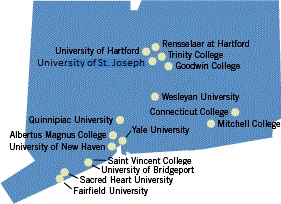
The CCIC institutions include Albertus Magnus College, Connecticut College, Fairfield University, Goodwin College, Mitchell College, Quinnipiac University, Rensselaer at Hartford, Sacred Heart University, St. Vincent’s College, Trinity College, University of Bridgeport, University of New Haven, University of Hartford, University of Saint Joseph, Wesleyan University and Yale University.

Young Adult Unemployment Rates Persist at High Levels, Education Remains Key Factor

Analyzing the enduring economic effects of youth unemployment, a new report by Demos outlines a serious job crisis, especially those with less education and individuals of color.  Surveying a full year of U.S. Bureau of Labor Statistics data from 2012, Stuck: Young America’s Persistent Jobs Crisis shows that 18 to 34 year-olds make up 45% of the total share of the unemployed population nationwide and continue to face a serious jobs gap—with 4.1 million new jobs needed to return to pre-recession levels of employment.STUCK Among the report’s key findings:

  • Young adults gained little ground in 2012. Altogether, there are more than 5.6 million 18 to 34-year-olds, 45 percent of all unemployed Americans, who are willing and able to take a job, but have been shut out of opportunities for employment.
  • Young adult Hispanic workers experience unemployment rates 25 percent higher than those of whites, while African Americans face rates approximately double.
  • The greatest differences were attributed to education: the unemployment rate for 18 to 24 year olds with a Bachelor’s degree was 7.7% compared to 19.7% for those with a high school diploma.
  • In 2012, the labor force participation rate of 18 to 24 year olds declined to its lowest point in more than four decades.
  • Workers with a four-year degree are 9 to 12 percentage points more likely to be in the labor market than workers with a high school diploma in every age group. The unemployment rate for workers with a high school diploma is twice as high as unemployment among workers with a Bachelor’s degreegraph

The findings update data provided in 2012 to the Connecticut Commission on Children and Connecticut Workforce Development Council, which indicated that teenage labor force participation had dropped 48.2 percent over the past 22 years across the US, and employment rates were lowest among teens of color.   The Commission and Council held a public forum on youth unemployment last year, noting that “For young people, the Great Depression isn't a history lesson - it's a current event.  While the overall unemployment rate hovered around 8 percent last summer, it stood at 17.3 percent for those between the ages of 16 and 24.”  The new Demos report suggests that progress has been negligible in the year since.

Demos is a public policy organization “working for an America where we all have an equal say in our democracy and an equal chance in our economy.”  The organization is led by former Connecticut Secretary of the State Miles Rapoport, and has offices in New York, Washington and Boston.   The new report indicates that if job growth continues at 2012 levels,  “it will be another ten years before the country recovers to full employment. Even then, workers under 25 will face unemployment rates twice the national average.”

The Demos report recommends that “Public investment to directly employ young adults—especially young adults of color and those without a college degree—could address the jobs crisis facing this generation, contribute to the recovery through increased consumer spending, and accomplish the kind of strong, stable, and diverse society that we envision for our future.”

Single Person Households on the Rise in Connecticut, Nationwide

People of a certain age remember the phrase “one is the loneliest number” from the Three Dog Night song of the ‘70’s.  Well, apparently in Connecticut and the nation, that’s not as true as it once was. In 1950, 22 percent of American adults were single. Four million lived alone. They accounted for 9 percent of all households. Today, more than 50 percent of American adults are single -- 31 million, about one out of every seven, live alone. These so-called “singletons” are the focus of a recent book by Eric Klinenberg, a sociologist at New York University, "Going Solo: The Extraordinary Rise and Surprising Appeal of Going Alone."

About 17 mil­lion women are living alone, compared to 14 million men. The majority, more than 15 million, are middle-age adults between the ages of 35 and 64.  About ten million are age 65 plus. Young adults be­tween 18 and 34 total more than five million, compared to 500,000 in 1950, making them the fastest-growing segment of the solo-dwelling population, Klinenberg points out.

Data from the 2010 U.S. Census on households and families reflect that in Connecticut 27.3 percent of households are one-person households, and 10.6 percent are a one-person household where the individual is 65 or older.  Those numbers are both slightly higher than the U.S. average nationwide of 26.7 percent one-person households, with 9.4 percent age 65 or older.

The Census Bureau also noted that the 2010 data was “the first time that husband-wife families fell below 50 percent of all households in the United States since data on families were first tabulated in 1940.”living alone

Among non-family households, the Census found that “one-person households predominated (31.2 million) and were more than three times as common as nonfamily households with two or more people (8.0 million).”  In addition, The Pew Research Center reports that the average age of first marriage for men and women is 'the highest ever recorded, having risen by roughly five years in the past half century. The percentage of Americans living by themselves has doubled since 1960.

"People who live alone are now tied with childless couples as the most prominent residential type -- more common than the nuclear family, the multigenerational family, and the roommate or group home. Surprisingly, living alone is also one of the most stable household arrangements. Over a five-year period, people who live alone are more likely to stay that way than everyone except married couples with children,” Klinenberg reports.

In the last century, he points out, living alone was by far most common in the open, sprawl­ing Western states -- Alaska, Montana and Nevada -- that attracted migrant working men, and “it was usually a short-lived stage on the road to a more conventional domestic life.” Today, people who live alone are most-often in metropolitan areas in all regions. The cities with the highest proportion of people living alone include Wash­ington, D.C., Seattle, Denver, San Francisco, Minneapolis, Chicago, Dallas, New York City, and Miami.

As Connecticut’s cities seek to add downtown living options to boost their 24-hour populations, the trends in the nation’s leading cities – and the national overall - are not going unnoticed.  The City of Hartford’s plan of development, for example, notes that “there are approximately 2,500 to 2,800 residents living in Downtown Hartford. A resident population of between 8,000 and 10,000 people is needed for a vibrant Downtown Hartford that is self-sustaining.”  It calls for an increase in “housing types that should include active adult housing, housing for college students, housing for young professionals and housing for families.”

Survey Reveals Teens Unprepared for Costs of College, Uncertain About Future

As prospective college students receive word this month on whether they’ve been accepted to their preferred institution – and how much financial aid they’ll be receiving - the greater challenge begins.  That’s the grueling exercise to crunch the numbers to try to come up with ways to afford the impending and imposing tuition bill. That reality makes the findings of the Junior Achievement USA® (JA) and The Allstate Foundation's 2013 Teens and Personal Finance Poll ring alarm bells for teens and their families, as they look ahead to the financial impact of college:

  • Only 9% of teens report they are currently saving money for college.
  • More than a quarter of teens (28%) haven’t talked with their parents about paying for college.
  • More than half (52%) of teens think students are borrowing too much money to pay for college.

JA is helping students understand the importance of saving and planning for future financial needs, working with students from kindergarten through 12th grade.  That’s at the core of JA’s work, driven by volunteers who provide a real-world view for students.  To meet the need reflected in the latest data and reach more students, JA has opportunities right now – often at a school close to home - for volunteers to participate.

The increasing cost of college, difficult job market and sluggish economy appear to be affecting teens’ views on the timetable for attaining financial independence, and the prospects for their long-term financial security.  According to the poll, during the past two years the percentage of teens who:

  • Think they will be financially dependent on their parents until age 25 has more than doubled – from 12% in 2011 to 25% in 2013.
  • Say they don’t know or are not sure at what age they will attain financial independence from their parents jumped from a mere 1% in 2011 to 11% in 2013.
  • Don’t know or who are unsure if they will be financially better off than their parents has risen significantly, from 4% to 28%.

Teens’ uncertainty about their financial future is also a reflection of their lack of financial knowledge and understanding.  More than one-third (34%) are somewhat or extremely unsure about their ability to invest money.  And of the 33% of teens who say they do not use a budget, 42% are "not interested," and more than a quarter (26%) think that "budgets are for adults."

“Today’s teens expect to be financially dependent on their parents longer, and the number who can’t even predict when they might gain financial independence has jumped ten-fold in just the past two years,” said Louis J. Golden, Pstudentsresident of JA of Southwest New England.  “The economy certainly plays a role, but part of the uncertainly is because far too many teens lack a fundamental understanding of how to manage their money.  JA delivers specific, effective programs directly to the classroom that respond to that knowledge gap.”

JA's unique delivery system provides the training, materials, and support necessary to build student skills in financial literacy, work readiness and entrepreneurship. Last year, more than 2,500 volunteers - business professionals, parents, retirees, and college students – offered JA programs to more than 34,500 students in schools throughout Hartford, Litchfield, New Haven, Windham, Tolland, New London and Middlesex counties.

The volunteers use their personal experiences to make the JA curricula practical and realistic. Providing children with positive adult role models, who illustrate ways to build self-confidence, develop skills and find avenues of success in our economic system, is a hallmark of Junior Achievement.  Individual interested in learning more about the JA volunteer program should contact 860-525-4510 or visit www.jaconn.net for details.