State Mental Health Budgets, Cut During Recession, Increase After Newtown Tragedy, Report Finds

State mental health budgets were gutted during the recession, according to a report issued by the National Alliance on Mental Health (NAMI), and are only now beginning to return to previous levels in most states, even as mental health needs are becoming better known and growing.

“With reductions totaling $4.35 billion from FY2009 to FY2012, public mental health systems struggled to meet rising demand with diminishing resourcesnami,” the report indicated. Then, the shooting at Sandy Hook Elementary School in Newtown on December 14, 2012 provided “a major impetus for lawmakers to propose legislation which would impact children and adults living with mental illness,” the 63-page report indicated.
Nearly 60 million Americans experience a mental health condition every year, according to the organization. Regardless of race, age, religion or economic status, mental illness impacts the lives of at least one in four adults and one in 10 children across the United States.

NAMI is the nation’s largest grassroots mental health organization.  NAMI advocates for access to services, treatment, supports and research and is steadfast in its commitment to raise awareness and build a community for hope for all of those in need.

“Realizing the risks of failure to provide adequate public mental health services, governors and legislatures in many states began the process of restoring state mental health budgets,” according to the report, “Trends, Themes & Best Practices in State Mental Health Legislation.”

The report concludes that “Dramatic changes in American healthcare finance and delivery systems combine with an improving economy and a growing array of best practices to provide a window of opportunity in the next few years to transform the mental health system and integrate care across systems.”

In addition, NAMI recommends that “advocates and policy makers should continue the work of building the mental health system of the future, one in which mental illness is identified as it emerges and an array of proven, cost-effective services are available as needed to provide children, youth and adults with the mental health care they need to stabilize, recover and live healthy lives.”

Looking ahead to the 2014 state legislative sessions, NAMI issued a series of recommendations including: mental health budgets
  • Actively engage in outreach and enrollment
  • Increase integrated care
  • Increase the mental health workforce capacity
  • Identify mental illness and intervene early
  • Build the bridge from Medicaid to private health coverage
  • Increase access to supported employment services
  • Increase housing with supportive services
  • Increase justice system diversion strategies
  • Comply with mental health parity
  • Expand Medicaid

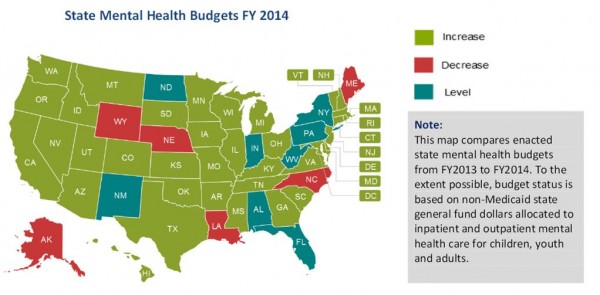
Most states either increased or maintained state mental health authority budgets at current levels during 2013 legislative sessions. Of special note, the report indicated, is Texas which allocated a $259 million increase over the previous biennial budget, the largest mental health budget improvement in the state’s history. South Carolina reversed previous cuts to its mental health budget while Illinois restored $32 million that had been cut in 2011 due to an administrative error. In California, an additional $143 million was allocated to create crisis and triage positions throughout the state.

The report stated that “A tipping point on the heels of several recent mass shootings, the Newtown tragedy shaped the debate about the lack of access to mental health services and the barriers that many families and individuals face in light of the nation’s fragmented and grossly inadequate mental health system.”

After the Newtown tragedy NAMI advocated for policies supporting early identification and intervention, training for school personnel, families and the public, mental health services in schools and increased access to care.

The report highlights actions by states in 2013 in areas including mental health system monitoring, early identification and mental health screening, services for transitional youth, school mental health training and services, mental health facilities and suicide prevention.  Also included are elements of state legislation in law enforcement areas such as juvenile justice, incarceration and the courts.  A final section looks at stigma reduction efforts in the states.

Mental illnesses are medical conditions that disrupt a person's thinking, feeling, mood, ability to relate to others and daily functioning. Mental illnesses are medical conditions that often result in a diminished capacity for coping with the ordinary demands of life.  Serious mental illnesses include major depression, schizophrenia, bipolar disorder, obsessive compulsive disorder (OCD), panic disorder, post traumatic stress disorder (PTSD) and borderline personality disorder.

Connecticut resident Marilyn Ricci, a past president of NAMI Connecticut, serves on the national NAMI Board of Directors, and is on the board of NAMI Farmington Valley in Connecticut, which she helped found in 2004.  Kevin Sullivan, a former Connecticut Lieutenant Governor currently serving as Commissioner of Revenue Services, is a past Board member of the organization. The state legislative report was issued on October 28, 2013.


Connecticut Skater Seeks Olympic Chance At U.S. Championships in Boston

Timing, as they say, is everything.  For Olympic hopeful Zachary Donohue of Madison, Connecticut, and his skating partner Madison Hubbell of Michigan, a lifetime of training, determination, resiliency and competition will be in full view at the U.S. Figure Skating Championships in Boston this week.

As U.S. national bronze medalists in 2012, and fourth place finishers at the 2013 U.S. Championships, the ice dance couple is at the cusp.  Three couples will earn U.S. Olympic team slots, to be announced on Sunday. The contest for those positions is expected to be extremely close.2014 USChampionships

For Donohue, it has been a long and winding road from New Haven and Madison, where he grew up, through New Jersey, Colorado, and Michigan where he trained and lived beginning at age 15, to the U.S. Championships in an Olympic year, just days after his 23rd birthday.

The journey began while visiting cousins in North Carolina, who took him along to go skating at a local spot.  “I was just messing around, imitating what they were doing.  One of my cousins said, “hey, you’re pretty good.”  Unbeknownst to 10-year-old Zach, his athletic ability on blades was mentioned to his mom, who promptly signed him up for a “Learn to Skate” program when they returned home to New Haven. He excelled, and skating soon evolved from a “cool outlet for all my energy” to a more serious interest.

Then at age 13, he grew a foot and a half in a year, and had to reduce his ice time to let his body catch up to itself.  The bones were outpacing the muHubbell_Donohue_FS_145scles, which made jumps and spins painful.  It was during that time that his love of music and interest in skating merged toward ice dance.

Now 6’2”, 195, Donohue is “tall, long and strong” – all attributes for a powerful yet graceful ice dancer.  Madison “Madi” Hubbell, at 5’8” is taller than many ice dance partners, and together they bring and impressive line to their skating.   The word most associated with their performances is “connection. “ They convey an emotional bond on the ice that is mesmerizing –earning the effusive admiration of commentators describing the fluidity, artistry and technical precision reflected in their routines.

In addition to training seven-days-a-week at the Detroit Skating Club, Donohue coaches skaters in nearby Troy, from 7 year-olds to young adults.  His coaching focuses on everything but dance, an understandable change of pace.  Through the years, he has discovered that he not only enjoys coaching, but choreography as well.  That is not only helpful with his students, but in developing the championship-caliber routines of Hubbell & Donohue.

Perseverance Through Injuries

It has been a stunningly successful and incredibly challenging, injury-riddled year.  Hubbell, out for two months recuperating from a concussion during which doctors precluded her from any exercise whatsoever, fought back and they not only competed effectively but won the coveted 2013 Nebelhorn Trophy in Oberstdorf, Germany, exceeding their personal best scores.  No small task in the best of circumstances; remarkable given the realities.  They had won the same competition two years ago, in their debut season together.

Barely back on the ice, and with pressure-packed competition as skating’s Grand Prix season intensifying, Hubbell has bravely forged through the current season despite a diagnosis of a labral tear, a hip-injury not uncommon in the sport, but incredibly painful, and at times, debilitating.  She has been forthright about the injury, describing the challenges and limitations on their blog, while remaining upbeat and positive.  And despite it all, they won their first-ever Grand Prix medal, and finished fourth at Skate America.

“They just focus, and they’re so supportive of each other.  It is the persistence of an athlete – I’ve worked so hard for this, I’m just not gonna stop.  They both have that,” observes Diane “Dee” Eggert, Donohue’s mother and biggest fan.  Their recent success, in the midst of trying times, comes built on a foundation of trust and confidence that is “essential to any partnership,” Donohue points out.  “Although still a relatively new team, just three years together, it was evident relatively quickly that “all the pieces fell into place” when they got together.  “It takes time to get the kinks out,” Donohue says, but “we have become that well-oiled machine, through a tremendous amount of hard work.”  Hubbell’s determination working through injuries has impressed not only Donohue, but the skating community.

It is an on-ice partnership that was unplanned, but clicked immediately.  Hubbell had skated with her brother at the lower rungs of the skating ladder, and excelled, winning championships and much notice.  When he opted to retire from skating, Donohue was simultaneously ending a previous partnership, which also had brought success.  They found themselves on the same Detroit rink, at the same time, in need of new partners, and a coach off-handedly suggested they help each other out that day by working together.  Hubbell and Donohue haven’t looked back.

Local Roads to National Acclaim

Donohue easily recalls time spent training and practicing at rinks in Cromwell, Newington and Simsbury, as his interest in and dedication to the sport grew.  It was his mom who drove endlessly through central Connecticut to get him to training sessions, coaches, and practice time.  “She’s always been by my side,” Donohue points out, appreciatively.  “Skating puts a lot of stress on parents.”  For those of modest means, especially so.

Employed by the security department at Yale University for nearly 15 years after a career in law enforcement, she added an extra job or skating imagetwo along the way to help meet the relentless expenses of a skating career.  She worked the overnight shift, so days could be spent with her son.  Because of his skating-centric life, Donohue was home-schooled through his teenage years, and college plans remain on hold for now.


Beyond the ever-present skating, he has interests – and talent - in music and culinary arts, in addition to coaching and choreography.  When Zach was 12 years old, he was selected as the singer to open a show at the Shubert Theater in New Haven, and his mom marveled at his ability to sing in front of an audience of nearly 500 people.  Entertaining crowds has always been something he’s comfortable with.  “He’s my cheering section, and I’m his cheering section,” she says proudly, recalling his growing success and relentless tenacity.

At every turn, she concluded “how can I stand in the way of his whole career,” as he proceeded to pursue the next step in the dream.  She recalls vividly when she once broached the subject of giving up skating, as a youngster.  “Well, there was just no way.  He said he’d run away from home, sleep on the ice, and drive the Zamboni if he had to.  That’s when I knew how much skating meant to him.”

At 15, he moved to New Jersey where he lived in his coach’s home and trained during the week, returning to Connecticut on weekends.  By 17, he was moving to Colorado to work with a new coach as his development and advancement continued.  While there, he had an opportunity to work with ice dance legend Christopher Dean, among his icons in the sport.

“It’s a sacrifice you make,” Eggert says, reminiscing about the Christmases, Thanksgivings and other holidays where Zach hasn’t quite been able to make it home.  Donohue’s mom and Hubbell’s mom talk regularly, provide support and encouragement as needed, and look ahead.  Whether or not they are selected for the Olympic team, other goals beckon, including the World Championships later this Spring, and noteworthy competitions thereafter.

“There are daymadi_zach_sc2013s it’s hard but then you get to the competition and you realize it’s all worth it,” said Donohue.  “There’s never a day I don’t love it.  I love being on the ice.”

Artistry and Athleticism

The music for their Short Program, to be skated on Friday, will be a “Big Bad Voodoo Daddy,” medley featuring the quickstep, foxtrot, and Charleston. For the free dance (long program) the next day, “Nocturne into Bohemian Rhapsody.” The music has been well received by audiences this year, and Donohue is pleased with his role assisting in the choreography.  “I’m stubborn and outspoken,” and thereby earns a say in choreography decisions.

“He and Madi both feel the music.  It’s a gift.  Even when he was young, when he was practicing and someone else’s music would start, he’d skate away to the music.  It’s been that way since day one,” Eggert recalled.

Four years ago, Donohue was in juniors, with a different partner on the ice.  Today, he is on the brink of the Olympic dream becoming reality.  What will fans see in Boston?  A “better-than-ever version” of performances that earned top honors in Germany, even as extremely talented American teams vie for coveted Olympic slots.

“We’ve been working on our lifts and elements, and becoming stronger, faster and lighter.” Donohue admits to some nervousness prior to skating competitions, but that is quickly eclipsed by confidence as the music begins.  The training regimen, from intense cardio to a relentless series of physically demanding exercises, is unending but essential.  Injuries have required adjustments, but no stoppage.

The contrasts in skating can take your breath away.  The unique combination of artistry and athleticism makes it a singular sport - also unique in that a man and woman are paired in competition.

Not to get ahead of the story, but the 2014 Olympics will have an attractive new feature – the first-ever figure skating team event, similar to the team competition in gymnastics.  That will provide Olympic skaters with an opportunity to medal not only in individual events, but as part of a team – and Team USA is expected to be very much in the running.  If all goes wonderfully in Boston, Madi and Zach – described by his mom as “two peas in a pod” - will be, too.

Task Force Report on State Response to Alzheimer’s Nears Completion

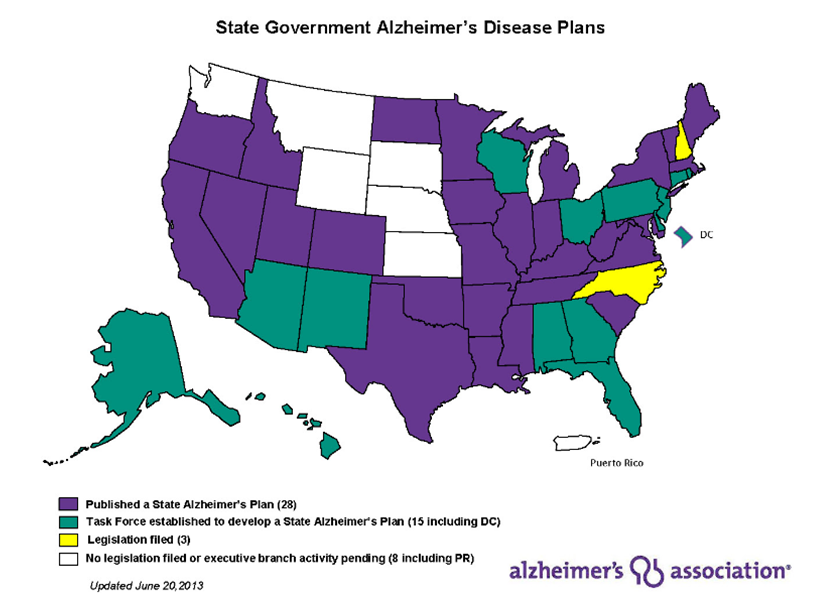
Thirty-one states have published a plan to respond to what advocates describe as the “escalating crisis” of Alzheimer’s Disease. Connecticut may be next, and is one of 13 states currently in the midst of developing plans.

The Connecticut Chapter of the Alzheimer’s Association was among the leaders in crafting and shepherding legislation in the 2013 General Assembly session to create a task force to study the care provided to persons diagnosed with Alzheimer's disease and dementia in the state.  That Task Falzheimers-wordsorce has been up and running throughout the fall, and is poised to announce its recommendations next month, just ahead of the start of the 2014 legislative session in February.

The 23-member task force of key agencies and community stakeholders convened in September, under the auspices of the Legislative Commission on Aging, to prepare findings and recommendations on ways to improve early detection, better coordinate health care services, set training requirements for health care providers and other professionals, services for early-stage and younger onset, and support to family caregialz mapvers.

The Task Force was co-chaired by State Commissioner on Aging Edith Prague and Rep. Joseph Serra of Middletown.  Members included Laurie Julian of the Alzheimer’s Association in Connecticut and other diverse community stakeholders appointed by legislative leadership and representatives from state agencies including the Department of Public Health, Department of Emergency Services, Department of Banking, Department of Labor and Department of Social Services, as well as six current legislators.

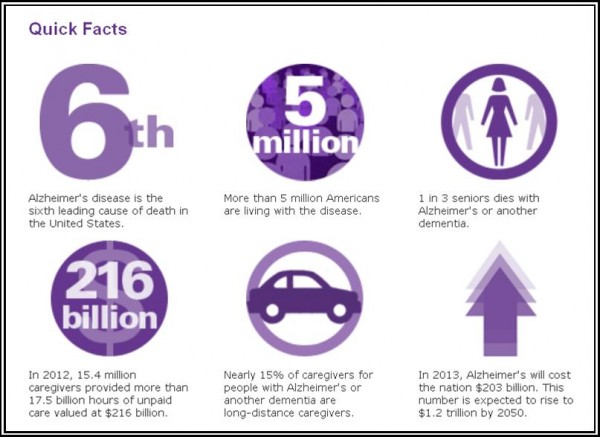
Over 5 million Americans are living with Alzheimer’s, and as many as 16 million will have the disease in 2050. Nearly one in every three seniors who dies each year has Alzheimer’s or another dementia. The cost of caring for those with Alzheimer’s and other dementias is estimated to total $203 billion in 2013, increasing to $1.2 trillion (in today’s dollars) by mid-century. Between 2000 and 2010, nationally, the number of people who died as a result of breast cancer, prostate cancer, heart disease, stroke and HIV all declined, while the number of people who died with Alzheimer’s increased by 68 percent.

In Connecticut, there were 820 deaths due to Alzheimer’s Disease in 2010, there are more than 63,000 individuals with Alzheimer’s in nursing homes in the state and it is estimated that 68% of nursing home residents have a cognitive impairment. As of 2010, there were an estimated 2,800 people between age 65-74 with Alzheimer’s in Connecticut, 30,000 between 75 and 84, and 37,000 age 85 or older.

The task force, in accordance with the legislation, will make recommendations in areas including:alz stats

  • services provided to persons diagnosed with Alzheimer's disease and dementia; including persons with early-state and early-onset of Alzheimer's disease, and such persons' family members and caregivers
  • legislative policy changes to better serve such persons, family members and caregivers;
  • coordination between state agencies and private community-based health care providers to serve such persons, family members and caregivers;
  • case management services for such persons, family members and caregivers;
  • the transition of such persons from one health care facility to another; and
  • the placement of such persons in community-based settings or health care facilities other than nursing home facilities, when feasible.

The state legislature acknowledged the growing numbers of residents impacted by the disease, passing the bill unanimously earlier this year, with 67 co-sponsors. It was signed into law in June by Gov. Malloy.  The Alzheimer’s Association has been actively involved in the effort. The organization’s   Connecticut chapter is based in Rocky Hill, with regional offices in Hamden, Norwalk, Norwich and New Milford.

In accordance with the legislation, the task force report is due to be published early next month, according to officials at the State Legislative Commission on Aging.


Hartford Hospital Will Devote Annual Fundraiser to Mental Health

The call to action regarding mental health awareness and treatment, which intensified in the aftermath of the Sandy Hook Elementary School murders a year ago, now has a strong local voice for the New Year.  Hartford Hospital is kicking off a campaign to end the stigma of mental illness at the annual Black & Red Gala on January 25, 2014 at The Bushnell Center for the Performing Arts in Hartford. The goal is to obtain 5,000 pledges, spreading the message that changing attitudes can begin to change minds.

Proceeds raised at this year’s Black &Red will benefit the Institute of Living (IOL) at Hartford Hospital. The IOL will be better able to respond to this national call to action with improved access to mental health care for adolescents and young adults –a critical need not only in Connecticut, but throughout the nation. Support will help carry out critically needed research, offer increased shhMainLogoSubervices and treatments, and provide much needed education to those impacted by mental illness.

An estimated 26.2 percent of Americans ages 18 and older — about one in four adults — suffer from a diagnosable mental disorder in a given year. In addition, mental disorders are the leading cause of disability in the U.S. and Canada. Many people suffer from more than one mental disorder at a given time.

Mental health stigma can be divided into two distinct types, according to the Hartford Hospital website:

  • social stigma is characterized by prejudicial attitudes and discriminating behavior directed towards individuals with mental health problems as a result of the psychiatric label they have been given.
  • perceived stigma or self-stigma, is the internalizing by the mental health sufferer of their perceptions of discrimination and perceived stigma can significantly affect feelings of shame and lead to poorer treatment outcomes.StopTheStigma_WordsMatter

The annual gala – Hartford Hospital's lead fundraising event - will feature entertainment by Barenaked Ladies, winner of two American Billboard Music Awards and two Grammy nominations.

Individuals attending the event will be asked to sign a “pledge” to...

  • Show compassion by reaching out to those in need of help. I will not let anyone suffer in silence.
  • Have the courage to speak up and challenge stereotypes and attitudes. I will not tolerate or perpetuate stigma.
  • Teach by sharing my own experiences with mental illness and encouraging others to share their stories with me. I will learn in order to change.
  • Demand a change in how we view and address mental illness. I will help lead the way.

The pledge, and additional information about mental illness and the Hartford Hospital initiative, is now available on a new webpage on the Hospital’s website, at www.stopthestigma.org   Individuals do not need to attend the event in order to sign the pledge – that can be accomplished directly on the website.

 “We will be looking to our employees of Hartford Hospital and across the Hartford HealthCare system to take the pledge. As a healthcare leader in the community and the state, it is our duty to set the example and stop the stigma associated with mental illness. Together, we can do it,” said Stuart Markowitz, M.D., President Hartford Hospital and Hartford Region, Senior Vice President Hartford HealthCare.

Harold (Hank) Schwartz, M.D., Hartford HealthCare Regional Vice President, Psychiatrist in Chief, Institute of Living at Hartford Hospital, says for some people, a mental illness iol_logo_300x175may be a lifelong condition, like diabetes. “However, as with diabetes, proper treatment enables many people with a mental illness to lead fulfilling and productive lives. By helping combat the stigma associated with mental illness, we can help increase the number of people that seek treatment.”
Examples of common mental illnesses include bipolar disorder, depression, PTSD, schizophrenia, OCD, anxiety disorders, eating disorders, ADD/ADHD, autism and Asperger’s.  CT by the Numbers has previously reported on research underway at the Institute of Living.

A year ago, over $1,000,000 in net proceeds was raised at the Black & Red gala for Hartford Hospital’s transplant services.

New Haven Is Among Most Walkable Cities in America, Ranks #8 Nationwide

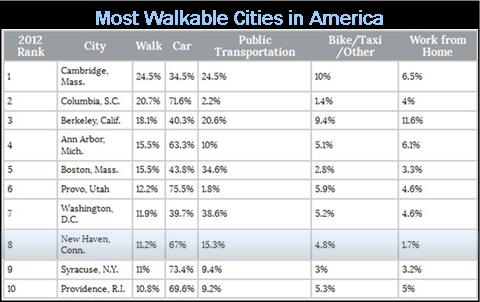
New Haven is one of America’s most walkable cities, with 11.2 percent of commuters walking to work, the 8th highest percentage in the nation, among cities with populations of at least 100,000.  The top 10 list of Most Walkable Cities, published by GOVERNING magazine, notes that many of top communities are in the Northeast, and that communities across the country are stepping up efforts to enhance alternative ways of commuting from home to work. New_Haven_downtown_mapThe top cities were Cambridge, MA (24.5%), Columbia , SC (20.7%), Berkeley, CA (18.1%), Ann Arbor, MI (15.5%), Boston, MA (15.5%), Provo, UT (12.2%), Washington, DC (11.9%), New Haven, CT (11.2%), Syracuse, NY (11%) and Providence, RI (10.8%).OLYMPUS DIGITAL CAMERA

Overall, 67 percent of New Haven commuters use their car, 11.2 percent walk, 4.8 percent bike or use other modes of transportation, and 1.7 percent work from home., according to the data developed from the U.S. Census Bureau's American Communities Survey, which included 300 metropolitan areas.

Nationally, only 2.8 percent of workers primarily commuted by walking last year, a figure that remains mostly unchanged from recent annual estimates, GOVERNING reported.

Among the New Haven walkers, 36 percent are age 16-24, 52 percent are age 25-44, 9 percent are age 45-64 and 2 percent are age 65 or older.  The median age of walk commuters is 27.8, according to the date.  In categorizing individuals, a person’s longest distance traveled is used, so those walking tp transit stations are designated as public transportation commuters, even though a portion of their daily commute involves walking.

Among Connecticut’s most populous cities, in Bridgeport 4.3 percent of commuters walk to work; in Stamford the figure is 4.7 percent, in  Hartford 7.9 percent, and in Waterbury 2.6 percent.

walkable chart

Pediatrician’s Invention to Stop Pain of Injections Could Improve Public Health

Many parents bring their infants and young children to the doctor for injections and leave muttering “there’s got to be a better way,” their child in tears or traumatized by the shot – or shots – administered to prevent illness and disease.  When Amy Baxter left the pediatrician’s office with her youngster, she resolved to find that better way.

Baxter, who attended Yale University as an undergraduate, Emory Medical School, and is now an emergency pediatrician, pain researcher and inventor in Atlanta, successfully developed  - with financial support from the National Institute of Health – a game-changing  device that combines high frequency, low amplitude vibration and a unique reusable ice pack a combination sAmy Baxter ATLpecifically designed to remove pain from the injection.

By stimulating competing sensations, nerve transmission of sharp pain, itching, or burning is blocked.  Simply put, the shots don’t hurt – and independently verified research indicates that it works.

As inventor of the unique needle pain blocking device - called Buzzy - Baxter founded a company that manufactures and distributes the product nationwide.  It is now in 1,200 children’s and adult hospitals across the country, including Yale-New Haven Hospital, Connecticut Children’s Medical Center, and Lawrence & Memorial Hospital in New London,  and it is being used in Connecticut, with varying frequency, by about 100 physicians in medical practices all across the state, from Ashford to Westport.

Buzzy is a bee-shaped palm sized device (wings included) that appears as cute as a toy but has a more important mission – to alleviate pain, thus eliminating the onset of fear. Baxter’s company, Georgia-based MMJ Labs, produces the fast, effective solution– which has applications beyond children, and beyond injections, to other ailments and sources of quick, sharp pain.

Since its launch in 2009, Buzzy has amassed more than 36,000 users, $1 million in annual revenue, and rapidly increasing sbuzzy shotales.  Baxter is one of Inc. Magazine’s Top Women in Tech to Watch, and is asked all over the world to educate physicians, nurses, Child Life specialists, and others about the importance of pain management.
“I invented Buzzy after experiencing first-hand the indifference of the healthcare system to the pain and suffering of children. As a pediatric emergency physician and pain researcher, I have learned that pain relief is not just a luxury; it actually improves the outcomes of procedures,” Baxter explains.

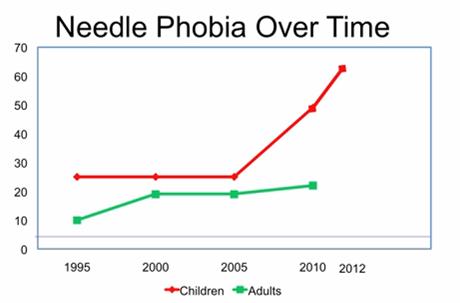
Data indicates that fear of needles is growing among children and the general population, and Baxter says that’s reason for concern.  Especially troubling is the long-term impact of a growing population oneedle phobia over timef needle-averse adults will have on their own health and the health care system.
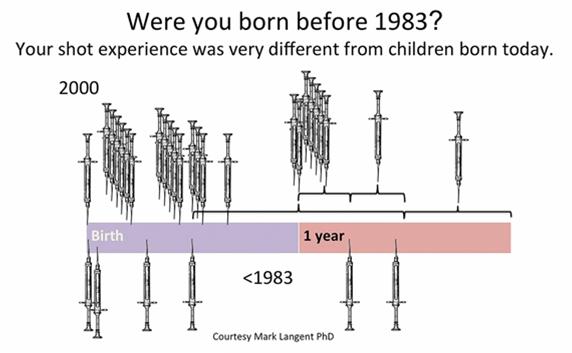
She cites statistics that reflect a dramatic increase in the number and frequency of shots children receive as youngsters – as much as four times higher than 50 years ago – and sometimes as many as four or five shots in a single doctor’s office visit.  And she stresses that pediatricians generally do little or nothing to try to diminish the pain that accompanies those injections.  That, Baxter says, has dramatic and long-lasting effects, on children as well as their parents.   The youngsters come to view the visits as more about pain than health, and the parents begin to have second thoughts about continuing to inflict the pain of needles on their children, often regardless of the potential benefits.

In a TEDx talk in Atlanta last month, Baxter discussed the public health repercussions of having populations whose fear of vaccinations could turn them shotsaway from the very remedies that can improve their individual health and the health of entire populations, warning that “by ignoring pain we’re endangering the future of health care.”

In the talk, titled “Pain, Empathy and Public Health,” Baxter warned that “the number and the way were giving shots is causing needle fear” which may lead to today’s children electing to stay away or delay visits to doctor’s offices as adults – at considerable potential health peril.

In the face of a potential “public health tsunami,” Baxter says “the solution is not to stop vaccinating, it’s to start making the shots better— vaccines shouldn't have to hurt.”

Nonprofits Nationally Suffer From Late Government Payments, CT Tackling Issue

Connecticut is one of eight states that has begun to respond to a serious problem facing nonprofit organizations in a time of tight budgets and reductions in state funding:  late payments and duplicative requirements by government agencies.  A new report from the Urban Institute says the problem – which grew more serious during the recession – may be easing somewhat, but still has a way to go.

The 57-page report, “Nonprofit-Government Contracts and Grants:  Findings from the 2013 National Survey,” indicated that “Joint government-nonprofit working groups in Connecticut, Hawaii, Illinois, Maine, Maryland, New Jersey, New York, and Texas are tackling issues, such as duplicative documents and audits and late payments, with the goal of improving government processes and the ability of nonprofits to win and successfully implement contract and grant requirements.”

The data, according to the report, is “a sobering reminder that human service nonprofits are continuing to wait extended periods of time for payments.”  The national survey indicates that 22 percenonprofit report covernt of nonprofits received payments 61-90 days late from local governments, 24 percent from state governments and 20 percent from the federal government – all increases from 2009 survey data.  The number of nonprofits experiencing late payments of more than 90 day dropped slightly for local and state government payments, but grew slightly for federal government payments.

The Urban Institute report outlined a series of recommendations for governments and nonprofits to improve systematic relationships; state-by-state data is due to be released next month.

A 22-member Connecticut panel appointed by Gov. Dannel Malloy, in a report issued last fall, found that “some state agencies do not pay contractors in a timely manner consistent with agreed upon timeframes and thereby create additional hardship and costs of borrowing for nonprofit service providers.”

The group recommended that “the State of Connecticut adopt Principles to Guide the State-Private Nonprofit Provider Partnership, intended to promote a fair, effeCT Report coverctive, responsive, transparent and accountable partnership between nonprofit providers and their state government funders.” It also called for revisions to the state’s procurement standards, streamlining data gathering, and “payment rates that cover the true cost of services.”

Nationally, nearly half of organizations reported that they experienced limitations on the percentage of government funds that could be used for program and organization administration costs. Approximately one-quarter of organizations with a contract indicated that they had to share in the cost of the contract and one-half of grantees said they had a matching requirement associated with a grant.

Reflecting the fiscal challenges faced by nonprofits, the report found that “more than 40 percent of respondents turned to their reserves to make ends meet and about 25 percent of nonprofits reduced the number of employees on their payroll. About 14 percent of organizations reduced the number of clients served and almost 11 percent cut programs.”  In addition, 21 percent of respondents nationwide said their experience with government contracts and grants was worse than in the prurban institute chartevious year, while 6 percent said it had improved.

The report concluded that “all types of nonprofits reported problems with late and insufficient payments, complex and burdensome application and reporting processes, and changes made to contracts and grants after they have been approved.”

Late payments have the biggest impact on human-service and health organizations, which receive the lion’s share f all government spending on nonprofits, the Chronicle of Philanthropy reported. Overall, the national study found that:

  • government agencies entered into approximately 350,000 contracts and grants with about 56,000 nonprofit organizations;
  • on average, nonprofits have six contracts and/or grants per organization; the median is three; and
  • governments paid $137 billion to nonprofit organizations for services (in 2012)

The Urban Institute is a nonprofit, nonpartisan policy research and educational organization that examines the social, economic, and governance problems facing the nation.

CT, NY, NJ Should Expect Unprecedented Flooding by Mid-Century, Scientists Predict

It will get worse, not better, for shoreline residents and businesses in Connecticut, New York and New Jersey within range of the Atlantic Ocean.  That’s the likely scenario based on newly completed research by a team of geoscientists who are predicting that the New Jersey shore will likely experience a sea-level rise -- about 1.5 feet by 2050 and of about 3.5 feet by 2100 – that will be 11 to 15 inches higher than the average for sea-level rise globally over the century.

Hurricane Sandy Bears Down On U.S. Mid-Atlantic CoastlineThat would mean that by the middle of this century, the one-in-10 year flood level at Atlantic City, for example, would exceed any flood level seen previously, including the natural disaster that was Superstorm Sandy.  The scientists suggest, based on their research, that “planners should account for rising sea levels,” noting that “where the consequences of flooding are high, prudent planning requires consideration of high-end projections” outlined in their study.

Geoscientists at Rutgers University and Tufts University base their projections in part upon an analysis of historic and modern-day records of sea-level rise in the U.S. mid-Atlantic region. Their research appears in the inaugural issue of the journal Earth's Future, published this month by the American Geophysical Union (AGU).

While much to the work centers on the New Jersey shore and The Battery in Lower Manhattan, Rutgers researcher Ken Miller told Connecticut by the Numbers that their analysis included both Montauk on Long Island and Bridgeport.  Since Connecticut lies on bedrock, Miller said, it will largely behave like The Battery in New York CityAGU logo.  “I believe that the projections for bedrock locations are applicable throughout Connecticut,” said Miller, a professor of earth and planetary sciences in Rutgers' School of Arts and Sciences. shore map
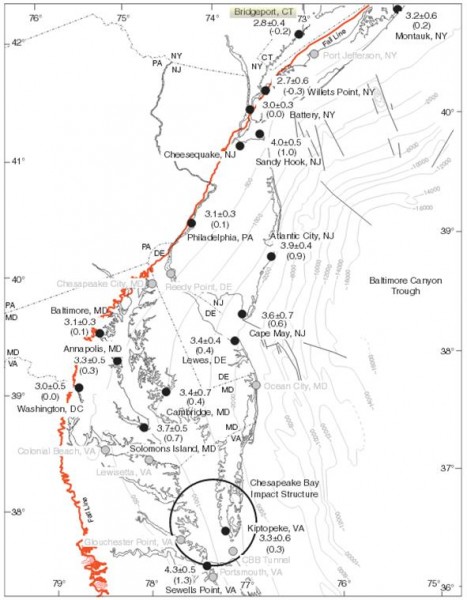
Miller collaborated in the study with colleagues Robert Kopp, Benjamin Horton and James Browning of Rutgers and Andrew Kemp of Tufts. Kemp, an assistant professor of earth and ocean sciences at Tufts since May, joined the faculty from Yale University, where he was a Postdoctoral Associate at the Yale Climate and Energy Institute (YCEI).  The new research builds upon a recent study by Kemp, Horton and others that reconstructed a 2,500-year record of sea level at the New Jersey shore. Horton is a professor of marine and coastal sciences in Rutgers' School of Environmental and Biological Sciences.

"It's clear from both the tide gauge and geological records that sea level has been rising in the mid-Atlantic region at a foot per century as a result of global average sea-level rise and the solid earth's ongoing adjustment to the end of the last ice age," Miller told Rutgers Today. "In the sands of the New Jersey coastal plain, sea level is also rising by another four inches per century because of sediment compaction -- due partly to natural forces and partly to groundwater withdrawal. But the rate of sea-level rise, globally and regionally, is increasing due to melting of ice sheets and the warming of the oceans."

The researchers suggest that “additional work is needed to integrate site-specific sea-level rise projections with storm tide statistics to guide planning decisions and investments that may have time frames of 20 years, 40 years, or longer.”  They indicate that sea-leEarth's Future covervel rise in the mid-Atlantic region also results from changes in ocean dynamics. The researchers said sea-level rise could be higher -- 2.3 feet by mid-century and 5.9 feet by the end of the century -- depending on how sensitive the Gulf Stream is to warming and how fast the ice sheets melt in response to that warming.
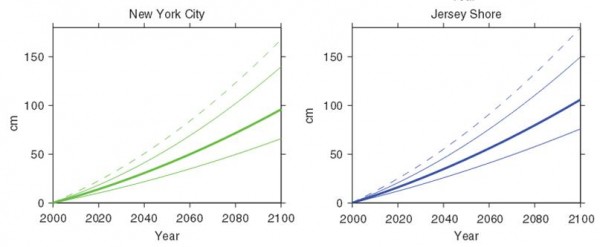
The study found that the eight inches of climate change-related regional sea-level rise in the 20th century exposed about 83,000 additional people in New Jersey and New York City to flooding during 2012's Superstorm Sandy.  The research was supported by a grant from the National Science Foundation.

Earth’s Future, with its inaugural issue, joins AGU’s prestigious portfolio of peer-reviewed research publications, including Geophysical Research Letters and Journal of Geophysical Research – Atmospheres. Both are ranked among the top ten most-highly cited research publications on climate change over the past decade.  The American Geophysical Union is dedicated to advancing the Earth and space sciences for the benefit of humanity through its scholarly publications, conferences, and outreach programs. AGU is a not-for-profit, professional, scientifinyc njc organization representing more than 62,000 members in 144 countries.

Developing Downtown Housing Above Commercial Space Brings Obstacles, Opportunities, New CT Report Finds

Connecticut's downtowns have a wealth of potential to redevelop under-utilized buildings into housing above commercial space - if mixed-use development can be encouraged through financing and favorable regulations, according to a new report from the Connecticut Main Street Center (CMSC).

The report comes at the conclusion of the first year of Come Home to Downtown, a pilot program CMSC established to encourage and facilitate viable, interesting housing opportunities while revitalizing downtown neighborhoods.  The initiative was contracted by the Connecticut Housing Finance Authority (CHFA) to promote housing in Connecticut's downtowns.

Three communities - Middletown, Torrington and Waterbury - as well as three property owners and their buildings, were selected as the focus of the program’s inaugural year. CMSC chose buildings typically found throughout Connecticut so they could serve as models for other towns. As a result, most of the findings expressed in the report apply to any Connecticut downtown wishing to maximize the potential of its existing infrastructure.Come-Home-logo-150x150

Among the key findings, the report indicates that mixed-use development is among the most challenging, and private owners are often in a “catch-22” as they seek financing.  Downtown management capacity is critical to the success of mixed-use development, the study found. In addition, the CMSC report explains that even when zoning regulations promote redevelopment, they are often not enough to enable mixed-use growth and a severe lack of financing impedes the growth of much-needed mixed use development.

"CMSC's report provides insights that will guide future housing development on Main Streets across Connecticut. The first year of the Come Home to Downtown program is not only creating opportunities to establish new rental housing in downtown neighborhoods, it's creating a model for other communities to follow,"   said Eric Chatman, President & Executive Director of CHFA, which has contracted with CMSC for a second year of the pilot program, which will focus on finding and creating financing.

The report's seven key findings are:

1. There is a huge amount of potential for accommodating mixed-use development - which both saves and generates monies - in Connecticut's downtowns. According to the U.S. Environmental Protection Agency, the infrastructure costs to service compact, dense development like that found Downtown reportin mixed-use neighborhoods are one-third to one-half lower than in suburban areas. It has been estimated that every downtown in Connecticut has at least one building that is under-utilized, containing a store or restaurant on the first floor, but with upper floors that are vacant or used for storage that could instead generate income if converted to apartment homes.
2. Mixed-use development is one of the hardest types to accomplish. There are several reasons why this is the case: these buildings are usually older and in need of greater rehabilitation; they are in need of complex financing from multiple sources; combine several uses in one building (such as housing and retail space); and are often owned by people with little to no redevelopment experience.

3. A severe lack of financing impedes the growth of mixed-use development. Because these deals are so intricate and multi-faceted, financing for the total development costs rarely exists from traditional sources.

4. Education and outreach to owners of possible mixed-use property is needed. Property owners are often unprepared for the complex process of redeveloping their building and unaware of the potential benefit in doing so. Very often, they also need assistance learning how to become landlords and attract good tenants.

5. Private-owners are in a catch-22 when it comes to obtaining financing. With regard to apartment homes located in mixed-use buildings, private owners can either apply for subsidies if they place income/affordability restrictions on the apartments, or the units are not restricted, but there is no subsidy for apartments at the same rental rate.

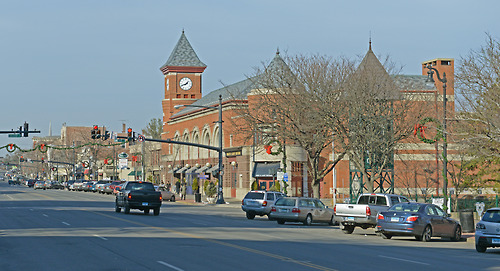
6. Even when zoning regulations promote redevelopmmiddletownent, they are often not enough to enable mixed-use growth. Favorable zoning regulations are important, but they cannot create mixed-use development by themselves. Each of the pilot communities had zoning policies that allowed for buildings with a mix of uses - a practice which should be commended and encouraged - but there were still significant impediments to promoting this type of growth. In addition, lessening current on-site parking requirements as a whole will also help promote housing in our downtowns.

7. Downtown management capacity is critical to the success of mixed-use development. Any community interested in promoting revitalization of its downtown should consider enhancing its management function by becoming a resource center for mixed-use development, including convening key stakeholders, collecting data, offering education and information and coordinating development incentives.

"There is now a better understanding of what the next steps need to be, and a greater appreciation of the importance of the public-private partnership that is necessary to overcome the challenges and achieve reuse of these properties," Rose Ponte, Torrington's former Director of Economic Development, said about the new report.

 Engaging an expert team of consultants, CMSC worked with municipal officials and the building owners to develop viable redevelopment options including: determining what financing would likely be needed for redevelopment; performing an assessment of zoning and regulatory requirements; reviewing the downtown management function; and measuring the downtown's walkability. Specific recommendations for improving the buildings, including a recommended floor plan designed to attract new residents and bring market rate housing downtown, was also provided to each property owner.

Once rehabilitated, these buildings will create 60 new units of rental housing in downtown Middletown, Torrington and Waterbury, as well as make approximately 25,000 square feet of commercial and retail space available. The total development cost to renovate all three buildings is estimated to be $11.4 million.

"You see it on an almost daily basis - news articles and reports showing the demand, especially among Millennials and Baby Boomers who want to live in walkable, interesting places. It doesn't seem to matter if the downtown is large or small, as long as they can live there and get around without a car to go to the movies, grocery store or coffee shop, that's where people want to be these days," said John Simone, CMSC President & CEO.

In the pilot program’s second year, CMSC will choose two new communities while continuing to work with the property owners and municipal officials in Middletown, Torrington and Waterbury.

Bullying Presents Ongoing Danger; Efforts to Educate Intensify As Incidents Continue

"From a young age, we teach children to say, 'Sticks and stones will break my bones, but names will never hurt me.' But this isn't true. Bullying hurts so much not because one individual is rejecting us but because we tend to believe that the bully speaks for others that if we are being singled out by the bully, then we are probably unliked and unwanted by most. Otherwise, why would all those others watch the bully tease us rather than stepping in to help support us? Absence of support is taken as a sign of mass rejection.”

That observation, in Social: Why Our Brains Are Wired to Connect, a new book by Matthew D. Lieberman, Director of the UCLA Social Cognitive Neuroscience laboratory, Socialpublished by Random House, provides insight into why bullying has such dramatic impacts, including incidents in Connecticut.

A Hartford Courant review of state education records, published this fall, found more than 1,250 incidents of school bullying were reported to the state from 2005 to 2012. The state's largest cities — Hartford, Bridgeport and New Haven — reported the most incidents, with Hartford reporting 91 verified incidents.

A quarter of the state's high school students — and 35 percent of the state's ninth-graders — report having been bullied or harassed on school property, according to the state Commission on Children. The Connecticut School Health Survey shows that state high school students who report being bullied are more likely to get less sleep, miss school because they feel unsafe, feel depressed, or attempt suicide, the Courant reported.

New Recommendations Anticipated

The state Department of Education plans to make a series of recommendations to the 2014 General Assembly “to address current conditions in Connecticut.”  Those recommendations may include an examination of the terminology regarding bullying and climate in an attempt to signal increased and focused attention on improving school climate in addition to, or rather than, exclusively reacting to bullying incidents, as well as addressing the relationship between the definitions of bullying and harassment and the implications for actions that the district or state should take regarding reported incidents.

The Department prepared “Bullying and Harassment in Connecticut:  A Guide for Parents and Guardians” a year ago, in December2012.

Programs Respond and Teach

The Anti-Defamation League (ADL) is one of the leading organizations providing information and training for individuals who work with students on a daily basis, and anti-bias and anti-bullying programs for students ranging in age from fourth grade through seniors in high school. Such programs include “Names Can Really Hurt Us,” “Step Up!” and “Becoming an Ally.” The Connecticut ADL hosted two parent workshops in Greenwich this fall, just weeks after a 15-year-old Greenwich student took his own life on the first day of school this fall, and friends said bullying may have been a factor in the death.

The programs, which had been planned since the spring, sought to give parents strategies for bullying prevention and intervention. As part of the program, Greenwich High School students who had been trained by ADL talked to those in attendance about their experiences with bullying and cyber-bullying, Greenwadllogoich Time reported. “We offered strategies and resources that the parents found very valuable. It was a unique opportunity for parents and high school students to have an open and honest dialogue about bullying and cyber-bullying issues that face today’s youth,” said Marji Lipshez-Shapiro, ADL Connecticut’s Director of Education.

The ADL programs explore stereotyping, prejudice, discrimination and scapegoating through the lens of students' experiences, and include student testimony, skits, videos and discussion groups. The ADL’s Names Can Really Hurt Us is described as a powerful, student-centered assembly program designed to give a voice to the targets of bullying and prejudice, build empathy in the perpetrators and inspire bystanders to become allies. ADL works with a team of students and school staff who participate in six hours of training and assist ADL in putting on a full-day program consisting of a morning assembly, break-out groups and a closing assembly.  During the morning assembly, student participants share their personal experiences with bullying, name-calling and prejudice in a safe forum. Students then participate in small group discussions led by student-teacher teams. The program culminates with a report of “next step” ideas, generated by students, to help create a welcoming and supportive school community.

Incidents Continue Despite Law

Stamford police arrested a 12-year-old girl and charged her with disorderly conduct for bullying another girl this fall. Police said an investigation began in September when the target's parents contacted police and said another student had repeatedly bullied the 13-year-old at school. When the bullying worsened and the targeted girl made comments about committing suicide, police saidstop bullying they immediately got involved. School administrators in Manchester last month suspended four Manchester High School students suspected of creating and posting degrading descriptions of female students, The Hartford Courant reported.

In Connecticut, the state legislature unanimously passed an anti-bullying law in 2011 that speeds school response, expands staff training, makes all school employees mandated reporters of bullying, addresses cyber bullying and launches statewide school climate assessments.  Under the state legislation, schools must report acts of bullying to the state. The state's definition of bullying includes "the repeated use by one or more students of communication, a gesture or a physical act directed at or referring to another student in the same district that causes physical or emotional harm or fear of such harm."

A 2011 U.S. Department of Justice survey shows that 54 percent of Asian-American teenagers, 38.4 percent of black students and 34.3 percent of Hispanics reported being bullied in the classroom. The survey found that 31.3 percent of white students reported being bullied.

In September, Michelle Pincince, Project Director of the Connecticut ADL’s A World of Difference Institute met with about 25 school resource officers from throughout Connecticut. The program, which took place at Redding Elementary School, was organized by Redding Police Chief Doug Fuchs, according to published reports.  A school resource officer is a law enforcement officer who is assigned to a school in his town, and who protects the students in the school and works to promote positive relationships between students and law enforcement. ADL runs 200 education programs and reaches over 20,000 individuals in Connecticut annually.  Since the school year began this fall, 31 Connecticut schools have participated in ADL programs.