Aurora Foundation Grants Focus on College Preparedness, College Completion for Region's Girls

The Aurora Foundation, which supports women and girls in Greater Hartford, has awarded a $20,000 grant to Trinity College and four partner organizations to launch Free to Succeed, a pilot program designed to increase higher education opportunities for women being released from prison in Connecticut.  The grant is the largest among ten grants, focused on college preparation and college completion, being provided to ten organizations, totaling $92,000. By forging a collaborative initiative, the Trinity Prison Seminar Series, Capital Community College (CCC), Manchester Community College (MCC), Community Partners in Action, and Judy Dworin Performance Project have created a program providing accessible college-level course offerings, advising, arts engagement, and mentoring for female inmates at York Correctional Institution (YCI), the state’s only prison for women, and pivotal support services after their release to expedite enrollment in associate degree programs at CCC and MCC.aurora_logo_new2

At Trinity, Judy Dworin, professor of theater and dance, emerita, and Sheila Fisher, professor of English and coordinator of the Trinity Prison Seminar Series, were instrumental in developing Free to Succeed, the goal of which is to ensure that participating women, who begin taking college classes while still incarcerated, are able to complete an associate’s degree upon release.

Since 2005, Dworin’s nonprofit organization, Judy Dworin Performance Project (JDPP), has offered comprehensive arts outreach programs for women, children, and families affected by incarceration. The Trinity Prison Seminar Series (TPSS), since 2012, has provided post-secondary credit-bearing courses for women incarcerated at YCI. Prison education outreach efforts at Trinity College provide educational opportunities for Trinity undergraduates to investigate critical issues concerning the correctional system through reading and discussion, as well as through field study.

The Aurora Foundation will also be providing a $15,000 grant to the University of Saint Joseph (USJ) for a new initiative, Inspiring College Readiness &aurora Increasing College Retention for Minority Women in the Greater Hartford area. This new program will provide a stipend for USJ Latina students to complete an internship at either the Connecticut Department of Children and Families or the USJ Gengras Center. It will also provide inspiration to Bulkeley high school girls to hear from the USJ students about exploring careers and remaining in school.

The Urban League of Greater Hartford’s Project Ready College Success Program, GO, GIRLS! leverages an existing program and will pilot its first minority female cohort. This program, which also is to receive a $10,000 grant from Aurora Foundation, “has the potential for being a model to replicate at other Urban Leagues.,” according to the Foundation. The grant will enhance and expand its existing program designed to provide college preparation and retention services to at-risk minority females to increase the likelihood that they will enroll in and succeed in attaining college degrees.

The Women in Transition (WIT) program at Charter Oak State College is an initiative that provides the opportunity for single, underemployed and underserved mothers to earn a college degree on-line. A $10,000 grant from Aurora Foundation will cover the cost of tuition and fees, books and internet service. The Women in Transition Program was established in 1999 by the former President of Charter Oak State College, Dr. Merle Harris.

The Aurora Foundation, which partnered with the Farmington Bank Community Foundation to support Free to Succeed, is currently focusing strategic grant making and community initiatives in the areas of college readiness and retention, based on findings from the organization’s 2014 Aurora Report indicating that college completion is critical to a woman’s economic stability and well-being, as well as that of her family.  Grants are also being provided to the University of Hartford’s Women’s Advancement Initiative, the Hartford region YWCA, Grace Academy, Goodwin College’s Women Investing in Secure Education (WISE) program, and the Boys & Girls Club of Hartford.

The organization’s website stresses that “As we move into our planning for the 2016 grants cycle, we will be increasingly focused on partnering with organizations with programs proven to help females complete their college education, knowing how important a post-secondary degree is to economic self-sufficiency that women seek for themselves and their families.”

Trinity College President Joanne Berger-Sweeney will be the keynote speaker at the foundation’s 10th Annual Signature Breakfast on October 16.  The theme is “Driving Change for Women.”

Shelton's Wiffle Ball Being Pitched for National Toy Hall of Fame

A Connecticut native is being considered for induction into the National Toy Hall of Fame.  The Strong National Museum of Play in Rochester, N.Y. has announced its twelve finalists for this year's induction into the National Toy Hall of Fame, and the Wiffle Ball – invented and still manufactured in Connecticut - is among them.Screen-Shot-2015-09-17-at-11.10.28-AM-1050x623 It all began in the summer of 1953, when David N. Mullany, grandfather of the current company owners (brothers David and Stephen) was watching his 12 year old son and a friend play a game in their backyard in Fairfield, using a perforated plastic golf ball and a broomstick handle. They had given up on baseball and softball - not enough players for two teams, not enough space for a field, and too many broken windows.


After some trial and error, the wiffle ball was invented, and the rest is history – perhaps Hall of Fame worthy history. Even with the abundance of toys and rapidly expanding new technology available to today’s youth, the Wiffle Ball business remains strong, with millions manufactured in Shelton and distributed world-wide every year.wiffle

The competition is tough, including favorites from more recent decades and some with origin generations ago.  Among the other toy finalists for 2015: American Girl dolls, Battleship, coloring book, Jenga, PLAYMOBIL, puppet, scooter, Super Soaker, Teenage Mutant Ninja Turtles, top, and Twister. Only two of these iconic toys will be inducted into the Hall of Fame. The finalists are chosen by historians and curators at The Strong. From there, a national panel of judges made up of inventors, educators, psychologists and others choose the winners.

strongEstablished in 1998, the National Toy Hall of Fame serves to recognize toys that have stood the test of time, remaining popular with kids generation after generation. The 12 toys are chosen on the advice of an advisory committee, and the winner will be announced at the Strong Museum in Rochester next month - on Thursday, November 5 at 10:30 a.m.

Inducted toys are selected on the basis of the following criteria:

  1. Icon-status: The toy is widely recognized, respected, and remembered.
  2. Longevity: The toy is more than a passing fad and has enjoyed popularity over multiple generations.
  3. Discovery: The toy fosters learning, creativity, or discovery through play.
  4. Innovation: The toy profoundly changed play or toy design. A toy may be inducted on the basis of this criterion without necessarily having met all of the first three.

If the Wiffle Ball wins, it will join toys such as bubbles, Candy Land, checkers, Crayola Crayon, Mr. Potato Head, Barbie, Monopoly, Easy-Bake Oven, G.I. Joe, the Frisbee, View-Master and Hot Wheels, just to name some of the 56 toys that have been inducted so far.  Last year’s selections were the Rubik's Cube, bubbles and Little Green Army Men.  The previous year, Chess and the Rubber Duck were inducted.

The Strong Museum is also running an internet-based poll asking viewers to select their preferred toy.  (One vote permitted every day.)   With 4,500 votes cast as of this week, the Whiffle Ball is in the lead among the 12 finalists, with 854 votes, about 18 percent of the total votes cast; followed by the puppet, the coloring book and Teenage Mutant Ninja Turtles.

https://youtu.be/iPrFiBxCX-s

Building Police-Community Connections As Diversity Lags in Hartford

When Governing magazine examined the diversity within local police departments, compared with the communities they serve, Hartford was among the ten cities with the largest disparity.  But two recent programs that have also received national attention underscore the city’s efforts to strengthen relationships between police and the community. The data indicated that Hartford’s police department was 35.3 percent minority, in a city where the population is 84.1 percent minority.  That was the 7th largest gap in the nation, after Fontana, CA; Edison, NJ; Irving, TX; Grand Prairie TX; Daly City, CA; and Allentown, PA.  Using 2013 data, Governing reviewed 269 local police agencies across the country.

The article points out that “although no national standards regarding diversity levels exist, the Commission on Accreditation for Law Enforcement Agencies does require accredited agencies to adopt steps to ensure their workforce mirrors their communities.”  It also indicates that “law enforcement experts emphasize that mending fractured relationships with communities takes much more than merely a diverse force.”hartfordltc1

Two locally developed programs, one at the Hartford Public Library (HPL) and the other at the Charter Oak Cultural Center, are working at building police-community relationships.

HPL is one of 10 public libraries in the U.S. that have been participating in the American Library Association’s Libraries Transforming Communities (LTC) initiative since April 2014. The initiative, in collaboration with the nonprofit Harwood Institute for Public Innovation, is an 18-month community engagement training program where libraries learn how to address challenges facing their community.

Hartford’s work was recently featured on the national website of the American Library Association.Week-3-boy-teaching-HPD1-e1435857651518

Through eight community conversations in Hartford’s North End neighborhood, HPL found that residents’ main concerns were public safety, community violence, and their relationship with the police. In response, a three-session community dialogue on public safety with police and community members was held, led by HPL community engagement director Richard Frieder.  Participants ranged in age from 18 to 87.

During the three sessions, according to published reports, the groups got to know each other; talked about what makes a good neighborhood and what they liked about theirs, what they would like to change, how safe community members feel, and what they believed the residents’ and police officers’ roles were in making the community safe; and figured out how to take action and solve the problems.

Some of the ideas generated include having the police and the community members participate in more activities and learning experiences together, such as block parties and community theater, where they address these issues.  Even though the 18-month project officially ends this month, HPL’s staff hopes to sustain the values and goals they developed.

3958730264_662fc1b23f_zAt the same time, another initiative in the city was taking root – one which soon reached the pages of The New York Times and the attention of the White House.

The Charter Oak Cultural Center’s Good Vibrations program began with a conversation between Hartford’s police chief, James Rovella, and the Center’s director, Rabbi Donna Berman.  The innovative program, which began earlier this year, sought to pair middle school age students who were at a crossroads in their lives with Hartford police officers to inspire and inform the youths involved as well as helping to change the community's negative perception of police officers.  Nearly two dozen students – and police officers – collaborate on musical instruments, and in composing rap lyrics.  The relationships built, and music made, has been described as transformative. Good Vibrations includes two free courses; a Rap Poetry/CD production class, and a guitar class. All the materials are free, including the guitars, which students get to keep.

white hosueLast month, a Hartford police officer and a seventh-grader who participate in the program were honored at the White House as "Champions of Change" for their role in helping to build "bridges between youth and law enforcement, while improving public safety," according to the White House. "During the three-and-a-half month program, officers and youth helped to lift the negative stigma between police and youth through open discussions about racism, crime, government, and family."

One participating middle-schooler told the Times: “I thought police officers were just to catch bad guys and be in a bad tone. But these guys are awesome. They’re always in a good tone with us. They play with us. They tag along in our jokes. They do stuff with us. They help us. They give us advice and everything.”


Medical Device Tax Seen as Inhibitor to Innovation, Repeal Sought

Emerging technologies that can develop breakthrough medical devices are at the intersection of innovation and tax policy, and a growing list of businesses and organizations are urging Congress to repeal a tax, instituted as part of the Affordable Care Act, that they say is harmful to industries with the potential to improve lives and boost local economies.  The issue has particular resonance in Connecticut, where efforts to grow technology, precision manufacturing and the medical and pharmaceutical industries have accelerated in recent years. tech Medical technology creates more than two million jobs directly and indirectly across the United States. The industry is one of the few U.S. manufacturing sectors that is a net exporter, and its innovations help reduce the human and economic burden of chronic disease.  Industry officials point out that while U.S. leads the world in the development of new medical technology, the device tax “threatens that leadership.”

Earlier this year, a bipartisan majority of the U.S. House of Representatives voted to repeal the medical device tax.  The fate of the proposal in the Senate is unclear.  A growing coalition of research advocates, disability rights leaders, patient groups and others support repeal of the device tax because, they say, it drains critical resources away medical innovation.  According to a 2015 study by opponents of the tax, two-thirds of med-tech companies that were surveyed said they had to either slow or halt job growth at their companies because of the medical device tax.backpain_skeleton-165x300

Between 2002 and 2012, the number of jobs in the Medical Equipment and Supplies Manufacturing industry in Connecticut increased by 10.75 percent, with the addition of about 700 jobs, according to the Connecticut Economic Resource Center (CERC).  CERC’s research indicated that jobs in the field were almost twice as concentrated in Connecticut in comparison to the United States, with average wages above the national average, with more than 150 companies in the medical equipment and supplies manufacturing business.

Connecticut’s medical device industry continues to see new entries.  Just two years ago, a company launched by a 2011 UConn graduate, Orthozon Technologies, received local notice for its newly developed “minimally invasive tool for spine surgeons,” which led to the company’s quickly “gaining momentum in the medical device field,” the Fairfield County Business Journal reported that year.

The Stamford-based company’s Lumiere™ is a state-of-the-art minimally invasive surgical retractor that provides “access and visibility for physicians as well as faster and less painful recovery time for patients,” according to the company website.  Utilizing a patented technology with powerful unobstructed fiber optic lighting, translucent retractor blades, full medial access, and an expandable field of view, the medical device provides surgeons with a tool “for quicker and more efficient spinal decompressions.”

Earlier this month, when the state’s fastest growing technology firms were honored at the 2015 Marcum Tech Top 40, in partnership with the Connecticut Technology Council, medical devices were among the technologies highlighted. chart

One of the leading categories included “Medical Devices companies manufacturing medical instruments and devices including medical diagnostic equipment (X-ray, CAT scan, MRI), medical therapeutic devices (drug delivery, surgical instruments, pacemakers, artificial organs), and other health related products such as medical monitoring equipment and handicap aids.”

Among the companies selected was Guilford-based Bio-Med Devices, which designs, manufactures, and markets a complete line of critical care and transportable respirators/ventilators, air - oxygen blenders, ventilation monitors,  disposable and reusable breathing circuits, and accessories.

Connecticut Innovations. The state’s leading source of financing and ongoing support for Connecticut’s innovative, growing companies, highlights six Connecticut companies in the medical device industry within its investment portfolio, with some investments dating back to 2007.

Nationwide, an aging population, people with disabilities living longer lives, and chronic disease rates growing at faster rates, lead advocates of repeal say now is the time for more—not less—resources to advance cures and treatments that help people live longer and healthier lives.  The industry survey indicated that 85 percent of respondents plan to reinstate forgone R&D projects if the tax is repealed.

https://youtu.be/uqTdNffOaas

Early Childhood Data Aims to Helps Pre-K Learners in Hartford, West Hartford Neighborhoods

Long before a child steps into a Kindergarten classroom, they are getting ready for school. How ready they are on day one, and how local policies can influence that preparedness, is the focus of an initiative in Greater Hartford that has proven to be successful in communities around the world. In partnership with the public school districts and municipal leadership of Hartford and West Hartford, the Hartford Foundation for Public Giving is piloting the use of the Early Development Instrument (EDI) to gauge the learning readiness of incoming Kindergarteners from different neighborhoods.

photoRecognizing that families and caregivers are the first teachers— and homes and neighborhoods are the first learning environments – the EDI process strives to discern what works best.  The EDI is an assessment that provides population-level data by neighborhood on school readiness, and has been used in over 40 communities in the United States and extensively internationally.

“Positive relationships and supportive environments guide a young child’s development and provide the foundation for future learning and well-being,” said Richard Sussman, director of Early Childhood Investments at the Hartford Foundation for Public Giving. “While the EDI provides important data, the most impactful aspect of this project is the collective action strategy which encourages parents, residents, and communities to use data to make positive changes to support young chilteccs-logo-web21dren and families in their neighborhoods.”

Last year, after students had been in class for at least three months, Kindergarten teachers in Hartford, West Hartford, and Jumoke Academy filled out a comprehensive questionnaire regarding the social competence; emotional maturity; language and cognitive skills; physical health and well-being; and communication skills of each of their students.  Approximately 2500 kindergarten students were included, representing about 85 percent of the kindergarten-age population of Hartford and West Hartford.

EDI looks at the whole population of children in a neighborhood; it is not a diagnostic tool for individual children or a means to evaluate individual teachers or programs. The process enables local leaders to develop customized solutions designed specifically for their communities. It identifies obstacles facing children in individual neighborhoods and builds improvement strategies around resources that already exist, officials point out.

The Hartford Foundation worked in partnership with Trinity College’s Cities and Suburbs and Schools Project, the Connecticut Data Collaborative, and the University of Connecticut’s Mapping and Geographic Information Center (MAGIC) to analyze and visualize the data to help communities examine outcomes in the context of neighborhoods, socioeconomic and community resources. This information can be accessed by logging on to edi.ctdata.org.

It is hoped that this work will be shared broadly with key stakeholders in the community including local municipal officials to create dialogue that focuses on using limited resources more effectively to support young children and families.edi-logo

The Foundation has trained community residents and community-based organizations in Hartford to interpret the EDI data and lead discussions in Hartford neighborhood. Several parent-led “community cafés” focused on analyzing neighborhood data have already taken place with a half dozen additional  cafés and follow-up meetings scheduled, to take closer looks at specific data and steps to improve outcomes for young children

The Hartford Foundation has developed a brochure in English and Spanish for local residents that explains the background, purpose and methodology of the Early Development Instrument. This brochure can be downloaded at hfpg.org.  At present, over 40 communities nationwide work with UCLA on the EDI project and the university center works with its international colleagues in Canada, Australia, and the United Kingdom where the instrument is used widely.

The Hartford Foundatiblok 2on for Public Giving is the community foundation for Hartford and 28 surrounding communities. In 2015, the Foundation marks ninety years of grant making in the Greater Hartford region, made possible by the gifts of generous individuals, families and organizations. It has awarded grants of more than $620 million since its founding in 1925.


Votes to Decide if Hartford Journalism & Media Academy Will Receive $100,000 Grant

The Hartford Journalism & Media Academy is one of six education programs in New England vying for a $100,000 grant to further their student-centered learning approach to education.  Voting is now underway via the internet – and the deadline to cast a vote is September 30. JMA-for-webThe Lawrence W. O’Toole Award is given out each year to an individual, organization, school or district exhibiting great leadership through innovation or courage in moving student-centered approaches to learning forward in New England. The winner will receive a $100,000 grant from the Nellie Mae Education Foundation.


The Students at the Center Hub – a relatively new website - was created through a partnership between the Nellie Mae Education Foundation and Jobs for the Future. It is a resource for educators, families, students and communities interested in learning more about student-centered approaches to learning. Visitors to the site can “explore the research behind it; the practices that nurture it; policies that support it; and how to communicate about it.”  Details on each of the nominated programs are included on the site.media

The mission of the Hub is to help raise the visibility of student-centered learning in New England and beyond, offer a centralized location for tools and resources on student-centered learning approaches, and provide a user-friendly, interactive space for practitioners, implementers and supporters of student-centered approaches to learning.

vote_pdga-193x193At the Hartford Journalism and Media Academy (JMA), students are learning first-hand how storytelling and student voice can transform education. Students at JMA attend a satellite campus at Connecticut Public Broadcasting Network (CPBN) in Hartford, where they are working alongside seasoned journalists to produce content for the station while gaining 21st skills like creativity, collaboration and communication. As part of the station’s Education Reporting Initiative, students are investigating the impact of student-centered learning policies and practices in the public education system.

The Nellie Mae Education Foundation is working to reshape public education across New England to be more equitable and more effective – so every student graduates from high school ready to succeed in college or the workplace – and contribute to their communities as informed citizens.

In addition to the Hartford Journalism & Media Academy, in the running for the grant are Portland Empowered (Maine), Burlington High School (Vermont), The Highlander Institute (Rhode Island), Sanborn Regional School District (New Hampshire) and Youth on Board (Boston).

Voting is open to one vote per email address. As of Monday morning, the Hartford Journalism & Media Academy was running fifth in the voting.  A total of nearly 11,000 votes had been cast.

https://youtu.be/Qq8w3mj4NZI

CT Ranks Fourth in Number of Planned Parenthood Sites Per Capita

As controversy continues to swirl in the nation’s capital regarding federal funding of Planned Parenthood, a recent tally of Planned Parenthood locations nationwide indicates that Connecticut ranks 4th in the number of locations within the state, based on the state’s female population. The news organization Bloomberg ranked the U.S. states and the District of Columbia based on the number of Planned Parenthood locations per 100,000 women, ages 15 to 49.  Connecticut, with 2.08 locations per 100,000 women, ranked behind Vermont (8.74), Alaska (2.37), and Montana (2.33).  Rounding out the top 10 were Washington, Iowa, Wisconsin, New Hampshire, Colorado, and Indiana. images

With 17 locations in Connecticut, the state ranked 14th in the number of Planned Parenthood locations within the state.  The largest number are in California (114), New York (59), Pennsylvania (36), Texas (35), and Washington (32).  Also ranked among the top 15 are Ohio (28), New Jersey (26), Florida and Indiana (23), Wisconsin (22), Michigan and Colorado (21), Illinois and Minnesota (18) and Connecticut (17).

Locations of Planned Parenthood Centers in Connecticut include Bridgeport, Danbury, Danielson, Enfield, Hartford, Manchester, Meriden, New Britain, New Haven, New London, Norwich, Old Saybrook, Stamford, Torrington, Waterbury, West Hartford and Willimantic.

According to the organization’s website, Planned Parenthood has 59 unique, locally governed affiliates nationwide operating approximately 700 health centers, "which reflect the diverse needs of their communities."

These health centers provide a wide range of safe, reliable health care — and the majority is preventive, primary care, which helps prevent unintended pregnancies through contraception, reduce the spread of sexually transmitted infections through testing and treatment, and screen for cervical and other cancers, the website points out.

Youth Face Substantial Challenges in Fairfield County, Report Reveals

There are significant unmet needs among the children and youth of Fairfield County, with over 800 students dropping out of high school each year, 1 in 8 youth ages 16-24 unemployed and over 2,600 youth ages 16-19 neither employed nor in school, according to a new report by Connecticut Voices for Children.  Youth well-being differs from town to town and city to city according to the report, commissioned by Fairfield County’s Community Foundation. The outcome disparities “present a threat not only to the children, families and neighborhoods of Bridgeport, but also to Fairfield County,” the report concluded, noting that Bridgeport today educates as many students as Westport, Wilton, Weston, New Canaan, and Darien combined.  The report indicates that Fairfield County’s future lives in its cities and depends very much on the success of its vulnerable children and youth.fairfield county towns

The purpose of the report is to inform and develop Fairfield County's Community Foundation’s Thrive by 25 Program, to help Fairfield County young people achieve self-sufficiency by age 25. The report points out that “Fairfield County’s 100,000 young people ages 16 to 24 face youth unemployment rates between 13.6 percent and 49.5 percent, one of the nation’s most expensive housing markets, and a shortage of living-wage entry jobs.  When large numbers of young adults remain dependent on family or relocate for jobs, their futures are shortchanged and their communities decline.”voices20

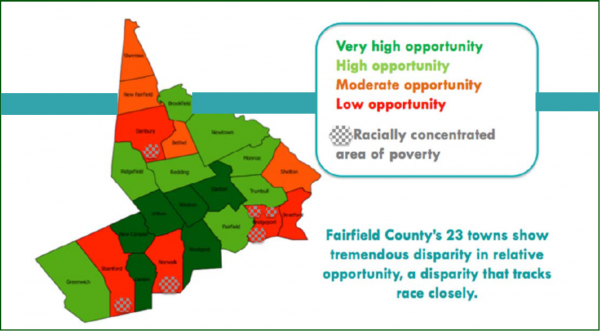
Looking across the towns of Fairfield County, large disparities in relative opportunity emerged in the study. Six “very high opportunity towns” stood out clearly among their peers, the report highlighted: Darien, Westport, New Canaan, Wilton, Weston, and Easton are among the wealthiest towns in the United States. Unsurprisingly, few children in those towns face the sort of barriers to opportunity children typically face in Bridgeport, Stratford, Norwalk, Stamford, and Danbury, the report said.

Five relatively “low opportunity towns” also stood out: on nearly every indicator they fell in the bottom third of Fairfield County’s 23 towns. “Even more disturbing,” the report emphasized, these “low opportunity towns” were home to racially concentrated areas of poverty: “not only is youth opportunity lower, but that lower opportunity affects mainly children of color,” the Voices report indicated.

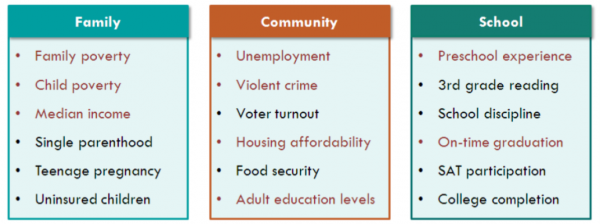
The 27 page report includes town-by-town breakdowns for each of Fairfield County’s 23 municipalities, including breakdowns of specific data for 20 distinct factors in the areas of Family, Community and School.  The assessment includes the percentage of the population that includes families in poverty, unemployment, housing unaffordability, preschool experience, median income and on-time graduation from high school.

The report indicated that Danbury has the highest proportion of students learning English in Fairfield County (21 percent), and a rate of student arrest twice that of Bridgeport, Norwalk and Stamford.  Over one-third of Danbury children live in households with income below 200 percent of the poverty level, which is $47,700 for a family of four.  Among the other data revealed in the report:

  • Bridgeport is the city in Fairfield County with the greatest need, with over 1,100 disconnected youth 400 annual high school dropouts and a youth unemployment rate of 17 percent.
  • Shelton (13%) and Wilton (17%) have exceptionally high rate of chronic absenteeism – on par with cities like Norwalk (12%) and Stamford (15%).
  • Redding performs exceptionally low on housing affordability compared to other high opportunity towns, with almost half of housing unaffordable (45 percent).
  • Stamford’s teenage pregnancy rate (3 percent of total births) is lower than in many suburban towns.thumb55dcc3167d80c

The comparison between Bridgeport’s youth and their counterparts in Westport is striking.  Bridgeport educates a student population of which nearly 40 percent never attended preschool and almost 80 percent of third graders failed to score proficient in reading, drawing from a property tax base less than one-sixth the size per pupil of Westport. In Westport, barely 5 percent of students miss preschool and only 17 percent of third graders fail to score proficient in reading. While over 400 students drop out of Bridgeport high schools each year and only 18 percent of Bridgeport students complete college within six years, Westport reports only 4 high school drop-outs per year and a 71 percent college completion rate.

threeConnecticut Voices for Children is a research-based think tank that focuses on issues that affect child well-being, from educational opportunity to healthy child development to family economic security. Its mission is to ensure that all of Connecticut’s children have the opportunity to achieve their full potential.

To assess specific obstacles to youth opportunity in Fairfield County and to prepare the way for new solutions, Connecticut Voices for Children constructed a Youth Opportunity Index containing over two-dozen indicators from the U.S. Census Bureau, State Department of Education, Federal Bureau of Investigation, and others. Guided by existing research, the researchers, including Ellen Shemitz, J.D., Nicholas Defiesta, and Wade Gibson, J.D., compiled family, community, and school indicators for every town in Fairfield County.

The study also assessed three measures of the number of disconnected youth in each town: the annual number of high school dropouts, the number of youth, ages 16-19 neither employed nor in school, and youth unemployment (ages 16-24). For each indicator, they assessed towns’ standing relative to one another. They then looked across indicators and assessed how each town stacked up relative to others in Fairfield County. In addition, Fairfield County as a whole was compared with the broader State of Connecticut.

NewsON Venture to Bring Local Newscasts to Smart Phones & Tablets Nationwide, WTNH Set to be Among Participants

Five major broadcast television station groups collectively reaching two-thirds of U.S. TV households have formed NewsON, a new venture to provide live and same-day local TV newscasts on demand from leading stations around the country to consumers' mobile and selected connected TV devices. Two Connecticut-based TV stations are part of the NewsON venture – WTNH and WCTX, both in the Hartford-New Haven TV market, which are owned by NewsON partner Media General. The NewsON (www.newson.us) service will be provided by a new venture formed by The ABC Owned Television Station Group, Cox Media Group, Hearst Television, Media General and Raycom Media.  In New Haven, the WTNH news staff produces newscasts for WTNH NewsChannel 8 and WCTX, known as MyTV9. news ON

Plans for NewsON were announced prior to the more recent announcement this month of Media General’s plans to buy Meredith Corp. for about $2.4 billion in cash and stock.  Meredith, which began as an agricultural publisher in 1902, is known for magazines such as Better Homes & Gardens and Family Circle. But its 17 local TV stations – including Hartford-based WFSB - are the centerpiece of the deal. The combined company—Meredith Media General— would encompass 88 stations that reach 30 percent of U.S. households, or 34 million homes.

Meredith had not been part of the NewsON venture, and it is unclear whether the combined company would remain in the plan, or whether a combined company may be required to divest of either WFSB or WTNH, which serve the same Hartford-New Haven market.

The free, advertising-supported NewsON service will be delivered through apps available for download from leading mobile and connected TV app stores.  NewsON will enable users to watch live and on-demand newscasts from their local markets or from any of the 112 participating news stations, in 84 viewing markets across the country, whose owners have already contracted to deliver their news streams through NewsON.  These include stations in eight of the Top 10 U.S. TV markets and 17 of the top 25.Picture1

Multiple stations will be available through NewsON in 21 markets, giving viewers the opportunity to "change channels" as they wish. The number of participating TV stations is expected to grow in the months ahead as additional broadcast TV station groups activate their streams into NewsON. Whether the Hartford-New Haven market will ultimately be among them may hinge on the outcome of the Meredith-Media General deal.

Media General is one of the nation's largest connected-screen media companies that operates or services 71 television stations in 48 markets, along with the industry's leading digital media business. Their portfolio of broadcast, digital and mobile products informs and engages 23 percent of U.S. TV households and 46 percent of the U.S. Internet audience.

"As a truly connected-screen media company, we are always seeking innovative ways to share our superior local content with a broader audience, no matter where, when or what screen or device they prefer," said Robb Richter, Chief Digital Officer of Richmond, VA based Media General.  He told Connecticut by the Numbers said the new service would provide “brand extension” for WTNH newscasts, and increase viewership.  “Now, about 15% to 20% of the market has downloaded their app.  This will draw more people to WTNH who have not. It’s a great way to gain more audience.”220px-Wtnh_news_2010

Richter said that the appetite for breaking news is strong, and that may be attractive to advertisers as well, as more people use mobile devices to watch locally originated newscasts.  The ability to send out breaking news alerts and live stream coverage of breaking local news provides a potential new revenue stream,” as well as providing viewers nationwide easy access to local coverage of news that may be of interest beyond a local region.

A recent commentary by former WFSB news director Mark Effron, now a college professor, points to the need for local news to find new ways to attract audiences – especially younger audiences, for whom watching television on a television is fast becoming a footnote in their media consumption.

“For them, watching content on channels and networks and stations hasn’t only lessened, it’s actually fallen off the cliff,” Effron observed.

NewsON officials stress that Americans place a great deal of trust in their local news teams, who are typically the first informers from the local scene of the biggest news developments around the country.  NewsON will bring instant access to live local news to a generation of viewers accustomed to using mobile and connected TV platforms to stay informed.

According to the March 2015 report "Local News in a Digital Age" by the Pew Research Center, local TV stations remain the dominant source of news for Americans in large and small markets.  NewsOn points out that the appetite for local and neighborhood news, the staple of TV station newscast coverage, is up to twice the appetite for national and international news, the study found.

The NewsON service, current in BETA testing, is expected to launch to the public later this fall. “We are driving the evolution in local content creation and distribution and we are excited about the opportunities with NewsON," Richter added.


Building Character in Children Can Improve Voter Participation As Adults, Study Finds

As primary voters head to the polls in nearly two dozen Connecticut communities, with relatively low turnout anticipated, a newly released academic study on connections between childhood character-building and adult voting participation is gaining some notice. A researcher at Duke University has found that data from years of national surveys of youth reveal “a strong relationship” between measures of character in youth and the subsequent likelihood of voting, even controlling for test scores and demographics.vote

The study appears to have identified a causal relationship: Disadvantaged elementary-school children around the country who were randomly assigned to receive character-building education two decades ago were more likely to vote as adults by 11 to 14 percentage points.

The research paper, by John B. Holbein of Duke University, is entitled “Childhood Non-Cognitive Skill Development and Adult Political Participation.” Matching participants to voter files, Holbein found that childhood intervention had a large long-run impact on political participation.”  Non-cognitive factors were seen as at least as critical as cognitive factors – and perhaps more influential on voting behavior later in life.

The results of the study “suggest a refocusing of civics education.”  The study, published on the Social Science Research Network, concludes that “specific programs that schools implement—including those targeting psychosocial skills—appear to have a large impact on civic participation later on. This finding has important policy implications.”character

In the last midterm election, in 2014, only 36.4 percent of eligible voters cast a ballot nationwide, the lowest turnout since 1942. To understand the causes of low turnout, the Census Bureau regularly asks citizens why they chose not to exercise their constitutional right, Jonah Lehrer points out on his website, summarizing that “the number one reason is always the same: ‘too busy.’ (That was the reason given by 28 percent of non-voters in 2014.) The second most popular excuse is ‘not interested,’ followed by a series of other obstacles, such as forgetting about the election or not liking any of the candidates.”

The Holbein study suggests there is more behind the lack of voting behavior than those oft-cited reasons would suggest.

Critical factors in character building are self-regulation and those involving social skills.  Components of self-regulation include, but are not limited to, grit or perseverance, emotion recognition and emotion regulation—the ability to understand and control individual affect; and inhibition, or the ability to avoid negative behavior and exhibit positive behavior.  Social skills involve the ability to work with others productively; components include the ability to communicate, build friendships, and solve group-based problems.ssrn

“Rather than focusing exclusively on the number of years a citizen spends in school, it is important to consider what context they were exposed to while in school… In a landscape of stagnant macro-level trends in participation and small estimates for many adult mobilization efforts, this finding should give scholars and policymakers renewed hope,” according to the study.

The research indicated that “interventions in early life can have large and long-lasting impacts on stubbornly low rates of political participation in adulthood. This finding suggests a reorientation of political socialization studies towards early childhood; a previously neglected critical period in the development of participatory predispositions.”  Similar research into the impact of non-cognitive learning has come away with consistent findings.

Looking ahead, the study suggests that “expanding our view in this way will help expand our understanding of why some people vote, while others do not, and how to design reforms to increase turnout, particularly among individuals with a low propensity to vote.”