Advertisers Target Hispanic and Black Youth with Unhealthy Snack Ads, UConn Center Study Finds

The University of Connecticut’s Rudd Center for Food Policy & Obesity is calling on media companies to “set nutrition standards” for snack ads aimed at children and teens and “stop targeting advertising high-calorie, nutritionally poor foods to all young people,” but “especially advertising aimed at Black and Hispanic youth.” The recommendations come in the wake of a report that found that Black and Hispanic children “are exposed to more food advertising than white non-Hispanic children” and much of it is for unhealthy foods that have a greater likelihood of adversely impact children’s health.rudd-logo-300x77

The Rudd Center’s report, Snack Facts, found that Black children saw 64 percent more snack food ads on TV compared to white children, and Black teens viewed 103 percent more compared to white teens.  The disparity, according to the report issued last fall, had increased between 2010 and 2014, the most recent year studied.  “FACTS” is an acronym for “Food Advertising to Children and Teens Score.”

The findings also indicated that in addition to a barrage of advertising for unhealthy snacks, Black children and teens saw approximately 50 percent and 80 percent more ads for healthier fruit and yogurt brands – although the positive findings were generally outdistanced by findings of concern.  Black children also saw 99 percent more ads for savory snacks and Black teens saw 129 percent more, compared with white children and teens.spanish snak ads

From 2010 to 2014, TV ads for savory snacks (salty or spicy) viewed by black children increased 48 percent and ads viewed by black teens increased 95 percent.  “Given that youth of color suffer from higher rates of obesity and other diet-related diseases,” the Rudd Center indicated, “snack food advertising likely exacerbates health disparities affecting their communities.”

Two-thirds of 2- to 5 year-olds and more than half of youth ages 6 to 19 report having three of more snacks per day, and Americans are spending more on snacks – an increase of more than $100 million from 2012 to 2015, according to data cited in the report.

The Rudd Center report found that snack advertising on Spanish language television had changed dramatically between 2010 and 2014, and not for the better:

  • Yogurt advertising declined by 93 percent, and not one fruit brand advertised on Spanish-language TV in 2014.
  • Spending on savory snack ads (salty/spicy snacks) skyrocketed 551 percent and sweet snack ads rose 30 percent.
  • Ads for unhealthy snacks comprised 88 percent of snack food ads viewed by Hispanic children on Spanish-language TV in 2014, a dramatic jump from 39 percent in 2010.

The 102-page report reviewed the advertising practices of specific companies in the snack food industry, and highlighted changes in advertising emphasis.  It also tracked trends in advertising on social media.  The advertising analysis examined 90 brands spending more than$1 million in total advertising in 2014 from 43 different companies, according to the report. chips

The report suggested that “media companies could provide lower rates for advertising that promotes nutritious foods,” noting that aggressive marketing of unhealthy snack foods to children and teens exacerbates the crisis of poor diet and related diseases among young people.”

Snack FACTS examined the nutritional quality and advertising for 90 snack food brands offered by 43 companies that were marketed to U.S. children and teens on TV, internet, and in schools in 2014. Researchers analyzed healthier snacks, including yogurt, fruit, and nuts, as well as unhealthy snacks, including sweet and savory snacks such as cookies, chips, and fruit snacks, comparing 2010 and 2014 when possible.

The report also indicates that “companies have recognized the business opportunity in marketing healthy snacks to young people,” and urges those companies to respond in children and youth’s best interest.

The Rudd Center for Food Policy & Obesity, which affiliated with UConn a year ago after a decade at Yale University, is a non-profit research and public policy organization devoted to improving the world’s diet, preventing obesity, and reducing weight stigma. The Rudd Center is described as “a leader in building broad-based consensus to change diet and activity patterns, while holding industry and government agencies responsible for safeguarding public health.”  Research related to the report was funded by a grant from the Robert Wood Johnson Foundation.snack food

CT Ranked 14th Among Smaller States for Small Business Activity; MA Is 2nd Among Large States

Small business activity is on the rise in 49 of the 50 U.S. states, according to a new report from the Kauffman Foundation. The report provides a broad index measure of small local business activity, analyzing the states in peer groups of the 25 largest states by population and the 25 smallest states by population.  Connecticut ranked 14th among the smaller 25 states, for the second consecutive year, and was the lowest-ranked New England state.CT rank The density of established small businesses per 100,000 residents increased slightly from the previous year, from 1,147.3 to 1,167.4 in 2015.  Established small businesses are defined in the study as businesses over the age of five employing at least one, but less than fifty, employees.  The rate of small business ownership also grew slightly in Connecticut, from 6.14 percent to 6.34 percent.

Demographic trends for Connecticut noted in the report indicate an increase in native-born small business ownership, and upticks in the percentage of small businesses led by Latinos, 55 to 64 year-olds, 35-44 year-olds, high school graduates and college graduates.  More small businesses are run by men than women.

Overall, what the report describes as “Main Street entrepreneurial activity – an indicator of the number of established small businesses and the number of business owners in a location – experienced a large increase in 2015, reversing a six-year downward and stagnant trend in the U.S.”Kauffman logo

"Following a post-recession downward and stagnant trend in small business activity, we're now seeing Main Street Entrepreneurship begin to rise," said E.J. Reedy, director in Research and Policy at the Kauffman Foundation. "This obviously is good news given that these small businesses make up 63 percent of all employer firms nationally."

The Kauffman Index: Main Street Entrepreneurship State Trends report includes these findings:

Among the 25 largest states, the five states with the highest activity were Minnesota, Colorado, Massachusetts, New York and New Jersey. Among the 25 smallest states, the states with the highest activity were Vermont, Montana, North Dakota, South Dakota, Wyoming, Maine, Nebraska, New Hampshire, Rhode Island, Iowa, Oregon, Idaho, and Kansas.

Insights on business owner demographics for the 25 smallest states, including Connecticut:

  • States with the highest rates of female business owners were Vermont, Montana, Wyoming, Oregon, and South Dakota.
  • States with the highest rates of older adult business owners (ages 55-64) were South Dakota, Vermont, North Dakota, Montana and Nebraska.
  • States with the highest rates of young adult business owners (ages 20-34) were South Dakota, North Dakota, Montana, Wyoming and Vermont.

state ranksTennessee is the only state that did not show an increase in established small business activity in 2015 compared with 2014.


The new Main Street Entrepreneurship Index is an indicator of small business activity, presenting trends over the past two decades, focusing on established small businesses (firms older than five years with less than 50 employees) and trends in ownership rates. The Index measures business activity along two distinct and complementary dimensions: the rate of business owners in the economy – the percentage of adults owning a business in a given month, and established small business density – the ratio of established small employer businesses compared to population.

The Kauffman Index of Entrepreneurship is the first and largest index tracking entrepreneurship across city, state and national levels for the United States, and also presents demographic characteristics of the business owners.

In a companion study and report, focusing on the nation’s largest metropolitan areas, Small business activity is on the rise 38 of the top 40 largest metropolitan areas, the top five metropolitan areas for small business activity as measured by the Index were New York, Boston, Providence, San Francisco and Portland.  The report on metropolitan areas noted that “the one to experience the biggest increase in rankings was Providence, which moved up three spots to tie with Boston for second place in the 2015 Index.”

Whalers Departing Attendance, Carolina's Recent Attendance, Among NHL's Lowest (Hartford Higher)

During the 2014-15 National Hockey League season, the teams with the lowest average home attendance were the Arizona (13,345), Carolina Hurricanes (12,594) and Florida Panthers (11,265). So far in the current season, through 23 home games, the attendance for Hurricanes games has sunk even lower, averaging 11,390, lowest in the league.  They are the only team in the league to draw less than 13,000 fans per game. Hartford_Whalers_Logo.svg

Fifteen years ago, during the 2000-01 season, the attendance numbers weren’t much better.  Carolina had the league’s second lowest attendance, drawing an average of 13,355 per game for 41 home games.  That ranked 29th in a 30-team league.

That was also only a handful of seasons after the teams’ move South, ending their 18-year history as the Whalers in Hartford, moving to Greensboro, North Carolina and becoming the Carolina Hurricanes for the start of the 1997-98 season.

In the 30-team league, during the past 15 years, Carolina has been among the league’s bottom-third in  average attendance eight times, and the bottom-half every season but one.  In 2006-07, the team ranked 15th in the league, their high-water mark.  It was the season after the team won the league’s Stanley Cup.   (The 2004–05 NHL season was not played due to a labor dispute.)

Those attendance number aren’t significantly different that the attendance levels when the team abruptly departed Hartford, nearly two decades ago.  In early 1996, a 45-day “SNHL logoave the Whale” season-ticket drive resulted in 8,300 season tickets sold, about 3,000 more than the previous year.  In the aftermath of the season ticket drive, and heading into the 1996-97 season, the Whalers management said they would remain in Hartford for two more years, in accordance with their lease.
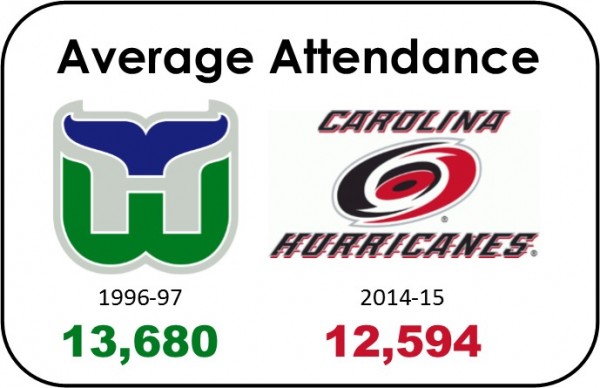
In the Whalers' final season in Hartford, 1996-97, attendance at the Hartford Civic Center had grown to 87 percent of capacity, with an average attendance of 13,680 per game.  Published reports suggest that the average attendance was, in reality, higher than 14,000 per game by 1996-97, but Whalers ownership did not count the skyboxes and coliseum club seating because the revenue streams went to the state, rather than the team.  Attendance increased for four consecutive years battendenceefore management moved the team from Hartford. (To 10,407 in 1993-94, 11,835 in 1994-95, 11,983 in 1995-96 and 13,680 in 1996-97.)
During the team’s tenure in Hartford, average attendance exceeded 14,000 twice – in 1987-88 and 1986-87, when the team ranked 13th in the league in attendance in both seasons.

Last season’s top attendance averages were in Chicago (21,769), Montreal (21.286), Detroit (20,027), Philadelphia (19,270), Washington (19.099), Calgary (19,097), Toronto (19.062), Minnesota (190230 Tampa Bay (188230 and Vancouver (18,710).  The New York Rangers drew an average of 18,006, ranking 17th in the league in average attendance.

Florida’s attendance last year was a league-low 11,265; Arizona was 13,345 per game. The previous season, the New York Islanders, Columbus Blue Jackets, Dallas Stars, Florida Panthers and Arizona Coyotes all drew less than 15,000 fans to home games across the season.  So far this season, with about half the home games played, five teams continue average 14,000 fans per game or less.

On March 26, 1997, Connecticut Gov. John G. Rowland and Whalers owner Peter Karmanos Jr., who had purchased the team in 1994, announced that the Whalers would leave Hartford after the season because they remain far apart on several issues, with the main sticking points linked to construction of a new arena. The team agreed to pay a $20.5 million penalty to leave at the end of the season, a year before its commitment was to expire.

The final Whalers game in Hartford was on April 13.  Less than a month later, the Carolina Hurricanes were born, beginning play that fall in Greensboro while a new facility was built in Raleigh.  Efforts to bring the NHL back to Hartford since that day have been unsuccessful.

memories


Award-Winning Start-Up Accelerator to Launch Largest Class of Social Enterprises, Fledgling Businesses

When the Hartford-based Social Enterprise Trust, known as reSET, was among the winners of the U.S Small Business Administration’s Growth Accelerator Competition last year – the only Connecticut organization to do so and one of 80 nationwide – it was not known what earning that designation, and  the $50,000 that came with it, would mean for reSET’s Impact Accelerator program. Now, the picture is becoming clearer – and boosting Hartford’s reputation as a city for socially committed entrepreneurial start-up businesses.  The expanding initiative is attracting not only home grown companies, but start-ups from elsewhere across the country, including as far away as California.

Tailored for impact-driven businesses but available to all early-stage ventures, reSET’s Impact Accelerator, now beginning its fourth year, has as its primary objective to test and hone entrepreneurs’ models, and to connect them to networks, mentors, customers, and resources.

A cohort of 22 businesses have been accepted to the program and most of their models are impact focused, serving the educational technology, health and health tech, energy, and agriculture industries. More than 60 percent of them are already generating revenue.  It is the largest group of companies to take part in the accelerator program at reSET, and the first to include a handful of out-of-state participants.cohort 2016

Running from January 20 to June 2, reSET’s accelerator will feature a more flexible program designed for busy, full-time entrepreneurs, as well as a ‘pay what you can’ model.  Entrepreneurial teams will attend five weekend summits, with 30+ optional workshops, mentor office hours, and consultations with an Entrepreneur in Residence conducted during the week.

At program’s end, a $25,000 accelerator funding pool will be available to the cohort, and they'll have priority access to reSET’s investment fund as well, via mentors and advisors that can help them put their best foot forward with their applications, according to reSET officials.

The 2016 cohort includes: Agyncy (www.agyncy.com), AmRide (www.amride.com), Asarasi (www.asarasi.com), BLT Robotics (www.bltrobotics.com), Doors to Explore (www.doorstoexplore.com), DopaFit (www.mydopafit.com), Enviro Power, LLC (www.enviropowertec.com), Keep Sight (www.keepsight.com), Lion’s Heart (www.lionsheartservice.org), Mivy (www.mivyapp.com), Movia Robotics (www.moviarobotics.com), Muni (www.muni.info), myHomeProNetwork (https://myhomepronetwork.com), Plucked (www.pluckedadmissions.org), RepVisits (www.repvisits.com), ScripFlip (www.scriptflip.org), SnapSeat (www.snapseatbooths.com), Tainted Inc. (www.tainted-beauty.com), Text Engine (www.textengine.info), The TubieGuard (the-tubieguard.myshopify.com), Trekeffect (https://trekeffect.com), and Untapped Potential (www.upotential.org).

“We’ve made a strategic shift with our accelerator model so it can accommodate more participants at one time, which we feel will really encourage more collaboration,” said Rosie Gallant, reSET’s Director of Programs. “The shift will help tee up the accelerator for our annual Impact Challenge as well, since the program will wrap in the spring right around when applications will open for the competition in which participants will vie for this year’s $100,000 prize purse.”

reSET is a non-profit organization whose mission is to advance the social enterprise sector.  Its strategic goals are threefold: to be the “go-to” place for impact entrepreneurs, to make Hartford the Impact City, and Connecticut the social enterprise state.  reSET aims to inspire innovation and community collaboration, and to support entrepreneurs in creating market-based solutions to community challenges.  reSET’s goal is to meet entrepreneurs wherever they are in their trajectory and to help them take their businesses to the next level.

Increasing Percentage of Children in Single-Parent Families; CT 21st in US

Single-parent households are growing more common across the U.S., new research reveals.  Connecticut ranks 21st in the percentage of children in single-parent families, although the number has steadily climbed in Connecticut as nationwide, according to data compiled by the Annie E. Casey Foundation.data Nearly 25 million children— 35% of the country’s children — lived in single-parent families in 2014, the latest full-year data.  That is an increase of 392,000 since 2010.

In Connecticut, the percentage has grown from 32 percent in 2010 to 34 percent in 2014, an increase of 3,000 children in single-parent families, but keeping the state below the national average.  In 2000, the percentage in Connecticut was 27 percent, with 211,000 children in single-parent families, compared with 252,000 in 2014, according to the data.kids

Compared with children in married-couple families, those raised by one parent are more likely to drop out of school, have or cause a teen pregnancy and get divorced as an adult, according to research.

Forty-six states reported an uptick in the number of children raised in single parent households, with the largest jumps occurring in New Hampshire and Delaware.

Utah has the lowest incidence of kids being raised by one parent (19%) followed by Idaho (26%), Wyoming (27%), Minnesota (29%), Iowa (29%), North Dakota (29%) and Nebraska (29%).  Louisiana (47%) and Mississippi (47%) top the list, with nearly half of all kids growing up in single-parent families.  The other states with a high percentage of single-parent children are South Carolina (43%), Delaware (42%) and New Mexico (41%).map

The report, released last month, also found that nationwide 26 perlogocent of children live in mother-only households and 8 percent live in father-only households.  Those numbers are virtually unchanged since 2010.  Back in 2000, however, 69 percent of children lived in married-couple households, 25 percent in mother-only homes and 6 percent in father-only households.


In Connecticut, the percentage of children living in married-couple households has fallen from 74 percent in 2000 to 67 percent in 2014.  The percentage of children living in mother-only households has increased from 21 percent to 26 percent, while the number of children in father –only households has grown by 16,000 between 2000 and 2014, from 5 percent of children to 7 percent of children.


Cellphone Likely Won’t Tell 911 Operator Your Location

The Federal Communications Commission has estimated that about 70 percent of 911 calls are placed from wireless phones, and that percentage is growing. For many Americans, according to the federal agency, “the ability to call 911 for help in an emergency is one of the main reasons they own a wireless phone.”  Yet, in an emergency, a cell phone may provide potential first responders with less information than one would expect. The National Emergency Number Association (NENA),which represents dispatchers, supervisors and private-sector service providers, points out that “when 9-1-1 calls are made from wireless phones, the call may not be routed to the most appropriate 9-1-1 center, and the call taker doesn't receive the callback phone number or the location of the caller. This presents life threatening problems due to lost response time, if callers are unable to speak or don't know where they are, or if they don't know their wireless phone callback number and the call is dropped.”  The organization’s motto is “emergency help, any time, anywhere, any device.”911 cell call

Recent published reports in Governing magazine indicate that “when you check movie times on your cellphone, search for a restaurant or hail a ride, the device automatically knows exactly where you are and can suggest things nearby. So it’s understandable that many people assume the same holds true when they call 911 for emergency assistance.  But the fact is, 911 call centers frequently receive imprecise locations of callers from wireless carriers -- and some don’t get any location information at all. Calls from landline phones are linked to addresses.”

The FCC website explains that “since wireless phones are mobile, they are not associated with one fixed location or address. While the location of the cell site closest to the 911 caller may provide a general indication of the caller's location, that information is not always specific enough for rescue personnel to deliver assistance to the caller quickly.”

More reliable and specific location information could save lives, advocates say, and earlier this year an order from the Federal Communications Commission (FCC) set targets for companies to improve both the availability and accuracy of location information. But those upgrades remain a long way off.EmergencyResponse

Under the new rules, carriers will have to provide caller location info within 50 meters 80 percent of the time by 2021, along with vertical location information, if the call is being made from an apartment building or high rise office tower -- that would have to be in place in major markets by 2023.

Some have said the industry needs to provide those capabilities much sooner.  While 911 dispatchers routinely ask callers for their location, callers at times hang up before providing that information, for any number of reasons. And, they argue, if a cell phone knows where you are, that information should be instantly made available to 911 dispatchers as well.

The latest FCC guidelines are available for public review.  “We would have liked to have seen a more compressed timetable,” NENA CEO Brian Fontes told Governing.

Published reports in Connecticut indicate that some communities are moving forward with new technology.  The town of Wolcott, according to reports, has begun using a system that will allow police to pinpoint the location of emergency calls made from cell phones.  The Republican-American newspaper reports the town was the first in the state to use the next-generation system in a pilot program that was slated to include the New Britain, Wilton, Enfield, Newington, Valley Shore, Fairfield, Middletown, Mashantucket and Shelton police departments .  The new system shows dispatchers the caller’s location within a 50-foot radius, compared with the old system  which would indicate the location of a wireless 911 call within a quarter-mile radius.

Plans are also in the works that would permit individuals to text 911 from their cell phones.  The CT Post reported last month that about 24 dispatch centers out of 110 statewide are being upgraded to the text-to-911 system. Stratford and Fairfield will be among the first towns in the state to get the texting capability. Officials hope the entire state will have text-to-911 by late 2016 or early 2017, the newspaper reported.


Newman's Own Foundation Awards $1.5 Million in Grants to Military Service Organizations, Including 8 in Connecticut

In celebration of its 10th anniversary, Newman’s Own Foundation is awarding $1.5 million in grants to 29 organizations – including eight in Connecticut - that provide services to military men, women, veterans, and their families. Based in Westport, Newman’s Own Foundation’s awards will benefit more Connecticut nonprofit organizations than in any other state; more than one-quarter of the total number of organizations slated to receive funds. Paul Newman, the late actor and philanthropist, established Newman’s Own Foundation in 2005 to carry on his philanthropic legacy after he started Newman’s Own, the food company, in 1982 with all profits going to charity. Less well known is that Newman was a World War II veteran.  According to the organization’s website, he enlisted in the United States Navy after high school, serving in the Pacific during World War II.ownlogo

“One particular experience provided the core of his belief about luck and humility. In Saipan, the pilot of his crew became sick, grounding their bomber. The rest of Paul’s squadron was ordered to deploy aboard the USS Bunker Hill and days later were killed by kamikaze aircraft. It was simply luck that Paul had not been aboard. He attributed much of his success in life to luck, and what followed was a commitment to give back to those who were perhaps not so lucky,” the website explains.

The organizations receiving the grants provide a wide variety of support to veterans, including physical/mental rehabilitation, career development, entrepreneurship, education, and housing. There are also organizations that focus on female veterans.  The organizations and services are located across the country.

The Connecticut organizations are Applied Behavioral Rehabilitation Institute, Inc. (Bridgeport), Columbus House (New Haven), Connecticut Public Broadcasting Network (Hartford), Connecticut Veterans Legal Center (West Haven), Fidelco Guide Dog Foundation, Inc. (Bloomfield), Help Our Military Heroes, Inc. (Easton), Work Vessels for Veterans, Inc. (Noank), and Workplace, Inc. (Bridgeport).

“Our men and women in uniform make great sacrifices in their own lives to protect the unique freedom, privileges, and opportunities we enjoy as Americans. It is not so much a responsibility to support them, but more a privilege to express our gratitude for their service,” said Robert Forrester, President and CEO of Newman’s Own Foundation, who served in Vietnam as an Army officer.  “We’re proud to fund these organizations that provide services for military personnel, veterans, and their families.”military

Military nonprofit organizations have been supported for over 20 years, with a total of $12 million donated since 2010, alone. In addition to the Foundation grants, Newman’s Own, Inc. has supported military service charities through the Newman’s Own Awards for 16 years, in partnership with Fisher House Foundation and Military Times.

Since the Foundation was founded, more than $280 million has been donated to charitable organizations around the world. The grants reached across international borders and countless organizations that addressed needs such as serious illness, hunger, homelessness, disaster relief, environmental issues, and education. Today the Foundation has four primary focus areas: Philanthropy, Children with Life Limiting Conditions, Empowerment, and Nutrition.   More information is available at: http://newmansownfoundation.org/military

Income Inequality in CT's 4th Congressional District is 4th Largest Gap in Nation; 2nd District Has Least Income Inequality in State

Connecticut’s 4th Congressional district, centered in Fairfield Country, has been ranked as the district with the 4th highest level income inequity in the nation.  A year ago, the 4th C.D. was ranked fifth. A ranking of congressional districts of by their level of income inequality, conducted by Bloomberg, uses the Gini coefficient, a formula that measures the distribution of income across a population. The closer a Gini number is to 1, the greater the level of inequality; the closer to zero, the closer to perfect equality. The average score for the United States was 0.4804.

All of Connecticut’s ctcountiesCongressional Districts, with the exception of the Fourth District, did better than the national average in the degree of income inequality.

Bloomberg Businessweek has previously pointed out that the U.S. congressional districts with the most inequality share certain traits: “they contain a small, enormously wealthy elite surrounded by impoverished neighbors.” Most of the districts with the greatest disparity are located in or near major urban metropolitan areas.

The greatest income inequality in the most recent analysis indicated that the Congressional Districts with the most income inequality are Pennsylvania’s 2nd District, New York’s 10th District, and Florida’s 27th District.  Following Connecticut’s 4th District on the list are Illinois; 7th District, and three additional Congressional Districts in New York – the 12th, 7th and 16th.  Rounding out the 10 C.D.’s with the most income inequality are Ohio’s 11th District and Georgia’s 5th District.inequality

In Connecticut’s 4th Congressional District, which includes Bridgeport, the state’s largest city, as well as the communities often referred to as the “Gold Coast,” 59.3 percent of the population has household income in the highest quintile, while 6.7 percent of households have income below the poverty level.

Connecticut’s 5th Congressional District (.4810) ranked number 88 on the list of Congressional Districts with the most income inequality among residents.  The state’s 3rd Congressional District (.4792) ranked at number 95, and the 1st C.D. (.4631) at number 175.  Much later in the rankings, Connecticut’s 2nd District (.4261) came in at number 387, indicating it is the C.D. in Connecticut with the least income inequality.

The Gini coefficient, which is calculated by the U.S. Census from household income share by quintiles, was used to measure distribution of wealth. It ranges from zero, which reflects absolute equality, to one, complete inequality. The data was updated in November 2015, using 2014 data.  In 2014, a person living alone making less than $12,071 was classified as in poverty. The threshold increases for each additional household member and varies by the number of adults and children in each household.


Courant Community Replaces Reminder News in Eastern, Northern Connecticut

Nearly two years ago, the Hartford Courant purchased Reminder Media Inc., long-time publisher of 15 free weekly Reminder News publications distributed in eastern and northern Connecticut. The 15 Reminder News weeklies were in Colchester, East Hartford, Enfield, Glastonbury, Hebron/Columbia, Jewett City, Killingly/Plainfield, Manchester, Putnam, South Windsor, Stafford, Vernon, Windham/Mansfield, Windsor and Windsor Locks.  Soon-to-depart publisher Nancy Meyer said at the time that the purchase “reinforces our commitment to reporting and delivering local news in Connecticut."courant community cover

Now those publications have a new look and a new name.  Beginning with the Thanksgiving week issue, the publication was redesigned and renamed “Courant Community.”  The tagline “powered by Reminder News” remains on the front page.  Existing “Courant Extra” publications in Manchester and Enfield have been “consolidated” into the new-look publications.

In a message to readers, Courant Publisher Richard J. Daniels explained the “major makeover” as key to The Hartford Courant Media Group’s “print and digital operations designed to deliver more local news to readers.”  The “sweeping redesign” of the Reminder News and Courant Extra weeklies will offer “enhanced coverage of local business, dining and entertainment, real estate, community events and more.”

The redesign doesn’t stop there.  “The makeover has extended to the Courant’s digital universe as well,” Daniels points out, “with redesigned community-based pages online (at courant.com/community)” and “more opportunities for reader interaction.”courant community

Courant Community Group Editor is Bonnie Phillips; Deputy Editor is Erin Quinlan.  Offices are based in Manchester.

On the website of The Hartford Courant, news articles submitted by readers now are categorized under the Courant Community moniker.  An interactive map, on which readers can select their town and be guided to local news, also seeks contributions ranging from birthdays and engagements to local news and events.

The list of Hartford Courant Media Group entries now includes the Courant, CTNow (which previously subsumed the Hartford Advocate), Hartford magazine (previously purchased from an independent company), New Haven Living, Courant Community and ValuMail.

Two Connecticut Librarians Receive National Public Service Recognition

Ten librarians from around the country – including two from Connecticut, in New Haven and Groton - were honored this month with this year’s I Love My Librarian Award for their exceptional public service to the community and ongoing commitment to transforming lives through education and lifelong learning. The winning librarians were selected from a pool of more than 1,300 nominations submitted by library patrons nationwide who use public, school, college, community college or university libraries. The nominations detailed stories about how their favorite librarians helped improve the quality of life in their communities. The last time Connecticut had a winner was in 2012.  There were two winners from the state in 2012 and in 2011.ilml2015-250-400_0

The nation’s more than 166,000 certified librarians “continue to play a vital role in assisting and inspiring all who seek information and access to technologies,” according to officials. “The I Love My Librarian Award winners are living examples of how library professionals are expanding beyond their traditional functions and providing more opportunities for community engagement and delivering new services that connect closely with patrons’ needs.”

The Connecticut recipients of the national recognition are:

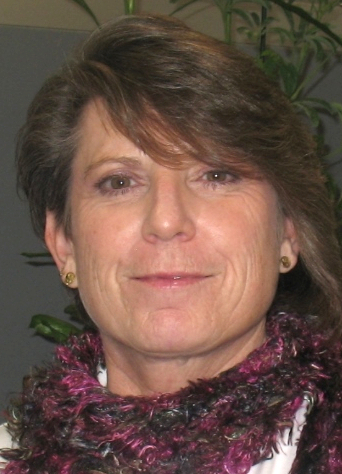
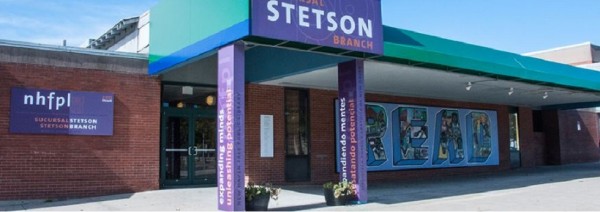
brown-dianeDiane Brown is branch manager of the New Haven Free Public Library’s Stetson Branch. Known as the “urban librarian” to her patrons, Brown develops valuable programs and services to meet the needs of the underserved residents in a community with high rates of poverty, crime and low literacy levels.  Under Brown’s leadership, the library has been transformed into a true community center. She brings residents together by hosting cultural and educational events such as an international “pop up” festival, art exhibits, lectures and health fairs, according to officials.  She has been praised for facilitating an afterschool tutoring program for K-8 students and providing opportunities for children and their families to spend time together by establishing history and game nights.
“It is gratifying to have the I Love My Librarian Award bring much deserved recognition to librarians. As libraries transform so do librarians to support individual opportunity and community progress,” said Sari Feldman, president of the American Library Association. “Every day librarians connect library users with the books, information and critical technology resources they need to thrive in the digital age.”

Each winning librarian will receive a $5,000 prize at an award ceremony and reception held in New York City, hosted by the philanthropic foundation Carnegie Corporation of New York, which sponsors the award. The New York Public Library and The New York Times are co-sponsors of the award, which is administered by the American Library Association.

rumery-e-2Elizabeth G. Rumery, library director for the Avery Point Campus Library at the University of Connecticut in Groton, has “transformed the library into a welcoming and dynamic place for students by modernizing the facility to meet the needs of 21st century learners.”  Officials indicate that she worked with contractors and school administrators on renovating the library, with improvements including new media rooms and collaborative study spaces for students and faculty.
Rumery has also expanded services to create a safe haven for students, establishing a place in the library where anyone can talk with her about concerns related to GLBTQ, depression or other personal issues. She finds the appropriate help and resources they may need. She also serves as an advisor for the student gay/straight ALLIANCE club at the campus.

The other recipients in 2015 are librarians in Texas, California, Alaska, North Carolina, Missouri, Alabama and Mississippi.  In addition to Connecticut, there were two recipients from Texas.

The award recipients include a librarian who fought censorship when residents attempted to ban and remove books from the shelves, a librarian who works with incarcerated youth at a school within a juvenile hall, a librarian who fostered a deeper understanding of the Muslim world by facilitating a campus exhibit and lecture and a librarian whose efforts helped raise student reading scores significantly at an underserved elementary school.

Stetsonver22013The librarians join “an esteemed group of award recipients who are recognized as being catalysts for powerful individual and community change.” Only 80 librarians have received the national award since its inception in 2008, including six from Connecticut.  In 2012, the recipients were Rachel Hyland, Tunxis Community College Library in Farmington, and Rae Anne Locke, Saugatuck Elementary "Secret Garden" Library in Westport. The 2011 winners included Jennifer O. Keohane, The Simsbury Public Library and Michelle Luhtala, New Canaan High School Library.


For more information regarding the 2015 I Love My Librarian Award recipients, go to www.ilovelibraries.org/ilovemylibrarian