State Mental Health Budgets, Cut During Recession, Increase After Newtown Tragedy, Report Finds
/
State mental health budgets were gutted during the recession, according to a report issued by the National Alliance on Mental Health (NAMI), and are only now beginning to return to previous levels in most states, even as mental health needs are becoming better known and growing.
“With reductions totaling $4.35 billion from FY2009 to FY2012, public mental health systems struggled to meet rising demand with diminishing resources ,” the report indicated. Then, the shooting at Sandy Hook Elementary School in Newtown on December 14, 2012 provided “a major impetus for lawmakers to propose legislation which would impact children and adults living with mental illness,” the 63-page report indicated.
Nearly 60 million Americans experience a mental health condition every year, according to the organization. Regardless of race, age, religion or economic status, mental illness impacts the lives of at least one in four adults and one in 10 children across the United States.
NAMI is the nation’s largest grassroots mental health organization. NAMI advocates for access to services, treatment, supports and research and is steadfast in its commitment to raise awareness and build a community for hope for all of those in need.
“Realizing the risks of failure to provide adequate public mental health services, governors and legislatures in many states began the process of restoring state mental health budgets,” according to the report, “Trends, Themes & Best Practices in State Mental Health Legislation.”
The report concludes that “Dramatic changes in American healthcare finance and delivery systems combine with an improving economy and a growing array of best practices to provide a window of opportunity in the next few years to transform the mental health system and integrate care across systems.”
In addition, NAMI recommends that “advocates and policy makers should continue the work of building the mental health system of the future, one in which mental illness is identified as it emerges and an array of proven, cost-effective services are available as needed to provide children, youth and adults with the mental health care they need to stabilize, recover and live healthy lives.”
Looking ahead to the 2014 state legislative sessions, NAMI issued a series of recommendations including: 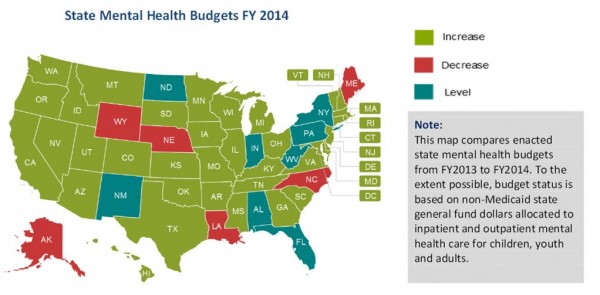
- Actively engage in outreach and enrollment
- Increase integrated care
- Increase the mental health workforce capacity
- Identify mental illness and intervene early
- Build the bridge from Medicaid to private health coverage
- Increase access to supported employment services
- Increase housing with supportive services
- Increase justice system diversion strategies
- Comply with mental health parity
- Expand Medicaid
Most states either increased or maintained state mental health authority budgets at current levels during 2013 legislative sessions. Of special note, the report indicated, is Texas which allocated a $259 million increase over the previous biennial budget, the largest mental health budget improvement in the state’s history. South Carolina reversed previous cuts to its mental health budget while Illinois restored $32 million that had been cut in 2011 due to an administrative error. In California, an additional $143 million was allocated to create crisis and triage positions throughout the state.
The report stated that “A tipping point on the heels of several recent mass shootings, the Newtown tragedy shaped the debate about the lack of access to mental health services and the barriers that many families and individuals face in light of the nation’s fragmented and grossly inadequate mental health system.”
After the Newtown tragedy NAMI advocated for policies supporting early identification and intervention, training for school personnel, families and the public, mental health services in schools and increased access to care.
The report highlights actions by states in 2013 in areas including mental health system monitoring, early identification and mental health screening, services for transitional youth, school mental health training and services, mental health facilities and suicide prevention. Also included are elements of state legislation in law enforcement areas such as juvenile justice, incarceration and the courts. A final section looks at stigma reduction efforts in the states.
Mental illnesses are medical conditions that disrupt a person's thinking, feeling, mood, ability to relate to others and daily functioning. Mental illnesses are medical conditions that often result in a diminished capacity for coping with the ordinary demands of life. Serious mental illnesses include major depression, schizophrenia, bipolar disorder, obsessive compulsive disorder (OCD), panic disorder, post traumatic stress disorder (PTSD) and borderline personality disorder.
Connecticut resident Marilyn Ricci, a past president of NAMI Connecticut, serves on the national NAMI Board of Directors, and is on the board of NAMI Farmington Valley in Connecticut, which she helped found in 2004. Kevin Sullivan, a former Connecticut Lieutenant Governor currently serving as Commissioner of Revenue Services, is a past Board member of the organization. The state legislative report was issued on October 28, 2013.
 013. Only Rhode Island lost population (1,056 people) during the period, and the Southern and Western states accounted for more than 80 percent of the growth nationwide.
 from 114,555,744 in 2010 to an estimated 118,383,453 in 2013. The West was close behind, with a 3.2 percentage-point growth during the period, from 71,945,553 in the 2010 Census to an estimated 74,254,423 in July 2013.
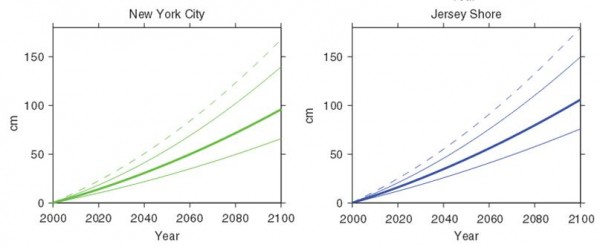
 That would mean that by the middle of this century, the one-in-10 year flood level at Atlantic City, for example, would exceed any flood level seen previously, including the natural disaster that was Superstorm Sandy. The scientists suggest, based on their research, that “planners should account for rising sea levels,” noting that “where the consequences of flooding are high, prudent planning requires consideration of high-end projections” outlined in their study.
 . “I believe that the projections for bedrock locations are applicable throughout Connecticut,” said Miller, a professor of earth and planetary sciences in Rutgers' School of Arts and Sciences.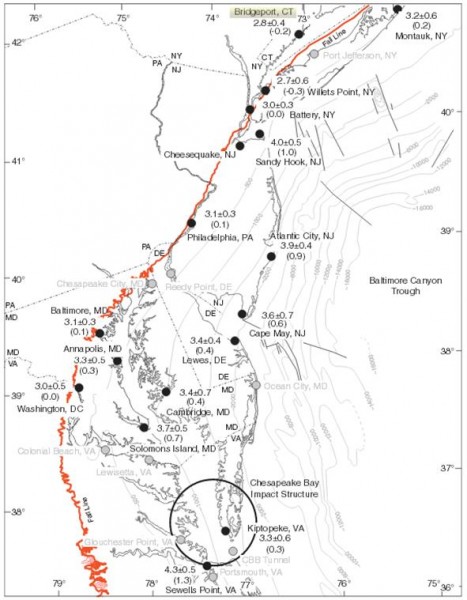
 vel rise in the mid-Atlantic region also results from changes in ocean dynamics. The researchers said sea-level rise could be higher -- 2.3 feet by mid-century and 5.9 feet by the end of the century -- depending on how sensitive the Gulf Stream is to warming and how fast the ice sheets melt in response to that warming.
 c organization representing more than 62,000 members in 144 countries.
 . Those attending school in the state: are Wesleyan student Samantha Jacobson of Needham, MA, Yale undergraduates Gabriel Perlman of New York, Reid Magdanz of Alaska and Jon Morgan of South Africa, and Yale Law School student Giselle Barcia of Miami, FL, Business New Haven reported.
 nternship experience includes an emphasis on service and interns participate in regularly scheduled service projects at schools and non-profit organizations in Washington, D.C.
 Internship Program is now open. The deadline is January 4, 2014.
 sbury in 2013 and 2011, and Cheshire in 2013 and 2011. Single appearances were made by Norwalk, Stamford, Portland, Tolland, Greenwich, South Windsor, Fairfield, and most recently, Brookfield.
 Hartford at #55. The town was joined by Stamford at #78, Hamden at #87, and Norwalk at #90.
 ts of both political parties into mayoral offices in cities and towns across the landscape?
 tors frequently confronted devastating epidemics that wiped out many of the members of their groups; at such times, having a healthy leader might have been particularly important,” they wrote recently in

 ce organizations across the country that deal with issues such as health, housing, education, career development, and family support. When veterans return home, they face vast and complex challenges. According to the Department of Defense, the military suicide rate hit a record high in 2012, increasing nearly 16 percent over the previous year. Over 60,000 veterans are homeless. The unemployment rate for Gulf War-era veterans was 9.9 percent in 2012, compared to 8 percent for all Americans.
 nce again offering the League of American Bicyclist-designed Traffic Skills 101 program, a day long course to give cyclists the skills, knowledge and confidence to handle on-road cycling in traffic. The program will be held on Sunday, November 10 at Bishops Corner in West Hartford.