Turning Guns Into Jewelry, CT Entrepreneur Helps Gun Buyback Program

Jessica Mindich is a Connecticut jewelry designer who has begun transforming recycled pistols, rifles and shotguns from Newark, N.J. – recovered in the city’s gun buyback program - into a line of fashionable bangle bracelets. The “Caliber Collection” began last fall with the melted down metal from 250 guns and bullet casings seized by the Newark Police Department. The result was a series of bracelets that embody the gun’s transformation from a destructive weapon to a powerful symbol of renewal. Jewelry for a Cause, Mindich’s business, donates 20 percent of the proceeds from each sale to the Gun Buyback Amnesty program in Newark, and recently presented a check for $20,000 to the city.caliber

Each of the guns was processed and then released to Jewelry for a Cause by the Police Department of Newark.  Their serial numbers were tracked and are an important part of the design in each of the pieces of jewelry.  The metal from the guns and bullet casings are shredded by Sims Metal Management in Jersey City, according to The New York Times.

The name Caliber was chosen for its two meanings; the caliber of a gun and how the caliber of a city is raised when illegal guns are taken off its streets, the company's website explained.  As a reminder of their source, the Caliber cuffs and bangles are marked on the inside with the serial number from a recovered weapon and "Newark." Prices range from $150 from a basic steel cuff to $375 for brass bangle with a diamond, the Greenwich Time has reported.

A former lawyer who lives in Greenwich with her husband and two young sons, Mindich started the company in 2008. It donates 20 percent of all sales - on items including necklaces and jewelry kits for charitable fundraisers - to nonprofit organizations, local and national.

The newest initiative began, the Times reported, when Mindich ran into Newark Mayor Cory Booker of Newark, who attended Yale Law School with her husband, at a conference. They spoke about Newark’s no-questions-asked gun buyback program, which was founded in 2009 and gave up to $200 dollars for each weapon that was turned in.  The program needed an infusion of money – and the jewelry line was born, with the support of Booker and the city’s police chief.logo

Mindich is reportedly considering expanding the jewelry line to include other U.S. cities - no word of cities in her home state are among them.  Bridgeport, New Haven and Hartford are among the Connecticut communities that regularly conduct gun buyback programs.

New Haven’s gun buyback program brought in 65 weapons and 63 weapons, including a Bushmaster .223 semiautomatic rifle similar to the one used in the Newtown shooting, on successive Saturdays last December, the New Haven Register and WTNH-TV reported. A gun buyback program that began in December in Bridgeport, Connecticut's largest city, has brought in more than 500 weapons to date, according to an Associated Press report.




Connecticut Ranks #25 in Homelessness, Federal Data Shows

Connecticut ranked #25 in the nation in state-by-state comparisons of the homeless population in emergency and transitional shelters in each state, according to data compiled by the U.S. Census Bureau and reported in the AARP Bulletin. Earlier this week, The Hartford Courant reported that “volunteers and social service workers roved the streets for the U.S. Department of Housing and Urban Development's national ‘point in time’ homeless census, which provides more up-to-date data to consider along with the 2010 census data that was the basis of the state comparisons.

Mandated at least every other year, the ‘point in time’ count helps advocates and housing officials analyze trends in homelessness, determine who stays in the shelters and gain insight into why, despite a stronger government push to combat homelessness, people remain out in the cold, the Courant reported.

About 4,210 homeless people lived in the state in 2012, including men, women and children in emergency shelters and transitional housing, federal data show. Among the nearly 770 reported homeless in Hartford — the biggest homeless population of the state's urban centers — 141 were children, according to a report released Wednesday by the Connecticut Coalition to End Homelessness.

Latinos are overrepresented among clients using the state’s many homeless shelters, and they tend to be much younger, according to coverage of the report by ctlatinonews.com. “While Hispanic/Latino persons represent only 12.3% of the Connecticut population, they comprised 28 percent of all emergency shelter and 23 percent of all transitional housing clients.

“They also tended to be younger. The most common age of Hispanic/Latino emergency shelter clients was between 18-29 years old (29 percent), while that of non-Hispanic/Latino clients was 40-49 years old (31 percent).”

“Connecticut’s emergency shelters alone served 11,700 people, including more than 1,500 children. The number of people in shelters and transitional programs at any given point in time increased 3% from 2009 to 2010, while shelter bed usage has exceeded 100% during all of 2010 and much of 2009. While collectively we may have slowed the rate of growth in homelessness over time, the numbers continue to increase,” the report said.


CT Businesses Less Optimistic About Immediate Prospects

Business confidence in both the U.S. and Connecticut economies slumped in the fourth quarter of 2012, according to a survey released by the Connecticut Business & Industry Association (CBIA).   The organization’s Quarterly Economic Survey: Fourth Quarter 2012 found that more than half (52%) of surveyed business leaders expect the state’s economy to worsen in 2013. That represents an increase of eight percentage points over the previous quarter. Just 14% thought the state economy would improve, while 34% believed conditions would remain stable.  Expectations for the national economy also dipped, with 40% of those surveyed responding pessimistically, compared with 36% last quarter. About one-quarter (24%) felt conditions would improve.

The survey, as reported by CBIA,  showed similar results to the two prior quarters, with most differences within the margin of error of the survey. Some noteworthy responses include:

  • 34% of respondents expect increases in production and sales, with 21% seeing decreases, the best numbers in the survey.CBIA
  • 18% see their work force expanding, while 19% expect to shed positions over the next quarter.
  • 27% see an improved outlook for their firm against 22% who see conditions declining.
  • For their industry, 23% see improving conditions while 28% see declines.

The third quarter rebound in business confidence--recovering from record low optimism in the April-June 2012 survey--was short-lived. And the outlook has taken a turn for the worse since the fourth quarter of 2011, when two-thirds saw improving or stable conditions in the state and 81% forecast the same for the U.S. economy.

Based on the state Department of Labor’s latest figures, Connecticut lost 1,800 jobs in December, finishing the year with a net loss of 100 jobs.  The unemployment rate fell three-tenths of a point to 8.6%. Writing in the Connecticut Economy recently, UConn economist Steven P. Lanza noted that “Connecticut’s economy will struggle to post more than nominal job gains’ in the coming months.

The Connecticut Economic Digest, in the current issue, noted that in December 2012, private sector workweek hours show Connecticut “is still firmly in slow employment recovery mode, highlighted by the hours worked month-to-month volatility.”  The publication is developed by the state Department of Labor and Department of Economic and Community Development.

CBIA’s Quarterly Economic Survey: Fourth Quarter 2012 was emailed to approximately 1,900 Connecticut businesses in January of 2013. A total of 187 responded, for a 10.2% response rate and a margin of error of +/- 7.3%.

Credit Card Debt Increases Among Older Residents

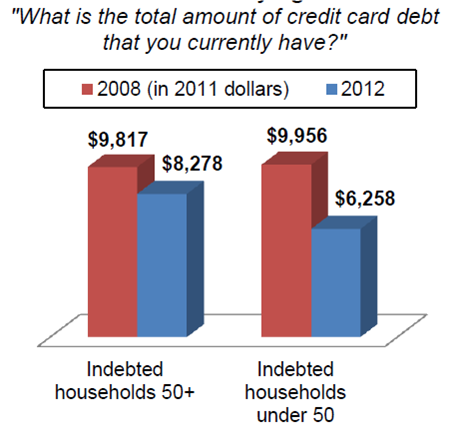
As Connecticut struggles to lift itself from a nagging recession and rebuild a shaky economy and grow jobs, new national data suggest that economic realities plus an aging population are combining to increase the credit card debt among a significant segment of the population. It has been estimated that the state's 65+ population would increase by 69 percent between 2000 and 2030. Middle-income Americans age 50 and older are carrying more credit card debt on average than younger people, according to a National Survey on Credit Card Debt of Low- and Middle-Income Households, released last month by Demos, a national policy think tank and AARP’s Public Policy Institute.

The results of the 2012 survey are a reversal of findings from a survey conducted by Demos in 2008.  It reveals a troubling picture of middle-income 50+ households carrying card debt near or in their retirement years.

The report shows that nationwide, older households carried an average credit card balance of $8,278 in 2012. For those underlogo 50, credit card debt averaged $6,258. Other key findings for middle-income households that carried credit card debt for three months or more:

  • A third of older households used credit cards to pay for basic living expenses such as rent, mortgage payments, groceries, or utilities.
  • Half of Americans age 50+ carried medical expenses on their credit cards. Prescription drugs and dental expenses were the main contributors.
  • A quarter of older households said loss of a job contributed to their credit card debt in the last three years.
  • Nearly one in five (18 percent) older Americans nearing retirement said they dipped into retirement funds to pay down credit card debt.chart
  • Older Americans were twice as likely as those under age 50 to take on credit card debt to assist other family members (23 percent vs. 11 percent).

This report suggests that credit card debt among older Americans is primarily a reflection of difficult economic times, not a lack of personal financial responsibility.  State-by-state data was not available.

The findings may help to explain the economic challenges facing Connecticut’s citizenry, which is on track to becoming one of the oldest among the states, expected to grow from 470,183 (13.8% of the total state population) in 2000 to 794,405 in 2030, constituting 21.5% of the projected total state population.


Connecticut to Receive National Support to Reduce Premature Births

With one in 10 babies born premature in the state, the National Governors Association (NGA) has targeted Connecticut and three other states for extra help in better developing and coordinating policies to reduce the rate of preterm births. NGA will convene in-state sessions with the selected states to facilitate this process and convene a networking conference for that group of states to share lessons learned and to further their respective planning processes. NGA has selected Kentucky, Louisiana and Michigan, along with Connecticut, to participate in a Learning Network on Improving Birth Outcomes. The goal is to assist states in developing, implementing and aligning their key policies and initiatives related to the improvement of birth outcomes, as measure by the incidence of preterm births and infant mortality.

Of the 41,000 babies born each year in Connecticut, about 4,000 are born preterm. The median gestational age for these babies is 35 weeks -- about a month earlier than the median 39 weeks for a full-term birth. These babies typically weigh 5.5 pounds compared with the full-term rate of 7.5 pounds.

The Learning Network will focus on demonstrated best practices of states that have improved birth outcomes. Participating states will learn about coordinating activities across agencies and options to accelerate the pace of improving outcomes and reducing costs.

The nation's premature birthrate is 11.7% of all live births — the lowest in a decade, according to figures from the National Center for Health Statistics. The March of Dimes has set a goal of 9.6% by 2020.  Nationwide, key signs of improvement in the report issued late last year:

  • Four states (Vermont, Oregon, New Hampshire and Maine) earned an "A" for meeting the 9.6% goal; in 2010, only Vermont earned the top grade.
  • Connecticut, at 10.1%, received a “B” in the report.

  • 45 states, the District of Columbia and Puerto Rico posted improved preterm birthrates from 2009march of dimes map to 2011, earning 16 of them better grades.
  • The states with the highest preterm birthrates — Mississippi (16.9%), Louisiana (15.6%), Alabama (14.9%) — are among 48 states, along with Puerto Rico (17.5%) and the District of Columbia (13.7%) that have all formally set goals to lower their preterm rates 8% by 2014 from their 2009 rates.

Connecticut's rate of pre-term births also reflect a racial and ethnic disparity. The pre-term rates are 14 percent among black/African Americans, 12 percent among Latinos and 9.4 percent among whites, according to the state Department of Public Health.

The initiative  is part of the Alliance for Information on Maternal and Child Health Services (AIM). AIM is sponsored by the Maternal and Child Health Bureau of Health Resources and Services Administration of the United States Department of Health and Human Services.

Premature birth is associated with infant mortality as well as a greater risk of learning disabilities and lifelong hearing and visual problems. Some of the major risk factors for having a premature baby are smoking during pregnancy and having a pre-existing medical condition, such as diabetes or hypertension, officials said.

Hole in the Wall Gang Camp, Angel Ride Launch Anniversary Years

Registration has opened for this year’s Angel Ride, an all-volunteer effort that organizes annual athletic endurance events as fundraising initiatives with 100 percent of the money raised going directly to The Hole in the Wall Gang Camp's Hospital Outreach Program.  This year’s events, marking the 10th anniversary of Angel Ride amidst the 25th anniversary year of The Hole in the Wall Gang Camp, will be held May 25-26. Angel Ride, a 501(c)3 non-profit organization, has supported The Hole in the Wall Gang Camp's Hospital Outreach Prograngel rideam since 2007. Hospital Outreach® brings the hopeful, playful spirit of The Hole In The Wall Gang Camp – founded in 1988 by the late actor and philanthropist Paul Newman - to children and families in the hospital setting. By offering unique, creative and developmentally appropriate activities and interactions, the program helps to restore joy and laughter in a time often laden with fear, stress and uncertainty. Consistent with other Camp programs, it is available to hospitals and families at no cost.

This past year, 18,000 hospitalized children received a visit from "Camp".  They work collaboratively with hospital staff to enhance, augment or support existing programs focused on improving the quality of life during treatment. The Hospital Outreach Program brings the joy and fun of Camp’s summer programming to seriously ill children year-round. Yale-New Haven Hospital and the Connecticut Children’s Medical Center are among the hospitals in the Northeast that are participating in the program. holeinwall logo

The Hole in the Wall Gang Camp recently released an inspiring song and music video to kick off its 25th anniversary as a hideout where seriously ill kids can simply be kids.  Natalie Merchant, one of America's most respected recording artists, created a new sing-a-long version of her iconic song "Wonder" and recorded it at the Camp in Ashford, Conn. this past summer with the campers. In the music video, Merchant leads the kids in song interspersed with clips of the late Paul Newman and the campers sharing what the Camp means to them.

Another newly released video highlights the connection between campers Hannah and Janis, who have formed a special bond during the past two years at The Hole in the Wall Gang Camp.  That bond has allowed them to face the challenges of mitochondrial disease together and experience “a different kind of healing.” The unforgettable story of their friendship brings the unique spirit of The Hole in the Wall Gang Camp to life in the first online “Healing Feeling” profile, which is part of a series being released during the Camp’s 25th anniversary.

"Wonder" was written by Natalie Merchant for her first solo album "Tigerlily."  The song, released as a single in 1996, reached the top 20 on the Billboard Hot 100 charts. Its lyrics contain the refrain, "They say I must be one of the wonders" and were inspired by Merchant’s own experience meeting twin sisters coping with a congenital disease. Merchant was struck by how positive the girls were as they faced significant challenges, thanks to an inner strength that she attributed to the love and support of their family and friends.

"For years, I've been told by parents of kids with special needs and medical staff and children themselves that 'Wonder' has become an anthem for sick kids. So I know the healing power of the song. I am delighted to add my voice to all the love, camaraderie and sharing that goes on at Camp.  Paul really did it so well. The Camp is a magical place."


Hole in the Wall Gang Camp, Angel Ride Launch Anniversary Years

Registration has opened for this year’s Angel Ride, an all-volunteer effort that organizes annual athletic endurance events  as fundraising initiatives with 100 percent of the money raised going directly to The Hole in the Wall Gang Camp's Hospital Outreach Program.  This year’s events - marking the 10th anniversary of Angel Ride, amidst the 25th anniversary year of the remarkable Camp - will be held May 25-26. Angel Charitable Trust, a 501 (c) 3 non-profit organization,  has supported The Hole in the Wall Gang Camp's Hospital Outreach Program since 2007.  Hospital Outreach® brings the hopeful, playful spirit of The Hole In The Wall Gang Camp – founded in 1988 by the late actor and philanthropist Paul Newman - to children and families in the hospital setting.  By offering unique, creative and developmentally appropriate activities and interactions, the program helps to restore joy and laughter in a time ofteangel riden laden with fear, stress and uncertainty. The Hospital Outreach Program brings the joy and fun of Camp’s summer programming to seriously ill children year-round.

This past year, 18,000 hospitalized children received a visit from "Camp". Consistent with other Camp programs, it is available to hospitals and families at no cost.  They work collaboratively with hospital staff to enhance, augment or support existing programs focused on improving the quality of life during treatment. Yale-New Haven Hospital and the Connecticut Children’s Medical Center are among the hospitals in the Northeast that are participating in the program.

The Hole in the Wall Gang Camp recently released an inspiring song and music video to kick off its 25th anniversary as a hideout where seriously ill kids can simply be kids.  Natalie Merchant, one of America's most respected recording artists, created a new sholeinwall logoing-a-long version of her iconic song "Wonder" and recorded it at the Camp in Ashford, Conn. this past summer with the campers. In the music video, Merchant leads the kids in song interspersed with clips of the late Paul Newman and the campers sharing what the Camp means to them.

Another newly released video highlights the connection between campers Hannah and Janis, who have formed a special bond during the past two years at The Hole in the Wall Gang Camp.  That bond has allowed them to face the challenges of mitochondrial disease together and experience “a different kind of healing.” The unforgettable story of their friendship brings the unique spirit of The Hole in the Wall Gang Camp to life in the first online “Healing Feeling” profile, which is part of a series being released during the Camp’s 25th anniversary.

"Wonder" was written by Natalie Merchant for her first solo album "Tigerlily."  The song, released as a single in 1996, reached the top 20 on the Billboard Hot 100 charts. Its lyrics contain the refrain, "They say I must be one of the wonders" and were inspired by Merchant’s own experience meeting twin sisters coping with a congenital disease. Merchant was struck by how positive the girls were as they faced significant challenges, thanks to an inner strength that she attributed to the love and support of their family and friends.

"For years, I've been told by parents of kids with special needs and medical staff and children themselves that 'Wonder' has become an anthem for sick kids. So I know the healing power of the song. I am delighted to add my voice to all the love, camaraderie and sharing that goes on at Camp.  Paul really did it so well. The Camp is a magical place."

The Camp was recently featured on CBS Sunday Morning.


Blizzard of '78 Numbers Still Devastating, Unsurpassed

With “historic” levels of snow predicted by some local meteorologists for Friday and Saturday, it is natural to look back at an unforgettable February snowfall in the state 35 years ago this week.  The Blizzard of ’78 is legendary not only in the amount and intensity of the snow and wind, but in other impacts as well, including coastal high tides and damage to homes and property, and even politics – it is seen as central to the re-election later that year of Gov78ernor Ella Grasso. Just a year ago, Connecticut Public Television aired a new documentary about the Blizzard of ’78, which included these statistics not soon forgotten by those in the state at the time:

  • 30 inches of snow
  • 70 mile per hour winds
  • 5,000 people stranded
  • 16 foot snowdrifts
  • Air and rail traffic were shut down amidst 3 days of snow
  • Snowfall as high as 4 inches per hour
  • 1,200 cars towed from state highways and thousands stuck on secondary roads

A retrospective published in The Hartford Courant adds these statistics:

  • More than $25 million in damage
  • A contingent of 547 soldiers from Fort Hood, Texas,   flew to Connecticut to help National Guard crews with snow removal and clean up
  • Mail delivery ceased for the first time in 40 years
  • Gov. Grasso shut down the state for three days, and President Carter  declared Connecticut, Rhode Island and  Massachusetts federal disaster areas.

It was a storm for the ages, the likes of which Connecticut has not seen in more than three decades.  We’ll see what this weekend brings.

Textbook Prices Vary Widely Between Campus Bookstore, Online Options

Seven years ago, a Connecticut Board of Governors for High Education study revealed that only 58 percent of the state’s higher education faculty were aware of the cost of the textbooks they selected for their courses.  While changes in the textbook industry, the increased availability of electronic textbooks, and the development of a textbook rental program at most institutions may have improved awareness, there are two certainties that remain.  Textbooks remain expensive at traditional college bookstores, but there are alternatives – and students are finding them. A report published this week by the student newspaper at UConn, The Daily Campus, showed the prices of a single textbook from four different retailers, and compared the purchase and rental options available to students.  The graph accompanying the story compared the price differences, from prominent retailers including the UConn Co-Op Bookstore, Amazon, Chegg and Half.com.1606298843

The textbook used for the price comparison, Introductory Chemistry Essentials (4th Ed.), is a frequent purchase among UConn undergraduates because it is a required textbook for CHEM 1122, a prerequisite for higher-level science courses.

The College Board (the organization responsible for the SAT exam, among other initiatives) has said the average student at a public four year college should expect to spend over one thousand dollars a year on textbooks and course materials. According to the American Enterprise Institute, textbook prices have increased at a faster rate than tuition.

In The Daily Campus report, to buy the textbook new and unused, the UConn Co-Op Bookstore charges $80.41 over the Amazon price, which was the second-priciest option.  The Bookstore charges $110.43 more than Half.com, the least expensive option.  As for renting the textbook, the UConn Co-Op is $45.91 more than Amazon, the second-priciest option. It costs $68.03 more than Chegg, which is the least expensive option.

It was recently reported that New York University has been experiencing an annual decline in textbook sales at its campus bookstore of about 5 percent each year since 2008, as students use less expensive alternatives to purchase books needed for their classes.

(chart prepared by The Daily Campus)


Concussion Dangers Continue to Resonate in High School Sports

Nearly 450 Idaho prep athletes who competed last fall in football, soccer and volleyball were held out of games or missed practice because of confirmed or potential concussions, according to a new survey reported by the Associated Press. The survey was conducted by the Boise-based Idaho High School Activities Association, the governing body for all prep sports and high schools statewide. The survey was sent to all schools, but data compiled in the findings are based on responses from just 45 percent, or 68, schools from all competitive class levels.

Football was by far the leading sport for missed games or practices, with 307 football players missing action during the season last fall, according to a story published Friday in the Idaho Statesman. Girls soccer ranked second, followed by boys soccer and volleyball.

A recent study in Massachusetts found that 28 percent of high school athletes in the state have shown regression in their cognitive abilities after moderate exertion once returning to the playing field too soon following a concussion. The study highlighted that high school student-athletes who have suffered concussions are returning to the playing field before their brain has fully recovered.121102ConcussionsFINAL

The study, conducted by neuropsychologist Neal McGrath of Brookline, Mass., looked at 54 athletes in football, soccer and hockey who suffered head injuries. McGrath told the Boston Globe that the findings suggest more oversight is needed in regard to when athletes can return to the field following a concussion. The study is schedule to be published in the upcoming issue of Brain Injury.

The findings come on the heels of the Boston Globe’s findings last October that almost 3,000 students in Massachusetts schools suffered concussions while playing sports during the 2011-12 school year.

Connecticut was one of the first states in the nation to adopt a concussion law,

following Oregon and Washington, which implemented similar statutes in 2009. Connecticut's concussion law was signed by Gov. M. Jodi Rell on May 19, 2010 and became effective July 1, 2010. The law is in place to prevent student-athletes from participating in games after suffering head injuries.  Main provisions include:

  • All coaches holding a coaching permit issued by the State Board of Education are required to take a three-hour concussion training course
  • Annually, coaches are expected to review new information provided by the State Board of Education
  • Every five years after the initial training, coaches must complete a refresher course
  • Any athlete who exhibits signs or symptoms of a concussion must be removed from play
  • Athletes will not be permitted to return to play until they have received written medical clearance from a qualified medical provider
  • Coaching permits may be revoked if coaches are in violation of these provisions

Connecticut state law requires all coaches to take a concussion management course prior to the start of their season.

The web site Masters in Health Care has prepared an extensive infographic with nationwide data highlighting the prevalence of concussions and symptoms to keep a watchful eye for.

The Centers for Disease Control and Prevention (CDC) has developed a web page with information about concussions and injury prevention.  Heads Up: Concussion in Youth Sports is a free, online course available to coaches, parents, and others helping to keep athletes safe from concussion.

It features interviews with leading experts, dynamic graphics and interactive exercises, and compelling storytelling to help recognize a concussion and know how to respond.