More Social Capital = Fewer Traffic Accidents, Research Study Finds

If you’ve never made a connection between traffic accidents and social capital, you’re probably not alone.  However, the Harvard Business Review (HBR) is reporting on research by Matthew G. Nagler of the City College of New York which found, perhaps surprisingly, that a 5% increase in the average level of agreement with the statement "most people are honest" within a U.S. state results in a decline in traffic fatalities in that state by about 11%. The “most people are honest” statement is a measure of trust in others that is an indicator of the state's level of social capital, sometimes defined as a willingness to engage in community activities. Less-conscientious people who reject civic engagement presumably drive more recklessly, HBR reported.

Nagler’s abstract for the researchCarAccidentSafety_main_022, to be published next month in the journal Economic Inquiry, explains that “evidence that social capital reduces traffic accidents and related death and injury, using data from a 10‐year panel of 48 U.S. states show that social capital has a statistically significant and sizable negative effect on crashes, traffic fatalities, serious traffic injuries, and pedestrian fatalities that holds up across a range of specifications.”

In case you were wondering, Nagler – an Associate Professor in the Department of Economics - did not want the research unduly impacted by snow-related accidents, so he used only data from summer months.  The research data used was from 1997 to 2006. His research paper is entitled “Does Social Capital Promote Safety on the Roads?”

The death toll in the U.S. from traffic accidents has been approximately 43,000 deaths annually, according to the report. Traffic fatalities remain a major cause of death at all ages and the leading cause for persons under the age of 44.

In the paper’s conclusion, Nagler notes that the results of his study “parallel prior findings with respect to social capital’s beneficial effects on economic growth and various health outcomes.”  In 2004, a study by three University of Connecticut researchers found that social capital is associated with decreased risk of hunger.“Households may have similarly limited financial or food resources, but households with higher levels of social capital are less likely to experience hunger,” they concluded.
Health Analysis Ranks Tolland, Middlesex, Fairfield Counties At Top of List

If you’re looking for the healthiest counties in Connecticut, look no further than Tolland and Middlesex Counties.  According to a report released by the Robert Wood Johnson Foundation and the University of Wisconsin Population Health Institute, Connecticut’s eight counties vary across a range of health categories and indices. In the report’s analysis of health outcomes, the order of ranking was Tolland, Fairfield, Middlesex, Litchfield, New London, Hartford, Windham, and New Haven.

The report – County Health Rankings & Roadmaps - also includes a ranking by Health Factors, which finds a slightly altered order:  Middlesex, Tolland, Litchfield, Fairfield, New London, Hartford, New Haven, and Windham. Factors included in the analysis are health behaviors, clinical care, social & economic factors, and physical environment.

The Rankings look at a variety of measures that affect health such as the rate of people dying bCounty-Health-Rankings-logoefore age 75, high school graduation rates, unemployment, limited access to healthy foods, air and water quality, income, and rates of smoking, obesity and teen births.

The report relies on a robust set of data and analysis that allows counties to see what it is that is making residents sick or healthy and how they compare to other counties in the same state. A dynamic, interactive website shows the rank of the health of nearly every county in the nation and illustrates “that much of what affects health occurs outside of the doctor’s office.”

It examines25 factors that influence health, including rates of childhood poverty, rates of smoking, obesity levels, teen birth rates, access to physicians and dentists, rates of high school graduation and college attendance, access to healthy foods, levels of physical inactivity, and percentages of children living in single parent households.

The data has been used to garner support among government agencies, healthcare providers, community organizations, business leaders, policymakers, and the public for local health improvement initiatives. The website’s Action Center offers access to free personalized assistance to places that need guidance on what steps to take to make their communities healthier places to live, learn, work, and play.

This year’s Rankings show significant new national trends:

  • Child poverty rates have not improved since 2000, with more than one in five children living in poverty.
  • Violent crime has decreased by almost 50 percent over the past two decades.
  • The counties where people don’t live as long and don’t feel as well mentally or physically have the highest rates of smoking, teen births, and physical inactivity, as well as more preventable hospital stays.
  • Teen birth rates are more than twice as high in the least healthy counties than in the healthiest counties.
  • Access to health care remains an important factor and this year, the Rankings include residents’ access to dentists, as well as primary care doctors. Residents living in healthier counties are 1.4 times more likely to have access to a doctor and dentist than those in the least healthy counties.

The County Health Roadmap, which accompany the rankings, are designed to help bring people together from all walks of life to look at the many factors that influence health, focus on strategies that work, learn from other communities so as not to reinvent the wheel, and make changes that will have a lasting impact on health.

The Robert Wood Johnson Foundation focuses on the pressing health and health care issues facing our country. As the nation’s largest philanthropy devoted exclusively to health and health  care, the Foundation works with a diverse group of organizations and individuals to identify solutions and achieve comprehensive, measurable, and timely change.

The University of Wisconsin Population Health Institute is the focal point within the University of Wisconsin School of Medicine and Public Health for translating public health and health policy research into practice.


Being A Good Neighbor, Connecticut Exceeds National Average

Do you trust your neighbors?  Data compiled by the National Conference on Citizenship indicates that Connecticut residents outpace the national average on the neighborliness scale.  The report indicates the 17.9% of Connecticut residents trust “all of the people” in their neighborhood, compared with 15.6% nationally.  In addition, 43.6% of Connecticut residents trust “most of the people” in their neighborhood, slightly higher than the national average of 41.1%. The study, done in conjunction with the Corporation for National & Community Service, also found that 72.8 percent of Connecticut residents “do favors for their neighbors” – again exceeding the U.S. average of 65.1%.

Social cohesion, highlighted in the NCoC report Volunteering and Civic Life in America,  is made up of key indicators of how individuals engage with their neighbors—how often do we talk with one another, help each other out, and how much do we trust the people in our communities? High levels of social cohesion are critical to individual and community well-being.

The data shows that these areas are worth exploring and strengthening further across the country, the organization reported. Just 13.3% of Americans said that they talk with their neighbors every day and 30.4% do a few times a week. However, a full 13.5% of Americans report never talking with their neighbors. neighbors When asked if they exchange favors with neighbors, such as watching each other’s children, helping with shopping, or lending garden or house tools, only 14% of Americans do so everyday or a few times a week. A striking 35% of Americans report never engaging in this behavior.

Looking out for one’s neighbors often connects directly to levels of trust in a neighborhood. Of individuals that indicated they trust all or most of their neighbors, approximately 4 in 5 (77%) said they do favors for their neighbors a few times per year or more. In contrast, of individuals that indicate they trust none of their neighbors, only 24% said they do favors for their neighbors.

Nationally, 15.6% of Americans report they trust all of their neighbors, 41.1% report they trust most, 34.6% report they trust only some, and 8.7% trust no one in their neighborhood.

The 2013 National Conference on Citizenship will be held September 19-20 in Washington D.C. The theme for this year's conference is "America's Charter: Past, Present, and Future." Throughout 2013, NCoC celebrates the 60th anniversary of the organization’s Congressional charter, which charged them to explore the meaning of and find ways to increase active citizenship in America. The event and celebration will help participants “understand the significance of where we've been as a country, the civic reawakening we are experiencing now, and how we carry this revitalized sense of purpose forward.”

After-School Network Highlights Accomplishments, Fights for Budget

The lengthy corridor between the State Capitol building and the Legislative Office Building routinely hosts informational poster displays on its walls, in two-week cycles, from a broad range of agencies, organizations and associations, highlighting their work and the impact it has on the state.  Reservations for the space are routinely made weeks in advance. One of the current displays, coordinated by the Connecticut After School Network, comes at a time when they – like many other nonprofit organizations and state agencies – are facing a potential budget cut from the state, at the urging of Gov. Malloy.  Ultimately it is the state legislature that will determine the parameters of the budget, a debate underway throughout the Capitol complex amongst legislators who pass by the posters each day, with messages and statistics that are hard to miss.  Among them:after school

  • After-school programs cut the risk of juvenile crime by as much as 75%
  • In Connecticut, 19% of children under the age of 18 experience food hardship.  Many rely on the meals they get at school and in after-school programs as a primary source.
  • $1.7 to $2.3 million is saved by putting one high-risk youth on the right path.
  • 73% of working parents miss less work when their children attend an after-school program.
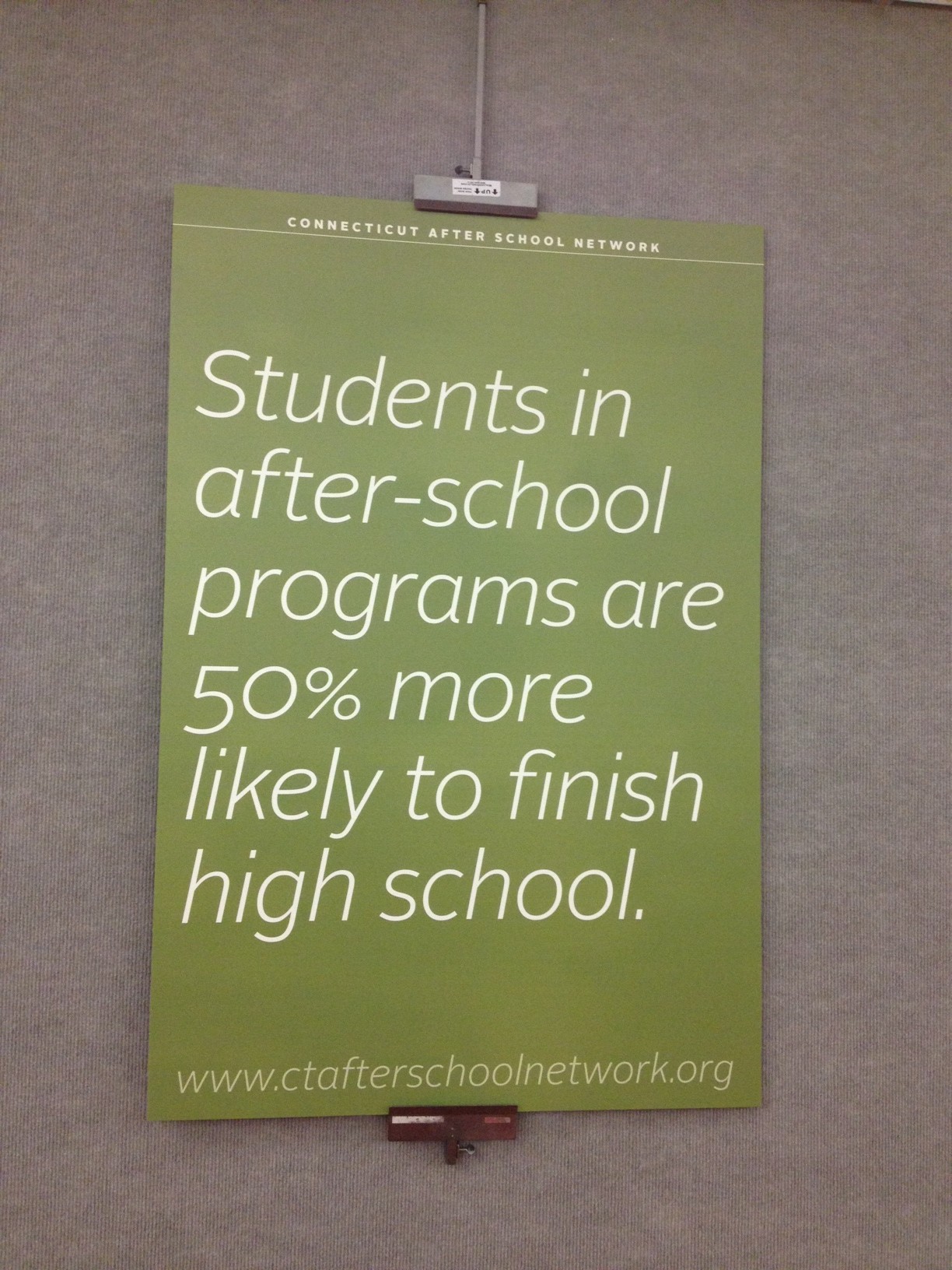
  • Students in after-school programs are 50% more likely to finish high school
  • One in five Connecticut children (21%) regularly spends time after school unsupervised. This trphotoanslates to more than 80,000 Connecticut children
  • Children and youth involved in after-school programs have fewer absences from school.

March 7 was “After School Day at the Capitol.” The organization released a major report "Supporting Student Success in Connecticut: A BluePrint for Expanded Learning Opportunities".   The report calls on the state to make “7 smart, strategic investments,” reflecting that “after-school not be an after thought.”  The recommendations include addressing the issues of summer learning loss, incorporating expanded learning opportunities into the state’s education reform strategies, increasing alignment between systems and funding sources, rethinking the relationship between time and learning, and strengthening quality and accountability.

Their website currently features a petition urging restoration by legislators of the $4.5 million proposed cut and is promoting the organization’s 7th Annual Literacy Essentials Conference, to be held on Saturday, April 6 in conjunction with Central Connecticut State University.

The organization’s web site also points out that “every dollar invested in after school programs will save taxpayers approximately $3, not including the savings from reduced crime.”

The Connecticut After School Network is a nonprofit 501(c)(3) organization originally founded in 1989 and incorporated in 1990 under the name Connecticut School Age Care Alliance (CSACA). In 1990, CSACA became affiliated with the National School Age Care Alliance (now the National After-School Association).

Following similar action by the national organization, CSACA changed its name and broadened its mission in 2006, becoming the Connecticut After School Network.  It is a partnership of individuals and organizations working to ensure that every Connecticut child and youth will have the opportunity to participate in high quality, affordable after school programs.

The State Department of Education is a significant partner and major funder of the Network, providing leadership, support and technical assistance. SDE also oversees the CT After-School Advisory Council which provides advice and direction to the Network.

Efforts to Close the Digital Divide Prompts Company Move To Hartford

GreenShare Technology is a company that takes its mission – to bridge the digital divide by providing technology to those who cannot afford it – quite seriously.  That is plainly evident in their move from Farmington to new, larger headquarters at 1200 Park Street in Hartford. The new, 2,000 square foot location doubles the company’s space, allowing GreenShare Technology to bring more affordable computers and computer maintenance services to Hartford and surrounding areas. The company plans to provide basic computer training and computer recycling services on-site. The new location wilogo-greenshare-technologyll also contain a retail section where customers can try out computers before purchasing them.

“We’re excited to become a part of the Hartford community,” said Brenda Steigman, Executive Director of GreenShare Technology. “It is our goal to become a one-stop source for low-cost computer technology and repair. We hope this new location will make us more accessible to the people who can benefit from our services.”

GreenShare Technology will host an open house at its new location Thursday, March 28 from 5 to 7 p.m. The public is welcome to stop by to learn more about the company’s services and bring an unwanted computer to be re-purposed or recycled. For more information, visit www.greensharetechnology.org or call 860-724-3535.

A 501(c) (3) charitable organization and Microsoft® registered refurbisher, Greenshare Technology offers computer recycling services for businesses and families to discard unwanted technology, keeping working computers out of landfills and putting them into the hands of small businesses, schools, non-profit organizations, government programs, and other eligible customers who might otherwise not have access to this technology.

GreenShare Technology received the 2011 Social Entrepreneur Award and the 2010 Hartford Young Professionals & Entrepreneurs (HYPE) Award.  The company is a reSET incubator program.


CT Receives Recognition for Economic Development

The Connecticut Department of Economic and Community Development has received national recognition from a top site selector organization for its economic development efforts.  DECD was selected to receive the 2013 Site Selectors Guild Award for its work with Tronox Inc., a chemical company that announced in 2012 that it would be locating its world headquarters in Stamford.  The Site Sectors Guild is a professional association that includes some of the worlds most respected site consultants. The most recent recognition underscores ongoing efforts of DECD, which include highlighting Connecticut's strong position to attract and grow businesses.  Some of the noteworthy stats:

  • Connecticut is a leader in patents, ranking 8th in the nation.
  • Connecticut is a leader in business research and development, ranking #1 per capita.
  • Connecticut is a global competitor, ranking #6 in world GDP per capita.
  • Connecticut’s workers are among the most productive in the nation, ranking fourth among states.
  • Connecticut is a leader in venture capital deals, which are key to the development of small business, ranking #7.
  • The state ranks 9th in the nation as a leader in the New Economy.
  • Connecticut is a leader in finance and insurance, ranking #2 in total employment.
  • Connecticut is a leading exporter ranking tenth in per capita exports.
  • Connecticut has a highly educated workforce ranking third with an adult population with advanced degrees.
  • Connecticut ranks 6th in the number of scientists & engineers per 100,000 employees.

The data, provided by CL&P's Connecticut Economic Review 2013 and The Information Technology & Innovation Foundation, reflects a mix of widely known and virtually unknown stats about Connecticut workforce and global position in a range of industries.

Early Childhood Education Cabinet to Meet Amidst Changing Landscape

The Connecticut Early Childhood Education Cabinet next meets on March 28 in Middletown, less than two months after Governor Dannel Malloy announced the establishment of an Office of Early Childhood (OEC) by merging functions previously under the jurisdiction of five different agencies. The new agency is designed to provide a comprehensive, collaborative system for delivering improved programs and services to children ages zero to five and their parents. The meeting also comes a year after the Cabinet, which was reformed by former Gov. M. Jodi Rell in 2010, issued a Needs Assessment report, which included the following sit-up-and-take-notice statistics:

  • There are approximately 212,504 children from birth to age five in Connecticut; 29,379 of those children live in poverty and 78,803 children are from low income families.
  • Approximately 161,013 of children under the age of six are potentially in need of child care.
  • The state currently has 2,173 child care centers, with 25% of the centers nationally accredited .
  • The annual cost of center-based care for an infant is $12,469, approximately 15% of the state’s median family; income.  The annual cost of care for an infant in a family child care setting is $9,230, 11% of the median family income.
  • According to the National Center for Children in Poverty, 6% of Connecticut’s children under the age of six are experiencing extreme poverty.
  • The percent of Connecticut children living in families where no parent has full-time, year-round employment is 26%, with 10% of children having at least one unemployed parent.
  • The number of children served in Connecticut’s emergency shelters increased by 15% between 2010 and 2011.

The new Office of Early Childhood is a product of work by agency commissioners, early childhood education and development advocates, parents, caregivers, and other stakeholders, the Malloy administration explained.  It is comprised of related programs that were previously housed in five separate state agencies, and builds on work done in 2012 when Connecticut invested $9.8 million in early childhood initiatives, created 1,000 new spots for early learners, invested early$3 million for a tiered quality rating and improvement system.

The purpose of the Early Childhood Education Cabinet has been to develop a high-quality, comprehensive system of early childhood education among the wide array of early childhood programs in the state (including Head Start, child care and School Readiness). It is chaired by Fairfield Schools Superintendent David Title. The Cabinet’s 2012 report concluded by stating their commitment to serve as “the catalyst for ongoing coordination and collaboration with statewide stakeholders to ensure that Connecticut’s youngest children have increased access to high quality early learning experiences as a foundation for lifelong success.”

Under Gov. Malloy’s revamped Office of Early Childhood, 71 staff will move to the new office, and four new positions will be created—an Executive Director and three staff positions.  The OEC will require a $370,000 investment in fiscal year 2014, and will use the Department of Education administrative and back office support. It will phase in over two years.

The planning of the OEC was made possible by support from the William Casper Graustein Memorial Fund, the Early Childhood Collaborative funders, and the Early Childhood Alliance.


Small Business Development Center is Re-launched At UConn Campuses, Chambers of Commerce

The Connecticut Small Business Development Center (CTSBDC), a collaborative initiative of the federal Small Business Administration (SBA), State of Connecticut and University of Connecticut, is being rebooted, redesigned and re-launched in an effort to be more responsive to the state’s small and newly-forming businesses. CTSBDC is a five-year, $11.6 million program to provide financial and technical assistance to businesses with 500 or fewer employees – which accounts for roughly 93 percent of Connecticut employers.

The initiative was announced by UConn’s Vice President for Economic Development Mary Holz-Clause and state Commissioner of Economic and Community Development Catherine Smith during Connecticut Business Day at the State Capitol.  They were joined by Gov. Dannel P. Malloy, President and CEO of the Business Council of Fairfield County Chris Bruhl, UConn Board Chair and Middlesex Chamber of Commerce President Larry McHugh and business leaders from across the state.

“The new SBDC is designed to focus more like a private sector business: close to its customers, interconnected, efficiently using scarce resources, and offering a slate of innovative new services,” Bruhl said. “With a statewide network of 11 local SBDC offices, the Center strives to build the local ecosystem, recognizing that small business begins at the local level.”

The program will fund 16 full-time positions and two part-time positions, with individuals located at each of the 11 service centers, including seven local Chambers of Commerce and four regional UConn campuses, as well as the UConn cSBDCampus in Storrs, and the Department of Commerce Export Assistance Center in Middletown.

During the news conference, Holz-Clause pointed out that the University is an ideal home for the SBDC, as the power of UConn’s network of more than 100,000 alumni can be tapped to serve as both mentors and connectors for small businesses to ensure they are successful. In addition, the six regional campuses provide the SBDC with an established network of satellite sites that are already engaged in local, state, and national business development efforts. She also noted the work of organizations such as UConn Ventures, which are helping to launch new businesses based on research and innovation at UConn.

“UConn is really focused on growing Connecticut’s economy from the ground up,” said Holz-Clause. “That’s why this partnership is such a perfect fit for us. It builds on some of our existing strengths and gives us a front-row seat for truly exciting developments in the state’s business community.”

Governor Malloy pointed out that “The reinvigorated Small Business Development Center takes our economic development strategy to a new level, combining the academic strength and resources of our flagship university with the knowledge and reach of our chambers of commerce, to bring technical and financial assistance to the sector responsible for the overwhelming majority of our jobs: small businesses.”

The Small Business Development Center program, administered by the federal government’s Small Business Administration, has been providing service to small businesses for more than 30 years and is one of the largest professional small business management and technical assistance networks in the nation with over 900 locations across the country.  In Connecticut, it had been based at Central Connecticut State University and the Connecticut State University System in recent years.  Previously, UConn had hosted the program.

For more information regarding the SBDC and its programs, please visit the newly designed  website at  www.ctsbdc.org. To learn more about UConn’s Office of Economic Development, please visit www.innovation.uconn.edu.


First-in-Nation Audio Service for Hospitalized Children Launched in Connecticut

In what may be the first program of its kind in the nation, CRIS Radio and Connecticut Children's Medical Center are working together to offer children who are patients at the hospital a new way to pass their time while receiving medical treatment. Connecticut Children's patients may now listen to CRISKids, a service that provides audio versions of articles published in nearly 20 award-winning children's magazines, through the hospital's in-house television system.  The audio alternative to printed magazines - through an in-house system streamed to each patient TV – can be tremendously comforting for young patients unable to read or turn pages of a magazine due to their condition or medical treatment.

CRIS (Connecticut Radio Information System) is a 34-year-old nonprofit based in Windsor and is Connecticut's only radio-reading service providing audio access to news and information for people who are blind or print-handicapped, including those unable to read due to physical, learning, intellectual or emotional disabilities.

CRISKids, the only extensive line-up of audio versions of children's magazines in the nation and Canada, was launched in December 2011.  More than a dozen titles are available, mostly for children aged 4 to 15, including National Geographic for Kids, Science World, Ranger Rick,  Junior Scholastic, Sports Illustrated for Kids and Scholastic News. CRIS radio

CRIS Board Chairman William H. Austin said that the Board “is excited to form a partnership with Connecticut Children's and thankful for the funding support received to bring this project to life.  Comcast provided technical assistance and a donation of special equipment necessary for the project. Other funders of the project include the Ellen Jeanne Goldfarb Memorial Charitable Trust, and the Ahearn Family Foundation.

"The availability of CRISKidsTM in patient rooms will allow children to enjoy educational entertainment, which is an extremely valuable offering and can be a helpful component of the healing process," said Martin J. Gavin, President and CEO of Connecticut Children's Medical Center.

The CRISKids initiative has received financial support from several foundations, including: Help for the Blind of Eastern Connecticut, Fund for Greater Hartford, The Gibney Family Foundation, and the Hartford Foundation for Public Giving.

CRIS Radio records more than 70 newspapers and magazines to provide audio access to printed material for people who are blind and print-handicapped. The audio recordings can be heard with a special CRIS radio, toll-free through the CRIS Telephone Reader, online streaming live or on-demand at the CRIS Radio website, www.crisradio.org, or with any mobile device, including tablets or smartphones.  CRIS operates with nearly 350 volunteers at its broadcast center in Windsor and four satellite studios located in Danbury, Norwich, Trumbull and West Haven.  The CRISKids program is also available for individual subscription.

Connecticut Children's Medical Center is a nationally recognized, 187-bed not-for-profit children's hospital serving as the primary teaching hospital for the Department of Pediatrics at the University of Connecticut School of Medicine. Named among the best in the nation for several of its pediatric specialties in the annual U.S. News & World Report "Best Children's Hospitals" rankings.


CT Ranked #5 in Green Job Creation in 2012

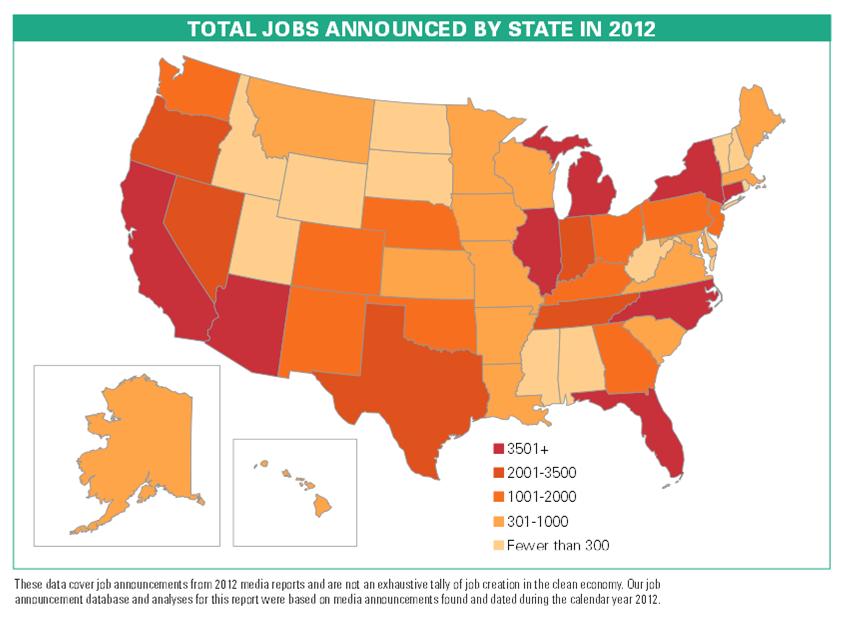
Connecticut ranked #5 in the U.S. for green job creation during 2012, according to a national business association compiling of media reports. Environmental Entrepreneurs, a New York City-based organization, ranked all 50 states for green job creation based on projects completed, in progress, or announced in 2012 and the estimated number of jobs created by those projects.  Nationwide, companies and communities announced more than 300 clean energy and clean transportation projects in 2012 that are expected to create 110,000 jobs, the report said.

Connecticut had four projects in 2012 expected to generate 4,958 jobs, the Hartford Business Journal noted in its reporting.  Those projects were the construction of the $97 million headquarters of North Haven construction parts manufacturer Sustainable Building Solutions; the opening of Scottish power company Renewable Resources in Stamford; the construction of the New Britain-to-Hartford busway; and the Plainfield Renewable Energy biomass plant.  The report indicated that Connecticut had 50 projects in progress.

Connecticut was the only New England state in the top 10. Leading the states was California with 25,354 jobs followed by Florida, North Carolina, Illinois, Connecticut, Arizona, New York, Michigan, Texas, and Oregon.map

As a region, the Southeast led the country in manufacturing-related clean energy job announcements, with more than 13,700 jobs announced last year, accounting for about 80 percent of the nation’s total. Solar, advanced vehicles and wind energy were the leading clean energy manufacturing industries in the Southeast.  Nationwide, clean transportation projects led the job growth last year, followed by clean power generation, manufacturing and energy efficiency projects.

The report was issued by Environmental Entrepreneurs (E2), described as “a national community of individual business leaders who advocate for good environmental policy while building economic prosperity.”