Research Shows Schools Start Too Early; Some South Windsor Students Begin at 6:30 AM

A national publication, highlighting policies that school districts around the country are experimenting with to “make schools better for kids,” suggests starting classes after 8:30 a.m.  Some schools in Connecticut and across the nation are doing so, moving high school start times from earlier hours.  In South Windsor, however, the experiment is in the opposite direction, with a select group of high school students beginning weekday classes at 6:30 a.m. It's part of a new pilot plan called "zero period," created as a temporary relief for some students until the school can transition from a seven-period to an eight-period school day, Principal Daniel Sullivan recently told The Hartford Courant.school-start-times_456px

"It's not for everybody and it's not a requirement for the kids that are doing it," Sullivan said. "It's going to be tough … but they chose it because it's what they want. They're doing what they want to do and we're glad to give them that opportunity."

In other schools, the pendulum is moving the opposite way.  “In order to stay healthy, adolescents need at least eight hours of sleep each night; deprivation can lad to weight gain, focus issues, lower academic performance and other problems, the article in TIME magazine points out.

“Biologically, adolescents are hardwired to stay up late, often until 11 p.m. or midnight.  That’s why federal official and medical experts are calling for middle and high schools to start after – at or after 8:30 a.m.,” the magazine indicates.  The Portland Press Herald recently reported that the Centers for Disease Control (CDC),  the American Academy of Pediatrics and numerous studies recommend later start times for secondary education – preferably 8:30 or later. 8 30 clock

In more than 40 states, at least 75 percent of public schools start earlier than 8:30 a.m., according to the CDC’s report. But those numbers are changing.  The idea is to improve the odds of adolescents getting sufficient sleep so they can thrive both physically and academically. Among an estimated 39,700 public middle, high, and combined schools in the United States, the average start time was 8:03 a.m., the CDC reported. In Connecticut, fewer than 5 percent of middle and high schools started at 8:30 or later, one of the lowest rates in the country.

early clockThe CDC’s recommendations in August came a year after the American Academy of Pediatrics urged schools to adjust start times so more kids would get the recommended 8.5 to 9.5 hours of nightly rest. Both the CDC and the pediatricians’ group cited significant risks that come with lack of sleep, including higher rates of obesity and depression and motor-vehicle accidents among teens as well as an overall lower quality of life, The Atlantic recently reported.

At South Windsor High School, two "zero period" courses begin at 6:30 a.m. and end at 7:15 a.m., allowing students about 10 minutes for breakfast before the start of first period at 7:25 a.m. The school day concludes at 2 p.m.

In South Windsor, the early classes are aimed primarily at sophomore intervention, special education, AP science and music and art students, according to school officials. About 25 students are participating in the pilot program as the school year gets underway. The Courant reports that similar programs have been implemented in schools on the West Coast, with mixed reactions.

In Guilford, school officials were considering revised start times in discussions late last year.  But the schedule for the new school year shows the high school start time as 7:25, with middle schools beginning at 7:50 and 8:00 a.m.

This fall, students can choose from a photography and a health class. In the spring, students will have the option of business communications and physical education. Bus transportation is being provided for the students, the Courant reported. "These kids are committing to getting up early, getting here early and taking care of business,” Sullivan said, indicating that the experimental zero period is not a substitute for an eight-period school day.


Youth Face Substantial Challenges in Fairfield County, Report Reveals

There are significant unmet needs among the children and youth of Fairfield County, with over 800 students dropping out of high school each year, 1 in 8 youth ages 16-24 unemployed and over 2,600 youth ages 16-19 neither employed nor in school, according to a new report by Connecticut Voices for Children.  Youth well-being differs from town to town and city to city according to the report, commissioned by Fairfield County’s Community Foundation. The outcome disparities “present a threat not only to the children, families and neighborhoods of Bridgeport, but also to Fairfield County,” the report concluded, noting that Bridgeport today educates as many students as Westport, Wilton, Weston, New Canaan, and Darien combined.  The report indicates that Fairfield County’s future lives in its cities and depends very much on the success of its vulnerable children and youth.fairfield county towns

The purpose of the report is to inform and develop Fairfield County's Community Foundation’s Thrive by 25 Program, to help Fairfield County young people achieve self-sufficiency by age 25. The report points out that “Fairfield County’s 100,000 young people ages 16 to 24 face youth unemployment rates between 13.6 percent and 49.5 percent, one of the nation’s most expensive housing markets, and a shortage of living-wage entry jobs.  When large numbers of young adults remain dependent on family or relocate for jobs, their futures are shortchanged and their communities decline.”voices20

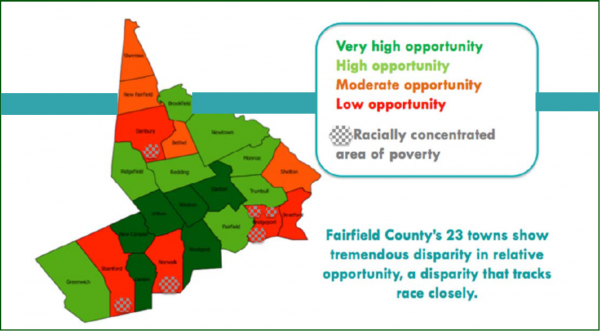
Looking across the towns of Fairfield County, large disparities in relative opportunity emerged in the study. Six “very high opportunity towns” stood out clearly among their peers, the report highlighted: Darien, Westport, New Canaan, Wilton, Weston, and Easton are among the wealthiest towns in the United States. Unsurprisingly, few children in those towns face the sort of barriers to opportunity children typically face in Bridgeport, Stratford, Norwalk, Stamford, and Danbury, the report said.

Five relatively “low opportunity towns” also stood out: on nearly every indicator they fell in the bottom third of Fairfield County’s 23 towns. “Even more disturbing,” the report emphasized, these “low opportunity towns” were home to racially concentrated areas of poverty: “not only is youth opportunity lower, but that lower opportunity affects mainly children of color,” the Voices report indicated.

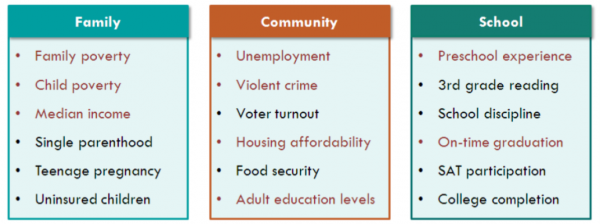
The 27 page report includes town-by-town breakdowns for each of Fairfield County’s 23 municipalities, including breakdowns of specific data for 20 distinct factors in the areas of Family, Community and School.  The assessment includes the percentage of the population that includes families in poverty, unemployment, housing unaffordability, preschool experience, median income and on-time graduation from high school.

The report indicated that Danbury has the highest proportion of students learning English in Fairfield County (21 percent), and a rate of student arrest twice that of Bridgeport, Norwalk and Stamford.  Over one-third of Danbury children live in households with income below 200 percent of the poverty level, which is $47,700 for a family of four.  Among the other data revealed in the report:

  • Bridgeport is the city in Fairfield County with the greatest need, with over 1,100 disconnected youth 400 annual high school dropouts and a youth unemployment rate of 17 percent.
  • Shelton (13%) and Wilton (17%) have exceptionally high rate of chronic absenteeism – on par with cities like Norwalk (12%) and Stamford (15%).
  • Redding performs exceptionally low on housing affordability compared to other high opportunity towns, with almost half of housing unaffordable (45 percent).
  • Stamford’s teenage pregnancy rate (3 percent of total births) is lower than in many suburban towns.thumb55dcc3167d80c

The comparison between Bridgeport’s youth and their counterparts in Westport is striking.  Bridgeport educates a student population of which nearly 40 percent never attended preschool and almost 80 percent of third graders failed to score proficient in reading, drawing from a property tax base less than one-sixth the size per pupil of Westport. In Westport, barely 5 percent of students miss preschool and only 17 percent of third graders fail to score proficient in reading. While over 400 students drop out of Bridgeport high schools each year and only 18 percent of Bridgeport students complete college within six years, Westport reports only 4 high school drop-outs per year and a 71 percent college completion rate.

threeConnecticut Voices for Children is a research-based think tank that focuses on issues that affect child well-being, from educational opportunity to healthy child development to family economic security. Its mission is to ensure that all of Connecticut’s children have the opportunity to achieve their full potential.



To assess specific obstacles to youth opportunity in Fairfield County and to prepare the way for new solutions, Connecticut Voices for Children constructed a Youth Opportunity Index containing over two-dozen indicators from the U.S. Census Bureau, State Department of Education, Federal Bureau of Investigation, and others. Guided by existing research, the researchers, including Ellen Shemitz, J.D., Nicholas Defiesta, and Wade Gibson, J.D., compiled family, community, and school indicators for every town in Fairfield County.

The study also assessed three measures of the number of disconnected youth in each town: the annual number of high school dropouts, the number of youth, ages 16-19 neither employed nor in school, and youth unemployment (ages 16-24). For each indicator, they assessed towns’ standing relative to one another. They then looked across indicators and assessed how each town stacked up relative to others in Fairfield County. In addition, Fairfield County as a whole was compared with the broader State of Connecticut.

Religion Slipping Away From Millennial Generation

A major academic study into millennials and religion is gaining attention for its conclusion that the generation born in this century appears to be the least religious generation of the last six decades, and possibly in the nation's history. “Survey results from 11.2 million American adolescents demonstrate a decline in religious orientation, especially after 2000. The trend appears among adolescents as young as 13 and suggests that Millennials are markedly less religious than Boomers and GenX’ers were at the same age. The majority are still religious, but a growing minority seem to embrace secularism, with the changes extending to spirituality and the importance of religion as well.”millenial

The report also indicates that “correlational analyses show that this decline occurred at the same time as increases in individualism and declines in social support. Clearly, this is a time of dramatic change in the religious landscape of the United States.”

The researchers -- including Jean M. Twenge and Ramya Sastry from San Diego State University, Julie J. Exline and Joshua B. Grubbs from Case Western Reserve University and W. Keith Campbell from the University of Georgia -- analyzed data from 11.2 million respondents from four nationally representative surveys of U.S. adolescents ages 13 to 18 taken between 1966 and 2014.

Recent adolescents are less likely to say that religion is important in their lives, report less approval of religious organizations, and report being less spiritual and spending less time praying or meditating, the researchers point out. The results were published recently in the journal PLOS One.faith_589

Compared to the late 1970s, twice as many 12th graders and college students never attend religious services, and 75 percent more 12th graders say religion is "not important at all" in their lives. Compared to the early 1980s, twice as many high school seniors and three times as many college students in the 2010s answered "none" when asked their religion.

Compared to the 1990s, 20 percent fewer college students described themselves as above average in spirituality, suggesting that religion has not been replaced with spirituality.

"Unlike previous studies, ours is able to show that millennials' lower religious involvement is due to cultural change, not to millennials being young and unsettled," said Twenge. "Millennial adolescents are less religious than Boomers and GenX'ers were at the same age. We also looked at younger ages than the previous studies. More of today's adolescents are abandoning religion before they reach adulthood, with an increasing number not raised with religion at all."

The study comes just after research released last month by the Pew Research Center that showed the portion of U.S. population as a whole that's not affiliated with any religion has climbed from around 16 percent in 2007 to nearly 23 percent last year. Christianity's share of the country's population dropped from 78 percenold timet to under 71 percent, according to Pew.

"These trends are part of a larger cultural context, a context that is often missing in polls about religion," Twenge said. "One context is rising individualism in U.S. culture. Individualism puts the self first, which doesn't always fit well with the commitment to the institution and other people that religion often requires. As Americans become more individualistic, it makes sense that fewer would commit to religion."sm_people

Twenge and her colleagues looked at four large, nationally representative studies, according to published reports: The annual Monitoring the Future studies of eighth, 10th, and 12th graders, and the American Freshmen survey of entering college students (focusing on the years 1966 through 2014). They compared answers given by each of those groups to those given by members of previous generations at the same age.

The study finds the decline in religiosity is larger among young women, whites, those of lower socioeconomic status, and residents of the Northeast, the publication Public Standard points out. In contrast, this trend is “very small among blacks,” the researchers write, “and nonexistent among political conservatives.”

NewsON Venture to Bring Local Newscasts to Smart Phones & Tablets Nationwide, WTNH Set to be Among Participants

Five major broadcast television station groups collectively reaching two-thirds of U.S. TV households have formed NewsON, a new venture to provide live and same-day local TV newscasts on demand from leading stations around the country to consumers' mobile and selected connected TV devices. Two Connecticut-based TV stations are part of the NewsON venture – WTNH and WCTX, both in the Hartford-New Haven TV market, which are owned by NewsON partner Media General. The NewsON (www.newson.us) service will be provided by a new venture formed by The ABC Owned Television Station Group, Cox Media Group, Hearst Television, Media General and Raycom Media.  In New Haven, the WTNH news staff produces newscasts for WTNH NewsChannel 8 and WCTX, known as MyTV9. news ON

Plans for NewsON were announced prior to the more recent announcement this month of Media General’s plans to buy Meredith Corp. for about $2.4 billion in cash and stock.  Meredith, which began as an agricultural publisher in 1902, is known for magazines such as Better Homes & Gardens and Family Circle. But its 17 local TV stations – including Hartford-based WFSB - are the centerpiece of the deal. The combined company—Meredith Media General— would encompass 88 stations that reach 30 percent of U.S. households, or 34 million homes.

Meredith had not been part of the NewsON venture, and it is unclear whether the combined company would remain in the plan, or whether a combined company may be required to divest of either WFSB or WTNH, which serve the same Hartford-New Haven market.

The free, advertising-supported NewsON service will be delivered through apps available for download from leading mobile and connected TV app stores.  NewsON will enable users to watch live and on-demand newscasts from their local markets or from any of the 112 participating news stations, in 84 viewing markets across the country, whose owners have already contracted to deliver their news streams through NewsON.  These include stations in eight of the Top 10 U.S. TV markets and 17 of the top 25.Picture1

Multiple stations will be available through NewsON in 21 markets, giving viewers the opportunity to "change channels" as they wish. The number of participating TV stations is expected to grow in the months ahead as additional broadcast TV station groups activate their streams into NewsON. Whether the Hartford-New Haven market will ultimately be among them may hinge on the outcome of the Meredith-Media General deal.

Media General is one of the nation's largest connected-screen media companies that operates or services 71 television stations in 48 markets, along with the industry's leading digital media business. Their portfolio of broadcast, digital and mobile products informs and engages 23 percent of U.S. TV households and 46 percent of the U.S. Internet audience.

"As a truly connected-screen media company, we are always seeking innovative ways to share our superior local content with a broader audience, no matter where, when or what screen or device they prefer," said Robb Richter, Chief Digital Officer of Richmond, VA based Media General.  He told Connecticut by the Numbers said the new service would provide “brand extension” for WTNH newscasts, and increase viewership.  “Now, about 15% to 20% of the market has downloaded their app.  This will draw more people to WTNH who have not. It’s a great way to gain more audience.”220px-Wtnh_news_2010

Richter said that the appetite for breaking news is strong, and that may be attractive to advertisers as well, as more people use mobile devices to watch locally originated newscasts.  The ability to send out breaking news alerts and live stream coverage of breaking local news provides a potential new revenue stream,” as well as providing viewers nationwide easy access to local coverage of news that may be of interest beyond a local region.

A recent commentary by former WFSB news director Mark Effron, now a college professor, points to the need for local news to find new ways to attract audiences – especially younger audiences, for whom watching television on a television is fast becoming a footnote in their media consumption.

“For them, watching content on channels and networks and stations hasn’t only lessened, it’s actually fallen off the cliff,” Effron observed.

NewsON officials stress that Americans place a great deal of trust in their local news teams, who are typically the first informers from the local scene of the biggest news developments around the country.  NewsON will bring instant access to live local news to a generation of viewers accustomed to using mobile and connected TV platforms to stay informed.

According to the March 2015 report "Local News in a Digital Age" by the Pew Research Center, local TV stations remain the dominant source of news for Americans in large and small markets.  NewsOn points out that the appetite for local and neighborhood news, the staple of TV station newscast coverage, is up to twice the appetite for national and international news, the study found.

The NewsON service, current in BETA testing, is expected to launch to the public later this fall. “We are driving the evolution in local content creation and distribution and we are excited about the opportunities with NewsON," Richter added.


Building Character in Children Can Improve Voter Participation As Adults, Study Finds

As primary voters head to the polls in nearly two dozen Connecticut communities, with relatively low turnout anticipated, a newly released academic study on connections between childhood character-building and adult voting participation is gaining some notice. A researcher at Duke University has found that data from years of national surveys of youth reveal “a strong relationship” between measures of character in youth and the subsequent likelihood of voting, even controlling for test scores and demographics.vote

The study appears to have identified a causal relationship: Disadvantaged elementary-school children around the country who were randomly assigned to receive character-building education two decades ago were more likely to vote as adults by 11 to 14 percentage points.

The research paper, by John B. Holbein of Duke University, is entitled “Childhood Non-Cognitive Skill Development and Adult Political Participation.” Matching participants to voter files, Holbein found that childhood intervention had a large long-run impact on political participation.”  Non-cognitive factors were seen as at least as critical as cognitive factors – and perhaps more influential on voting behavior later in life.

The results of the study “suggest a refocusing of civics education.”  The study, published on the Social Science Research Network, concludes that “specific programs that schools implement—including those targeting psychosocial skills—appear to have a large impact on civic participation later on. This finding has important policy implications.”character

In the last midterm election, in 2014, only 36.4 percent of eligible voters cast a ballot nationwide, the lowest turnout since 1942. To understand the causes of low turnout, the Census Bureau regularly asks citizens why they chose not to exercise their constitutional right, Jonah Lehrer points out on his website, summarizing that “the number one reason is always the same: ‘too busy.’ (That was the reason given by 28 percent of non-voters in 2014.) The second most popular excuse is ‘not interested,’ followed by a series of other obstacles, such as forgetting about the election or not liking any of the candidates.”

The Holbein study suggests there is more behind the lack of voting behavior than those oft-cited reasons would suggest.

Critical factors in character building are self-regulation and those involving social skills.  Components of self-regulation include, but are not limited to, grit or perseverance, emotion recognition and emotion regulation—the ability to understand and control individual affect; and inhibition, or the ability to avoid negative behavior and exhibit positive behavior.  Social skills involve the ability to work with others productively; components include the ability to communicate, build friendships, and solve group-based problems.ssrn

“Rather than focusing exclusively on the number of years a citizen spends in school, it is important to consider what context they were exposed to while in school… In a landscape of stagnant macro-level trends in participation and small estimates for many adult mobilization efforts, this finding should give scholars and policymakers renewed hope,” according to the study.

The research indicated that “interventions in early life can have large and long-lasting impacts on stubbornly low rates of political participation in adulthood. This finding suggests a reorientation of political socialization studies towards early childhood; a previously neglected critical period in the development of participatory predispositions.”  Similar research into the impact of non-cognitive learning has come away with consistent findings.

Looking ahead, the study suggests that “expanding our view in this way will help expand our understanding of why some people vote, while others do not, and how to design reforms to increase turnout, particularly among individuals with a low propensity to vote.”

First-Of-Its-Kind Audio Service for Spanish-Speakers with Print Disabilities Launched in CT

CRIS Radio, a 36-year-old nonprofit based in Windsor and Connecticut’s only radio-reading service, has introduced its new Spanish-language streaming service, expanding the services offered by the volunteer-based organization with a longstanding, solid track-record of responsive programming. The service, called CRIS en Español, is the first in the nation to offer an extensive line-up of audio versions of Spanish-language magazines – all featuring human narration -- for Spanish-speakers who are blind or have a print disability, including those with learning, physical, emotional or intellectual disabilities.cris-logo

“This collaboration is essential to the people we serve in the Hispanic community,” said Annette Deonarine, director of Latino Initiative of Advocacy Unlimited at Toivo Center in Hartford. “It will enable people who are disabled to receive quality broadcasts that are culturally competent and in a language that is understood by many people from different Latino cultures.”

Hartford Mayor Pedro E. Segarra, who attended the launch of the new audio services, said: “CRIS Radio has for years made sure people stay connected to current events, culture and literature. I’m very grateful to see that they’re expanding this valuable service to Spanish-speaking audiences.”

Included in the CRIS en Español programming are articles published in Spanish-language magazines and newspapers such as Identidad, National Geographic in Spanish, Cosmopolitan in Spanish, Hola and People in Spanish.  All CRIS recordings feature human narration, thanks to CRIS volunteers who provide the voice talent. The recordings also are available on-demand at crisradio.org or from special CRIS Internet radios.

“Thanks to funding from the Hartford Foundation for Public Giving, CRIS Radio is launching Spanish-language programming to better meet the needs of the Latino community who are blind or print disabled,” said Diane Weaver Dunne, executive director of CRIS Radio. “CRIS is now providing Internet radios tuned to CRIS en Español’s URL free-of-charge to organizations that serve Spanish-speakers with disabilities.”Sitting, Diane Weaver Dunne and Pedro Segarro. Standing, from lieft, Annette Deonarine, Yanira Rios, Alice Diaz, Deron Drumm, Kelvin Young and Jon Jacobs.

CRIS (Connecticut Radio Information System) provides audio access to news and information for people who are blind or print-challenged, including those unable to read due to physical, learning, intellectual or emotional disabilities. CRIS operates with more than 300 volunteers at its broadcast center in Windsor and regional studios located in Danbury, Norwich, Trumbull, West Haven and at ESPN in Bristol.

Jon Jacobs, program director of Humanidad, which operates group homes for Spanish-speakers with intellectual and developmental disabilities in Greater Hartford, piloted the service at two group homes. “CRIS en Español is an impactful and informative service that brings Spanish-language programming right to the homes of our consumers, Jacobs said. “This is a warm, informative, and user-friendly way to bring culturally competent content to the members of our community with special needs.”

CRIS Radio broadcasts 24 hours a day, seven days a week featuring articles published in more than 70 newspapers and magazines, including award-winning children's magazines available online and on-demand. Programs powered by CRIS Radio include: CRIS Radio; CRIS Listen Now (online streaming); CRIS Listen On Demand; CRISKids, and CRISKids for Schools.

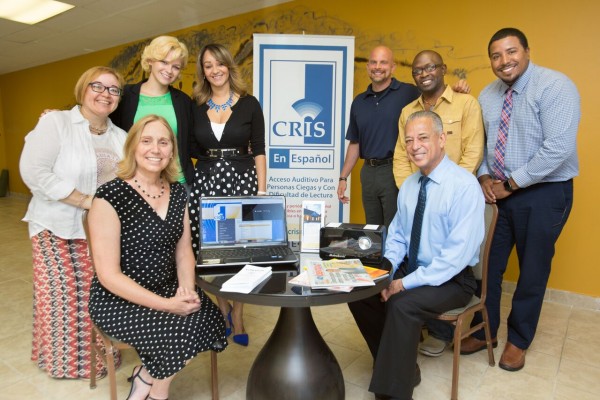
Photo:  Attending the demonstration of CRIS en Español, are: (sitting), Diane Weaver Dunne, executive director of CRIS Radio; and Hartford Mayor Pedro Segarro; Standing, from left, are Standing, from left, Annette Deonarine, Yanira Rios, Alice Diaz, Deron Drumm, Kelvin Young and Jon Jacobs.

https://youtu.be/DzN3Bi-vjyw

Manufacturing Businesses, Not Only GE, Being Courted to Move As Fewer Praise CT's Quality of Life

Connecticut’s state government has been working diligently to boost manufacturing and manufacturers in the state, but the latest statewide survey suggests there remain significant obstacles on the road to realizing the goal of growing and sustaining a vibrant manufacturing sector. Among manufacturers, 94 percent handle their production in Connecticut, according to the just-released 2015 Survey of Connecticut Businesses by the Connecticut Business and Industry Association and BlumShapiro. While the survey analysis describes that number as encouraging, it also notes that 28% have production facilities in other parts of the U.S., and 24% in other countries—“which means they may be more likely to consider expanding or shifting more of their production elsewhere.”cover

The report indicates that the “factors that drive site location include access to key inputs; proximity to suppliers and customers; access to skilled labor; cost of labor; occupancy costs; affordable energy; and where companies are in their life cycle (e.g., mature companies are often likely to disperse geographically to reduce costs).

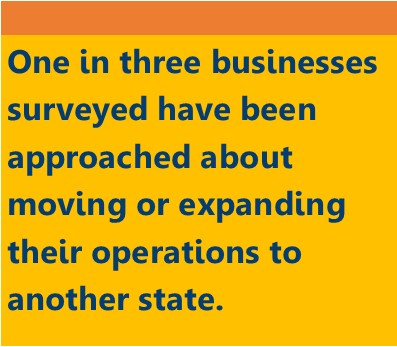
Although the courting by Governors from across the nation of General Electric’s corporate management has garnered much media and political attention, it is certainly not the only company that is the subject of someone else’s attention.  The CBIA-BlumShapiro report said that one in three businesses surveyed have been approached about moving or expanding their operations to another state.

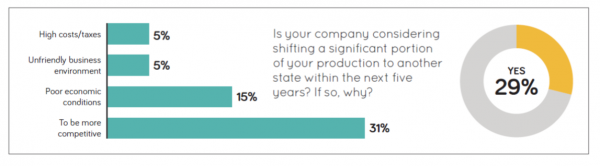
Of those, the analysis continued, “nearly one in four are planning on moving to that state, 29 percent are considering shifting significant production to another state within five years, and 31 percent are weighing expansion in another state within five years.aother state

Although the report shows that 63 percent of businesses surveyed showed a profit this past year—the best this survey has seen since 2006 - the report indicated that “a primary area of concern” is the expansion of businesses over the next five years, and whether that expansion will take place in Connecticut or elsewhere.

quoteWhether perception drives reality or reality is drives perception, the opinions stated by business surveyed are less than encouraging, according to the report.  Primary reasons cited for moving or expanding outside Connecticut are the state’s high costs (including taxes) and its “anti-competitive business environment,” reflecting an oft-stated CBIA viewpoint.  More than three-quarters say Connecticut’s business climate is subpar compared with other states in the Northeast, and the nation.
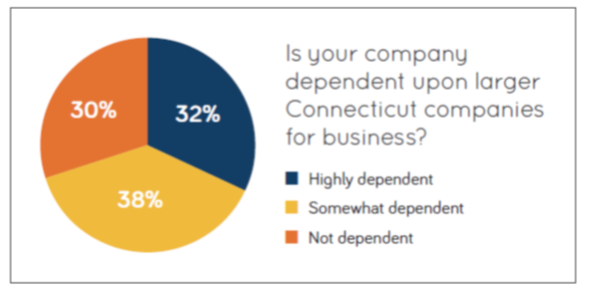
The report also noted the significant number of state companies that depend on other Connecticut businesses.  “The vast majority of companies surveyed (70 percent) are somewhat or highly dependent on larger Connecticut companies or businesses,” the analysis highlighted, “which raises concerns when tax hikes threaten to push large companies out of state.”

CBIA’s surveys consistently find that personal reasons also factor significantly in location decisions.  “Many business leaders point to Connecticut’s quality of life and the desire to work close to where they live as the main reason for locating and/or staying in-state. However, we are slipping here,” the report said.dependant

In a survey of Hartford-New Haven-Springfield businesses conducted earlier this year, quality of life—traditionally the number-one benefit to operating a business in this region— surprisingly emerged as less of a competitive advantage today.  In fact, there has been a steady decline in the percentage of company leaders citing quality of life as the greatest benefit of operating a business here: 47 percent in 2009, 43 percent in 2011, 40 percent in 2013, and just over a third (35 percent) in 2015.


Innovation Summit Seeks Companies to Showcase Entrepreneurship, Connect with Investors

It is billed as Connecticut’s “ultimate gathering of entrepreneurship and innovation,” as the Connecticut Technology Council honors tech and non-tech startups representing early stage and emerging growth companies at The Innovation Summit, to be held on November 10 featuring a Pitch Fest, Funding Fair, Poster Expo, and Awards Ceremony. The well-attended annual event includes 100 exhibiting Tech Companies To Watch, 40 pitching companies, and more than 400 attendees. The Council has begun  accepting applications and will continue selecting companies, on a rolling basis. The application deadline is September 30.

The  Innovation Summit is held in conjunction with Angel Investor Forum, BEACON, Crossroads Venture Group, CURE and Connecticut Innovations.

IS2012-logo_with CTC One of the key features at the 9th Annual Innovation Summit will be the Funding Fair, where angels, VCs, investment bankers, lenders, family offices, private investors, and other resources are on-hand to offer individual guidance and advice to attendees. The Funding Fair also offers fledgling businesses opportunities to connect with incubators and co-working spaces.

“Our Tech Companies To Watch are the focus of this event making it crucial that we offer a variety of valuable opportunities to those selected,” said Bruce Carlson, President and CEO of the Connecticut Technology Council. “Connecticut’s growing companies are looking for resources that will enable them to thrive in today’s economy. This year’s Innovation Summit is the place for them to find everything they’re looking for; a one-stop-shop for talent, funding, mentors, and peer support.”summit

In the Pitch Fest, selected Tech Companies To Watch will deliver a three-minute pitch to a live audience of investors, entrepreneurs, and other interested parties, and panel of judges.  The TCTW Expo affords an opportunity for entrepreneurs to show off their companies and ideas to potential partners, customers, investors, and talent.  The awards will be presented to the next generation of high-growth companies in Connecticut, honored for their potential in their respective industry categories.

Workshops will be offered in a variety of focus areas. “We’ve added workshops, some of which will focus on funding, raising alternative forms of capital, and understanding each stage of financing. Other workshop will be geared toward growth company needs like marketing and talent recruitment,” said Carlson.

Companies will be notified by October 9 if they are selected to participate. There is no charge to apply, however there is a discounted registration fee of $90 for admission and an exhibitor table.  The Innovation Summit will be held on Tuesday, November 10, 2015, 10:00am - 5:00pm, at the Connecticut Convention Center, a new location for the event reflecting the need for a larger venue as the number of participating companies increases.

The Connecticut Technology Council is a statewide association of technology oriented companies and institutions, providing leadership in areas of policy advocacy, community building and assistance for growing companies. Speaking for 2,500 companies that employ some 200,000 residents, the Connecticut Technology Council seeks to provide a strong and urgent voice in support of the creation of a culture of innovation.


https://youtu.be/EKpko3oppMk

Social Skills Increasingly Needed in Workplace, Study Finds

Between 1980 and 2012, the number of workplace tasks requiring social skills jumped 24%, those requiring math skills rose just 11%, and tasks requiring routine skills have steadily declined, according to Harvard Graduate School of Education associate professor David Deming. A faculty research fellow at the National Bureau of Economic Research, Deming shows that “the labor market increasingly rewards social skills. Since 1980, jobs with high social skill requirements have experienced greater relative growth throughout the wage distribution. Moreover, employment and wage growth has been strongest in jobs that require high levels of both cognitive skill and social skill.”NBERLogo-BlueLarge

The data show that social skill tasks grew by 24% from 1980 to 2012, compared to only about 11% for math-intensive tasks. While the latter has slightly declined since 2000, the importance of social skills has grown by about 2% since the turn of this century, as jobs characterized by routine work have continued to decline.deming_website2

Deming stresses ‘the growing return to social skills is pervasive and not restricted to management and other top-paying jobs. Moreover, the strongest wage and employment growth has been in occupations that require high math and high social skills,” he points out in describing the research on his website.

Harvard Business Review Associate Editor Nicole Torres writes on HBR.org in her roundup of the research that people with both social and math skills tend to be winners in today's job market. But ultimately, having social skills allows a person to be flexible and adapt to changing circumstances at work, which is a huge advantage.social skills

The research paper explains three things about the growing importance of social skills, according to HBR.org: 1) social skills are valued in jobs across the entire wage distribution, 2) social skill and cognitive skill complement each other, and 3) jobs that require low levels of social skills are also likely to be routine jobs (filing clerks, factory jobs) at high risk of automation.

Deming notes that “the slow growth of high-paying jobs in the U.S. since 2000 and rapid advances in computer technology have sparked fears that human labor will eventually be rendered obsolete. Yet while computers perform cognitive tasks of rapidly increasing complexity, simple human interaction has proven difficult to automate.”

While it still pays to be good at math in today’s labor market, Torres writes, it’s often no longer enough. “The days of being able to plug away in isolation on a quantitative problem and be paid well for it are increasingly over,” Deming told Torres. “You need of have both types of skills.”social skills e

Deming, an Associate Professor of Education and Economics,  has presented his research at universities throughout the country of economic and labor topics, including at Yale University and the University of Connecticut in recent years.

Norwalk Joins Stamford, Bridgeport in Rebranding Efforts to Attract Business

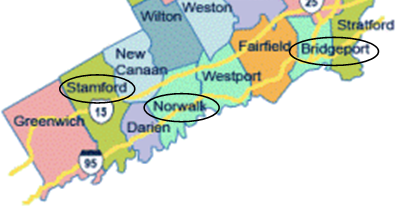
Norwalk Mayor Harry Rilling and Economic Development Director Elizabeth Stocker have selected South Norwalk-based branding and design firm, Zunda Group, to develop a strategic marketing plan that will include a brand implementation program.. With this week's announcement, Norwalk becomes the third major municipality in Fairfield County to turn to a rebranding initiative to boost business prospects and spark interest among potential developers. Bridgeport and Stamford have similar efforts either underway or in the planning stages.rebranding

Mayor Rilling said that “Norwalk recognizes the power of presenting the city with a strong brand image” and is moving forward as part of his recently released economic development action plan, which aims to capitalize on the city’s assets, attract and sustain new business, develop its workforce, and to continually improve its quality of life.

Rilling stated that “essential to the plan’s success is the city’s ability to communicate and build local pride around an ownable brand position that brings to life Norwalk’s unique personality and benefits.   Norwalk has an eye on the future and the new brand will elevate its position as a destination to live, work and play.”  The new branding and marketing communication is targeted to launch in early 2016.

Norwalk doesn’t need to look far to see other municipal branding efforts underway. map

Thomas Madden, Stamford’s economic development director, told the Fairfield County Business Journal this summer that the city Office of Economic Development is working on a multiphase plan to make Stamford more attractive to businesses in a nationally competitive market. Initiatives include conducting research on Stamford’s economic landscape, outreach, rebranding and improving digital resources, the business paper reported.

“It puts us on par with a lot of the economic development corporations to make sure we have the right information out there to make businesses look at Stamford,” Madden said, noting that it is the first time this type of project has been undertaken in Stamford. Planning began about a year ago, and the nonprofit Stamford Partnership, a civic organization, is leading the effort with Stamford-based brand development company Daymon Worldwide handling the marketing.

Daymon is to conduct surveys and focus groups in Stamford and in the tristate area exploring people’s views on Stamford. The data will guide which industries Stamford should focus on and provide guidance to the city’s Office of Economic Development regarding information about income level, incentives, taxes and transportation that can be highlighted in brochures to distribute to businesses considering Stamford as a location. It is anticipated that Stamford will begin using a new logo and launch a marketing campaign as part of the initiative.mq1

In Bridgeport, the administration of incumbent Mayor Bill Finch is already working with a pair of companies -- Mandate Media of Oregon and Gum Spirits of Maine – on an advertising campaign launched late last year, “Better Every Day.”  Mandate has created an economic development website, www.bridgeportbettereveryday.com, along with a digital and web-based marketing strategy for the city.  Ads have been seen not only locally but in statewide media, such as the website CT Capitol Report.  Gum Spirits was to develop radio and television spots focused on local success stories and revitalization efforts, according to plans for the initiative, and a series of videos are currently posted on the website.

According to the website, which touts the Park City as a “great place” to live, “Bridgeport is a city on the way up. We've got a lot of work to do, but we're investing in the future, making our city a place where our kids and grandkids will choose to live, work and raise their families. We're improving the city by building schools, re-opening parks, making downtown more vibrant, and developing the waterfront.”  The website is separate and distinct from the official Bridgeport government website, which features a range of city services traditionally highlighted on municipal sites.

In Norwalk, Zunda Group is owned and managed by longtime Norwalk business leaders Charles Zunda and Gary Seve Esposito. In announcing the selection, the city stressed that the firm “has enjoyed a 35 year history of building and positioning strong, relevant brands.”  Zunda Group has proven success with Connecticut based brands like Newman’s Own, start-up brands like Chobani, and global brands such as Dove, city officials pointed out.  The local Norwalk community is invited to share their feedback about Norwalk by completing a voluntary public survey that is available from September 8 through September 22 at www.norwalkct.org/survey


https://youtu.be/-77lj-hO2Xc