CT Ranked 14th Among Smaller States for Small Business Activity; MA Is 2nd Among Large States

Small business activity is on the rise in 49 of the 50 U.S. states, according to a new report from the Kauffman Foundation. The report provides a broad index measure of small local business activity, analyzing the states in peer groups of the 25 largest states by population and the 25 smallest states by population.  Connecticut ranked 14th among the smaller 25 states, for the second consecutive year, and was the lowest-ranked New England state.CT rank The density of established small businesses per 100,000 residents increased slightly from the previous year, from 1,147.3 to 1,167.4 in 2015.  Established small businesses are defined in the study as businesses over the age of five employing at least one, but less than fifty, employees.  The rate of small business ownership also grew slightly in Connecticut, from 6.14 percent to 6.34 percent.

Demographic trends for Connecticut noted in the report indicate an increase in native-born small business ownership, and upticks in the percentage of small businesses led by Latinos, 55 to 64 year-olds, 35-44 year-olds, high school graduates and college graduates.  More small businesses are run by men than women.

Overall, what the report describes as “Main Street entrepreneurial activity – an indicator of the number of established small businesses and the number of business owners in a location – experienced a large increase in 2015, reversing a six-year downward and stagnant trend in the U.S.”Kauffman logo

"Following a post-recession downward and stagnant trend in small business activity, we're now seeing Main Street Entrepreneurship begin to rise," said E.J. Reedy, director in Research and Policy at the Kauffman Foundation. "This obviously is good news given that these small businesses make up 63 percent of all employer firms nationally."

The Kauffman Index: Main Street Entrepreneurship State Trends report includes these findings:

Among the 25 largest states, the five states with the highest activity were Minnesota, Colorado, Massachusetts, New York and New Jersey. Among the 25 smallest states, the states with the highest activity were Vermont, Montana, North Dakota, South Dakota, Wyoming, Maine, Nebraska, New Hampshire, Rhode Island, Iowa, Oregon, Idaho, and Kansas.

Insights on business owner demographics for the 25 smallest states, including Connecticut:

  • States with the highest rates of female business owners were Vermont, Montana, Wyoming, Oregon, and South Dakota.
  • States with the highest rates of older adult business owners (ages 55-64) were South Dakota, Vermont, North Dakota, Montana and Nebraska.
  • States with the highest rates of young adult business owners (ages 20-34) were South Dakota, North Dakota, Montana, Wyoming and Vermont.

state ranksTennessee is the only state that did not show an increase in established small business activity in 2015 compared with 2014.

The new Main Street Entrepreneurship Index is an indicator of small business activity, presenting trends over the past two decades, focusing on established small businesses (firms older than five years with less than 50 employees) and trends in ownership rates. The Index measures business activity along two distinct and complementary dimensions: the rate of business owners in the economy – the percentage of adults owning a business in a given month, and established small business density – the ratio of established small employer businesses compared to population.

The Kauffman Index of Entrepreneurship is the first and largest index tracking entrepreneurship across city, state and national levels for the United States, and also presents demographic characteristics of the business owners.

In a companion study and report, focusing on the nation’s largest metropolitan areas, Small business activity is on the rise 38 of the top 40 largest metropolitan areas, the top five metropolitan areas for small business activity as measured by the Index were New York, Boston, Providence, San Francisco and Portland.  The report on metropolitan areas noted that “the one to experience the biggest increase in rankings was Providence, which moved up three spots to tie with Boston for second place in the 2015 Index.”


Whalers Departing Attendance, Carolina's Recent Attendance, Among NHL's Lowest (Hartford Higher)

During the 2014-15 National Hockey League season, the teams with the lowest average home attendance were the Arizona (13,345), Carolina Hurricanes (12,594) and Florida Panthers (11,265). So far in the current season, through 23 home games, the attendance for Hurricanes games has sunk even lower, averaging 11,390, lowest in the league.  They are the only team in the league to draw less than 13,000 fans per game. Hartford_Whalers_Logo.svg

Fifteen years ago, during the 2000-01 season, the attendance numbers weren’t much better.  Carolina had the league’s second lowest attendance, drawing an average of 13,355 per game for 41 home games.  That ranked 29th in a 30-team league.

That was also only a handful of seasons after the teams’ move South, ending their 18-year history as the Whalers in Hartford, moving to Greensboro, North Carolina and becoming the Carolina Hurricanes for the start of the 1997-98 season.

In the 30-team league, during the past 15 years, Carolina has been among the league’s bottom-third in  average attendance eight times, and the bottom-half every season but one.  In 2006-07, the team ranked 15th in the league, their high-water mark.  It was the season after the team won the league’s Stanley Cup.   (The 2004–05 NHL season was not played due to a labor dispute.)

Those attendance number aren’t significantly different that the attendance levels when the team abruptly departed Hartford, nearly two decades ago.  In early 1996, a 45-day “SNHL logoave the Whale” season-ticket drive resulted in 8,300 season tickets sold, about 3,000 more than the previous year.  In the aftermath of the season ticket drive, and heading into the 1996-97 season, the Whalers management said they would remain in Hartford for two more years, in accordance with their lease.
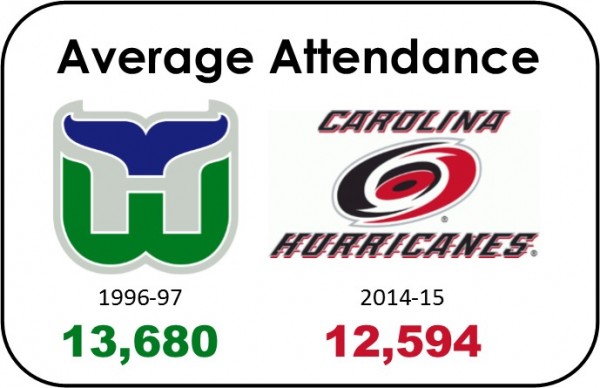
In the Whalers' final season in Hartford, 1996-97, attendance at the Hartford Civic Center had grown to 87 percent of capacity, with an average attendance of 13,680 per game.  Published reports suggest that the average attendance was, in reality, higher than 14,000 per game by 1996-97, but Whalers ownership did not count the skyboxes and coliseum club seating because the revenue streams went to the state, rather than the team.  Attendance increased for four consecutive years battendenceefore management moved the team from Hartford. (To 10,407 in 1993-94, 11,835 in 1994-95, 11,983 in 1995-96 and 13,680 in 1996-97.)
During the team’s tenure in Hartford, average attendance exceeded 14,000 twice – in 1987-88 and 1986-87, when the team ranked 13th in the league in attendance in both seasons.

Last season’s top attendance averages were in Chicago (21,769), Montreal (21.286), Detroit (20,027), Philadelphia (19,270), Washington (19.099), Calgary (19,097), Toronto (19.062), Minnesota (190230 Tampa Bay (188230 and Vancouver (18,710).  The New York Rangers drew an average of 18,006, ranking 17th in the league in average attendance.

Florida’s attendance last year was a league-low 11,265; Arizona was 13,345 per game. The previous season, the New York Islanders, Columbus Blue Jackets, Dallas Stars, Florida Panthers and Arizona Coyotes all drew less than 15,000 fans to home games across the season.  So far this season, with about half the home games played, five teams continue average 14,000 fans per game or less.

On March 26, 1997, Connecticut Gov. John G. Rowland and Whalers owner Peter Karmanos Jr., who had purchased the team in 1994, announced that the Whalers would leave Hartford after the season because they remain far apart on several issues, with the main sticking points linked to construction of a new arena. The team agreed to pay a $20.5 million penalty to leave at the end of the season, a year before its commitment was to expire.

The final Whalers game in Hartford was on April 13.  Less than a month later, the Carolina Hurricanes were born, beginning play that fall in Greensboro while a new facility was built in Raleigh.  Efforts to bring the NHL back to Hartford since that day have been unsuccessful.

memories


PERSPECTIVE: Consider the Meaning of Language Before You Use It – Or Prepare to Lose

by Paul Steinmetz A university is a wonderful place to work if you like the energy of young people, smart coworkers who are trained to challenge the status quo, and the clanging excitement that the combination creates. You will also notice that the inhabitants of universities and colleges sometimes get themselves knotted up in problems that others don’t face, and they often involve the use of language.

One reason for these issues is that there are a lot of constituencies of higher education, and trying to please them all might be impossible.

Complicating the situation, colleges and universities are often at the forefront of trends in lifestyle and other thinking, which means the words we use to describe these new things are not well defined or accepted. It’s very easy to be well-meaning and yet upset someone.

Finally, you have professors who are very definite in their opinions and students who are enthusiastic in their challenge of such opinions.

The occasional result: chaos, misunderstanding and anger.

perspective squareHere are a few examples:

At the University of Tennessee at Knoxville, an administrative office published a guide of pronouns that transgender people might prefer. The list included ze and hir or zir instead of he/she and her or him. Xe and xem would take the place of they and them.

The education trade journal Inside Higher Ed reported that the guide “created a political uproar in the state.” The university president ordered the guide removed from the UT website, saying, “The social issues and practices raised by the Office for Diversity and Inclusion are appropriate ones for discussion on a university campus. However, it was not appropriate to do so in a manner that suggests it is the expectation that all on campus embrace these practices.”

At Washington State University, a professor wrote a syllabus that banned the use of certain words in class and promised punishment to any students who used the words.

From the syllabus:

“Use of racist, sexist, homophobic, transphobic, xenophobic, classist or generally offensive language in class or submission of such material will not be tolerated. (This includes ‘The Man,’ ‘Colored People,’ ‘Illegals/Illegal Aliens,’ ‘Tranny’ and so on — or referring to women/men as females or males.)”language quote

The university administration acknowledged that the professor was attempting to provide a safe and supportive learning environment for everyone. But it pointed out that the syllabus probably violates the First Amendment and ordered all professors “to ensure that students’ right to freedom of expression is protected along with a safe and productive learning environment.”

Finally, you might think that the definition of genocide is clear-cut, but it’s not. Sacramento State University in California is the most recent institution to teach us this.

A sophomore there says her professor threatened to kick her out of class after she allegedly challenged his statement that the term “genocide” wasn’t appropriate for U.S. settler and government actions against American Indians.

Again according to a report in Inside Higher Ed, the professor allegedly said that genocide implies intention and, in his opinion, most native people were killed by European diseases.

The student said she was “enraged” by that statement and a couple of days later she debated the professor in class and began reading out loud the United Nations’ 1948 definition of genocide. The professor asked her to stop, inviting her to talk to him after class rather than “hijack” his lesson. Social media and bloggers reported on the confrontation and the university is investigating exactly what happened in the classroom. (The Inside Higher Ed article offers examples of the many variables considered in deciding what is and what isn’t considered genocide.)

Although none of these situations occurred at the university where I work, I pay attention to them because it would be my task, along with many others, to advise on a response to such an uproar should it happen here.

As a professional writer and public relations practitioner, I often say that anticipating problems and addressing possible issues is usually better for an organization, and individuals, than moving ahead without thinking about the consequences of words. Language is sometimes volatile and has the potential to convey things not intended if mishandled. My other advice is that, when about to engage in potentially controversial activity, you should always let the boss know what you are doing. He/she/ze might later backtrack, but at least you have communicated thoughtfully and clearly. And that is what is important.

________________________________________________

Paul Steinmetz is director of Public Affairs & Community Relations at Western Connecticut State University. As the founder of Writing Associates, he consults on writing issues for businesses and individuals. If you want to discuss a writing issue, contact him at paul@paulsteinmetz.com.

PERSPECTIVE commentaries by contributing writers from across the state appear each Sunday on Connecticut by the Numbers.

Health Care Seen as Economic Driver in Connecticut, Propelling Growth

The first thought that comes to mind when someone mentions health care is likely not “economic driver.”  If a new marketing initiative by the Connecticut Health Council succeeds, that may be changing. Newly launched in January 2016, the Connecticut Health Council's "Did You Know" campaign is a multichannel content marketing program designed to raise awareness of the health sector's importance as an economic and employment driver in Connecticut. The initiative highlights data that may have escaped widespread attention across the state, with the aim of “promoting Connecticut as a center of health excellence.”connecticut-health-council-logo

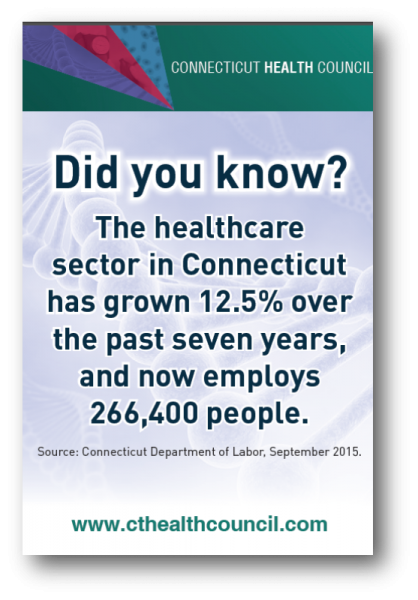
The campaign includes a series of informational posters, now on display at the State Legislative Office Building in Hartford through the end of January, along with “traditional print and broadcast media content, social media alerts, and thought leadership.”  Among the stats highlighted:

  • The healthcare sector in Connecticut has grown 12.5% over the past seven years, and now employs 266,400 people.
  • There are 20,434 registered healthcare employers in the State of Connecticut.
  • From 2007 to 2014, healthcare and social services was the fourth fastest growing employment category in the state.
  • Connecticut’s healthcare sector generated $29.6 billion in estimated total before-tax revenue in 2012.

ozIn addition, the marketing campaign also highlights that thee of the top 10 fastest growing companies headquartered in Connecticut in 2014 were healthcare related companies, and that Connecticut’s healthcare sector has the fifth highest number of sole proprietorships of any sector in the state, with the seventh highest revenues. Connecticut’s “unique base of health sector assets” include health insurance companies, hospitals, medical schools, research capacity, and specialty practices, according to the organization’s website. hartford-logo

Founded in 2012 by the MetroHartford Alliance, the Connecticut Health Council is an association of health sector leaders who work to advance the development of businesses, initiatives and technology that improve health care and wellness both nationally and in the State.  The organization, which currently has 90 partners, fosters “collaboration, education, entrepreneurship and networking among leaders of for-profit and non-profit health sector entities.”

Speaking at this month’s Economic Summit & Outlook in Hartford, Oz Greibel, President & CEO of the MetroHartford Alliance, spoke to the need to highlight the data at the State Capitol, where the info-posters are on display.  “(The campaign) is based on the notion of the health sector as an economic and employment driver – and a place for additional capital investment.  Making sure that people at the legislature understand the importance of this sector, and that the actions that they take can be either helpful or detrimental, to long-term growth.”

posterThe Council's primary activity is to host programs focused on health sector topics that feature speakers of regional, national and international renown, the website points out. The Council also provides “a forum for a robust network of experts, professionals and other parties interested in promoting Connecticut as a center of health excellence and the health sector as a primary driver of economic and employment growth in our State.”

As Greibel described it, the Council’s activities are designed specifically “to leverage the extraordinary resources we have in Connecticut in the health care disciplines.”

Highlighting the impact of the state’s hospitals, the Council points out that Connecticut hospitals provide jobs to 55,000 full-time employees and spend $4.2 billion on goods and services.  Overall, Connecticut hospitals contribute $21.9 billion annually to the state and local economies.

The Connecticut Health Council is co-chaired by Marty Gavin, President & CEO of Connecticut Children’s Medical Center, and Bob Patricelli, Chairman & CEO of Women’s Health USA.  The executive director is Amy Cunningham.CT Health Council

GE Leaves Wisconsin for Canada, Blames Government; Cuts Thousands of Former Alstom Jobs Across Europe

Virtually unnoticed amidst the attention given to the months long saga of GE’s decision to move its corporate headquarters from Fairfield was another relocation by the company – this time not only leaving a state, but the United States.  And in that instance as well as the latest decision, government was cited as a reason for the departure. Less than four months ago, GE announced it was leaving Waukesha, Wisconsin for Canada, and moving 350 jobs north of the border.  GE closed a long-time engine manufacturing plant in Wisconsin and announced plans to invest $265 million to build a new one in Canada in order to take advantage of Canadian export credit financing.  The new plant was expected to be completed in 20 months and was described by GE as “a flexible production facility that can expand over time and also support manufacturing requirements for other GE businesses.”GE

The company said the new state-of-the-art plant in Canada and will be a flexible facility that can expand over time and also support manufacturing requirements for other GE businesses. GE notified employees in Waukesha and more than 400 U.S. suppliers of its plans. In Wisconsin alone, suppliers generated almost $47 million in revenue from the plant, GE said at the time.

“We know these announcements will have regrettable impact not only on our employees but on the hundreds of U.S. suppliers we work with that cannot move their facilities, but we cannot walk away from our customers,” said John Rice, Vice Chairman, GE, when the Wisconsin move was announced.

The blame, according to a GE news release, rested on Congress, which allowed the nation’s Export-Import Bank to cease functioning.  Last week, in an effort to break a political logjam in the Republican-controlled Congress, the White House announced it would nominate a Republican to lead the agency.canada

When the company announced its decision to leave Wisconsin for an unnamed Canadian city, it pointed the finger squarely at Congress:

“GE is currently bidding on $11 billion of projects that require export financing. While more than 60 other countries have export credit agencies (ECAs) that support domestic manufacturing for export, the US does not. The authorization for the U.S. export credit agency – the Export-Import Bank, or Ex-Im – lapsed on July 1. For the last year, exporters and suppliers have called upon Congress to reauthorize the U.S. Export-Import Bank to support manufacturing jobs and level the playing field for U.S. companies that compete globally. Most countries are hungry for manufacturing and export jobs. The U.S. remains the only major economy in the world without an export bank.”

The headquarters move to Boston was not GE’s only major announcement this week.  The company also announced plans to cut 6,500 jobs in Europe as it moves to integrate Alstom SA’s power business and push through cost savings from the acquisition, made last year.  The acquisition included facilities in Windsor and Bloomfield in Connecticut, including about 1,000 jobs.  No word on whether cuts may be coming there as well.  Published reports indicated that GE has not yet announced how many jobs it could eliminate in the Americas, Africa and Asia, where it is also working to integrate Alstom’s operations with its own power business.


roads


Award-Winning Start-Up Accelerator to Launch Largest Class of Social Enterprises, Fledgling Businesses

When the Hartford-based Social Enterprise Trust, known as reSET, was among the winners of the U.S Small Business Administration’s Growth Accelerator Competition last year – the only Connecticut organization to do so and one of 80 nationwide – it was not known what earning that designation, and  the $50,000 that came with it, would mean for reSET’s Impact Accelerator program. Now, the picture is becoming clearer – and boosting Hartford’s reputation as a city for socially committed entrepreneurial start-up businesses.  The expanding initiative is attracting not only home grown companies, but start-ups from elsewhere across the country, including as far away as California.

Tailored for impact-driven businesses but available to all early-stage ventures, reSET’s Impact Accelerator, now beginning its fourth year, has as its primary objective to test and hone entrepreneurs’ models, and to connect them to networks, mentors, customers, and resources.

A cohort of 22 businesses have been accepted to the program and most of their models are impact focused, serving the educational technology, health and health tech, energy, and agriculture industries. More than 60 percent of them are already generating revenue.  It is the largest group of companies to take part in the accelerator program at reSET, and the first to include a handful of out-of-state participants.cohort 2016

Running from January 20 to June 2, reSET’s accelerator will feature a more flexible program designed for busy, full-time entrepreneurs, as well as a ‘pay what you can’ model.  Entrepreneurial teams will attend five weekend summits, with 30+ optional workshops, mentor office hours, and consultations with an Entrepreneur in Residence conducted during the week.

At program’s end, a $25,000 accelerator funding pool will be available to the cohort, and they'll have priority access to reSET’s investment fund as well, via mentors and advisors that can help them put their best foot forward with their applications, according to reSET officials.

The 2016 cohort includes: Agyncy (www.agyncy.com), AmRide (www.amride.com), Asarasi (www.asarasi.com), BLT Robotics (www.bltrobotics.com), Doors to Explore (www.doorstoexplore.com), DopaFit (www.mydopafit.com), Enviro Power, LLC (www.enviropowertec.com), Keep Sight (www.keepsight.com), Lion’s Heart (www.lionsheartservice.org), Mivy (www.mivyapp.com), Movia Robotics (www.moviarobotics.com), Muni (www.muni.info), myHomeProNetwork (https://myhomepronetwork.com), Plucked (www.pluckedadmissions.org), RepVisits (www.repvisits.com), ScripFlip (www.scriptflip.org), SnapSeat (www.snapseatbooths.com), Tainted Inc. (www.tainted-beauty.com), Text Engine (www.textengine.info), The TubieGuard (the-tubieguard.myshopify.com), Trekeffect (https://trekeffect.com), and Untapped Potential (www.upotential.org).

“We’ve made a strategic shift with our accelerator model so it can accommodate more participants at one time, which we feel will really encourage more collaboration,” said Rosie Gallant, reSET’s Director of Programs. “The shift will help tee up the accelerator for our annual Impact Challenge as well, since the program will wrap in the spring right around when applications will open for the competition in which participants will vie for this year’s $100,000 prize purse.”

reSET is a non-profit organization whose mission is to advance the social enterprise sector.  Its strategic goals are threefold: to be the “go-to” place for impact entrepreneurs, to make Hartford the Impact City, and Connecticut the social enterprise state.  reSET aims to inspire innovation and community collaboration, and to support entrepreneurs in creating market-based solutions to community challenges.  reSET’s goal is to meet entrepreneurs wherever they are in their trajectory and to help them take their businesses to the next level.

Health Care Providers, Insurers Need to Collaborate to Improve Care, Rein in Costs

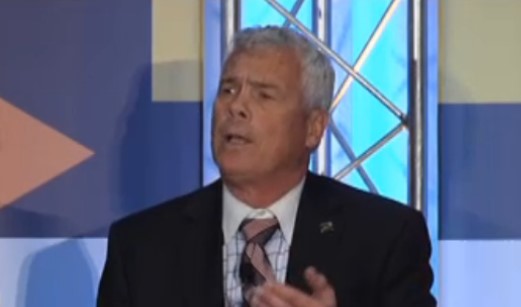
When Eric Schultz began his keynote remarks, the President and CEO of Massachusetts-based Harvard Pilgrim Health Care made sure to alert his audience to his homegrown pedigree.  Whether his youth in the Naugatuck Valley, college years (five of them) at UConn, or graduate work at Yale contributed to Harvard Pilgrim’s more-than-solid inaugural years doing business in Connecticut isn’t certain, but the above-expectations numbers are indisputable.  And Schmitt made clear that his nonprofit health insurance company is looking for even greater achievements in his home state.schultz Since entering the Connecticut market in the summer of 2014, the company has been aggressively growing its customer base in a competitive market while working diligently to grow and expand its network of doctors.  Harvard Pilgrim Health Care announced recently that its Connecticut membership has grown to more than 24,000, exceeding expectations for 2015. It now serves more than 800 Connecticut businesses.  Twenty-nine of the state’s 30 hospitals are now in-network.

logo_harvard-pilgrimWith more than 500 business leaders in attendance at an annual Economic Summit & Outlook last week, brought together by the Connecticut Business and Industry Association and MetroHartford Alliance, Schmitt spent some time touting a new model launched in the state of New Hampshire that he believes may be a glimpse into the direction the industry is moving. Harvard Pilgrim Health Care’s footprint in New England now covers “where 90 percent of New Englanders live,” in Massachusetts, Connecticut, Maine and New Hampshire. quote

Schultz, who succeeded now-Massachusetts Governor Charlie Baker in leading the organization five years ago, pointed to what he described as “a practical example of how an insurance company and groups of providers can work together to get control of medical cost trends and to help improve medical outcomes and help create better experiences for physicians and their patients.”

The goals, Shultz explained, are to reduce insurance premium trends by 10 to 15 percent, to improve clinical outcomes, to create a better “practice environment” for medical staff and to grow business.  The partnership is driven to “produce something that’s better than what we have today, because we know the financing of health care is largely broken in the U.S.”

economic summitLaunched in October 2015 and in business as of January 1, Benevera Health, a joint venture led by senior leadership at Harvard Pilgrim Health Care and Dartmouth-Hitchcock, is a population health company, centered around “clinical and medical informatics.”  Dartmouth-Hitchcock, a nonprofit academic health system that serves a patient population of 1.2 million in New Hampshire and Vermont, is led by Dr. James Weinstein, recently named as one of “100 Physician Leaders to Know” by a national health care trade publication.

“We are combining insurance data with clinical data,” Schultz said, “from their electronic medical records and our claims system, and creating a very powerful source of information.”  That information, he stressed, could be used to better understand what’s happening in regards to patient care, and it can help to redesign and improve clinical care.  This has the potential to be especially important in chronically ill patients, noting that 10 percent of patients drive 50 percent of health care costs.  “It is a great financial opportunity and a great clinical opportunity.”

“The magic,” Shultz noted, is in having the provider and the payer sit down together and figure out” what should be done.  Too often in the past, he said, providers and insurers haven’t gotten together – a lack of cooperation and collaboration that contributes to higher costs and to disconnects regarding patient care.  His expectation is the Benevera will “reduce headaches” that insurance companies often cause providers, reduce duplication and costs, and improve patient care. cbia alliance

In fact, when the new venture was launched last fall, officials from the two companies stressed that the groundbreaking entity, “will take health care coordination to a new level by bringing together clinical, financial and operational data from across partner institutions to provide actionable analytics for clinicians to further improve the quality and efficiency of patient care.”  They added that  “at the center of this approach will be locally-based care advocates who will identify early opportunities to engage patients – especially those with chronic, complex or emerging conditions - and provide them with one-on-one support.”

Schultz noted that insurance companies tend to resist providers suggesting how insurance plans ought to be designed.  He disagrees with that resistance.  “If more insurers took more input from providers on plan design, we’d be a lot better off.”

Harvard Pilgrim is the only not-for-profit, regional health plan operating in four contiguous New England states.  Harvard Pilgrim’s flagship health plans in New England provide health coverage to 1.3 million members, while another 1.4 million individuals are served through Health Plans, Inc., a subsidiary that provides integrated care management, health coaching and plan administration solutions to self-funded employers nationwide.  Schultz holds an MBA in Health Care Leadership from Yale University’s School of Management, as well as a bachelor of science degree in biology and a bachelor of arts degree in economics from the University of Connecticut.

“We’re about change and driving change,” Schultz told those attending the Hartford summit, “and I believe we need to do more of that.”  He’s hoping to build a similar structure in Connecticut, and in other states around the country, because “it’s exactly what we need to do.”

Link to CT-N video of Economic Summit & Outlook.

Increasing Percentage of Children in Single-Parent Families; CT 21st in US

Single-parent households are growing more common across the U.S., new research reveals.  Connecticut ranks 21st in the percentage of children in single-parent families, although the number has steadily climbed in Connecticut as nationwide, according to data compiled by the Annie E. Casey Foundation.data Nearly 25 million children— 35% of the country’s children — lived in single-parent families in 2014, the latest full-year data.  That is an increase of 392,000 since 2010.

In Connecticut, the percentage has grown from 32 percent in 2010 to 34 percent in 2014, an increase of 3,000 children in single-parent families, but keeping the state below the national average.  In 2000, the percentage in Connecticut was 27 percent, with 211,000 children in single-parent families, compared with 252,000 in 2014, according to the data.kids

Compared with children in married-couple families, those raised by one parent are more likely to drop out of school, have or cause a teen pregnancy and get divorced as an adult, according to research.

Forty-six states reported an uptick in the number of children raised in single parent households, with the largest jumps occurring in New Hampshire and Delaware.

Utah has the lowest incidence of kids being raised by one parent (19%) followed by Idaho (26%), Wyoming (27%), Minnesota (29%), Iowa (29%), North Dakota (29%) and Nebraska (29%).  Louisiana (47%) and Mississippi (47%) top the list, with nearly half of all kids growing up in single-parent families.  The other states with a high percentage of single-parent children are South Carolina (43%), Delaware (42%) and New Mexico (41%).map

The report, released last month, also found that nationwide 26 perlogocent of children live in mother-only households and 8 percent live in father-only households.  Those numbers are virtually unchanged since 2010.  Back in 2000, however, 69 percent of children lived in married-couple households, 25 percent in mother-only homes and 6 percent in father-only households.

In Connecticut, the percentage of children living in married-couple households has fallen from 74 percent in 2000 to 67 percent in 2014.  The percentage of children living in mother-only households has increased from 21 percent to 26 percent, while the number of children in father –only households has grown by 16,000 between 2000 and 2014, from 5 percent of children to 7 percent of children.


PERSPECTIVE: Fiduciary Duty - A Pledge Board Members Need to Uphold

by Lisa Wills The whole of an organization is only as strong as the composition of its board.

Many individuals become nonprofit board members because of their passion for the entity’s mission.  Once the organization determines the member is a fit, it’s assumed that the pledge to honor and uphold the fiduciary duties will naturally follow.

PageLines- CTperspective.jpgThe benefits of sitting on a board are innumerable.  However, board members who use their position for surreptitious gains and lose sight of their responsibility to uphold the organization’s best interests, or are not fully paying attention, may wind up in one of these scenarios.


Recently, a jury verdict against the board of directors of Lemington Home for the Aged, a nonprofit nursing home, was upheld by the U.S Circuit Court of Appeals.  The directors were found personally liable for breach of their duty of care for failure to remove the CFO of the nursing home after learning of his mismanagement of the entity.

New York Attorney General Eric Schneiderman has called for an investigation of the board members of The Cooper Union for the Advancement of Science and Art over alleged mismanagement of the higher education institution’s endowment and physical assets.  Their actions caused the school to charge undergraduates tuition for the first time in its history.

The lack of transparency by Sweet Briar College’s board of trustees led to legal action after the board failed to communicate to its constituents the accuracy of their financial situation, yet in turn, voted to abruptly close the institution.  After a long legal battle, a settlement was reached in June 2015 to keep the institution open, with several conditions, one being the resignation of the entire board of trustees.

These are just a few of the national headlines that exhort us to question how serious some nonprofit board members take their fiduciary responsibilities. These responsibilities are known as the duties of care, loyalty and obedience.quote

Board members are expected to exercise reasonable care when making decisions on behalf of the entity in which they serve.  In instances where they do not exercise such care, board members may be held personally liable.

Increased scrutiny over the activities and decisions of nonprofit boards may result in members and prospective members evaluating if their involvement is worth the risk.  There are some key practices that board members need to uphold as assurance that they are exercising fiduciary responsibilities:

  • Know the entity – Read and understand the articles of incorporation and bylaws, and ensure that documents are updated and amended as appropriate. Be aware of pending and threatened legal claims against the entity.
  • Be informed of strategic initiatives – Read the organization-wide long-term, strategic plan. Understand the financial and economic challenges facing the entity and the industry, as a whole.
  • Stay informed of financial activities – Understand significant components of the annual budget, encourage regular reporting of financial information, review the annual audit report and management recommendations with the external auditors.
  • Understand conflict of interest policy – Be aware of potential conflicts of personal and professional conflicts of interest between the board member, a family member or an employee and the nonprofit entity. Disclose conflicts of interest and abstain from board votes where appropriate.
  • Understand the nonprofit entity’s indemnification policies – Ensure that the entity’s policies provide for indemnification of its board members, and that there is a directors’ and officers’ liability policy in place to cover claims arising from board service.
  • Prepare for and attend board meetings – Review board minutes and financial statements in advance of meetings, which will allow you to be an active participant and ask questions and understand the issues.  Don’t be afraid to roll up your sleeves.
  • Always use good judgement - Remember that the fiduciary responsibility requires board members to make decisions that are both prudent and informed.

Board members receive great satisfaction from their involvement and should feel that, in exercising due care, they have acted in the best interest of the nonprofit in furthering the mission and making a difference.

___________________________

Lisa Wills is an audit director with Whittlesey & Hadley, P.C.  She specializes in audits of nonprofit organizations.


PERSPECTIVE commentaries by contributing writers from across the state appear each Sunday on Connecticut by the Numbers.

Cellphone Likely Won’t Tell 911 Operator Your Location

The Federal Communications Commission has estimated that about 70 percent of 911 calls are placed from wireless phones, and that percentage is growing. For many Americans, according to the federal agency, “the ability to call 911 for help in an emergency is one of the main reasons they own a wireless phone.”  Yet, in an emergency, a cell phone may provide potential first responders with less information than one would expect. The National Emergency Number Association (NENA),which represents dispatchers, supervisors and private-sector service providers, points out that “when 9-1-1 calls are made from wireless phones, the call may not be routed to the most appropriate 9-1-1 center, and the call taker doesn't receive the callback phone number or the location of the caller. This presents life threatening problems due to lost response time, if callers are unable to speak or don't know where they are, or if they don't know their wireless phone callback number and the call is dropped.”  The organization’s motto is “emergency help, any time, anywhere, any device.”911 cell call

Recent published reports in Governing magazine indicate that “when you check movie times on your cellphone, search for a restaurant or hail a ride, the device automatically knows exactly where you are and can suggest things nearby. So it’s understandable that many people assume the same holds true when they call 911 for emergency assistance.  But the fact is, 911 call centers frequently receive imprecise locations of callers from wireless carriers -- and some don’t get any location information at all. Calls from landline phones are linked to addresses.”

The FCC website explains that “since wireless phones are mobile, they are not associated with one fixed location or address. While the location of the cell site closest to the 911 caller may provide a general indication of the caller's location, that information is not always specific enough for rescue personnel to deliver assistance to the caller quickly.”

More reliable and specific location information could save lives, advocates say, and earlier this year an order from the Federal Communications Commission (FCC) set targets for companies to improve both the availability and accuracy of location information. But those upgrades remain a long way off.EmergencyResponse

Under the new rules, carriers will have to provide caller location info within 50 meters 80 percent of the time by 2021, along with vertical location information, if the call is being made from an apartment building or high rise office tower -- that would have to be in place in major markets by 2023.

Some have said the industry needs to provide those capabilities much sooner.  While 911 dispatchers routinely ask callers for their location, callers at times hang up before providing that information, for any number of reasons. And, they argue, if a cell phone knows where you are, that information should be instantly made available to 911 dispatchers as well.

The latest FCC guidelines are available for public review.  “We would have liked to have seen a more compressed timetable,” NENA CEO Brian Fontes told Governing.

Published reports in Connecticut indicate that some communities are moving forward with new technology.  The town of Wolcott, according to reports, has begun using a system that will allow police to pinpoint the location of emergency calls made from cell phones.  The Republican-American newspaper reports the town was the first in the state to use the next-generation system in a pilot program that was slated to include the New Britain, Wilton, Enfield, Newington, Valley Shore, Fairfield, Middletown, Mashantucket and Shelton police departments .  The new system shows dispatchers the caller’s location within a 50-foot radius, compared with the old system  which would indicate the location of a wireless 911 call within a quarter-mile radius.

Plans are also in the works that would permit individuals to text 911 from their cell phones.  The CT Post reported last month that about 24 dispatch centers out of 110 statewide are being upgraded to the text-to-911 system. Stratford and Fairfield will be among the first towns in the state to get the texting capability. Officials hope the entire state will have text-to-911 by late 2016 or early 2017, the newspaper reported.