PERSPECTIVE: Clearing A Path to Better Health

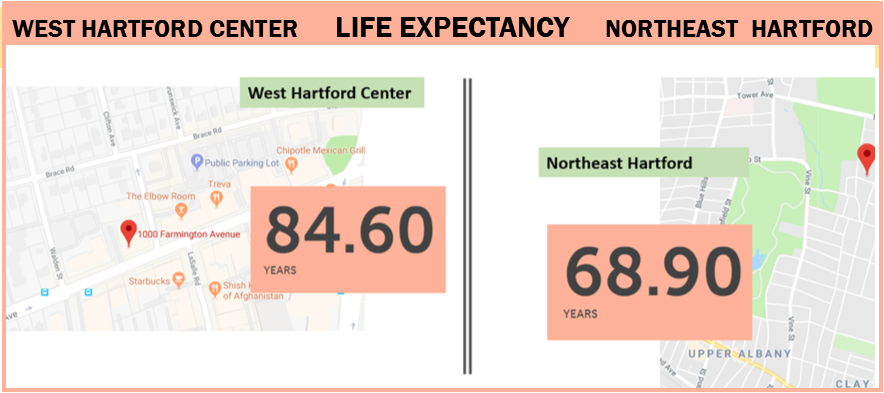
by Arielle Levin Becker Hartford’s Northeast neighborhood is about four miles from West Hartford Center. Yet living in one place or the other can mean a 15-year difference in life expectancy.

That’s according to recently released data that identifies the life expectancy for nearly every census tract in the country, offering a stark illustration of the disparities that exist even between neighborhoods in the same city or region.

In Northeast Hartford, the life expectancy of 68.9 years is more than 11 years below the average life expectancy in Connecticut – 80.8 years. West Hartford Center tops that, at 84.6 years.

Similar patterns hold true across the state. There’s a nearly 14-year life expectancy gap between parts of Bridgeport and neighboring Fairfield. A baby born in Westport has a life expectancy that’s more than 20 years longer than a baby born in Northeast Hartford.
There is variation within cities and towns. In New Haven’s Newhallville neighborhood, life expectancy is 71.7 years. In the neighborhood next door, Prospect Hill, life expectancy is more than a decade longer: 82.3 years.

Depending on the neighborhood, life expectancy in New London ranges from 69.8 years to 83.3 years (a 13.5-year difference), while in Norwalk, it ranges from 76.3 years to 87.9 years (11.6 years). Life expectancy in Torrington ranges from 71.6 years to 85.6 years – a 14-year gap.

The data comes from the United States Small-Area Life Expectancy Estimate Project, an effort of The Robert Wood Johnson Foundation, National Association for Public Health Statistics and Information Systems, and the National Center for Health Statistics, which is part of the Centers for Disease Control and Prevention. The numbers are estimates of average life expectancy at birth for 2010 to 2015 – that is, how long, on average, a person can expect to live.

“It is truly unsettling to see how small differences in geography yield vast differences in health and longevity. In some places, access to healthy food, stable jobs, housing that is safe and affordable, quality education, and smoke-free environments are plentiful. In others, they are severely limited,” Donald F. Schwarz, senior vice president, program at the Robert Wood Johnson Foundation, wrote in a recent blog post. “Data can help us better understand the health disparities across our communities and provide a clearer picture of the biggest health challenges and opportunities we experience.”

All of this new data is consistent with a longstanding challenge in health in Connecticut: While Connecticut is among the healthiest states in the country, there are significant disparities in health outcomes by race and ethnicity – a sign that not everyone has the opportunity to be as healthy as possible.
Here are three examples:

  • Babies born to black women in Connecticut are nearly three times as likely to die before turning 1 as babies born to white women, while among Hispanic mothers, babies are twice as likely to die in their first year.
  • The rate of cancer deaths among black Connecticut residents was 9 percent higher than among white residents in 2016 – even though black residents were far less likely to be diagnosed with cancer.
  • Hispanics in Connecticut were twice as likely to be uninsured than white state residents in 2016.

At the Connecticut Health Foundation, our work is centered on eliminating racial and ethnic health disparities and assuring that all Connecticut residents have access to affordable and high-quality care. We focus on ensuring that all state residents have access to health care coverage and a regular source of health care, as well as ensuring that the health care people receive is high-quality and connected to the many non-clinical factors that affect health.

The strategies that can help to eliminate health disparities will benefit everyone. They can also help move Connecticut closer to our vision of a state in which everyone – regardless of race, ethnicity, or socioeconomic status – has the opportunity to be as healthy as possible.

_________________________

Arielle Levin Becker is Communications Director for the Connecticut Health Foundation, which focuses on improving health outcomes for people of color and ensuring that all Connecticut residents have access to affordable and high-quality care. Through public policy, grantmaking, and leadership development, the Connecticut Health Foundation works to make lasting changes that improve lives.



Report Provides Guidance for School Districts and State Policymakers to Address Students’ Trauma & Mental Health Needs

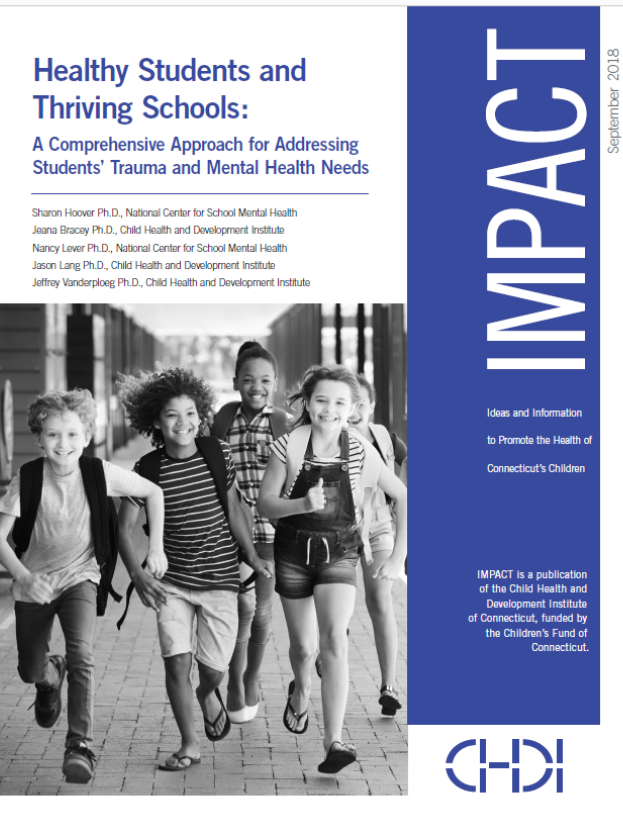
It is described as a “framework to advance policy and strategic school district planning to more effectively address the mental health and trauma needs of students and promote student success.”  A new report, driven by research highlighting the connection between mental health and educational outcomes, is aimed at school districts looking to increase integration of student mental health services and supports. The 40-page report, developed by The Child Health and Development Institute of Connecticut (CHDI), a subsidiary of the Children’s Fund of Connecticut, in partnership with the national Center for School Mental Health at the University of Maryland, provides a framework for policymakers and school districts interested in improving outcomes by addressing the mental health and trauma needs of students. The report indicates that “in a typical classroom of 25 students, approximately five will meet criteria for a mental health disorder but most of them are not receiving appropriate mental health treatment or support. Among those who do access care, approximately 70 percent receive services through their schools.”
Connecticut is cited as an example of how states can promote collaborations within and across the behavioral health, education, and juvenile justice systems to provide an array of trauma-informed, evidence-based, and tiered services for students.  It notes that school principals indicate that mental health is one of the most challenging unmet needs among their students and schools are increasingly seen as a critical setting for the delivery of mental health services.

The report provides “a blueprint and resources to guide state policymakers and school district leaders," including:

  • an overview of core components of the Comprehensive School Mental Health
  • Systems (CSMHS) model structured around family-school-community partnerships and the delivery of evidence-based mental health services within a multi-tiered system of supports;
  • examples of best practice strategies to develop, implement, and sustain CSMHS;
  • a model for a trauma-informed multi-tiered system of supports for school mental health;
  • creative approaches to advance policy and funding structures to sustain CSMHS; and
  • recommendations for state-level policymakers, districts, and schools to advance a comprehensive statewide system of school mental health to improve outcomes for all students.

“Approaching student mental health with a comprehensive lens that integrates health promotion, prevention, early intervention, and more intensive treatments leads to better school, student and community outcomes," said Dr. Sharon Hoover, Co-Director of the Center for School Mental Health at the University of Maryland and lead author of the report.


National prevalence rates indicate that approximately 20 percent of children meet criteria for a mental health disorder; however, many children’s mental health needs are not identified and the majority of children with identified challenges do not receive services, the report explained.  Among those who do access care, approximately 70 percent receive services through their schools. Linking children to services through their schools reduces many traditional barriers to care. School mental health services are also associated with higher completion rates than treatment delivered in traditional outpatient community-based settings.

The report uses Stamford Public Schools (SPS) as a” local model for improving outcomes by adopting a trauma informed approach to school mental health.” CHDI began working with SPS in 2014 to conduct a review of the district’s mental health system and to develop a plan to enhance trauma-informed mental health services district-wide.  That plan was subsequently implemented, and “lessons learned in Stamford are being used to engage other Connecticut districts to … integrate school and community-based mental health services, and promote quality and sustainability of these enhancements.”

“Schools are well positioned to promote wellness and social emotional competence for all students, as well as identify and address mental health concerns for students in need,” said Dr. Jeana Bracey, Director of School and Community Initiatives at CHDI and report co-author. “However, the responsibility is not on schools alone to integrate or fund these supports. This framework helps districts connect to and collaborate with Connecticut’s robust network of trauma-informed state and community-based services and programs so all students can be successful.”

The report concludes that a “systematic and streamlined partnership between families, schools, and communities to support a continuum of mental health supports in schools can lead to better behavioral health for all students, as well as increased access, earlier identification and intervention, and ultimately better outcomes for students with mental health challenges.”

[Visit wwws.chdi.org to download the IMPACT report or to read more about CHDI’s work related to school mental health.]

CT Minimum Wage Tied for 10th Highest in USA

Connecticut's state minimum wage rate is $10.10 per hour, greater than the federal minimum wage of $7.25 but not nearly the highest in the nation. The top five states are District of Columbia: $12.50 per hour; Washington: $11.50 per hour; California: $11.00 per hour; Massachusetts: $11.00 per hour and Oregon: $10.75 per hour, according to U.S. Department of Labor data analyzed by the website howmuch.com.  Arizona and Vermont are just behind the leaders at $10.50, followed by New York at $10.40 and Colorado at $10.20.  Maryland, Hawaii and Rhode Island join Connecticut at $10.10 in a four-way tie.

The Connecticut minimum wage was last changed in 2008, when it was raised $2.45 from $7.65 to $10.10. A proposal considered by the Connecticut legislature in 2018 – but not approved - would have raised the state minimum hourly wage from $10.10 to $12 on Jan. 1, 2019; from $12 to $13.50 on Jan. 1, 2020; and from $13.50 to $15 on Jan. 1, 2021. After reaching $15 in 2022, it would have indexed any future increases to annual increases in the consumer price index.  A similar proposal is expected to be considered when the legislature next convenes in January.

The federal minimum wage is $7.25 an hour, a rate used by 20 states. That includes five states – Alabama, Louisiana, Mississippi, South Carolina and Tennessee – that have no state minimum wage laws and therefore the federal minimum wage is the default.  And two states – Georgia and Wyoming – have minimum wages below the federal level, so the federal minimum is in effect. 

The Massachusetts minimum wage will rise to $15 an hour over five years under legislation approved earlier this year, becoming the third state – after California (effective 2022) and New York – to approve legislation putting the state on a path to a $15 minimum wage in the years ahead.  In New York, the current rate of $10.40 will increase incrementally in the coming years, to $12.50 as of January 1, 2020. Thereafter, it will be adjusted annually for inflation until it reaches $15.00.

Delaware enacted a two-step increase in 2018. The rate rises from $8.25 to $8.75 effective January 1, 2019, and will increase again to $9.25 effective October 1, 2019.

Eighteen states began 2018 with higher minimum wages than the previous year, according to the National Conference of State Legislatures. Eight states (Alaska, Florida, Minnesota, Missouri, Montana, New Jersey, Ohio, and South Dakota) automatically increased their rates based on the cost of living, while eleven states (Arizona, California, Colorado, Hawaii, Maine, Michigan, New York, Rhode Island, Vermont and Washington) increased their rates due to previously approved legislation or ballot initiatives.

Seattle, Washington’s largest city and half of the state’s population, has moved toward a local minimum wage of $15 per hour, based on a city law passed in 2014 that incrementally increased the local minimum over several years.


New Haven, Bridgeport at Bottom of Ranking for Disability-Friendly Cities

Connecticut’s two largest cities are not particularly hospitable for individuals with disabilities, according to a new national analysis.  New Haven and Bridgeport are at the bottom of a list of 182 cities that were included in the review, released this month to coincide with National Disability Employment Awareness Month The personal-finance website WalletHub compared the largest U.S. cities – including at least two from each state - across 31 key indicators of disability-friendliness. The data set ranges from wheelchair-accessible facilities per capita to rate of workers with disabilities to quality of public hospital system. The 31 indicators were grouped into three categories:  Economy, Quality of Life and Health Care.


The report on 2018’s Best & Worst Cities for People with Disabilities placed New Haven at the bottom of the list, and Bridgeport just two positions higher.  They were the only Connecticut cities evaluated in the analysis.

According to the Centers for Disease Control and Prevention, one in four U.S. adults, or 61 million total, have a disability that impacts their major activities. And among Americans age 65 and older, that number rises to two in five. In 2017, nearly 5.7 million people with disabilities were employed.

New Haven, which ranked number 182 overall, ranked 180 in Economy, 134 in Quality of Life and 173 in Health Care.  Bridgeport, just above New Haven at number 179 in the overall ranking, placed 164 in Economy, 128 in Quality of Life and 163 in Health Care.

WalletHub analyst Jill Gonzalez explained that among the metrics dragging down New Haven's overall ranking was the second lowest employment rate for people with disabilities, at 71.03 percent. This refers to the civilian non-institutionalized population aged 18-64 in the labor force. Other areas where New Haven ranked poorly, Gonzalez pointed out, were the share of people with disabilities living in poverty, which is almost 37 percent, and the relatively low number of family doctors and general practitioners per capita.

Bridgeport ranked as the fourth worst city for people with disabilities. One of the issues driving the ranking, Gonzalez said, was similar to New Haven's - a low employment rate for people with disabilities, at 74.28 percent. The other issues are mostly related to the quality of life.

“Bridgeport has one of the lowest number of wheelchair accessible art, entertainment and recreational establishments per capita, and a large number of older buildings with little to no access for disabled residents," Gonzalez said.

The analysis found that only Detroit had a lower employment rate for individuals with disabilities that New Haven.  On the overall list, Providence, RI was just one notch above New Haven, at the bottom of the rankings.

The cities ranked at the top of the list were Overland Park, KS; South Burlington, VT; Sioux Falls, SD; Scottsdale, AZ; Columbia, MD; San Francisco; Rapid City, SD; St. Louis, MO; Bismarck, ND; and Grand Rapids, MI.

Data used to create this ranking, according to WalletHub, were collected from the U.S. Census Bureau, Bureau of Labor Statistics, Department of Housing and Urban Development, Council for Community and Economic Research, Centers for Disease Control and Prevention, National Center for Education Statistics, Centers for Medicare & Medicaid Services, Trust For Public Land, Genworth Financial, United Cerebral Palsy, WalkScore, Yelp, Rails-to-Trails Conservancy, Affordable Housing Online, Kaiser Family Foundation, Eligibility.com, Redfin and WalletHub research.

Income Inequality Increasing Faster in CT Than US; Among Largest Disparities in Nation

In Connecticut, to earn a place in the top one percent would require making $700,800, the highest threshold in the nation.  The average annual income of the top one percent is also among the highest in the nation at $2,522,806.  That is 37 times the annual income of the bottom 99 percent, which is $67, 742, according to data analyzed by the Economic Policy Institute. The data reveal that the top one percent take home 27.3 percent of all the income in Connecticut, and that the share of income by the top one percent has increased at a faster rate in Connecticut in recent years than in the nation as a whole.

Connecticut ranks #3 of the 50 states in income inequality, based on the ratio of top one percent to bottom 99 percent income.  (New York’s top one percent makes 44 times the bottom 99 percent; Florida 39 times; Connecticut 37 times)  The Bridgeport-Stamford-Norwalk metro area is the most unequal metro area in Connecticut, the data indicate. The top 1 percent make 62.2 times more than the bottom 99 percent.

Overall in the Northeast, the top 1 percent take home 24.7 percent of all the income in the Northeast.  The average annual income of the top one percent is $1,777,756 compared with $54,662 for “everyone else,” the other 99 percent.  Nationwide, the top one percent take home an annual income of $1,316,985 versus $50,107 for the other 99 percent.   The most unequal metro area in the U.S. is Jackson, WY, where the top one percent make 132 times the rest of the population.

The data is based on an Economic Policy Institute report published this summer. EPI is an independent, nonprofit think tank based in Washington, D.C. that researches the impact of economic trends and policies on working people in the United States.

The report used 2015 data, the most recent available, finding that the top 1 percent of families in the U.S. earned, on average, 26.3 times as much income as the bottom 99 percent—an increase from 2013, when they earned 25.3 times as much.

Eight states plus the District of Columbia had gaps wider than the national gap. In the most unequal—New York, Florida, and Connecticut—the top 1 percent earned average incomes more than 35 times those of the bottom 99 percent.

The report found that income inequality has risen in every state since the 1970s and, in most states, it has grown in the post–Great Recession era. From 2009 to 2015, the incomes of the top 1 percent grew faster than the incomes of the bottom 99 percent in 43 states and the District of Columbia.

(Infographics:  Economic Policy Institute; howmuch.net)

PERSPECTIVE: A Needed Credential to Advance Infant and Early Childhood Mental Health

by Abby Alter and Heidi Maderia Professionals who care for young children play an important role in promoting social-emotional development, positive mental health, and relational health, as well as identifying problems early and connecting young children to intervention and treatment services when necessary. Unfortunately, most pre-professional education and training programs lack specific courses or modules related to infant and toddler mental health, and many professionals lack the critical skills needed to work with very young children.

Many states, including Connecticut, are taking steps to ensure that professionals working with infants, toddlers, and their families are well-trained to promote optimal mental health, promote preventive strategies, and facilitate linkage to early intervention or treatment.

Attention to the Mental Health of Young Children is Critical for their Healthy Development

Infant and early childhood mental health is defined as a young child’s capacity to regulate and express emotions, form close and secure relationships, safely explore their environment, and learn. Young children develop these capabilities within the context of their family, environment, community, and culture, as well as through relationships with their primary caregivers. Infants and toddlers who develop healthy and strong social and emotional competency are better prepared for school and have healthier and more prosperous lifelong outcomes.

A System of Professional Endorsement is Improving Connecticut’s Workforce

The Connecticut Association for Infant Mental Health (CT-AIMH) purchased a license in 2010 from the Michigan Association of Infant Mental Health to provide the Endorsement for Culturally Sensitive, Relationship-Focused Practice Promoting Infant Mental Health®. The license was purchased with support from the Children’s Fund of Connecticut, the Connecticut Head Start State Collaborative Office, and others. Since obtaining the license, CT-AIMH has built a statewide competency system known as the CT-AIMH Endorsement® for providers caring for children up to age 3. The system provides professional development through training and education programs with a goal of building a more skilled workforce.  In 2017, with help and guidance from a national workgroup, the endorsement system was expanded to include professionals working with children from 3 to age 6.

Becoming endorsed demonstrates that an individual has completed specialized education, related work, in-service training, and reflective supervision/consultation experiences that have led to competency in the promotion and/or practice of infant or early childhood mental health. The credential does not replace licensure or certification, but is meant as evidence of a specialization in the promotion and practice of infant and/or early childhood mental health within each professional field, such as child development, early care and education, pediatrics, psychiatry, psychology, social work, and others. To date, 56 professionals in Connecticut are endorsed in Infant Mental Health through this system, and three providers have earned the Early Childhood Mental Health Endorsement® (currently in its pilot phase). CT-AIMH plans to revise the endorsement program based on lessons learned during this pilot, and offer the Early Childhood Mental Health Endorsement® to professionals in 2019.

Additional Measures to Build a More Competent Infant and Early Childhood Workforce

Connecticut agencies and stakeholders have taken several steps to build a more competent infant and early childhood workforce. Examples include: increasing support for reflective supervision/consultation groups in Birth to Three and home visiting programs; committing to having at least one endorsed infant mental health professional on staff for every Birth to Three operated program; and providing a bi-annual infant mental health training series for child welfare and Head Start staff through a partnership with Head Start, the Department of Children and Families, and CT-AIMH.

While these measures are expanding the capacity of the early childhood workforce in Connecticut to address the social and emotional needs of young children, more can and should be done. Recommendations for Connecticut include:

  • Increase public funding to support endorsement activities, including funding for: infant and early childhood mental health training, release time for staff to attend training, reflective supervision/consultation, deployment of a university-level cross-discipline Faculty Infant Mental Health Training Institute with accompanying materials.
  • Ensure that all State and/or public agencies serving the most vulnerable children and their families have infant/early childhood mental health endorsed staff in every region.
  • Follow Michigan’s practice requiring Endorsement® in infant and early childhood mental health for practitioners who bill Medicaid for mental health services provided to infants and toddlers. Additionally, Medicaid and commercial insurers should pay for infant and early childhood mental health services delivered to young children birth to 6 years who show signs of risk (without a diagnosis) if delivered by a professional holding the Endorsement.
  • Require state institutions of higher education to include infant and early childhood mental health competencies in their infant, young child, and family related courses (e.g., nursing, social work, education, psychology) and/or support an Endorsement requirement to develop a pipeline of professionals who can pursue endorsement within their careers. Use the Faculty Infant Mental Health Training Institute to help faculty across disciplines to incorporate infant mental health into existing courses.

These additional actions can advance and sustain a statewide system of professionals who are endorsed and credentialed in infant and early childhood mental health. In that way, we can best promote optimal mental health and preventive strategies, and facilitate, as needed, early intervention or treatment.

_____________________________

Abby Alter is Senior Associate for Early Childhood Initiatives at the Child Health and Development Institute, and Heidi Maderia is Executive Director of the Connecticut Association for Infant Mental Health. To learn more, visit www.ct-aimh.org or read "The Infant Mental Health Workforce: Key to Promoting the Healthy Social and Emotional Development of Children."  This article was adapted from an Issue Brief developed for Child Health and Development Institute of Connecticut, Inc, a catalyst for improving the health, mental health and early care systems for children in Connecticut.

Housing and Health - Foundations Fund Research in CT to Examine Relationship

Housing and health are increasingly the focus of study, to better determine how one impacts and influences the other.  Foundations at the state and national level are among those devoting resources in Connecticut to seek answers that can ultimately guide future public policy. With a $125,000 grant from the Connecticut Health Foundation, the Open Communities Alliance will work to create better links between housing and health care and set the stage for a two-year pilot program to enable interested families of children with acute asthma to move to healthier neighborhoods.

The “Healthy Housing Vouchers” project aims to use housing policy to improve health outcomes for low-income families and reduce health disparities, tying together clinical and nonclinical factors that affect people’s well-being. 

The Open Communities Alliance project will create a streamlined process for low-income families of children with asthma to help them access affordable housing in healthier communities if they choose. It will include referrals, counseling on the impact of environmental conditions on health, help identifying potential rental locations, and assistance with security deposits, moving expenses, and supportive services as they adapt to a new community. The initial participants in the pilot program will be low-income families who receive government-funded housing vouchers and have children with acute asthma.

The Connecticut Health Foundation will also be providing a $100,000 grant to support Connecticut Voices for Children’s work to promote policies that advance health equity for children and families. The work will include conducting policy research, producing educational materials and analyses to inform policymakers about issues affecting children and families, bringing together state agencies and advocates through the Covering Connecticut’s Kids and Families Coalition, and participating in state-run councils to represent research-based policy solutions.

These projects are among  11 awarded a total of $535,000 - announced this month - by the Connecticut Health Foundation, based in Hartford.  It is the state’s largest independent health philanthropy dedicated to improving health outcomes for people of color.

Earlier this year, the Connecticut Data Collaborative and the Liberal Arts Action Lab were awarded a 500 Cities Data Challenge grant by the Urban Institute and the Robert Wood Johnson Foundation. The joint proposal was one of 10 selected from a large competitive pool of applications submitted by organizations from cities across the United States.

The one-year $148,000 grant will support local research and educational outreach on housing conditions, health outcomes, and neighborhood disparities in the capital city of Hartford.

The Connecticut Data Collaborative is a nonprofit organization focused on providing public access to data, creating an ecosystem of data users, and increasing data literacy. The Liberal Arts Action Lab, launched in early 2018 by Trinity College and Capital Community College, investigates problems posed by Hartford community partners, with teams of undergraduate students and faculty fellows who conduct semester-long research projects to strengthen the city.

The Urban Institute and the Robert Wood Johnson Foundation designed this challenge grant to encourage communities to delve into the 500 Cities open-access dataset, to design innovative solutions on social factors that influence health, and to guide local organizations on how to effectively use neighborhood-level data. The broader goal is to promote more comprehensive cross-collaborative approaches to foster a broader “Culture of Health” in urban areas.


Hartford, New Haven Rank 73, 74 Among Best U.S. Cities to Retire

Even as Hartford and New Haven spend considerable time and attention directed at attracting millennials, a new national survey finds that the two Connecticut cities are ranked in the nation’s top 100 best places to retire. Hartford ranked 73rd on the list with an overall score of 6.35. New Haven came in 74th with a score of 6.33.  Among New England cities, only Boston and Springfield scored higher. U.S. News evaluated the country's 100 largest metropolitan areas based on how well they meet Americans' retirement expectations.  Perhaps not surprisingly, three Florida cities placed in the top 10.  It was Lancaster, Pennsylvania, that earned the No. 1 on the 2019 list. According to U.S. News, Lancaster moved to the No. 1 spot after placing No. 2 last year thanks to increases in housing affordability and overall happiness of its residents.

Fort Myers, Florida, moved from No. 15 to No. 2, driven by "increases in desirability and happiness scores." Last year's top place to retire — Sarasota, Florida — fell to No. 3 because of a decline in overall happiness and desirability, U.S. News reported.

Of Hartford, U.S. News said “Don't let the historic architecture fool you – even as one of the oldest metro areas in America, Hartford, Connecticut, has a lot to offer, both old and new.”  The Capitol City scored 5.3 in Housing Affordability and 8.5 in Healthcare, the two components of the overall score.

New Haven is described as “home to one of the most walkable city centers between New York City and Boston,” with “centuries-old architecture” which “houses the galleries, concert venues and coffee shops that help make New Haven the cultural capital of Connecticut.”  New Haven earned a 5.2 in Housing Affordability and 8.8 in Healthcare.

The top ranked New England city was Boston at #25.  Springfield, MA ranked #69,  Worcester was #77, and Providence was #85.  New York’s state capitol, Albany, ranked #61.

The top 10 places to retire, according to U.S. News, are: Lancaster; Fort Myers; Sarasota; Austin; Pittsburgh; Grand Rapids; Nashville; San Antonio; Dallas-Fort Worth; and Lakeland, Florida.

The rankings, according to U.S. News,  “offer a comprehensive evaluation of the country's 100 largest metropolitan areas based on how well they meet Americans' expectations for retirement, with measures including housing affordability, desirability, health care and overall happiness.” Data sources include the U.S. Census Bureau and the Bureau of Labor Statistics, as well as U.S. News rankings of the Best Hospitals.

Connecticut Has Nation's Highest Average Student Loan Debt, Analysis Shows

The average student debt in Connecticut is higher than any state in the nation, according to a new analysis.  The latest annual report from The Institute for College Access & Success (TICAS), a nonprofit and nonpartisan organization focused on making higher education more affordable, looked at the Class of 2017 broken down by the state in which they graduated college. The average student debt in Connecticut was $38,510, just ahead of Pennsylvania ($36,854), Rhode Island ($36,250), New Hampshire ($34,415), Delaware ($34,144), New Jersey ($32,247) and Massachusetts ($32.065).  On the other end of the scale are Utah ($18,838), New Mexico ($21,237) and Nevada ($22.064).

As the data reflects, the highest student debt is in states located in the Northeast. There are only two states from the Deep South where average debt tops $30,000, Alabama and Mississippi, and none are from the West Coast. States in the West produce graduates with average debt burdens of only $19-25,000, substantially less.

Nationally, about two in three graduating seniors had student loans. Their average debt was $28,650, about 1 percent higher than the Class of 2016. New graduates’ likelihood of having debt varied from 38 percent (Utah) to 74 percent.  In Connecticut, it is 57 percent.

In all but 8 states, 50 percent or more graduates are saddled with debt of some amount. New Hampshire, South Dakota and West Virginia are tied for having the greatest percentage of indebted graduates (74%). Utah takes first place as the most affordable where only 38 percent of students leave owing student loans.

Between 1996 and 2012, federal data on bachelor’s degree recipients show that the average debt of borrowers increased steadily, according to the study, at an average of 4 percent per year. It has edged higher only slightly in recent years.

(Infographic by howmuch.)


CT Office of Early Childhood Receives Global Recognition for Effective Communication

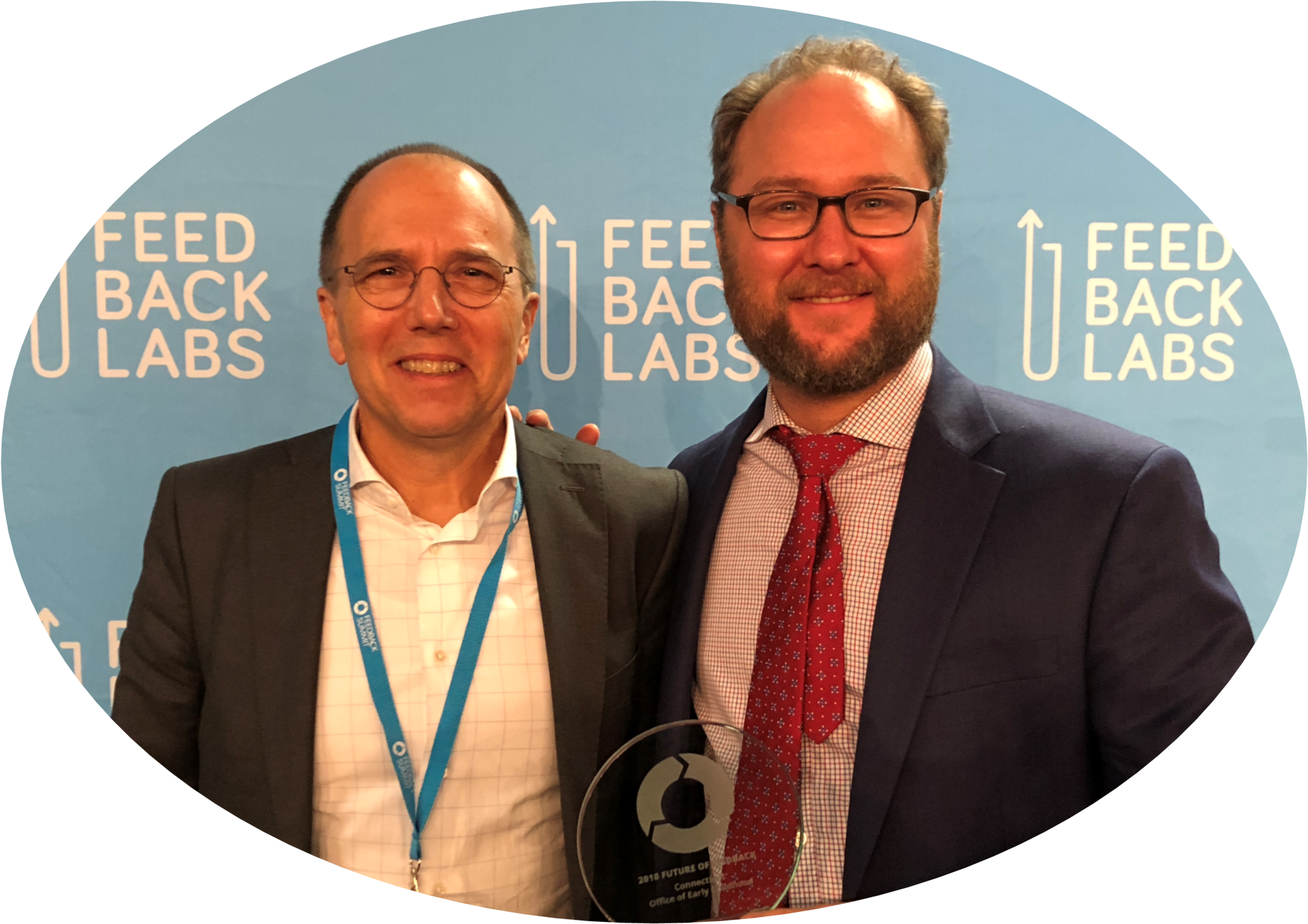
The Connecticut Office of Early Childhood (OEC) – a state agency that didn’t exist just over five years ago - has earned global recognition for success and innovation in serving the state’s youngest children and their families. The agency was chosen to receive the “Future of Feedback Award” at the annual Feedback Summit in Washington, D.C.   The award was presented last week to OEC Commissioner David Wilkinson for his agency’s efforts at effective listening to the people it serves and the nonprofit providers who serve them.

“The Office of Early Childhood is honored to be recognized for its efforts in communicating effectively with Connecticut’s families and providers, and for finding strategies to meet their needs,” said Commissioner Wilkinson. “The parents we serve and the community providers we support are the best experts in what they need to succeed, but too often they don’t have a seat at the table.  OEC is trying a new approach to put parents and our hardworking providers at the center of our policymaking.  We’re saying, ‘nothing we plan for you should be done without you.’’

"Connecticut’s Office of Early Childhood is pioneering innovative ways of both listening and acting.  OEC’s outreach to families – and frontline service providers – is creating conversations about what matters most, and what they can all do together," said Dennis Whittle, Co-Founder of Feedback Labs and GlobalGiving.

Feedback Labs, the organizer of the Summit, is a global network of over 400 leading aid, philanthropy, and governance organizations around the world.  Feedback Labs was conceived in 2013 and launched in connection with the Obama White House. Whittle also co-founded GlobalGiving, a leading marketplace connecting social, environmental, and economic development projects to individual and corporate donors. Since its inception GlobalGiving has facilitated $335 million in funding to over 20,000 projects in 170 countries.

Established in 2014 through a bipartisan effort of Gov. Dannel Malloy and the legislature, OEC oversees and funds Connecticut’s early childhood programming – including child care, pre-K, early intervention for children with developmental delays, and family support services for at risk families – components that once were housed in five disparate state agencies.

Among the 10 largest state agencies in Connecticut, OEC’s goal is to keep the state’s children safe, healthy, learning and thriving. Through its innovative feedback efforts, the agency is acting on evidence that engaging providers and parents in policymaking yields better results.  Officials said that the agency combined data from 1,700 family surveys, another survey shared with all providers in the state, and 400 community and provider meetings in order to build a draft plan to transform the ECE system in the state, which serves 200,000 children.


Wilkinson added that “An award like this is an encouraging validation of our efforts to listen to families and providers, and then do all we can to act on their advice.  We believe that by listening and responding, we will provide better, more effective services for Connecticut families with young children – and in so doing help create a brighter future for the state.”

"OEC’s approach contains key ingredients of more responsive, innovative, and effective government.  OEC’s leadership in asking for and responding to feedback has the potential to spread widely through the public sector,” Whittle added.

“Child care centers work hard every day for children,” Said Dr. Monette Ferguson, Executive Director of ABCD, Inc., a nonprofit operating several leading child care centers in and around Bridgeport. “Usually the state tells us what to do and by the time we share any concerns, it’s too late.  I am not used to a state agency asking what I think before it acts.  It’s good to feel heard and to see OEC acting on our advice.”

David Wilkinson was named Commissioner by Gov. Malloy in April 2017 to serve as the second Commissioner of the state’s Office of Early Childhood (OEC). He previously served as Director of the White House Office of Social Innovation and Civic Participation under President Barack Obama. While at the White House, Wilkinson worked closely with the Malloy Administration on signature early childhood efforts, including a first-of-its-kind initiative – scaling a program proven to reduce parental substance use and child welfare interaction – for which the administration has achieved national acclaim.  He has also served as an advisor to the Yale Child Study Center, a leading collaborator with the state and its early childhood service providers.

Christine Johnson-Staub is the Interim Director of Child Care and Early Education at CLASP, a 50-year-old national nonprofit based in Washington, D.C., that focuses on shaping policy to support families living in poverty. She said, “OEC’s approach to setting its policy direction was unique because not only did it build on input from the community and existing research and data, but it went back to a wide range of impacted people, including parents, providers and other stakeholders, to make sure they got it right.”

“Parents and child care providers know the challenges facing the early care system better than anyone but rarely does anyone from state government ask our opinion,” said Merrill Gay, Executive Director of the nonprofit Early Childhood Alliance, a state consortium of providers and advocates. “That's why it was so refreshing to have the Office of Early Childhood ask us: ‘What are the pain points?  How do we make this system work better for you?’  I'm really excited to see OEC now turning that agenda for improvement into concrete action to better serve children and families.”

The strategy of communicating successfully with a target audience, and then acting upon that communication, is known as a “feedback loop” – an approach widely studied and increasingly appreciated by thought leaders, initially gaining traction in international development, but seen to have powerful implications for advancing more responsive, cost-effective and impactful government services in the US. The 2018 Feedback Summit was attended by over 150 feedback pioneers and leaders from around the U.S. and the world.

“They speak. We listen. We make change. It’s about being responsive to the needs of the young children in our state and, of course, their parents and caregivers,” Wilkinson said.  To contact the Office of Early Childhood, visit www.ct.gov/oec or call (860) 500-4412.