Number of Brewery Permits Nearly Doubles in CT in Past Five Years
/
The number of brewery permits in Connecticut has nearly doubled during the past five years, from 19 in 2008 to 36 in 2013, reflecting the rapid growth in the state – and nationwide – in the craft brewing industry.
Connecticut ranked #29 in the nation, between Georgia and New Jersey, in the state-by-state rankings, compiled by Bloomberg.com using data f rom the Beer Institute and the Alcohol and Tobacco tax and Trade Bureau. There were 3,699 permitted breweries in the United States last year, about 34 percent more than the previous year.
California led the nation with 508 brewery permits, followed by Washington State with 251, Colorado with 217, Oregon with 208 and Michigan with 188. Rounding out the top ten were Pennsylvania (176), New York (172), Wisconsin (147), Texas (117), North Carolina (114) and Illinois and Ohio, each with 112 permitted breweries. Every state in the nation saw an increase from 2012 to 2013.
According to the data, Connecticut had 19 permitted breweries in 2008 and 22 in 2012. That number jumped to 36 last year. In comparison to other states, Connecticut’s ranking dropped from 19th in 2012 to 29th in 2013, even as the number of permitted breweries increased by more than 50 percent.
With 19 breweries and 16 in planning, according to the Brewers Association, Connecticut's economy and craft brewing industry could see tens of thousands of dollars of reinvestment. In t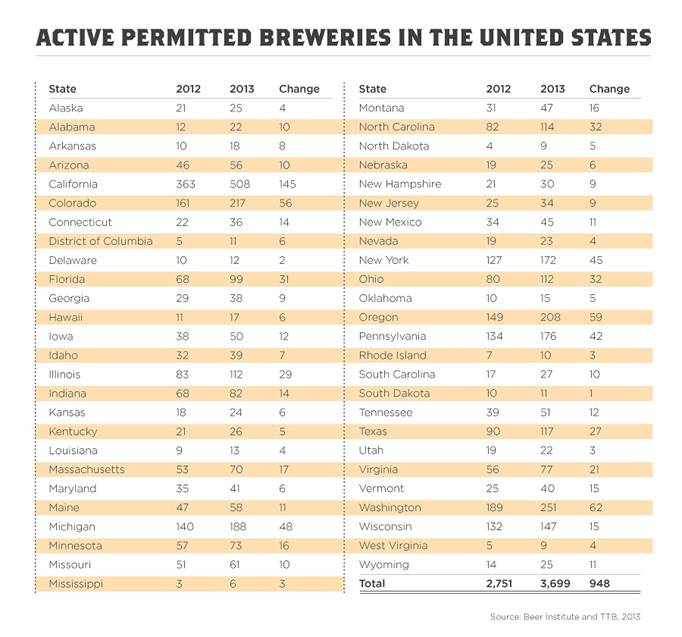 he comparative survey, permitted breweries refer to manufacturers that have completed the appropriate paperwork and obtained the necessary permits to operate, though they may not be fully operational yet, according to Bloomberg.com .
Among our neighboring states, between 2008 and 2013, Massachusetts increased from 41 to 70 brewery permits, New York from 72 to 173, and Rhode Island, which ranked #48, from 5 to 10. North Dakota, which had one permitted brewery in 2008, now has nine, moving from #50 to #49 in the nation.
The U.S. Department of Justice Bureau of Alcohol, Tobacco & Firearms (www.atf.gov) requires retailers and manufacturers of alcohol (i.e. brew pubs) to register. The Bureau also regulates the operation of distilleries, wineries, and breweries as well as, importers and wholesalers in the industry. In addition, the Liquor Control Division of the Connecticut Department of Consumer Protection requires a liquor permit.
The state’s tourism website, “Still Revolutionary,” suggests that “Whether you’re looking for a relaxing Sunday afternoon with friends or a longer vacation with a significant other, take a few days to explore the Connecticut Beer Trail.”
The site states unequivocally that “Connecticut is home to some of the best breweries in the country! The Connecticut Beer Trail spotlights the high quality and creative diversity of fresh, hand-crafted, locally-brewed beer, linking together some of the best breweries in the nation.”
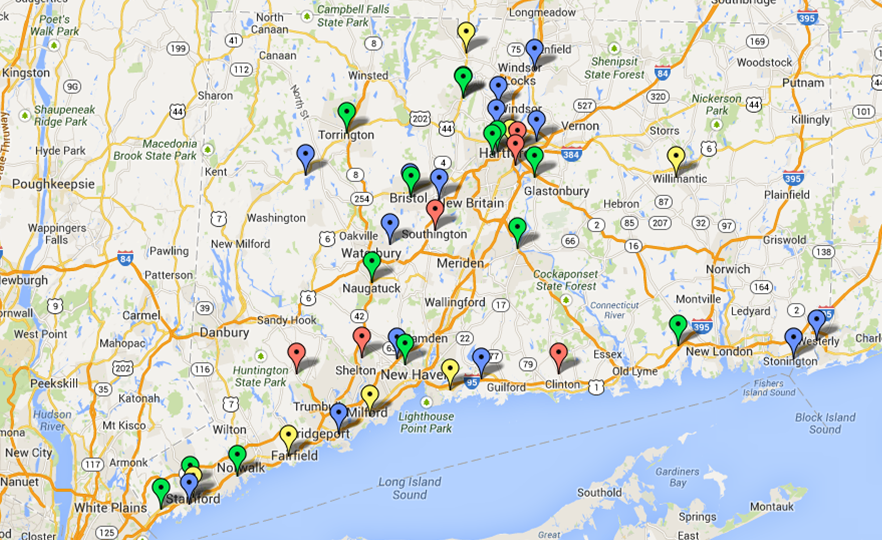
The Connecticut Beer Trail website, www.ctbeertrail.net, lists:
- Thomas Hooker Brewing Company
- Olde Burnside Brewing Company
- New England Brewing Company
- Cottrell Brewing Company
- Cavalry Brewing Company
- City Steam Brewery Cafe
- Back East Brewing Company
- Half Full Brewery
- Relic Brewing
- Two Roads Brewing Company
- Beer'd Brewing Co.
- Thimble Island Brewing Co.
- Southport Brewing Company Restaurant & Brewery
- Shebeen Brewing
- Top Shelf Brewing
- Broadbrook Brewing
- Firefly Hollow Brewing
Other local brands included are:
Additionally, a number of breweries are in an early phase of development, according to the website:
CTBeerTrail.net was launched in 2010 by Byron Turner, according to the website ctbeerwine.com, to create a local craft beer social media community that was well-timed with Connecticut’s legislative push for a “Connecticut Brewery Trail.” Gov. Malloy signed Senate Bill No. 464 into law on July 13, 2011, establishing a Connecticut Beer Trail by allowing the Department of Transportation to permit directional and other official signs or notices about facilities where Connecticut beer is made or sold, including signs or notices containing the words “Connecticut Brewery Trail”. The website reports that as of December 2013, such signs have yet to be posted. (Chart: Washington Post)
 an estimated
  as new spending from tax revenues. The other study says that tobacco taxes offer a how-to road map for policy makers.
 ished this month, researchers ran a simulation of the impact of 20-percent soda tax in Illinois and California—selected for regional differences—and found slight employment increases would occur, but the net effect would be close to nothing. They found that people choose to spend their money on other things, not to forego spending entirely, and that employment gains in other sectors of the economy far outweigh the job losses for soda makers, National Journal reported.

 luding plug-in hybrids – and the other will go to the dealer who sells or leases the most EVs as a percentage of total sales during the period.
 al Protection provides an
 st Century? Join the
  ker series focused on the first-hand perspectives of leaders making a mark in business and the community. The next event at
  hrive? The Lyceum, Hartford
 7 - An Honest Look at Mental Illness, Connecticut Forum, The Bushnell
 ity to learn about the benefits of collaboration which save money and leverage the purchases and agreements for towns. The event will highlight people that are already implementing positive changes. Panel discussions, workshops and Q&A with key leaders and a panel of experts.
 rship of Hartford-based organizations stepped up in a way that has proven quite effective, and is gaining national recognition.
 just to their new land.
 und and southbound, or eastbound and westbound).
 enjoyable. Participating businesses must indicate how many potential visitors they hope to attract at various periods during the year. Those accepted
  into the signage program must annually update DOT on their visitor-traffic counts and provide related information.
 The
The 


 e surveyed in the tri-state area viewed healthcare among the favored sectors for 2014 - 55% “good” in the tri-state region vs. only 45% nationally.
 Connecticut’s high net worth investors, Barber said, are a savvy lot, reflecting greater knowledge of investments than the national numbers reflect, yet more than 7 in 10 say they consult financial professionals. Another clear distinction came in the percentage of investors who said dividend-bearing stocks are a good investment: 49 percent nationally, 61 percent in the tri-state area, and 71 percent in Connecticut. “There are clear indications that Connecticut’s high net worth investors are focused on opportunity,” Barber said.
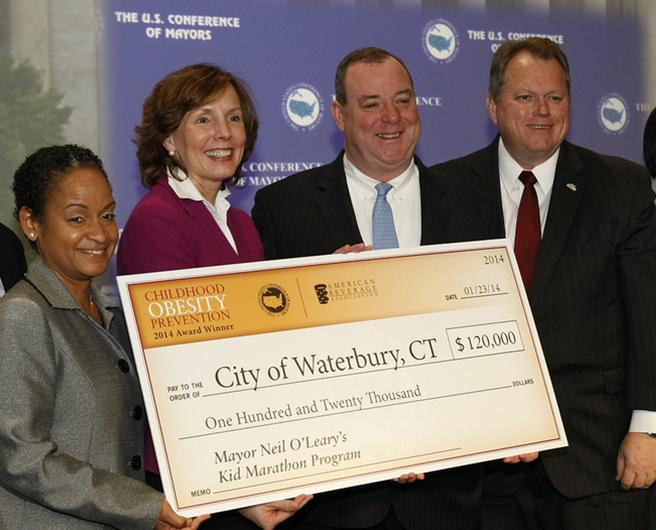 reg Fischer, U.S. Labor Secretary Thomas Perez and Wendy Spencer, CEO of the Corporation for National and Community Service.
 The Kid’s Marathon Program is designed to target city youth lacking in physical activity and good nutrition habits. Students run 1-2 miles, two or three times per week, completing a cumulative 26.2 mile marathon over the course of the program. They also receive positive and practical guidance on nutrition that helps foster long-term healthy eating behaviors. In 2013, the program’s first year, 438 students participated, with the culminating 1-mile run occurring at Crosby High School before a crowd of family, friends and supporters.
 e Association (ABA), to support and/or enhance mayors’ ongoing childhood obesity prevention programs in their cities. A total of $445,000 in grants was awarded to support both new and existing programs. Denver, CO and Dallas, TX (large cities) and York, PA and Monrovia, CA (small cities) were the other recipients.
 ed Middlesex County Chamber of Commerce remains by far the state’s largest, with over 2,350 members that employ over 50,000 people. The organization, led by longtime President Larry McHugh, “strives to be the voice of business in Middlesex County and the surrounding area,” according to its
 n Chamber and the Quinnipiac Chamber began to “officially collaborate on all aspects of their respective organizations, while continuing to operate as separate business units in separate office locations.”