Connecticut Ranks #2 in Millionaires; New Jersey Drops to #3

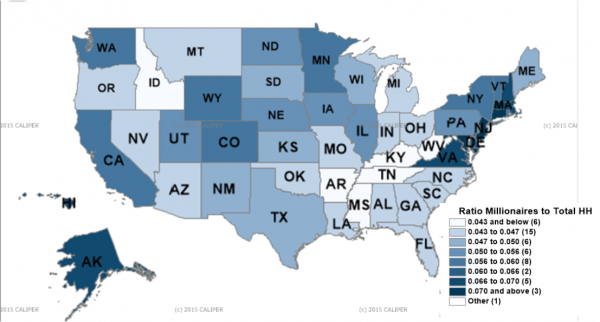
Which state has 99,965 millionaires?  Connecticut.  How many states have a greater percentage of millionaires, based on population?  Only one. Connecticut is ranked at #2 among the states in an analysis of the number of millionaires, as a percentage of population, developed by Phoenix Marketing International.  Only Maryland has a higher percentage – and Connecticut moved up one notch this year, surpassing New Jersey, which was ranked second a year ago.

Perhaps surprisingly, it’s not all about Fairfield County.  David Thompson, Managing Director of the Phoenix Global Wealth Monitor and the lead researcher, points out that the data shows “pockets of wealth” throughout the state – in the Bridgeport-Norwalk-Stamford corridor, but also in Litchfield County, Hartford-West Hartford, and Norwich-New London.  In fact, only California has more metropolitan areas in the nation’s top 30 for millionaires per capita.top states
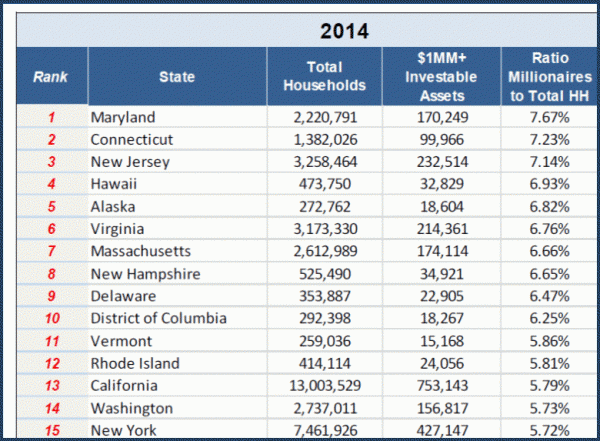
And while some have suggested that Connecticut’s tax structure and economy are pushing people to exit the state, millionaires seem to be quite comfortable here.  The total number of millionaires dropped slightly during the past year from 100,754 to 99,965, a loss of 789 millionaires.  New Jersey lost more individuals with investable assets over a million dollars as a percentage of population, dropping behind Connecticut.  New Jersey's total number fell from 242,647 to 232,514, a loss of more than 10,000 millionaires during 2014 (from 7.49 percent to 7.14 percent of the state's population).

“Connecticut holds on to its wealthy population.  There’s no downward trend (compared with other states),” Thompson notes.  “The tax structure isn’t so onerous, the state offers stability, and attracts industries that grow wealth.”  Thompson, a Connecticut resident, adds that the quality of life in the state, as well as its accessibility to New York and Boston also prove attractive.

Maryland has 170,248 millionaires, a ratio of 7.67 to total households.  Connecticut ranks #2, with 99,965 and a ratio of 7.23, followed by New Jersey with a ratio of 7.14 and 232,514 millionaires.  Connecticut has consistently been a top five state, placing third  in 2013, fourth in 2012, 2011 and 2010.

Among the key findings for 2014:millionaire_1890954b

  • Maryland held strong in the first position for its fourth year in a row
  • On the strength of its oil boom, North Dakota continued its meteoric rise in the millionaire rankings, moving up to number 20 in 2014. Its neighbor, South Dakota, however, was the biggest gainer this year, rising twelve points to number 26
  • The top ten states remained the same, with only slight shifts: New Jersey #3 (down one point), Hawaii, Alaska, Virginia (up one point), Massachusetts (down one point), New Hampshire, Delaware and the District of Columbia.

Besides Maryland, the top ten states remained the same, with slight shifts: Connecticut rose one notch to hold the #2 spot, followed by New Jersey (down one spot), Hawaii, Alaska, Virginia (up one position), Massachusetts (down one slot), New Hampshire, Delaware and the District of Columbia.

“The amazing rise of North Dakota in the millionaires rankings clearly demonstrates the power of an industry to quickly create wealth,” Thompson said.  But he indicated that “new industries may not be a sustainable economy,” and cited the nation’s large population centers, including those along the east coast, as more likely to retain their positions as most attractive to wealthy individuals.

There were a few notable declines in the rankings: Louisiana dropped 6 positions to number 38, Texas dropped 5 slots to number 27, erasing gains it made last year; and Georgia lost another 5 places this year for the second year in a row, falling to number 40.

Smallest percentage of millionaires?  Mississippi, Idaho, Arkansas, Kentucky, Tennessee and West Virginia.

The PMI Global Wealth Monitor (GWM) provides ongoing intelligence on the attitudes, behaviors and needs of affluent and High Net Worth consumers to leading organizations in the U.S., Canada, and Europe.

millionaires map

Year of Volleyball Underway; First Tournament in the Books

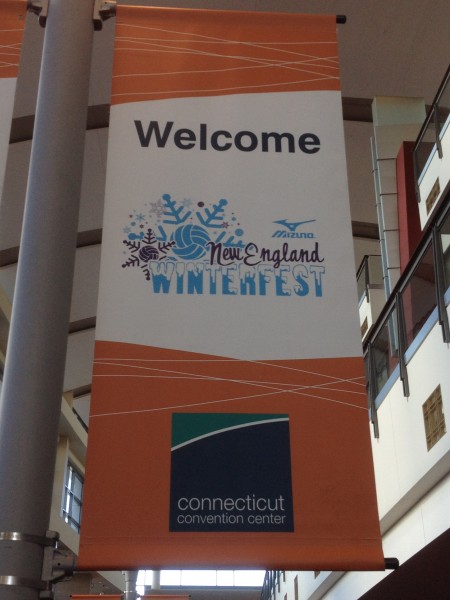
More than 2,000 female volleyball players from across the Northeast spent the holiday weekend in Hartford for the New England Region Volleyball Association’s 2015 Mizuno New England Winterfest Volleyball Tournament, held at the Connecticut Convention Center.  The event, which started in Hartford six years ago, has steadily grown in popularity, and will be returning for at least the next two years. Tournament organizers, the Connecticut Convention & Sports Bureau (CTCSB), and the Connecticut Convention Bureau said the three-day event brought in close to 10,000 visitors over the long weekend including approximately 2,000 players, 250 coaches, 100 officials and volunteer tournament staff, and thousands of family members and fans – and tremendous enthusiasm.25

There were 25 volleyball courts arrayed on the Convention Center floor, with 12 matches per court every day, simultaneously, each lasting no more than one hour.  Five years ago, the tournament was launched with 18 courts in continuous operation.

“The Mizuno New England Winterfest is designed to showcase female volleyball players – ages 12 to 18 – to college coaches and recruiters from throughout the Northeast,” explains Tournament Chair Alex Temkin. “The Northeast has one of the largest concentrations of Collegiate Division II and Division III schools in the country, and there are many Division I schools here as well.”

“We are excited to welcome back this successful tournament, one that is projected to generate over $3.3 million in revenue for the Greater Hartford region,” said H. Scott Phelps, Interim President of the Connecticut Convention & Sports Bureau (CTCSB), prior to the tournament. Phelps reports an estimated 885 jobs in the hospitality industry will be supported by this tournament, and $270,500 in Connecticut Sales Tax will be generated.sign

Where's UConn?

”Having more than 800 matches in a single location encourages college recruitment decision-makers to come and scout as many players as possible.” Temkin said.  On Friday evening, a College Showcase was held to showcase athletes for college coaches and recruiters, as well as a College Recruiting Seminar for parents of volleyball players.

Approximately 38 colleges had coaches on hand, watching the talent.  Surprisingly absent:  the University of Connecticut.  Among the coaches on hand from local colleges were representatives of University of Hartford, University of Saint Joseph, and Sacred Heart University.  By Saturday morning, a number of institutions with volleyball teams still had materials on hand touting their programs, aimed at prospective college applicants.  None of the material was from a Connecticut school.

Temkin notes that volleyball teams’ interest in registration for Winterfest was so great this year – 25 percent more than in 2014 – that organizers established a smaller, independent volleyball tournament called the “Husky Sweet 16” to accommodate the additional athletes. That competition was held at a facility in Windsor.

More in May

There’s more volleyball to come later this year at the Connecticut Convention Center.  Building on the success of the Winterfest tournament, the New England Region Volleyball Association (NERVA) will bring its first-ever Northeast Junior Championships to Hartford over Memorial Day weekend.

The tournament, featuring junior girls and boys teams from throughout the Northeast, is expected to bring nearly 200 teams, more than 2,000 players, 400 coaches, 75 officials and volunteer tournament staff, and 3,500 family members and fans downtown, from Friday, May 22 through Monday, May 25, 2015. volleyballs

NERVA has committed to holding the event at the venue for the next three years, through at least 2017, with over 3,000 overnight rooms and 1,100 rooms anticipated for the new annual event.

“We have always valued our partnership with the Connecticut Convention Center and the Connecticut Convention and Sports Bureau,” states David Peixoto, NERVA Commissioner. “Our partnership has grown to develop Winterfest as the premier volleyball tournament in the Northeast. We look forward to making the Northeast Junior Championship just as successful.”

The new four-day event does not require teams to qualify to participate. While it will serve as a season-ending tournament for some, the event will allow for additional preparation to teams continuing on to nationals. Participants are 12-18 years old, as NERVA follows USA Volleyball age guidelines.

“Downtown Hartford is a great location for our sports event and the city and region really make our players and fans feel welcome,” added Temkin. “Restaurants extend their hours and customize the menus, the Dash shuttle bus that circulates Downtown adds hours of operation, and everyone does their best to accommodate our group.”

The New England Region is one of many Regions in the United States that aid in the governing of the sport of volleyball. Regional Volleyball Associations (RVAs) are member organizations of USA Volleyball (USAV). The RVAs serve as the grassroots function for the USAV and individually and collectively serve as a catalyst for USAV functions.

Volleyball footnote:  While many know that the sport of  basketball was invented in Springfield, MA; fewer are aware that volleyball was also invented in nearby Massachusetts, in Holyoke.  That’s where the National Volleyball Hall of Fame is located.

2013-CTCC-NERVA-Winterfest-300x200


CT Ranked #41 in Climate for Small Business and Entrepreneurship

Connecticut ranks #41 in its policy environment for small businesses and entrepreneurship, according to a study that ranked the 50 states in a Small Business Policy Index.  Most of the New England states landed towards the bottom of the list, with none ranking in the top 25. The report, Small Business Policy Index 2014: Ranking the States on Policy Measures and Costs Impacting Small Business and Entrepreneurship, tracks 42 measures with 33 of them pertaining to taxes and regulations. SBE report coverIssued by the Small Business & Entrepreneurship Council, the index ranks the 50 states according to 42 different policy measures, including a wide array of tax, regulatory and government spending measurements. The index, which has been published annually for 19 years, continues to point to South Dakota as the most entrepreneurial-friendly state in the U.S., benefiting most from the lack of individual income tax, capital gains tax, corporate income tax and inheritance tax.

The top 10 states are South Dakota, Nevada, Texas, Wyoming, Florida, Washington, Alabama, Indiana, Colorado and North Dakota.  Among the New England states, the highest ranked was New Hampshire at #27, followed by Massachusetts at #31, Rhode Island at #40, Connecticut at #41, Maine at #42 and Vermont at #45.

Commenting on Connecticut, the report indicates that “Connecticut’s entrepreneurs, businesses, investors and workers benefit from a low crime rate and low consumption-based taxes. However, the state’s negatives are numerous, including high personal income, individual capital gains, corporate income, corporate capital gains, property, gas and diesel taxes, along with high levels of government spending and debt.”

Connecticut’s ranking was unchanged from last year’s Index report.  In 2012 the state ranked #42 and in 2011 was ranked at #44.  In 2010, Connecticut ranked at #41, which was a drop from #40 in 2009.

“States like Arizona, Indiana, Kansas, New Mexico, North Carolina, North Dakota, and Ohio have really stepped up their game on the policy front. In each of these cases, tax reform and relief were undertaken, which reduces the costs of risk taking and doing business. Meanwhile, top-tier policy states like Texas, Nevada, South Dakota, Florida and Wyoming continue to leverage their long-standing policy advantage, and are doing things to get better,” said SBE Council President and CEO Karen Kerrigan.sbelogo

Of the 42 measures included in the recently issued 2014 edition of the Index, 24 are taxes or tax related, 9 relate to regulations, five deal with government spending and debt issues, with the rest gauging the effectiveness of various important government undertakings, according to the report. The lowest ranked states were New York, New Jersey and California.

The report states that “most business owners understand the array of costs and burdens imposed by government. Taxes and regulations, for example, drain enterprises of vital resources, distort decision-making, and redirect resources and energies away from maintaining, improving and/or expanding a business.”

In the individual measures, among Connecticut’s highest rankings were #7 in crime rate, #10 “State and Local Sales, Gross Receipts and Excise Taxes as a Share of Personal Income,” #13 in the rankings of “Adjusted Unemployment Taxes,” and #17 in workers compensation costs.

The Small Business and Entrepreneurship Council (SBE Council) is a 501c(4) advocacy, research, education and networking organization dedicated to protecting small business and promoting entrepreneurship.  SBE Council works to educate elected officials, policymakers, business leaders and the public about key policies that enable business start-up and growth. The report, issued in December, was authored by Raymond J. Keating, chief economist for the Small Business & Entrepreneurship Council.

small bus map


Plans Unfold for National Museum Store Conference in Hartford in April

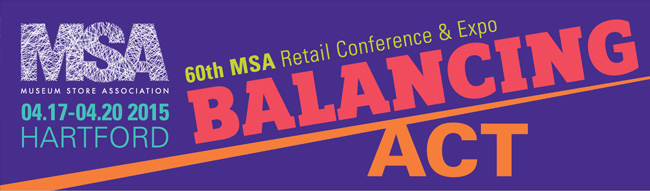
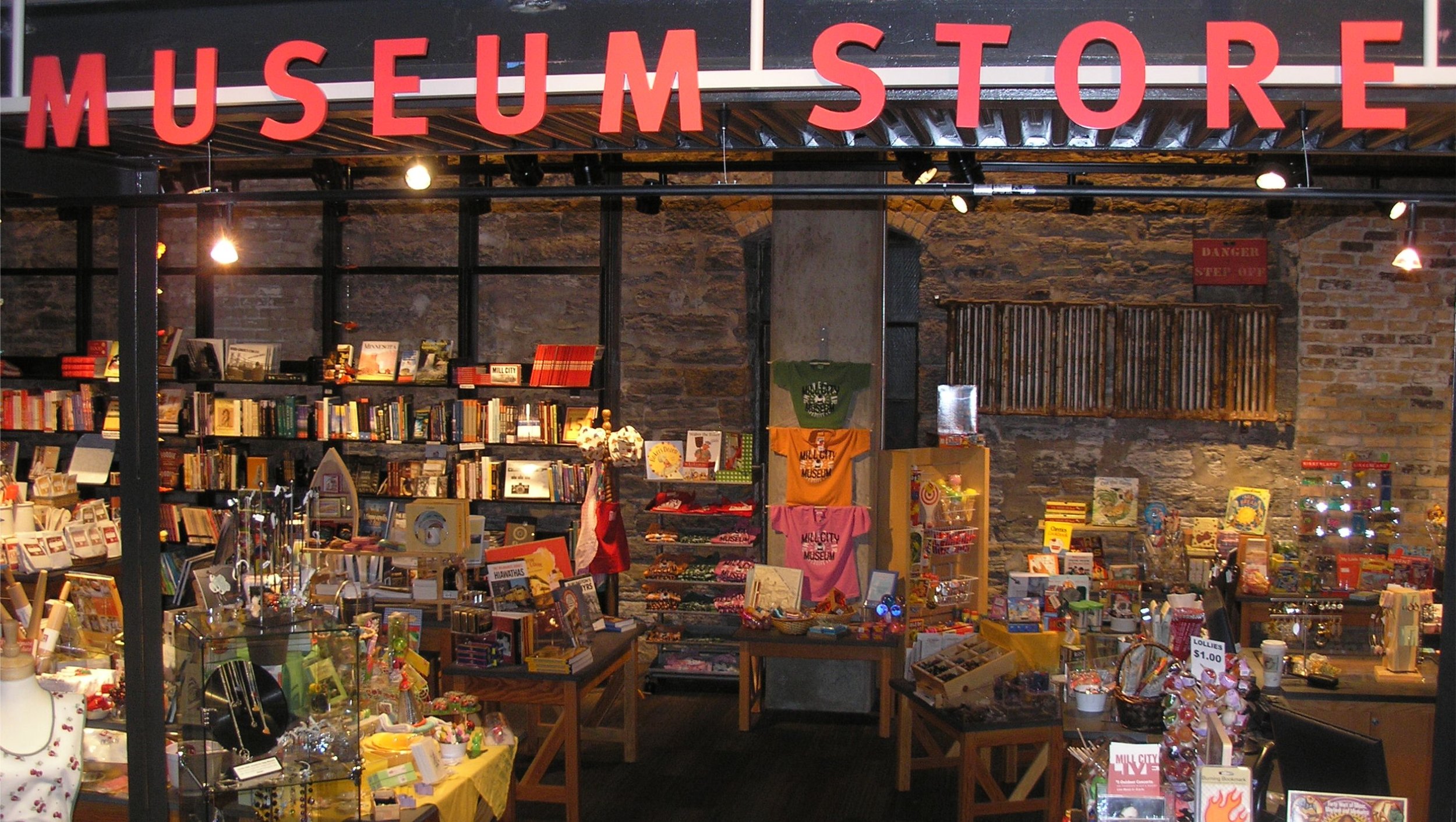
If you’ve ever made a purchase at a museum store and wondered about how the merchandise was selected or the store operates, there will be no shortage of experts from the industry in Hartford this spring.  The 60th Annual Museum Store Association Retail Conference & Expo will be held April 17-20, 2015 at the Connecticut Convention Center. The event is the only conference and expo specifically created for retailers at museums, historic sites, botanic gardens, aquariums, zoos, libraries and more. The 2015 MSA Retail Conference & Expo is designed to help nonprofit retail professionals by providing four days of education sessions featuring industry experts and opportunities to connect with vendors who offer products matched with the museum store industry.museum

It will be the first time the national conference will be in Hartford.  In recent years the host cities were Houston, Los Angeles, New Orleans and Chicago.  The national meeting in Hartford will include a “retail boot camp” and a tour of the Mark Twain House and Harriet Beecher Stowe House.

The MSA website points out that “learning sessions are presented by the leading thinkers in nonprofit retailing who share the knowledge you need to run your store, meet the needs of management, make the most out of challenges, be a leader and through retailing contribute to your institution’s brand and extend the experience of your visitors.”Balancing-Act-600x175-indd.jpg

Manager of the Museum Shop at the Wadsworth Atheneum Museum of Art, immediate past MSA Board President Stacey Stachow, said when Hartford was selected to host the conference, “Connecticut has so much to offer with its rich cultural history, so many museums and things to do that relate to our members.”   In addition to the Wadsworth Atheneum, other MSA member institutions in the area include the Connecticut Historical Society Museum & Library, Harriet Beecher Stowe House, New Britain Museum of American Art and Friends of Dinosaur State Park and Arboretum.

The opening keynote speaker will be Roderick Buchanan, director of buying and retail at the British Museum Company.  The closing keynote speaker will be Dick Durrance, an award-winning National Geographic photographer and U.S. Army combat photographer during the Vietnam War. MSA-Logo_sm

Among the industry issues that will be discussed is fair trade, which will be the focus of a panel discussion.  The conference website points out that “as consumers are increasingly interested in the origin of the goods they purchase, the fair trade movement is gaining momentum and is affecting buying in the museum store world. Expert panelists will offer insights into critical aspects of the fair trade industry, including who benefits from fair trade, why retailers should buy fair trade, and questions that should be asked about business practices in order to ensure that products are indeed fair trade.”

Other sessions include presentations on pop-up shops, museum store launches, visual merchandizing, ecommerce, the influence of various cultures, and the importance of museum stores in the overall experience of museum visitors.

The four-day event is expected to bring in 900 participants downtown utilizing an estimated 1,130 room nights, according to organizers. There will be 21 educational sessions, and more than 200 vendors on hand.  Approximately 800 institutions are part of MSA with more than 1200 individual members representing those institutions.

Stores in cultural institutions are different from typical retail operations in several ways, the organization points out. “These retail operations play a vital role in supporting the institution’s educational mission. They offer products that provide visitors with mementos and educational materials directly related to their cultural experience.’  Purchases made at museum stores provide important financial support for the institution, officials emphasize.

FCC “Enforcement Hold” of WTIC-AM License Renewal Continues in New Year

The license renewal application of WTIC-AM, filed more than a year ago, remains on “enforcement hold” at the Federal Communications Commission, as the agency’s Enforcement Bureau continues to consider “an alleged violation of FCC rules,” according to an FCC official. Until the enforcement hold is lifted, the agency’s Media Bureau cannot proceed with a decision on whether or not to renew the station’s broadcast license.  The Enforcement Bureau must first determine whether or not a violation of FCC rules has occurred.  If the allegation is substantiated, the agency has a range of options, such as warning that the violation not be repeated or imposing a monetary fine on the station, officials said. FCC

WTIC-AM, which is licensed to Hartford but operates from studios in Farmington, can continue broadcasting under the broadcast license that expired nine months ago, on April 1, 2014, until the FCC acts on its renewal application.  The renewal application was filed by the station more than a year ago, on November 27, 2013. Stations must file an application for license renewal) four months prior to the expiration date of the station's license.

Precisely what the allegation under review involves is not made known to the public, officials reiterated this week.  That information is only made available to the licensee or their attorney, according to an FCC official. The agency can, and often does, communicate with the station as part of their review process.  WTICWTIC_1080_AM_Radio_logo has declined to comment on the ongoing review process at the FCC.
Officials say it is not unusual for a license renewal to be on enforcement hold for an extended period of time.  Stations in such a status routinely continue to operate without any interruption until a decision on license renewal is made.

When the license renewal application does reach the agency’s Media Bureau, they will consider “how the allegation of violation was resolved,” as well as a range of other factors in deciding whether or not to renew the station’s license.

The other, more routine, factors include whether any other objections have been raised about the station, whether the station has been adequately serving the public in their area of license, their history of compliance with FCC regulations, and their overall performance.  License renewals for radio stations are issued by the FCC for a period of eight years.

Connecticut by the Numbers first reported the FCC’s enforcement hold last September.  Subsequently, Hartford Attorney Ken Krayeske filed an informal objection on October 1, 2014 to WTIC’s broadcast license renewal, alleging that the station “demonstrated serious malfeasance” and “helped conceal violations of federal law,” related to Rowland’s use of his radio program to promote the Congressional campaign of Lisa Wilson-Foley. Krayeske had filed a previous complaint in 2012 that did not result in FCC action against the station.

More Passengers Flying at Bradley; Atlanta Growing As Top Destination

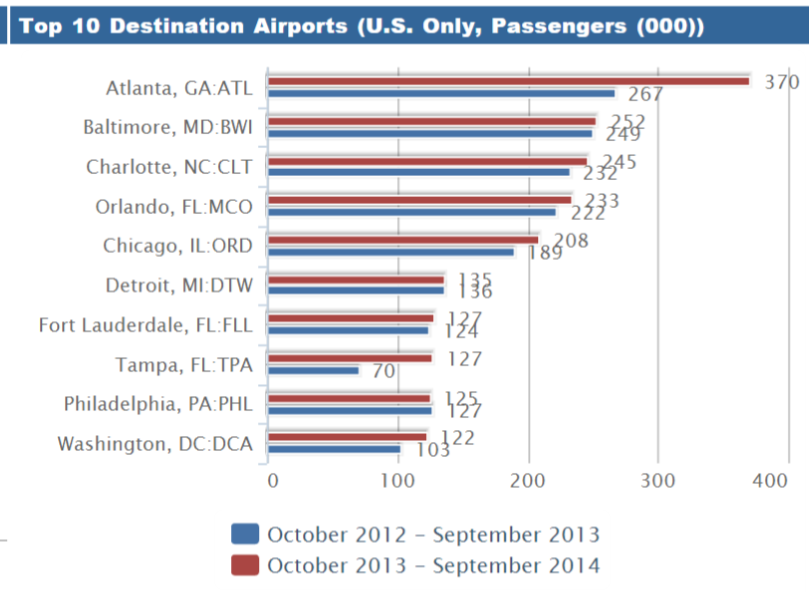
If you’re flying out of Bradley International Airport (BDL), you’re probably flying to Atlanta.  According to data from the United States Department of Transportation, the top five destinations from Bradley are Atlanta, Baltimore, Charlotte, Orlando, and Chicago. If a recent trip to the airport has left you with  the impression that the terminal in Windsor Locks has been more crowded than it used to be, you’re right. More people are flying in and out of BDL in recent months, as compared with the same period a year ago.Bradley_INTL_Logo.svg

The other destinations reaching the top ten from Bradley are Detroit, Fort Lauderdale, Tampa, Philadelphia and Washington, DC.  In eight of the top ten destinations, with the exception of Detroit and Philadelphia, the number of passengers grew during the past year (October 2013 through September 2014) as compared with the previous 12-month period.

Recent additions to their schedules by carriers operating at Bradley may be influencing the numbers.  United started daily nonstop service to Houston in October. JetBlue added flights to Tampa and Fort Myers and expanded service to Washington, DC earlier in the year and Southwest has added flights to Atlanta, heightening competition with Delta.top 10

The total number of “enplanements” has increased at Bradley in month-over-month comparisons for the first five months of the fiscal year that began on July 1, 2014, according to data provided on the Bradley airport website.  The number of passengers arriving on flights at Bradley were up 11.59 percent in July from the same month the previous year, and up 12.62 percent in August, 9 percent in September, 4.7 percent in October, 3 percent in November.  Data for December has not yet been published.

Between July 2013 and June 2014, the most popular months for travel from Bradley were the months of  April (258,756), May (257,627) and December (255,144). If recent trends continue, this spring may bring record-setting months to the airport.

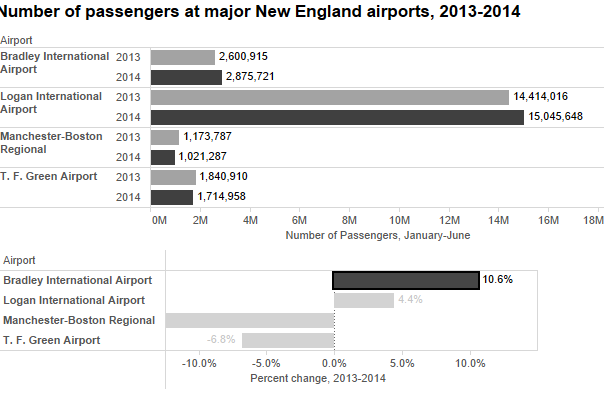
During the first six months of 2014, about 2.9 million passengers used Bradley. That was a 10.6 percent increase from the 2.6 million passengers who used the airport in the first half of 2013, according to published reports.dot logo

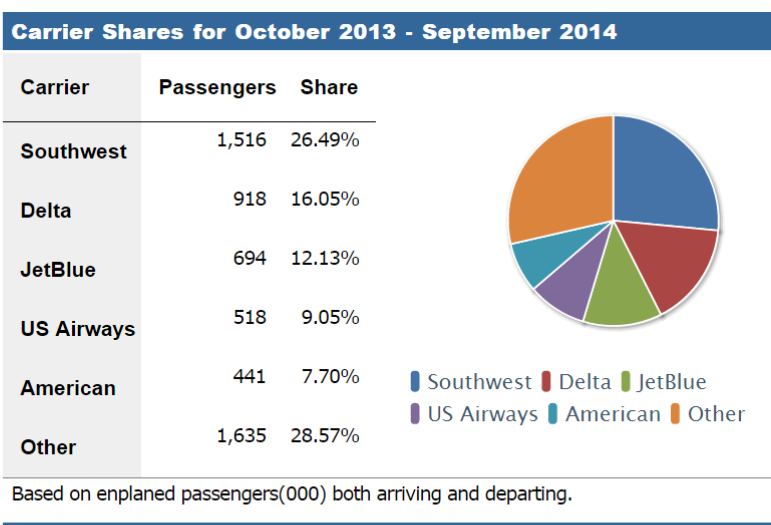
Southwest carries the largest percentage of passengers at Bradley, 26.4 percent. Delta is next with 16 percent, followed by JetBlue at 12.1 percent, US Airways with 9 percent and American with 7.7 percent.  An assortment of smaller carriers carry 28 percent of the passengers, arriving and departing, at Bradley.airlines at BDL

The on-time performance of the airlines at Bradley remained virtually identical between November 2013 and October 2014, at 81 percent, compared with 82 percent a year ago.  Among flights that have been delayed, the average duration of the delays has declined, from just over to just under an hour.

Bradley International Airport is the second largest airport in New England. According to the most recent economic impact analysis, Bradley contributes $4 billion in economic activity to the state of Connecticut and the surrounding region, representing $1.2 billion in wages and 18,000 full-time jobs.


Dashboard 1

Eight Communities to Receive Funds to Support Downtown Improvement Initiatives

Connecticut Main Street Center (CMSC), the downtown revitalization and economic development non-profit, is awarding eight organizations and municipalities a total of $80,000 in 2015 Preservation of Place grants.  The grants will be used to provide Bridgeport, Canton, Hartford, New Milford, Newtown, Putnam, Torrington, and Windsor Locks with targeted resources to increase their capacity to plan for preservation and revitalization initiatives in their downtowns and neighborhood commercial districts.preservation of place The Preservation of Place grant program provides a source of funding for new initiatives that can be integrated into, and leverage, comprehensive Main Street preservation and revitalization programs.  The funds are meant to be flexible to meet individual community need.


The 2015 recipients of Preservation of Place Grant funds are:

  • Bridgeport Downtown Special Services District for a feasibility study of the creation of a regional food hub and community supported agriculture in downtown BridgeportCT Main Street LOGO
  • Town of Canton for a comprehensive market study and brand strategy for Collinsville
  • Hartford Business Improvement District for the creation of a community vision plan for a six block area of the Asylum Hill neighborhood
  • Town of New Milford for a historic downtown New Milford branding & marketing program
  • Town of Newtown for the Sandy Hook Village Signage & Wayfinding Design Plan
  • Town of Putnam for Downtown Putnam design guidelines & standards
  • City of Torrington for a Downtown Torrington market study & branding/imaging program
  • Town of Windsor Locks for the historic train station reuse studytorrington

"Historic preservation and the revitalization of our Main Streets create jobs, bring vacant buildings back on the tax rolls and add value and vitality to adjacent buildings and neighborhoods," said John Simone, CMSC President & CEO.

"The diversity of locations, from the Northwest Corner of Connecticut to New London, matched with the diversity of projects, from creative placemaking in urban open spaces to organizational and leadership development that will improve the management function in downtown, will allow each community to respond to their greatest current need, actively creating their direction of growth," he added.

Since 2008, CMSC has awarded $446,130 through the Preservation of Place grant program to twenty four Connecticut communities, leveraging over $1 million in local Main Street initiatives.  The program receives support from the State Historic Preservation Office with funds from the Community Investment Act. A year ago, a total of $70,000 in grants were awarded to Bridgeport, Canton, Essex, New London, Norwalk, the Northwest corner, and Willimantic.

The mission of Connecticut Main Street Center is to be the champion and leading resource for vibrant and sustainable Main Streets as foundations for healthy communities. CMSC is dedicated to community and economic development within the context of historic preservation, and is committed to bringing Connecticut's commercial districts back to life, socially and economically.

Boston Will Be U.S. Hope for 2024 Olympics; CT Could Provide Assist

Boston’s selection by the U.S. Olympic Committee (USOC) as the United States representative in the sweepstakes to host the 2024 Summer Olympic Games could be good news for Connecticut. The USOC will hope to convince international Olympicsvoters to bring the Summer Games to America after a 28-year gap.  The International Olympic Committee will award the Games in 2017. The U.S. last hosted a Summer Olympiad in Atlanta in 1996; a Winter Olympics in 2002.  St. Louis hosted in 1904 and Los Angeles held the Games in both 1932 and 1984.

Boston2024_LogoUSOC board members chose Boston, with its promise of frugality and temporary, reusable venues, over Los Angeles, San Francisco and Washington.  Boston joins Rome as the only other city that has officially decided to bid. Germany will submit either Hamburg or Berlin, with France, South Africa and Hungary among those also considering bids, according to published reports.

The Connecticut Convention & Sports Bureau (CCSB), the state’s official meetings and sports event sales and marketing organization, “supports Boston’s bid for the 2024 Olympics,” Interim President H. Scott Phelps told CT by the Numbers last fall.

CCSB officials noted that if the Olympic Games decide to come to Boston, “it could be great for tourism in nearby Connecticut as well, as spectators and competitors would be encouraged to come visit our State’s attractions,” adding that “there might be opportunities for our state to host pre-Olympic competitions and … athletes.”ConnecticutConvnSports

Even before Boston’s selection by the USOC, at least one Olympics observer suggested that Connecticut may have an Olympic supporting role to play.  Rosanna Garcia, associate professor of marketing in the D’Amore-McKim School of Business at Northeastern University in Boston, who has attended the past eight Summer Olympics, sees the city turning to Connecticut and Rhode Island to host some events.

“With more than 300 events that typically occur at the Olympics, many cities around Massachusetts, and even Rhode Island and Connecticut, will need to partner with the International Olympic Committee to host these events,” Garcia points out.

“Many preliminary competition events would need to take place outside of the main Olympic Park areas so events may occur as far away as Connecticut. This also is an opportunity for more people to get involved with the Olympic Spirit,” Garcia adds.

America's last two attempts to land the Games were unsuccessful - fourth-place finishes for New York seeking the 2012 Games that went to London and Chicago which had hoped to be selected for 2016.U.S.-Olympic-Committee-logo

Boston focused on its ability to use universities throughout the area to house events and athletes.  It touted a walkable, technology-based Olympics and said as many as 70 percent of its venues would be temporary, and the schools would pay for many of the venues, then take them over after the Games, according to reports on the city’s bid.

Olympic_rings_without_rims.svgLast fall, a promotional video advocating a Boston bid was released, and a website was launched. With an eye toward innovation and efficiency, the video highlights Boston’s bid “to create a sustainable model for hosting the Olympic and Paralympic Games that can become the blueprint for future host cities.”
It is the first time that Boston has prepared a bid to host the Games, and it is being led by an organization called the Boston 2024 Partnership, a nonprofit organization formed to prepare the bid materials. The group is governed by a 36-member executive committee, and has launched a series of subcommittees aimed at master planning, fundraising, outreach, and engagement.

Organizers note that no tax dollars have been spent on Boston 2024, and tax dollars will not be used to build venues or pay for the operation of the Games. Public investment will be confined to roadway, transportation and infrastructure improvements, most of which are already planned and are needed with or without the Olympics.

“Regardless of whether or not Boston wins the Olympics, the City’s bid has helped to elevate the Boston and other New England brands to sports event planners from all over the world,” Connecticut officials added.

https://www.youtube.com/watch?v=IiNItLCJ1jI

40 Years Ago, Transportation and Fiscal Austerity Highlighted Inauguration Day

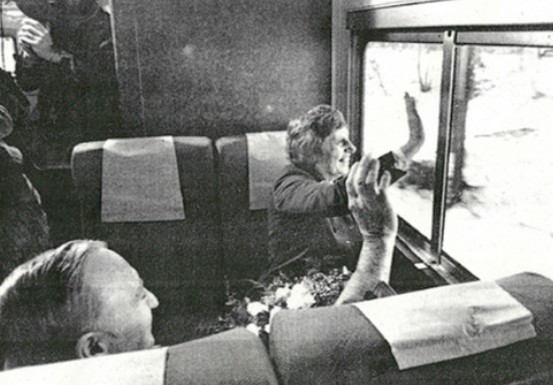
On  inauguration day, Connecticut’s incoming Governor would be “commuting by train to the Capitol for the inauguration to dramatize the need for more mass transit,” local news media reported. The Governor-elect was Ella Grasso, and the year was 1975.  She took the train from her hometown of Windsor Locks into Hartford.

Four decades later, transportation will once again be center-stage on inauguration day, as Governor Dannel Malloy has indicated in the weeks prior to taking the oath of office for a second time that transportation will be a leading issue of his second term. ella train

The Wall Street Journal has reported that a White House economic analysis from July 2014 found that 41 percent of the state’s roads were in poor condition, noting that Connecticut was tied with Rhode Island with the highest percentage of poor roads.  The state is also in the midst of improving the New Haven - Springfield rail corridor, poised to launch a revitalized "Hartford line."

Grasso, according to news reports of the day, also took the opportunity “to emphasize the need for fiscal authority in the face of projected money pr1000px-seal_of_the_governor_of_connecticut.svgoblems for the state.”

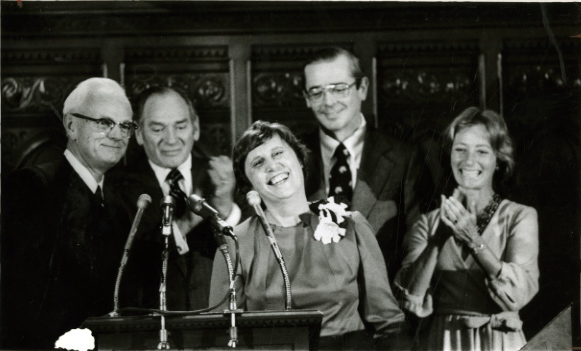
Dollars and sense were also central to the first inaugural address of Governor William A. O’Neill on January 7, 1981.

Published reports indicated “that he favored cutting spending rather than increasing taxes to eliminate a deficit in this year's budget. But he said that balancing spending with existing revenues would be even harder for the fiscal year beginning July 1.”

Speaking before a joint session of the State House of Representatives and Senate, The New York Times reported that Mr. O'Neill said: ''Government at all levels faces increasingly tough decisions, finding itself forced to do more with less. It seems we have only one choice: Curb spending and control taxation.''

O’Neill, who had succeeded to the office just a week earlier upon Grasso’s resignation due to ill health, said 'To maintain a budget balance, we can raise taxes or cut spending even further,'' he said. ''I do not want to raise taxes.''

Later in his term, O’Neill would respond to the collapse of the Mianus River Bridge on I-95 in Greenwich on June 28, 19oneill83, which exposed a poor record of road and bridge maintenance in the state, with creation of a Special Transportation Fund to set aside money to maintain and repair the state's bridges.
That same year, the legislature agreed to eliminate tolls from Connecticut roads, in part due to a horrific accident in January at the Stratford tograssoll station that killed seven people and galvanized public opinion.  The state had collected tolls at 14 locations - eight on the Connecticut Turnpike between Greenwich and Plainfield, three on the Merritt and Wilbur Cross Parkways, and at three bridges in the Hartford area. The tollbooths generated $66 million a year, The New York Times reported that year.
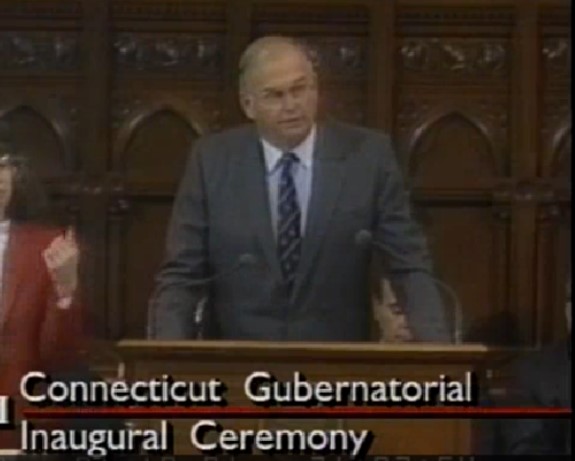
On January 9, 1991, former U.S. Senator and newly elected Governor Lowell P. Weicker said in his inaugural address that “The people of Connecticut have sent us here to do the right thing: to face up squarely to the facts of a state in fiscal trouble.'' Describing the state as ''rudderless,'' he said ''A deficit has taken control of our lives, coloring all else as it climbs beyond comprehension, sapping our confidence, humbling our visions. The past is not worth the best of our courage and creativity. That belongs to the future. 'So let's get this deficit business done, and fast.''weicker

Although he did not propose it on day one, he would soon recommend imposition of a state income tax in Connecticut, which was approved in August 1991 by a reluctant state legislature and signed into law.  Just a few weeks later, Gov. Weicker signed legislation increasing transportation fees by $6 million, clearing the way for dozens of stalled road and bridge projects.  The New York Times reported that the $6 million” will raise the state transportation fund to $63 million” and “insure enough money to pay for road projects for the next six years.”


Nominations Sought for Women of Innovation as Efforts to Boost Representation in STEM Fields Intensifies

The Women of Innovation® awards gala, held annually, recognizes Connecticut women accomplished in science, technology, engineering, math and those who are involved in their community.  As the January 16 nomination deadline for this year’s 11th annual event approaches, organizers at the Connecticut Technology Council are urging state residents to nominate their peers, colleagues, mentors and students, teachers and business leaders, research associates and inventors. A study last fall for the U.S. Small Business Administration found that “the gender gap persists for women in STEM fields. Women have increased their representation in STEM graduate enrollment, but that increase has been uneven across STEM fields,” the report found.women of innovation

“While women have achieved parity for PhDs in biological and medical sciences, their enrollment continues to lag in some of the most entrepreneurial fields, such as bioengineering, mechanical, and civil engineering and materials science,” the report pointed out.

Last month, the White House urged women in the technology fields to share their stories as a way of attracting more women to the STEM disciplines. “When it comes to inspiring young women to pursue careers in STEM fields,” the White House website explained, “research has already shown us what works: Providing early, hands-on experience and encouragement; sharing the stories of positive role models in these fields (like the women whose stories we share); and illustrating the broad impact of roles in these fCT-ORGields.”

In Connecticut, the Women of Innovation awards recognizes women who have demonstrated and sustained accomplishment in their field, from students to business owners.  Women can be nominated for awards in eight categories:

  • Research Innovation and Leadership
  • Academic Innovation and Leadership
  • Entrepreneurial Innovation and Leadership
  • Large Business Innovation and Leadership
  • Small Business Innovation and Leadership
  • Youth Innovation and Leadership
  • Collegian Innovation and Leadership
  • Community Innovation and Leadership

The awards event is "a time for like-minded, successful women to get together and celebrate their accomplishments” – and it provides a reminder that women are excelling in fields where their ranks have traditionally been slim.  The awards will be presented at the annual Women of Innovation Gala on Wednesday, April 1 at the Aqua Turf Club in Southington.  Presenting sponsors include Boehringer Ingelheim, Covidien, Day Pitney and United Technologies.

Keynote speaker for the event will be Maggie Wilderotter, Chairman and Chief Executive Officer, Frontier Communications, headquartered in Stamford.  Wilderotter serves on the boards of Xerox Corporation and Procter & Gamble Company and on the boards of a number of non-profit organizations. Frontier Communications Corporation  offers broadband, voice, satellite video, wireless Internet data access, data security solutions, bundled offerings, specialized bundles for residential customers, small businesses and home offices and advanced communications for medium and large businesses in 27 states.It recently began offering services in Connecticut for the first time.SBA

The SBA report also found that “women are more likely to start firms that provide research and consulting services and are less likely to start firms in semiconductor and aerospace manufacturing, navigational instruments or communications equipment, which may correlate with lower reported rates of R&D activities for women STEM PhDs.”

As Connecticut seeks to promote growth in the bioscience and related technology fields, the SBA findings may be of particular note, including that “High-tech women-owned businesses may also be less likely to locate in geographic regions where they can take advantage of regional clustering of highly skilled labor and knowledge spillovers.”  The report found, however, that “female STEM PhDs value the independence of self-employment more than their male counterparts.”

The White Houwhite hosuese Office of Science and Technology Policy notes that “Supporting women STEM students and researchers is not only an essential part of America’s strategy to out-innovate, out-educate, and out-build the rest of the world; it is also important to women themselves.”


Women in STEM jobs earn 33 percent more than those in non-STEM occupations and experience a smaller wage gap relative to men, according to the Office.  “Increasing opportunities for women in these fields is an important step towards realizing greater economic success and equality for women across the board.”