Middle School Girls of Innovation to Convene in Hartford to Explore STEM Careers

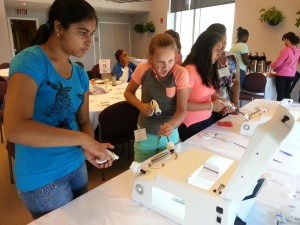
Connecticut’s ongoing effort to interest young girls in pursuing education in science and technology will receive another nudge when Girls of Innovation, the Connecticut Technology Council’s signature program for middle school-age girls, is held on June 13 at the Connecticut Science Center in Hartford. The annual event for girls entering grades 7 & 8 provides opportunities to experience science and its challenges in a fun, interactive way, officials say.  The program highlights possible careers in STEM (science, technology, engineering, math) through hands on, interactive activities led by real world tech professionals.WOI

The girls in attendance will have the chance to work alongside their peers as well as with an impressive roster of volunteers who are currently working, or studying, in STEM fields in Connecticut. Volunteers come from presenting sponsor Covidien as well as professionals from CTC’s member companies and the Women of Innovation program.

A year ago, close to 40 students came to the Connecticut Science Center to experience first-hand the benefits of studying and working in STEM related careers, and gave the Girls of Innovation program high marks.  Among some of the schools that have registered to participate in the 2015 program are Ansonia Middle School, Washington Middle School (Meriden), Moran Middle School (Wallingford), CT Academy of Science & Engineering, St. Brigid School (West Hartford), Bedford Middle School (Westport), Talcott Mountain Academy, Ethel Walker School, YMCA Super Girls, Irving Robbins Middle School (Newington) and King Philip Middle School (West Hartford). In addition, 12 girls from CCSU’s Institute of Technology & Business Development TRiO Educational Talent Search program have also registered.6a00d834559ccd69e20192ab43a1f4970d-500wi1imge

Mentors talk with students about their experiences and careers and guide them through the scientific challenges created by the Connecticut Science Center Staff Scientists.  Students spend time with mentors, ask questions and discuss the benefits and challenges associated with careers in STEM, and participate in hands-on science activities.

A key message of the Girls of Innovation program is to show the girls scientists “like me” and so inspire them with the confidence, enthusiasm and persistence to continue pursuing their scientific interests, officials point out, adding that studies of cultural beliefs indicate that girls begin to conclude that STEM is not for them in middle school, and these beliefs influence choices they make throughout their school years.  Stereotypes of who is a scientist are changing, but not quickly enough, organizers note.

“Spurring growth through creative invention will be a key objective of many companies in the next decade as it will provide the necessary fuel to address challenges in energy, healthcare, and global infrastructure realms. The solutions to these challenges will evolve and mature over many years and our bright and talented youth will drive the bus on this. This program is designed to galvanize our youth around invention and creative thought,” said Chuck Pagano, former Chair of the CTC Board of Directors, and VP of Technology at ESPN.CTCLogoLarge
The Connecticut Technology Council is a statewide association of technology oriented companies and institutions, providing leadership in areas of policy advocacy, community building and assistance for growing companies.  With over 2,000 companies that employ some 200,000 residents in the technology fields, the CTC seeks to provide a strong and urgent voice in support of the creation of a culture of innovation.

Connecticut Is Part of ESPN’s Strategic Focus on Corporate Citizenship Targeting Youth

There’s a change at ESPN.  The sports giant has launched a new citizenship strategy focused on using the power of sports for social good, and Connecticut is very much a part of the strategy. The launch includes a new name change (from Corporate Outreach to Corporate Citizenship), as well as a new website that highlights ESPN’s commitment to the community, www.ESPN.com/Citizenship,  Ed Durso, ESPN’s Executive Vice President of Administration, in explaining the overall strategy, said ESPN has “a tremendous legacy of giving and as our brand and reach have grown, so too has our commitment to the community. We are now taking a more strategic approach that focuses on using sports to transform lives and uplift communities.”

Durso explained that ESPN will focus in five key areas:espn

  • Access to Sports
  • Leadership Through Sports
  • The V Foundation
  • Good Neighbor grants
  • Sustainability

He noted that “ESPN can offer meaningful help to many in need. For example, it may be surprising to some, but youth sports participation in the U.S. has been on the decline since 2008. The decline is due to many factors and the problem is especially prevalent in underserved communities.

This is worrisome because sports is so important to development.”

teamespn_info_002“Studies show that kids who are physically active have higher test scores, are more likely to go to college, and smoke and drink less,” he added. ”Sports can also help build life skills, including enhancing self-esteem, unifying teams and driving social inclusion. By driving support to entities enhancing access to sports, we can help.”

Earlier this year, ESPN announced it would team up with the National Recreation and Park Association (NRPA) to award grants to seven local park and recreation departments in the U.S. that improve and expand their youth sports programs, especially in underserved communities.  The $150,000 grant would be targeted to purchase needed equipment, make improvements in facilities and help local parks expand their programs to give more children the opportunity to participate in community-based sports.

The communities receiving grants included Hartford, Los Angeles, Charlotte, Coral Gables, New York City and Austin.  In Hartford, the parks department set out to introduce 1,000 kids, ages 3-6 years, to the sport of soccer throughout the winter at inside recreation centers, with the objective of launching the "Litter Soccer Stars" league this spring, according to ESPN.

We believe that everyone should have the opportunity to play sports and be able to take advantage of its many benefits. ESPN is working with nonprofits to develop sports curriculum, distribute sports equipment and create safe spaces to play sports. We’re also finding ways to foster physical development, leadership and life skills through sports. We’re working with others who share this vision, and together hope to make sports more accessible, especially to those in underserved communities,” Durso explained.

A 2014 study from the University of Kansas suggests that if students are given a compelling reason to come to school—even if that reason has nothing to do with academics – they will. University of Kansas’s Angela Lumpkin and Rebecca Achen analyzed high-school testing, graduation, and attendance data and found that Kansas’s student athletes go to school more often than non-athletes. They also have higher graduation rates: 98 percent of athletes in Kansas’s class of 2012 graduated, compared with 90 percent of non-athletes.

An article published in The Atlantic pointed out “The higher graduation rates could be explained away by the theory that teachers have lower standards for athletes—that they’re willing to let athletes pass without doing all the work. But state test data challenges that theory: Athletes also score highfuture filmmakerer on the Kansas state assessments than non-athletes, in all subject areas. They are clearly learning something in their classes.”

ESPN has also included 32 colleges and universities across the country in a new initiative with the legendary Tribeca Film Institute for budding filmmakers.   Connecticut’s Quinnipiac University, University of Hartford, and Connecticut College are among the eligible institutions.   The TFI/ESPN Future Filmmaker Prize will award three graduate level media makers devoted to creating short-form documentaries highlighting the exceptionally creative work of an athletic community or organization that is working towards solving social issues in the United States or around the world. Submissions opened May 5 and close July 5.

The prize aims to support the next generation of filmmakers in producing creative, story-driven films that highlight issues of social importance through the lens of sports, athletics and or competition with a $25,000 production grant.

Recipientsteamespn_icons_008 will also receive professional guidance and mentorship from TFI staff and select media professionals. Along with the monetary grant, the three filmmaking teams will participate in a two-day workshop in the fall with activities tailored to their needs and culminating with an industry showcase to both celebrate their work and introduce them to the filmmaking community at large.

The workshop will include pitch training, story structure lectures, footage critiques, master classes led by industry leaders and one-on-one meetings with industry professionals and nonprofit athletic institutions. Also, each grantee will be paired with a current or former Tribeca Film Fellow. They will work closely together throughout all aspects of the filmmaking process from production to editing.


Connecticut Road, Rail, Bridge Infrastructure Continues to Earn Scrutiny

Often described as “an accident waiting to happen,” the condition of Connecticut’s road, rail and bridge infrastructure continues to earn scrutiny from policy makers and the public.  In the transportation-congested Northeast corridor, the intertwining highway and rail bridges, often stacked above and below one another or alongside each other, underscore the potential consequences of infrastructure failure.  The state legislature is poised this week to devote a portion of the state sales tax in the coming years to the start of a long-term transportation infrastructure revitalization plan proposed by Gov. Malloy. “Improving safety features on Connecticut’s roads and highways would likely result in a decrease in the state’s traffic fatalities and serious crashes,” a report in December 2014 by TRIP, a nonprofit organization that researches transportation issues, pointed out.  “It is estimated that roadway features are likely a contributing factor in approximately one-third of all fatal and serious traffic crashes.”underbridge

The report noted that “highways are vitally important to continued economic development in Connecticut, particularly to the state’s tourism, farming, agriculture, manufacturing, and insurance industries. As the economy expands, creating more jobs and increasing consumer confidence, the demand for consumer and business products grows. In turn, manufacturers ship greater quantities of goods to market to meet this demand, a process that adds to truck traffic on the state’s highways and major arterial roads.”

Amtrak's ridership through the Northeast corridor, including Connecticut, is up 50 percent since 1998, boosted by the introduction of high-speed trains.  A record 11.6 million riders rode Amtrak in the corridor in fiscal year 2014, the Associated Press recently reported.  Commuter railroads that rely heavily on the rail corridor, like the Metro-North Railroad serving New York and Connecticut, also have been breaking ridership records.

That same report, however, indicated that half of the route's 1,000 bridges are around a century old. Not all are at the end of their useful lives, but at current funding levels, it would take 300 years to replace all of them, according to the Northeast Corridor Commission of transportation officials, the AP reported.

“The terrible tragedy in Philadelphia is only the most recent reminder of the tremendous backlog of basic repairs and safety upgrades we have accumulated as the result of years of underinvestment in this critical asset,’’ U.S. Senator Chris Murphy said recently.  He’s proposing that $555.8 million in the president’s budget for Northeast Corridor rail improvements to be directed at rail-safety projects only.  Murphy calls the $555.8 million a “drop in the bucket,’’ noting that the Northeast Corridor repair backlog currently stands at $21.1 billion.

railAs one example, state officials are working on a plan to replace a swinging bridge over the Norwalk River, built in 1896.  "As a piece of engineering, it's just amazing," John Bernick, assistant rail administrator for the state Department of Transportation told the AP. "But, it's certainly reached its retirement age.” The computer that operates the bridge is from the 1980’s, and replacing the bridge could cost as much as $650 million.

Last October state officials announced a plan, using state and federal funds, for the design and replacement of that century-old Walk Bridge, which malfunctioned in two separate incidents within a two week period last summer. The project is be funded with 34 percent state funds and 66 percent federal funds. Officials anticipate the design for the replacement bridge, which began last July, to be complete by 2016.  With a contract bid package complete by late 2016, construction of the replacement bridge could begin in 2017 with a completion date in 2020.

A report in 2010 from the Federal Highway Administration found that out of 4,186 bridges in Connecticut, 378 bridges were considered structurally deficient and 1,028 bridges were considered functionally obsolete.  In 2008, a report by TRIP, indicated that the average age of bridges in Connecticut was 40 years, and that 46 percent of the state’s bridges were built prior to 1960.  The organization’s updated report, in December 2014, found that 35 percent of Connecticut bridges are in need of repair, improvement or replacement. Ten percent of the state’s bridges are structurally deficient and 25 percent are functionally obsolete.

Annually, $143 billion in goods are shipped from sites in Connecticut and another $119 billion in goods are shipped to sites in Connecticut, mostly by truck, the 2014 TRIP report indicated.  Forty-one percent of Connecticut’s major locally and state-maintained roads and highways have pavements in poor condition, while an additional 41 percent of the state’s major roads are rated in mediocre or fair condition and the remaining 18 percent are rated in in good condition.Congestion

In addition, Connecticut has more than 3,400 bridges and culverts on municipally maintained roads, according to the state Department of Transportation. Construction and maintenance of these expensive structures is the responsibility of the cities and towns who own them.  The state legislature, which is scheduled to adjourn on Wednesday, is considering a proposal that would increase the available funds under the State Local Bridge Program to assist local municipalities for FY 2016 applications to $15 million and would add $10 million for FY 2017 applications.

The TRIP report concluded that “making needed improvements to Connecticut’s roads, highways and bridges could provide a significant boost to the state’s economy by creating jobs in the short term and stimulating long-term economic growth as a result of enhanced mobility and access,” warning that “without a substantial boost in federal, state and local highway funding, numerous projects…will not be able to proceed, hampering the state’s ability to improve the condition of its transportation system and to enhance economic development opportunities in the state.”


White House Conference on Aging Will Be July 13

At the White House Conference on Aging regional forum in Boston Thursday, U.S. Health and Human Services (HHS) Secretary Sylvia Burwell announced that the 2015 national Conference will be held on July 13 at the White House. That’s of particular interest for Connecticut, the state with the nation’s 7th oldest population.   logo-WHCOA2015 The July event is part of a year-long effort to listen, learn, and share with older adults, their families, their caregivers, community leaders, and experts in the aging field on how to best address the changing landscape of aging in the coming decade, officials said. Since the 1960’s the White House Conference on Aging (WHCOA), held about once a decade, has helped to drive national policy.

According to Nora Super, Executive Director of the WHCOA, “The 2015 Conference seeks to embrace the transformative demographic shift occurring in the United States to recognize the possibilities, rather than the limitations of aging.”  65

At a Connecticut State Capitol hearing, dubbed a "listening session" for the WHCOA, earlier this month, (CT-N video) among the statistics highlighted were:

  • Connecticut is undergoing a “permanent and historic transformation” in its demographics
  • Between 2010 and 2040, Connecticut’s population of people age 65 and older is projected to grow by 57%, with less than 2% growth for people age 20 to 64 during the same period
  • Residents born in Connecticut today can expect to live to be 80.8 years old—the third highest life expectancy in the nation.
  • In Connecticut’s 65 to 69 year-old age group, 39% are in the labor force, as are 21% of Connecticut residents aged 70–74, and 7% of those 75 years and over. These rates are among the highest in the country

Testimony at the State Capitol hearing, co-sponsored by the state Department of Aging and the Legislative Committee on Aging, will be shared with officials planning the White House Conference.

Common themes that have emerged as the five regional hearings proceeded, according to officials, include: how to ensure we prepare for financial needs in retireph-kissing-couple-320ment; how to remain healthy as we age; what types of services and supports can help older Americans remain independent in the community as we age; and how to support this care and the caregivers who provided it; and how to protect older Americans from financial exploitation, abuse and neglect.

Federal officials are urging Americans of all ages to get involved in the July 13 White House Conference on Aging, by:

  • Watching the event, which will be live streamed
  • Hosting watch party (PDF)
  • Participating in Q&A using Twitter (Tweet questions using #WHCOA , and they will be shared with panels at the conference.)
  • Interviewing someone of a different generation using the StoryCorps appquestion
  • Completing the sentence: “Getting older is getting better because....” and sending us your answer via Twitter using #WHCOA (People are asked to download a form, fill in their answer, take a photo, and send it back via Twitter using #WHCOA.)

Policy briefs on Retirement Security, Healthy Aging, Elder Justice, and Long-Term Services and Supports, have been released for public review and comment. Americans are living longer than ever before. In 2012, officials noted, life expectancy at birth in the United States reached a record high of 78.8 years. A 65 year-old man can expect to live another 17 years and a 65 year-old woman another 20 years.

This year marks the 50th anniversary of Medicare, Medicaid, and the Older Americans Act, as well as the 80th anniversary of Social Security.  Leading up to the July 13 conference, regional sessions were held in Tampa, Phoenix, Seattle, Cleveland and Boston.

https://youtu.be/gdAWa6wNYXs


Agencies, Organizations to be Honored for Efforts Advancing Local Downtowns

A high school AP economics class that engages students in proactive land-use planning, the owners of a downtown Segway tour company that let the community help name their new business, and the state’s Department of Transportation are among the organizations and initiatives chosen to receive a 2015 Award of Excellence from the Connecticut Main Street Center (CMSC). Seven recipients were selected for the prestigious award, representing initiatives in Mansfield, New London, Putnam, Simsbury, Waterbury, and Upper Albany in Hartford.segway

The other winning entries included a First Fridays series that draws thousands of visitors with its hands-on arts and cultural events; a massive, multi-cultural downtown gathering of dozens of ethnic groups to celebrate a common community pride; a multi-year, multi-million dollar public/private partnership to design and build a brand-new town center; and a local merchant who remains committed to the neighborhood and the state despite becoming an international success.

wpid-img_20150311_152459_058For the first time in the history of the awards program, a state agency was also selected to receive an award. The CT Department of Transportation received a special award for Starting a Revolution: Integration of Land Use and Transit in recognition of the progressive nature of CTfastrak, the bus rapid transit system opened earlier this year. The awards jury that selected the winners gave the award because they felt the new busway represents a cultural shift in how Connecticut views transit, and wanted to acknowledge the future promise of transit oriented development that will hopefully result around the station locations.

The Connecticut Main Street Awards annually celebrate and communicate the most successful and innovative efforts in Main Street revitalization in Connecticut. A jury comprised of industry-related professionals and CMSC staff judged the submissions on criteria that included innovation, replication, representation, partnerships utilized, and outcomes.20150507_townsquare_pavilion

"Our members continue to impress us with how they support, encourage and implement new ideas from the ground up," said CMSC President & CEO John Simone. "They're constantly forming partnerships with new groups, working to sustain local merchants, and tirelessly promoting how wonderful our downtowns and Main Streets are. We're proud of their efforts and excited to share their achievements with everyone else."putnam

The awards will be presented at the 2015 Connecticut Main Street Awards Gala on June 8th at Trinity-on-Main in downtown New Britain. This year's event will feature guided tours of downtown New Britain, including a Downtown Arts, Heritage & Culture tour, a tour of Walnut Hill Rose Garden & New Britain Museum of American Art, and a tour of CTfastrak in New Britain: Transportation, Housing & Main Street.

The full list of 2015 Awards of Excellence winners:

2015 Connecticut Main Street Awards of Excellence                 

Main Street Partnership

▪   Simsbury High School AP Economics Course, to Simsbury Main Street Partnership and Simsbury High School.

Planning

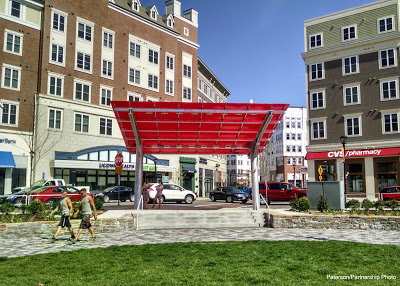
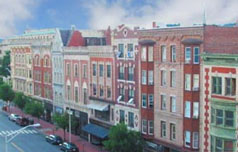
▪   Step by Step: Building a Downtown from Scratch (Storrs Center), to Mansfield Downtown Partnership, the Town of Mansfield, UConn, LeylandAlliance and the Citizens of Mansfield. (photo, above right)

Events & Programming  (Sponsored by Webster Bank)

▪    The Gathering (Downtown Waterbury), to the City of Waterbury, the Waterbury Observer, and Main Street Waterbury.

Award of Merit for Events & Programming

▪   First Fridays (Downtown Putnam), to the Town of Putnam, Putnam Business Association, and the Putnam Arts Council.

Business Owner of the Year

▪   Dawn & Kristin Harkness / Wheeling City Tours (New London), Submitted by New London Main Street.

2015 Main Street Pioneer: Outstanding Commitment to The Avenue  (Sponsored by Webster Bank)

▪    Vivian Akuoko / Evay Cosmetics (Upper Albany Avenue, Hartford), Submitted by Upper Albany Main Street.

Starting a Revolution: Integration of Land Use and Transitphoto_center_01

▪   CTfastrak, to the State of Connecticut Department of Transportation and the Capitol Region Council of Governments (CRCOG).

The Connecticut Main Street Awards of Excellence were created in 2003 to recognize outstanding projects, individuals and partnerships in community efforts to bring traditional downtowns and neighborhood commercial districts back to life, socially and economically.  In recent years, the Awards Gala has been held in New Haven, Hartford, Manchester, Torrington and Bridgeport.

CT Ranks #21 for Working Women, New Analysis Finds

Connecticut ranks 21st in the nation for working women seeking to balance the various aspects of work and family life, according to a new analysis by the Institute of Women’s Policy Research. The top five:  New York, California, D.C., New Jersey and Rhode Island. The bottom five:  Indiana, Utah, Montana, Mississippi and Wyoming. Women make up almost half of the workforce, according to the report, which notes that “few families have someone who can stay at home to take care of health emergencies, pick children up from school and supervise howoman with laptop and childmework, or take an elderly parent to a doctor’s appointment.”  In half of all families with children, women are the primary or co-breadwinner, the report indicates, and low-income families are particularly likely to have all parents in the labor force.


“Yet, as mothers’ labor force participation has dramatically increased in the past decades (U.S. Bureau of Labor Statistics 2014) and the number of women and men aged 50 and older who provide care for a parent has tripled during the last 15 years (MetLife 2011), the development of an infrastructure to support workers with family caregiving responsibilities has been largely neglected," the report stresses.logo

The work and family composite compares states’ performance across three components of work-family policy—paid leave, dependent and elder care, and child care—and a fourth component, the gender gap in the labor force participation of parents of children under six, an indicator that highlights gender inequality in family care of young children.

Connecticut received an overall “C” grade in the analysis of work and family issues; no state received a grade higher than B.  In breaking down the rankings, Connecticut ranked 5th in paid leave legislation, 27th in Elder and Dependent Care, 34th in Child Care, and 12th in the Gender Gap in Parents’ Labor Force Participation Rates.  The report indicated that 11.6 percent of women in Connecticut have a person with a disability in their household.

21The analysis pointed out that nationally “many workers lack access to even the most basic supports such as earned sick days and job-protected paid parental leave. Quality child care is also out of reach for many families because it is not affordable. Women are the large majority of family caregivers, and in the absence of reliable family supports, too many women are forced to make difficult decisions between keeping their jobs and caring for their family members.”
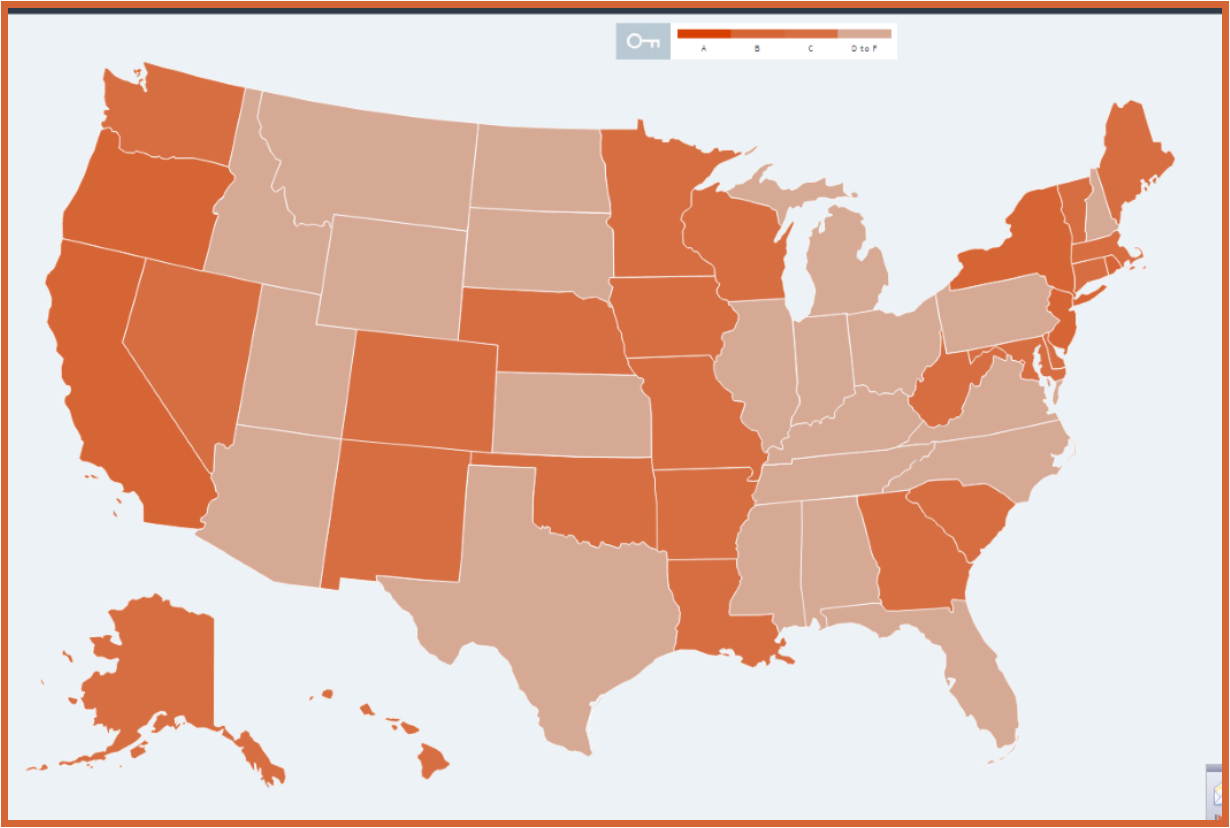
New York, California, and the District of Columbia have the highest scores on the work and family composite index, which reflects, in part, high rankings on paid leave. None of the highest ranking states, however, consistently ranks in the top ten states for each of the four component indices, the analysis indicates.

The large majority of mothers are in the workforce, according to the data cited in the report, including 62 percent of mothers who gave birth within the last 12 months map(U.S. Department of Labor Women’s Bureau 2015). The report indicates that Connecticut has 392,974 “breadwinner mothers in households with children under 18,” using 2013 data, ranking the state 25th in the nation at 29 percent.
The Work & Family index was one chapter in a larger report card developed by the Institute of Women’s Policy Research, in their Status of Women in the States report.  Connecticut’s ranking was lowest in the Work & Family analysis.  The state ranked as high as 4th in Poverty & Opportunity, 5th in Employment & Earnings, 6th in Reproductive Rights, 7th in Health & Well-Being, 12th in Political Participation, in addition to ranking 21st in Work & Family.  Overall, Connecticut ranked 5th when all the areas researched were considered.

The Institute for Women’s Policy Research conducts rigorous research and disseminates its findings to address the needs of women, promote public dialogue, and strengthen families, communities, and societies.  Among the partners in the study in Connecticut were the General Assembly's Permanent Commission on the Status of Women and Fairfield County's Community Foundation Fund for Women & Girls.


Stamford Population Grows as Most Cities See Drop in Past Year

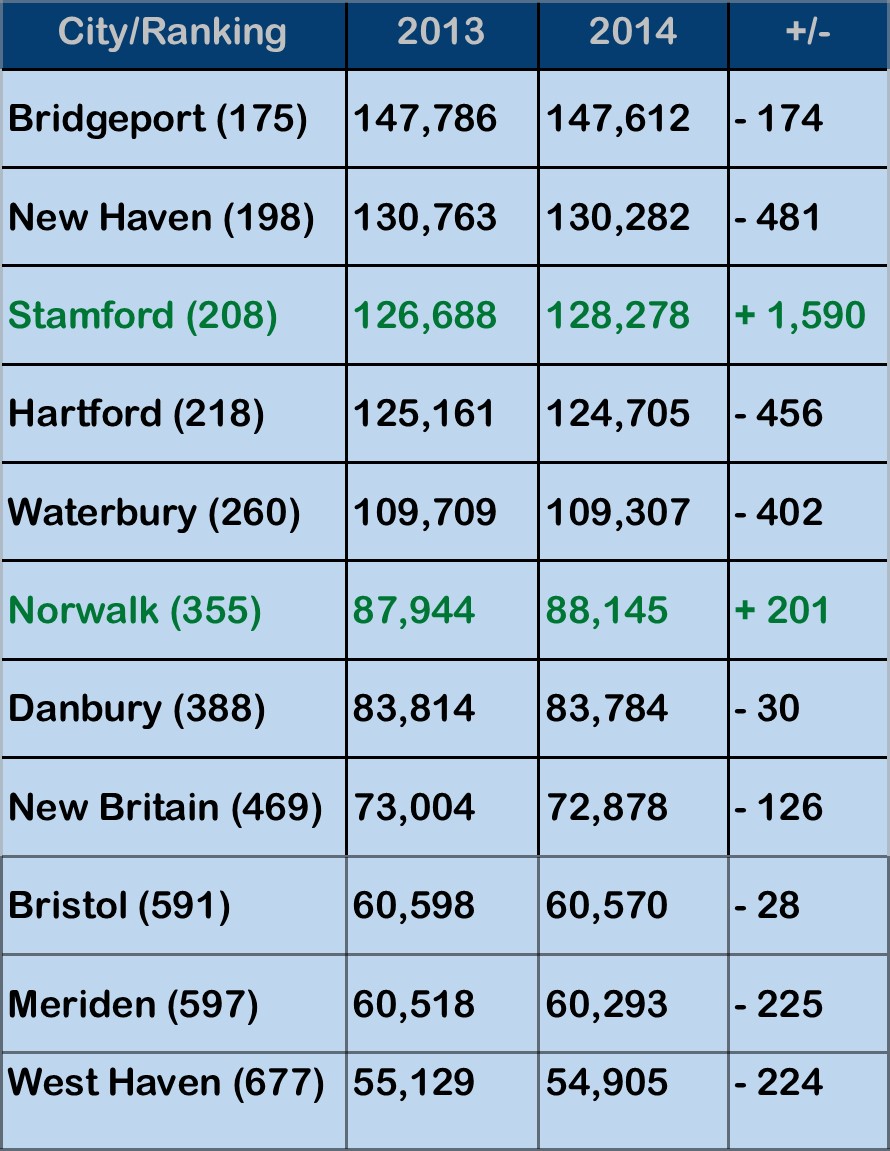
The growth in Connecticut’s population in recent years is largest in Stamford and across Fairfield County, and Stamford is gaining on New Haven, the state’s second largest city.  The U.S. Census Bureau has reported the municipalities in Connecticut that have experienced the largest increases in population last year, and over the past four years, revealing population declines in most of the state's largest cities during the past year. The municipality gaining the most people in Connecticut between July 1, 2013 and July 1, 2014, was Stamford, whose population rose by 1,590 over the period.  Stamford was followed by Stratford, with a population increase of 502, Darien (310), Fairfield (230) and East Lyme (222). Between 2013 and 2014, Bridgeport, New Haven, Hartford, Waterbury, Danbury, New Britain, Bristol, and Meriden  lost population while Stamford and Norwalk  experienced growth, among the state's largest cities.

The estimated population in Stamford, the 208th largest city in the U.S., grew from 122,815 as of July 1, 2010 to 128,278 in 2014.  Bridgeport, ranked number 175 in the nation by population and Connecticut’s largest city, grew from an estimated 144,845 in 2010 to 147,612 in 2014, which was a slight drop of 174 residents, from 147,786 in 2013, according to the census estimate data.

cities CTOver the past four years, population also grew in Hartford, New Haven, Stamford, Danbury and Norwalk, but declined in some of the state’s other large municipalities, including Waterbury, New Britain, Meriden and West Haven.

In New Haven, the 198th largest city in the nation, the population increased from 129,890 in 2010 to 130,282 in 2014.  Connecticut’s Capitol City and the state’s 4th largest, Hartford, saw population grow narrowly from 124,314 in 2010 to 124,705 last year.  Hartford’s population is now ranked #218 in the nation.

As New Haven gained 392 residents during the past four years, Stamford gained 5,463, which narroPrintwed the gap between the two cities to 2,004.  Just four years ago, the population differential was 7,075.  Stamford passed Hartford to rank as the state’s third largest city three years ago.
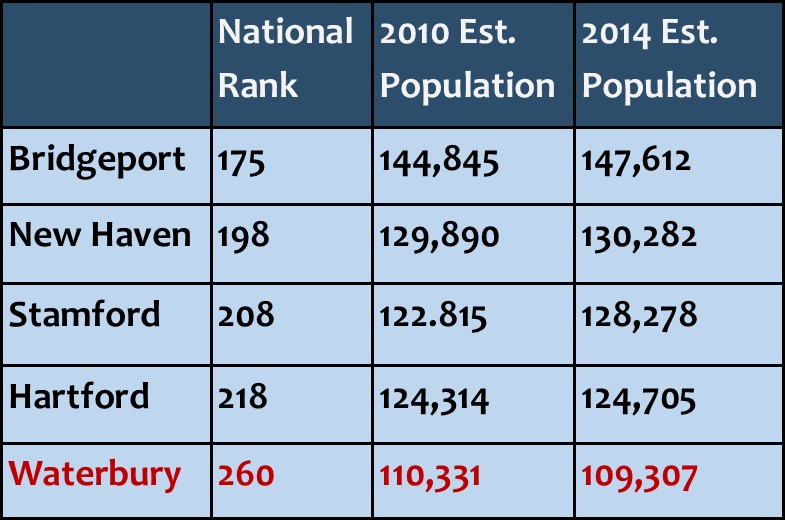
Waterbury saw a population decline over the past four years, from 110,331 to 109,307.  The Brass City is the nation’s 260th most populous city.  Norwalk, the nation’s 355th largest city, saw population growth from 85,992 to 88,145 over the past four years, while Danbury, ranked number 388, experienced an increase in population, from 81,354 in 2010 to 83,784 in 2014.

New Britain, ranked number 469, also experienced a decline in population, from 73,240 to 72,878, populationaccording to the census data, while Bristol (number 591) saw a slight uptick of just under 100 residents, from 60,477 to a 60,570.  Meriden (number 597) saw population slip from 60,868 to 60,293.  West Haven, the 677th most populous city in the nation, also experienced a drop in populations, from 55,565 to 54,905.
The population estimates are based on annual population estimates since the 2010 Census and the data  includes annual estimates each July 1, through July 1, 2014.

San Jose, Calif., is now among the 10 U.S. cities with a population of 1 million or more, according to the new U.S. Census estimates.  California has three cities with 1 million or more people (Los Angeles, San Diego and San Jose), tying Texas (Houston, San Antonio and Dallas) for the lead among states.

New York remained the nation’s most populous city and gained 52,700 people during the year ending July 1, 2014, more than any other U.S. city.  Rounding out the top ten were Los Angeles, Chicago, Houston, Philadelphia, San Antonio, San Diego, Dallas and San Jose.  The other top 20 cities are Austin, Jacksonville, San Francisco, Indianapolis, Columbus, Fort Worth, Charlotte, Detroit, El Paso and Seattle.

The only change in the rank order of the 15 most populous cities between 2013 and 2014 was Jacksonville, Fla., and San Francisco, each moving up one spot to 12th and 13th place, respectively, passing Indianapolis, which fell from 12th to 14th.

For the first time since Hurricane Katrina struck in 2005, New Orleans (384,320) returns to the list of the 50 most-populous cities this year at number 50, with Arlington, Texas, dropping off the list.

Connecticut’s is the nation’s 29th most populous state, with the population in 2014 estimated by the U.S. Census at 3,596,677, an increase from 3,574,096 in 2010.  However, the state's population  last year was less than the previous year (3,599,341 in 2013), down by 2,664 statewide, according to the U.S. Census data.

Pedals for Progress Sends Bicycles Overseas to Boost Opportunity, Improve Economic Conditions

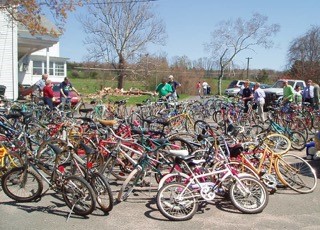
Area residents with an adult or child’s bicycle in repairable condition are urged to consider a donation to Pedals for Progress (P4P) in West Granby this weekend.  The national organization rescues bicycles destined for overburdened U.S. landfills and ships them to developing countries where they are sorely needed and highly valued. Last year, bike collections were sponsored by approximately 41 community partners in six states, including Connecticut. P4P bikes are put to work not only as basic transportation, but are used as a supplement to school and community programs. The bikes are adapted for use as trash haulers, produce trucks, taxis, and farm machinery.bicycle 1

With overseas partners, the bicycles take on an even greater significance – to keep the bikes working, maintenance is necessary. Children and adults are trained in bicycle maintenance and repair, and the bicycles are sold within the community, fostering the development of a local economy. If a person would like to have a bicycle but cannot pay for it, that person has to work for the shop (and learn a new skill) in order to cover the cost of the bicycle.

P4P also arranges for the bicycle shops to have a supply of tools, parts, accessories, and lubricants for maintaining the bikes. With Pedals for Progress, a bicycle becomes a valuable commodity for trade, employment, transportation, local government – the list goes on.

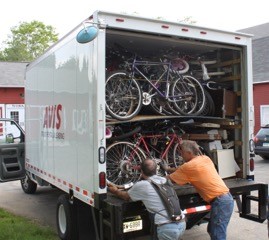
Sponsored by Jackie Rubell Johnson with support from Holcomb Farm, bikes can be dropped off from 12 noon to 3 PM on Saturday May 23, 2015, rain or shine at Holcomb Farm, 113 Simsbury Road, in West Granby. [“Bikes for parts” or disassembled bikes are not accepted.] It costs $40 to collect, process, ship, rebuild and distribute each bicycle. A donation toward shipping costs is necessary.  Organizers ask for a minimum $10 donation with each bike or sewing machine to help cover the cost of shipping. Receipts are offered for value of donation including cash.

P4P collects 5,000 to 7,000 bicycles annually and transfers this material wealth to those in need. To date, more than 140,000 have been shipped to developing countries in Latin America, Africa and Eastern Europe.  Last year, the bicycles were donated to recipients in Nicaragua, Guatemala, Albania, Moldova, and Madagascar. Pedals1

In these countries the bikes are reconditioned by partner agencies and distributed at low cost to poor working adults. These bikes provide reliable transportation for commuting to work, transporting product to market, or accessing health care and other services. Steady employment for is vital to the development and success of these economies.

In 2014, Pedals for Progress shipped a total of 3,634 bicycles, 274 sewing machines, and approximately $360,000 in bicycle parts and accessories, to seven nonprofit agency partners in seven developing countries. That brought the cumulative donations shipped in the last 24 years, since the organization’s inception in 1991, to 142,437 bicycles, 2,860 sewing machines, and over $12 million in parts and accessories donated to 38 countries.

Among the organizations providing support are the Clif Bar Family Foundation, FedEx and Thulé.   Connecticut organizations that participated in collecting bicycles in 2014, in addition to Jackie Rubell Johnson with support from Holcomb Farm in West Granby, include Newtown Rotary Club, Old Greenwich Presbyterian Church, and the Wilton High School Spanish Honor Society.

bicycle 2The organization also accepts working portable sewing machines and P4P seeks donations of wrenches for their overseas shops. All cash and material donations are fully deductible and a receipt will be available at the collection site.

Pedals for Progress is a 501 © (3) corporation and a registered charity in the states of New Jersey, Pennsylvania, Vermont, Iowa and Connecticut.  More information about the organization is available at  www.p4p.org; for information about the May 23 pick-up in West Granby, call 860 653 7758.

https://www.youtube.com/watch?v=U0qfStNmS6k&feature=youtu.be


States Under Pressure to Raise Gas Tax to Support Infrastructure Repair

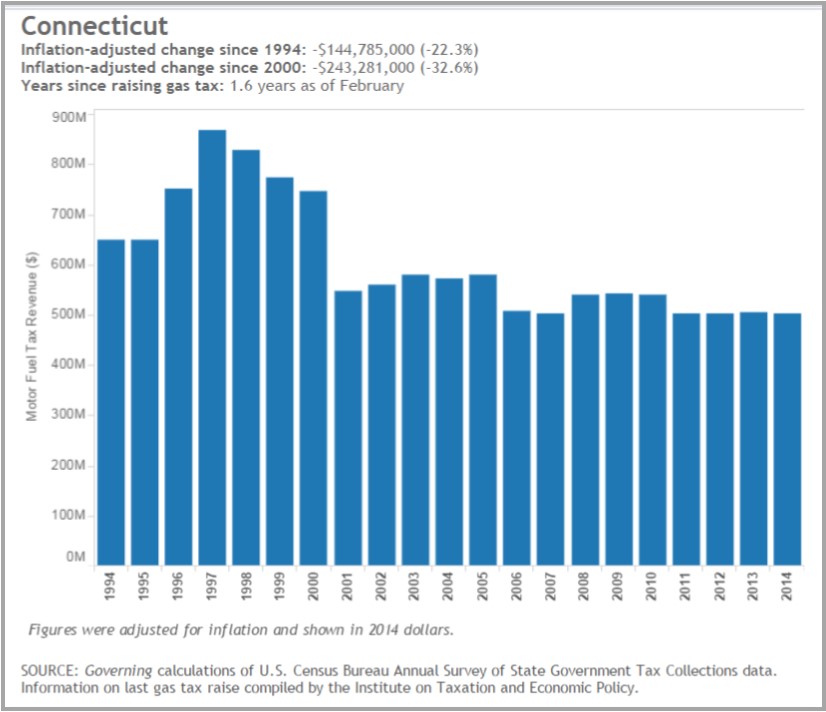
In nearly two-thirds of states, state-imposed fuel taxes have not kept up with inflation for two decades, according to a Governing analysis of state gas tax data reported to the U.S. Census Bureau. That is forcing legislators around the country to consider raising gas taxes or exploring other ways to increase transportation spending, as Congressional action on adjusting the federal portion of the gas tax to meet infrastructure needs remains stalled. As Connecticut – with among the nation’s highest gas taxes - contemplates embarking on a decades-long comprehensive transportation infrastructure upgrade, how to fund the likely record-setting fiscal requirements has been assigned to a task force to consider and propose recommendations.  Earlier this month, Michigan voters resoundingly defeated a measure -- 80 percent voted “no” -- to hike gas taxes and make many other changes to boost state transportation spending, Governing reported. Last fall, Massachusetts voters recinded (with 53% of the vote) a law that would have automatically tied gas tax rates to inflation.  The law had been passed by the state legislature in 2013. Gas-pump-image

Connecticut’s gas tax, increased most recently by about 4 cents per gallon in July 2013, based on legislation approved previously – a step not taken by many other states in recent years. The Institute on Taxation and Economic Policy reported earlier this year that 22 states hadn’t raised their gas taxes in more than a decade, according to Governing.  Connecticut is not among them.

At the federal level, the gas tax was last increased in 1993. Since then, inflation, fuel-efficient vehicles and changing driving habits are all undermining the per-gallon charges that are the country’s main source for transportation funding to repair roads, bridges, and related infrastructure.  In most states, just as nationally, those problems grow because lawmakers rarely adjust fuel taxes, Governing noted. Connecticut, as other states, has also seen funds derived from the gas tax diverted from transportation-related purposes through the years, adversely impacting the status of transportation infrastructure.

In January, USA Today and 24/7 Wall Street reported that Connecticut’s state fuel tax of 43.2 cents per gallon was the fifth highest in the nation, and as a percentage of the gas price, the state was third highest.  At the time, Connecticut’s gas price was the sixth highest in the nation.  Gas prices nationwide and in Connecticut have risen since January, and Connecticut continues to rank near the top of most gas price surveys.

CT gas taxIn Connecticut, the inflation-adjusted change is a reduction of in the value of the dollars provided by the tax of 32.6 percent since 2000 and 22.3 percent since 1994, according to the Governing analysis, using data from the U.S. Census Bureau and the Institute on Taxation and Economic Policy.  Earlier this year, Governor Malloy announced a two-part transportation plan consisting of a five-year ramp-up that utilizes $10 billion capital funding, and leads up to a 30-year vision utilizing $100 billion in funding.  The Transportation Finance Panel he appointed to  recommend options the state can utilize to finance the infrastructure transformation is due to report this summer (see members below).

The federal government’s 18.4-cent gasoline tax brought in a fifth less, in inflation-adjusted dollars, in 2013 than in 1993, Governing reported. The federal government’s buying power peaked in 1994, immediately following its gas tax hike. The purchasing power of states fuel taxes peaked five years later, in 1999. In 37 states, inflation-adjusted revenues from fuel taxes slipped since 2000.

At the federal level, fuel taxes have been flat for more than 20 years, starving the Highway Trust Fund of revenue used for rising infrastructure repair costs, according to Reuters.  According to Forbes, the Congressional Budget Office (CBO) has estimated that in 2024 alone the Highway Trust Fund will spend $18 billion more than it brings in, Forbes has reported. The CBO estimates the cumulative shortfall over the next decade will top $160 billion.

A year ago, when gas prices nationwide were at their lowest levels in years, Republican Senator Bob Corker of Tennessee and Democrat Chris Murphy of Connecticut proposed raising federal gasoline and diesel taxes by 12 cents a gallon over two years– to bring the tax where it would have been had it kept up with inflation for the past two decades.  As in the past, the prospect of a federal tax increase in the gas tax – even to address needed transportation infrastructure repairs – did not gain significant support.

At the time, it was estimated that American drivers pay an average of $94 a year to access over 11,618 miles of highways, roads and bridges.  Based on data from the Government accountability Office, the National Stone, Sand & Gravel Association pointed out that “with a growing number of potholes, cracked roads and traffic jams plaguing America, we need a common-sense and responsible way to pay for improving our infrastructure.”

The Governor’s Transportation Finance Panel, appointed earlier this spring, includes:
  • Cameron Staples (Chair): President and CEO, New England Association of Schools and Colleges; Former Co-Chair of the Finance, Revenue and Bonding Committee, Connecticut General Assembly
  • Beth Osborne: Senior Policy Advisor, Transportation for America; Former Acting Assistant Secretary for Transportation Policy, U.S. Department of Transportation
  • William Bonvillian: Director, Massachusetts Institute of Technology’s Washington, D.C. Office
  • Joan Carty: President and CEO, Housing Development Fund
  • Bert Hunter: Chief Investment Officer, Connecticut Green Bank
  • Oz Griebel: President and CEO, MetroHartford Alliance
  • Paul Timpanelli: President and CEO, Bridgeport Regional Business Council
  • Stanley Mickus: Marketing and Public Affairs, Cross Sound Ferry Services
  • Emil Frankel: Consultant on transportation policy; Former Commissioner, Connecticut Department of Transportation (1991-1995); Former Assistant Secretary for Transportation Policy, U.S. Department of Transportation (2002-2005)

AngelRiders Bicycle Across Connecticut to Help Children with Life Threatening Diseases

AngelRiders will pedal from the northwest hills of Connecticut down to the Mystic shoreline — totaling 135 miles over a two day stretch. It is a charity bike ride like no other, according to organizers, with the goal to raise money to support children who are battling life threatening diseases. More than 300 riders from across Connecticut are expected to participate in the 12th Annual AngelRide (#AngelRide #NeverStopClimbing), which will be held over Memorial Day weekend. Adult riders have the option to participate in a one or two day trek, May 23 and 24. There are also shorter rides for teens and children on Sunday.logo-tag

The charity ride — named for Angela "Angel" Uihlein of Westbrook — began in 2004 with 32 riders raising $67,000. Angela was diagnosed with leukemia at the age of 12 and attends the ride each year with her family. She has been in remission since the ride started and is now a registered nurse.

Growing steadily year after year, AngelRide has raised $4.6 million to benefit the Hospital Outreach Program (HOP) run by the Hole in the Wall Gang Camp in Ashford. HOP brings the hopeful, playful spirit of camp to children and families in a hospital setting. In 2014, HOP covered 39 hospital sites in Connecticut Massachusetts, New Jersey, New York, Pennsylvania and Rhode Island, where 28 specialists made nearly 32,000 hospital visits to sick children in need of joy and laughter.

“There is no other bike challenge like this one,” said Lynn McCarthy, AngelRide co-founder of Lyme. “We have been able to grow primarily by word of mouth because of the amazing experience it offers. We pay attention to the details, serve great food along the way and provide an overnight adventure at the Hole in the Wall Gang Camp.” AngelRide is the only organization that has been granted the privilege to stay overnight at the camp.

angel photoConnecticut riders return year after year to the AngelRide — some to ride and some to volunteer for the statewide event.  Westbrook resident Dan Shapiro was the first rider to register in 2004, and he has been participating in the AngelRide every year since. “I couldn’t imagine Memorial Day weekend without AngelRide,” said Shapiro. “The spirit of this ride is off the charts. We are all trying to do something bigger for the kids.”
West Hartford resident Keith Knowles has been involved with AngelRide for the last 10 years, either as a rider, volunteer or web site developer. This year, his 8-year-old daughter Emily will become an AngelRider. “I am going to ride six miles because I had a sister who passed away from cancer when she was only 5 years old. She is my motivation and inspiration for doing this,” said Emily.

Knowles sees the ride as a metaphor for the journey of sick children. “The hills we face are nothing compared to the hills the kids face. I'm not a cyclist. I don't train too much. Pedaling through the climbs one slow churn at a time and reaching the finish line is humbling experience. I know it's not nearly as difficult as battling cancer or some other life threatening disease,” he said.

There are many options for AngelRiders:

  • Two-Day Ride: Ride 135.4 miles across Connecticut over the course of two days. The two-day ride begins in Norfolk, and extends 85 miles to the Hole in the Wall Gang Camp in Ashford. angelDay two begins at camp and ends 50 miles away in Mystic.

  • One-Day Ride: Sunday only, ride 50 miles from the Hole in the Wall Gang Camp to Mystic.
  • Young Adult AngelRide: For ages 11-14, this 22-mile ride begins in Hopeville State Park on day two and ends in Mystic.
  • Young AngelRide: For ages 7 to 11, this is a 6.5 mile ride in Mystic.

Southington resident Tom Wood looks forward to ride each year and continues to recruit new people to either ride or volunteer. This year will be his eighth year as an AngelRider, which he does in honor of his brother who died of leukemia. “This is a great way to recharge your batteries. We have such an amazing and beautiful state. And it is not flat, so this is really a great challenge to undertake.”

“The renewal of body and spirit is exactly what the Hole in the Wall Gang Camp and HOP brings to a child with a life threatening condition,” said Dr. Brad Jubelirer, Assistant Clinical Professor of Pediatrics, UCONN School of Medicine in Farmington.

To find out more or to register for AngelRide, visit www.angelride.org . Registration remains open and encouraged; volunteers and donations are also welcome.

https://youtu.be/-r95hwj8DIw