Moving Vans Heading Outbound, Beyond Connecticut’s Borders

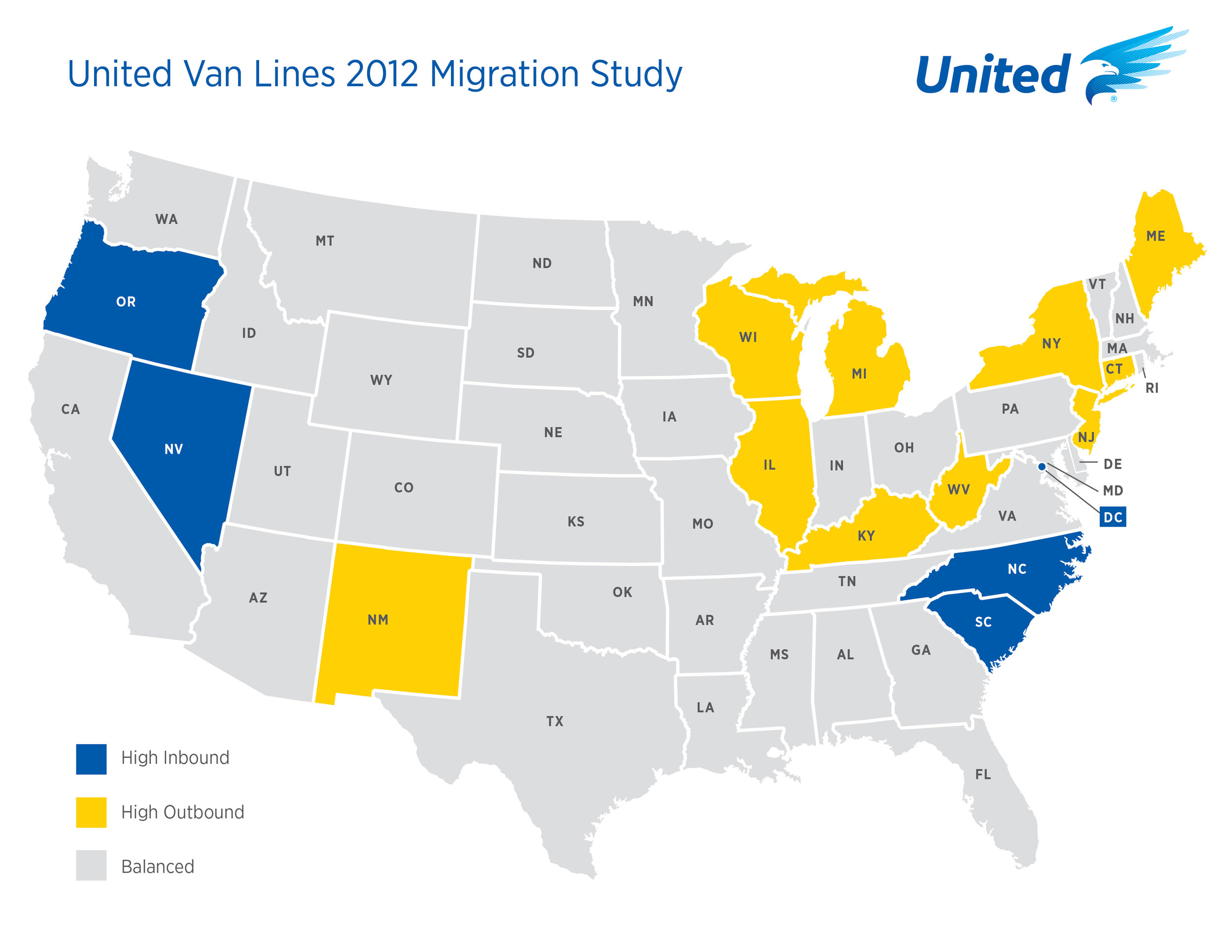
If it’s tough to tell sometimes if you’re coming or going, there is at least one well-known company that keeps close tabs on movement.  United Van Lines, long in the business of moving people from point A to point B, issues an annual “migration study” that tracks where people are moving to, and moving from. In 2012, more folks were going than coming to Connecticut, by a ratio of 56 percent to 44 percent, putting the state squarely among the top 10 outward bound leaders.  The pattern was similar throughout the Northeast.  New Jersey (62 percent) displaced the outbound leader from last year, Illinois (60 percent) reclaiming the top spot for high-outbound migration that it held in 2010.  In addition to New Jersey, New York (58 percent), Maine (56 percent) and Connecticut (56 percent) are also included.

Michigan (58 percent) and Wisconsin (55 percent) along with Illinois represented the Great Lakes region. Michigan fell to the No. 6 from the No. 4 spot it held in 2011. Previously, it had claimed the top outbound spot every year from 2006-2009.  Kentucky (55 percent) joined West Virginia (58 percent) as the only Southern states to appear on the high outbound list. New Mexico (58 percent) was the only Western state to appear on the list. The top 10 outbound states for 2012 were:

  1. New Jersey Migration Map
  2. Illinois
  3. West Virginia
  4. New York
  5. New Mexico
  6. Michigan
  7. Connecticut
  8. Maine
  9. Wisconsin
  10. Kentucky

That’s one list that states would prefer not to be included on.  United has tracked migration patterns  annually on a state-by-state basis since 1977. For 2012, the study is based on all household moves handled by United within the 48 contiguous states and Washington, D.C.  United classifies states as "high inbound" if 55 percent or more of the moves are going into a state and "high outbound" if 55 percent or more moves were coming out of a state or "balanced" if the difference of inbound and outbound is negligible.   The top-five inbound states of 2012 were 1) District of Columbia, 2) Oregon, 3) Nevada, 4) North Carolina and 5) South Carolina.

The Western United States is also represented on the high-inbound list with Oregon (61 percent) and Nevada (58 percent) both making the list. Oregon is number two for inbound migration for the third year in a row. Nevada returned to the high inbound traffic for the second consecutive year. The Carolinas each made the top five with North Carolina at 56 percent and South Carolina at 55 percent inbound moves.

Several states gained approximately the same number of residents as those that left. Those states include New Hampshire from the New England region, and the states of Louisiana, Iowa, Indiana, North Dakota, and Maryland.  This is the fifth consecutive year the District of Columbia (64 percent) was the top moving destination in the United States.  That trend may continue in 2013, what with members of Congress and the Cabinet coming and going.
Manufacturing Summit Planned to Accelerate Industry Growth

“Manufacturing is vital to Connecticut’s economic health and future. Now, after decades of uncertainty, the state’s manufacturers could be entering a new era of opportunity. Employment is rising, companies that moved overseas are returning and continuous improvement initiatives are helping many manufacturers hone their operations and enhance competitiveness.”  That assessment, from the Connecticut Business & Industry Association, is driving a Connecticut Manufacturing Summit on Friday, January 25 at the Trumbull Marriott. The program will include an overview of U.S. manufacturing from Steve Menaker, Partner,  McGladrey LLP, and a presentation of CBIA’s report, Connecticut Manufacturing: Building on the Past, Creating Our Future, issued in mid-2012, from Pete Gioia, Vice President and Economist at CBIA. Among the key stats manufacturingthat will inform the discussion:

  • Connecticut is home to nearly 5,000 manufacturing companies that employ approximately 165,000 people and produce a vast array of products.
  • A CBIA/ DataCore Partners index contained in the report, placed Connecticut as 30th in the nation for manufacturing competitiveness.
  • Connecticut ranked 9th in the nation in the Milken Science and Technology Index that measures states’ ability to support growing manufacturing industries. (The ranking is based on public investments in R&D, a well-educated and skilled workforce, and the availability of risk capital to help convert R&D into viable technology products and services.)
  • Citing manufacturing as a jobs driver, the report also said that for each manufacturing job created in the state, between 1.5 and 4 additional jobs are created in other parts of the economy.
  • Each dollar’s worth of manufactured goods creates another $1.35 of activity in other economic sectors – twice the multiplier effect of most of the services sector.
  • Each year, manufacturers purchase more than $21 billion in goods and services from other state businesses, according to the Connecticut Economic Resource Center.
  • According to a Connecticut Industrial Energy Consumers report, manufacturing contributed $25.9 billion to the gross state product and accounts for about 11.4 percent of the state’s total employment.

The Summit will also include manufacturing executives discussing approaches for achieving success, resources needed for sustaining success, and strategies for cost-control and streamlining operations.  Among the participants are Brian DiBella, Vice President and General Manager - Wiremold Electrical Wiring Systems Division, Legrand and Don Janezic, CFO, Bigelow Tea. Panel participants also include Jason Howey, President, Okay Industries, Dr. Karen Wosczyna-Birch, Executive Director College of Technology, Connecticut Community Colleges, Dave J. Tuttle, Department Head/ Manufacturing, Connecticut Technical High School System and Douglas Johnson, Vice President of Operations, Marion Manufacturing Company.

There will be a policy discussion on improving Connecticut’s manufacturing climate led by Joe Brennan, Senior Vice President of Public Policy, CBIA.

The Summit, coming at the start of the 2013 state legislative session and prior to the Governor’s presentation of the state budget, aims to build on efforts at the Capitol to focus on high-tech manufacturing as part of the state’s economic mix.  At a news conference last Many to announce the formation of a “manufacturing caucus,” Sen. Gary LeBeau, D-East Hartford, said that over the last 10 years Connecticut has lost 50,000 jobs in manufacturing, which equates to 419 jobs lost each month. The caucus includes Sen. Tony Guglielmo (R-Stafford Springs), Rep. Zeke Zalaski (D-Southington), Rep. Vincent Candelora (R-North Branford), and Rep. Jeffrey Berger (D-Waterbury).


Newtown Was Rated #4 Town Among Peers, with Lowest Crime Rate

When Connecticut magazine last ranked Connecticut’s towns and cities on their quality of life, Newtown placed fourth overall among 26 communities with between 25,000 and 50,000 residents. Breaking down the individual categories in the rating, Newtown placed first with the lowest crime rate, third in the vibrancy of its economy, and sixth in the quality of education, in data compiled for the 2011 rating.

The top eight communities were Westport, Farmington, Glastonbury, Newtown, Cheshire, Wallingford, Mansfield and New Milford. The categories included were education, crime, economy, cost, and leisure.

The crime category is based on major crimes (murder, rape, robbery, aggravated assault, burglary, motor-vehicle theft) committed in 2007, 2008 and 2009 per 1,000 population, using figures available from the state Department of Public Safety.  The education category combines five elements: the 2009, 2010 and 2011 Mastery Test results for 4th, 6th and 7th grades; results of the 2009, 2010 and 2011 Connecticut Academic Performance Test (CAPT); local SAT scores for 2008, 2009 and 2010, and the percentage of 2010 public high school graduates who went on to two- or four-year colleges. Test scores were weighted more heavily.

The strength of the local economy was determined by the 2011 Public Investment Community score, compiled by the Office of Policy and Management, which rates all Connecticut towns under a formula based on population, per capita income, the adjusted equalized grand list per capita, the unemployment rate, the equalized mill rate and per capita aid to children.

Newtown was in the middle of the pack in leisure/culture, placing 13th, and among the lowest in cost of living, placing 25th out of 26 communities evaluated. The cost of living category weighs most heavily the median price of a single-family house purchased in the first six months of 2011.   Leisure includes local library expenditures per capita in 2010, the number of theaters, museums, festivals, concert venues, historic sites, colleges and universities, golf courses, local newspapers, radio stations, state parks and forests, voter turnout in the 2008 election and good local restaurants.

Election Day Turnout Stats Reveal Surprising Leaders Among Towns

Statewide turnout in Connecticut for the November 6, 2012 elections was 73.77%, according to statistics released by the Office of Secretary of the State Denise Merrill.  That is a decrease from 2008's turnout of 78.14%, but enough to rank the state seventh nationally. Bridgewater led the way with 94.75% turnout and was the only municipality to exceed 90%. Just missing the 90% mark were Middletown (89.86%) and Ridgefield (89.42%). Twelve municipalities exceeded 85% turnout. Each of the state’s 169 municipalities had turnout of at least 50% (Waterbury and Windham were lowest at 56%).

In reviewing the number of individuals who voted in the 2012 elections, the stats are quite revealing, and perhaps illustrative as political eyes look ahead to the 2014 elections.

Stamford topped the list, with just over 47,000 voters, followed closely by New Haven with nearly 45,000.  Rounding out the top five were Bridgeport, Hartford, and West Hartford.  Four communities underscored the maxim that registration is a first step, but turnout is the giant leap.  The number of voters in Hartford and West Hartford differed by only 1,001, although Hartford has 11,000 more registered voters. Greenwich, which has about 11,000 fewer registered voters than Waterbury, had in excess of 3,000 more people voting this year, according to the statistics released.

Fairfield placed 6th, one of only six towns where more than 30,000 people voted.  Rounding out the top ten were Greenwich, Danbury, Waterbury and Milford.  Just missing the top ten was Hamden, with 25,610 voters, and Bristol, with 24,571.

Number of people voting / Percentage of registered voters voting

Stamford           47,289       71.60%

New Haven         44,973       62.48%

Bridgeport         37,510       52.22%

Hartford             33,452       65.14%

W. Hartford     32,451       80.81%

Fairfield             30,081       78.97%

Greenwich         29,894       81.93%

Danbury             27,763       78.83%

Waterbury         26,566       56.09%

Milford               25,610       75.90%

Hamden             24,641       71.97%

Bristol                24,571       69.93%


Industry Growth and Enforcement: CT’s Twin Insurance Strategies

The Connecticut insurance sector plays a vital role in the global insurance landscape and the state's economy, according to a report from the Connecticut Insurance and Financial Services (IFS) Cluster and PwC US.  The report, released at the recent  2012 Insurance Market Forecast event in Hartford, highlighted the industry’s importance to the state, which was echoed in comments by the state Insurance Commissioner and Gov. Malloy. Commissioner Thomas Leonardi pointed out that “we regulate the 2nd largest insurance industry in America,” noting that “if Connecticut were a stand-alone country, we would be one of the 10 largest insurance producing jurisdictions in the world.” You can’t ignore this industry without putting the state in great peril.”  Malloy said, stressing the need to both regulate the industry and view them as “partners” in job creation and economic development.

The 2012 Connecticut Insurance Market Report highlights the sector's rich history, current challenges and opportunities with analysis and findings from Connecticut IFS Cluster, PwC, and the Connecticut Economic Resource Center (CERC).

KEY STATS

According to the report, Connecticut ranks first nationally in insurance employment as a percentage of total state employment and the industry represents approximately 3 percent of the state's workforce, 6 percent of the state's payroll and 9 percent of the gross state product.  Full-time employment in the sector is said to be 50,242.

Insurance also impacts other sectors of the state's economy.  The report says that one new job in the insurance industry adds an additional 1.46 jobs to the Connecticut economy; an increase of $1 in insurance labor income puts an additional $0.78 into state commerce; and every year the insurance industry purchases an average of $2 billion in goods and services from other industries in Connecticut.

"The inaugural Insurance Market Forecast is the showcase effort of that collaboration and will serve as a valuable guidepost as we expand our efforts to attract businesses and talent to our state," said James Bedard, IFS Chairman and Chief Financial Officer/Chief Operating Officer for UnitedHealthcare's Northeast Region.  [CT-N video of event.]

Looking forward, the report emphasizes that competing globally, investing in education, retaining and developing human capital, and government-led economic development initiatives are essential to maintaining the state's leadership position in the industry and growing its economy.  To drive that future growth, the report identifies the five key megatrends – social, technological, environmental, economic and political – that will influence the world's insurance industry, explaining their implications, and offering ideas and actions for embracing them.

A year ago, Gov. Malloy’s office noted that there are more than 65,000 people who work in the insurance industry in Connecticut, described as being down by almost 25% over the past 20 years.  The report compares employment by state, highlighting the top nine:  California (179,936); Texas (163,690); New York (144,077); Florida (134,393); Illinois (112,408); Pennsylvania (110,484); Ohio (108,492); New Jersey (81,119); Connecticut (61,583).

CONSUMER INTEREST

The State Department of Insurance, even as it promotes development of the insurance industry, also goes to bat for consumers.  In the third quarter of 2012, the Department’s Consumer Affairs Unit (CAU) fielded more than 1,500 complaints and inquiries and helped policyholders recoup nearly $1.2 million. During that same period, the Market Conduct division levied more than $1.1 million in fines against carriers and returned that money to the state General Fund. The fines resulted from a variety of violations and settlements ranging from untimely claim payments to improper licensing.  Since January 1, the Department has recovered more than $6.3 million for policyholders and state taxpayers.

The majority of the funds recovered for policyholders stemmed from complaints over health, accident, homeowners and life and annuities policies. The Department calculates its consumer recoveries based on what the policyholder received as a result of the Department’s intervention. The inquiries and complaints also help the Department identify industry trends that may adversely affect consumers. This data also helps determine topics for consumer education and as tools to help the Department monitor the industry. The Market Conduct enforcement actions are posted on the Insurance Department’s web site at www.ct.gov/cid

Nonprofit Organizations Help Boost Voter Numbers, Study Finds

If one concurs with the adage that all politics is local, it should come as no surprise that the dust has barely settled on the state and national elections of 2012 as the focus shifts to the municipal–level elections of 2013. A Massachusetts-based organization devoted to increasing the role of nonprofit organizations in spurring voter interest and participation is already publicizing its “Voter Participation Starter Kit for Nonprofits and Social Service Agencies,” available for web download, coming off what it describes as the success of 2012.

The benchmark National Election Exit Poll showed that the lower income, younger, and diverse populations typically served by nonprofits accounted for a greater share of voter turnout than ever before. While some of this can be attributed to population increases, it was also aided by unprecedented voter education and engagement efforts from the nonprofit and civic sector, according to the organization reported.

“Nonprofits are among the nation’s most trusted messengers. An annual Harris poll consistently ranks nonprofits among the few sectors (small businesses are another) that respondents would like to have more rather than less influ­ence in government.”  That observation published in The Nonprofit Quarterly, from George Pillsbury, MPA, founder and executive direc­tor of Nonprofit VOTE, underscores the organization’s initiative.

He adds:  “Nonprofits of the 501(c)(3) variety are pre­sumed to have a limited capacity for promoting political participation because laws prohibit them from engaging in partisan politics to support or oppose a candidate for public office. Yet nonprof­its’ inherent civic engagement assets make them a potent force for political and electoral engage­ment, further strengthened by their nonpartisan approach.”

Organizations including the Connecticut Association of Nonprofits — a long-time partner of Nonprofit VOTE — have led this transition in recent years by bringing voter engagement into the sector mainstream. According to the organization’s newsletter, for the 2012 election they pointed a spotlight on the sector by sending educational materials on the needs of nonprofits to all state candidates.

“Elected officials pay attention to which communities and which populations turn out and are generally more responsive to organizations involved in registering voters and encouraging turnout,” emphasized Sophie Lehman, Communications Director for Nonprofit VOTE.

The National Election Exit Poll is the most relied on exit poll conducted by Edison Research on behalf of ABC News, Associated Press, CBS News, CNN, Fox News, and NBC News.

Tale of Two Lists: Influential Leaders in Greater Hartford

‘Tis the season of making a list and checking it twice. Which will probably be the strategy employed by Hartford magazine next year, after enduring considerable criticism for omitting Latinos from their list and feature article on the “50 Most Influential” individuals in the Greater Hartford region - a prominent, lengthy and well-photographed December edition cover story.

Now, Latinos United for Professional Advancement (LUPA) has issued its list of the 50 most Influential Latinos in the region – a list not only impressive for who’s included, but for the numerous talented and highly placed Latinos who didn’t make the list, an indication of the growing breadth of leadership in the region by individuals of Hispanic heritage.  It is the first such list to be issued by the relatively new organization, aimed at bringing together and advancing the Latino professional community.

At least Hartford magazine will have a place to start when they consider candidates for next year’s cover story.

Yes, such lists are incredibly subjective.  But as LUPA points out, their list “was developed to demonstrate the significant roles Latinos play in the capital region and the influence they have on many facets” of life in the region and the state.  “The Latino population in Hartford is more than 45 percent, according to the U.S. Census Bureau, and in Connecticut the total population growth from 2000-2010 was 168,532 with Latinos comprising 158,764 of that population growth.”

See the LUPA list and the Hartford magazine list.  All good and worthy people, who are making significant contributions to the region.   That's 100 names, no overlap.

Concerns raised by ctlatinonews and others regarding the Hartford magazine list will, one would expect, result next year in other names “making their first appearance, new faces on the Greater Hartford scene that we expect to see more of in years to come,” to quote, in a slightly different context, the Hartford magazine list preamble.


State's Childhood Obesity Numbers Continue to Raise Concerns

M. Alex Geertsma, Chairman of Pediatrics at St. Mary's Hospital in Waterbury and director of the Children's Health Center, says the road to childhood obesity is paved in tasty treats that are attracting children’s palates unnecessarily – and beginning very early in life. “Commercialism is driving change in how we feed our infants,” Geertsma recently told a group of advocates at a Capitol forum on childhood obesity.  Geertsma, who has practiced pediatrics in Connecticut for three decades, is a member of the Connecticut Commission on Children.

After being on a liquid diet for the first six months of life, they begin to taste discriminate, or recognize certain foods as tasty or disgusting. They begin to want something “novel” whether it is extremely sweet or really salty.  Food manufacturers take full advantage, producing choices with hefty salt content and other ingredients that begin to push the scales upward.

The increase in body fat has been occurring much earlier than seven to eight years of age in children who eventually become long-term obese. This pattern is worse in African-American and Latino children, Geertsma said.

A recently released report projects that if obesity rates continue on current trajectories, 46.5 percent of adults in Connecticut will be obese by 2030.  The rate in 2011 was 24.5 percent.  Commissioned by The Trust for America’s Health and the Robert Wood Johnson Foundation, the “F as in Fat Report” projects that nationally, 13 states could have adult obesity rates above 60 percent by 2030.

Currently Connecticut is not among the worst offenders, ranking among the states with the relatively lowest adult and childhood obesity rates (#40 in childhood obesity; #49 in adult obesity).

A report last year by the Connecticut Department of Public Health, “Overweight and Obesity Among Kindergarten and Third Grade Children in Connecticut,” found that the prevalence of obesity was significantly higher in grade 3 children than in kindergarten children. Third grade girls were more likely to be obese when compared to kindergarten girls.  Similarly, third grade boys were more likely to be obese when compared to kindergarten boys.

Almost one third (32%) of all the students in the sample were either overweight or obese. The prevalence was similar when compared by sex. Third-graders (33.6%) were more likely to be either overweight or obese than children in Kindergarten (29.8%), but the difference was not statistically significant. However, the non-Hispanic Black (40.8%) and Hispanic (43.3%) children in the sample were significantly more likely to be overweight or obese than non-Hispanic White (26.8%) children.

Obesity is the second-leading cause of preventable death in the United States, after smoking, according to the Connecticut Public Health Department.  If a child is overweight before age 8, obesity in adulthood is likely to be more severe, statistics by the American Academy of Pediatrics have noted.

The Connecticut Coalition Against Childhood Obesity, a coalition of more than 30 health advocacy organizations across the state which conducted the hearing, is encouraging discussion of ways to overcome the obesity epidemic, which they say is contributing to the academic achievement gap.

Quest Program Participants Target Issues From Sex Trafficking to Job Skills

Leadership Greater Hartford’s highly regarded Quest program develops and engages emerging and established leaders in the region through opportunities to sharpen skills, build new professional relationships and – most importantly - address pressing community issues.  The 2012 class of Quest – 47 participants strong – were grouped into four teams, each pursuing distinct and important projects during the course of the year.  Their work is already in evidence in the community, and received high praise at a recent “graduation” ceremony held at the Mark Twain House in Hartford.  The initiatives:

  • The HartBeat Ensemble taskforce focused on what members described as the “appalling, abhorrent and terrifying nature of human sex trafficking” in the Hartford region, coordinating with the Hartford Police Department. They worked with HartBeat Ensemble, an ensemble company that creates original, professional theater based on stories from the community. To help increase public awareness of the issue, the taskforce developed a marketing, collaboration and public relations plan for their newest play in development, Project: Turnpike, which is based on the 2007 landmark federal trial of United States vs. Dennis Paris that took place in Hartford. The play represents 72 hours in the life of four exploited sex workers in a motel room on the Berlin Turnpike.  The play’s opening night is scheduled for April 24, 2013.

Law enforcement officials have observed that Hartford’s location  - near mass transit and between New York and Boston – contributes to the human trafficking industry’s presence here.  Recently, human trafficking – estimated to be a $32 billion-a-year business worldwide – has been the subject of a national crackdown by the travel industry, which has launched an initiative to train employees to identify and report potential trafficking incidents.    The U.S. Departments of Homeland Security and Transportation along with Amtrak also announced plans to training 75,000 employees.

  • The North End Career Resources taskforce focused on the importance of providing career resources to the North End community of Hartford.  They developed and conducted a “Job Skills Resources Fair” at the Albany Avenue Branch of the Hartford Public Library on September 25, 2012.  It was a job skills fair, not a job fair – with the goal of connecting fair attendees with the skills necessary to make them employable in a tough hiring environment.  The “vendors” were non-profit agencies that work in the areas of job skills training.
  • The Billings Forge Community Works taskforce worked with Billings Forge Community Works, an innovative job education and training, housing, and community development organization that serves the residents of Hartford's Frog Hollow neighborhood. This taskforce accomplished three main goals: enhanced their corporate sponsorship program, implemented their auction event for the annual “Farm to Table” event/fundraiser and created an organizational membership program.
  • The Hartford Children’s Theatre taskforce partnered with Hartford Children’s Theatre, which provides theatrical training and entertainment for Connecticut children and families. The taskforce focused on the summer theatrical production of Hartford Children’s Theatre and worked specifically in the areas of development, marketing and general public relations efforts.  In doing so, they not only raised sufficient funds to offset the costs of the production, they also provided input and novel suggestions for future marketing and fundraising operations.

Participating in Quest 2012 were:

Kelsey Aderman - Lincoln Financial Group Debbie Albrecht- Murtha Cullina, LLP. Deb Battit - Hartford Foundation for Public Giving Yvette Bello - Latino Community Services Theresa Benoit - ConnectiCare, Inc. Joe Bierbaum - Stone Academy Maureen Bowman - Travelers Monique (Roxanne) Brown - Phoenix Life Suzanne Butler - OptumHealth Katie Carges - Hartford Hospital Vrinda Dabke - OptumHealth Theresa Desilets - Cigna Steve  Dibella - Hartford Police Department Alisa Dzananovic - Saint Francis Hospital Martin Estey - Hartford Consortium for Higher Education Tom Farrish  - Day Pitney, LLP Fred Faulkner - The Open Hearth Julie Geyer - Capital Workforce Partners LaResse Harvey - Civic Trust Lobbying Company John Henry Decker - Certified Financial Planner Kelly Hewes - The Hartford Carolyn Hoffman - Junior League of Hartford, Inc. Margo  Kelleher - VestA Corporation Lynne  Kelleher - CT Children's Medical Center Ryan Kocsondy - University of Connecticut John McEntee - Travelers Nicole  Miller   Goodwin College Kelly Muszynski - OptumHealth Tokuji Okamoto - Our Piece of the Pie Mario Oquendo, Jr. - Hartford Fire Department Janet Pasqua - ConnectiCare, Inc. Lisa Pawlik - Catholic Charities Sara Phillips - Travelers Jason Roberts - Travelers Josie Robles - Hartford Behavioral Health Kevin Roy - Shipman & Goodwin LLP Michael Ryan - Lincoln Financial Group Leslie Sanborn - Oak Hill Jerene  Slivinsky - UnitedHealthcare Quinten  Smallwood - Travelers Danielle Smiley - City of Hartford - HHS Jen Sprague - United Way of Central and Northeastern Connecticut Paul Stigliano - Hill-Stead Museum Amelinda Vazquez - Eastern Connecticut State University Sonia Worrell Asare, Esq. -  Travelers Andrea  Young - Goodwin College

Coastal Residents Tuned to Radio When Storm Hit; Ratings Soar

The arrival and immediate aftermath of Hurricane Sandy last month brought not only destructive weather, but the return of an old fashioned medium to temporary prominence.  While those with power looked to television, cable news channels, the internet and social media for information, those whose electricity had disappeared, particularly those in the hardest-hit areas, turned to radio. The New York Times is reporting that data from Arbitron, the radio ratings service, indicates that from 7 p.m. to midnight on Oct. 29, when the storm made landfall in the region, an average of just more than a million people in the New York metropolitan area were listening to the radio during any 15-minute period.

That is an astonishing 70 percent increase from the same period the week before. Besides the five boroughs of New York City, the metropolitan market includes five counties in New York, nine in New Jersey and part of one in Connecticut.

The audience increase was astronomical in the pummeled coastal areas. In Connecticut, Stamford and Norwalk had a 367 percent increase during that period; in New Jersey, that figure was up 247 percent in Monmouth County, and up 195 percent in Middlesex, Somerset and Union counties. These numbers increased even though some stations, like WNYC and WINS, lost their AM frequencies (although they continued to broadcast on FM.)

In some cases, as in past major storms, local stations without regular news staffs aired the audio of local television stations that were on the air with non-stop storm coverage.  For those with an abiding affinity for radio, the storm has become the preeminent recent example of the power of radio to provide critical information and reach large numbers of people in an emergency situation.  Some broadcast officials continue to urge the Federal Communications Commission to take action to encourage cell phones to have an FM radio receiver installed, harkening back to the generation for whom transistor radios were as ubiquitous as today’s cellphones.