Hartford’s Health & Fitness Ranks #12 Among Nation’s Top 50 Metro Regions
/Apparently, Hartford is in better shape than many of us may have thought. In fact, a national analysis by the American College of Sports Medicine (ACSM), with support from the Anthem Blue Cross and Blue Shield Foundation, ranks the metropolitan statistical area (MSA) of Hartford-West Hartford-East Hartford as 12th in the nation in the annual American Fitness Index™ (AFI) report. The 2014 AFI data report, “Health and Community Fitness Status of the 50 Largest Metropolitan Areas,” reflects a composite of preventive health behaviors, levels of chronic disease conditions, and community resources and policies that support physical activity.
In the 2014 report metropolitan Hartford received a score of 63.8 (out of 100 possible points) to earn the overall #12 ranking. Hartford ranked #7 in Community Health and #17 in Personal Health, according to the data analysis.
Leading th e rankings is the Washington, D.C., metro area with a score of 77.3, followed by Minneapolis-St. Paul, Portland, Denver, San Francisco, San Jose, Seattle, San Diego, Boston Sacramento and Salt Lake City.
Researchers analyzed the data from the U.S. Census, the U.S. Centers for Disease Control and Prevention’s Behavioral Risk Factor Surveillance System (BRFSS), The Trust for the Public Land City Park Facts and other existing research data in order to give a scientific, accurate snapshot of the health and fitness status at a metropolitan level.
The data regarding Hartford-West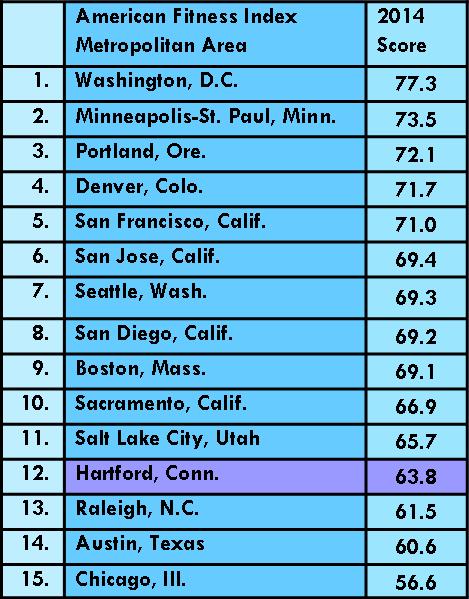 Hartford-East Hartford indicate that 78 percent engaged in physical activity or exercise within the past 30 days, 35 percent eat two pieces of fruit per day, and 14 percent eat 3 or more vegetables per day. Just over 15 percent of the population are smokers. Overall, 60 percent are described as being in “excellent or very good health,” although 36 percent indicate they had days when their “mental health was not good” during the past month.
Among the “areas of excellence” cited for Hartford-West Hartford-East Hartford are a higher percent bicycling or walking to work, more farmers’ markets per capita, more golf courses and tennis courts per capita and a higher percent eating two or more fruits per day.
ACSM worked with the Indiana University School of Family Medicine and a panel of 26 health and physical activity experts on the methodology of the AFI data report. The 2014 edition uses revised methods from the first six full-edition reports released from 2008 to 2013.
New variables, including each community’s Walk Score ranking, have been added or modified and some variables have been removed to improve and enhance the 2014 data report.
“The AFI data report is a snapshot of the state of health in the community and an evaluation of the infrastructure, community assets and policies that encourage healthy and fit lifestyles. These measures directly affect quality of life in our country’s urban areas,” said Walter Thompson, Ph.D., FACSM, chair of the AFI Advisory Board.
The American College of Sports Medicine is the largest sports medicine and exercise science organization in the world. More than 50,000 international, national and regional members are dedicated to advancing and integrating scientific research to provide educational and practical applications of exercise science and sports medicine.
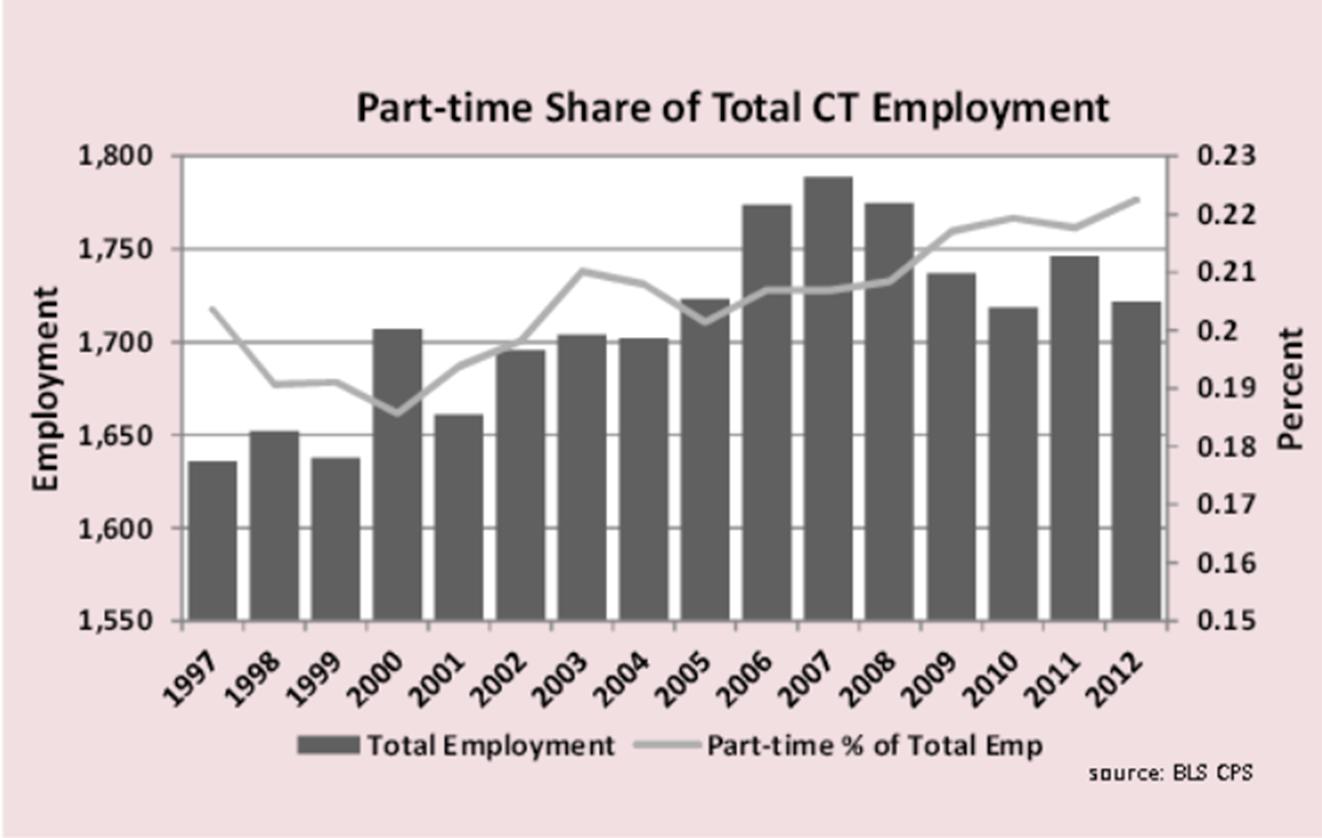
 a and the basis for the analysis. The breakdown of hours worked shows that Connecticut has less under 35 hours per week employment than other New England states but more than the Northeast region overall.
Part-time employment was 23.3% of all New England employment in 2012, higher than any other census division in the country. The other eight census divisions averaged 19.3% with the West- South Central division lowest at 16.4%.
a and the basis for the analysis. The breakdown of hours worked shows that Connecticut has less under 35 hours per week employment than other New England states but more than the Northeast region overall.
Part-time employment was 23.3% of all New England employment in 2012, higher than any other census division in the country. The other eight census divisions averaged 19.3% with the West- South Central division lowest at 16.4%.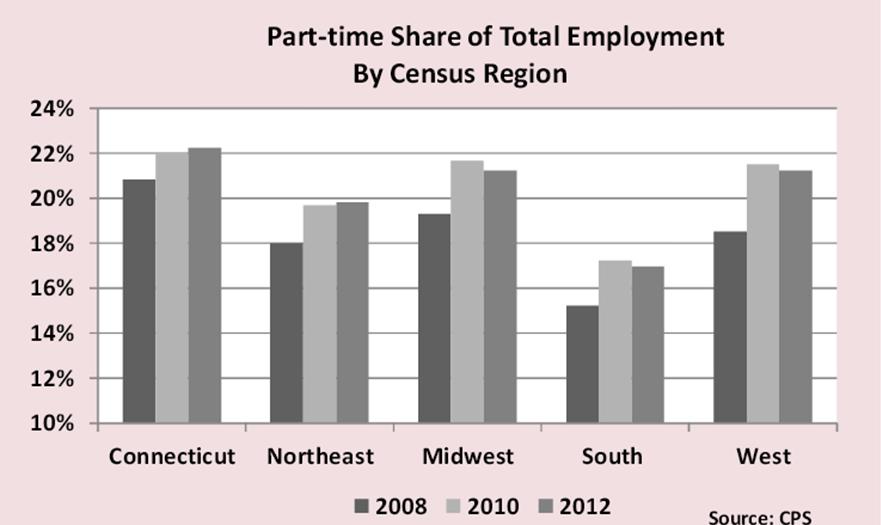
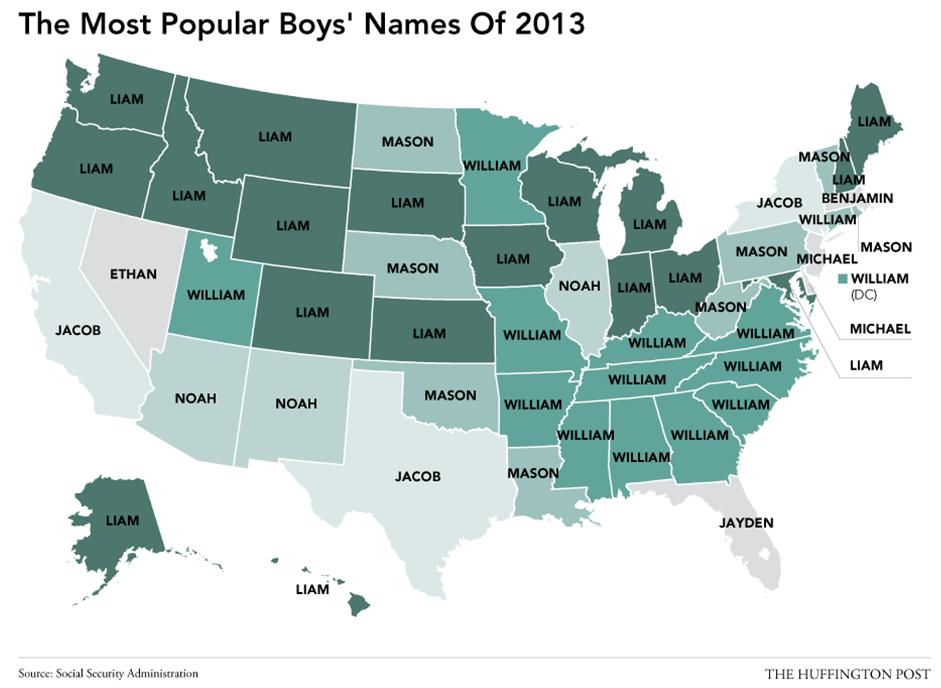
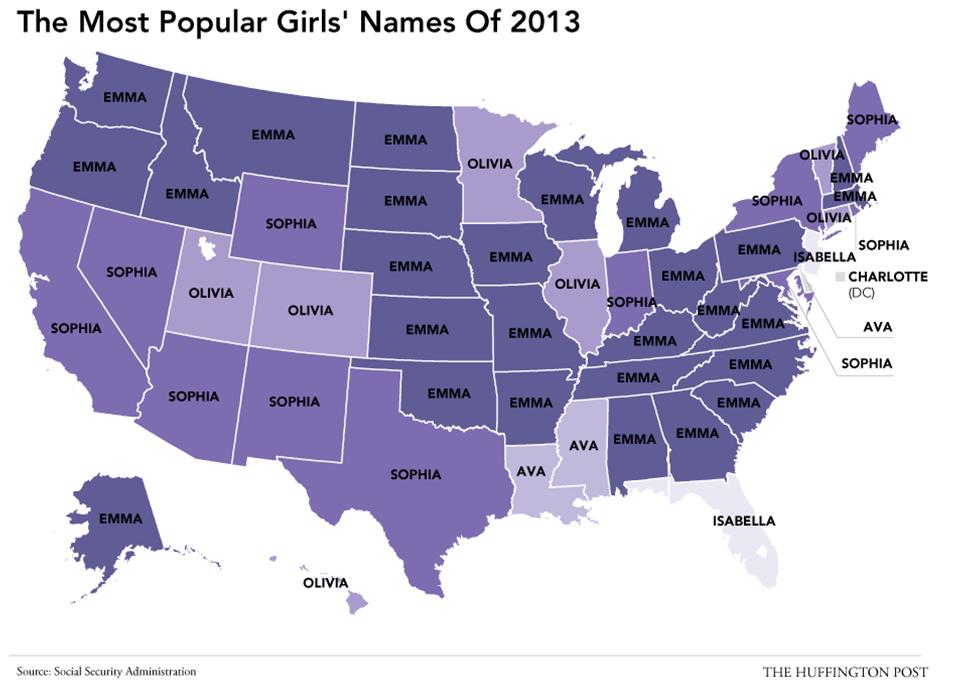
 The top names by state differ from the top national names overall, where Sophia and Noah take the top spots. For the first time since 1960, a new name unseated Michael or Jacob as the most popular for newborn boys, according to the
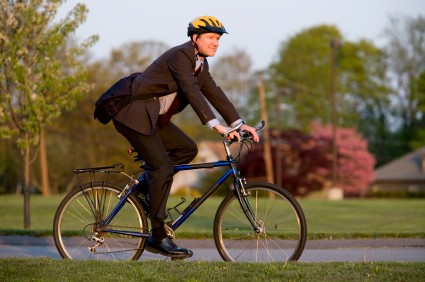
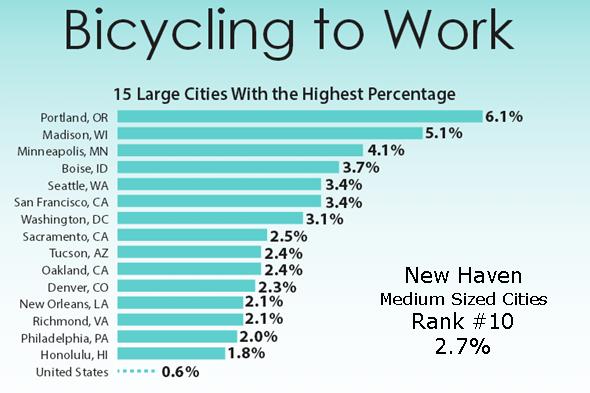 y bicycle remains low, according to the U.S. Census American Community Survey. In 1980, 0.5 percent of workers commuted by bicycle. This rate dropped to 0.4 percent in 1990, where it remained in 2000, before nudging upward in the latest survey.
 Among the nation’s medium sized-cities, (with p
 opulations between 100,000 and 199,999) New Haven ranks at #5 with 12.4 percent walking to work and at #10 with 2.7 percent of the population using bicycles to get to work. Hartford ranks at #10 among the top walk-to-work medium sized cities with 8.2 percent, and did not reach the top 15 in bicyclists.
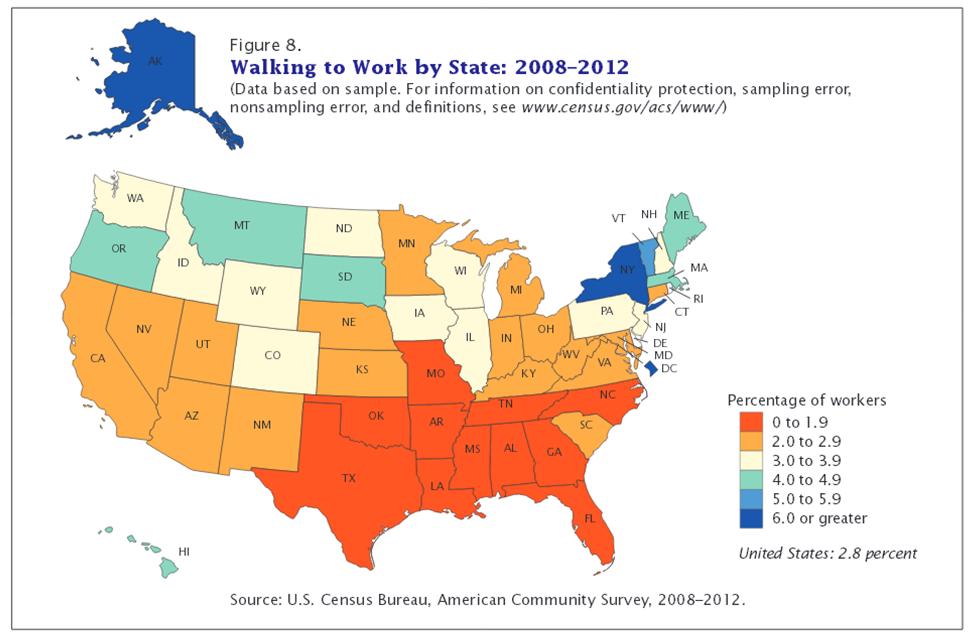 average commute to work in Connecticut is about 25 minutes, ranging from 28 minutes in Fairfield County, 27 minutes in Litchfield County, 26 minutes in Windham County, 25 minutes in Middlesex County and Tolland County, to 24 minutes in New Haven County, 23 minutes in New London County, and 22 minutes in Hartford County.
 the top tier of states in the percentage of residents
  es (often with state financial incentives) the report offers guidance of factors influencing the frequency of entrepreneurial launches. Connecticut Innovations, established and supported by state government, helps Connecticut businesses grow through creative financing and strategic assistance, and is the nation's sixth most-active early stage investor.
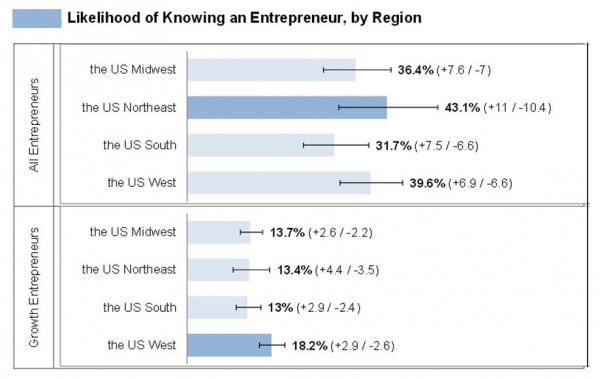 in the United States was 36.7 percent. The likelihood of knowing a growth entrepreneur was considerably lower, at 15.4 percent.
 In health outcomes, Tolland County led the way, followed by 2)Fairfield County, 3)Middlesex County, 4)Litchfield County, 5)New London County, 6)Hartford County, 7)Windham County and 8)
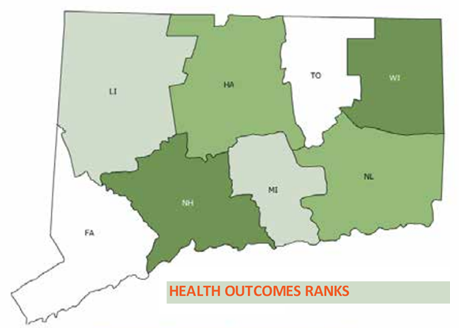 New Haven County.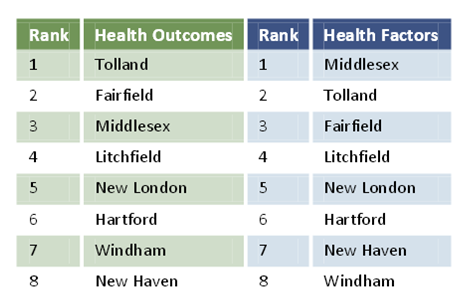
 based on their level of income inequality and identified the 50 with the greatest inequality. T